
Pulp Fiction, 1939 · page 63 of 116
10-Story Detective Magazine Cover — page 63: what you’re looking at
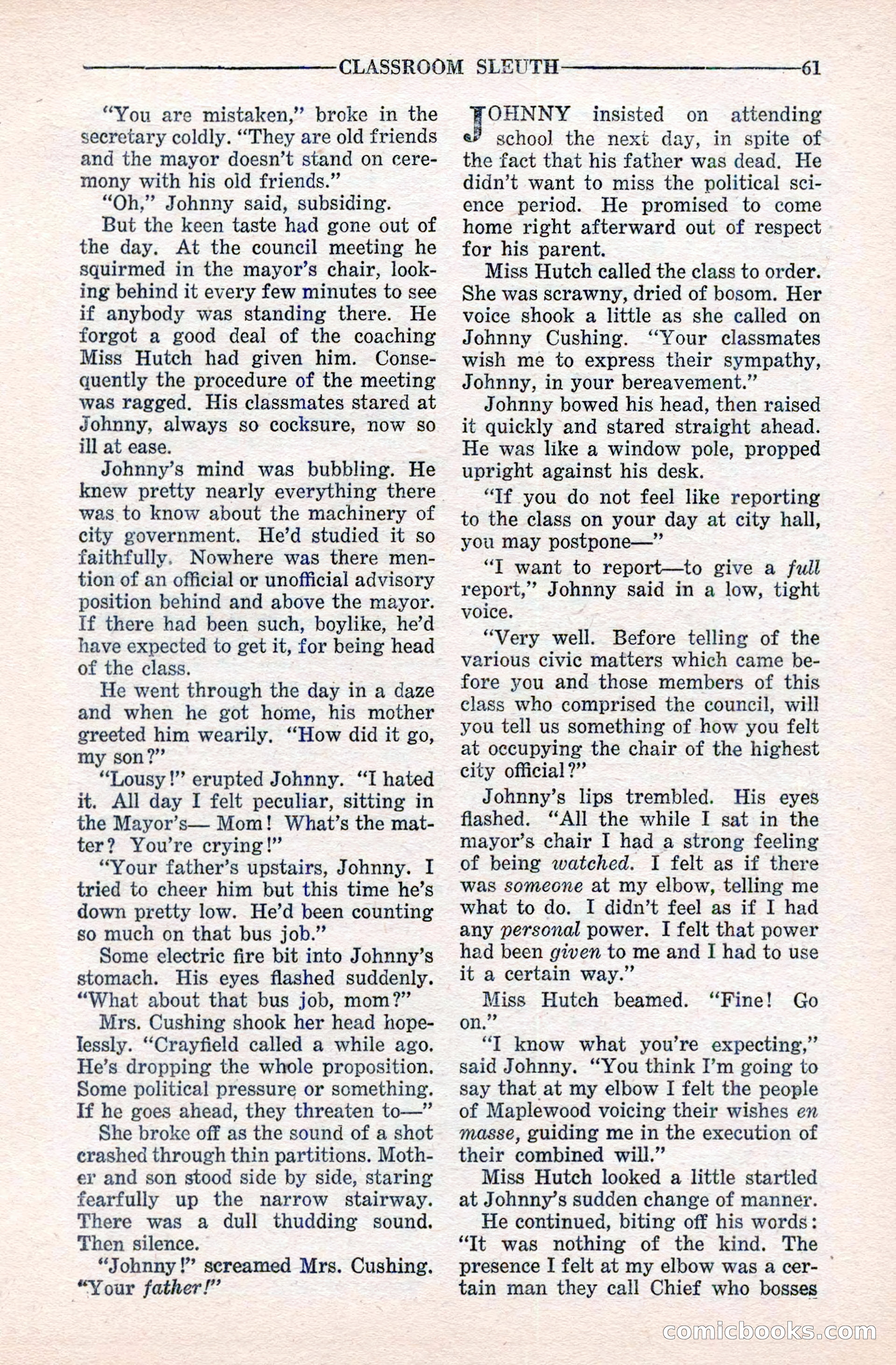
A restored page from Pulp Fiction, 1939. Page through the whole issue in the reader above.
📄 Transcribed text from this page (OCR, searchable)
Machine-transcribed from the original scan — historical spelling and the odd misread are preserved.
“You are mistaken,” broke in the secretary coldly. “They are old friends and the mayor doesn’t stand on cere- mony with his old friends.” “Oh,” Johnny said, subsiding. But the keen taste had gone out of the day. At the council meeting he squirmed in the mayor’s chair, look- ing behind it every few minutes to see if anybody was standing there. He forgot a good deal of the coaching Miss Hutch had given him. Conse- quently the procedure of the meeting was ragged. His classmates stared at Johnny, always so cocksure, now so ill at ease. Johnny’s mind was bubbling. He knew pretty nearly everything there was to know about the machinery of city government. He’d studied it so faithfully. Nowhere was there men- tion of an official or unofficial advisory position behind and above the mayor. If there had been such, boylike, he’d have expected to get it, for being head of the class. He went through the day in a daze and when he got home, his mother greeted him wearily. “How did it go, my son?” “Lousy!” erupted Johnny. “I hated it. All day I felt peculiar, sitting in the Mayor’s— Mom! What’s the mat- ter? You’re crying!” “Your father’s upstairs, Johnny. I tried to cheer him but this time he’s down pretty low. He’d been counting so much on that bus job.” Some electric fire bit into Johnny’s stomach. His eyes flashed suddenly. “What about that bus job, mom?” Mrs. Cushing shook her head hope- lessly. “Crayfield called a while ago. He’s dropping the whole proposition. Some political pressure or something. If he goes ahead, they threaten to—” She broke off as the sound of a shot erashed through thin partitions. Moth- er and son stood side by side, staring fearfully up the narrow stairway. There was a dull thudding sound. Then silence. “Johnny !” screamed Mrs. Cushing. “Your father!’ CLASSROOM SLEUTH ee. OHNNY insisted on attending schoo] the next day, in spite of the fact that his father was dead. He didn’t want to miss the political sci- ence period. He promised to come home right afterward out of respect for his parent. Miss Hutch called the class to order. She was scrawny, dried of bosom. Her voice shook a little as she called on Johnny Cushing. “Your classmates wish me to express their sympathy, Johnny, in your bereavement.” Johnny bowed his head, then raised it quickly and stared straight ahead. He was like a window pole, propped upright against his desk. “Tf you do not feel like reporting to the class on your day at city hall, you may postpone—” “T want to report—to give a full report,’ Johnny said in a low, tight voice. “Very well. Before telling of the various civic matters which came be- fore you and those members of this class who comprised the council, will you tell us something of how you felt at occupying the chair of the highest city official?” Johnny’s lips trembled. His eyes flashed. “All the while I sat in the mayor’s chair I had a strong feeling of being watched. I felt as if there was someone at my elbow, telling me what to do. I didn’t feel as if I had any personal power. I felt that power had been given to me and I had to use it a certain way.” Miss Hutch beamed. “Fine! Go on.” “T know what you’re expecting,” said Johnny. “You think I’m going to say that at my elbow I felt the people of Maplewood voicing their wishes en masse, guiding me in the execution of their combined will.” Miss Hutch looked a little startled at Johnny’s sudden change of manner. He continued, biting off his words: “It was nothing of the kind. The presence I felt at my elbow was a cer- — tain man they call Chief who bosses Gomichbooks (C©)