
Pulp Fiction, 1939 · page 41 of 116
10-Story Detective Magazine Cover — page 41: what you’re looking at
A restored page from Pulp Fiction, 1939. Page through the whole issue in the reader above.
📄 Transcribed text from this page (OCR, searchable)
Machine-transcribed from the original scan — historical spelling and the odd misread are preserved.
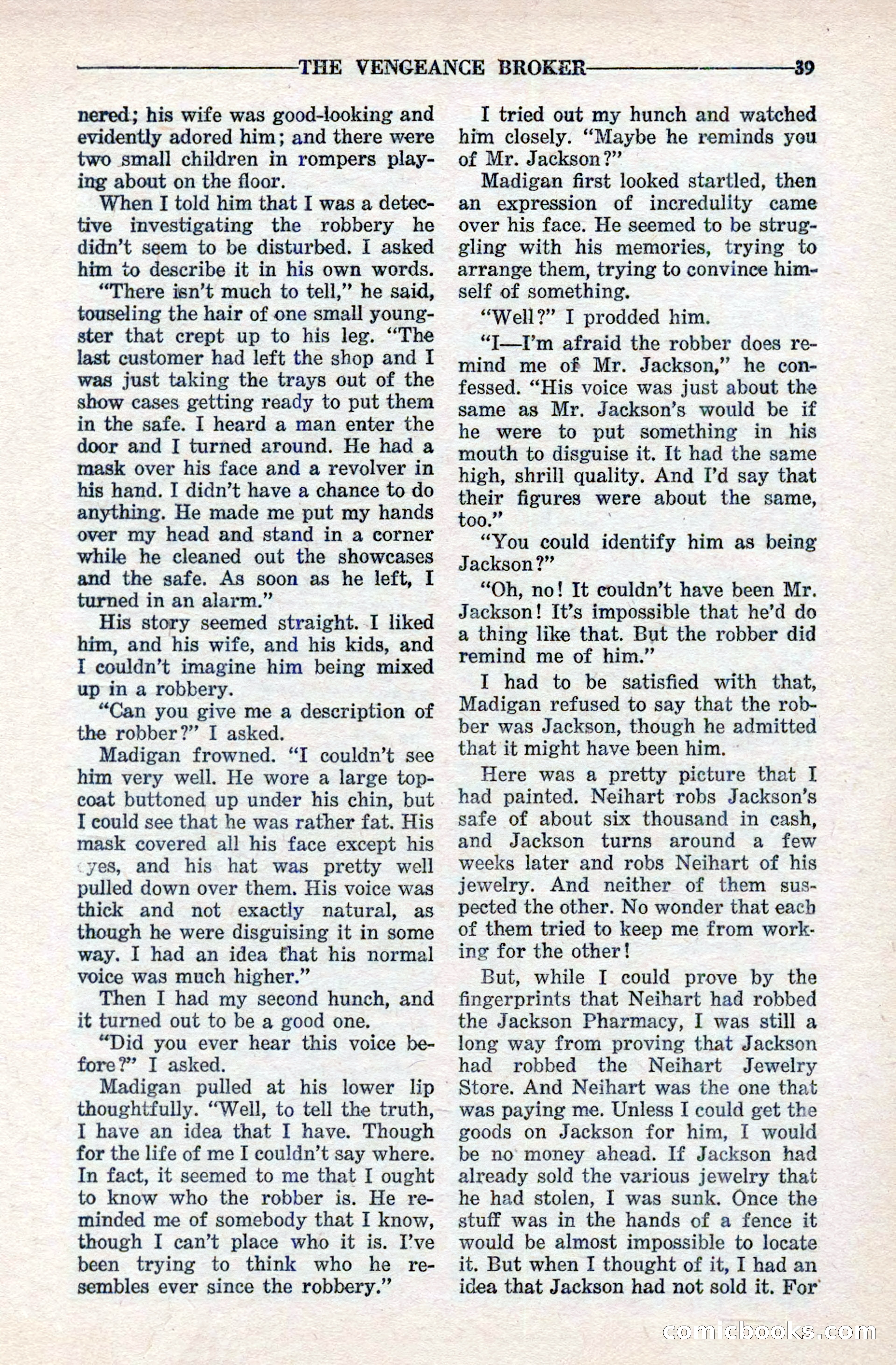
THE VENGEANCE BROKER nered; his wife was good-looking and evidently adored him; and there were two small children in rompers play- ing about on the floor. When I told him that I was a detec- tive investigating the robbery he didn’t seem to be disturbed. I asked him to describe it in his own words. “There isn’t much to tell,” he said, touseling the hair of one small young- ster that crept up to his leg. “The last customer had left the shop and I was just taking the trays out of the show cases getting ready to put them in the safe. I heard a man enter the door and [ turned around. He had a mask over his face and a revolver in his hand. I didn’t have a chance to do anything. He made me put my hands over my head and stand in a corner while he cleaned out the showcases and the safe. As soon as he left, I turned in an alarm.” His story seemed straight. I liked him, and his wife, and his kids, and I couldn’t imagine him being mixed up in a robbery. “Can you give me a description of the robber?” I asked. Madigan frowned. “I couldn’t see him very well. He wore a large top- coat buttoned up under his chin, but I could see that he was rather fat. His mask covered all his face except his yes, and his hat was pretty well pulled down over them. His voice was thick and not exactly natural, as though he were disguising it in some way. I had an idea that his normal voice was much higher.” Then I had my second hunch, and it turned out to be a good one. “Did you ever hear this voice be- fore?’ I asked. Madigan pulled at his lower lip thoughtfully. “Well, to tell the truth, I have an idea that I have. Though for the life of me I couldn’t say where. In fact, it seemed to me that I ought to know who the robber is. He re- minded me of somebody that I know, though I can’t place who it is. [ve been trying to think who he re- sembles ever since the robbery.” 39 I tried out my hunch and watched him clesely. “Maybe he reminds yeu of Mr. Jackson?” Madigan first looked startled, then an expression of incredulity came over his face. He seemed to be strug- gling with his memories, trying to arrange them, trying to convince him- self of something. “Well?” I prodded him. “I—I’m afraid the robber does re- mind me of Mr. Jackson,” he con- fessed. “His voice was just about the same as Mr. Jackson’s would be if he were to put something in his mouth to disguise it. It had the same high, shrill quality. And I’d say that their figures were about the same, too.” , “You could identify him as being Jackson?” “Oh, no! It couldn’t have been Mr. Jackson! It’s impossible that he’d do a thing like that. But the robber did remind me of him.” I had to be satisfied with that, Madigan refused to say that the rob- ber was Jackson, though he admitted that it might have been him. Here was a pretty picture that I had painted. Neihart robs Jackson’s safe of about six thousand in cash, and Jackson turns around a few weeks later and robs Neihart of his jewelry. And neither of them sus- pected the other. No wonder that each of them tried to keep me from work- ing for the other! But, while I could prove by the fingerprints that Neihart had robbed the Jackson Pharmacy, I was still a long way from proving that Jackson had robbed the Neihart Jewelry Store. And Neihart was the one that was paying me. Unless I could get the goods on Jackson for him, I would be no money ahead. If Jackson had already sold the various jewelry that he had stolen, I was sunk. Once the stuff was in the hands of a fence it would be almost impossible to locate it. But when I thought of it, I had an idea that Jackson had not sold it. For COMICMOoOokKs (C@