
Pulp Fiction, 1939 · page 39 of 116
10-Story Detective Magazine Cover — page 39: what you’re looking at
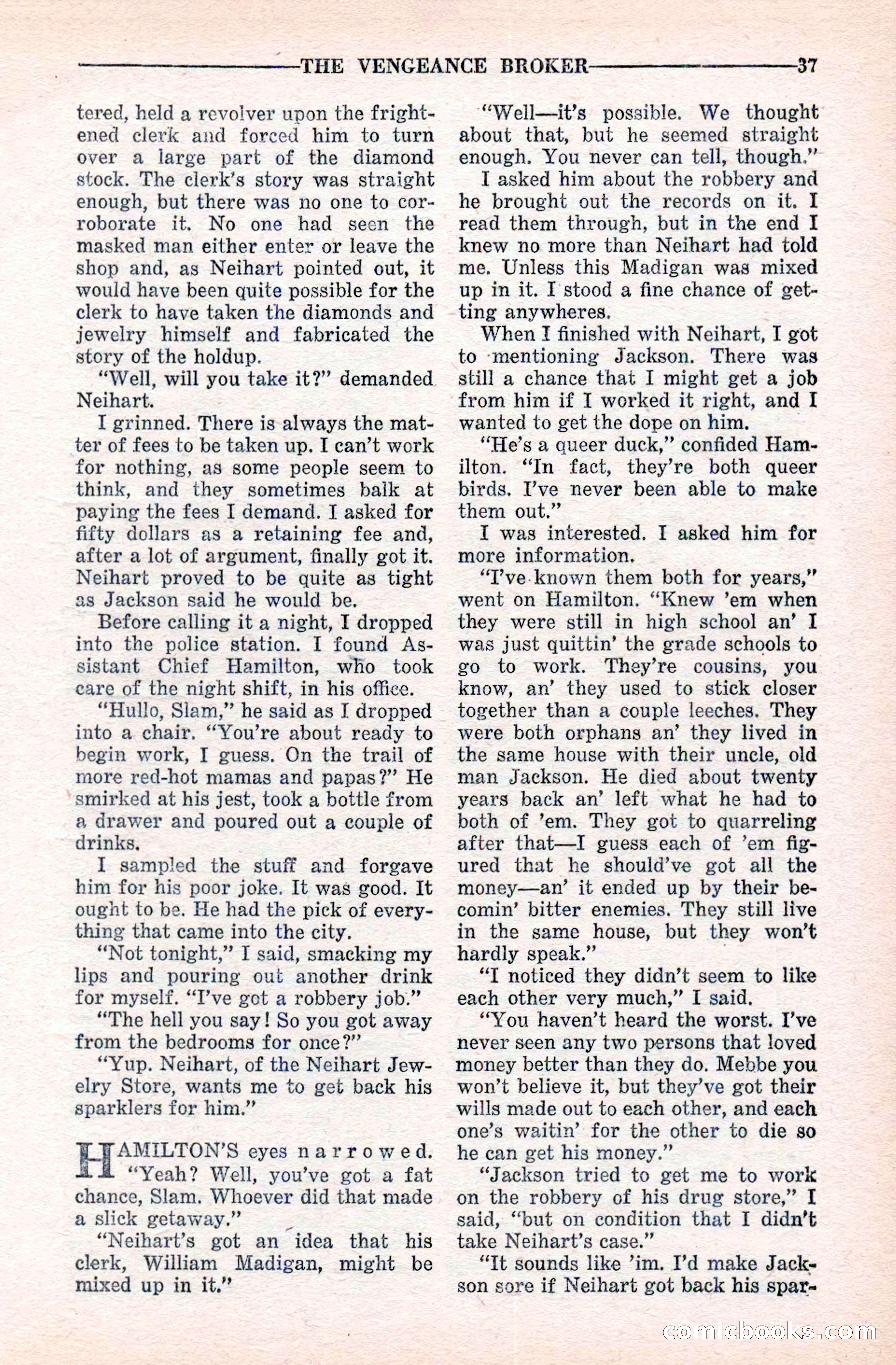
A restored page from Pulp Fiction, 1939. Page through the whole issue in the reader above.
📄 Transcribed text from this page (OCR, searchable)
Machine-transcribed from the original scan — historical spelling and the odd misread are preserved.
tered, held a revolver upon the fright- ened clerk and forced him to turn over a large part of the diamond stock. The clerk’s story was straight enough, but there was no one to cor- roborate it. No one had seen the masked man either enter or leave the shop and, as Neihart pointed out, it would have been quite possible for the clerk to have taken the diamonds and jewelry himself and fabricated the story of the holdup. “Well, will you take it?” demanded Neihart. I grinned. There is always the mat- ter of fees to be taken up. I can’t work for nothing, as some people seem to think, and they sometimes baik at paying the fees I demand. [I asked for fifty dollars as a retaining fee and, after a lot of argument, finally got it. Neihart proved to be quite as tight as Jackson said he would be. Before calling it a night, I dropped into the police station. I found As- sistant Chief Hamilton, who took eare of the night shift, in his office. “Hullo, Slam,” he said as I dropped into a chair, “You’re about ready to begin work, I guess. On the trail of more red-hot mamas and papas?” He smirked at his jest, took a bottle from a drawer and poured out a couple of drinks. I sampled the stuff and forgave him for his poor joke. It was good. It ought to be. He had the pick of every- thing that came into the city. “Not tonight,” I said, smacking my lips and pouring out another drink for myself. “I’ve got a robbery job.” “The hell you say! So you got away from the bedrooms for once?” “Yup. Neihart, of the Neihart Jew- elry Store, wants me to get back his sparklers for him.” is AMILTON’S eyes narrowed. “Yeah? Well, you’ve got a fat chance, Slam. Whoever did that made a slick getaway.” “Neihart’s got an ‘idea that his clerk, William Madigan, might be mixed up in it.” THE VENGEANCE BROKER ov “Well—it’s possible. We thought about that, but he seemed straight enough. You never can tell, though.” I asked him about the robbery and he brought out the records on it. I read them through, but in the end I knew no more than Neihart had told me. Unless this Madigan was mixed up in it. I stood a fine chance of get- ting anywheres. When If finished with Neihart, I got to ‘mentioning Jackson. There was still a chance that I might get a job from him if I worked it right, and I wanted to get the dope on him. ‘““He’s a queer duck,” confided Ham- ilton. “In. fact, they’re both queer birds. I’ve never been able to make them out,” I was interested. I asked him for more information. “T’ve- known them both for years,” went on Hamilton. “Knew ’em when they were still in high school an’ I was just quittin’ the grade schools to go to work. They’re cousins, you know, an’ they used to stick closer together than a couple leeches. They were both orphans an’ they lived in the same house with their uncle, old man Jackson. He died about twenty years back an’ left what he had to both of ’em. They got to quarreling after that—I guess each of ’em fig- ured that he should’ve got all the money—an’ it ended up by their be- comin’ bitter enemies. They still live in the same house, but they won't hardly speak.” “T noticed they didn’t seem to like each other very much,” I said. “You haven’t heard the worst. I’ve never seen any two persons that loved money better than they do. Mebbe you won’t believe it, but they’ve got their wills made out to each other, and each one’s waitin’ for the other to die so he can get his money.” “Jackson tried to get me to work on the robbery of his drug store,” I said, “but on condition that I didn’t take Neihart’s case.” “Tt sounds like ’im. ’d make Jack- son sore if Neihart got back his spar- COmiclboooks (C@