
Pulp Fiction, 1939 · page 64 of 116
10-Story Detective Magazine Cover — page 64: what you’re looking at
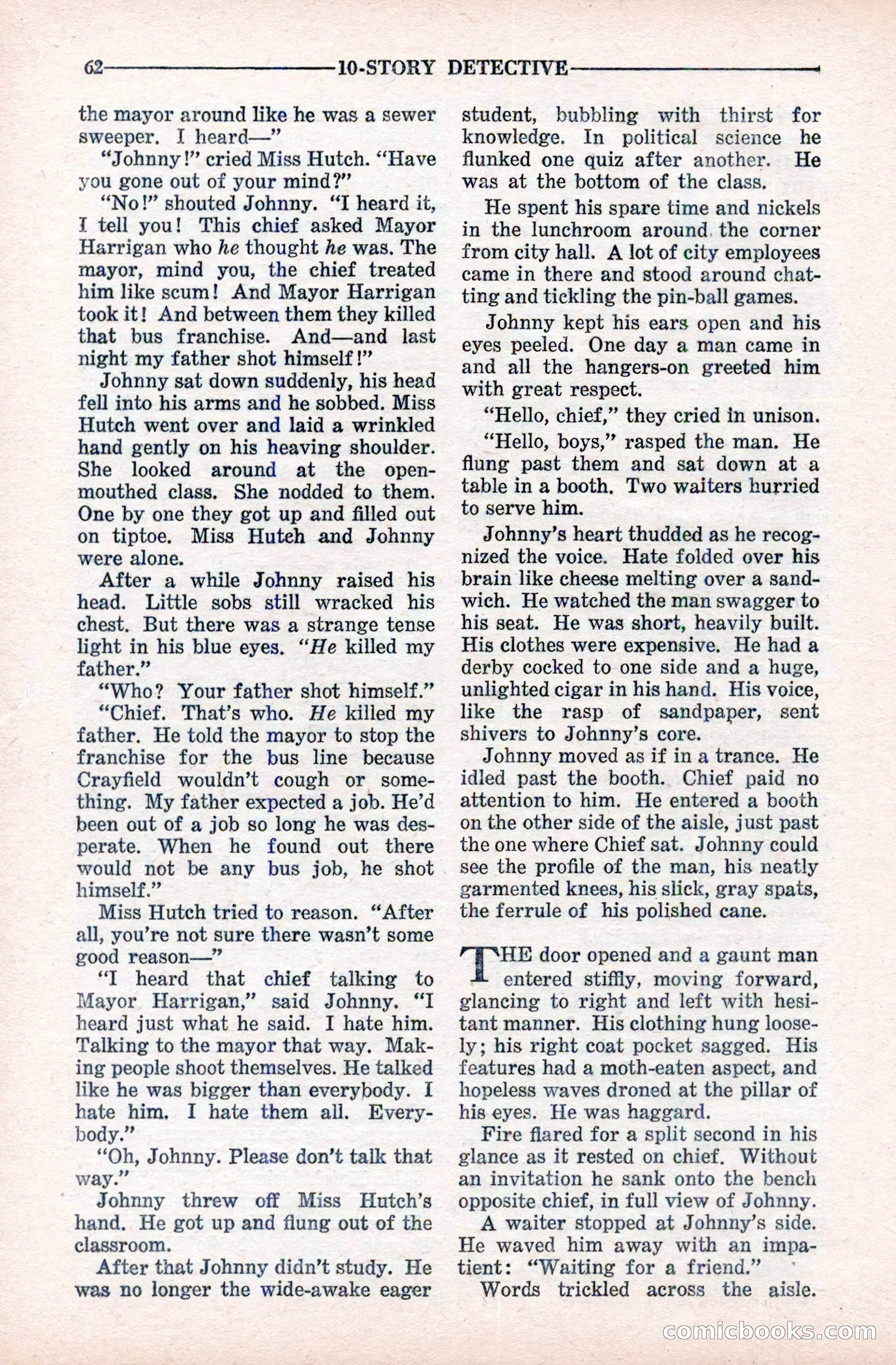
A restored page from Pulp Fiction, 1939. Page through the whole issue in the reader above.
📄 Transcribed text from this page (OCR, searchable)
Machine-transcribed from the original scan — historical spelling and the odd misread are preserved.
62 the mayor around like he was a sewer sweeper. I heard—” “Johnny!” cried Miss Hutch. “‘Have you gone out of your mind?” “No!” shouted Johnny. “I heard it, { tell you! This chief asked Mayor Harrigan who he thought he was. The mayor, mind you, the chief treated him like scum! And Mayor Harrigan took it! And between them they killed that bus franchise. And—and last night my father shot himself!” Johnny sat down suddenly, his head fell into his arms and he sobbed. Miss Hutch went over and laid a wrinkled hand gently on his heaving shoulder. She looked around at the open- mouthed class. She nodded to them. One by one they got up and filled out on tiptoe. Miss Huteh and Johnny were alone. After a while Johnny raised his head. Little sobs still wracked his chest. But there was a strange tense light in his blue eyes. “He killed my father.” “Who? Your father shot himself.” “Chief. That’s who. He killed my father. He told the mayor to stop the franchise for the bus line because Crayfield wouldn’t cough or some- thing. My father expected a job. He’d been out of a job so long he was des- perate. When he found out there would not be any bus job, he shot himself.” Miss Hutch tried to reason. “After all, you’re not sure there wasn’t some good reason—” “T heard that chief talking to Mayor Harrigan,” said Johnny. “I heard just what he said. I hate him. Talking to the mayor that way. Mak- ing people shoot themselves. He talked like he was bigger than everybody. I hate him, I hate them all. Every- body.” “Oh, Johnny. Please don’t taik that way.” Johnny threw off Miss Hutch’s hand. He got up and flung out of the classroom. After that Johnny didn’t study. He was no longer the wide-awake eager 10-STORY DETECTIVE student, bubbling with thirst for knowledge. In political science he flunked one quiz after another. He was at the bottom of the class. He spent his spare time and nickels in the lunchroom around. the corner from city hall. A lot of city employees came in there and stood around chat- ting and tickling the pin-ball games. Johnny kept his ears open and his eyes peeled. One day a man came in and all the hangers-on greeted him with great respect. “Hello, chief,” they cried in unison. “Hello, boys,” rasped the man. He flung past them and sat down at a table in a booth, Two waiters hurried to serve him. Johnny’s heart thudded as he recog- nized the voice. Hate folded over his brain like cheese melting over a sand- wich. He watched the man swagger to his seat. He was short, heavily built. His clothes were expensive. He had a derby cocked to one side and a huge, unlighted cigar in his hand. His voice, like the rasp of sandpaper, sent shivers to Johnny’s core. Johnny moved as if in a trance. He idled past the booth. Chief paid no attention to him. He entered a booth on the other side of the aisle, just past the one where Chief sat. Johnny could see the profile of the man, his neatly garmented knees, his slick, gray spats, the ferrule of his polished cane. HE door opened and a gaunt man entered stiffly, moving forward, glancing to right and left with hesi- tant manner. His clothing hung loose- ly; his right coat pocket sagged. His features had a moth-eaten aspect, and hopeless waves droned at the pillar of his eyes. He was haggard. Fire flared for a split second in his glance as it rested on chief. Without an invitation he sank onto the bench opposite chief, in full view of Johnny. A waiter stopped at Johnny’s side. He waved him away with an impa- tient: “Waiting for a friend.” Words trickled across the aisle. COMMICloookKks (C@