
Pulp Fiction, 1939 · page 66 of 116
10-Story Detective Magazine Cover — page 66: what you’re looking at
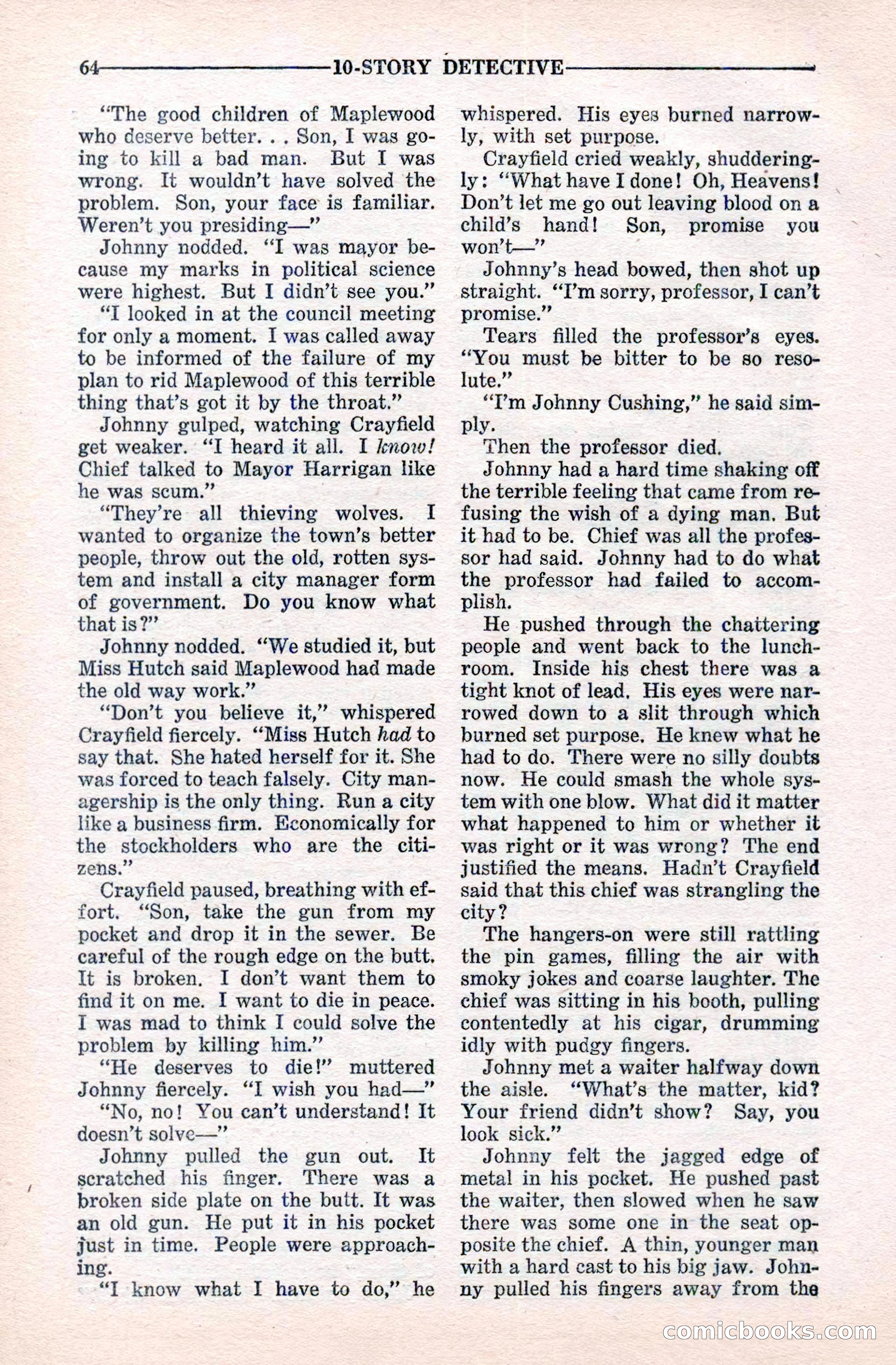
A restored page from Pulp Fiction, 1939. Page through the whole issue in the reader above.
📄 Transcribed text from this page (OCR, searchable)
Machine-transcribed from the original scan — historical spelling and the odd misread are preserved.
64-—_—_——————_—_—_—_——_-10-STORY DETECTIVE “The good children of Maplewood who deserve better... Son, I was go- ing to kill a bad man. But I was wrong. It wouldn’t have solved the problem. Son, your face is familiar. Weren’t you presiding—’”’ Johnny nodded. “I was mayor be- cause my marks in political science were highest. But I didn’t see you.” “TI looked in at the council meeting for only a moment. I was called away to be informed of the failure of my plan to rid Maplewood of this terrible thing that’s got it by the throat.” Johnny gulped, watching Crayfield get weaker. “I heard it all. I know! Chief talked to Mayor Harrigan like he was scum.” “They’re all thieving wolves. I wanted to organize the town’s better people, throw out the old, rotten sys- tem and install a city manager form of government. Do you know what that is?” Johnny nodded. “We studied it, but Miss Hutch said Maplewood had made the old way work.” “Don’t you believe it,’ whispered Crayfield fiercely. ‘“‘Miss Hutch had to say that. She hated herself for it. She was forced to teach falsely. City man- agership is the only thing. Run a city like a business firm. Economically for the stockholders who are the citi- zens.” Crayfield paused, breathing with ef- fort. “Son, take the gun from my pocket and drop it in the sewer. Be careful of the rough edge on the butt. It is broken. I don’t want them to find it on me. I want to die in peace. I was mad to think I could solve the problem by killing him.’ “He deserves to die!” muttered Johnny fiercely. “I wish you had—” “No, no! You can’t understand! It doesn’t solve—” 3 Johnny pulled the gun out. It scratched his finger. There was a broken side plate on the buit. It was an old gun. He put it in his pocket just in time. People were approach- ing. “T know what I have to do,” he whispered. His eyes burned narrow- ly, with set purpose. Crayfield cried weakly, shuddering- ly: “What haveI done! Oh, Heavens! Don’t let me go out leaving blood on a child’s hand! Son, promise you won’t—” Johnny’s head bowed, then shot up straight. “I’m sorry, professor, I can’t promise.” Tears filled the professor’s eyes. “You must be bitter to be so reso- lute.” “I’m Johnny Cushing,” he said sim- ply. Then the professor died. Jdohnny had a hard time shaking off the terrible feeling that came from re- fusing the wish of a dying man. But it had to be. Chief was all the profes- sor had said. Johnny had to do what the professor had failed to accom- plish. He pushed through the chaitering people and went back to the lunch- room. Inside his chest there was a tight knot of lead, His eyes were nar- rowed down to a slit through which burned set purpose, He knew what he had to do. There were no silly doubts now. He could smash the whole sys- tem with one blow. What did it matter what happened to him or whether it was right or it was wrong? The end justified the means. Hadn’t Crayfield said that this chief was strangling the city? The hangers-on were still rattling the pin games, filling the air with smoky jokes and coarse laughter. The chief was sitting in his booth, pulling contentedly at his cigar, drumming idly with pudgy fingers. Johnny met a waiter halfway down the aisle. ‘“‘What’s the matter, kid? Your friend didn’t show? Say, you look sick.” Johnny felt the jagged edge of metal in his pocket. He pushed past the waiter, then slowed when he saw there was some one in the seat op- posite the chief. A thin, younger man with a hard cast to his big jaw. John- ny pulled his fingers away from the COMMICMOOokKs (C@