
Pulp Fiction, 1939 · page 94 of 116
10-Story Detective Magazine Cover — page 94: what you’re looking at
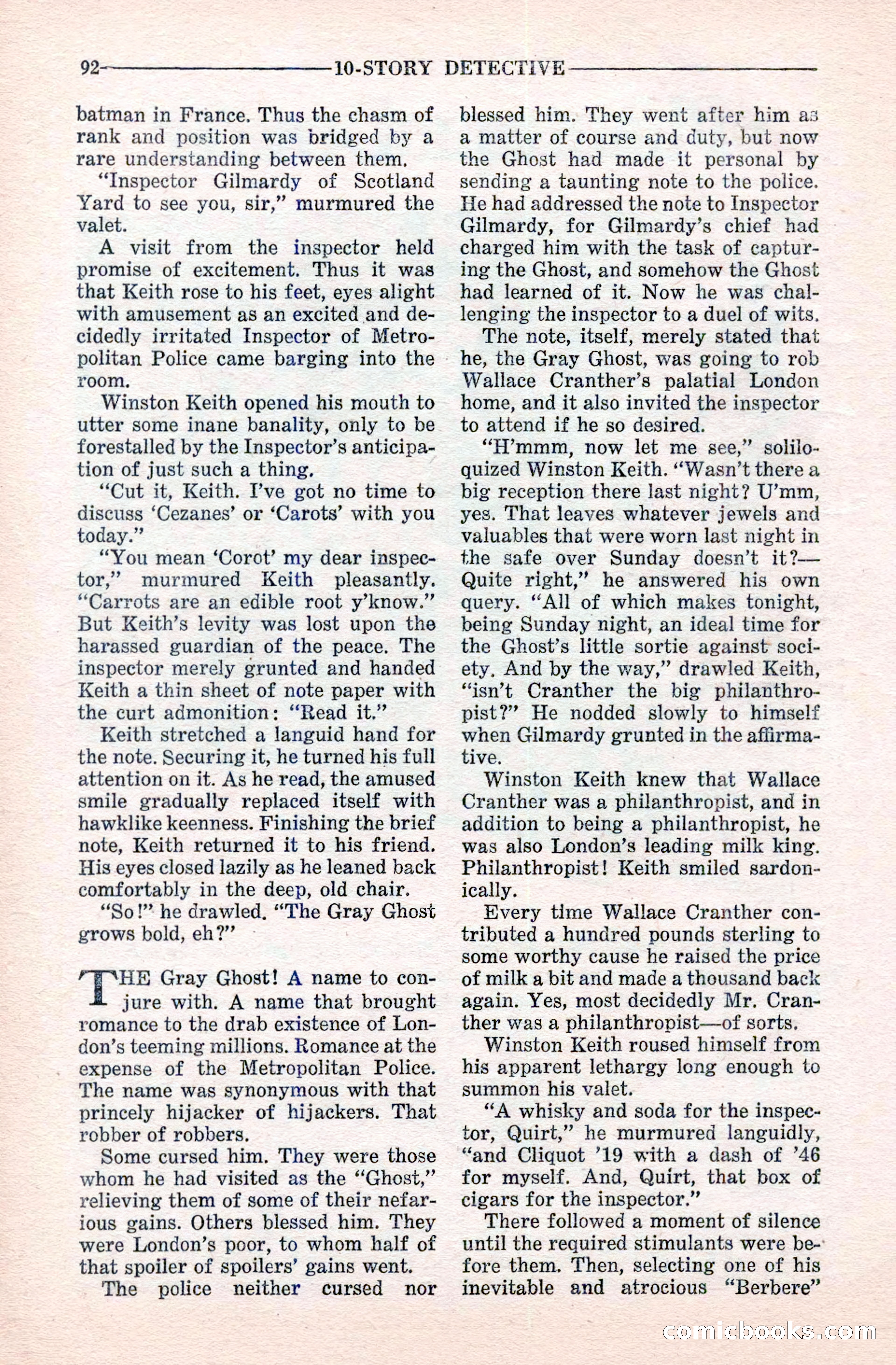
A restored page from Pulp Fiction, 1939. Page through the whole issue in the reader above.
📄 Transcribed text from this page (OCR, searchable)
Machine-transcribed from the original scan — historical spelling and the odd misread are preserved.
92 batman in France. Thus the chasm of rank and position was bridged by a rare understanding between them, “Inspector Gilmardy of Scotland Yard to see you, sir,” murmured the valet. A visit from the inspector held promise of excitement. Thus it was that Keith rose to his feet, eyes alight with amusement as an excited and de- cidedly irritated Inspector of Metro- politan Police came barging into the room, Winston Keith opened his mouth to utter some inane banality, only to be forestalled by the Inspector’s anticipa- tion of just such a thing, “Cut it, Keith. I’ve got no time to discuss ‘Cezanes’ or ‘Carots’ with you today.” “You mean ‘Corot’ my dear inspec- tor,’ murmured Keith pleasantly. “Carrots are an edible root y’know.” But Keith’s levity was lost upon the harassed guardian of the peace. The inspector merely grunted and handed Keith a thin sheet of note paper with the curt admonition: “Read it.” Keith stretched a languid hand for the note. Securing it, he turned his full attention on it. As he read, the amused smile gradually replaced itself with hawklike keenness. Finishing the brief note, Keith returned it to his friend. His eyes closed lazily as he leaned back comfortably in the deep, old chair. “So!” he drawled. “The Gray Ghost grows bold, eh?” HE Gray Ghost! A name to con- jure with. A name that brought romance to the drab existence of Lon- don’s teeming millions. Romance at the expense of the Metropolitan Police. The name was synonymous with that princely hijacker of hijackers. That robber of robbers. Some cursed him. They were those whom he had visited as the “Ghost,” relieving them of some of their nefar- ious gains. Others blessed him. They were London’s poor, to whom half of that spoiler of spoilers’ gains went. The police neither cursed nor 10-STORY DETECTIVE blessed him. They went after him as a matter of course and duty, but now the Ghost had made it personal by sending a taunting note to the police. He had addressed the note to Inspector Gilmardy, for Gilmardy’s chief had charged him with the task of captur- ing the Ghost, and somehow the Ghost had learned of it. Now he was chal- lenging the inspector to a duel of wits. The note, itself, merely stated that he, the Gray Ghost, was going to rob Wallace Cranther’s palatial London home, and it also invited the inspector to attend if he so desired. “H’mmm, now let me see,” solilo- quized Winston Keith. “Wasn’t there a big reception there last night? U’mm, yes. That leaves whatever jewels and valuables that were worn last night in the safe over Sunday doesn’t it?— Quite right,” he answered his own query. “All of which makes tonight, being Sunday night, an ideal time for the Ghost’s little sortie against soci- ety, And by the way,” drawled Keith, “isn’t Cranther the big philanthro- pist?” He nodded slowly to himself when Gilmardy grunted in the affirma- tive. Winston Keith knew that Wallace Cranther was a philanthropist, and in addition to being a philanthropist, he was also London’s leading milk king. Philanthropist! Keith smiled sardon- ically. Every time Wallace Cranther con- tributed a hundred pounds sterling to some worthy cause he raised the price of milk a bit and made a thousand back again. Yes, most decidedly Mr. Cran- ther was a philanthropist—of sorts, Winston Keith roused himself from his apparent lethargy long enough to summon his valet. “A whisky and soda for the inspec- tor, Quirt,” he murmured languidly, “and Cliquot 719 with a dash of ’46 for myself. And, Quirt, that box of cigars for the inspector.” There followed a moment of silence until the required stimulants were be- fore them. Then, selecting one of his inevitable and atrocious “Berbere” Gomichbooks (C@)