
Pulp Fiction, 1939 · page 31 of 116
10-Story Detective Magazine Cover — page 31: what you’re looking at
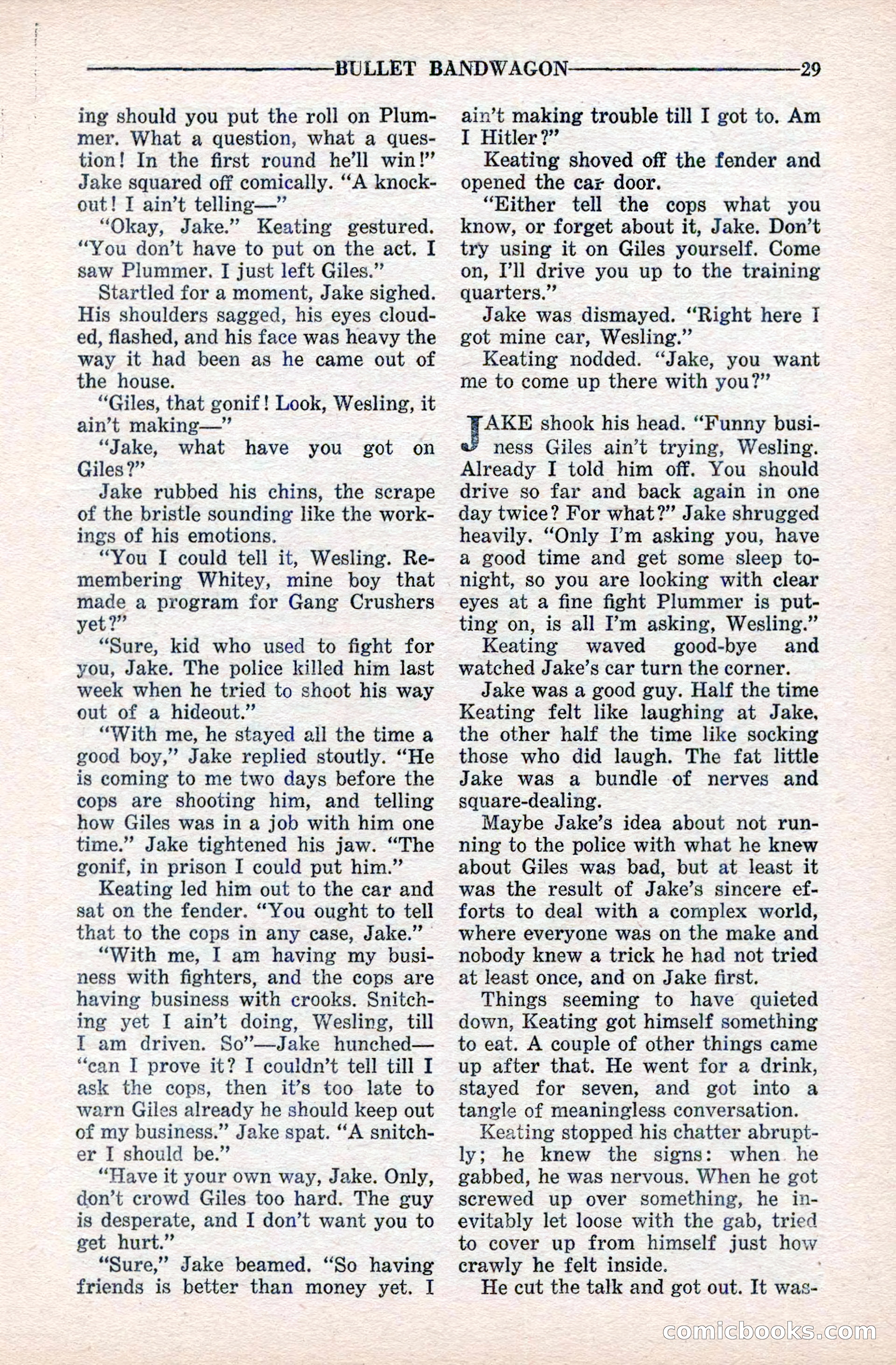
A restored page from Pulp Fiction, 1939. Page through the whole issue in the reader above.
📄 Transcribed text from this page (OCR, searchable)
Machine-transcribed from the original scan — historical spelling and the odd misread are preserved.
ing should you put the roll on Plum- mer. What a question, what a ques- tion! In the first round he'll win!” Jake squared off comically. “A knock- out! I ain’t telling—” “Okay, Jake.” Keating gestured. “You don’t have to put on the act. I saw Plummer, I just left Giles.” Startled for a moment, Jake sighed. His shoulders sagged, his eyes cloud- ed, flashed, and his face was heavy the way it had been as he came out of the house. “Giles, that gonif! Look, Wesling, it ain’t making—” “Jake, what have you got on Giles ?” dake rubbed his chins, the scrape of the bristle sounding like the work- ings of his emotions. “You I could tell it, Wesling. Re- membering Whitey, mine boy that made a program for Gang Crushers yet?” “Sure, kid who used to fight for you, Jake. The police killed him last week when he tried to shoot his way out of a hideout.” “With me, he stayed all the time a good boy,” Jake replied stoutly. “He is coming to me two days before the cops are shooting him, and telling how Giles was in a job with him one time.” Jake tightened his jaw. “The gonif, in prison I could put him.” Keating led him out to the car and sat on the fender. “You ought to tell that to the cops in any case, Jake.” “With me, I am having my busi- ness with fighters, and the cops are having business with crooks. Snitch- ing yet I ain’t doing, Wesling, till I am driven. So’—Jake hunched— “ean I prove it? I couldn’t tell till I ask the cops, then it’s too late to warn Giles already he should keep out of my business.” Jake spat. “A snitch- er I should be.” “Have it your own way, Jake. Only, don’t crowd Giles too hard. The guy is desperate, and I don’t want you to get hurt.” “Sure,” Jake beamed. “So having friends is better than money yet. I BULLET BANDWAGON 29 ain’t making trouble till I got to. Am I Hitler?” Keating shoved off the fender and opened the car door. “Either tell the cops what you know, or forget about it, Jake. Don’t try using it on Giles yourself. Come on, Ill drive you up to the training quarters.” Jake was dismayed. “Right here I got mine car, Wesling.” Keating nodded. “Jake, you want me to come up there with you?” AKE shook his head. “Funny busi- ness Giles ain’t trying, Wesling. Already I told him off. You should drive so far and back again in one day twice? For what?” Jake shrugged heavily. “Only I’m asking you, have a good time and get some sleep to- night, so you are locking with clear eyes at a fine fight Plummer is put- ting on, is all ’'m asking, Wesling.” Keating waved good-bye and watched Jake’s car turn the corner. Jake was a good guy. Half the time Keating felt like laughing at Jake, the other half the time like socking those who did laugh. The fat little Jake was a bundle of nerves and square-dealing. Maybe Jake’s idea about not run- ning to the police with what he knew about Giles was bad, but at least it was the result of Jake’s sincere ef- forts to deal with a complex world, where everyone was on the make and nobody knew a trick he had not tried at least once, and on Jake first. Things seeming to have quieted down, Keating got himself something to eat. A couple of other things came up after that. He went for a drink, stayed for seven, and got into a tangle of meaningless conversation. Keating stopped his chatter abrupt- ly; he knew the signs: when. he gabbed, he was nervous. When he got screwed up over something, he in- evitably let loose with the gab, tried to cover up from himself just how crawly he felt inside. He cut the talk and got out. It was- CORMMICGLOOOKS (C@)