
A complete issue · 142 pages · 1900
Rubaiyat of Omar Khayyam, and the Salaman and Absal of Jami
# Analysis This appears to be a **back cover or endpaper** of a Victorian penny dreadful. The page is predominantly blank with a deep purple or maroon cloth binding visible, showing the typical wear and aging of period literature. There is a small white illustration or vignette in the upper left corner, though its details are not clear due to image quality and grain. The OCR text is largely illegible special characters and artifacts, suggesting this page contains minimal or no readable printed text. The "comicbooks.com" watermark indicates this is a digital scan rather than original period material.
# Analysis This page is too degraded and noisy to read reliably. The image shows what appears to be a printed page with heavy discoloration, speckles, and digital artifacts obscuring the text. While there is clearly printed content beneath the visual noise—suggested by the vertical line on the right edge and faint horizontal striations—the specific words are not legible enough to transcribe accurately or determine subject matter with confidence. The OCR text provided appears empty or unreadable as well. Without clearer source material, I cannot responsibly identify what this penny dreadful page actually discusses, who is mentioned, or whether it contains prose, illustration, or advertisement. The page's condition makes definitive analysis impossible.

I cannot reliably read the OCR text provided, as it appears to be corrupted or illegible. The image itself shows what appears to be a heavily degraded or corrupted page with a speckled, glitchy appearance in predominantly purple and pastel tones—likely a scanning or digital artifact issue that has obscured the actual content. There are markings visible in the top left corner that appear to be reference numbers, and a watermark visible at the bottom right reading "comicbooks.com," but the actual page content—whether text, illustration, or title page—cannot be discerned from this image. A clearer scan would be needed to properly analyze this penny dreadful page.
# Analysis This page appears to be a **blank or nearly blank page from a Victorian penny dreadful**, possibly a back cover, endpaper, or separator between installments. The image shows a pink-toned, textured surface with minimal visible content. The OCR text is largely illegible—consisting of scattered fragments, symbols, and unclear characters that don't form coherent words or sentences. No title, illustration, or running narrative prose is discernible. The page number "7" is barely visible in the upper left corner. This is likely filler material typical of cheaply produced serialized fiction.
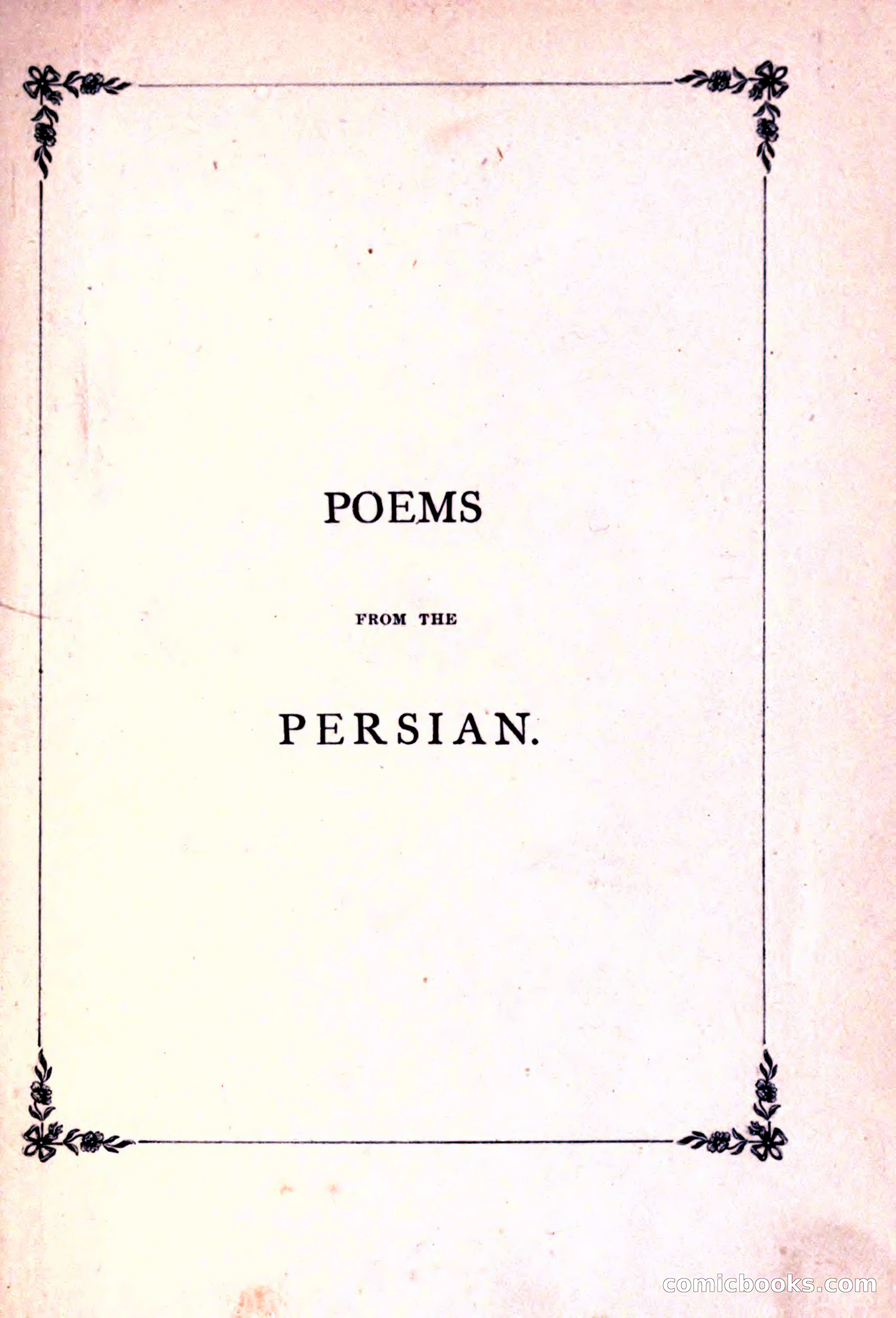
This is a title page from a book of poetry. The page presents a centered title reading "POEMS / FROM THE / PERSIAN." The text is plain and formal, typical of Victorian-era publishing. The page is framed by decorative corner ornaments—small floral or vine-like designs in black at each corner—and simple ruled lines forming a border around the entire text block. The background shows age-related discoloration and spotting. The OCR text at the bottom ("ae (O)(O KS @") appears to be artifact noise and is not meaningful. This appears to be a straightforward title page announcing a collection of translated or adapted Persian poetry, though no editor, translator, or publication date is visible on this particular page.
This is a blank page with decorative Victorian ornamental borders. The page features an elegant frame composed of delicate floral and leaf designs at all four corners, connected by thin lines along the edges. The interior of the page is entirely empty of text or illustration content. At the bottom of the page, there is barely legible OCR text that reads "BOOKS. Corn" and "COUN"—these fragments appear to be footer or watermark elements rather than meaningful page content. This page likely serves as a divider or section break within a Victorian penny dreadful publication, or possibly a title page awaiting printed content that was never added.
This is a cover or title page of a digitized document. The page features a simple classical architectural illustration—a temple or Greek revival building with four columns, a triangular pediment, and horizontal base lines rendered in pale green/cream tones against a pink textured background. The visible text indicates this material was digitized by the Internet Archive in 2008 with Microsoft Corporation funding. The URL and partial reference text suggest this is a digitized version of what appears to be a historical work, though the OCR text at bottom is too garbled to determine the exact title or subject matter with certainty.
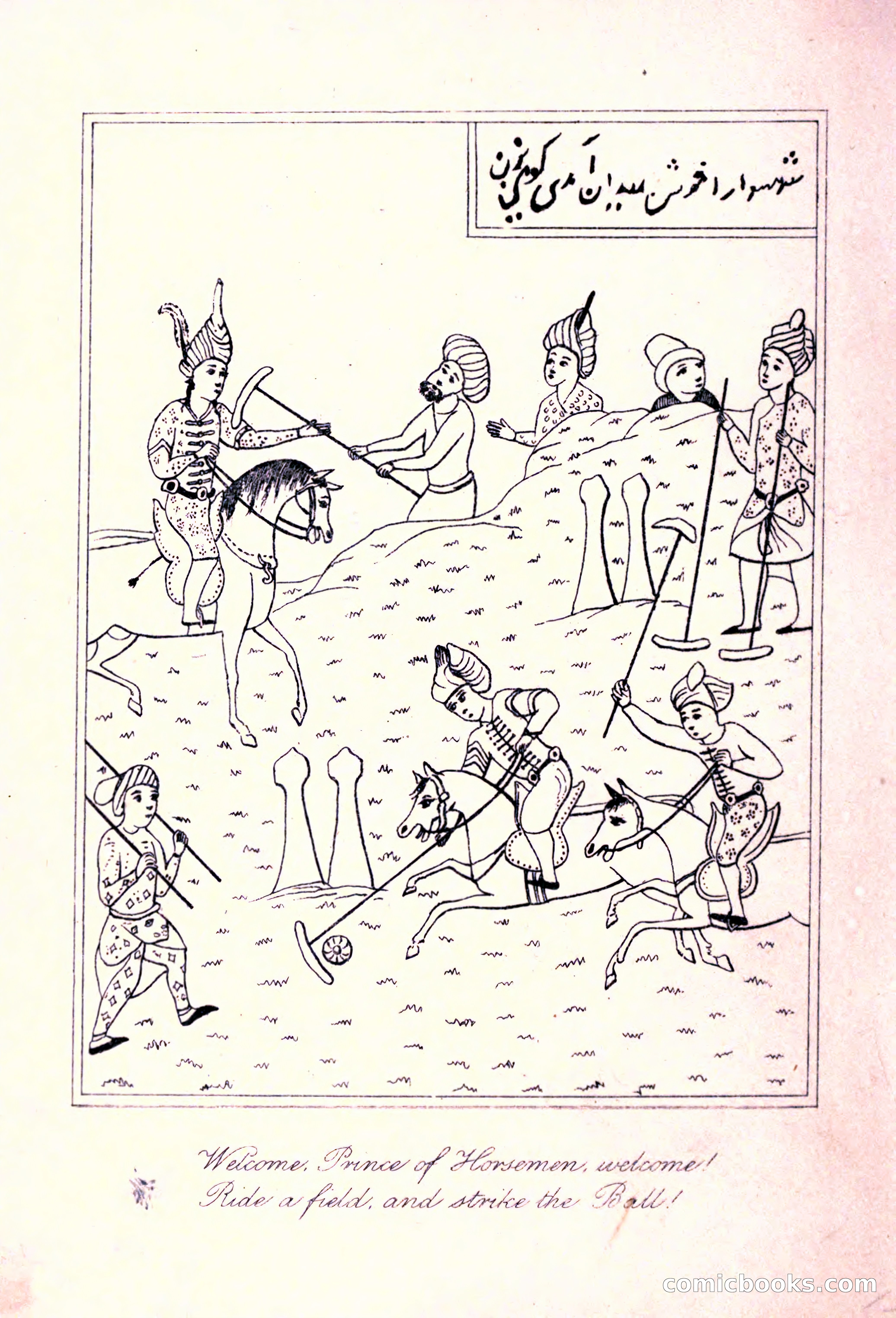
This is an illustration page from a Victorian penny dreadful depicting what appears to be a polo or field sports scene. The image shows several figures in ornate, patterned clothing and distinctive tall headdresses on horseback and on foot, engaged in some kind of game or sporting activity with sticks and a ball visible in the field. The caption at the bottom reads "Welcome, Prince of Horsemen, welcome! Ride a field, and strike the Ball!" The Persian or Central Asian script at the top of the page suggests this story involves non-European characters or settings. The detailed line-drawn illustration is characteristic of penny dreadful periodicals' visual storytelling style.
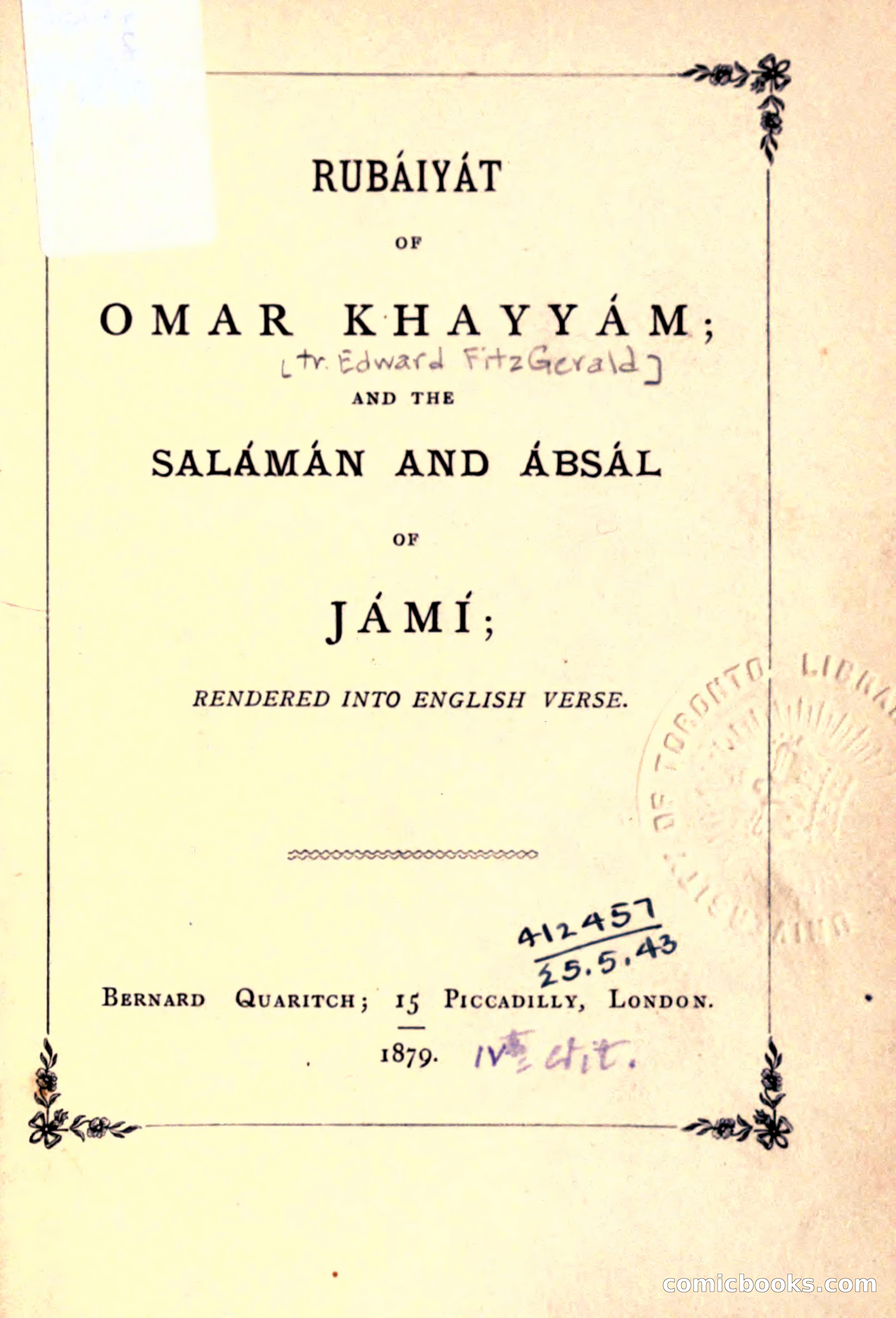
# Analysis of This Victorian Page This is a **title page** from an 1879 publication. It announces an English verse translation of two Persian literary works: the *Rubaiyat of Omar Khayyam* and *Salaman and Absal* of Jami. The page identifies Edward FitzGerald (handwritten annotation) as the translator, and lists the London publisher Bernard Quaritch at 15 Piccadilly. Library stamps and call numbers visible on the page indicate this copy belonged to an institutional collection. This is not penny dreadful fiction, but rather a prestigious literary translation of classical Persian poetry.
This is a title or colophon page from a Victorian publication. The page is mostly blank with decorative floral corner ornaments in black ink forming a border frame. The only text present identifies the printer: "G. NORMAN AND SON, PRINTERS, MAIDEN LANE, COVENT GARDEN" in London. This page serves as a publication information page typical of Victorian penny dreadfuls, indicating where the work was physically printed rather than containing narrative content or illustrations.
This is a title page, not a penny dreadful as suggested by the prompt's framing. The page announces the "Rubaiyat of Omar Khayyam, The Astronomer-Poet of Persia," rendered into English verse, and identifies this as the fourth edition. The text is centered and formal, surrounded by decorative ornamental borders typical of Victorian book design. This appears to be from a legitimate Victorian poetry publication—likely Edward FitzGerald's famous 1859 translation—rather than sensational cheap fiction. The page is plain text only, with no illustrations or advertisements.
This appears to be a largely blank page from a Victorian penny dreadful, featuring only decorative ornamental borders in the corners and along the edges—elaborate floral or vine-like designs typical of Victorian printing. There is a small decorative flourish of leaves or flowers in the center of the page. The OCR text is largely illegible or corrupted, providing no clear readable content. The page layout and decorative framing suggest this may be a title page, chapter divider, or transition page within the serialized publication, but the actual text content cannot be reliably determined from what is visible.
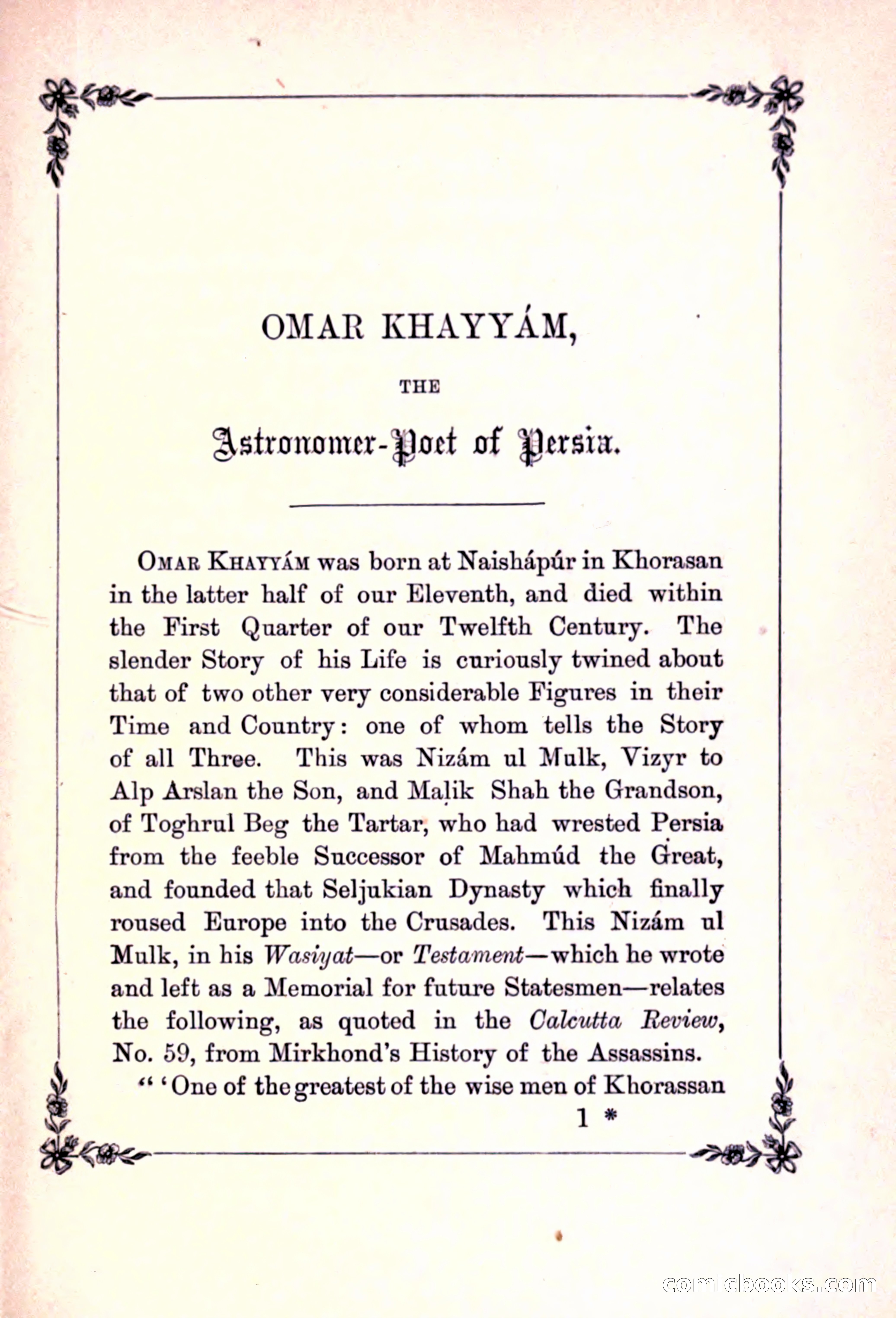
This is an opening prose page introducing Omar Khayyám, the Persian astronomer-poet. The text provides biographical context, stating he lived in the eleventh-to-twelfth centuries and that his life story is intertwined with that of Nizám ul Mulk, a vizier to Seljuk rulers. The passage explains that Nizám ul Mulk's written testament (*Wasiyat*) contains an account relating to Omar Khayyám, and the text quotes from this source as it appeared in the *Calcutta Review*. The page appears designed as an introductory article or section heading, presenting historical and genealogical information before the narrative proper begins.
This is a page of running prose from what appears to be a biographical or historical narrative about Omar Khayyam. The text describes the narrator's education under Imam Mowaffak of Naishapur, his friendship with two fellow pupils—Hakim Omar Khayyam and Hasan Ben Sabbah—and their studies together. The passage establishes the backgrounds of these three young scholars and hints at a philosophical disagreement when Hasan begins to challenge universal beliefs. The ornamental border and page number (iv) suggest this is from an early chapter or introduction of a longer work.
# Page Description This is a page of running prose narrative, page 5 of "The Astronomer-Poet of Persia." The text recounts a story about a vow made among schoolmates of the Imam Mowaffak: whoever attains fortune must share it equally with the others. The narrator, who becomes administrator under Sultan Alp Arslan, is eventually located by his old schoolfriends and honors the vow. One friend, Hasan, demands a government position; when granted one, he grows discontented and attempts court intrigue against his benefactor, leading to his disgrace. The passage concludes by noting that after subsequent misfortunes, Hasan became head of the Persian sect of the Ismailians.
# Page Description This is a page of running prose from what appears to be a biographical or historical work on Omar Khayyám (the header reads "OMAR KHAYYÁM"). The text discusses the rise of a fanatical group who, in A.D. 1090, seized the castle of Alamut near the Caspian Sea and became known to Crusaders as the "Old Man of the Mountains." The passage debates whether the word "Assassin" derives from hashish use or the founder's name, and notes that Nizám-ul-Mulk, Omar's childhood friend, was killed by an assassin's dagger. A footnote references Omar's Rubáiyát and includes a dying quotation attributed to Nizám-ul-Mulk.
This is a page of running prose from what appears to be a biographical or historical text titled "The Astronomer-Poet of Persia." The page recounts Omar Khayyam's meeting with a Vizier, describing how Khayyam requested only a pension and the freedom to pursue science rather than seeking titles or office. It details his life at Naishapur, his work under Malik Shah, his role in calendar reform resulting in the Jalali era, and mentions his astronomical tables. The text includes a quotation attributed to Gibbon comparing the Jalali calendar to the Julian and Gregorian styles.
This is a page of scholarly running prose (not a penny dreadful cover or illustration). The text provides biographical and etymological information about Omar Khayyám, explaining that his poetical name "Khayyám" means "tent-maker" and that he allegedly once practiced that trade before gaining patronage. The passage includes a self-referential poem attributed to Khayyám that uses tent-making metaphors to describe his life's misfortunes, and cites classical sources (Hyde's *Veterum Persarum Religio* and D'Herbelot's *Bibliothèque*) for biographical anecdotes. The footnotes compare Persian naming conventions to English occupational surnames.
# Analysis of Page This is a running prose page from what appears to be a Victorian-era literary work about Omar Khayyám, the Persian astronomer-poet. The main text presents a chronicle account of Omar Khayyám's death in 1123 A.D., followed by an anecdote from his student Khwájah Nizámi describing how Omar predicted his tomb would be in a place where "the north wind may scatter roses over it"—a prediction that allegedly came true. The page includes a substantial footnote discussing the "Rashness" of Omar's words and comparing his story to an anecdote from Captain Cook's Second Voyage involving a man named Oreo asking about burial places.
# Description This is a page of running prose from what appears to be a Victorian-era text about Omar Khayyám. The page contains two distinct passages: the first, extracted from the *Calcutta Review*, discusses Omar's grave and compares it to Archimedes' tomb, noting that Omar's "Epicurean Audacity of Thought and Speech" made him unpopular with the Sufis, whose religious practices he ridiculed. The second passage, set off in a footnote, is a personal anecdote about pronouncing the parish name "Stepney" and includes a quote attributed to Mr. Forster about the impossibility of knowing where one will be buried at sea. The page is framed with decorative floral borders typical of Victorian printing.
# Page Content Analysis This is a running prose page (page xi) from an introduction or preface to a work about Omar Khayyam, titled "The Astronomer-Poet of Persia." The text discusses Omar's philosophical approach: rather than seeking metaphysical answers about Providence and the afterlife, he chose to satisfy the soul through sensory experience and acceptance of the world as it appears. The passage notes that Omar prioritized gratifying the senses over intellectual inquiry, though this failed to answer life's vital questions. It concludes by stating that Omar has never been popular in his own country and therefore his works were scantily transmitted to posterity.
# What This Page Contains This is a page of scholarly prose—specifically, an introduction or preface discussing the textual history of Omar Khayyám's poems. The text examines the rarity and corruption of manuscript copies of Khayyám's work across various libraries in England, Paris, Calcutta, and elsewhere, noting how different manuscripts contain wildly varying numbers of quatrains (called "Rubaiyat" or "Tetrastichs"). A footnote indicates this material was written for a review, and a later editor has appended an update about discovering an 1836 printed edition containing 438 quatrains. The page appears to be from a Victorian scholarly edition rather than a penny dreadful.
This is a page of running prose from what appears to be an introduction or critical essay about Omar Khayyam, titled "The Astronomer-Poet of Persia" (page xiii). The text presents poetic quatrains attributed to Omar addressing divine justice and suffering, then discusses a "Bodleian Quatrain" on pantheism and atonement. It concludes with a reviewer's comparison of Omar to the Roman poet Lucretius, noting both were intellectually gifted men who rejected false religion but failed to replace it with a better moral philosophy. The page contains handwritten annotations in the margins.
# Analysis of Page XIV This is a **prose page** from what appears to be an introduction or preface rather than a penny dreadful itself. The text discusses Omar Khayyam's philosophical outlook—contrasting his Stoical contemplation of the universe as mechanical with his alternative approach of dismissing systematic philosophy as hopeless and instead embracing sensual pleasure and witty rejection of metaphysical questions. The passage then shifts to explain the translator's approach to rendering the original *Rubaiyát*, noting that these four-line stanzas (called *Tetrastichs* in English) feature varied prosody. This is scholarly editorial apparatus accompanying a translation of Khayyam's work.
# Analysis This is a **running prose page** (specifically, an introductory or editorial note) rather than fiction text itself. The visible text discusses the formal structure and translation choices behind selections from the *Rubaiyat* (spelled here "Rubáiyát"), a Persian poetic work. The author explains the alphabetic rhyme scheme of the original, notes that the selected verses have been arranged into an "Eclogue," and comments critically on the poem's philosophical tone—suggesting it movingly expresses human sorrow about mortality and fate rather than genuine merriment, despite the "drink and make-merry" theme that recurs in the original. The page appears to preface a poetic selection rather than being part of the penny dreadful's sensation fiction narrative itself.
This page appears to be largely blank or decorative, serving as a title page, chapter break, or endpaper from a Victorian penny dreadful. The page features an ornamental border composed of floral vines and bows at all four corners, with thin lines forming a rectangular frame around the edges. A small matching floral ornament appears in the center of the page. No substantial text is visible on the page itself—only what appears to be a watermark or publisher's mark ("comic books.c@") at the bottom, likely an artifact of the OCR process rather than original page content. The cream-colored paper and decorative styling are typical of Victorian-era serialized fiction publications.
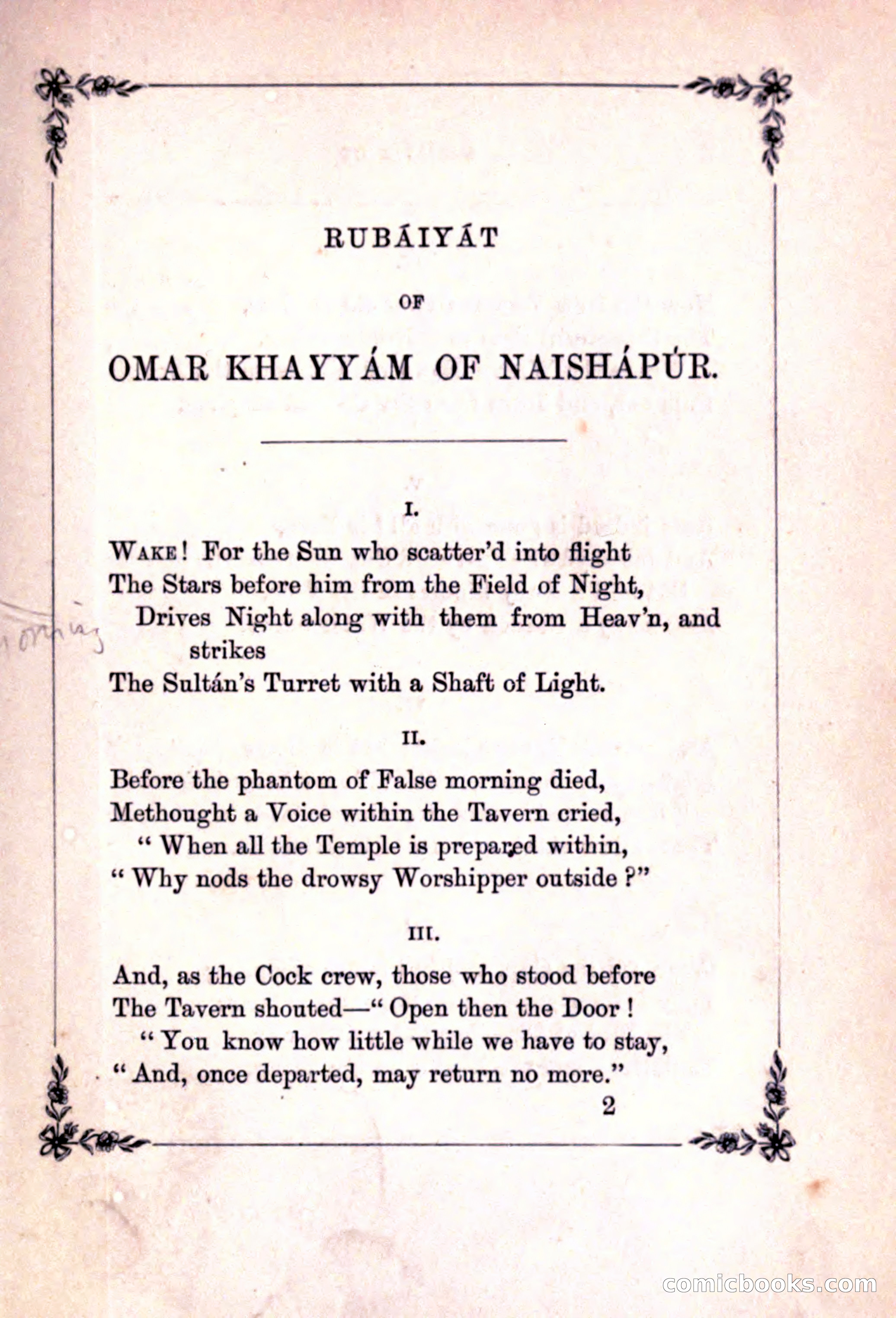
# Victorian Penny Dreadful Page Analysis This is a title page and opening text from a serialized Victorian publication. It presents the *Rubáiyát of Omar Khayyám of Naishápur*—a poetic work translated into English quatrains. The page displays the first three numbered stanzas, which describe dawn breaking over a sultanate, a mysterious voice calling from a tavern as morning arrives, and revelers at the tavern door urging entry, lamenting life's brevity. The ornamental border and page number "2" suggest this is an early installment of a serialized edition rather than a standalone volume.
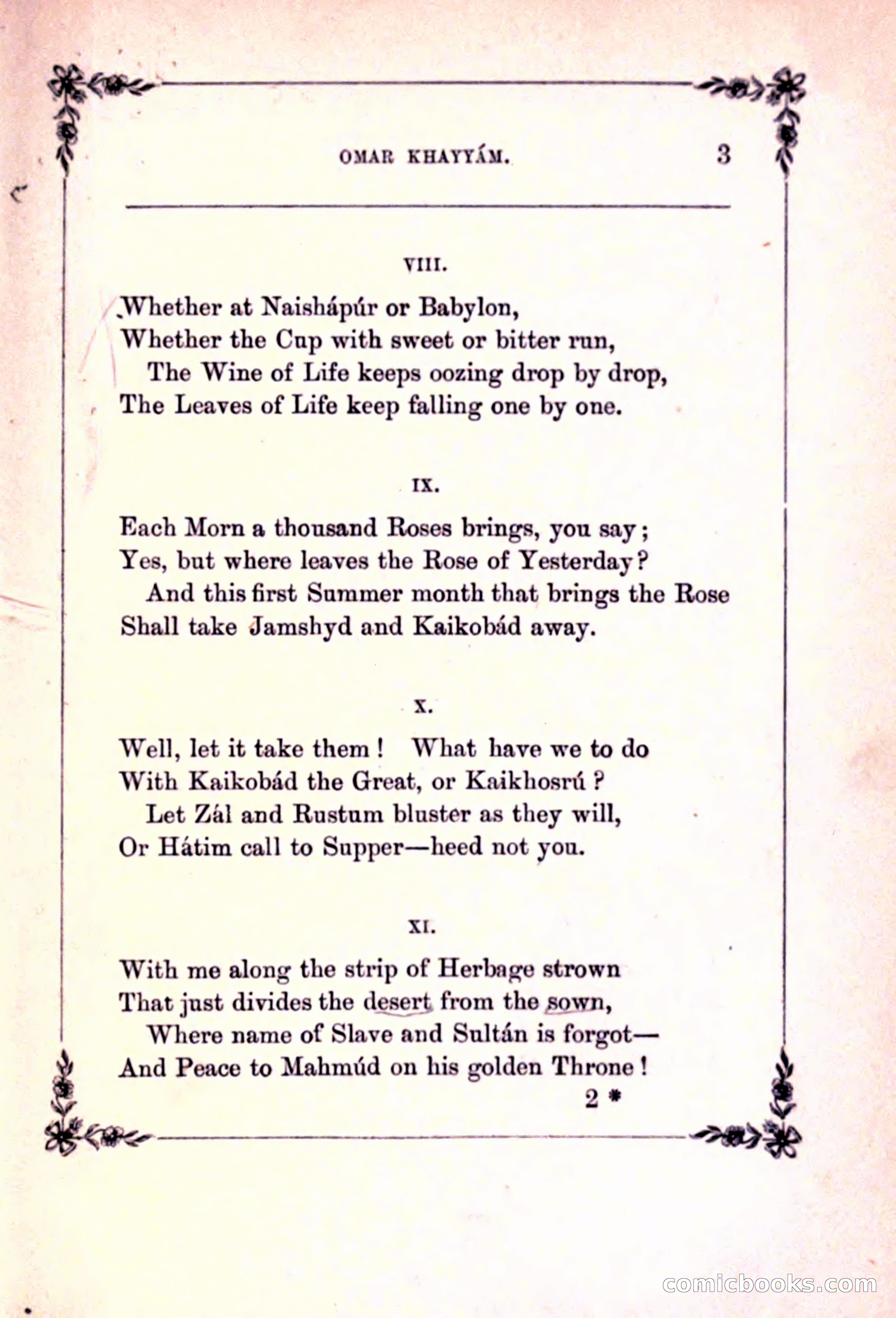
# Page Analysis This is a text page from a Victorian edition of *Omar Khayyám*, presenting quatrains (four-line stanzas) VIII through XI in English translation. The page contains philosophical verse reflecting on mortality and the passage of time—the Wine of Life oozing away, roses that bloom and fade, and the transience of even great rulers like Kaikobad. The final stanza offers an alternative vision of escape from worldly concerns, seeking peace in nature and oblivion to distinctions of power and servitude. This appears to be running prose rather than a penny dreadful; it is likely from a Victorian literary edition rather than serialized sensation fiction.
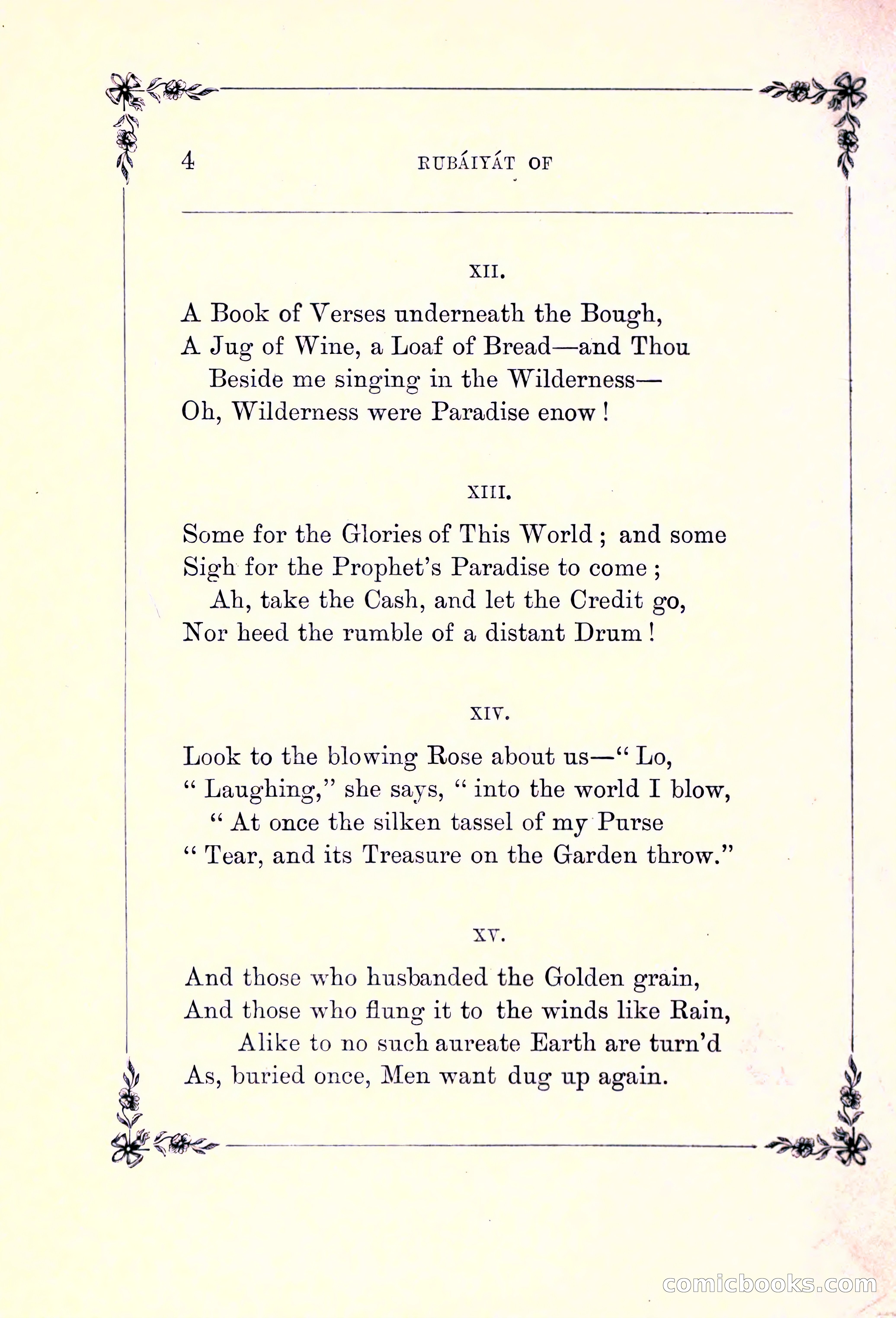
# Page Description This is a text page from what appears to be a Victorian edition of *The Rubaiyat of Omar Khayyam*, presenting quatrains (numbered XII through XV) in English verse. The page contains philosophical poetry about worldly pleasures, materialism, and mortality—featuring famous lines about wine, bread, and a beloved in the wilderness, alongside meditations on wealth, the rose as metaphor, and the futility of hoarding grain. The text is formatted with decorative floral borders and Roman numeral stanza divisions, characteristic of Victorian book design.
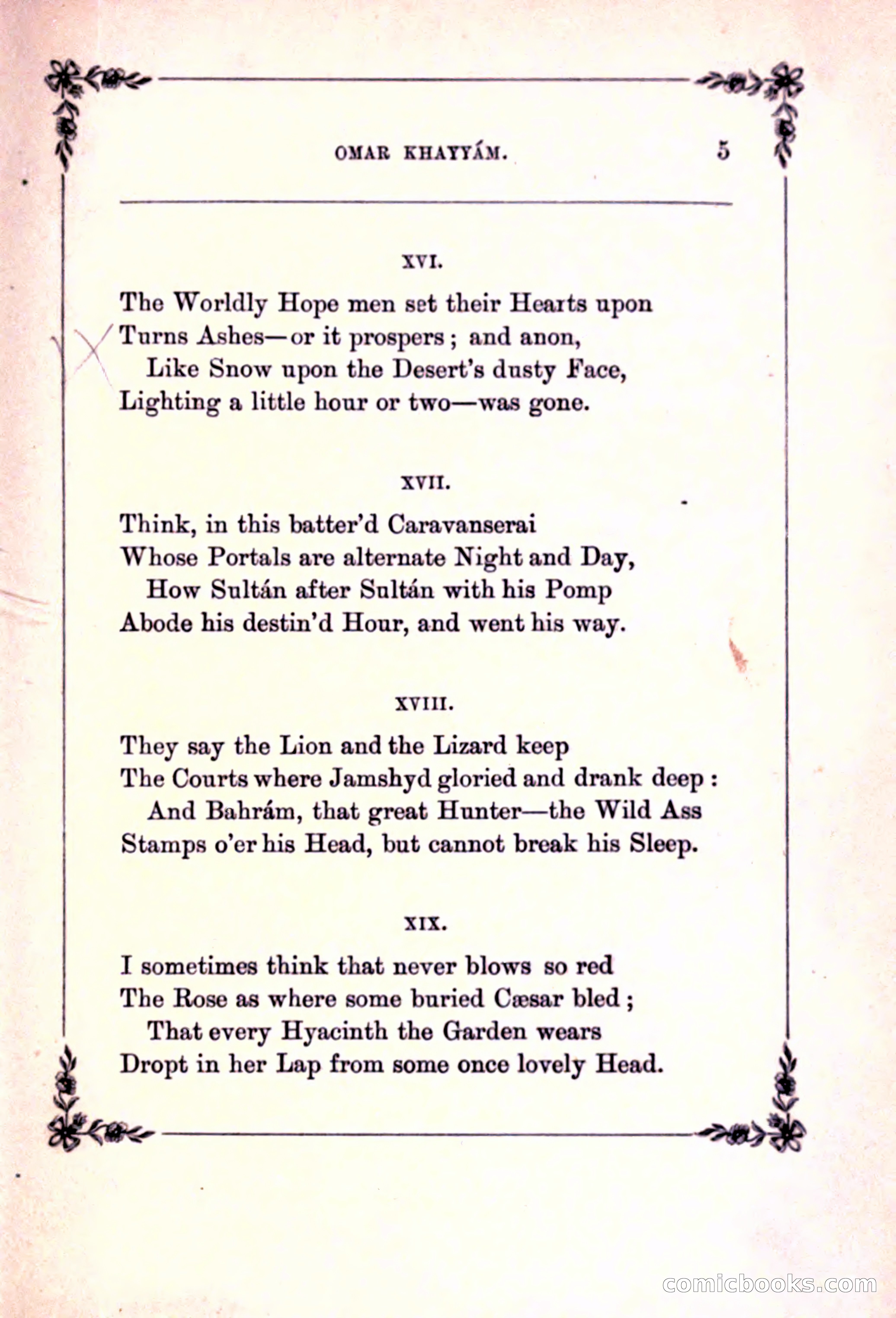
This is a text page from a Victorian edition, likely a penny dreadful or similar serialized publication, presenting four quatrains (XVI-XIX) from *The Rubáiyát of Omar Khayyám*. The verses meditate on mortality and transience—worldly hopes turning to ash, successive rulers passing through time's caravanserai, wild animals inhabiting ruined courts of ancient Persian kings, and flowers nourished by the blood of the dead. The page number indicates this is page 5 of the work. The ornamental borders and period typography are typical of Victorian book production.
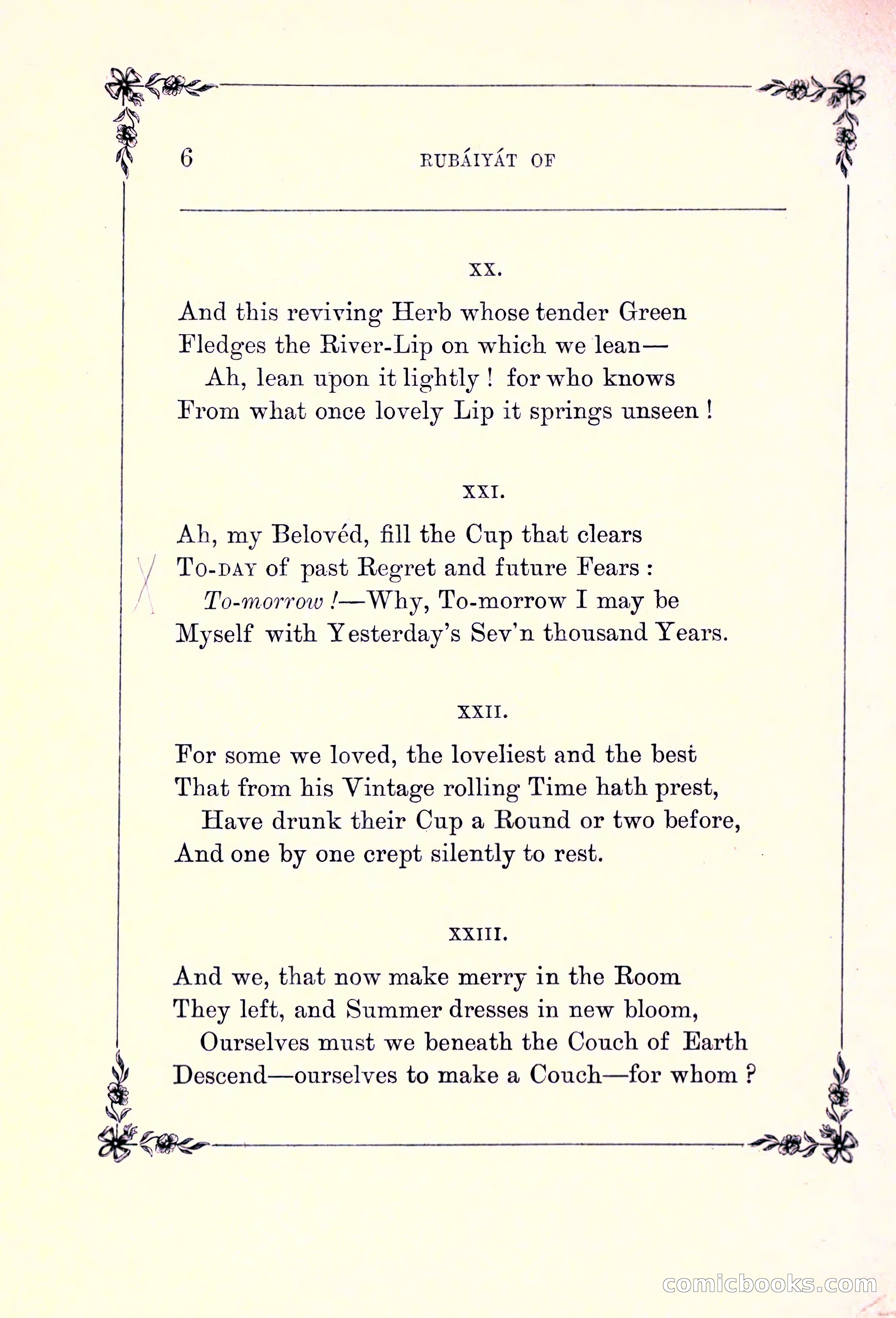
# Analysis This is a page of running verse poetry, not a penny dreadful as stated in the prompt's premise. The page presents four quatrains (XX-XXIII) from *Rubáiyát of Omar Khayyám*, a philosophical poem about mortality, love, and the passage of time. The verses meditate on death—describing how those we loved have "crept silently to rest" and warning that we too must eventually "beneath the Couch of Earth / Descend." The text emphasizes transience and the inevitability of death, using imagery of herbs, cups, and summer blooms. This appears to be from a Victorian edition of the classic Persian-inspired poem.
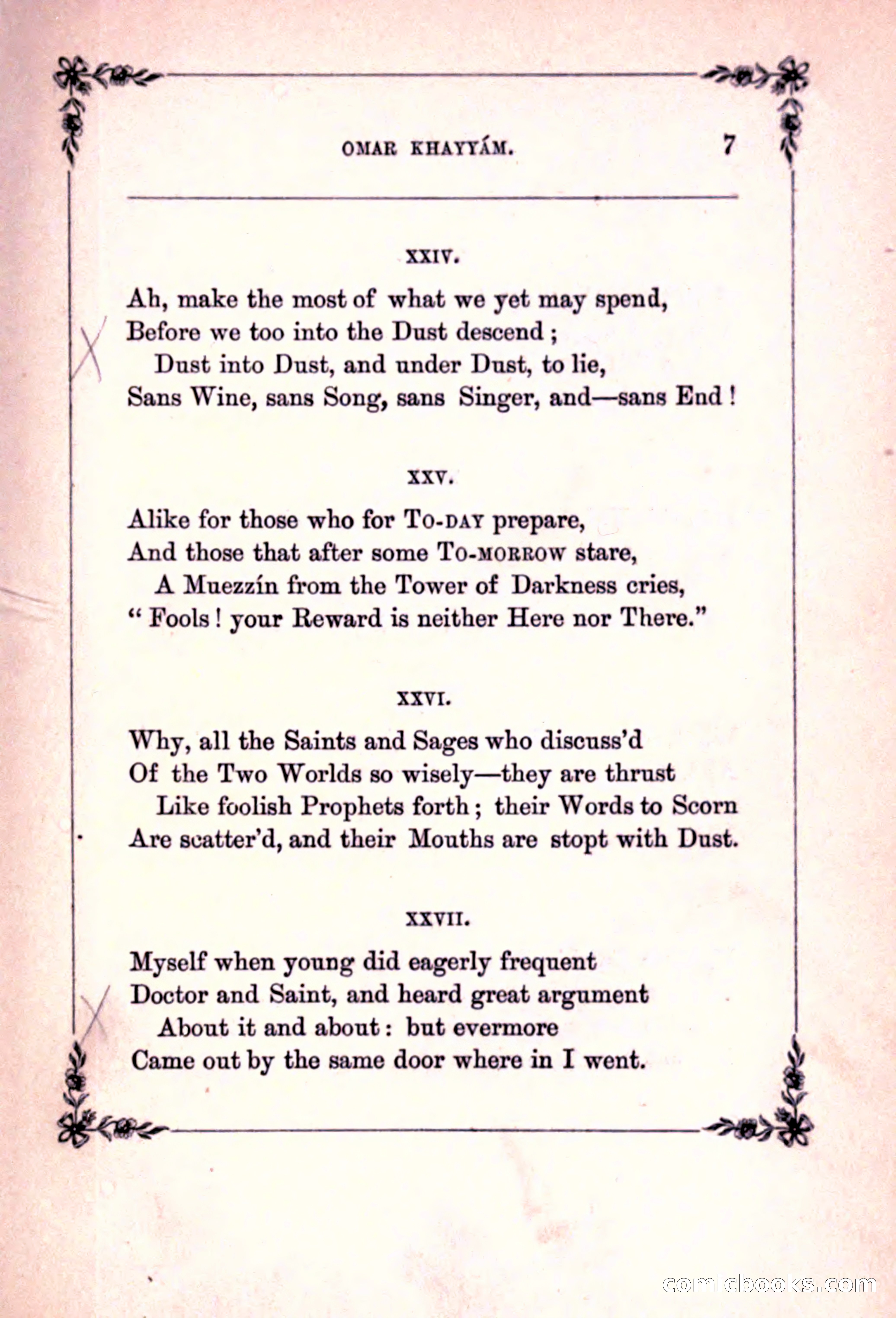
# Analysis This is a page of running prose poetry from what appears to be a Victorian edition of *The Rubaiyat of Omar Khayyam*. The page displays four numbered quatrains (XXIV–XXVII) presenting meditations on mortality, the futility of seeking religious or philosophical answers, and the inevitability of death. The verses emphasize themes of earthly pleasure before death, the meaninglessness of competing worldly and spiritual concerns, and the speaker's youthful pursuit of wisdom that ultimately yielded no answers. The ornamental border and classical typography suggest this is from a carefully produced Victorian literary edition rather than sensational penny dreadful content.
This is a page of poetry from *Rubaiyat of* (likely the famous *Rubaiyat of Omar Khayyam*), presenting four quatrains numbered XXVIII through XXXI. The verses explore existential themes: the speaker reflects on sowing wisdom but reaping nothing, describes flowing through the universe without understanding origin or destination, laments humanity's inability to answer fundamental questions about existence, and recounts a mystical journey through cosmic gates that unraveled many mysteries but not the ultimate mystery of human fate. The decorative border and serif typeface are characteristic of Victorian-era literary publications.
This is a page of running poetic text from what appears to be a Victorian edition of *The Rubáiyát of Omar Khayyám*. The page displays four quatrains (XXXII–XXXV) in English translation, featuring the work's characteristic philosophical meditation on mortality, divine mystery, and the pursuit of life's pleasures. The verses employ ornate, decorative typography with capitalized words for emphasis, discussing themes of inaccessible knowledge ("the Door," "the Veil"), cosmic indifference, and the famous exhortation to "Drink!"—the poem's recurring counsel to enjoy earthly life before death.
This is a text page from what appears to be a Victorian edition of *The Rubaiyat of Omar Khayyam* (a translated Persian poem collection). The page contains four numbered quatrains (XXXVI-XXXIX) rendered in English verse. The speaker reflects on a clay vessel that once lived and drank, remembers watching a potter work, and ponders whether human beings share a similar story of being shaped from earth by a maker—arguing that even water we discard may somehow relieve hidden suffering far below. The decorative border and typography suggest this is from a mid-to-late Victorian illustrated edition.
# Page Description This is a text page from what appears to be a Victorian edition of *The Rubaiyat of Omar Khayyam*. The page contains four numbered quatrains (XL-XLIII) in English verse translation. The verses use extended metaphors of tulips, wine, and cups to meditate on mortality, pleasure, and acceptance of fate—themes central to the Persian poet's work. The page is ornately bordered with decorative flourishes typical of Victorian printing. This is running poetry text rather than prose fiction, making it atypical for a penny dreadful.
This is a text page from what appears to be a Victorian edition of *The Rubaiyat of Omar Khayyam*, showing stanzas XLIV through XLVII. The page contains philosophical poetry in quatrains contemplating the soul's separation from the body, the brevity of human existence compared to eternity, and the insignificance of individual human lives within the vast sweep of time. The content reflects themes of mortality, divine creation, and cosmic indifference rather than sensation fiction—this appears to be a literary work, not a penny dreadful as initially suggested.
This is a page of verse text, specifically numbered stanzas (XLVIII-LI) from what appears to be a translation of Omar Khayyám's *Rubaiyat*. The page presents philosophical quatrains meditating on existence, the nature of truth and falsehood (symbolized by a dividing hair), and an elusive divine presence running through creation. The ornamental borders and page number (13) indicate this is from a bound book rather than a penny dreadful serialization. The content concerns metaphysical questions about life's brevity, hidden knowledge, and spiritual truth—characteristic of Victorian-era literary translations rather than sensation fiction.
# Page Description This is a text page from what appears to be a Victorian-era edition of *The Rubáiyát of Omar Khayyám* (verse 52-55 visible). The page contains running poetry arranged in numbered quatrains, with decorative floral borders. The verses discuss philosophical themes: the unknowable nature of existence, mortality and the passage of time, advice against futile pursuits, and a metaphorical celebration of wine and pleasure over reason. The final quatrain describes the speaker's "Second Marriage"—a poetic rejection of reason in favor of wine's comfort.
This page contains running prose poetry from what appears to be a Victorian-era translation or adaptation of *The Rubáiyát of Omar Khayyám*. The numbered stanzas (LVI-LIX) are presented in quatrain form. The speaker reflects on his lack of philosophical depth except regarding wine, defends his mathematical calendar reforms, describes an angelic figure offering him grapes at a tavern door, and concludes by praising grapes as a logical and alchemical solution capable of transmuting life's base elements into gold. The page number "15" appears at top right.
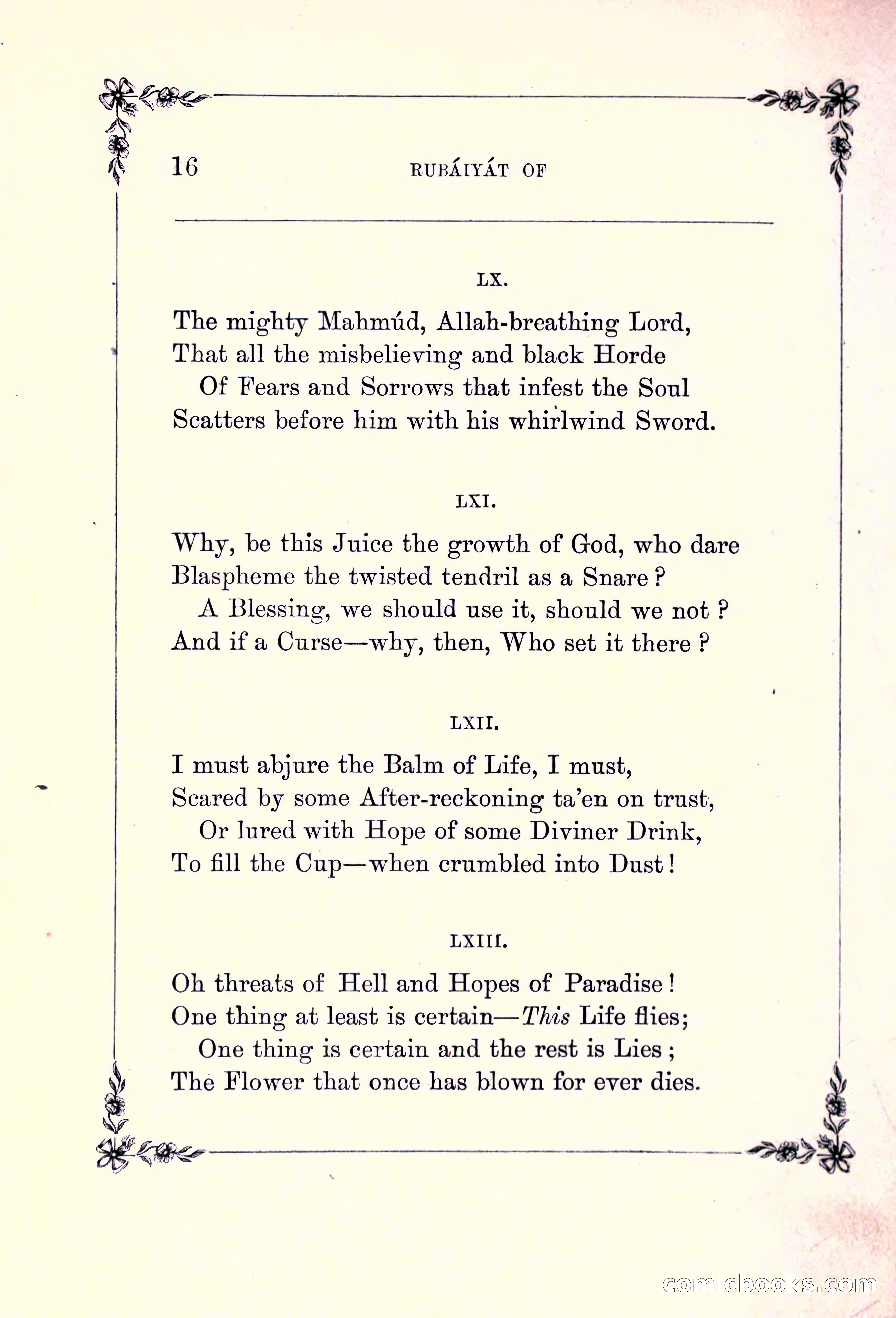
# Page Content Description This is a page of running poetry text from what appears to be a Victorian adaptation or parody of the *Rubaiyat of Omar Khayyam*. The page presents four numbered quatrains (LX through LXIII) in English verse. The poems address themes of divine power, the nature of blessing and curse, renunciation of worldly pleasures, and mortality—specifically, the certainty of death and the transience of life. The decorative floral border and page number (16) indicate this is interior text from a bound volume rather than a cover or title page.
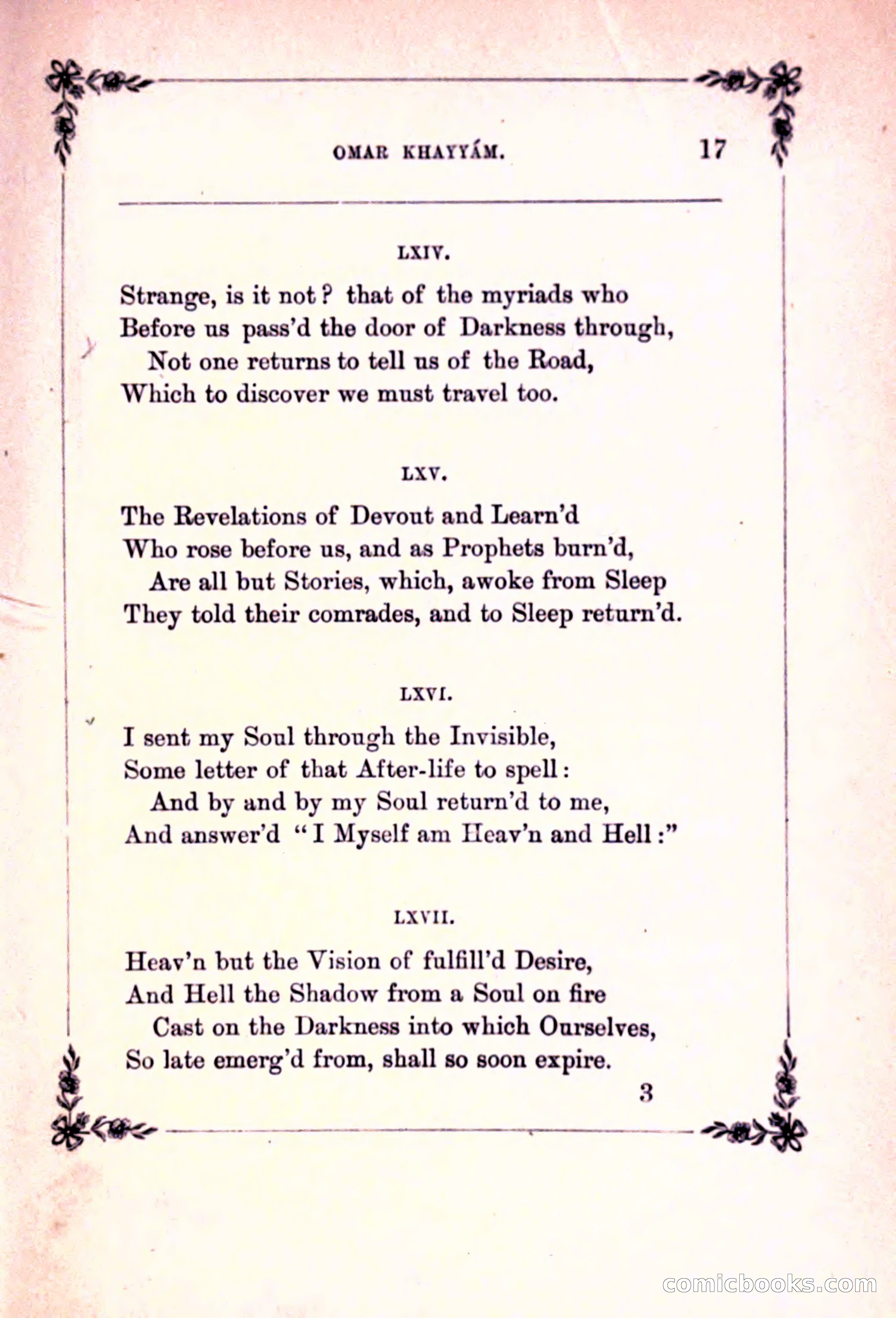
This is a text page from what appears to be a Victorian-era edition of *Rubaiyat of Omar Khayyam*, displaying quatrains LXIV through LXVII in English translation. The passage concerns the unknowability of death and the afterlife—no one returns from beyond "the door of Darkness" to report the way; religious revelations are merely stories told before sleep; and the speaker's soul reports that heaven and hell are projections of fulfilled or tormented desire rather than objective states. The page is formatted as poetry with ornamental borders typical of Victorian publications.
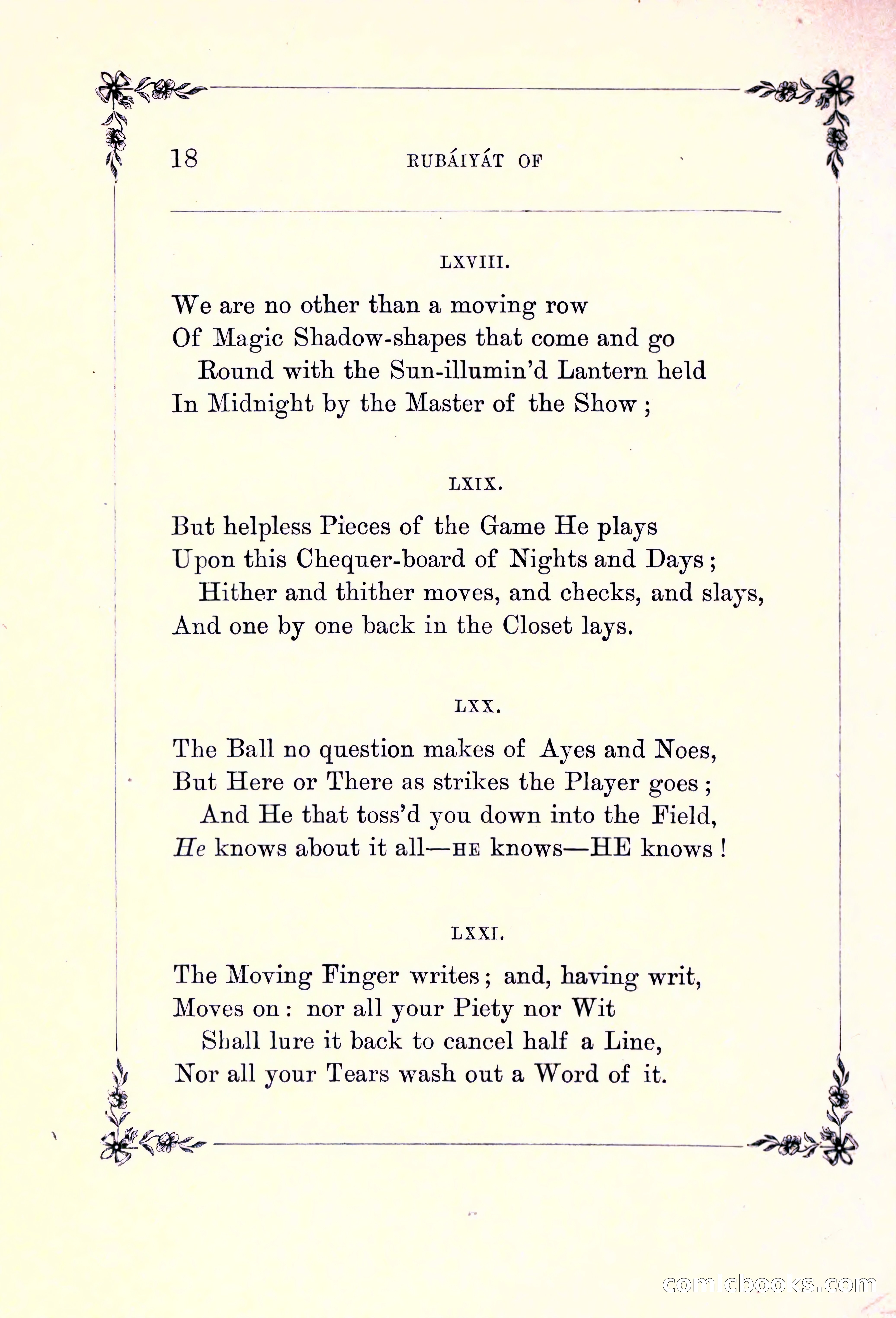
# Page Description This is a text page from what appears to be a Victorian edition of *The Rubaiyat of Omar Khayyam*, presenting four consecutive quatrains (LXVIII-LXXI) in English verse translation. The page contains running poetry with no illustrations, employing decorative floral border elements typical of Victorian publishing. The verses use extended metaphors—comparing human existence to shadow-shapes in a magical lantern show, chess pieces in a game, and a ball struck by a player—while concluding with the famous lines about the Moving Finger that writes fate and cannot be undone. This is clearly extracted literary content rather than a sensational penny dreadful narrative.
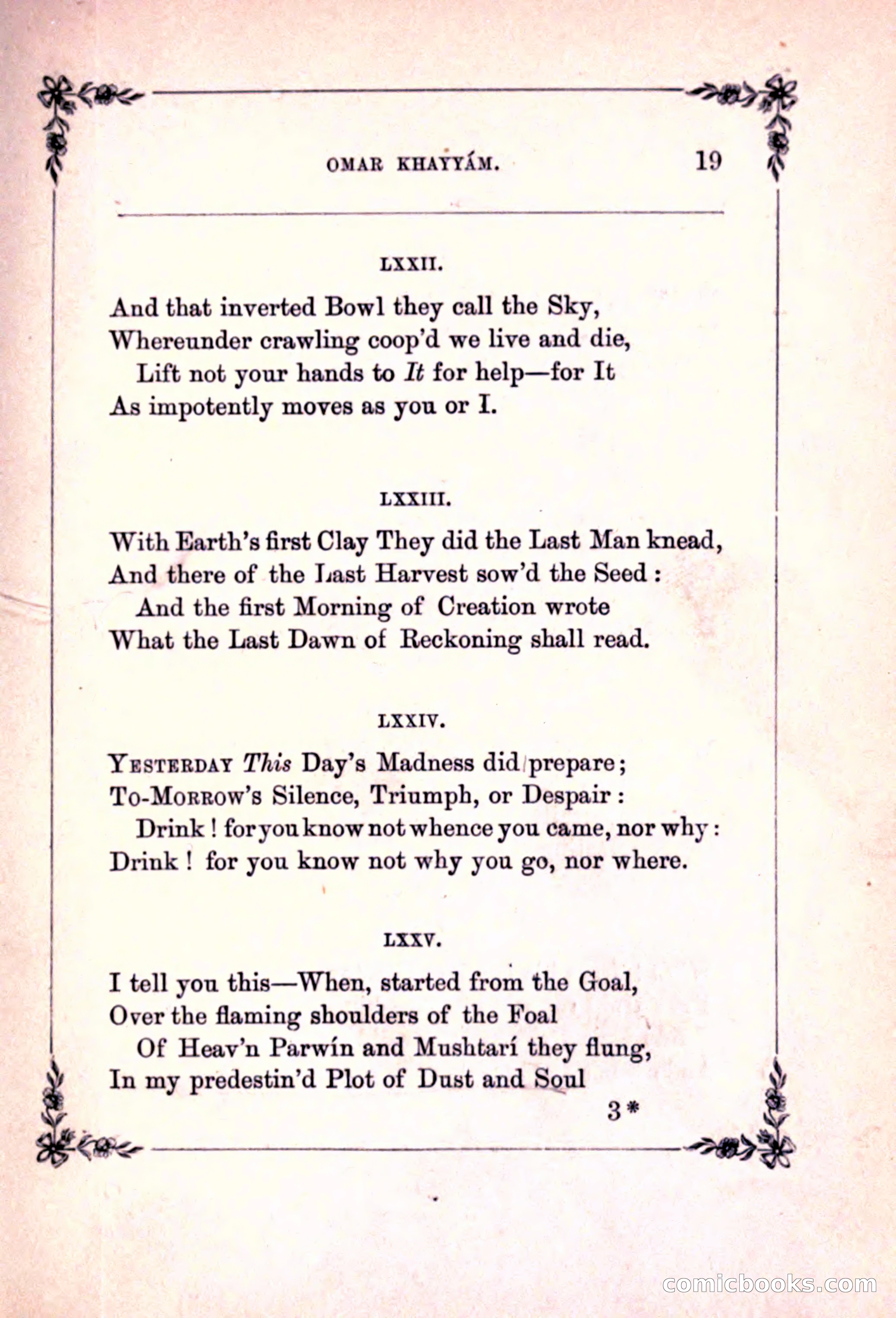
This is a page of running prose—specifically poetry—from what appears to be a Victorian edition of the *Rubáiyát of Omar Khayyám*. The page contains four numbered quatrains (LXXII-LXXV) presenting philosophical meditations on fate, creation, mortality, and the unknowability of human existence. The verses employ religious and astronomical imagery, urging the reader to drink and accept life's mysteries since the future remains unknowable. The ornamental borders and page numbering (19) indicate this is from the interior of a bound book rather than a penny dreadful installment.
# Page Analysis This is a text page from a Victorian edition of *Rubáiyát of Omar Khayyám* (the title visible at the top). It presents quatrains LXXVI through LXXIX of the poem in English translation. The verses concern philosophical and spiritual matters: the speaker's attachment to earthly life despite derision, a preference for divine experience in earthly taverns over formal temples, complaints about creation's inherent suffering and divine injustice, and resentment at being held accountable for debts incurred without consent. The page features decorative floral borders typical of Victorian book design.
# Page 21 of Omar Khayyám This is a text page presenting three numbered quatrains (LXXX, LXXXI, LXXXII) from what appears to be a Victorian translation of the Rubáiyát of Omar Khayyám. The verses concern humanity's moral responsibility and divine justice—the speaker questions whether God will hold him accountable for sins he was predetermined to commit, and appeals for forgiveness. The final quatrain shifts to a narrative moment where the speaker stands alone in a potter's house as Ramadan departs. The page features decorative border ornaments typical of Victorian publishing.
This is a page of running verse poetry from what appears to be "The Rubáiyát of Omar Khayyám" (here spelled "Rybaiyat"), presented in numbered quatrains (LXXXIII-LXXXVI). The text uses an extended metaphor of clay vessels discussing their creation and purpose—debating whether their maker (the Potter) intended them to be broken, and questioning divine will. The page contains no illustrations, only decorative floral borders at top and bottom corners typical of Victorian book design.
This is a page of running prose poetry from what appears to be a Victorian adaptation or interpretation of Omar Khayyam's *Rubaiyat*. The page contains four numbered quatrains (LXXXVII-XC) in which personified pottery vessels engage in philosophical dialogue about existence, divine judgment, and earthly pleasures. The verses employ the extended metaphor of pots and potters to discuss fate and indulgence, with vessels debating whether a maker threatens damnation and ultimately calling for wine and merriment. The tone is whimsical and irreverent, treating serious theological questions through witty, colloquial language.
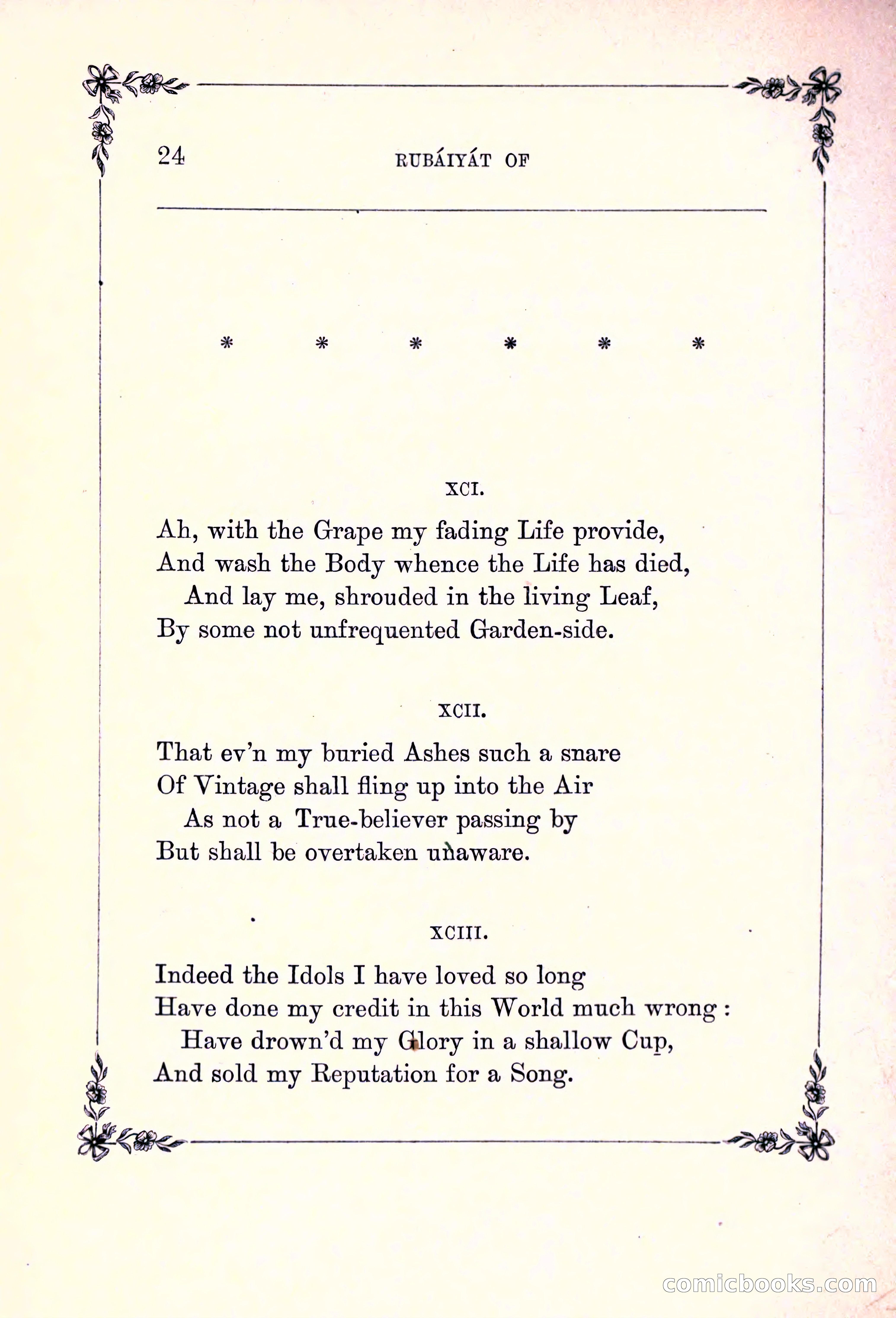
This page presents running poetry text from what appears to be a Victorian adaptation or parody of *The Rubaiyat of Omar Khayyam*. The visible stanzas (XCI-XCIII) are meditative verses on death, burial, wine, and regret—the speaker requesting grape wine for his final moments, warning that his ashes will intoxicate passersby, and lamenting that his love of idols has damaged his worldly reputation and reduced his glory to shallow pleasures. The decorative border and Roman numeral headings suggest this is from a serialized or bound edition of Victorian popular literature.
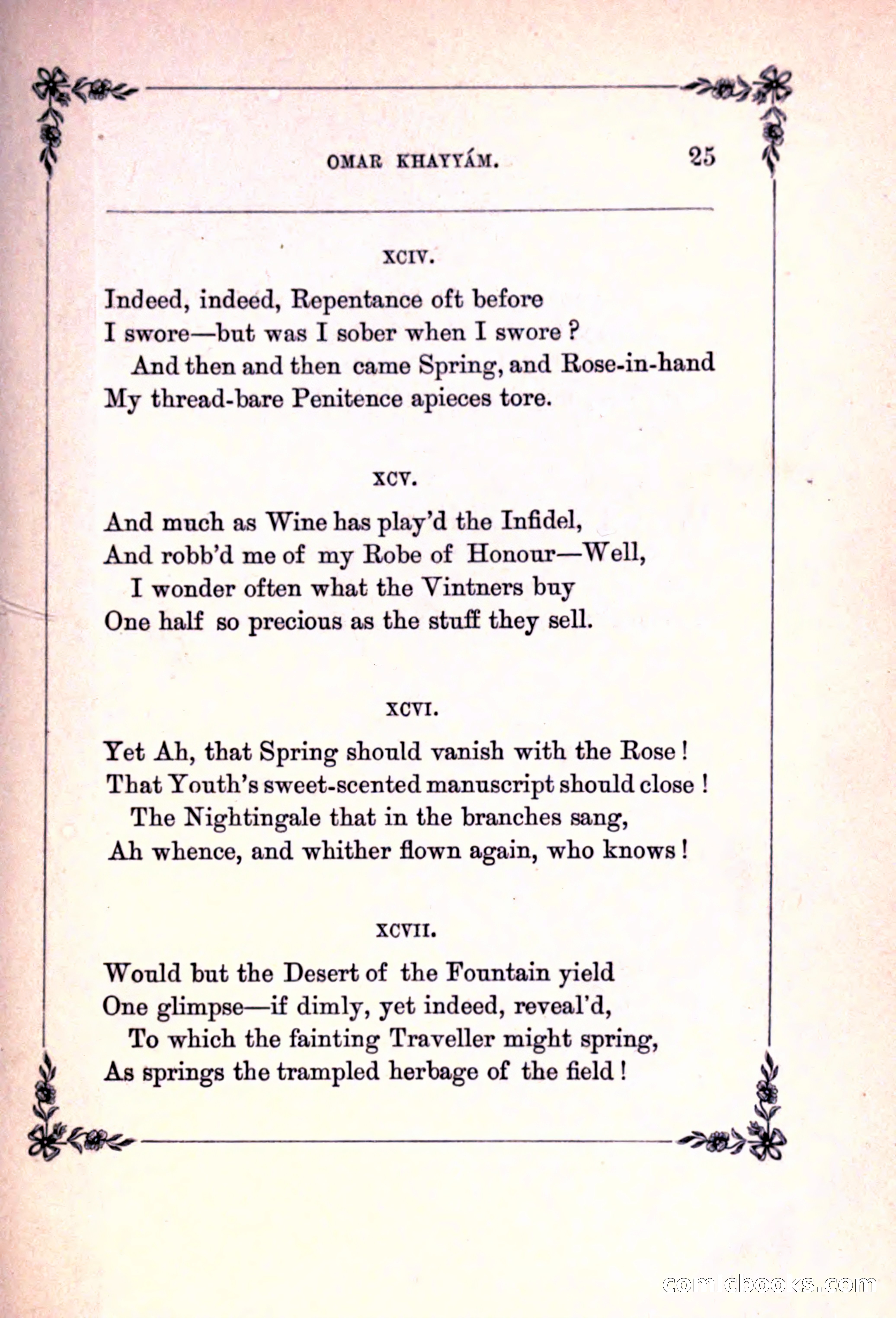
This page contains running poetry text from what appears to be a translation or adaptation of Omar Khayyam's *Rubaiyat*. The four quatrains (XCIV-XCVII) deal with themes of repentance, wine's corrupting influence, the transience of youth and spring, and longing for spiritual or physical refuge. The ornamental borders and page number (25) indicate this is from the body of a bound or serialized work, likely presented as literary content rather than sensationalist penny dreadful material, though the attribution to "Omar Khayyam" suggests it may be a popular Victorian adaptation or translation included in such publications.
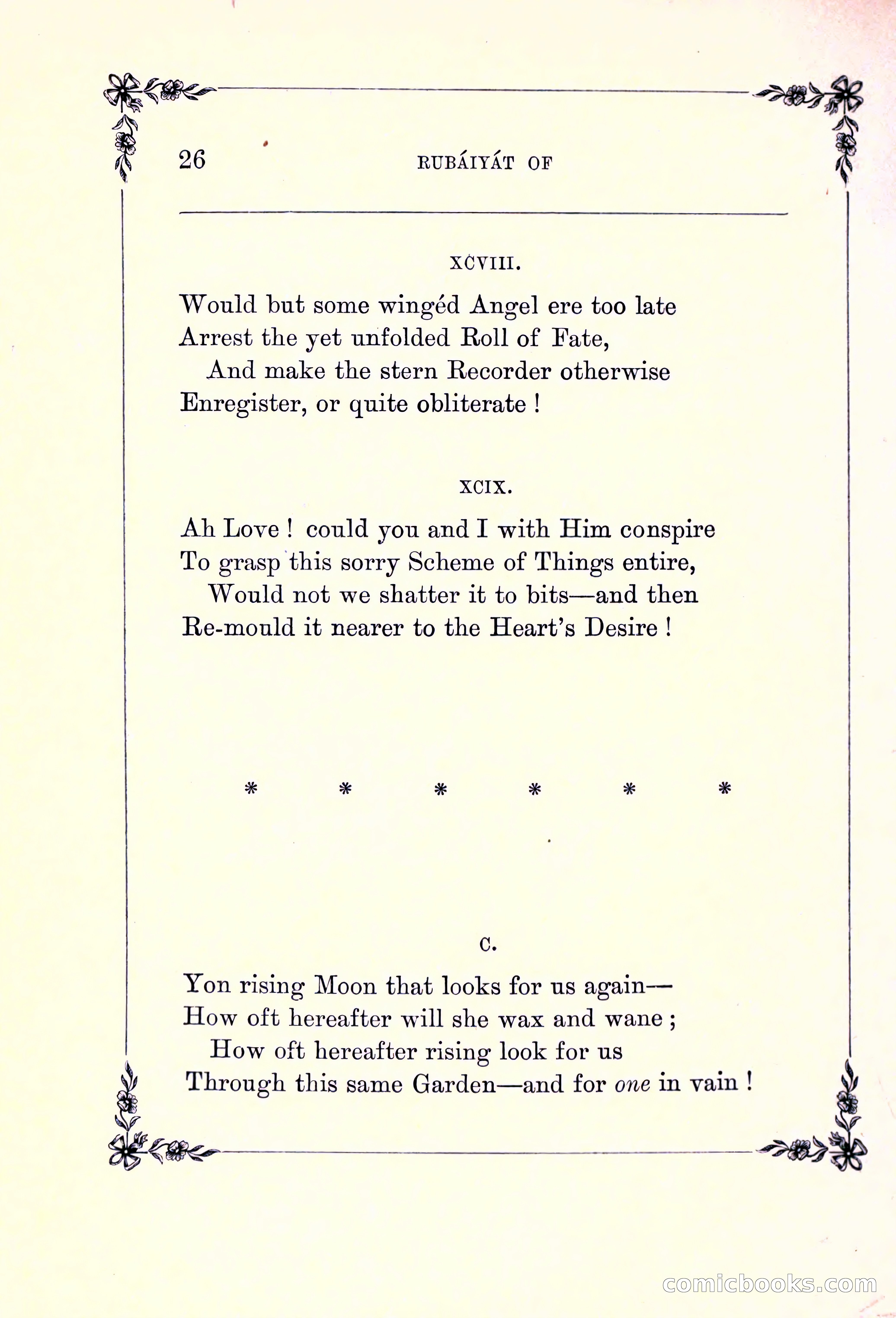
This page presents poetry in numbered quatrains (XCVIII, XCIX, and C) from what appears to be a Victorian-era edition of *Rubaiyat* — likely *The Rubaiyat of Omar Khayyam*, a popular Persian-influenced poem. The verses express philosophical laments: the first wishes an angel could alter fate; the second imagines reshaping existence to match desire; the third reflects on the moon's cyclical returns and an absent beloved. The decorative border and formal typography indicate this is from a bound literary edition rather than serialized penny dreadful fiction, despite the query's framing.
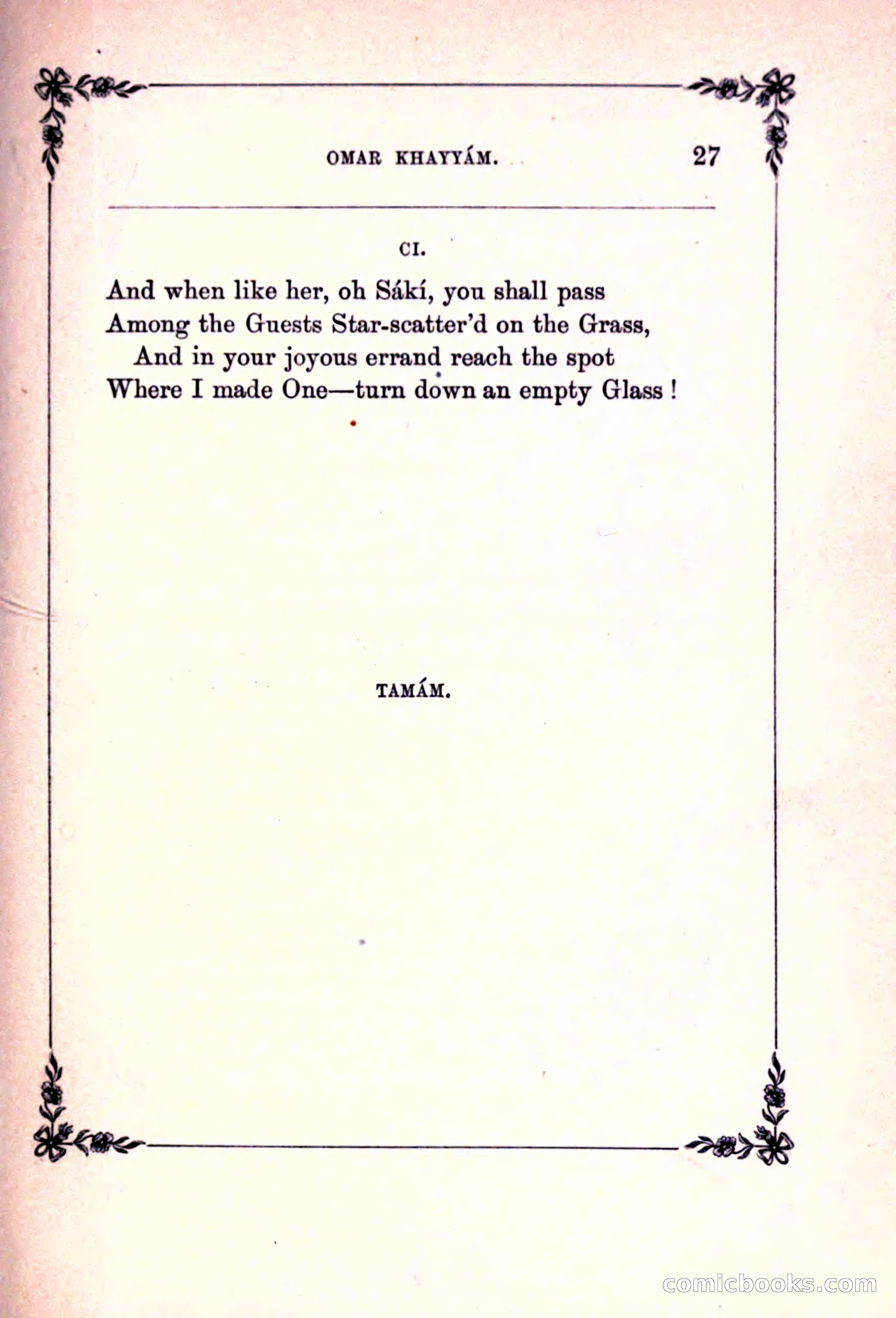
This is a text page from what appears to be a Victorian edition of the *Rubaiyat of Omar Khayyam*. It contains the final quatrain (numbered CL) of the famous Persian poetry collection in English translation. The verse addresses the "Saki" (cupbearer) with instructions to pass an empty glass at the spot where the speaker once sat among fellow drinkers. The word "TAMAM" below signals the end of the work. The page features decorative ornamental borders typical of Victorian publishing. This is running prose/poetry rather than an illustration or cover page.
# Notes Page from Victorian Literature This is a **notes page** (likely from a poem or literary work), featuring scholarly annotations in small print. The visible text provides historical and geographical context: it explains Eastern astronomical phenomena like the "False Dawn" (*Subhi Kázib*), discusses the Persian New Year (*Naw Rooz*) beginning at the Vernal Equinox, and quotes Mr. Binning's observations about spring's rapid arrival in Persia. The notes describe seasonal flora appearing at New Year—including thistles, clover, dandelions, and corn-flowers—and include a poetic quotation about spring buds adorning winter's landscape. The page uses decorative floral borders typical of Victorian printing.
# Page Analysis This is a notes page (numbered 29) from what appears to be an annotated literary text. The page consists entirely of scholarly footnotes explaining references and allusions in the main work—discussing Persian mythology, Islamic sources, biblical references, and literary citations. The notes explain terms like "the White Hand of Moses," references to Iram and Jamshyd's Cup from Persian tradition, the language Pehlevi, the hero Rustum, and Persepolis (also called Takht-i-Jamshyd). There are no illustrations, only dense explanatory prose with parenthetical numerical references keyed to the text above.
# Page Description This is a notes page (numbered 30) from what appears to be an annotated literary work, likely Victorian poetry. The text consists of scholarly explanatory notes discussing Persian and Eastern literary and historical references, including details about Bahram of the Wild Ass, the Seven Castles, a quatrain inscribed at Persepolis, and an English superstition about the Anemone flower. The notes also reference Omar's poetry and make comparative literary observations, suggesting this page accompanies a poem or narrative that draws heavily on Oriental themes and sources.
# Page Description This is a notes page (numbered 31) from what appears to be an annotated edition of literary or philosophical work, not a penny dreadful. The page contains scholarly footnotes explaining references and concepts, including discussions of Persian poetry, the custom of libating wine in Eastern cultures, and Oriental legend. The text is primarily running prose with decorative borders, containing numbered notes (XXXII, XXXVII, XXXIX, XLIII) that reference and elaborate on passages elsewhere in the work, mentioning poets like Attar and Hafiz, and the angel Azriel.
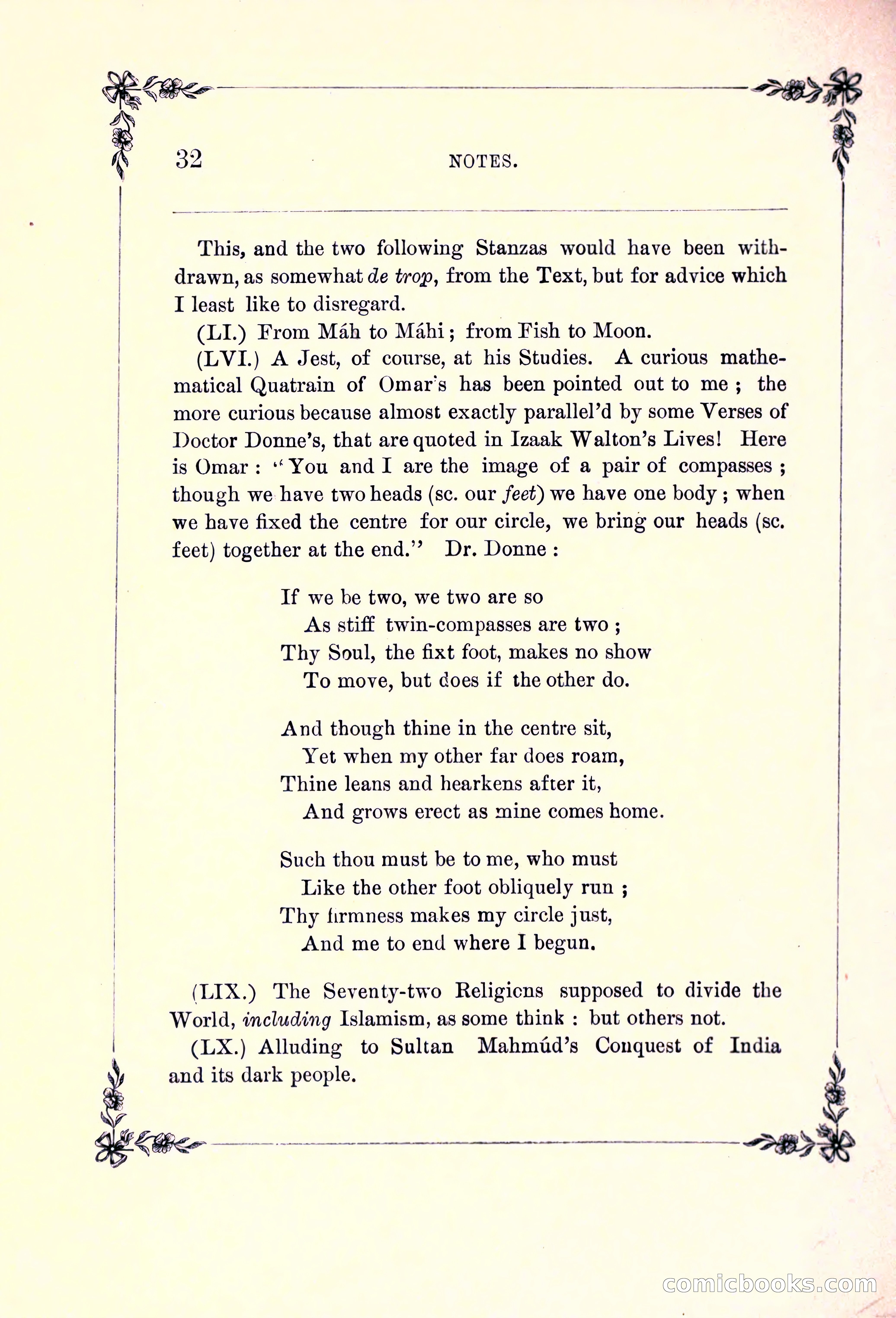
This is a notes page from what appears to be an annotated edition of poetry (likely Edward FitzGerald's *Rubaiyat of Omar Khayyam*). The page contains scholarly annotations explaining references in the text, including a discussion of mathematical imagery comparing Omar Khayyam's compass metaphor with a parallel passage from John Donne's poetry. The notes also briefly explain allusions to religious divisions and Sultan Mahmud's conquest of India. The page is primarily running prose with embedded verse quotations, formatted as explanatory endnotes rather than the main literary text.
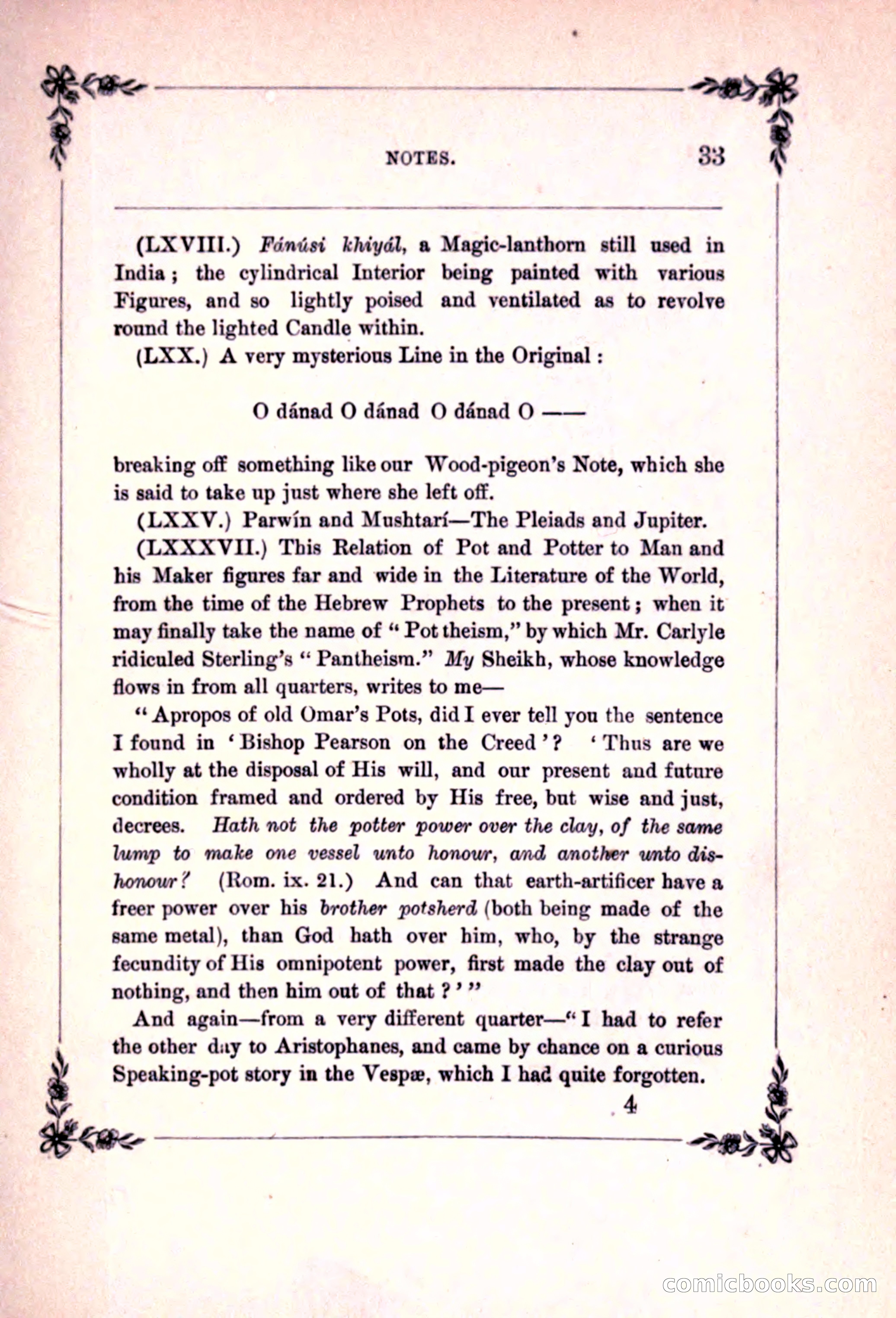
# THIS PAGE This is a **notes/commentary page** from what appears to be an annotated edition of a literary work (likely *The Rubaiyat of Omar Khayyam*, based on context). The page contains numbered footnotes explaining references and terms in the main text—including a description of an Indian optical device (the Pánási khiyál), an unexplained mysterious line from the original work, and an extended philosophical discussion about the metaphorical relationship between potter and clay, drawing on Biblical and classical sources. The notes cite Thomas Carlyle, Bishop Pearson, and Aristophanes.
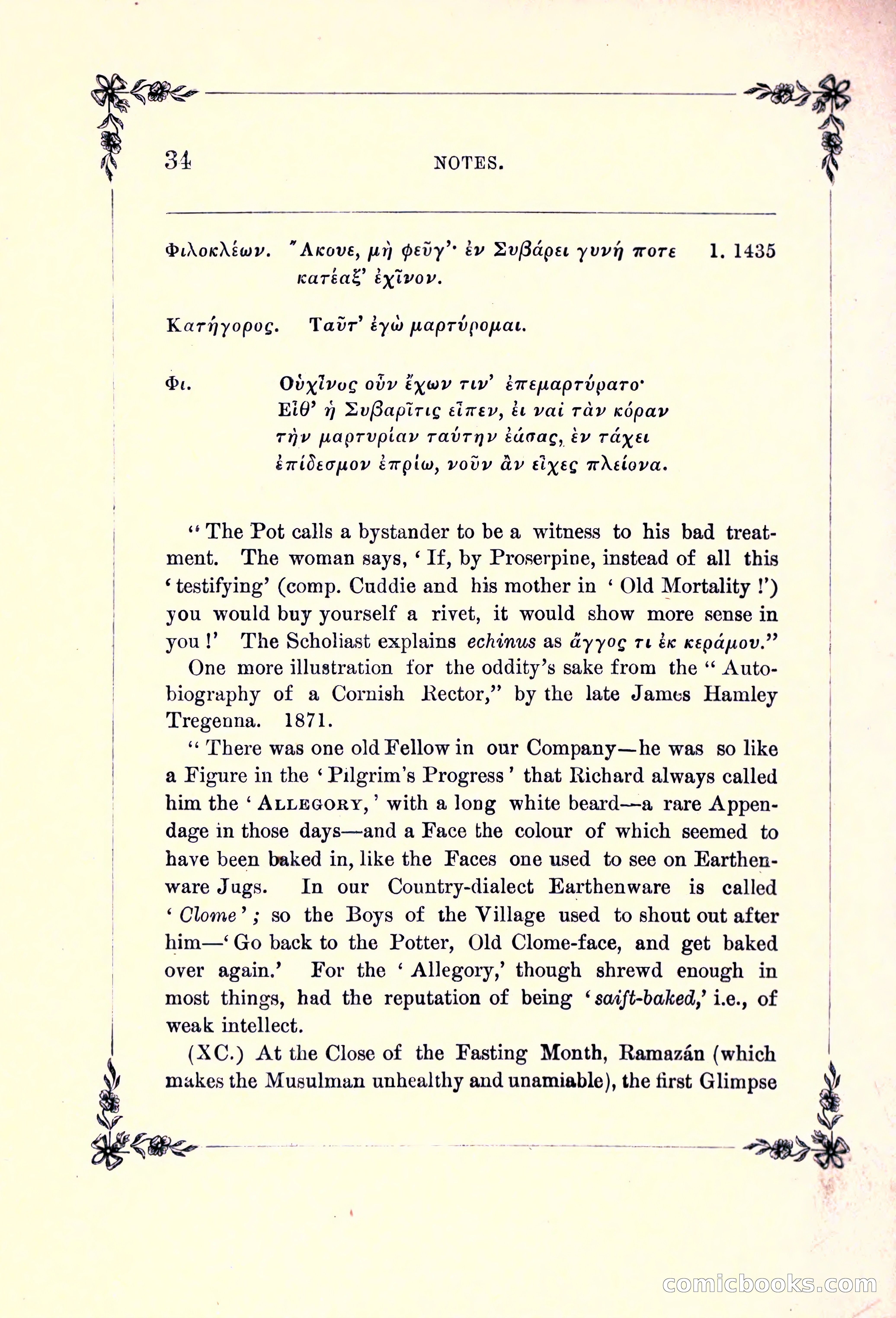
This is a notes page from a Victorian text, containing scholarly annotations in Greek and English. The page discusses a theatrical scene where "the Pot calls a bystander to be a witness to his bad treatment," with a woman's sarcastic rejoinder about buying a rivet instead of testifying. The notes include a lengthy anecdote from an 1871 "Autobiography of a Cornish Rector" about a village character nicknamed "the Allegory" due to his resemblance to a figure from *Pilgrim's Progress*, whom local boys mockingly called "Old Clome-face" and told to return to the potter. The page concludes with a brief reference to Ramazan (Ramadan). This appears to be scholarly commentary rather than penny dreadful fiction.
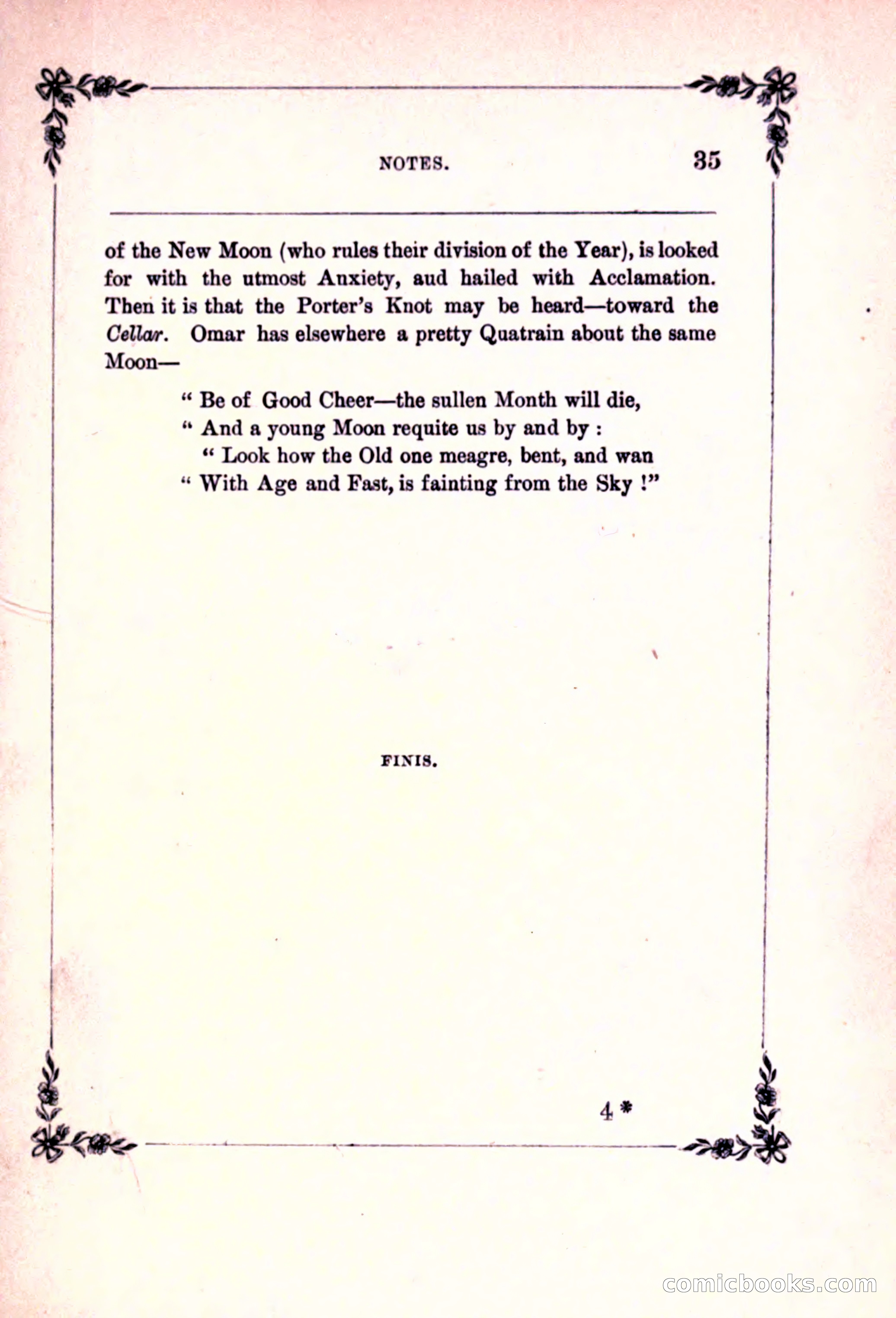
This is page 35 of a notes or commentary section, appearing near the end of a work (marked "FINIS"). The visible text discusses lunar observances and cites a quatrain attributed to Omar about the Old Moon fading and a new Moon arriving. The passage describes how the appearance of the New Moon is awaited with anxiety and greeted with celebration, and mentions a "Porter's Knot" that may be heard toward the cellar. The page consists entirely of prose commentary rather than narrative fiction or illustrations.
This is a decorative border page from a Victorian penny dreadful, featuring an ornamental frame with floral corner designs and a small illustration of what appears to be an aircraft or flying machine centered in the middle of the page. The page is otherwise blank, with no readable text content visible beyond OCR artifacts and a watermark reference to "comic books.com" at the bottom. This appears to be a title page, section divider, or illustration plate rather than a page containing narrative prose. The aircraft imagery suggests the publication may deal with aviation-related sensational fiction, though specific plot details cannot be determined from this page alone.
# Analysis This is a title page from a Victorian penny dreadful. The page presents the title "SALÁMÁN AND ABSÁL" in centered text, with decorative ornamental borders in the four corners connected by lines forming a frame. The paper shows age-related discoloration with a pinkish tint. The OCR text at the bottom appears to be corrupted scanning artifacts rather than actual printed content. The ornate border design and simple centered typography are typical of Victorian-era serialized fiction publications. Based on the title alone, this appears to be an adaptation of a classical Persian literary work, though the specific publisher and publication details are not visible on this page.
This is a decorative title or section page from a Victorian penny dreadful. The page is largely blank, featuring an ornate border with floral corner designs at all four corners and elaborate winged decorative elements in the center. The OCR'd text is illegible—it appears to contain only scattered characters or symbols that don't form coherent words. Based on its layout and ornamentation, this page likely serves as a title page, chapter divider, or frontispiece for a serialized story, but the actual content or subject matter cannot be determined from the visible text on this particular page.
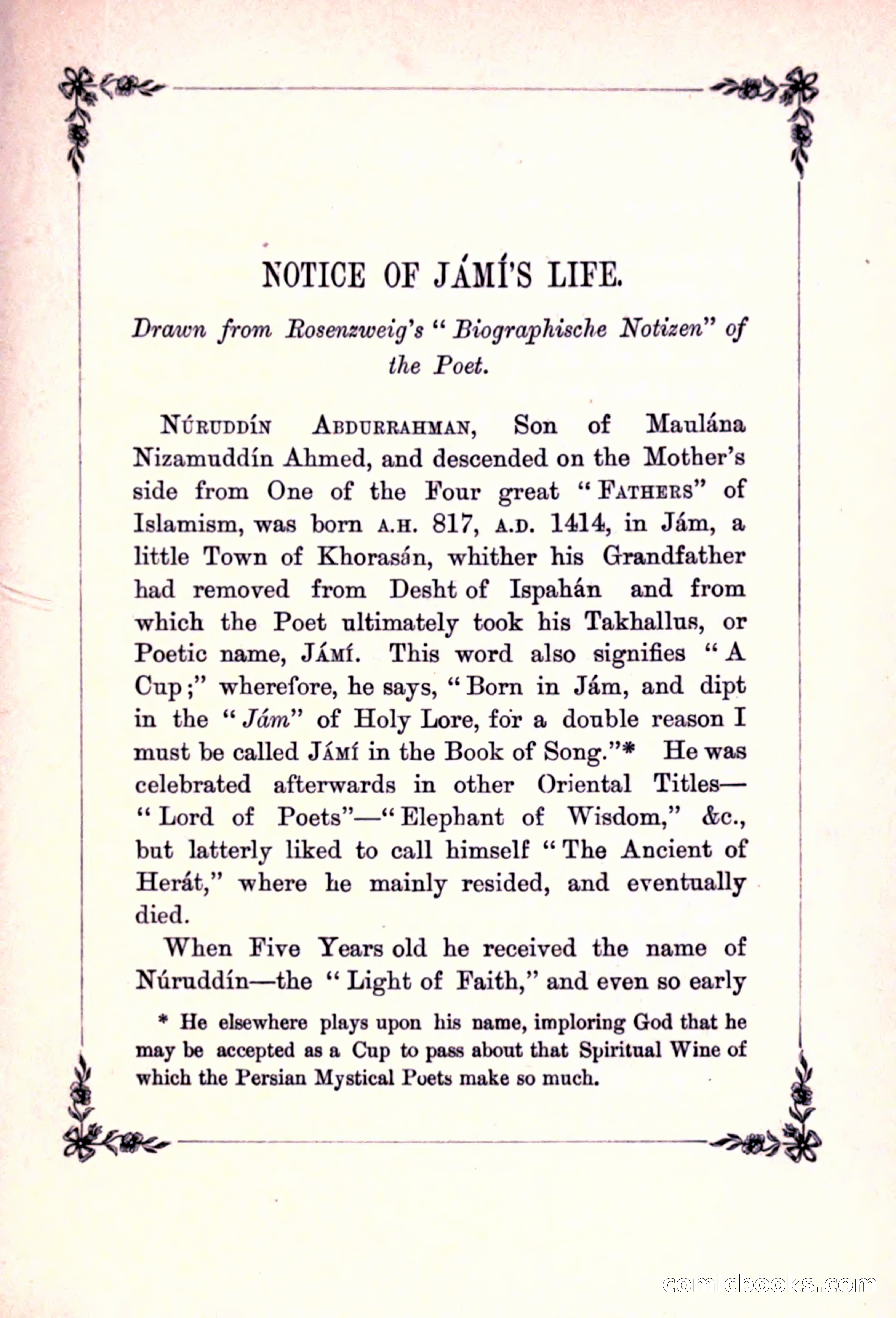
# What This Page Contains This is a biographical notice page, not a title page or illustration. It presents a prose biography of Jámi (full name Núruddin Abdurahman), drawn from Rosenzweig's "Biographische Notizen." The text covers Jámi's birth in 817 A.H./1414 A.D. in the town of Jám in Khorasan, his descent from Islamic founders, the etymology and spiritual significance of his poetic name, his various honorific titles ("Lord of Poets," "Elephant of Wisdom," "The Ancient of Herát"), and notes that he received the name Núruddin ("Light of Faith") at age five. A footnote explains wordplay Jámi made regarding his name's connection to spiritual wine in Persian mystical poetry.
# This page from a Victorian biography or historical narrative contains running prose describing formative childhood experiences of someone named Jámi. The text recounts two separate encounters: first, when five-year-old Jámi received a nosegay from a dying Sheikh in 1419, and second, when Maulana Fakhruddin Loristani taught him letters and inspired his religious devotion. The passage emphasizes spiritual awakening and the lasting impact of these early meetings on Jámi's later religious commitment to Dervish practice. The text breaks off mid-sentence, continuing the narrative.
# Page Analysis This is a page of running prose narrative from "Notice of Jámi's Life," page 41. The text describes Jámi's education at a school founded by Timur in Samarkand, where he excelled in Persian studies and impressed his teachers. A spiritual vision from the Sufi master Mohammed Saaduddin Kashghari summons him to Herat, where the Sheikh recognizes him as a promising disciple ("a Falcon in my Snare"). The passage concludes by noting Jámi's devoted studies under this master, illustrating his dedication with a poetic line about being lured back from holiday. The page features decorative corner ornaments typical of Victorian-era printing.
# Page Description This is a page of running prose (page 42) from what appears to be a biographical narrative titled "Notice of Jámi's Life." The text describes Jámi's spiritual withdrawal and training as a Sufi, his reluctance to teach publicly until late in life, and his subsequent fame as a poet. The passage includes a lengthy quotation in which Jámi reflects on his poetic reputation, claiming his verse has been celebrated by Persian and Indian poets and that kings and lords have sought his favor. The text is framed by decorative floral ornaments in the corners typical of Victorian printing.
This is a page of running prose from the body text of a Victorian penny dreadful, numbered page 43. Titled "Notice of Jámi's Life," it discusses the Persian poet Jámi's relationships with various historical princes and rulers, then recounts that in A.H. 877 (A.D. 1472) Jámi embarked on a pilgrimage to Mecca, during which he and his caravan were safely escorted through neighboring countries by order of several princes. The text emphasizes Jámi's honor among competing rulers and sets up an account of events connected to his life.
This is a page of running prose narrative from what appears to be a biographical work titled "Notice of Jami's Life" (page 44). The text describes the poet Jami's travels and troubles: his controversy in Baghdad over a misquoted verse disparaging Ali, his pilgrimage to holy Islamic sites including Najaf and Mecca, and his subsequent journey homeward through Damascus, where he narrowly missed envoys from the Turkish Mohammed who came with 5000 Ducats to summon him to Constantinople. The passage combines historical narrative with romanticized detail about Jami's spiritual devotion.
# Page Analysis This is a running prose page (page 45) from a biographical narrative titled "Notice of Jámi's Life." The text describes the Persian poet Jámi's travels and homecoming: after encountering war in Mesopotamia, he returns to Herat in 1473 at age sixty to see his aged mother. The passage identifies Hasan Beg (described as "Handsome" by Venetian ambassadors) as the father of Jámi's patron, and recounts how Jámi was received at home by Husein Mirza Baikara, where the vizier Nizamuddin Ali Shir had welcomed him in verse. The ornamental border and page number indicate this is from a formally printed Victorian edition.
# Page Analysis This is a page of running prose text (page 46) from what appears to be a biographical or historical work titled "Notice of Jámi's Life." The text describes the death and burial of Jámi, an Islamic poet and philosopher, who died in 1492 at age eighty-one. It details his final illness, his funeral arrangements ordered by Sultan Husein, and the monument erected in his memory in Herat. The passage also notes Jámi's veneration as a saint and recounts an anecdote about an Arab who falsely accused him and subsequently died, allegedly fulfilling Jámi's prediction. The text references historian Rosenzweig as a source.
# Page Description This is a page of running prose (page 47) from what appears to be a scholarly or annotated edition. The text is a biographical notice about Jámi, a Persian poet and scholar. It describes an anecdote about his death (allegedly from a horse bite causing lockjaw), explains Persian numerological systems for commemorating dates, and provides biographical details about his family—particularly that he had one wife and four sons, three of whom died in infancy. The page includes references to scholarly sources like Rosenzweig and Ouseley, and mentions Jámi's famous work "Beharistan."
# Page Description This is running prose from a biographical notice about the Persian poet Jámi. The page recounts how Jámi encouraged his nephew Maulána Abdullah to pursue poetry, beginning with an imitation of Firdusi's work, and subsequently wrote the opening couplet of his celebrated poem *Laila and Majnun*. The text goes on to enumerate Jámi's literary output, citing Rosenzweig's count of forty-four works and Shir Khán Lúdi's claim (via Ouseley) that he authored ninety-nine volumes of grammar, poetry, and theology admired throughout the Eastern world.
# Analysis of Page 49 This is a running prose page from what appears to be an introduction or critical preface (titled "NOTICE OF JÁMI'S LIFE"). The text discusses Jámi's literary works, particularly three poems—"Yúsuf and Zulaikha," the "Beharistan," and "Salámán and Absál"—which the author describes as among Jámi's seven best mystical poems, grouped under the name "Heft Aurang" (Seven Thrones). The page explains how these poems are known in Eastern tradition but appear diminished in English translation, and notes that "Salámán" functions as an allegory through which Persian mystics symbolized esoteric concepts. The decorative borders and typography are characteristic of Victorian-era literary editions.
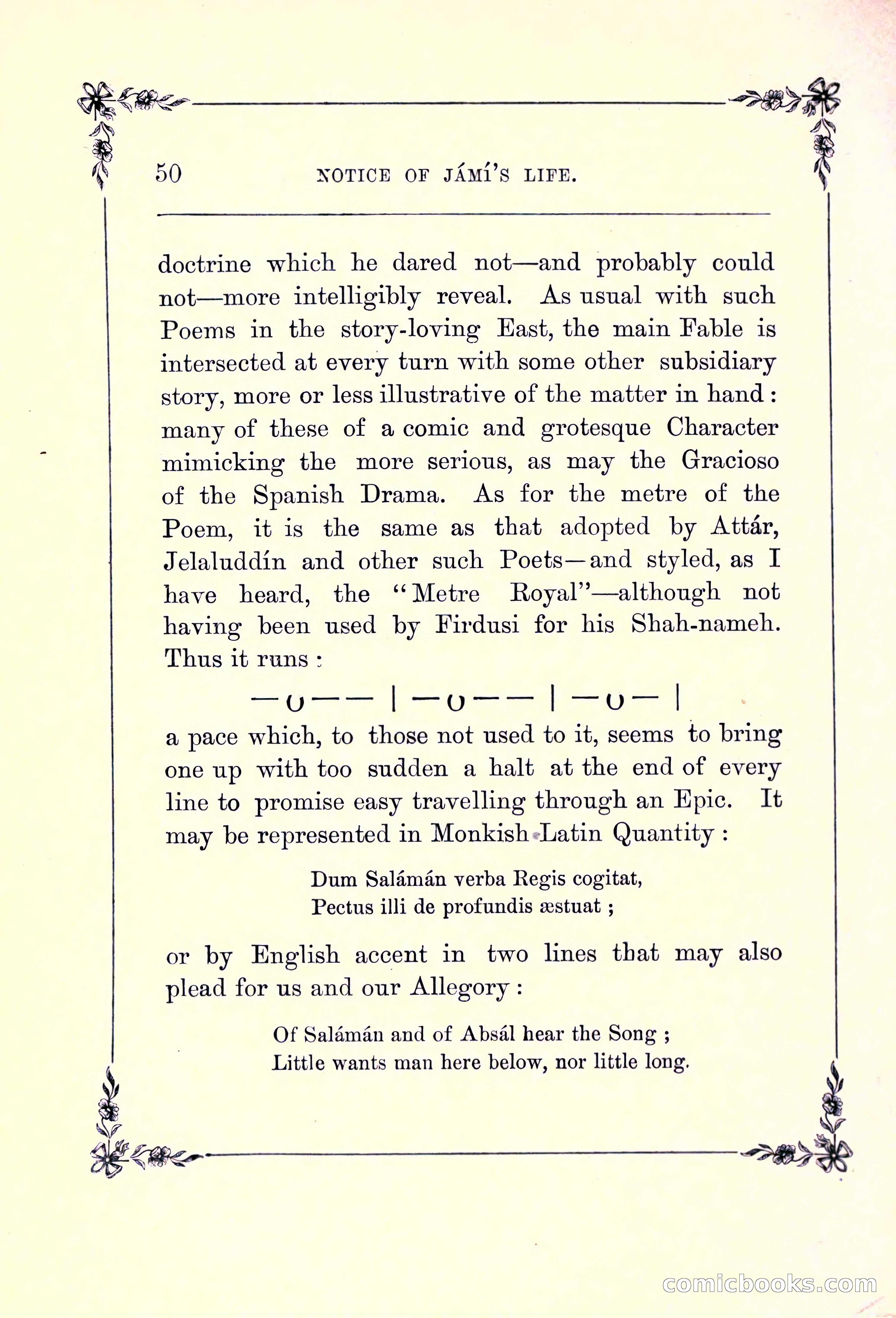
This is a page of running prose from the middle of a book (page 50). It is part of an introductory or critical essay titled "Notice of Jami's Life," discussing the structure and poetic meter of an Eastern literary work. The text explains that the poem intersperses a main narrative with subsidiary stories in comic and grotesque style, uses the "Metre Royal" employed by poets like Attar and Jelaluddin, and provides examples of the meter's pattern in Latin and English verse forms to illustrate how the rhythmic structure functions.
This is a text page from a Victorian penny dreadful titled "Salaman and Absál," presenting a "Preliminary Invocation"—an ornate poetic prayer in blank verse. The invocation appeals to a divine spirit to kindle love and beauty in mortal hearts, specifically naming characters Laila, Majnún, and Shírín (identified in a footnote as "well-known Types of Eastern Lovers"). The poem treats love and beauty as divine manifestations, with human passion described as ecstatic response to the divine revealed through mortal form. The decorative border and page number (5*) indicate this is early in the serialized narrative.
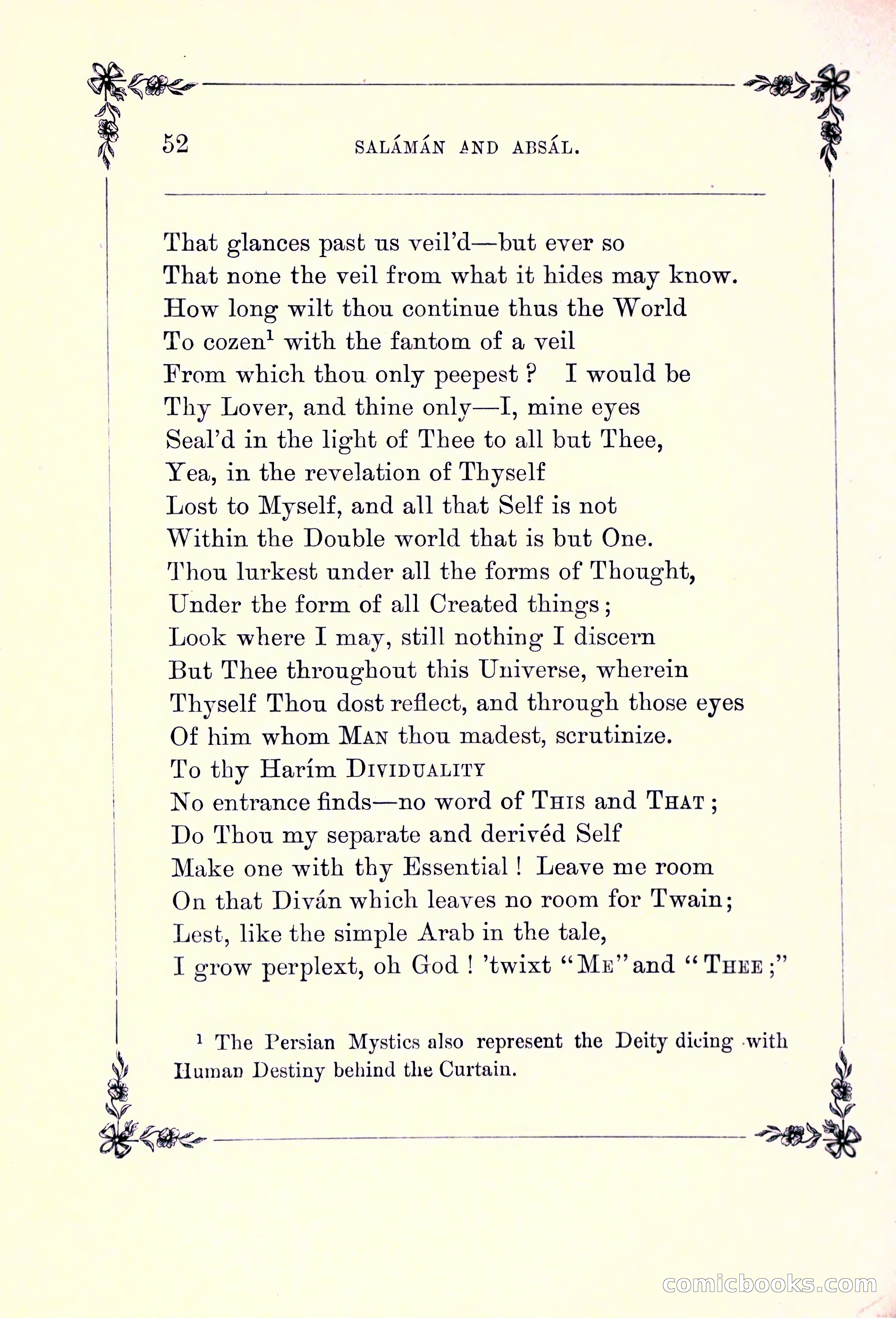
# Page Description This is a page of running poetry text from what appears to be a literary work titled "Salaman and Absal" (page 52). The verse, written in ornate Victorian language, presents a mystical meditation on divine unity and human love, addressing God or a beloved figure. The speaker expresses a desire to merge their individual self with an Essential or Divine being, invoking Persian mystical concepts of unity and dissolution of ego. A footnote references Persian mystics' representation of Deity. The ornamental borders and typography suggest this is from a bound Victorian edition rather than a cheap serialized penny dreadful.
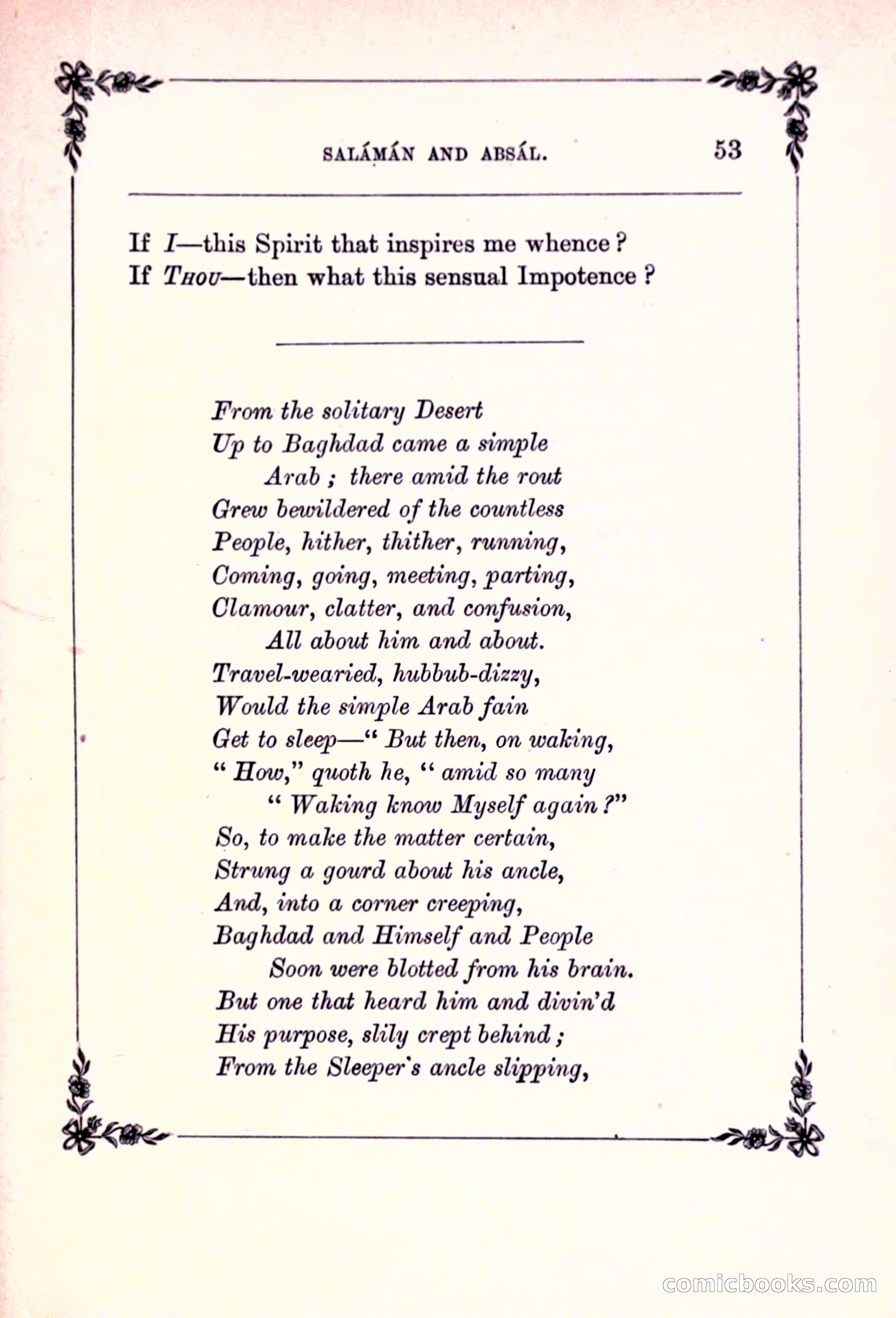
# Page Analysis This is a running prose page (page 53) from what appears to be a poetic narrative or literary work titled "Salaman and Absal." The page presents verse in italics describing a simple Arab who arrives bewildered in Baghdad's crowded chaos. Unable to sleep amid the confusion, he ties a gourd around his ankle as a means of self-identification, then creeps into a corner to sleep. The text concludes with someone overhearing his purpose and secretly approaching to remove the gourd from his sleeping ankle. The passage explores themes of identity and self-recognition through a narrative anecdote.
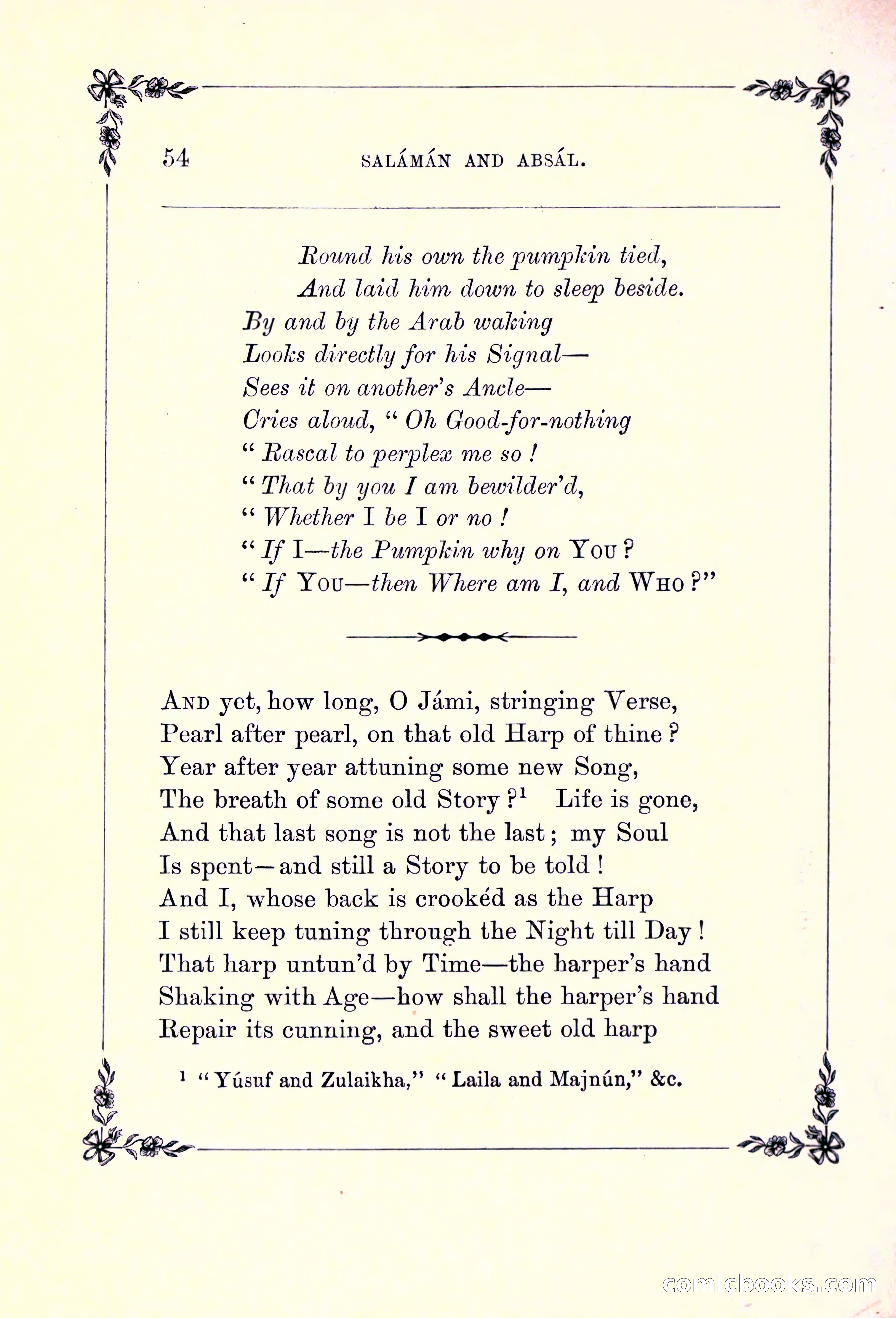
# Page Analysis This is a page of running prose poetry from what appears to be a Victorian literary work titled "Salámán and Absál" (visible at the top). The page contains two distinct poetic passages: the first narrates an Arab waking and discovering a signal (a pumpkin) tied to another's ankle, leading to an existential lament about identity; the second is a direct address to "Jámi" reflecting on a lifetime of stringing verses together "pearl after pearl" on a harp, with the speaker acknowledging that though life is spent, stories remain untold. The text employs elaborate metaphors comparing poetic composition to harp-playing worn by age and time.
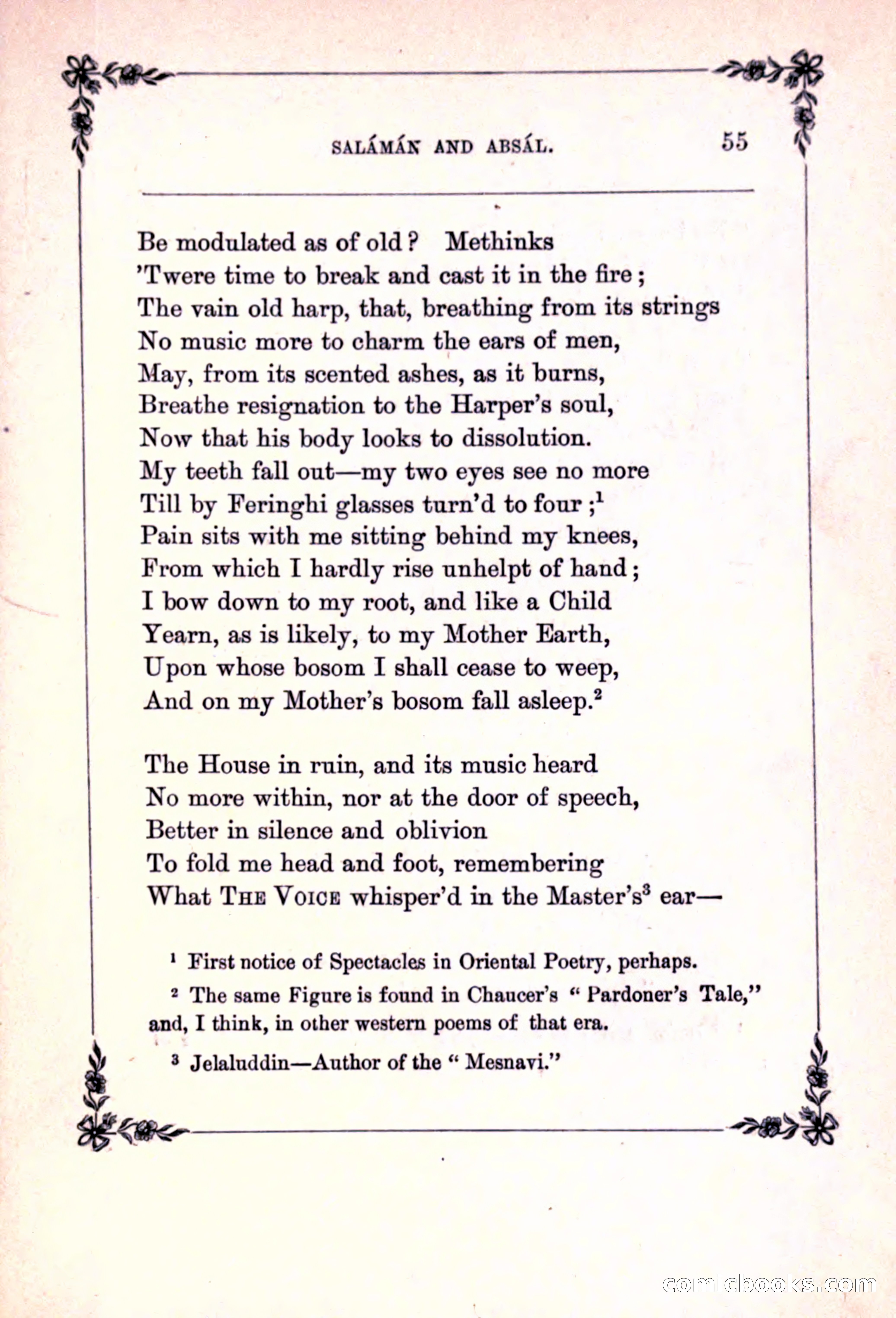
# Page Description This is a text page (page 55) from what appears to be a Victorian-era literary work or anthology titled "Salámán and Absál." The visible text consists of poetry in English translation, featuring an aged speaker lamenting physical decay—falling teeth, failing eyesight, bodily pain—and expressing a desire for death and return to "Mother Earth." The passage includes scholarly footnotes identifying references to spectacles in Oriental poetry, Chaucer's work, and attributing the piece to Jelaluddin, author of the "Mesnavi." The page has decorative floral borders typical of Victorian printing.
This is a page of running prose poetry from what appears to be "Salaman and Absal" (page 56). The text consists of philosophical verse addressed to a divine figure, urging the speaker to abandon thoughts of worldly "Rhyme" and contemplate God instead. The passage reflects on mortality, divine authority, and the speaker's final creative effort before age takes hold. Below the main poem, italicized lines introduce a scene of someone traveling in the desert who encounters a figure named Majnun tracing letters in sand—an allusion to a distracted lover. A footnote references Yakub Beg and mentions Jámi's gratitude.
# Page Analysis This is a text page from the narrative body of the work, featuring a poetic passage. It contains what appears to be a quoted response from a character named Majnûn, explaining that he writes only for himself and for someone named Laila. The passage is romantic in tone, describing how he contemplates her name and imagines drinking from her lips. The page is framed with decorative floral corner ornaments typical of Victorian book design. No illustration is present—only formatted verse text with minimal narrative context visible.
# Description This is a prose narrative page from what appears to be a Victorian literary work titled "Salaman and Absal" (page 58). The text, presented in verse form, begins "Part I" of "The Story" and recounts a legendary tale: a Shah ruled the realm of Yun wearing the Ring of Empire of Sikander, and during his reign a wise Sage of great insight attracted scholars from across the world. The Shah, observing this, took the Sage into his confidence, and under the Sage's counsel—granted divine sanction—the Shah's dominion expanded from Kaf to Kaf, with all peoples and princes bowing to him in battle and rising peacefully under his just rule. Footnotes provide historical context, identifying Yun/Younan as Persia's name for Greece and Sikander as Alexander the Great.
This is a text page from a Victorian literary work titled "Salámán and Absál" (page 59). The page contains verse poetry presented in multiple sections: an opening stanza criticizing a shah lacking wisdom, followed by a quoted divine speech to the Prophet David about just rulership, and finally the beginning of a narrative passage describing the Shah of Yúnan contemplating his empire at night. The ornamental border and typography indicate this is from a serialized literary publication rather than sensational penny dreadful material.
# Analysis This is a page of running prose from what appears to be a literary work titled "Salámán and Absál" (page 60). The text presents a monologue in which a ruler addresses a Sage, expressing his desire for a son to inherit his empire and continue his legacy. The ruler eloquently describes the blessing of having a son—as an heir, a companion in battle, a source of counsel, and a means of extending his name and influence beyond his own lifetime. A footnote identifies classical references (Plato, Aristotle) and mentions "Ten Intelligences." The passage concludes with a transitional line indicating the Sage is about to respond. This appears to be Victorian-era poetry or poetic drama rather than sensation fiction.
This is a page of running prose poetry from what appears to be a narrative work titled "Salámán and Absál" (page 61). The text contains two distinct passages: first, a moral commendation warning against evil sons, using the biblical example of Noah's son to caution against requesting children from Allah; second, a poetic scene depicting a childless man pleading desperately before a saint, begging Allah to grant him a son described as a "fresh young Cypress." The passages blend Islamic religious references with poetic language about parenthood, loss, and divine will. A footnote directs readers to an appendix for further explanation.
# Page Description This is a page of running prose poetry from "Salaman and Absal," presenting a narrative dialogue. A Dervish responds to a man's desperate plea for help by miraculously summoning a boy—described as "a musky Fawn of China"—who becomes a wayward youth addicted to drinking, gambling, and violence. The passage describes the boy's scandalous behavior in the city (insulting women, drawing daggers, brawling) and notes that despite the city's talk and the father's attempts at counsel and threats, nothing moves the boy until his "desperate Father" (the passage cuts off here). The text appears to illustrate a moral tale about parental suffering and a child's depravity.
This is a page of running prose poetry from what appears to be a narrative work titled "Salámán and Absál" (page 63). The text presents two contrasting passages: first, a Dervish (Islamic holy man) desperately pleading with a Saint for prayer to relieve his troubles, and the Saint's cautionary reply against blind petition to Allah; second, a moralizing speech apparently addressed to a Shah, warning against slavery to appetite and the corrupting effects of intoxicating drink, which the speaker suggests becomes a "noose to draw the Crown." The page is formatted as poetry with quotation marks indicating dialogue.
This page contains running prose poetry from a work titled "Salámán and Absál" (page 64). The text presents a man's bitter monologue denouncing Woman as foolish and faithless, describing how despite lavishing her with luxuries and affection, she will forget him instantly if he leaves her sight or if a younger lover appears. The passage concludes with a transition to a scene where "Sulayman and Balkis" sit together on a throne sharing secrets. A footnote identifies these figures as Solomon and the Queen of Sheba, suggesting the work draws on Islamic or Eastern literary tradition.
# Page Description This is a page of running prose poetry from a Victorian penny dreadful titled "Salámán and Absál" (page 65). The text presents dramatic dialogue in italicized verse, wherein a King of Farth named Sulayman speaks about his criteria for suitors, followed by a character named Balkis responding with her own confession about admiring comely youth. The passage concludes with a narrative section explaining that "the Shah," having resolved upon his purpose and consulted "Supreme Intelligence" and "Magic-mighty Wisdom," accomplishes his will, resulting in the birth of a child "of carnal composition unattaint." The page contains ornamental borders typical of period publications.
# Page Analysis This is a page of running poetic text (page 66) from a work titled "Salaman and Absál." The verse describes the birth and nurturing of a royal child named Salaman, whose names (combining "Salamat"—Security from Evil—and "Asmán"—Heaven) are explained in a footnote. The poem details how a young nurse named Absál is chosen to feed and care for the infant prince, becoming so devoted to him that she closes herself off from the world, existing only to tend to "her Royal jewel" in his golden cradle. The text is ornate and allegorical in style, employing elaborate metaphors of jewels, perfume, and beauty typical of Victorian literary translations.
This is a page of running prose poetry from page 67 of a work titled "Salaman and Absal." The text describes a woman's devoted care of a beautiful young boy over seven years, detailing her lavish preparations—washing him in rose and musk, adorning him with cosmetics and jeweled garments, and continuing to nurture him into his fourteenth year. The passage employs ornate, sensual language typical of Victorian literary translations, with footnotes providing etymological and textual references to clarify terms like "Mardumak" (pupil of the eye) and directing readers to an appendix.
# Page 68: Running Prose from "Salaman and Absal" This page contains running prose poetry describing Salaman's prowess in athletic competition. The text describes how Salaman, despite his youth, wounded every opponent and shone brilliantly; after the Lord of Heaven rode into the blue field, Salaman mounted a fiery horse and joined a troop of young princes for a game involving a golden ball on the Maidan (a field). Though all competed equally, Salaman consistently won the prize, shouting "Ha!" to drive the ball home. The passage concludes with Salaman then turning his talents to archery, learning from master craftsmen. Two footnotes reference Persian etymology and an appendix.
This is a page of running poetry text from what appears to be a narrative poem titled "Salámán and Absál" (page 69). The visible verses describe a skilled archer shooting with perfect precision, then depict the same figure's evening entertainments—playing chess, hosting a banquet with musicians, and playing stringed instruments like a harp and lute after drinking wine. A scholarly footnote below explains the historical practice of bow-stiffening among archers, citing an old translation of Chardin.
# Page 70: Running Prose from "Sai'aman and Absal" This is a page of running verse text, page 70 of what appears to be a poetic work titled "Sai'aman and Absal" (visible in the header). The text describes a character's accomplishments in music, wit, verse composition, writing, and generosity—comparing his bounty to a fathomless sea that produces jewels and pearls. A footnote references classical astronomical imagery (the Pleiades and Great Bear) and quotes from the "Anvari Soheili." The ornamental borders and typography suggest this is from a Victorian-era literary publication, though this does not appear to be a penny dreadful but rather a more elevated poetic work.
This is a page of running prose poetry from what appears to be a Victorian literary work titled "Salámán and Absál." The text presents a dramatic dialogue in verse, where a speaker is rebuked by an "inward Voice" for writing in celebration of an earthly shah, then responds with an elaborate defense invoking a eternal, divine power whose authority extends over "the Kingdoms Sev'n of this World, and the Seas, / And the Sev'n Heavens." The passage concludes with a stage direction indicating "Sate a Lover in a garden / All alone, apostrophizing," and a footnote clarifies that the story's hero is from Yunan-Ionia (Greece) rather than Persia.
# Page Description This is a running prose page from what appears to be a narrative poem. The page contains two distinct passages: the first is dialogue in which a lover explains that natural imagery (sun, moon, hyacinth, roses) symbolize his beloved lady, and a "Noodle" questions how these relate to love. The second passage describes how Salaman has reached full maturity and beauty, while Absal—described as the fairest among her companions—longs to "gather from the tree," suggesting an imminent encounter or romantic development. The text employs ornate Victorian poetic language and appears part of a longer romantic narrative titled "Salaman and Absal."
# Page 73: Running Prose from "Salaman and Absal" This is a page of poetic text from a work titled "Salaman and Absal" (page 73). The passage describes a woman using seductive "sorcery" and physical allure—darkening her eyes with surma (kohl), curling her hair, rouging her cheeks, and strategically displaying her silver-veined arms and golden anklets—to ensnare a beloved man's heart "by innumerable witcheries." The poem employs elaborate, sensual language typical of Victorian literature, with footnotes referencing cosmetic practices and a French phrase. The text appears to be poetry rather than penny dreadful prose, suggesting this may be from a more literary work despite appearing in a cheap serialized format.
# Page Description This is a page of running prose poetry from what appears to be a Victorian literary work titled "Salámán and Absál." The page contains two distinct poetic passages: the first a brief three-line stanza about seduction, followed by a longer italicized poem describing how a woman named Zulaikha builds a mirror-lined chamber to surround a man named Yúsuf with her image, then summons him and removes her veil to tell him a tale of love. Throughout the passage, Yúsuf cannot escape seeing Zulaikha's reflection wherever he looks. The text is ornately formatted with decorative floral borders typical of Victorian printing.
This is a page of running prose from what appears to be a narrative poem or dramatic work titled "Salámán and Absál" (page 75). The visible text describes a moment of temptation and spiritual resistance: a voice from Canaan calls to someone, a hand from darkness touches them, and though they are nearly seduced by bewildered eyes and a mirage, they ultimately recoil and escape danger. The ornamental borders and centered verse formatting are typical of Victorian-era book design. The content suggests a moral or religious narrative involving supernatural temptation.
This is a text page from "Salámán and Absál," Part II, containing romantic poetry about forbidden love. The visible text describes lovers intoxicated by each other's kisses, with Heaven's intervention warning against their passion, followed by the beginning of a narrative poem about a poor Arab who enters the Khalifah's banquet chamber in Baghdad where Harún the Great sits at supper. The page is ornamentally framed with decorative flourishes and appears to be standard running prose rather than a title page or illustration.
This is a page of running prose poetry from what appears to be a Victorian narrative poem titled "Salámán and Absál" (page 77). The text depicts a dramatic scene in which a famished man swallows food before a perfumed pastry and swears an oath to a figure called Khalifah, invoking Baghdad. Another character, Harún, dismisses him harshly. The passage then shifts to describe how Salámán and Absál rejoiced together for a year while others avoided the Shah's presence, until the truth of some unspecified matter is revealed and the Shah and Sage respond with physical action ("struck out with hand and foot in his redress").
# Page Description This is a page of running prose poetry from page 78 of what appears to be a literary work titled *Salaman and Absal*. The text consists of two poetic passages: the first discusses Reason as the supreme guide and fountain of prophetic wisdom, and the second presents The Shah addressing his son Salaman, urging him not to waste his royal potential and suggesting that his proper occupation should be riding and managing a horse named Rakhsh in the field. A footnote identifies Rakhsh as Rustam's famous horse from the Shah-Nameh (the Persian epic). The page is decorated with ornamental floral borders and includes a small decorative divider between the two sections.
This is a page of running prose poetry from a Victorian edition of "Salaman and Absal," a Persian literary work. The visible text consists of quoted verse (appears to be a dramatic monologue or parable) followed by explanatory footnotes. The quoted lines address themes of love, honor, and submission, with references to Persian figures like Zal and Rustam. Below the main text, footnotes identify characters from Persian history—specifically Kai Khusrau and his father Noshiravan—and note that this passage was "declared" as a parable when the father fell before his son's dagger. The page is ornately bordered with decorative floral elements typical of Victorian printing.
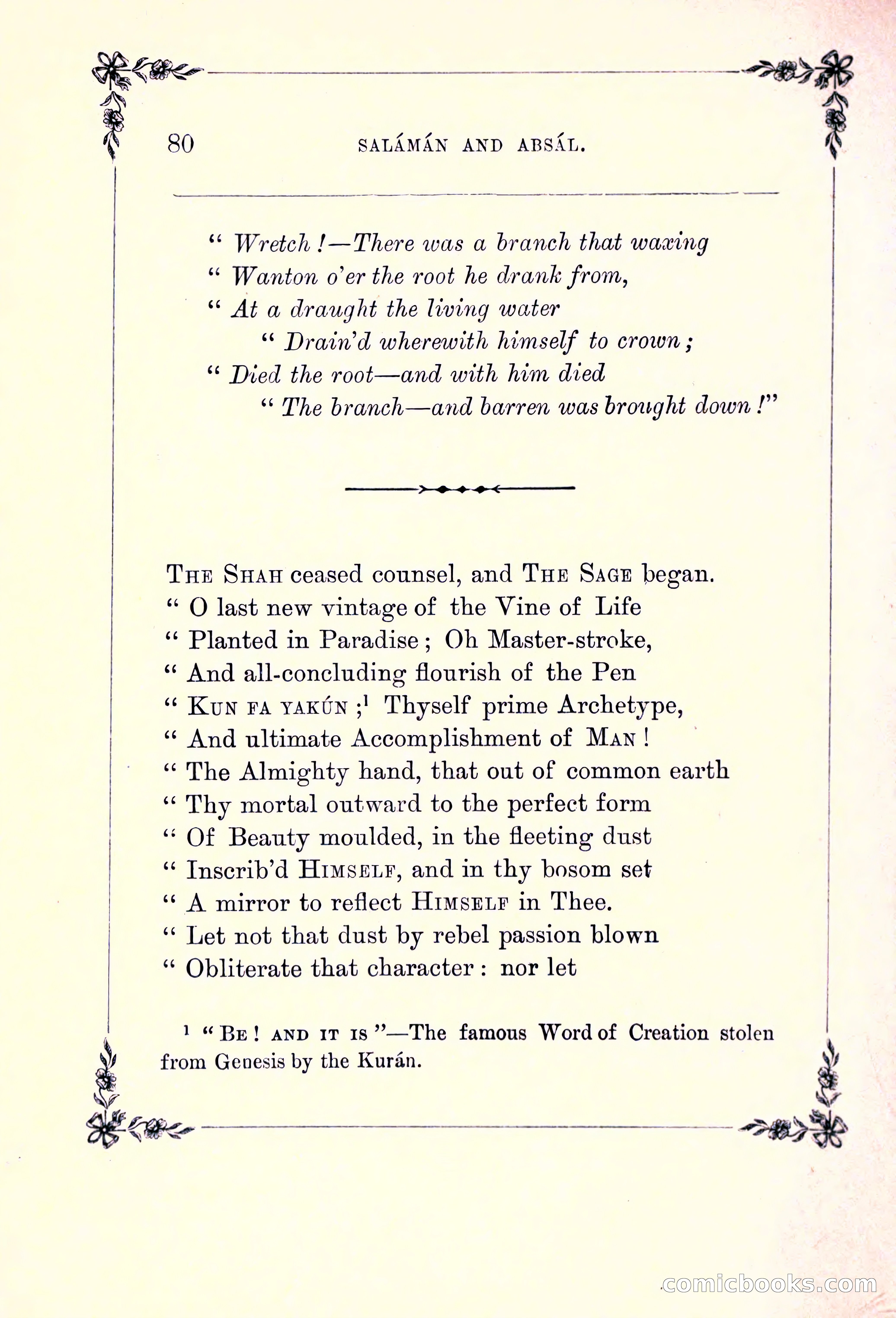
This is a page of running prose from what appears to be a poetic narrative work titled "Salaman and Absal" (page 80). The text presents two speakers—first "The Shah" delivering a cautionary tale in verse about a branch and root that died together, then "The Sage" beginning an elaborate philosophical address praising human creation as the "ultimate Accomplishment of Man" and warning against letting "rebel passion" corrupt the divine character inscribed in humanity. A footnote references the Quranic "Word of Creation." The page contains decorative borders and ornamental flourishes typical of Victorian book design.
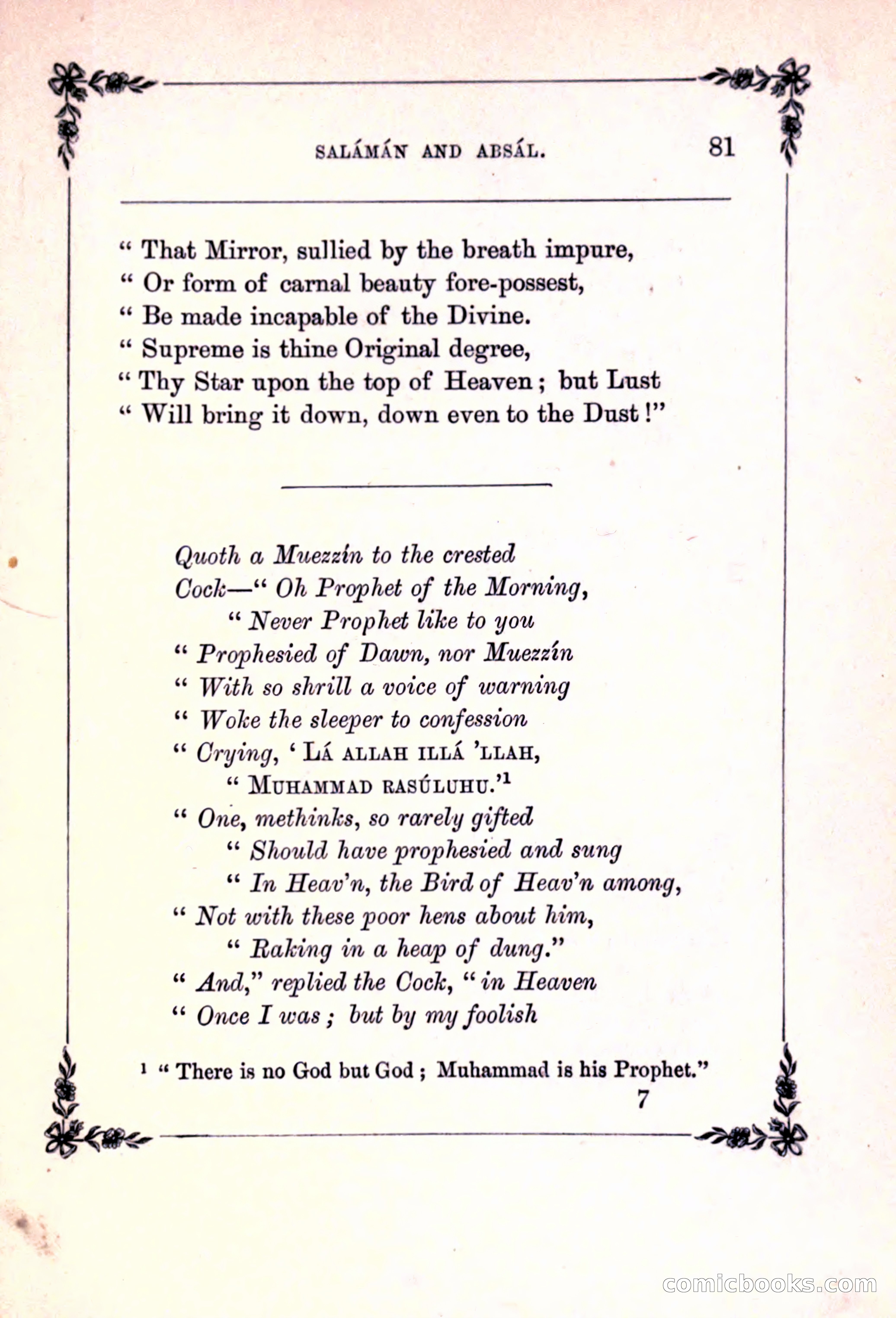
This is a page of running prose poetry from what appears to be a narrative work titled "Salámán and Absál." The visible text consists of quoted verse dialogue between a Muezzin (Islamic prayer-caller) and a rooster, discussing divine matters and the rooster's fallen state. The passage employs religious and mystical language, including Islamic phrases like "Lá Alláh Illá 'lláh" and references to the rooster's former celestial status. The poetry explores themes of spiritual degradation through earthly temptation, with the rooster lamenting its reduced circumstances among "poor hens" and "dung." The page number indicates this is mid-narrative rather than an opening.
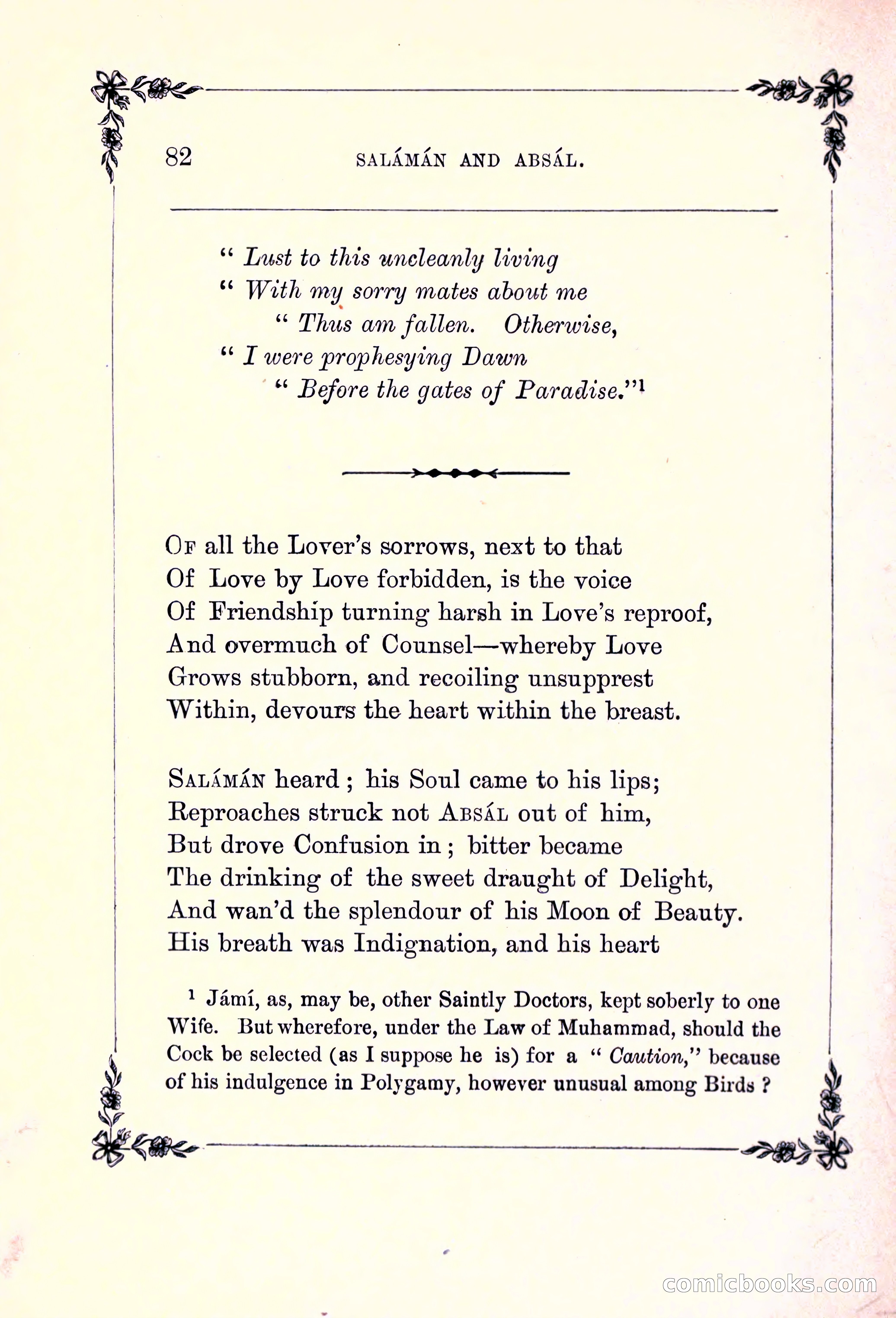
# Page Analysis This is a running prose page (page 82) from what appears to be a poetic narrative titled "Salaman and Absal." The visible text consists of quoted dialogue about fallen lust and paradise, followed by philosophical reflection on love's sorrows—specifically how harsh friendship and excessive counsel can embitter love and cause inner turmoil. The passage describes how the character Salaman heard these words, became confused rather than reproached, and lost his joy. A footnote queries Islamic law regarding the Cock as a symbol of caution for polygamy. The work appears to be a literary/allegorical poem rather than typical penny dreadful sensation fiction.
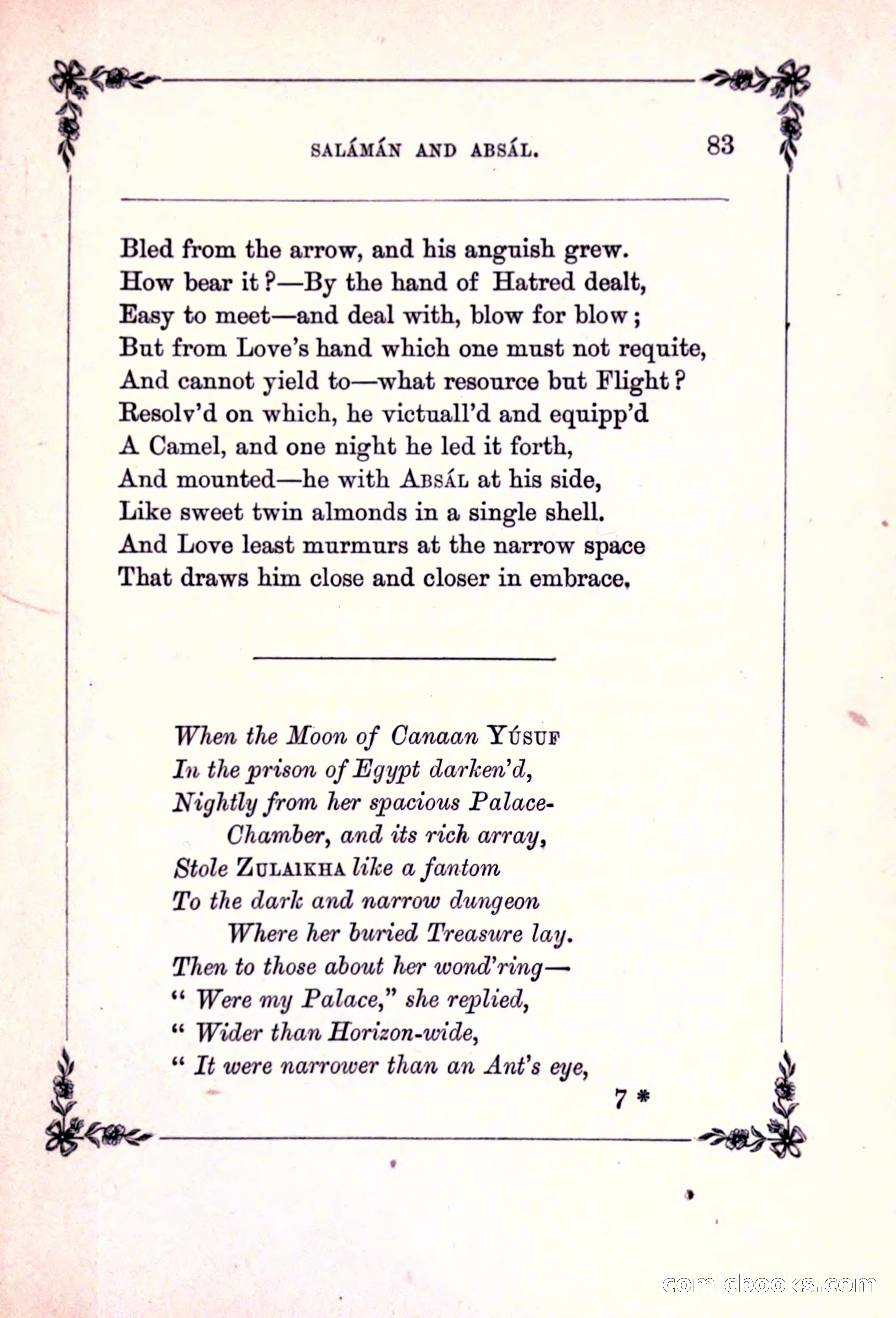
This is a page of running verse poetry from a Victorian penny dreadful titled "Salaman and Absal" (page 83). The text depicts romantic and dramatic scenes: a wounded man fleeing with his beloved Absal on a camel, described as "like sweet twin almonds in a single shell," and a separate passage about the Moon of Canaan Yusur stealing away from her palace prison in Egypt to reach her buried treasure, declaring that even a palace wider than the horizon would be narrower than an ant's eye if it separated her from her love. The page combines orientalist themes with melodramatic sentiment about love and sacrifice.
This is a page of running prose—specifically poetry—from what appears to be a literary narrative titled "Salámán and Absál." The text describes Salámán's six-day camel journey culminating at a seashore, where he encounters a vast sea described through elaborate metaphorical language comparing it to rolling mountains and troops of camels. A footnote references Islamic philosophical cosmology from Attar's *Pendnamah*, explaining the metaphysical layers supporting the earth. The page number is 84, and the decorative border indicates this is from a bound collection rather than a penny dreadful serialization.
This page contains running prose poetry from a work titled "Salámán and Absál" (page 85). The text describes Salámán constructing a crescent-shaped vessel from scented woods and sailing away with Absál across the sea, using elaborate imagery comparing their departure to celestial bodies. A footnote explains Eastern astronomical mythology regarding the Sidereal Dragon and its relation to lunar nodes, citing Sir W. Jones's scholarly works. The page appears to be from a Victorian-era literary publication, likely a serialized edition of this romantic or mystical narrative.
This is a page of running prose poetry from what appears to be a Victorian literary work titled "Salámán and Absál." The text describes two characters, Salámán and Absál, discovering a paradisiacal island in the sea—a magnificent garden filled with ornamental birds (peacocks, nightingales, pheasants, doves), fruit trees, and fountains. The passage employs elaborate poetic language comparing the scene to Paradise and an Islamic garden, before concluding that Salámán sees the isle and sits down beside Absál "together like the Lily and the Rose." The page is numbered 86 and includes a footnote reference to an appendix.
# Penny Dreadful Page Analysis This is a text page from the narrative portion of a Victorian penny dreadful, specifically from a work titled "Salámán and Absál." The page presents romantic poetry or prose-poetry describing two lovers in an idealized paradise—together under trees, drinking from fountains, and surrounded by exotic birds and flowers. The text then shifts to a dialogue in which someone questions a character named Wámik about his solitary, melancholic behavior, and Wámik responds that he is meditating on flight with a beloved named Azrá to a remote desert fountain. Footnotes identify Wámik and Azrá as "two typical Lovers." The content emphasizes romantic longing and separation.
# Page 88 of "Salaman and Absal" This is a text page from a Victorian narrative poem or tale. It opens with an italicized lyrical passage about undivided being and transcendent love, followed by prose verse describing the Shah's despair upon learning of lovers' flight and his pursuit through magical means. The Sage-Vizyr creates a magic mirror to aid the search, described as resembling "the bosom of All-wise Intelligence." The page appears to be mid-narrative, advancing a romantic plot involving pursuit and supernatural intervention.
# Page Content This is a text page (page 89) from what appears to be a poetic narrative titled "Salaman and Absal." The passage describes a figure called "the Shah" gazing into a magical mirror where he beholds two lovers in a distant paradise. Moved by compassion upon witnessing their happiness, the Shah hesitates in his intention to strike them down, ultimately pausing to allow them opportunity for repentance. The page includes Greek text in a footnote and an explanatory note about a pebble-in-cup signal, suggesting this is verse—possibly a translation of classical or Eastern literature—rather than typical penny dreadful sensationalism.
# Page Analysis This is a prose page from running narrative text, numbered 90, titled "SALÁMÁN AND ABSÁL." The visible text is a poetic passage describing tragic events involving characters named Farhád, Shírín, and Khusrau—apparently a tale of jealousy, poisoning, and violent retribution. A footnote below explains an alternate version of Farhád's story, claiming he attempted to cut through a mountain to win Shírín, only to be deceived into believing she was dead, whereupon he threw himself from a rock. The page notes that a sculpture at Beysitún was traditionally attributed to Farhád.
This is a page of running prose poetry from page 91 of what appears to be a Victorian literary work titled "Salámán and Absál." The text describes a narrative involving THE SHAH observing his son Salámán lost to desire for a woman, leading the Shah to use magical power against this "rebellious lust." Despite magical intervention, Salámán cannot reach his beloved; the passage concludes with him in anguish until "the door of Mercy open'd" and he perceives his Father's arm reaching to lift him from "the pit in which he lay." The content appears to be allegorical or mystical in nature rather than typical penny dreadful sensationalism.
# Page 92 of "Salámán and Absál" This is a page of running prose poetry from what appears to be a literary work titled "Salámán and Absál." The text consists of poetic verses in italics, featuring a dialogue between a student and a Teacher about how a father might recognize his reputed son as he matures. The Master responds with an extended parable comparing a son's resemblance to his father with the way darnel (a weed) grows among wheat in a field—appearing indistinguishable until harvest, when its true nature is revealed. The passage emphasizes how character emerges over time, whether "Good or Evil, Fool or Wise."
# Page Description This is a text page (page 93) from a Victorian narrative poem titled "Salámán and Absál." The passage is written in verse and describes the tragic fate of a lover named Salámán who, forbidden from his beloved, experiences mounting despair and eventually flees with his companion toward death. The text employs romantic, ornate language typical of Victorian poetry, depicting themes of forbidden love, remorse, and a final escape described metaphorically as a journey through fire. The page contains no illustrations, only decorative corner ornaments framing the printed text.
# Page 94: Running Prose from "Salaman and Absal" This is a page of running verse text from a work titled "Salaman and Absal." The passage describes a dramatic scene in which a character devises a plan involving fire and annihilation. Two figures—Salaman and a female character (referred to as "Her")—enter a central flame together, but a Sage has secretly orchestrated events so that the flame, guided by divine will, reduces the woman to ashes while leaving Salaman untouched. The final lines employ alchemical or metaphorical language, suggesting that base metals burn away while "authentic Gold" is purified and returned to itself. The page includes decorative ornamental elements typical of Victorian printing.
# Page Analysis This is a running prose page from Part III of a narrative poem titled "Salámán and Absál." The text presents verse describing the creation of Man from earth and tears, followed by a dramatic scene where a character named Salámán fires a pile that consumes another character named Absál "like straw." The passage describes Absál's death as a separation of divided self from individual soul, ending with his cry to Heaven. A footnote indicates the legend derives from Quranic commentaries by De Sacy and D'Herbelot. The page number is 95, suggesting this is mid-narrative in a longer work.
# Page Content Analysis This is a page of running poetry text (page 96) from a work titled "Salámán and Absál." The verse describes a grieving male figure (Salámán) suffering over the loss of a beloved woman (Absál, who appears to have died). The text depicts his deep anguish—his sighs, his nighttime solitude—until a "Wise One" finds him and counsels submission to divine wisdom and acceptance. The passage concludes with references to love, memory, and a phantom image of Absál being conjured. The ornamental page borders and typography suggest this is from a Victorian-era literary publication, though the poetic content itself appears classical or orientalist in source.
This is a page of running prose poetry from page 97 of a work titled "Salámán and Absál." The text describes a Sage narrating to the character Salámán a story of celestial love involving the figures Zuhrah and Absál. The verse recounts how the Sage's words about a divine beloved named Zuhrah gradually work upon Salámán's soul, causing him to abandon his earthly attachment to Absál and instead experience a vision of celestial beauty. Two footnotes define "Zuhrah" as Venus and "Maany" as a Sufi mystical term for spiritual rebirth.
# Analysis: Page 98 from "Salámán and Absál" This is a page of running poetry text from a Victorian literary work. The page presents verse narrative about spiritual transformation and earthly power: a beloved figure escapes bondage from "Absál," achieves spiritual worthiness, and is subsequently crowned by "The Shah" with a golden crown and throne. The Shah summons his empire's rulers—kings, counselors, and emirs—all of whom pledge obedience to Salámán. The text emphasizes the supremacy of heavenly virtue over earthly crowns and thrones. The ornamental header, footer, and page number (98) indicate this is from a bound Victorian edition rather than a serialized penny dreadful installment.
This is a prose page from a literary work titled "Salámán and Absál." The text presents a moral address by a figure speaking to an assembly, offering counsel to a king about governance. Using metaphorical language about divine wisdom and justice, the speaker instructs the son to base laws on God's revelation, consult the wise when uncertain, respect traditional kingship, and uphold justice fairly. A footnote explains that the author (Jámi) uses this allegorical narrative to deliver indirect lessons to contemporary readers, particularly targeting ministers in government.
# Page Description This is a page of running verse poetry, numbered 100, from a work titled "Salaman and Absal." The text consists of quoted lines (indicated by opening quotation marks) that appear to be moral or political advice addressed to a ruler. The speaker counsels the king to govern mercifully, avoid tyranny and overtaxing his people, treat his subjects like a shepherd tends his flock, and appoint wise and trustworthy advisors (Vizyrs) who do not exploit the realm through extortion or usury. The passage emphasizes virtues of compassion, justice, and proper governance.
This is a text page from a Victorian penny dreadful titled "Salámán and Absál" (page 101). It contains a passage of verse presented as a quotation, discussing divine ministers who bring reports of good and evil through a realm, with emphasis on remembering that "suffering accuser also to be judge" builds prosperity. The text appears philosophical or allegorical in nature, framed by decorative floral borders typical of Victorian printing. No illustration or running narrative prose is visible—only the quoted verse passage.
# Analysis of Page 102 This is a prose page of literary commentary titled "Meaning of The Story," appearing within a work called *Salaman and Absal*. The text presents an allegorical interpretation of the narrative, posing a series of rhetorical questions about symbolic elements: what various characters (The Shah, The Sage, Salaman, Absal, a heavenly figure named Zuhrah) and settings (a sea, a fiery pile) represent. The author suggests that the story operates on two levels—as a tale of universal principles enacted through particular characters—and invites readers to decode the spiritual or philosophical meaning underlying the narrative. Two footnotes reference other parts of the text.
This is a page of running prose from within a larger work titled "Salaman and Absal" (page 103). The visible text consists of a poetic passage about divine creation and the Ten Intelligences, followed by an extended footnote explaining the theological and philosophical underpinnings of this concept, drawing on Gnostic and Sufi traditions. The footnote details a hierarchical system correlating the Ten Intelligences with the Nine Heavenly Spheres and their corresponding planets, from Saturn down to Earth as the lowest sphere.
# Analysis of Page 104 This is a page of running poetic prose from what appears to be "Salaman and Absal," a philosophical or allegorical narrative work. The text presents an extended metaphysical exposition explaining the nature of divine creation, the soul of man (Salaman), and the body (Absal). The passage describes how a supreme divine power created all material and spiritual forms, and introduces two central characters—Salaman, described as "The Soul of Man" created by divine intelligence, and Absal, the "Sense-adoring Body" enslaved to blood and sense. The text concludes by noting that these two are "united as God only can divide, / As Lovers in this Tale are signified," suggesting the work is a allegorical love narrative exploring the relationship between soul and body.
# Page Description This is a page of running verse poetry (page 105) from "Salámán and Absál," presented in a decorative Victorian format with ornamental borders. The text consists of several stanzas in blank verse that appear to be commentary or exegesis on a narrative about two characters—Salámán and Absál—explaining the allegorical meaning of events: their creation of a false paradise of sensual passion, Absál's deception and the failure of desire, Salámán's spiritual return to God and intellectual righteousness, and his second flight into the desert. The verse treats these events as moral and spiritual allegory rather than literal narrative.
# Page Analysis This is a prose page from what appears to be a philosophical or allegorical poem titled "Salámán and Absál" (page 106). The text presents running verse discussing spiritual discipline and divine love. A Sage uses visions of a phantom from the past to gradually transform Salámán's mortal passion into divine love, ultimately describing how the soul, through discipline, transcends sensual matter and achieves intellectual enlightenment, uniting with the "Last and First Intelligence." The page is printed in standard Victorian typography with decorative corner flourishes and contains no illustrations.
This is the final page of a narrative section titled "Salaman and Absal" (page 107). The visible text consists of five lines of verse in which a narrator concludes an explanation of a mystery, instructing the reader to contemplate its meaning deeply until its secrets are fully understood. The narrator then announces the closing of the written summary and the setting of a seal. Below the text appears a circular red stamp reading "THE TRUTH GOD ONLY KNOWS," which appears to be either a publisher's mark or a seal referenced in the verse. The page is framed with decorative black ornamental borders typical of Victorian printing.
# Victorian Appendix Page This is an **appendix page** of prose annotations, not a cover or illustration. It provides scholarly notes explaining references in the main text, offering footnotes on three quotations (pp. 52, 60, 61). The page includes a Sufi parable attributed to Jelaluddin about spiritual union with the Divine (a lover who must surrender his ego to enter the Beloved's house), a brief anecdote about confusion between Aristotle and Plato when explaining Irish stew to an Eastern cook, and the beginning of a note on the Qur'anic story of Noah. The text suggests this appendix supports what appears to be a Victorian literary work drawing on Eastern philosophy and Islamic sources.
# Analysis of Page 109 This is a prose appendix page from a Victorian scholarly or literary work, not a penny dreadful as initially suggested. The page contains three distinct textual passages: first, a lengthy quotation from Sale's Qur'ān describing Noah's flood narrative; second, a poetic epigraph about bridal dolls; and third, a passage from Atkinson's version of the "Kitábi Kulsum Nánih" describing ceremonial dolls used by women to test reciprocated affection. The page functions as supporting textual evidence or scholarly annotation, likely referenced in the main text proper.
This is a page of running prose from an appendix (page 110) discussing "The Royal Game of Chugán," a Persian sport played on horseback with sticks and a ball, which the author compares to modern polo and horse-hockey as played in India and England. The text describes the frontispiece illustration (not shown on this page) that depicts horsemen competing for a ball, their equipment and dress, and explains that this illustration was copied from an engraving based on a Persian manuscript of Hafiz's works from 1549 CE, held in the author's collection.
# Page Content Description This is an appendix page (111) from a Victorian text containing scholarly notes in prose format. The page discusses two topics: first, a bearded figure meant to represent the Persian poet Hafiz, including a Persian verse inscription; second, "The Muezzin's Cry," where an Arabic scholar provides the Islamic call to prayer (adhan) as heard in Cairo and Damascus. The text presents the Arabic transliteration followed by an English translation explaining that the cry means "God is great" (four times), a declaration of monotheism (three times), acknowledgment of Muhammad as prophet (three times), and an invitation to prayer. This appears to be explanatory annotation for illustrations or references elsewhere in the book.
This is an appendix page of prose commentary, numbered 112. It contains two separate scholarly notes: the first discusses the legendary Garden of Iram from Islamic tradition, citing Sir W. Jones's reference to it in Mahomet's Alcoran as a garden planted by King Shedad in the Arabian desert, celebrated among Asian poets as the Greeks celebrated the Hesperides. The second note, titled "The Ten Intelligences," quotes theologian Paley's discussion of how God prescribes limits to divine power to allow for the exercise of wisdom, suggesting creation might be delegated to subordinate beings operating within divine laws—a doctrine the author claims is not necessarily anti-Christian, though it permits multiple creative agents.
# Analysis This appears to be a badly degraded or heavily damaged page, likely from a Victorian penny dreadful serial publication. The OCR text is largely illegible—consisting mostly of scattered fragments, punctuation marks, and garbled characters that don't form coherent words or sentences. The image itself shows what appears to be a heavily printed or worn page with a mottled, speckled texture in purplish and grayish tones. There is a visible edge or margin on the left side. The overall condition makes it impossible to discern whether this is prose, an illustration, or a title page with any certainty. The watermark "comicbooks.com" suggests this may be a digitized archive image. Without legible text or clear visual elements, the specific content of this penny dreadful page cannot be reliably determined.
This page appears to be heavily degraded or severely corrupted, with the image showing what looks like digital noise or extreme pixelation in predominantly purple, green, and gray tones. The only clearly legible text visible is a watermark reading "comicbooks.com" in the bottom right corner. The OCR text provided is completely blank, offering no readable content. It is impossible to determine whether this is a title page, illustration, or prose text, or to discern any plot details, character names, or thematic content from either the image or the text layer. The page appears either damaged or improperly scanned.
This is a library ownership and preservation label, not a page from the penny dreadful itself. The card is affixed to the inside front cover or endpaper of a book held by the University of Toronto Library. It bears an institutional stamp identifying the volume as library property and includes a clear directive: "DO NOT REMOVE THE CARD FROM THIS POCKET." The pocket referenced was a standard library feature of the era, designed to hold a borrowing card that tracked circulation. This label represents the book's cataloging and protection system rather than original Victorian publication material.
# Assessment This page is **too degraded to read reliably**. The image shows a purple-tinted textile or fabric surface with significant wear, discoloration, and damage. While OCR text is provided, it appears to be almost entirely corrupted gibberish—random letters, symbols, and fragments with no coherent words or sentences discernible. The actual printed content, if any existed on this original penny dreadful page, is not legible in either the image or the OCR output. This appears to be either a severely damaged archival copy or a scanning/reproduction error rather than a readable Victorian publication page.