
Penny Dreadfuls, 1900 · page 138 of 142
Rubaiyat of Omar Khayyam, and the Salaman and Absal of Jami — page 138: what you’re looking at
What you’re looking at
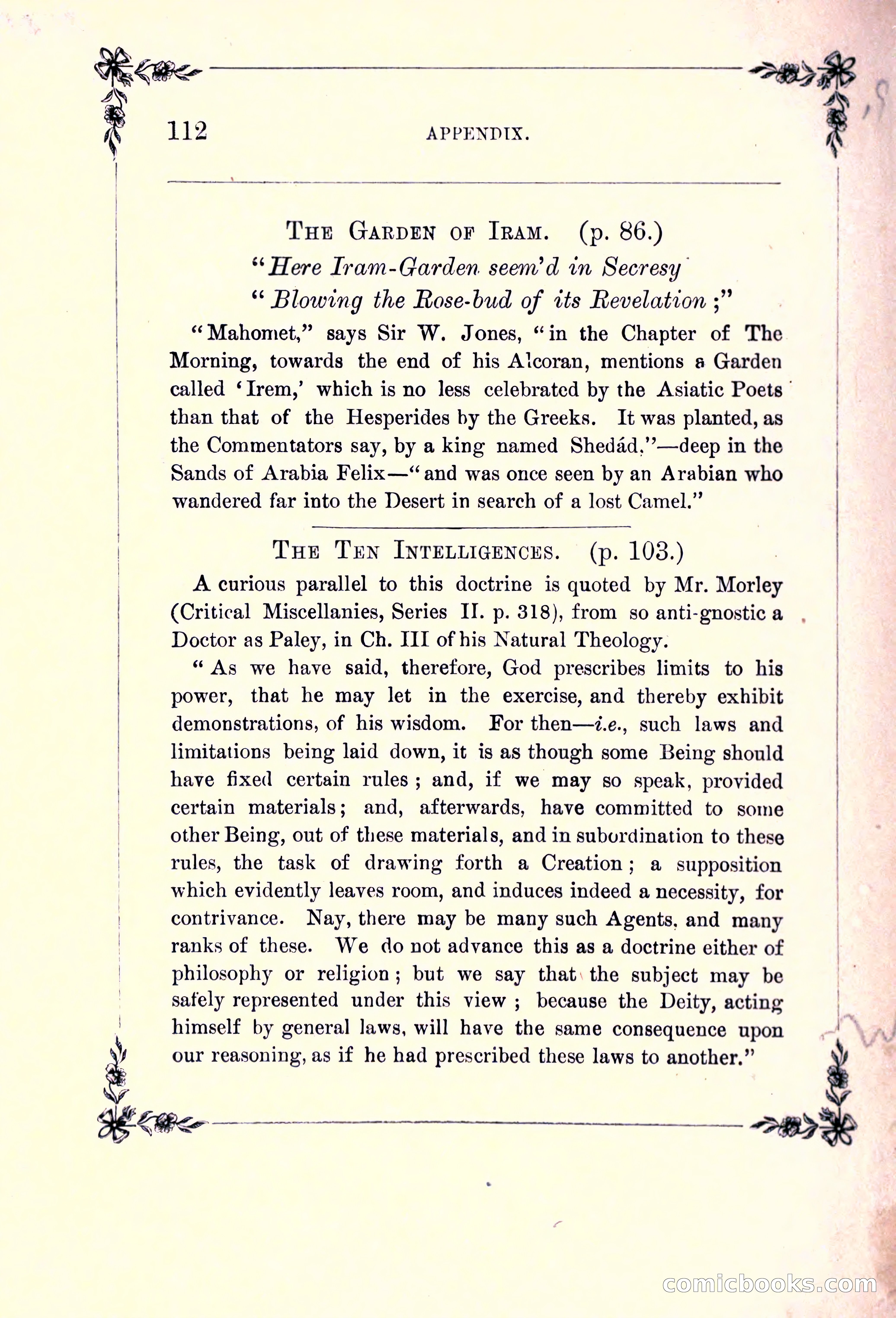
This is an appendix page of prose commentary, numbered 112. It contains two separate scholarly notes: the first discusses the legendary Garden of Iram from Islamic tradition, citing Sir W. Jones's reference to it in Mahomet's Alcoran as a garden planted by King Shedad in the Arabian desert, celebrated among Asian poets as the Greeks celebrated the Hesperides. The second note, titled "The Ten Intelligences," quotes theologian Paley's discussion of how God prescribes limits to divine power to allow for the exercise of wisdom, suggesting creation might be delegated to subordinate beings operating within divine laws—a doctrine the author claims is not necessarily anti-Christian, though it permits multiple creative agents.
📄 Transcribed text from this page (OCR, searchable)
Machine-transcribed from the original scan — historical spelling and the odd misread are preserved.
Ree ef IN a 112 APPENDIX. | 4 re on en te i re ee THE GARDEN oF IRAM. (p. 86.) “ Here Iram-Garden seem’d vn Secresy “ Blowing the Rose-bud of rts Revelation ;” “Mahomet,” says Sir W. Jones, “in the Chapter of The Morning, towards the end of his Alcoran, mentions s Garden called ‘Irem,’ which is no less celebrated by the Asiatic Poets © | than that of the Hesperides by the Greeks. It was planted, as the Commentators say, by a king named Shedad,’’—deep in the Sands of Arabia Felix—‘“ and was once seen by an Arabian who wandered far into the Desert in search of a lost Camel.” a | THE Ten INTELLIGENCES. (p. 103.) , | A curious parallel to this doctrine is quoted by Mr. Morley | (Critical Miscellanies, Series IT. p. 318), from so anti-gnostic a | Doctor as Paley, in Ch. III of his Natural Theology. | “As we have said, therefore, God prescribes limits to his | power, that he may let in the exercise, and thereby exhibit | | demonstrations, of his wisdom. For then—7.e., such laws and | | limitations being laid down, it is as though some Being should have fixed certain rules; and, if we may so speak, provided | certain materials; and, afterwards, have committed to some | other Being, out of these materials, and in suburdination to these rules, the task of drawing forth a Creation; a supposition which evidently leaves room, and induces indeed a necessity, for | contrivance. Nay, there may be many such Agents, and many ! ranks of these. We do not advance this as a doctrine either of | philosophy or religion; but we say that: the subject may be safely represented under this view ; because the Deity, acting J himself by general laws, will have the same consequence upon a 5 our reasoning, as if he had prescribed these laws to another.” | , ? ig & ET GL LLL ALL LL LC i tH, ta —— >> y COMmICooOokS. conn ™ @)