
Penny Dreadfuls, 1900 · page 121 of 142
Rubaiyat of Omar Khayyam, and the Salaman and Absal of Jami — page 121: what you’re looking at
What you’re looking at
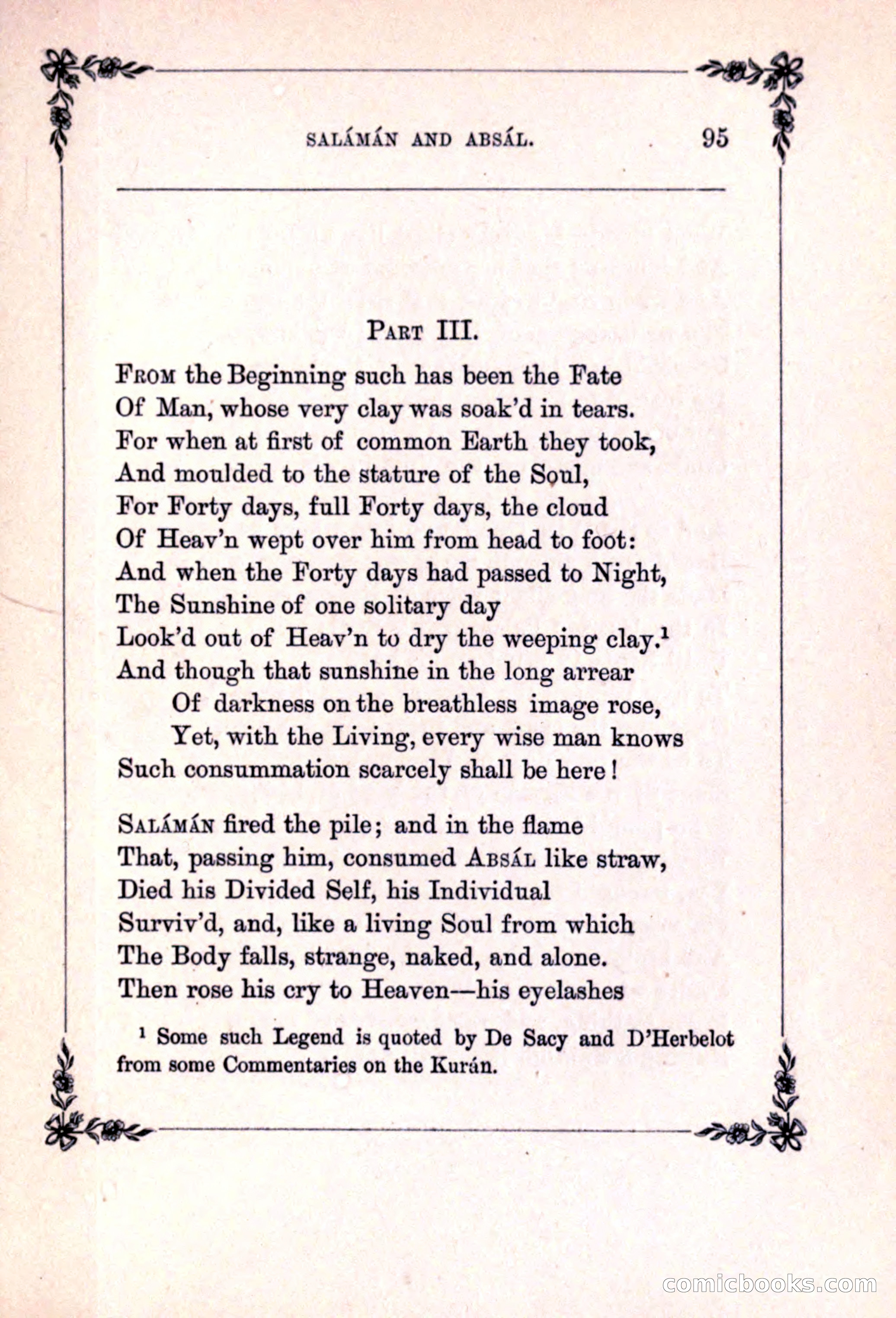
# Page Analysis This is a running prose page from Part III of a narrative poem titled "Salámán and Absál." The text presents verse describing the creation of Man from earth and tears, followed by a dramatic scene where a character named Salámán fires a pile that consumes another character named Absál "like straw." The passage describes Absál's death as a separation of divided self from individual soul, ending with his cry to Heaven. A footnote indicates the legend derives from Quranic commentaries by De Sacy and D'Herbelot. The page number is 95, suggesting this is mid-narrative in a longer work.
📄 Transcribed text from this page (OCR, searchable)
Machine-transcribed from the original scan — historical spelling and the odd misread are preserved.
SALAMAN AND ABSAL. Part ITI. From the Beginning such has been the Fate Of Man, whose very clay was soak’d in tears. For when at first of common Earth they took, And moulded to the stature of the Soul, For Forty days, full Forty days, the cloud Of Heav’n wept over him from head to foot: And when the Forty days had passed to Night, The Sunshine of one solitary day Look’d out of Heav’n to dry the weeping clay. And though that sunshine in the long arrear Of darkness on the breathless image rose, Yet, with the Living, every wise man knows Such consummation scarcely shall be here! SaLAmAn fired the pile; and in the flame That, passing him, consumed AxsAz like straw, Died his Divided Self, his Individual Surviv’d, and, like a living Soul from which © The Body falls, strange, naked, and alone. Then rose his cry to Heaven-—his eyelashes 1 Some such Legend is quoted by De Sacy and D’Herbelot from some Commentaries on the Kuran. COmiclbooks.coni