
Penny Dreadfuls, 1900 · page 16 of 142
Rubaiyat of Omar Khayyam, and the Salaman and Absal of Jami — page 16: what you’re looking at
What you’re looking at
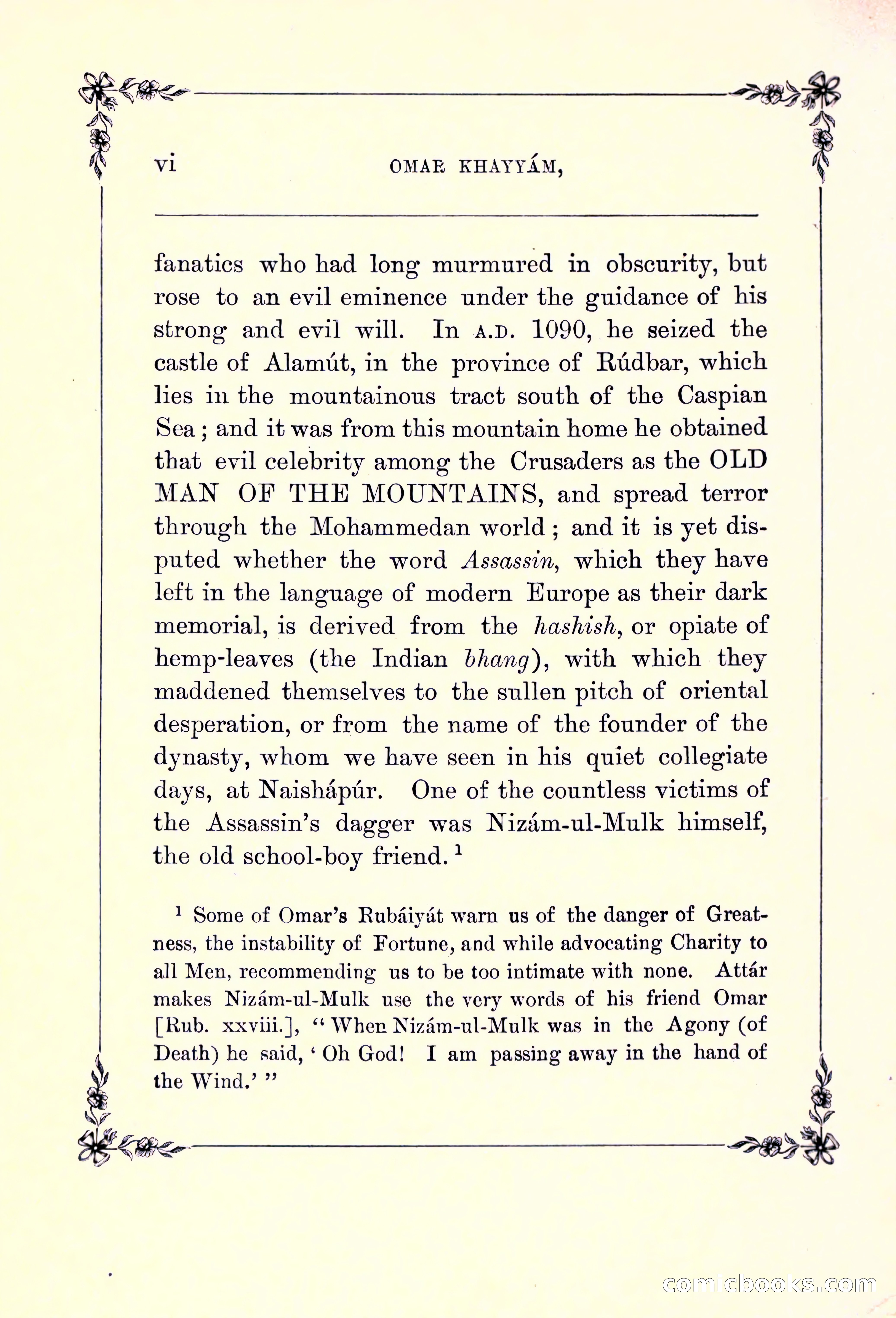
# Page Description This is a page of running prose from what appears to be a biographical or historical work on Omar Khayyám (the header reads "OMAR KHAYYÁM"). The text discusses the rise of a fanatical group who, in A.D. 1090, seized the castle of Alamut near the Caspian Sea and became known to Crusaders as the "Old Man of the Mountains." The passage debates whether the word "Assassin" derives from hashish use or the founder's name, and notes that Nizám-ul-Mulk, Omar's childhood friend, was killed by an assassin's dagger. A footnote references Omar's Rubáiyát and includes a dying quotation attributed to Nizám-ul-Mulk.
📄 Transcribed text from this page (OCR, searchable)
Machine-transcribed from the original scan — historical spelling and the odd misread are preserved.
Heke v1 OMAE KHAYYAM, fanatics who had long murmured in obscurity, but rose to an evil eminence under the guidance of his strong and evil will. In a.p. 1090, he seized the castle of Alamut, in the province of Rudbar, which hes in the mountainous tract south of the Caspian Sea; and it was from this mountain home he obtained that evil celebrity among the Crusaders as the OLD MAN OF THE MOUNTAINS, and spread terror through the Mohammedan world; and it is yet dis- puted whether the word Assassin, which they have left in the language of modern Europe as their dark memorial, is derived from the hashish, or opiate of hemp-leaves (the Indian bhang), with which they maddened themselves to the sullen pitch of oriental desperation, or from the name of the founder of the dynasty, whom we have seen in his quiet collegiate days, at Naishéptr. One of the countless victims of the Assassin’s dagger was Nizim-ul-Mulk himself, the old school-boy friend. * 1 Some of Omar’s Rubaiydt warn us of the danger of Great- ness, the instability of Fortune, and while advocating Charity to all Men, recommending us to be too intimate with none. Attar makes Nizam-ul-Mulk use the very words of his friend Omar [Rub. xxviii.], ‘‘ When Niz4m-ul-Mulk was in the Agony (of Death) he said, ‘Oh God! I am passing away in the hand of the Wind.’ ” | i Ore CORNICLOO