
Penny Dreadfuls, 1900 · page 24 of 142
Rubaiyat of Omar Khayyam, and the Salaman and Absal of Jami — page 24: what you’re looking at
What you’re looking at
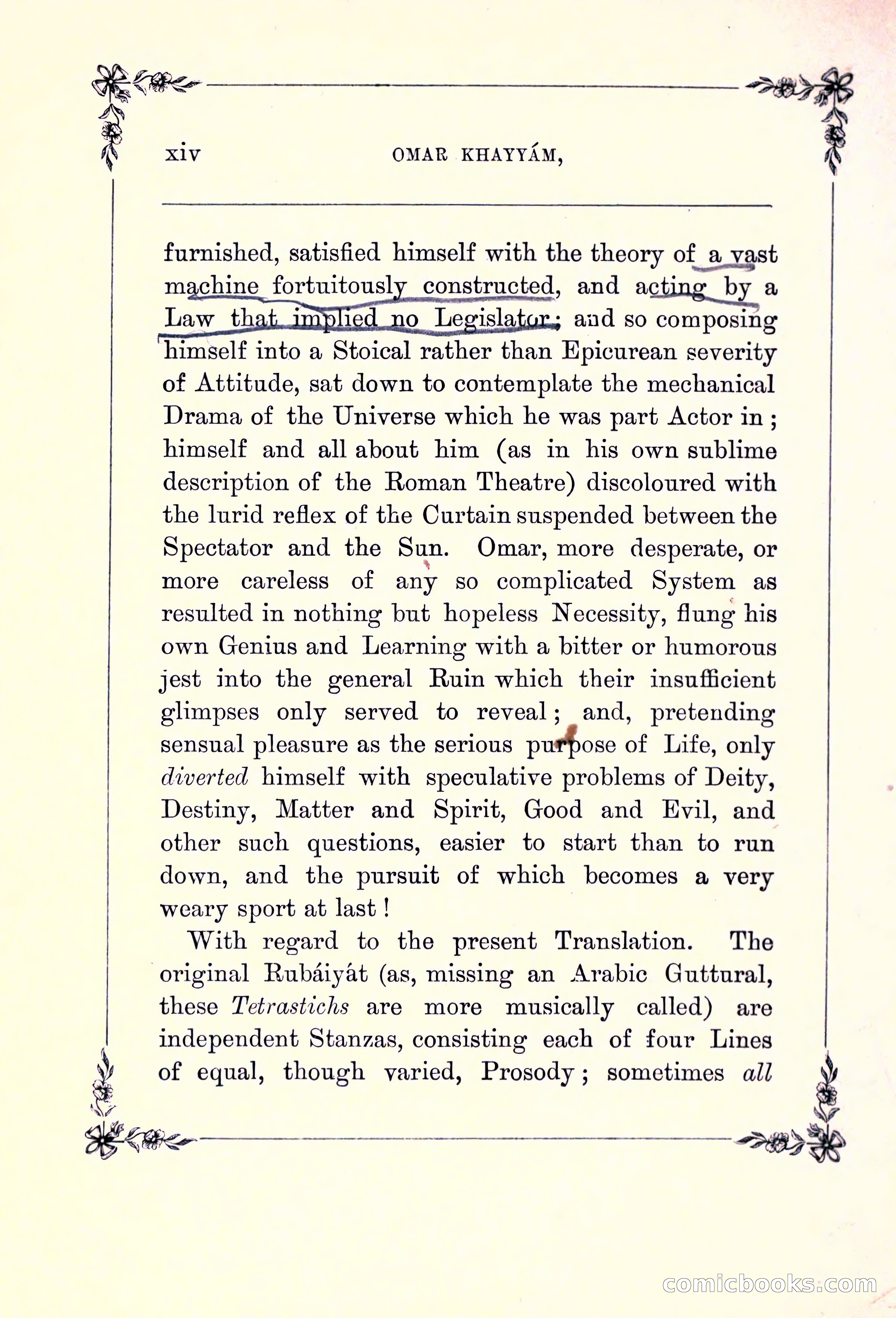
# Analysis of Page XIV This is a **prose page** from what appears to be an introduction or preface rather than a penny dreadful itself. The text discusses Omar Khayyam's philosophical outlook—contrasting his Stoical contemplation of the universe as mechanical with his alternative approach of dismissing systematic philosophy as hopeless and instead embracing sensual pleasure and witty rejection of metaphysical questions. The passage then shifts to explain the translator's approach to rendering the original *Rubaiyát*, noting that these four-line stanzas (called *Tetrastichs* in English) feature varied prosody. This is scholarly editorial apparatus accompanying a translation of Khayyam's work.
📄 Transcribed text from this page (OCR, searchable)
Machine-transcribed from the original scan — historical spelling and the odd misread are preserved.
X1V OMAR KHAYYAM, furnished, satisfied himself with the theory of _a_yast machine fortuitously constructed, and acting by a Law that 3 | ; aud so composing himself into a Stoical rather than E picurean severity of Attitude, sat down to contemplate the mechanical Drama of the Universe which he was part Actor in ; himself and all about him (as in his own sublime description of the Roman Theatre) discoloured with the lurid reflex of the Curtain suspended between the Spectator and the Sun. Omar, more desperate, or more careless of any so complicated System as resulted in nothing but hopeless Necessity, flung his own Genius and Learning with a bitter or humorous jest into the general Ruin which their insufficient glimpses only served to reveal; and, pretending sensual pleasure as the serious purpose of Life, only diverted himself with speculative problems of Deity, Destiny, Matter and Spirit, Good and Evil, and other such questions, easier to start than to run down, and the pursuit of which becomes a very weary sport at last ! With regard to the present Translation. The original Rubaiyat (as, missing an Arabic Guttural, these Tetrastichs are more musically called) are independent Stanzas, consisting each of four Lines of equal, though varied, Prosody; sometimes ail CORNICLOO Sal CO)