
Penny Dreadfuls, 1900 · page 19 of 142
Rubaiyat of Omar Khayyam, and the Salaman and Absal of Jami — page 19: what you’re looking at
What you’re looking at
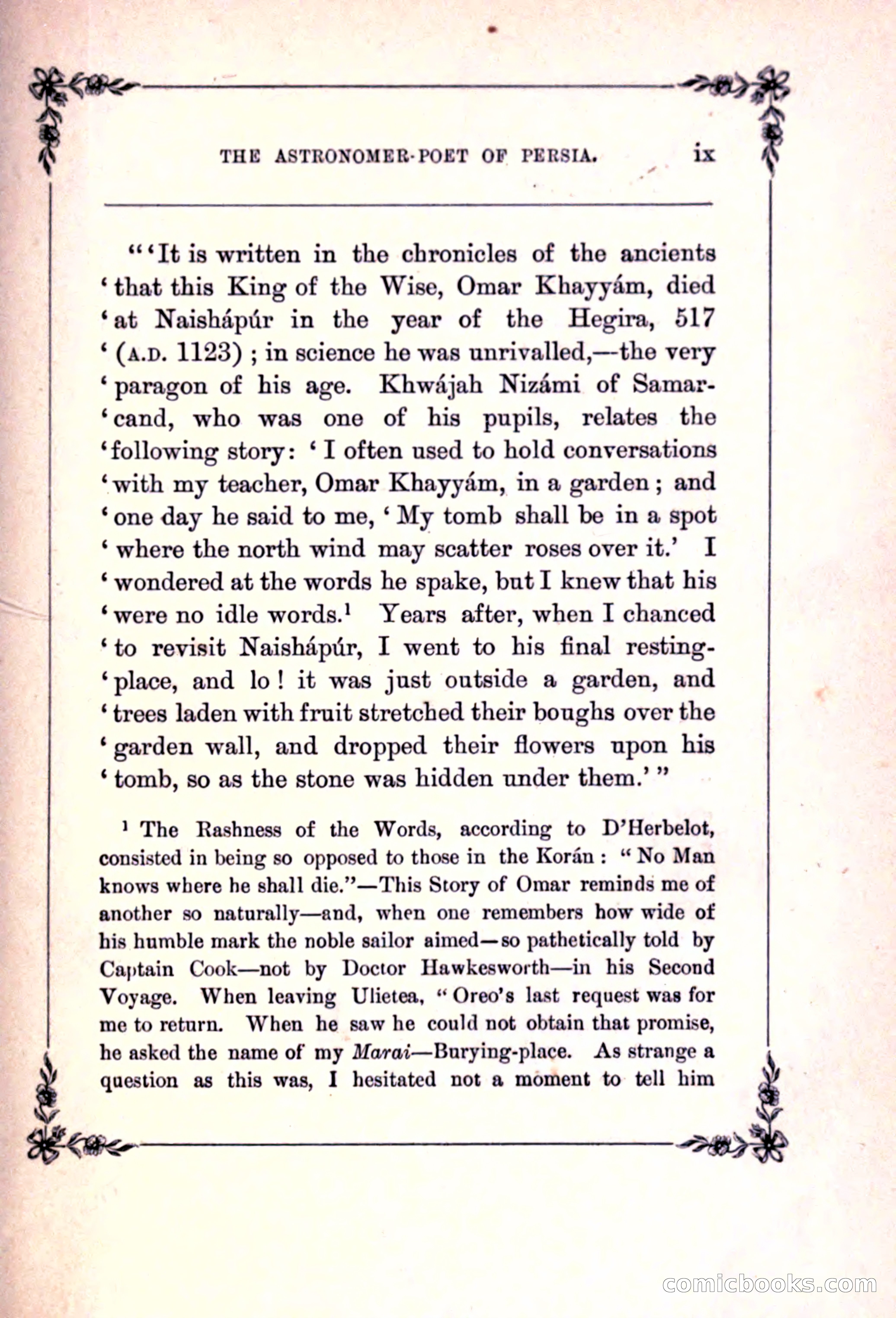
# Analysis of Page This is a running prose page from what appears to be a Victorian-era literary work about Omar Khayyám, the Persian astronomer-poet. The main text presents a chronicle account of Omar Khayyám's death in 1123 A.D., followed by an anecdote from his student Khwájah Nizámi describing how Omar predicted his tomb would be in a place where "the north wind may scatter roses over it"—a prediction that allegedly came true. The page includes a substantial footnote discussing the "Rashness" of Omar's words and comparing his story to an anecdote from Captain Cook's Second Voyage involving a man named Oreo asking about burial places.
📄 Transcribed text from this page (OCR, searchable)
Machine-transcribed from the original scan — historical spelling and the odd misread are preserved.
THE ASTRONOMER-POET OF PERSIA. **¢Tt is written in the chronicles of the ancients ‘that this King of the Wise, Omar Khayyém, died ‘at Naishdpir in the year of the MHegira, 517 *(a.D. 1123) ; in science he was unrivalled,—-the very ‘paragon of his age. Khwajah Niz4mi of Samar- ‘cand, who was one of his pupils, relates the ‘following story: ‘I often used to hold conversations ‘with my teacher, Omar Khayyam, in a garden; and ‘one day he said to me, ‘ My tomb shall be in a spot ‘where the north wind may scatter roses over it.’ I ‘wondered at the words he spake, but I knew that his ‘were no idle words.! Years after, when I chanced ‘to revisit Naishapuir, I went to his final resting- ‘place, and lo! it was just outside a garden, and ‘trees laden with fruit stretched their boughs over the ‘garden wall, and dropped their flowers upon his ‘tomb, so as the stone was hidden under them.’ ” 1 The Rashness of the Words, according to D’Herbelot, consisted in being so opposed to those in the Koran: “ No Man knows where he shall die.”—This Story of Omar reminds me of another so naturally—and, when one remembers how wide of his humble mark the noble sailor aimed—so pathetically told by Captain Cook—not by Doctor Hawkesworth—in his Second Voyage. When leaving Ulietea, “ Oreo’s last request was for me to return. When he saw he could not obtain that promise, he asked the name of my Marai—Burying-place. As strange a question as this was, I hesitated not a moment to tell him Gorn DOO S, (C@) =