
Penny Dreadfuls, 1900 · page 73 of 142
Rubaiyat of Omar Khayyam, and the Salaman and Absal of Jami — page 73: what you’re looking at
What you’re looking at
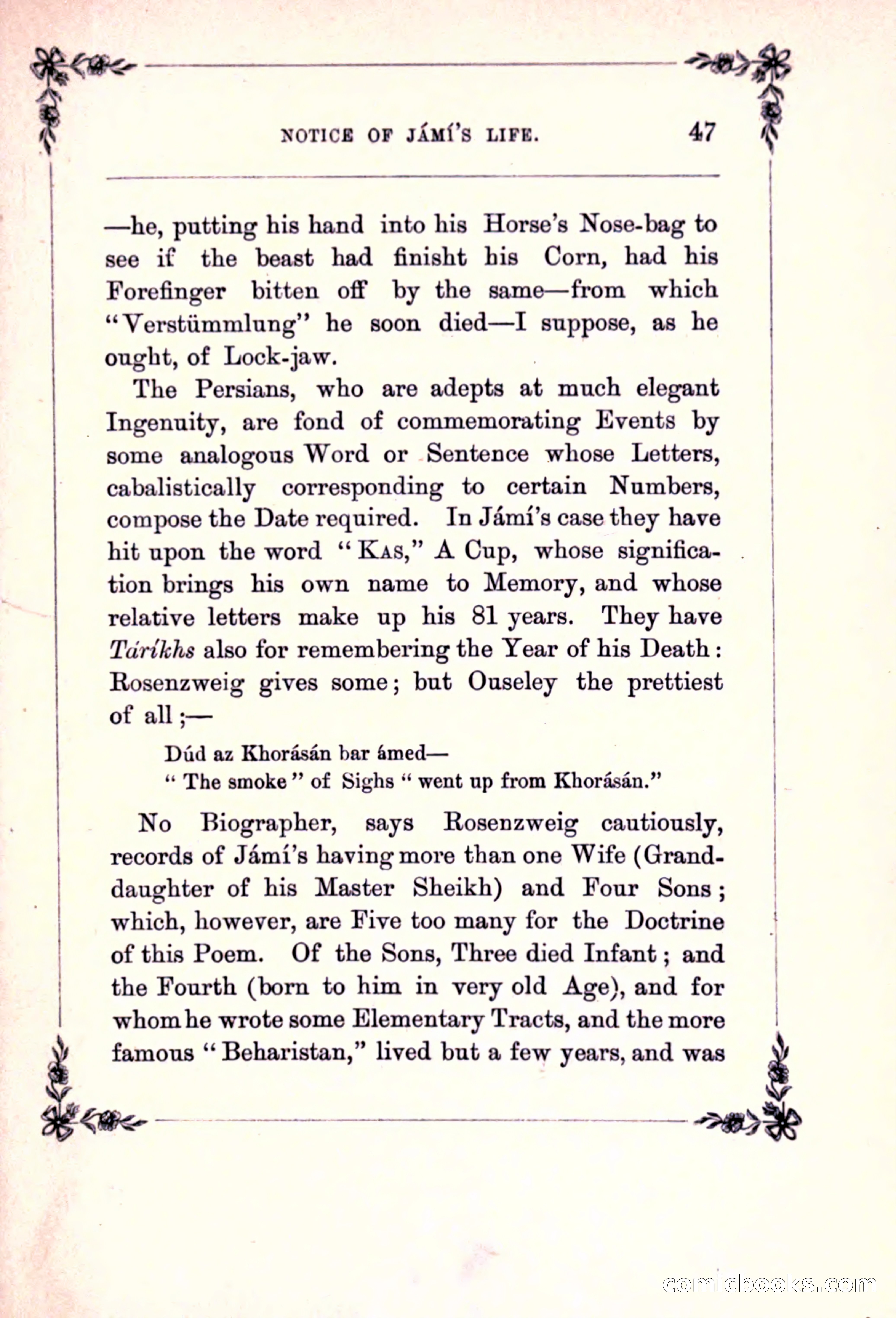
# Page Description This is a page of running prose (page 47) from what appears to be a scholarly or annotated edition. The text is a biographical notice about Jámi, a Persian poet and scholar. It describes an anecdote about his death (allegedly from a horse bite causing lockjaw), explains Persian numerological systems for commemorating dates, and provides biographical details about his family—particularly that he had one wife and four sons, three of whom died in infancy. The page includes references to scholarly sources like Rosenzweig and Ouseley, and mentions Jámi's famous work "Beharistan."
📄 Transcribed text from this page (OCR, searchable)
Machine-transcribed from the original scan — historical spelling and the odd misread are preserved.
NOTICE OF JAM{’S LIFE. 47 ee ee oe - i -—-—-=-- a e+ —he, putting his hand into his Horse’s Nose-bag to see if the beast had finisht his Corn, had his Forefinger bitten off by the same—from which “Verstiimmlung”’ he soon died—I suppose, as he ought, of Lock-jaw. The Persians, who are adepts at much elegant Ingenuity, are fond of commemorating Events by some analogous Word or Sentence whose Letters, cabalistically corresponding to certain Numbers, compose the Date required. In Jami’s case they have hit upon the word “ Kas,” A Cup, whose significa- . tion brings his own name to Memory, and whose relative letters make up his 81 years. They have Tartkhs also for remembering the Year of his Death: Rosenzweig gives some; but Ouseley the prettiest of all ;— Did az Khorasan bar 4med— ‘The smoke” of Sighs “ went up from Khorasan.”’ No Biographer, says Rosenzweig cautiously, records of Jami’s having more than one Wife (Grand- daughter of his Master Sheikh) and Four Sons; which, however, are Five too many for the Doctrine of this Poem. Of the Sons, Three died Infant; and the Fourth (born to him in very old Age), and for whom he wrote some EHlementary Tracts, and the more famous “‘ Beharistan,” lived but a few years, and was em | | | | conic DOO S, (C©)