
Penny Dreadfuls, 1900 · page 59 of 142
Rubaiyat of Omar Khayyam, and the Salaman and Absal of Jami — page 59: what you’re looking at
What you’re looking at
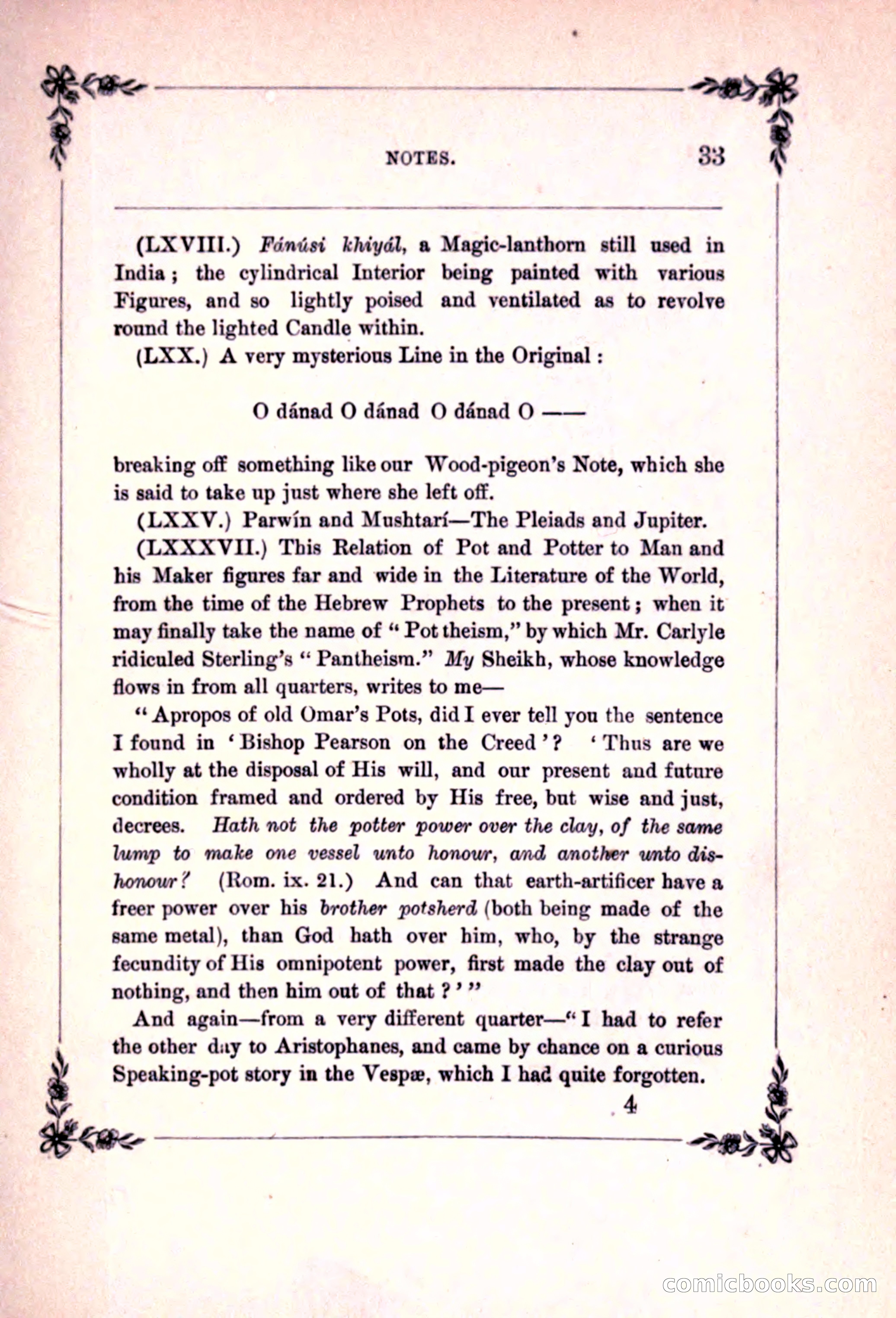
# THIS PAGE This is a **notes/commentary page** from what appears to be an annotated edition of a literary work (likely *The Rubaiyat of Omar Khayyam*, based on context). The page contains numbered footnotes explaining references and terms in the main text—including a description of an Indian optical device (the Pánási khiyál), an unexplained mysterious line from the original work, and an extended philosophical discussion about the metaphorical relationship between potter and clay, drawing on Biblical and classical sources. The notes cite Thomas Carlyle, Bishop Pearson, and Aristophanes.
📄 Transcribed text from this page (OCR, searchable)
Machine-transcribed from the original scan — historical spelling and the odd misread are preserved.
owe eee eee (LXVIII.) Fdnisi khiydl, a Magic-lanthorn still used in India; the cylindrical Interior being painted with various Figures, and so lightly poised and ventilated as to revolve round the lighted Candle within. (LX X.) A very mysterious Line in the Original : O danad O danad O dénad O —— breaking off something like our Wood-pigeon’s Note, which she is said to take up just where she left off. (LXXV.) Parwin and Mushtari—The Pleiads and Jupiter. (LXXXVII.) This Relation of Pot and Potter to Man and his Maker figures far and wide in the Literature of the World, from the time of the Hebrew Prophets to the present; when it may finally take the name of “ Pot theism,” by which Mr. Carlyle ridiculed Sterling’s “ Pantheism.” My Sheikh, whose knowledge flows in from all quarters, writes to me— ‘** Apropos of old Omar’s Pots, did I ever tell you the sentence I found in ‘ Bishop Pearson on the Creed’? ‘ Thus are we wholly at the disposal of His will, and our present and future condition framed and ordered by His free, but wise and just, decrees. Hath not the potter power over the clay, of the same lump to make one vessel unto honour, and another unto dis- honour’ (Rom. ix. 21.) And can that earth-artificer have a freer power over his brother potsherd (both being made of the same metal), than God hath over him, who, by the strange fecundity of His omnipotent power, first made the clay out of nothing, and then him out of that ?’ ” And again—from a very different quarter—“I had to refer the other day to Aristophanes, and came by chance on a curious Speaking-pot story in the Vespex, which I had quite forgotten. Gomi DOO S. (C@)