
Penny Dreadfuls, 1900 · page 20 of 142
Rubaiyat of Omar Khayyam, and the Salaman and Absal of Jami — page 20: what you’re looking at
What you’re looking at
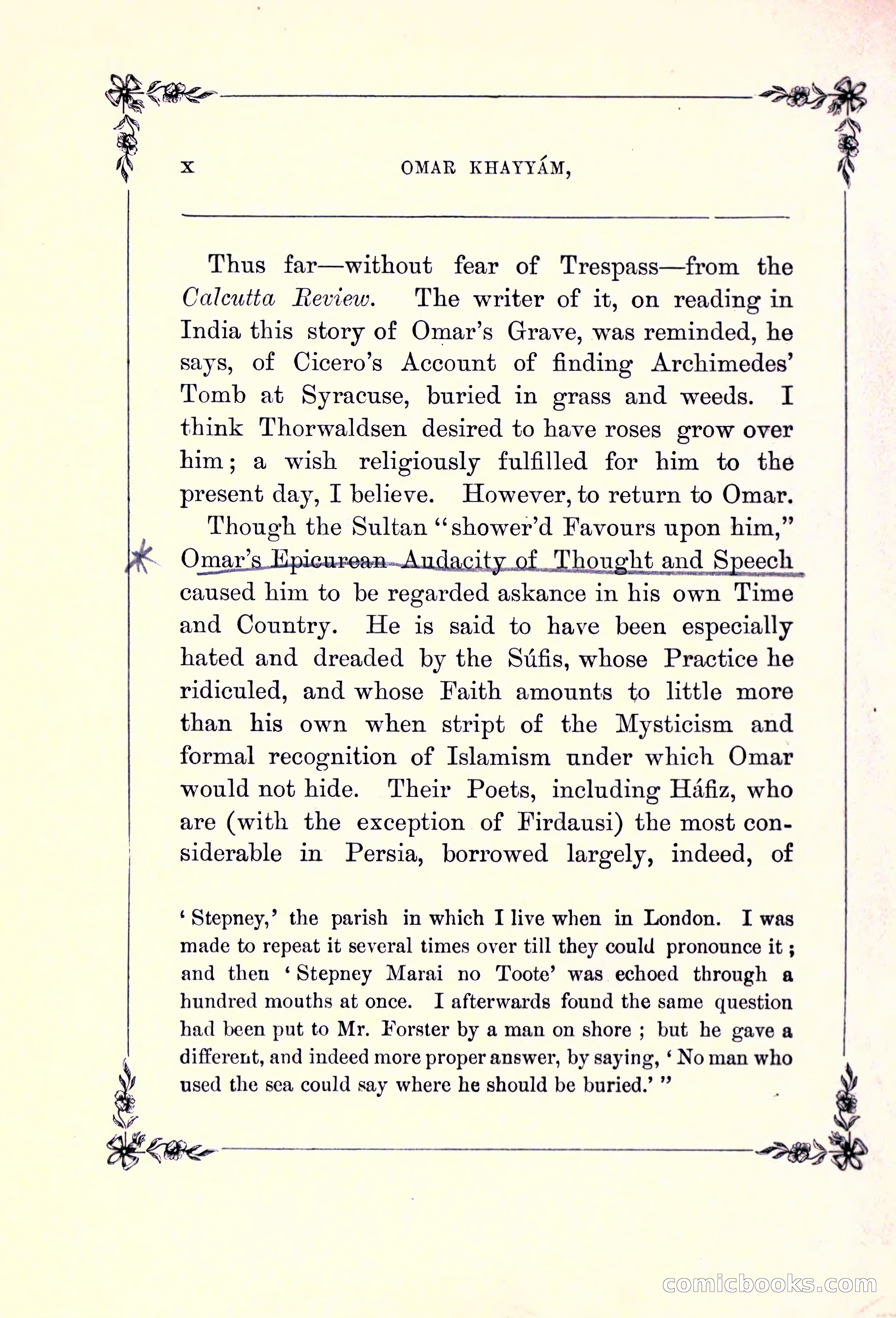
# Description This is a page of running prose from what appears to be a Victorian-era text about Omar Khayyám. The page contains two distinct passages: the first, extracted from the *Calcutta Review*, discusses Omar's grave and compares it to Archimedes' tomb, noting that Omar's "Epicurean Audacity of Thought and Speech" made him unpopular with the Sufis, whose religious practices he ridiculed. The second passage, set off in a footnote, is a personal anecdote about pronouncing the parish name "Stepney" and includes a quote attributed to Mr. Forster about the impossibility of knowing where one will be buried at sea. The page is framed with decorative floral borders typical of Victorian printing.
📄 Transcribed text from this page (OCR, searchable)
Machine-transcribed from the original scan — historical spelling and the odd misread are preserved.
*: Boman SR $$$ OMAR KHAYYAM, Thus far—without fear of Trespass—from the Calcutta Review. The writer of it, on reading in India this story of Omar’s Grave, was reminded, he says, of Cicero’s Account of finding Archimedes’ Tomb at Syracuse, buried in grass and weeds. I think Thorwaldsen desired to have roses grow over him; a wish religiously fulfilled for him to the ee day, I believe. However, to return to Omar. Though the Sultan ‘“‘shower’d Favours upon him,” ~ Omar’s Hpicurean—Audacity_of Thought and Speech caused him to be regarded askance in his own Time and Country. He is said to have been especially hated and dreaded by the Sufis, whose Practice he ridiculed, and whose Faith amounts to little more than his own when stript of the Mysticism and formal recognition of Islamism under which Omar would not hide. Their Poets, including Hafiz, who are (with the exception of Firdausi) the most con- siderable in Persia, borrowed largely, indeed, of ‘Stepney,’ the parish in which I live when in London. I was made to repeat it several times over till they could pronounce it ; and then ‘Stepney Marai no Toote’ was echoed through a hundred mouths at once. I afterwards found the same question had been put to Mr. Forster by a man on shore ; but he gave a different, and indeed more proper answer, by saying, ‘ No man who used the sea could say where he should be buried.’ ” ‘ é fe COMicooo @) 4 (CO)