
Penny Dreadfuls, 1900 · page 55 of 142
Rubaiyat of Omar Khayyam, and the Salaman and Absal of Jami — page 55: what you’re looking at
What you’re looking at
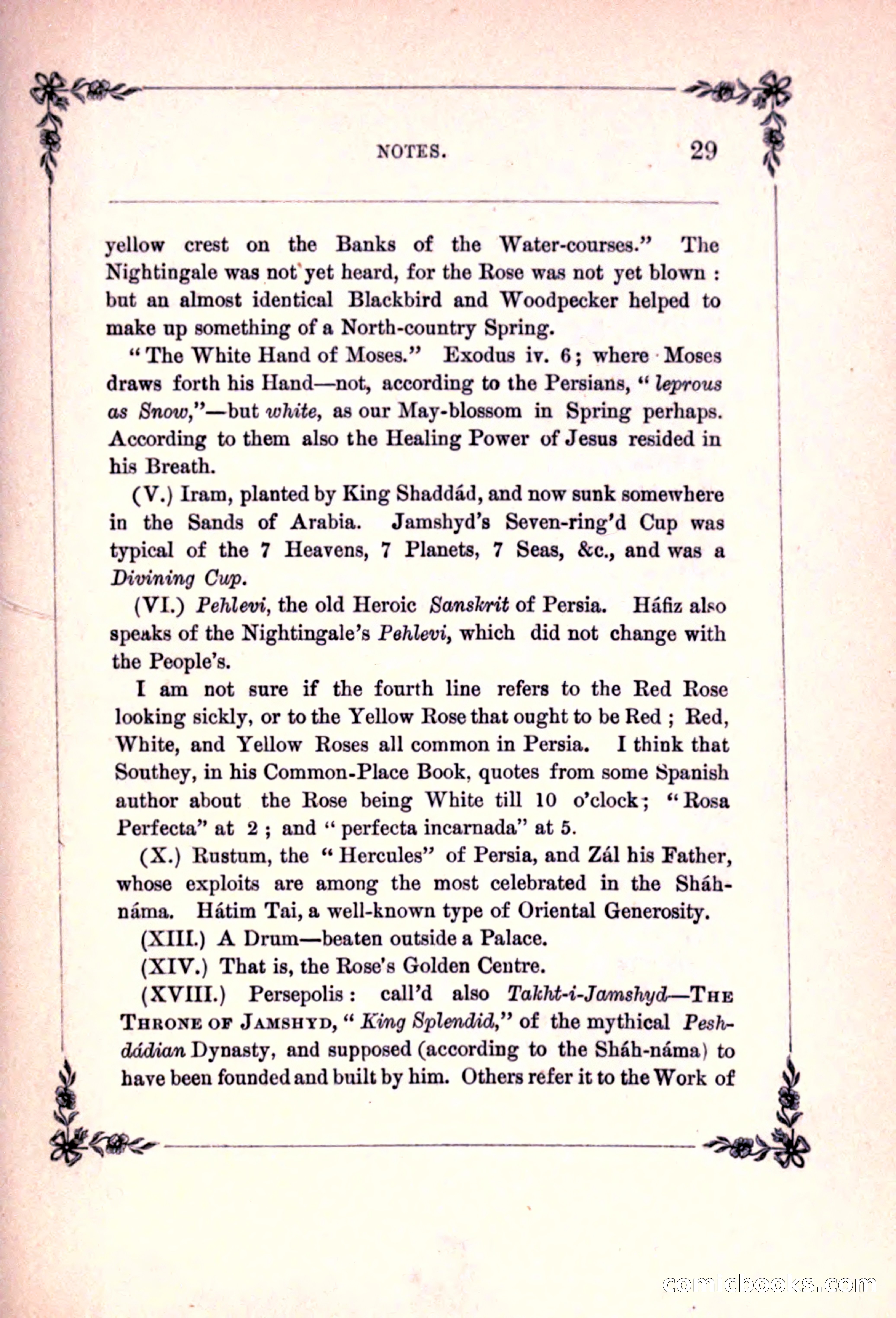
# Page Analysis This is a notes page (numbered 29) from what appears to be an annotated literary text. The page consists entirely of scholarly footnotes explaining references and allusions in the main work—discussing Persian mythology, Islamic sources, biblical references, and literary citations. The notes explain terms like "the White Hand of Moses," references to Iram and Jamshyd's Cup from Persian tradition, the language Pehlevi, the hero Rustum, and Persepolis (also called Takht-i-Jamshyd). There are no illustrations, only dense explanatory prose with parenthetical numerical references keyed to the text above.
📄 Transcribed text from this page (OCR, searchable)
Machine-transcribed from the original scan — historical spelling and the odd misread are preserved.
Oe NOTES. 29 e- —-- _ =- = --- ~ ee ee we ee —_—-— —_ a ee ee _ — —— — — | | yellow crest on the Banks of the Water-courses.” The | Nightingale was not’ yet heard, for the Rose was not yet blown : : but an almost identical Blackbird and Woodpecker helped to | make up something of a North-country Spring. | “The White Hand of Moses.” Exodus iv. 6; where - Moses | draws forth his Hand—not, according to the Persians, “ leprous | as Snow,”—but white, as our May-blossom in Spring perhaps. | According to them also the Healing Power of Jesus resided in | his Breath. | (V.) Iram, planted by King Shaddad, and now sunk somewhere | in the Sands of Arabia. Jamshyd’s Seven-ring’d Cup was | typical of the 7 Heavens, 7 Planets, 7 Seas, &c., and was a | | | | | | | Divining Cup. (VI.) Pehlevi, the old Heroic Sanskrit of Persia. Hafiz also speaks of the Nightingale’s Pehlevi, which did not change with the People’s. I am not sure if the fourth line refers to the Red Rose looking sickly, or to the Yellow Rose that ought to be Red ; Red, White, and Yellow Roses all common in Persia. I think that | Southey, in his Common-Place Book, quotes from some Spanish | | author about the Rose being White till 10 o’clock; ‘* Rosa | Perfecta” at 2; and “ perfecta incarnada” at 5. | (X.) Rustum, the “ Hercules” of Persia, and Zal his Father, whose exploits are among the most celebrated in the Shah- | nama, Hatim Tai, a well-known type of Oriental Generosity. (XIIL) A Drum—beaten outside a Palace. | (XIV.) That is, the Rose’s Golden Centre. (XVIII.) Persepolis: call’d also Takht-i-Jamshyd—Tur THRONE OF JAMSHYD, “ King Splendid,” of the mythical Pesh- dadian Dynasty, and supposed (according to the Shah-nama) to have been founded and built by him. Others refer it to the Work of Pee re a EEE -ee—= = - _ ————— a - | = GOMGIOOKSHEO