
Penny Dreadfuls, 1900 · page 18 of 142
Rubaiyat of Omar Khayyam, and the Salaman and Absal of Jami — page 18: what you’re looking at
What you’re looking at
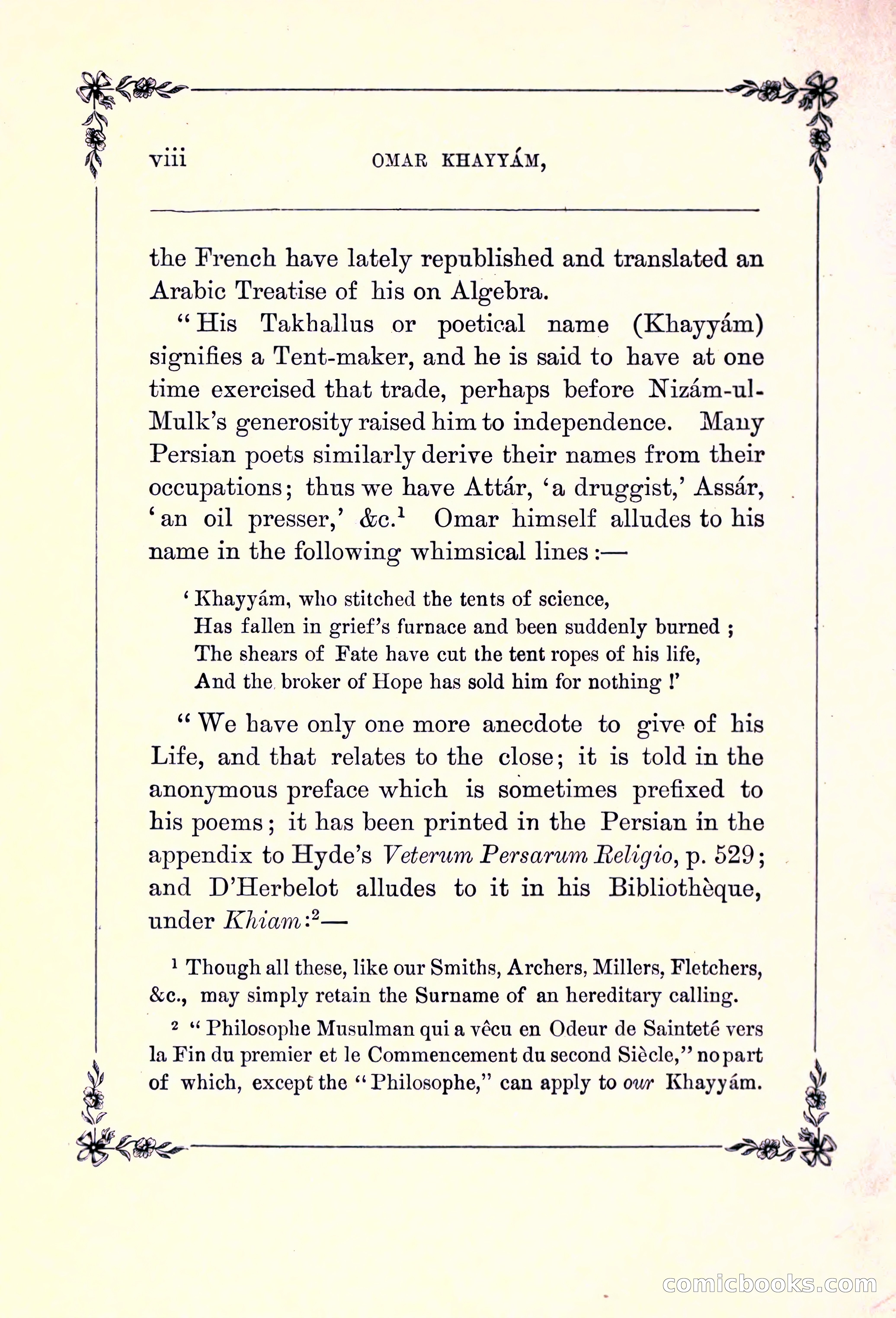
This is a page of scholarly running prose (not a penny dreadful cover or illustration). The text provides biographical and etymological information about Omar Khayyám, explaining that his poetical name "Khayyám" means "tent-maker" and that he allegedly once practiced that trade before gaining patronage. The passage includes a self-referential poem attributed to Khayyám that uses tent-making metaphors to describe his life's misfortunes, and cites classical sources (Hyde's *Veterum Persarum Religio* and D'Herbelot's *Bibliothèque*) for biographical anecdotes. The footnotes compare Persian naming conventions to English occupational surnames.
📄 Transcribed text from this page (OCR, searchable)
Machine-transcribed from the original scan — historical spelling and the odd misread are preserved.
EF Rew ee Vili OMAR KHAYYAM, the French have lately republished and translated an Arabic Treatise of his on Algebra. ‘His Takhallus or poetical name (Khayydém) signifies a Tent-maker, and he is said to have at one time exercised that trade, perhaps before Nizam-ul- Mulk’s generosity raised him to independence. Many Persian poets similarly derive their names from their occupations; thus we have Attar, ‘a druggist,’ Assar, ‘an oil presser,’ &c.1 Omar himself alludes to his name in the following whimsical lines :— ‘Khayyam, who stitched the tents of science, Has fallen in grief’s furnace and been suddenly burned ; The shears of Fate have cut the tent ropes of his life, And the, broker of Hope has sold him for nothing !’ ‘““We have only one more anecdote to give of his Life, and that relates to the close; it 1s told in the anonymous preface which is sometimes prefixed to his poems; it has been printed in the Persian in the appendix to Hyde’s Veterum Persarum Relvgio, p. 529; and D’Herbelot alludes to it in his Bibhothéque, under Khiam:?-— 1 Though all these, like our Smiths, Archers, Millers, Fletchers, &c., may simply retain the Surname of an hereditary calling. 2 « Philosophe Musulman quia vécu en Odeur de Sainteté vers la Fin du premier et le Commencement du second Siecle,” no part of which, except the ‘Philosophe,” can apply to ow Khayyam. Kee : 2H Gomi @) OOO