
Penny Dreadfuls, 1900 · page 134 of 142
Rubaiyat of Omar Khayyam, and the Salaman and Absal of Jami — page 134: what you’re looking at
What you’re looking at
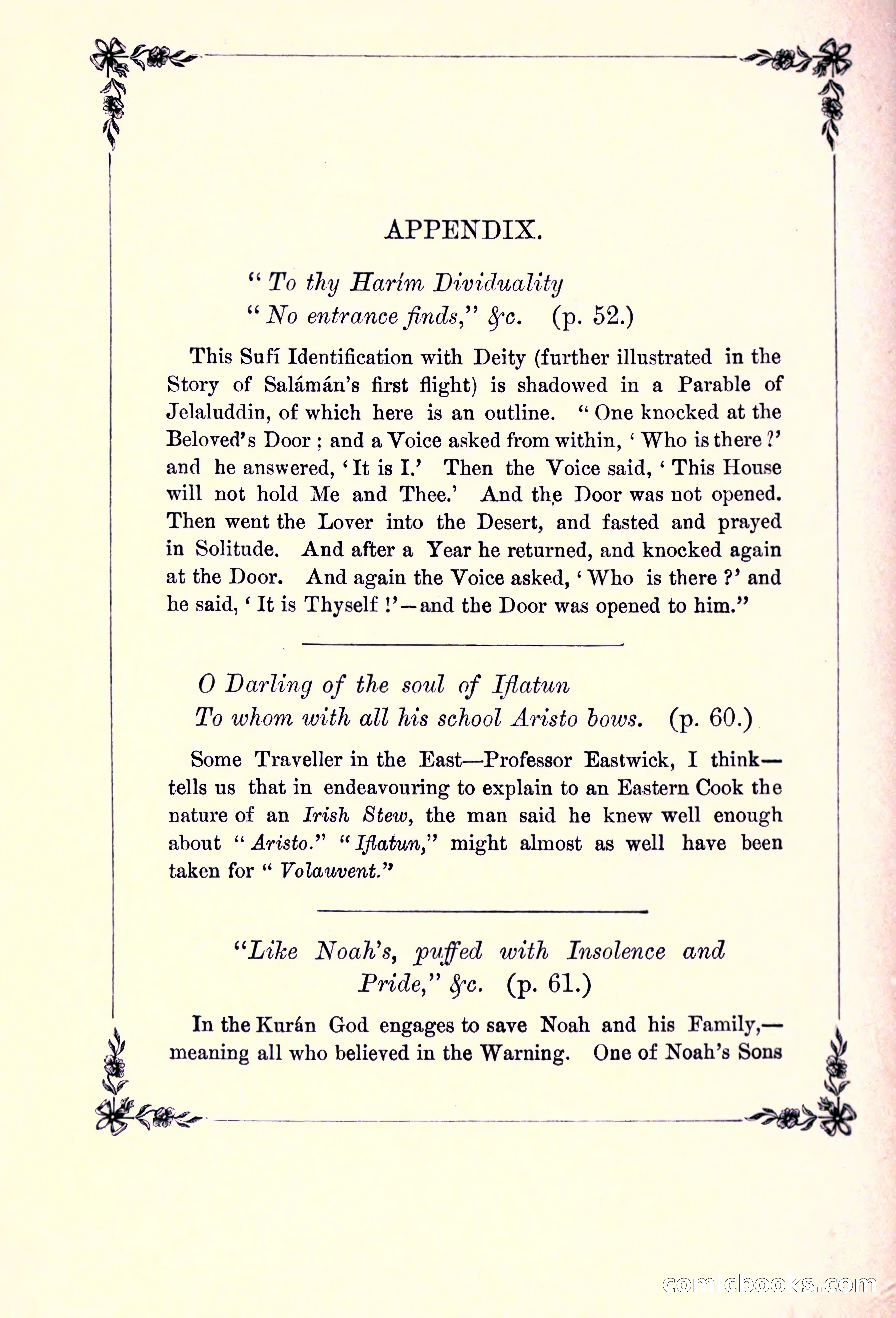
# Victorian Appendix Page This is an **appendix page** of prose annotations, not a cover or illustration. It provides scholarly notes explaining references in the main text, offering footnotes on three quotations (pp. 52, 60, 61). The page includes a Sufi parable attributed to Jelaluddin about spiritual union with the Divine (a lover who must surrender his ego to enter the Beloved's house), a brief anecdote about confusion between Aristotle and Plato when explaining Irish stew to an Eastern cook, and the beginning of a note on the Qur'anic story of Noah. The text suggests this appendix supports what appears to be a Victorian literary work drawing on Eastern philosophy and Islamic sources.
📄 Transcribed text from this page (OCR, searchable)
Machine-transcribed from the original scan — historical spelling and the odd misread are preserved.
APPENDIX. “To thy Harim Dividuality ‘No entrance finds,” Sc. (p. 52.) This Sufi Identification with Deity (further illustrated in the Story of Salaman’s first flight) is shadowed in a Parable of Jelaluddin, of which here is an outline. ‘“ One knocked at the Beloved’s Door ; and a Voice asked from within, ‘ Who is there 2?’ and he answered, ‘It is I.? Then the Voice said, ‘ This House will not hold Me and Thee.’ And the Door was not opened. Then went the Lover into the Desert, and fasted and prayed in Solitude. And after a Year he returned, and knocked again at the Door. And again the Voice asked, ‘Who is there ?’ and he said, ‘ It is Thyself !’—and the Door was opened to him.”? O Darling of the soul of Iflatun To whom with all his school Aristo bows. (p. 60.) Some Traveller in the East—Professor Eastwick, I think— tells us that in endeavouring to explain to an Eastern Cook the nature of an Irish Stew, the man said he knew well enough about ‘ Aristo.” “TIflatun,’” might almost as well have been taken for “ Volawvent.” “Tike Noah's, puffed with Insolence and Pride,” Sc. (p. 61.) In the Kur4n God engages to save Noah and his Family,— meaning all who believed in the Warning. One of Noah’s Sons COMICLOO @) So! CO)