
Penny Dreadfuls, 1900 · page 81 of 142
Rubaiyat of Omar Khayyam, and the Salaman and Absal of Jami — page 81: what you’re looking at
What you’re looking at
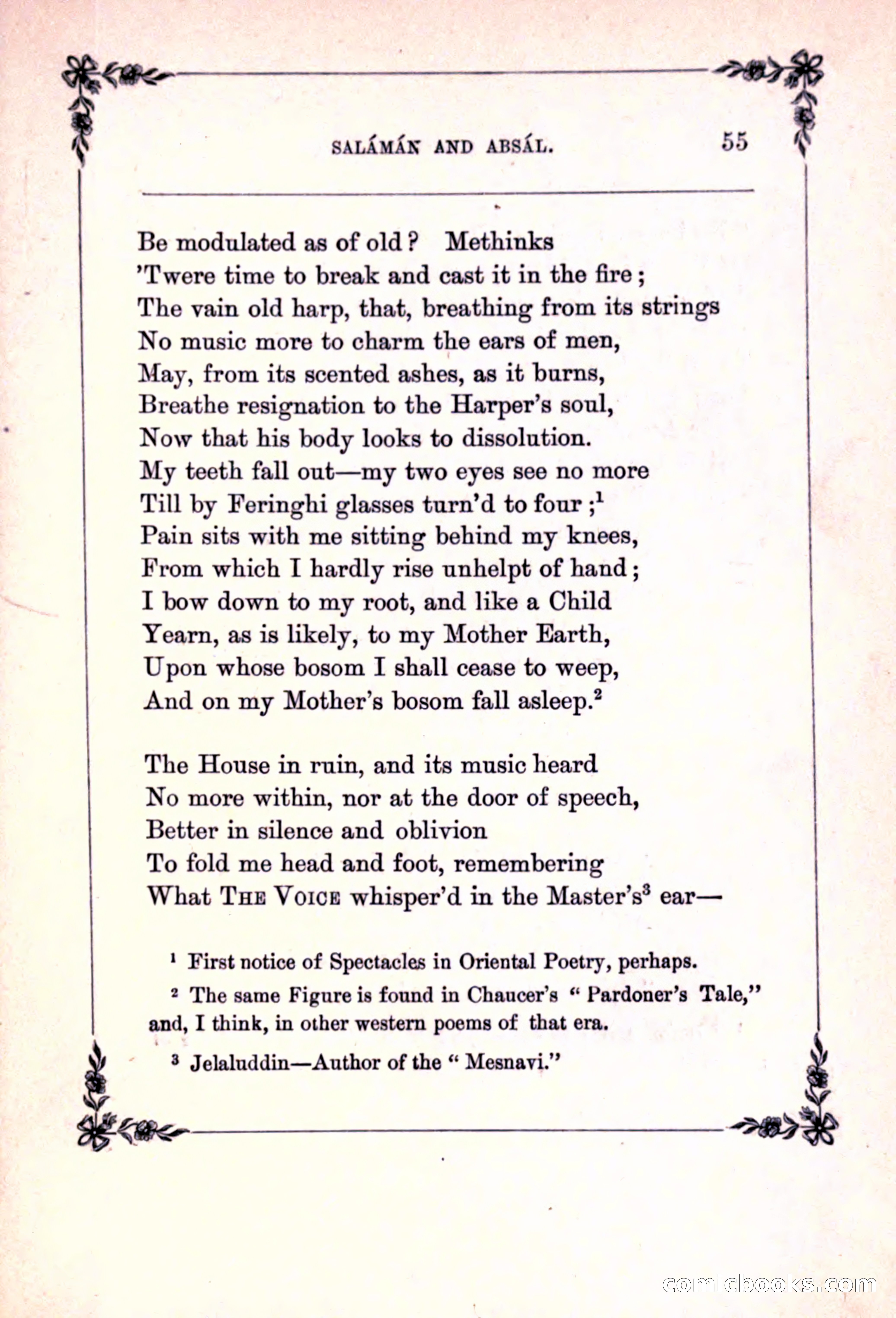
# Page Description This is a text page (page 55) from what appears to be a Victorian-era literary work or anthology titled "Salámán and Absál." The visible text consists of poetry in English translation, featuring an aged speaker lamenting physical decay—falling teeth, failing eyesight, bodily pain—and expressing a desire for death and return to "Mother Earth." The passage includes scholarly footnotes identifying references to spectacles in Oriental poetry, Chaucer's work, and attributing the piece to Jelaluddin, author of the "Mesnavi." The page has decorative floral borders typical of Victorian printing.
📄 Transcribed text from this page (OCR, searchable)
Machine-transcribed from the original scan — historical spelling and the odd misread are preserved.
he SALAMAN AND ABSAL. Be modulated as of old? Methinks ’T were time to break and cast it in the fire ; The vain old harp, that, breathing from its strings No music more to charm the ears of men, May, from its scented ashes, as it burns, Breathe resignation to the Harper’s soul, Now that his body looks to dissolution. My teeth fall out—my two eyes see no more Till by Feringhi glasses turn’d to four ;* Pain sits with me sitting behind my knees, From which I hardly rise unhelpt of hand ; I bow down to my root, and like a Child Yearn, as is likely, to my Mother Earth, Upon whose bosom I shall cease to weep, And on my Mother’s bosom fall asleep.’ The House in rnin, and its music heard No more within, nor at the door of speech, Better in silence and oblivion To fold me head and foot, remembering What Tux Voice whisper’d in the Master’s* ear— ! First notice of Spectacles in Oriental Poetry, perhaps. 2 The same Figure is found in Chaucer’s “ Pardoner’s Tale,” and, I think, in other western poems of that era. 3 Jelaluddin—Author of the “ Mesnavi.” COMmicoooks.con