
Penny Dreadfuls, 1900 · page 56 of 142
Rubaiyat of Omar Khayyam, and the Salaman and Absal of Jami — page 56: what you’re looking at
What you’re looking at
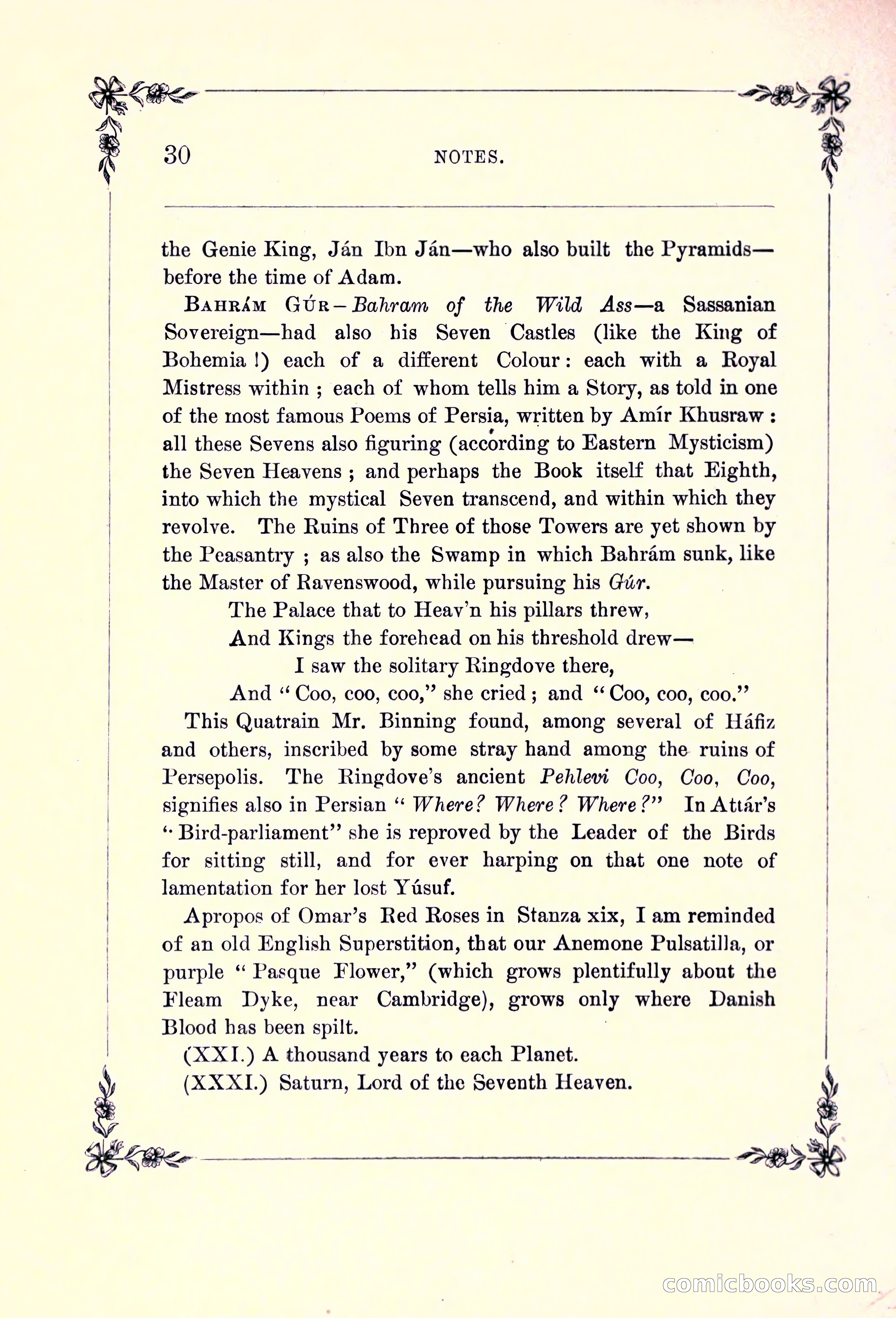
# Page Description This is a notes page (numbered 30) from what appears to be an annotated literary work, likely Victorian poetry. The text consists of scholarly explanatory notes discussing Persian and Eastern literary and historical references, including details about Bahram of the Wild Ass, the Seven Castles, a quatrain inscribed at Persepolis, and an English superstition about the Anemone flower. The notes also reference Omar's poetry and make comparative literary observations, suggesting this page accompanies a poem or narrative that draws heavily on Oriental themes and sources.
📄 Transcribed text from this page (OCR, searchable)
Machine-transcribed from the original scan — historical spelling and the odd misread are preserved.
30 NOTES. pe ee a the Genie King, Jan Ibn Jan—who also built the Pyramids— before the time of Adam. Baurim GUR-—Bahram of the Wild Ass—a Sassanian Sovereign—had also his Seven Castles (like the King of Bohemia !) each of a different Colour: each with a Royal Mistress within ; each of whom tells him a Story, as told in one of the most famous Poems of Persia, written by Amir Khusraw : all these Sevens also figuring (according to Eastern Mysticism) the Seven Heavens ; and perhaps the Book itself that Highth, into which the mystical Seven transcend, and within which they revolve. The Ruins of Three of those Towers are yet shown by the Peasantry ; as also the Swamp in which Bahram sunk, like the Master of Ravenswood, while pursuing his Gur. The Palace that to Heav’n his pillars threw, And Kings the forehead on his threshold drew— I saw the solitary Ringdove there, | And ‘Coo, coo, coo,” she cried ; and ‘‘ Coo, coo, coo.” This Quatrain Mr. Binning found, among several of Hafiz and others, inscribed by some stray hand among the ruins of Persepolis. The Ringdove’s ancient Pehlewt Coo, Coo, Coo, signifies also in Persian ‘‘ Where? Where? Where?” In Attar’s ‘- Bird-parliament”’ she is reproved by the Leader of the Birds for sitting still, and for ever harping on that one note of lamentation for her lost Y asuf. Apropos of Omar’s Red Roses in Stanza xix, I am reminded of an old English Superstition, that our Anemone Pulsatilla, or purple “ Pasque Flower,” (which grows plentifully about the Fleam Dyke, near Cambridge), grows only where Danish Blood has been spilt. : (X XI.) A thousand years to each Planet. 28 (XX XI.) Saturn, Lord of the Seventh Heaven. : come ‘@ OOO 4 (CO)