
Penny Dreadfuls, 1900 · page 135 of 142
Rubaiyat of Omar Khayyam, and the Salaman and Absal of Jami — page 135: what you’re looking at
What you’re looking at
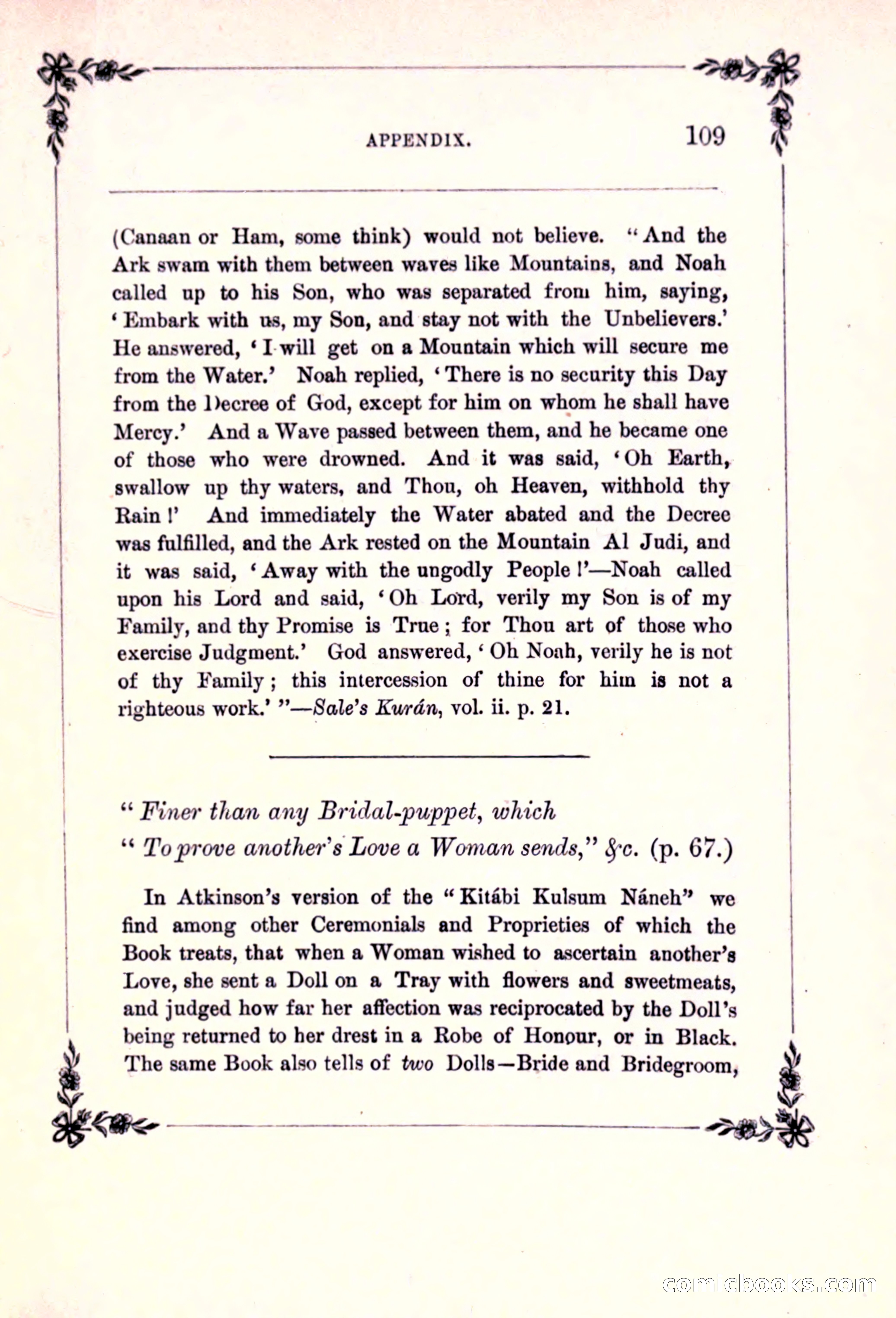
# Analysis of Page 109 This is a prose appendix page from a Victorian scholarly or literary work, not a penny dreadful as initially suggested. The page contains three distinct textual passages: first, a lengthy quotation from Sale's Qur'ān describing Noah's flood narrative; second, a poetic epigraph about bridal dolls; and third, a passage from Atkinson's version of the "Kitábi Kulsum Nánih" describing ceremonial dolls used by women to test reciprocated affection. The page functions as supporting textual evidence or scholarly annotation, likely referenced in the main text proper.
📄 Transcribed text from this page (OCR, searchable)
Machine-transcribed from the original scan — historical spelling and the odd misread are preserved.
0 ee we ee Or Rr APPENDIX. SS ee (Canaan or Ham, some think) would not believe. ‘‘ And the Ark swam with them between waves like Mountains, and Noah called up to his Son, who was separated from him, saying, ‘Embark with us, my Son, and stay not with the Unbelievers.’ He answered, ‘ I-will get on a Mountain which will secure me from the Water.’ Noah replied, ‘There is no security this Day from the Decree of God, except for him on whom he shall have Mercy.’ And a Wave passed between them, and he became one of those who were drowned. And it was said, ‘Oh Earth, swallow up thy waters, and Thou, oh Heaven, withhold thy Rain!’ And immediately the Water abated and the Decree was fulfilled, and the Ark rested on the Mountain Al Judi, and it was said, ‘ Away with the ungodly People !’—Noah called upon his Lord and said, ‘Oh Lord, verily my Son is of my Family, and thy Promise is True; for Thou art of those who exercise Judgment.’ God answered, ‘ Oh Noah, verily he is not of thy Family; this intercession of thine for him is not a righteous work.’ ”—Sale’s Kwrdn, vol. ii. p. 21. “ Finer than any Bridal-puppet, which ‘* To prove another's Love a Woman sends,” §c. (p. 67.) In Atkinson’s version of the “ Kitaébi Kulsum Naneh” we find among other Ceremonials and Proprieties of which the Book treats, that when a Woman wished to ascertain another’s Love, she sent a Doll on a Tray with flowers and sweetmeats, and judged how far her affection was reciprocated by the Doll’s being returned to her drest in a Robe of Honour, or in Black. The same Book also tells of two Dolls—Bride and Bridegroom, : COMICMOOKS.G