
A complete issue · 48 pages · 1928
Life — November 2, 1928
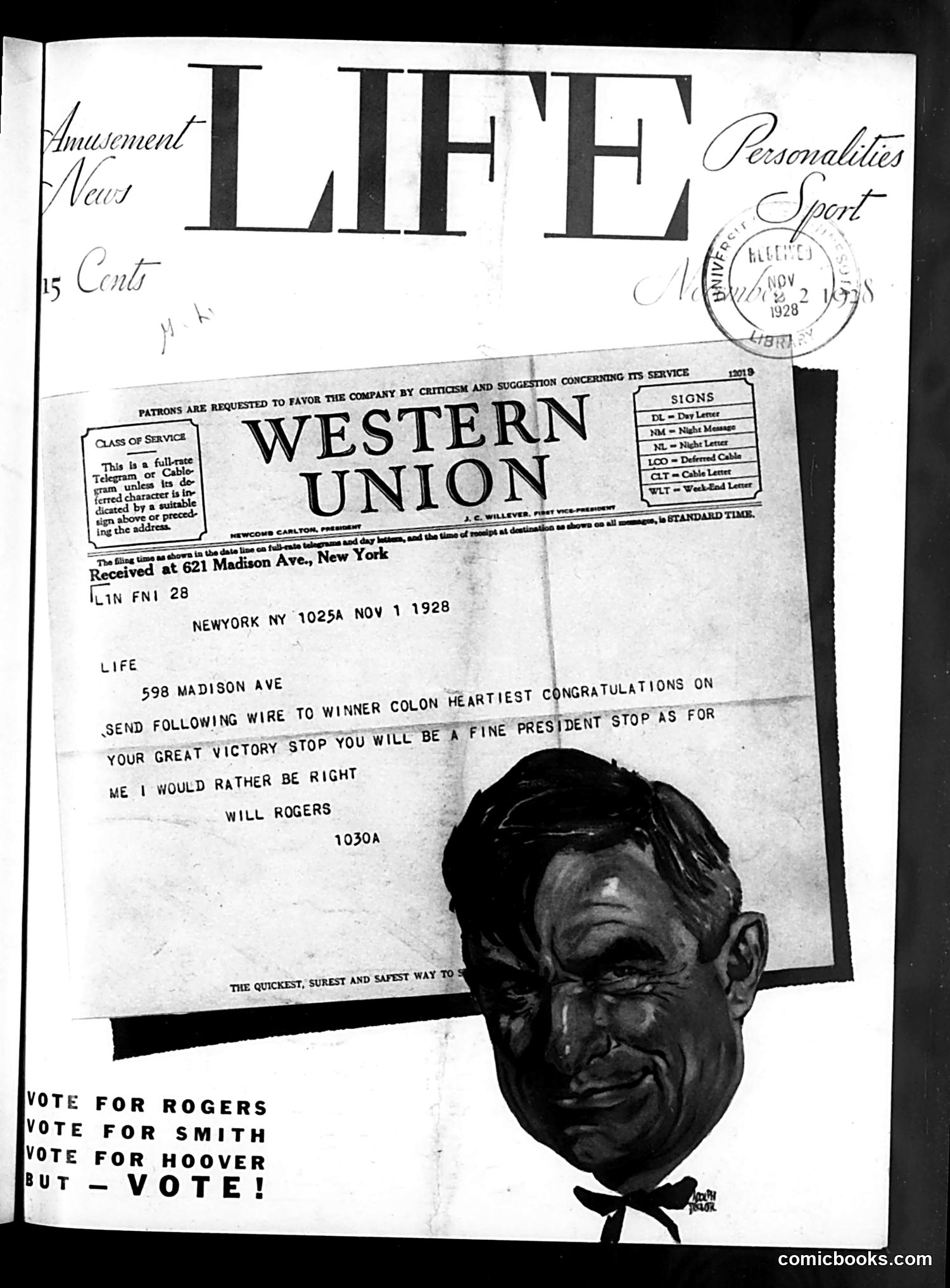
This page is primarily a **political advertisement** from November 1, 1928, featuring a Western Union telegram congratulating "Winner Colon" (likely a misspelling or garbled name) on a "victory stop." The telegram is attributed to **Will Rogers**, the famous humorist and social commentator, with his characteristic joke: "Me I would rather be right" — a quip suggesting he'd prefer accuracy over political victory. Below appears a caricatured face with voting instructions: "VOTE FOR ROGERS / VOTE FOR SMITH / VOTE FOR HOOVER / BUT — VOTE!" This references the 1928 presidential election between Herbert Hoover and Al Smith. Rogers' message emphasizes civic participation over candidate preference, using humor to encourage voting itself rather than endorsing a specific candidate.
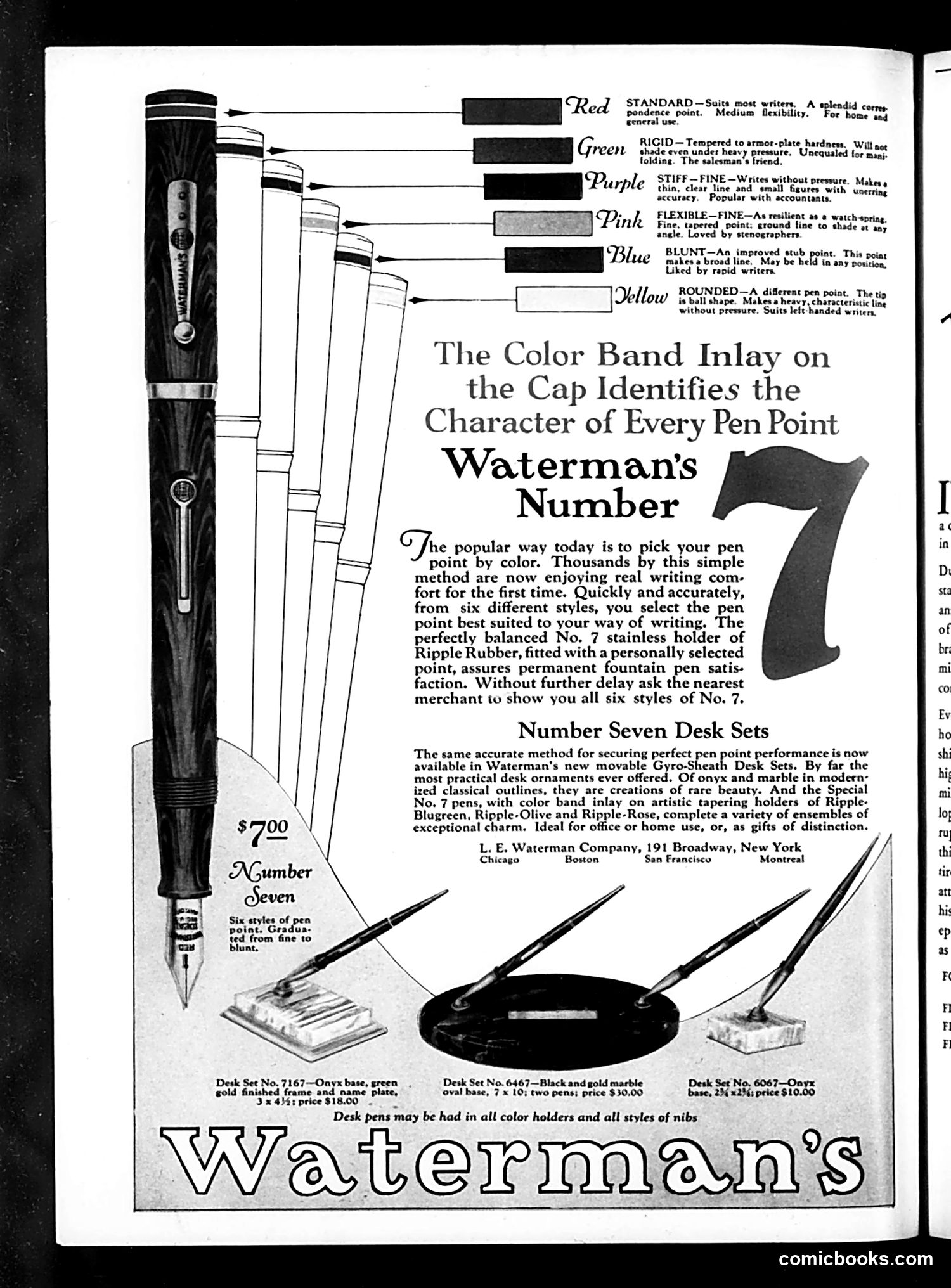
This page is **primarily an advertisement**, not editorial content or political satire. It promotes Waterman's fountain pens, specifically the "Number Seven" model priced at $7.00. The ad explains a color-coding system on pen caps that identifies different nib types (Red=Standard, Green=Rigid, Purple=Stiff, Pink=Flexible, Blue=Blunt, Yellow=Rounded). This allowed customers to quickly select the pen style matching their writing preference. The lower portion showcases "Number Seven Desk Sets" with different ornamental bases (onyx, marble, etc.) ranging from $10-$18. There is **no political cartoon or satire present**—this is straightforward commercial advertising from an era when Life magazine included substantial advertising alongside editorial content.
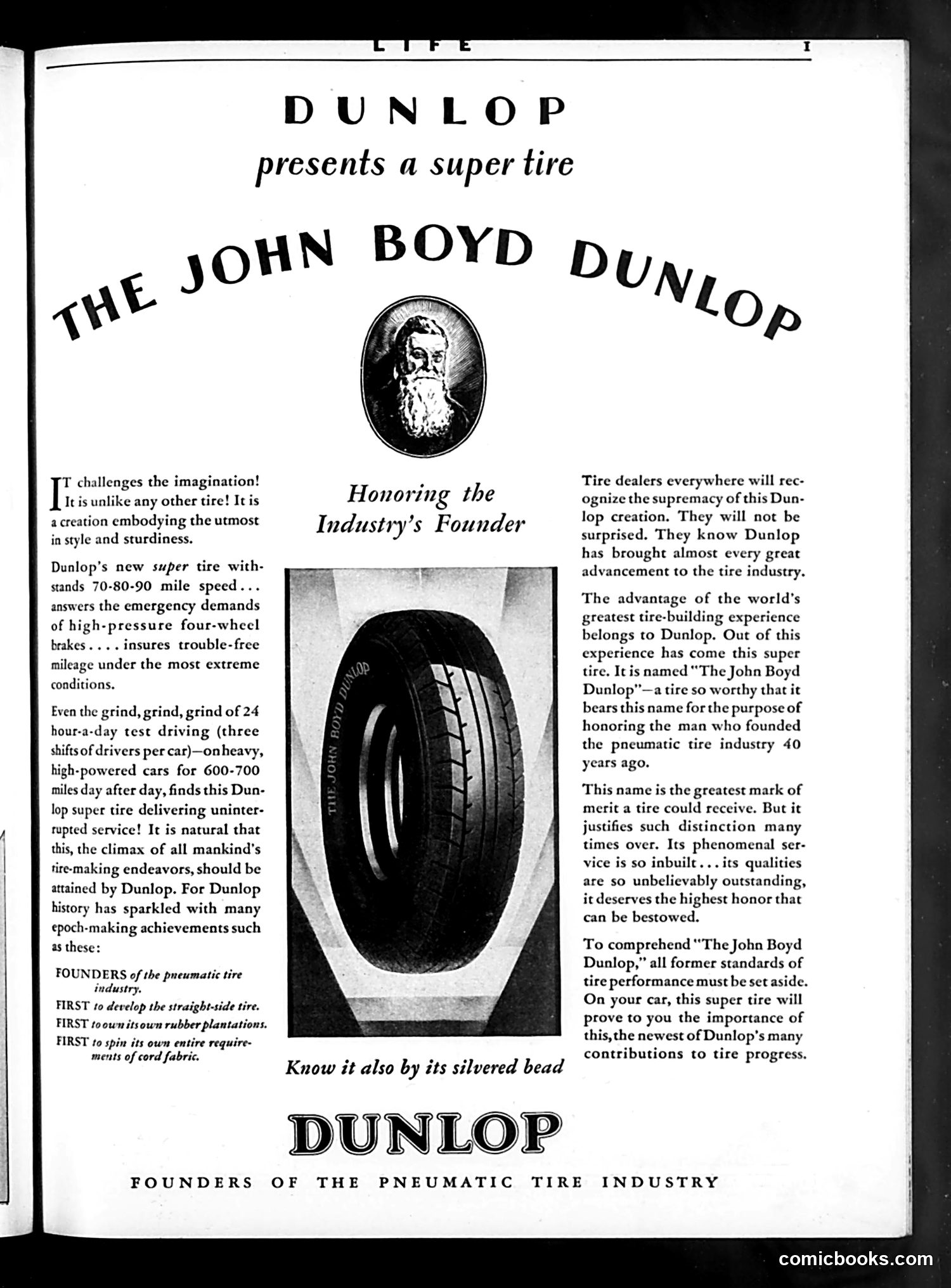
This is **not satire or a political cartoon**—it's a straightforward **advertisement for Dunlop tires**, specifically their "John Boyd Dunlop" brand super tire. The page honors **John Boyd Dunlop**, the historical founder of the pneumatic tire industry (the bearded figure shown in the portrait). The ad claims Dunlop invented the straight-sided tire and developed rubber plantation technology, positioning the company as tire-industry pioneers. The central image shows the tire itself with its "silvered bead" (a distinguishing feature). The copy emphasizes performance specs: 70-90 mph speeds, high-pressure braking capability, and durability under extreme driving conditions. **For modern readers**: This is vintage product marketing using founder veneration and technological achievement claims to establish brand prestige—common advertising strategy that remains recognizable today.
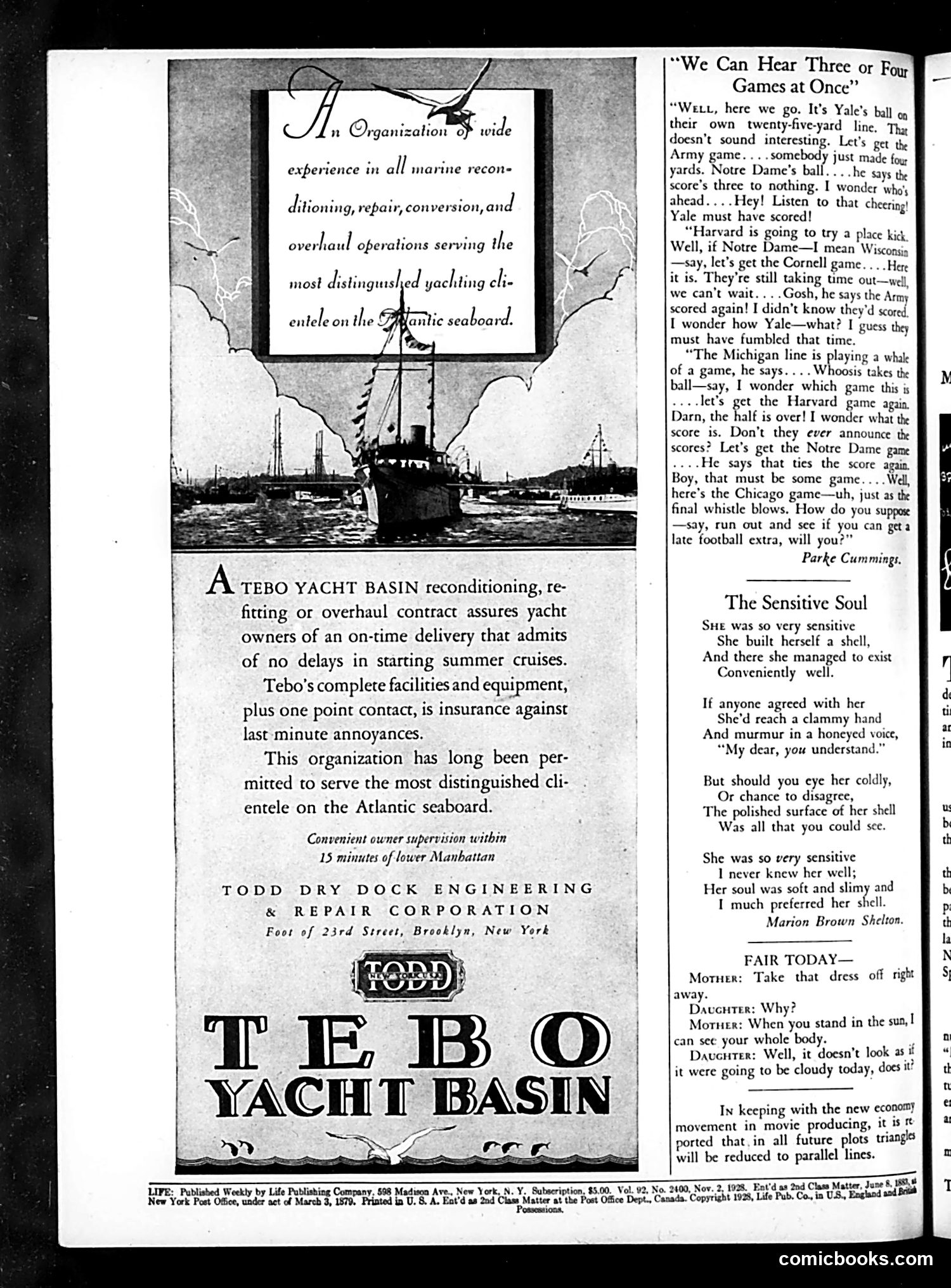
This page is primarily **advertising and literary content**, not political satire. The left side features a **Tebo Yacht Basin advertisement** highlighting marine reconditioning and repair services for yachts in Brooklyn, New York. The ad emphasizes reliability for wealthy clientele seeking summer cruises without delays. The right side contains: 1. **"We Can Hear Three or Four Games at Once"** — a humorous piece by Parke Cummings about simultaneously following multiple college football games (Yale, Army, Notre Dame, Harvard, Michigan, Chicago). This satirizes the era's radio technology and sports obsession among listeners. 2. **"The Sensitive Soul"** — a poem by Marion Brown Shelton about an emotionally delicate woman. 3. **"Fair Today"** — a brief domestic humor dialogue. The page reflects 1920s-era leisure activities and communication.
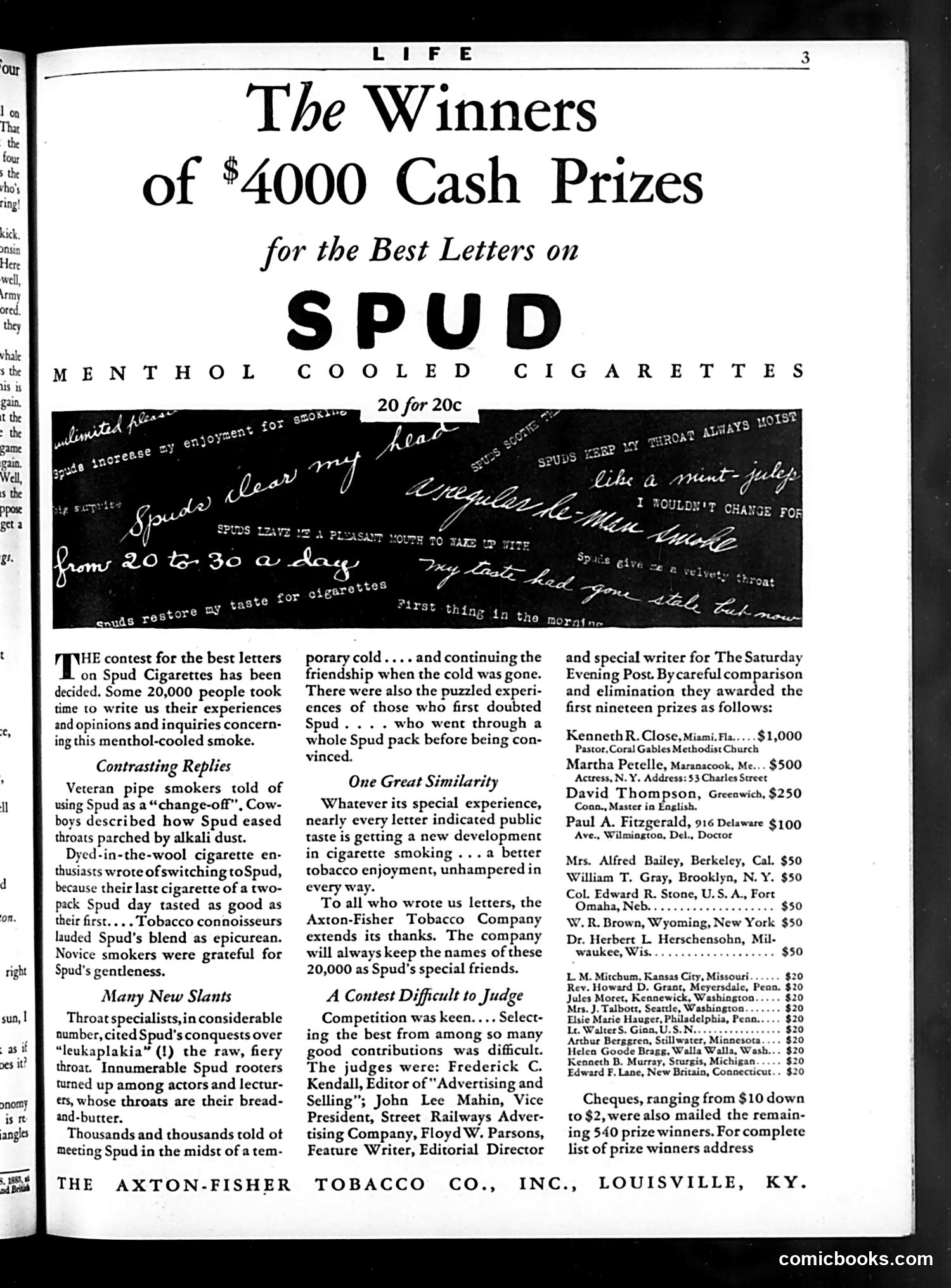
This page is **primarily advertising, not satire or editorial content**. It announces a $4,000 cash-prize contest run by Spud Menthol Cigarettes, seeking letters from smokers about their experiences with the product. The accompanying text describes the contest's success: 20,000 people submitted letters praising Spud cigarettes' cooling properties and throat-soothing effects. Testimonials mention smokers switching from pipes, former doubters becoming convinced, and relief from "alkali dust." The image shows sample handwritten letters (reproduced as promotional quotes) from winning contestants, though individual names and faces are not clearly identifiable in the reproduction. This reflects **mid-20th-century tobacco marketing**, when cigarette companies routinely sponsored consumer contests and prominently featured customer testimonials before modern health warnings existed.
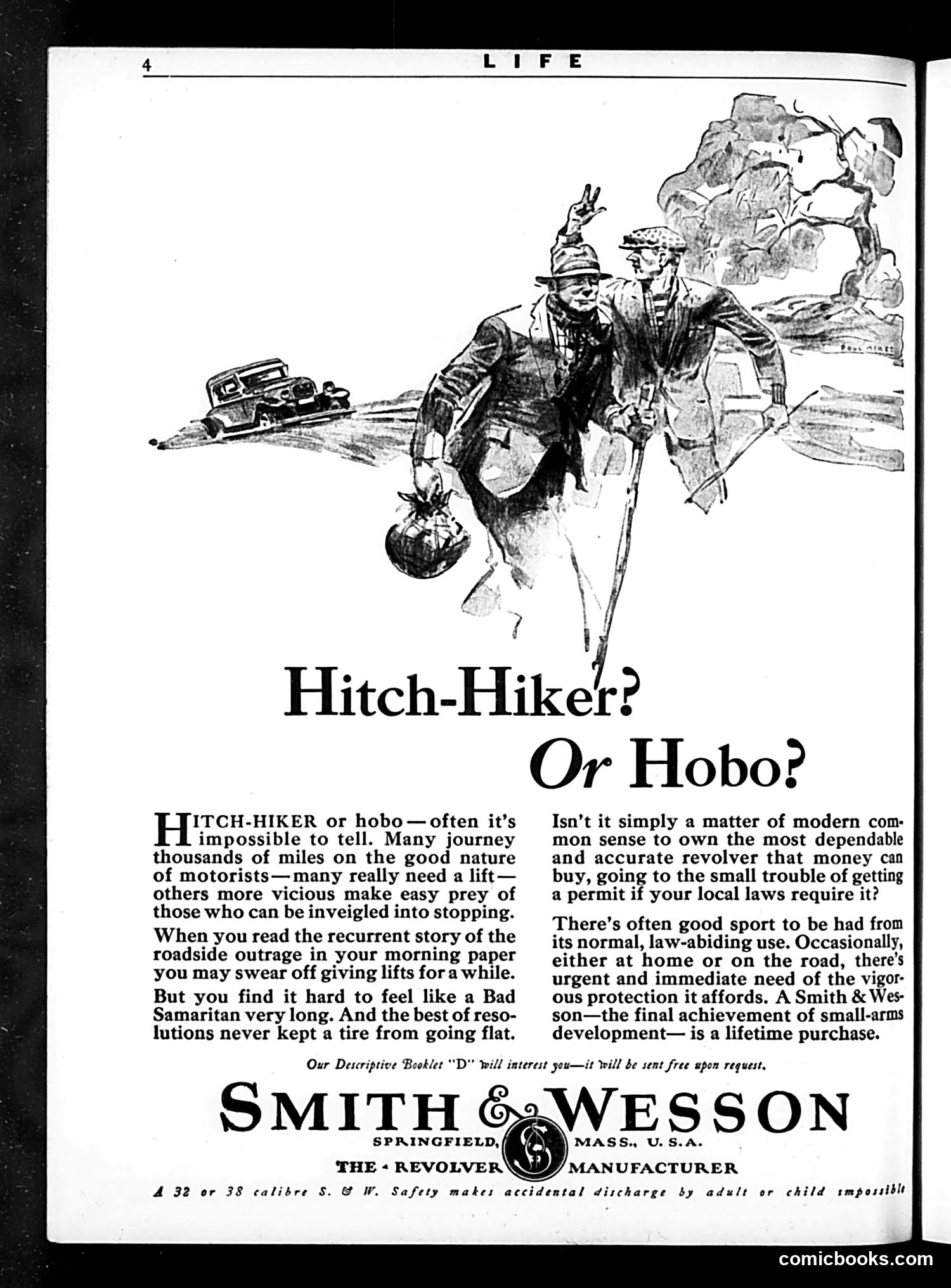
This page is primarily a **Smith & Wesson revolver advertisement** disguised as social commentary. The illustration depicts two figures on a road: one appears to be a traveler or hitchhiker, the other a suspicious vagrant or "hobo." The headline asks "Hitch-Hiker? Or Hobo?" The ad conflates roadside danger with class anxiety—playing on period fears about transient populations. The text suggests carrying a Smith & Wesson revolver for "protection" during travel, framing gun ownership as common sense self-defense against unpredictable strangers. This reflects early-20th-century anxieties about mobility, urban crime, and working-class people on the road. The ad markets firearms by exploiting social paranoia, positioning the gun as a practical travel accessory for safety-conscious motorists.
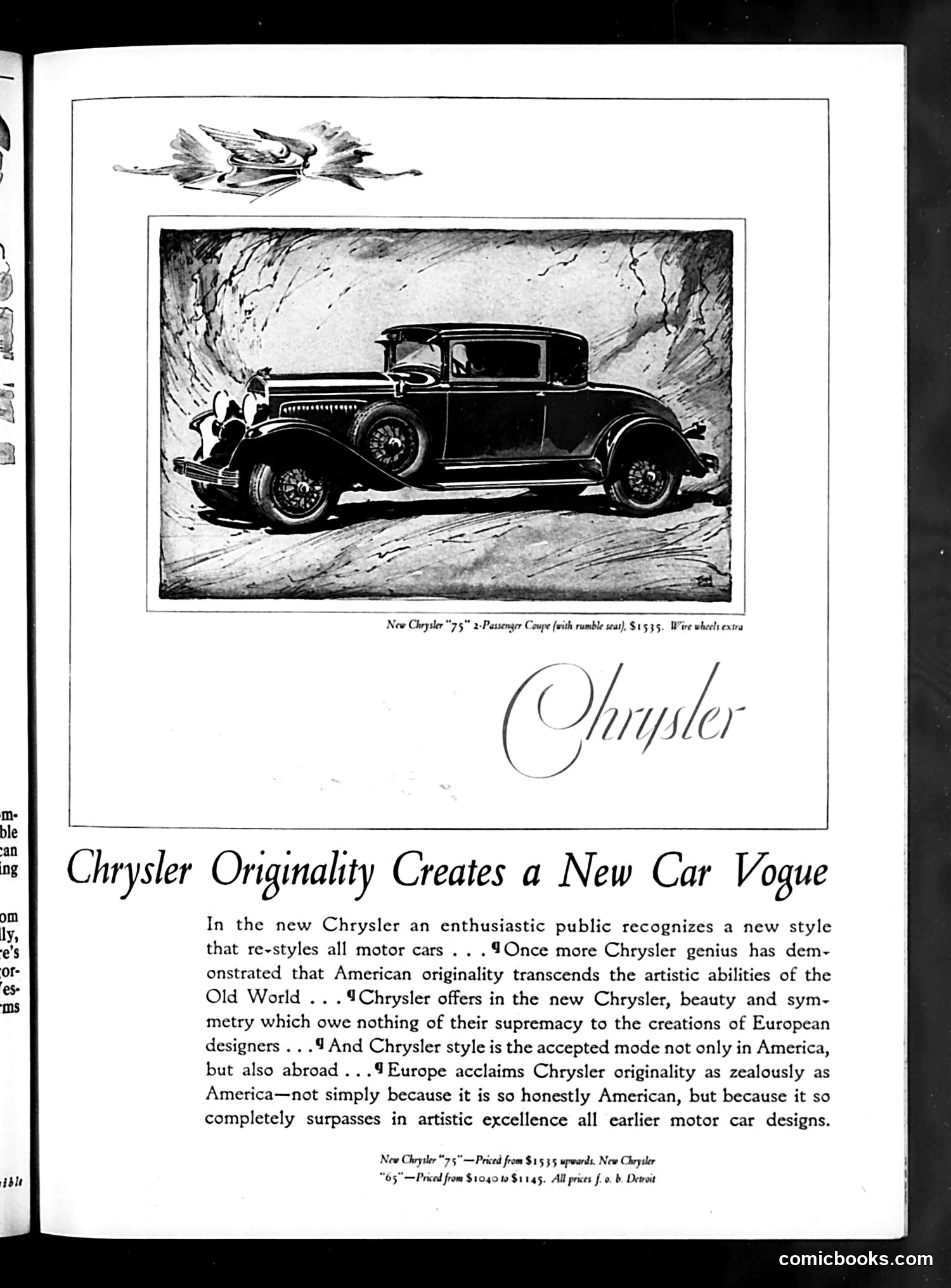
This is a **Chrysler automobile advertisement**, not political satire. The page features a stylized black-and-white illustration of a 1920s Chrysler "75" Passenger Coupe positioned dramatically in what appears to be a cave or rocky setting. The ad's text claims Chrysler has created "a new car vogue" and asserts American automotive originality surpasses European design. It emphasizes that Chrysler style is "accepted" both in America and abroad, and that Europe recognizes Chrysler's "artistic excellence" over "all earlier motor car designs." The decorative bird motif at top is typical 1920s advertising design ornamentation. This represents period advertising rhetoric celebrating American manufacturing innovation and styling during the early automotive era.
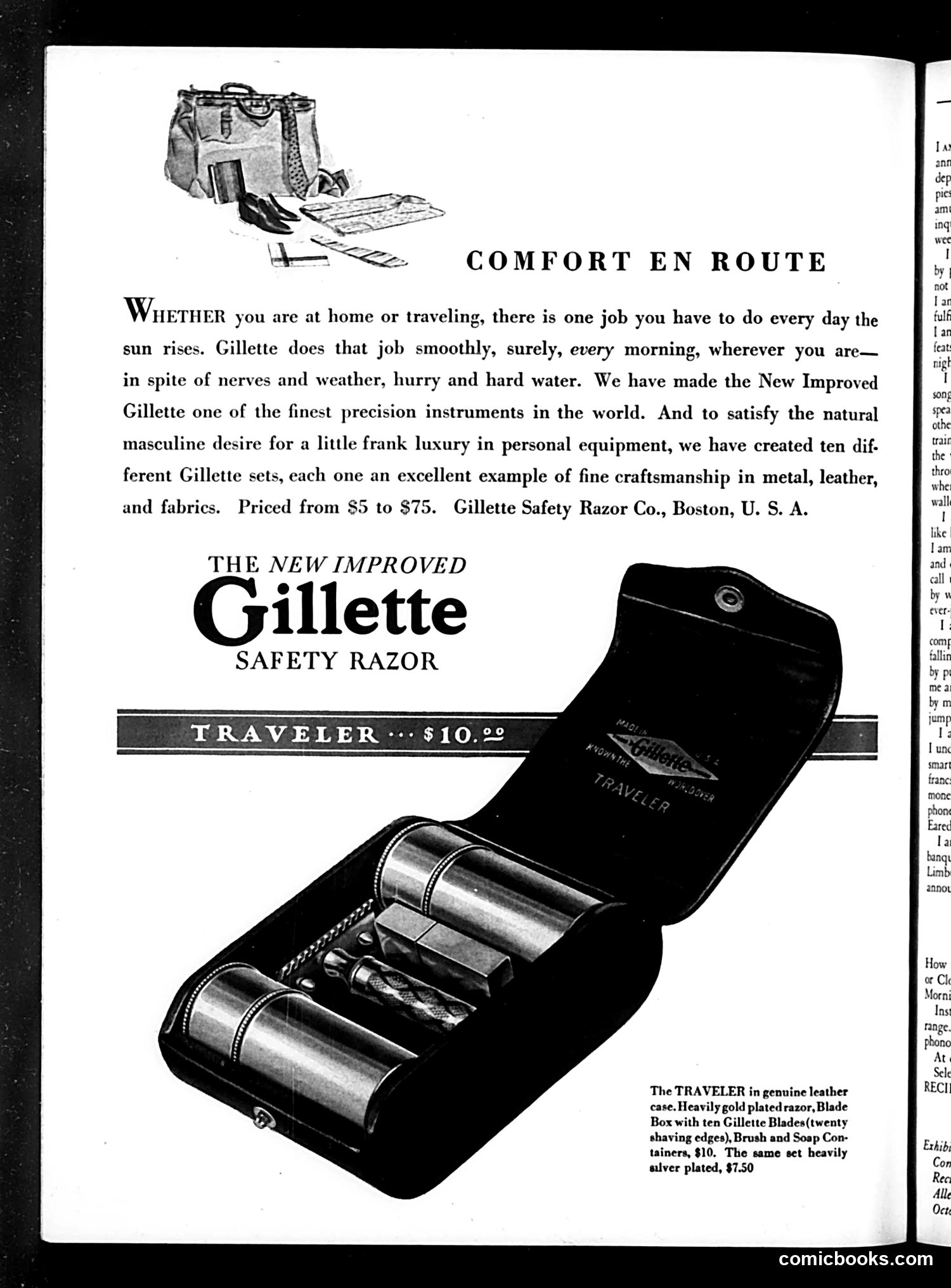
This is a Gillette Safety Razor advertisement, not political satire. The page promotes "The New Improved Gillette Safety Razor" with the heading "Comfort En Route," targeting travelers. The ad emphasizes that shaving is a daily necessity "whether you are at home or traveling" and positions Gillette razors as precision instruments satisfying "the natural masculine desire for a little frank luxury in personal equipment." The featured product is the "Traveler" model priced at $10.95, shown in a leather case containing two cylindrical razor holders, blades, brush, and soap containers. The text describes it as "heavily gold plated" with "ten Gillette Blades," also available in silver plate for $7.50. This is straightforward commercial marketing, not commentary or satire.
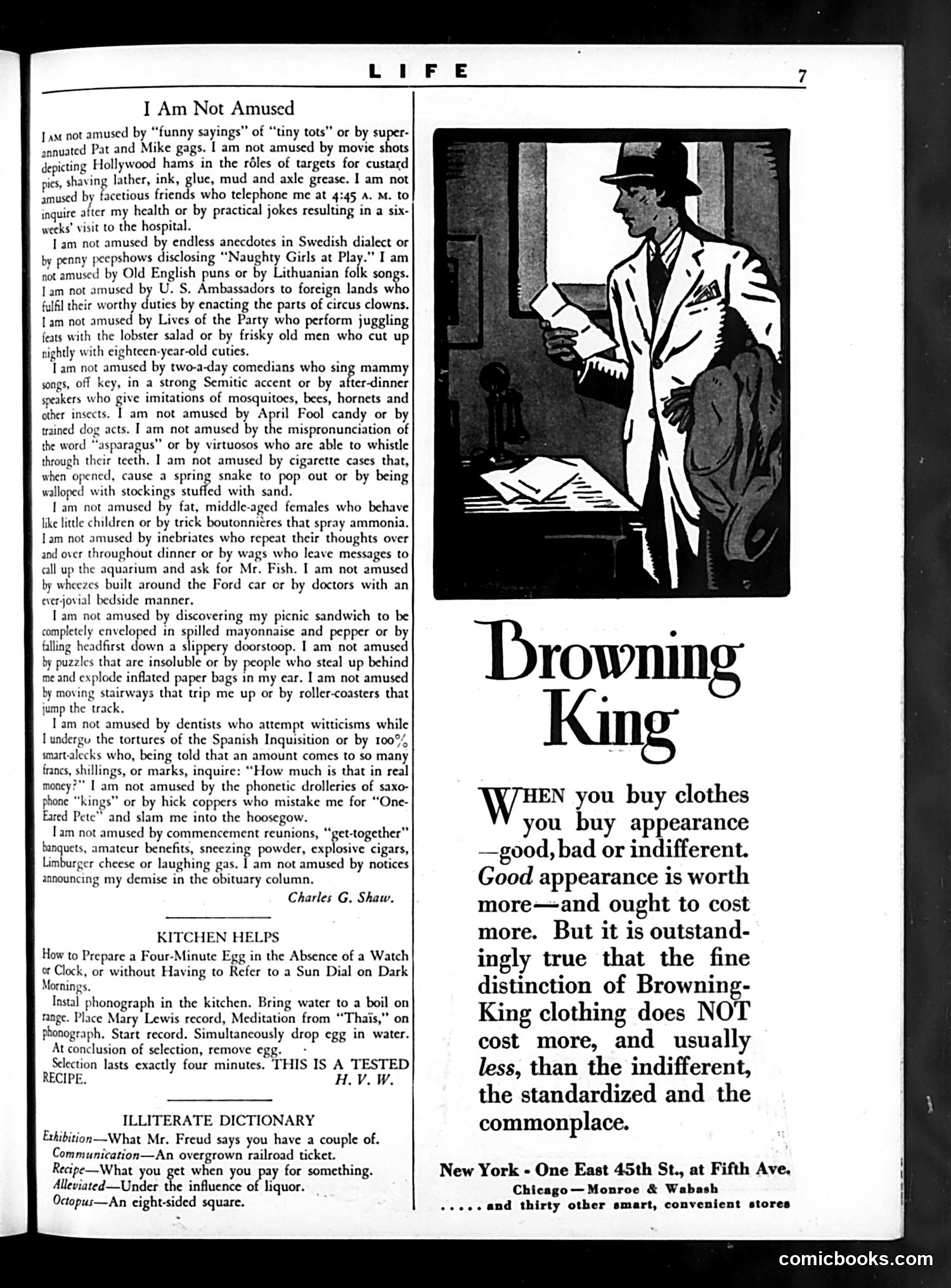
This page contains an essay titled "I Am Not Amused" by Charles G. Shaw, satirizing things the author finds tedious rather than funny—including bad comedians, pratfalls, dated jokes, and various social annoyances. The illustration depicts a well-dressed man in a suit and fedora, appearing somewhat disdainful or skeptical. This figure likely represents Shaw himself or the persona of a refined person above such "common" amusements. The page also features a **Browning King advertisement** for men's clothing, claiming their garments offer "fine distinction" while costing *less* than inferior brands—a typical early-20th-century appeal to both status consciousness and thriftiness. The "Illiterate Dictionary" section provides humorous definitions, adding light mockery of everyday misused terms.
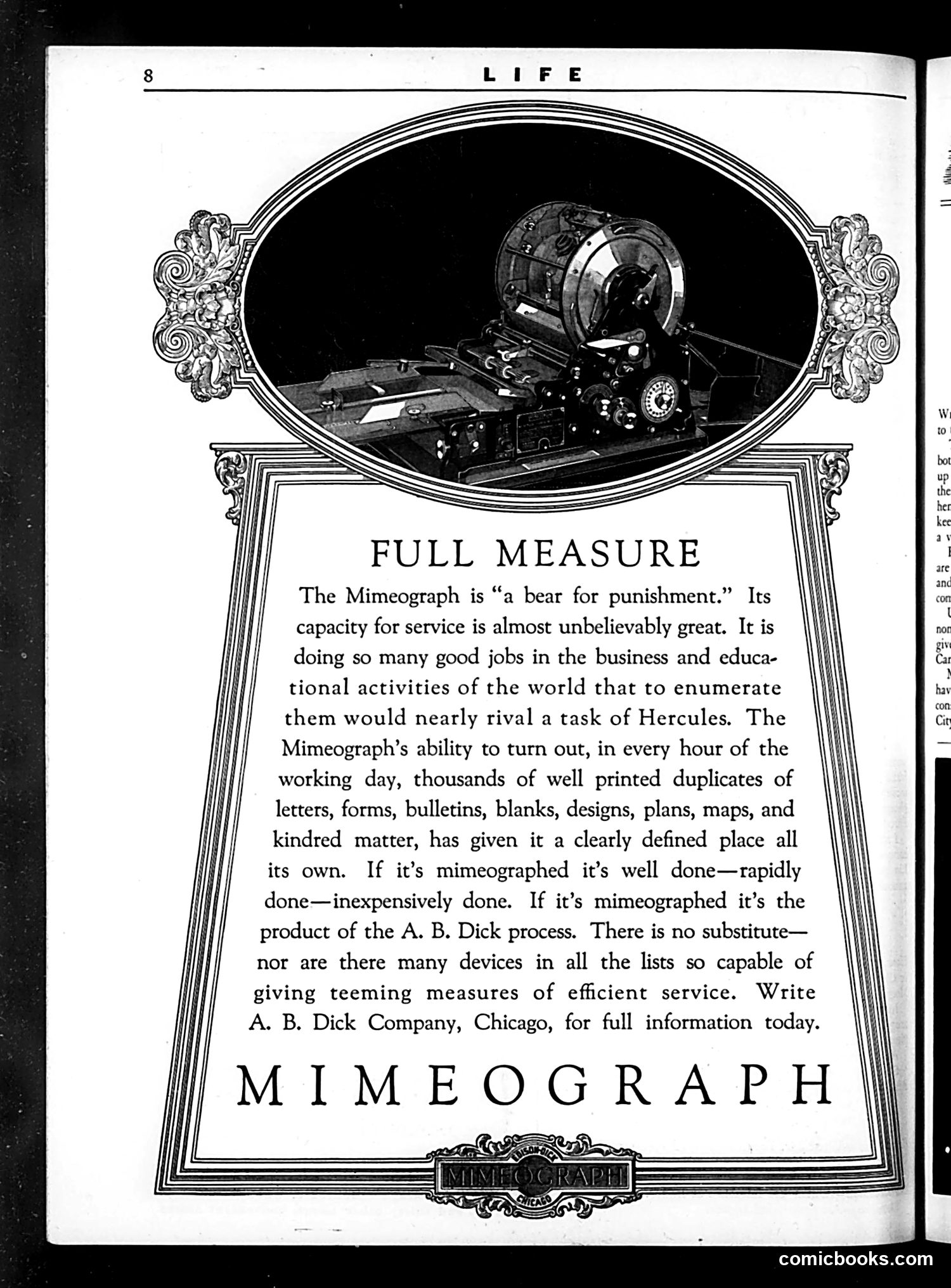
This is primarily an **advertisement, not satire or political commentary**. The page features a product called the Mimeograph machine, manufactured by the A. B. Dick Company of Chicago. The ad uses promotional language describing the mimeograph as highly efficient for producing duplicates of documents, forms, and designs. The oval image at top shows the machine itself. The headline "Full Measure" and text emphasizing the device's reliability and cost-effectiveness are standard advertising copy from the early 20th century, when mimeographs were essential office technology. **For modern readers**: This represents pre-photocopier era office equipment—the mimeograph was how organizations made bulk document copies before xerography became standard.
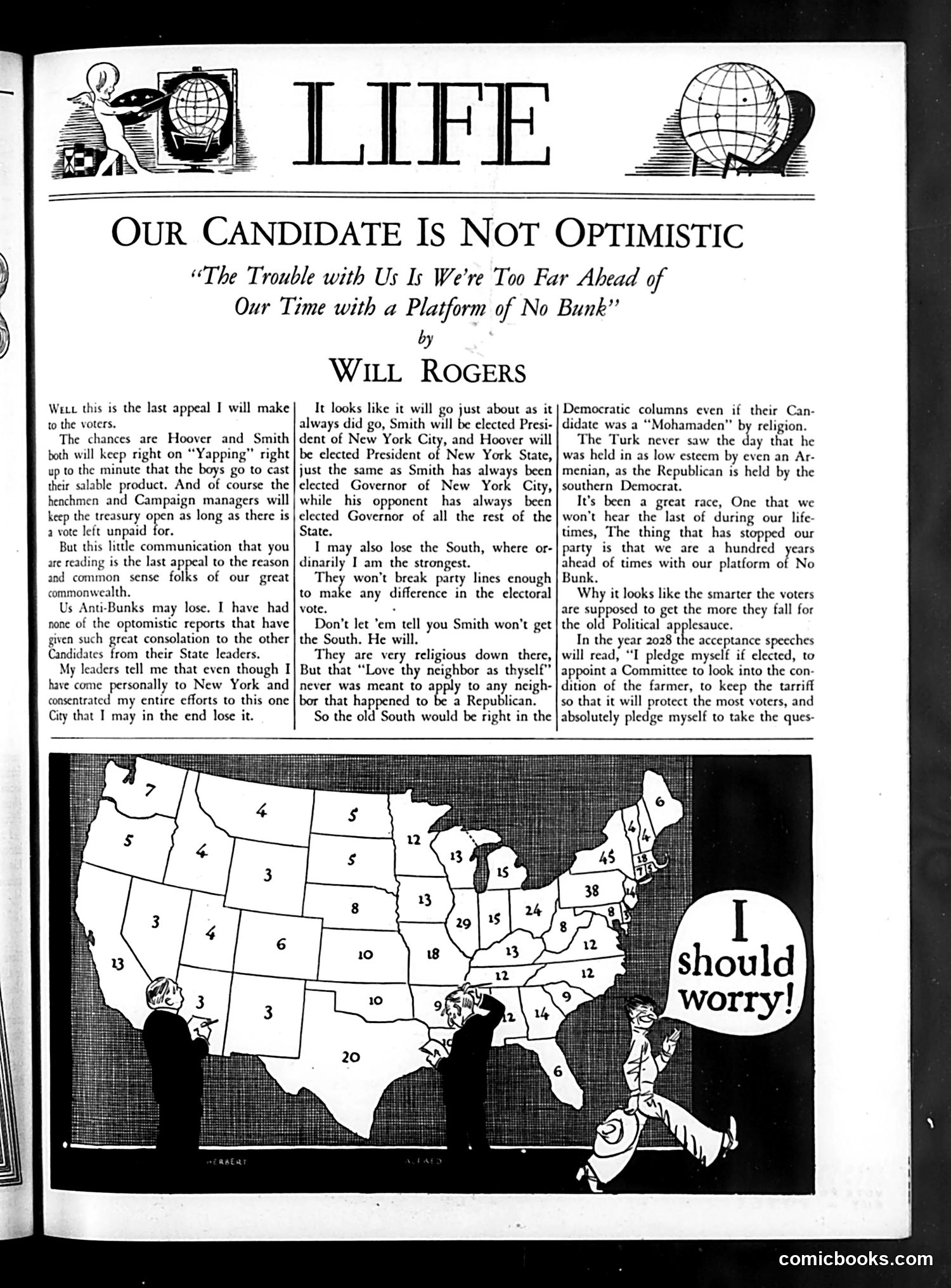
This is Will Rogers's satirical commentary on the 1928 U.S. presidential election, expressing pessimism about his party's candidate and platform. **The figures:** Rogers discusses Hoover and Smith as the two main candidates, with Smith appearing to be the Democratic nominee. **The satire:** Rogers claims Democrats are "a hundred years ahead of times with our platform of No Bunk"—meaning their progressive policies are too radical for voters to accept. He worries the South (shown on the electoral map) will abandon Democrats, and that even appealing to religious voters won't help if Smith is perceived as non-Christian. **The joke:** The cartoon shows a worried figure examining the electoral map saying "I should worry!"—expressing resignation that defeat is inevitable despite having superior ideas.
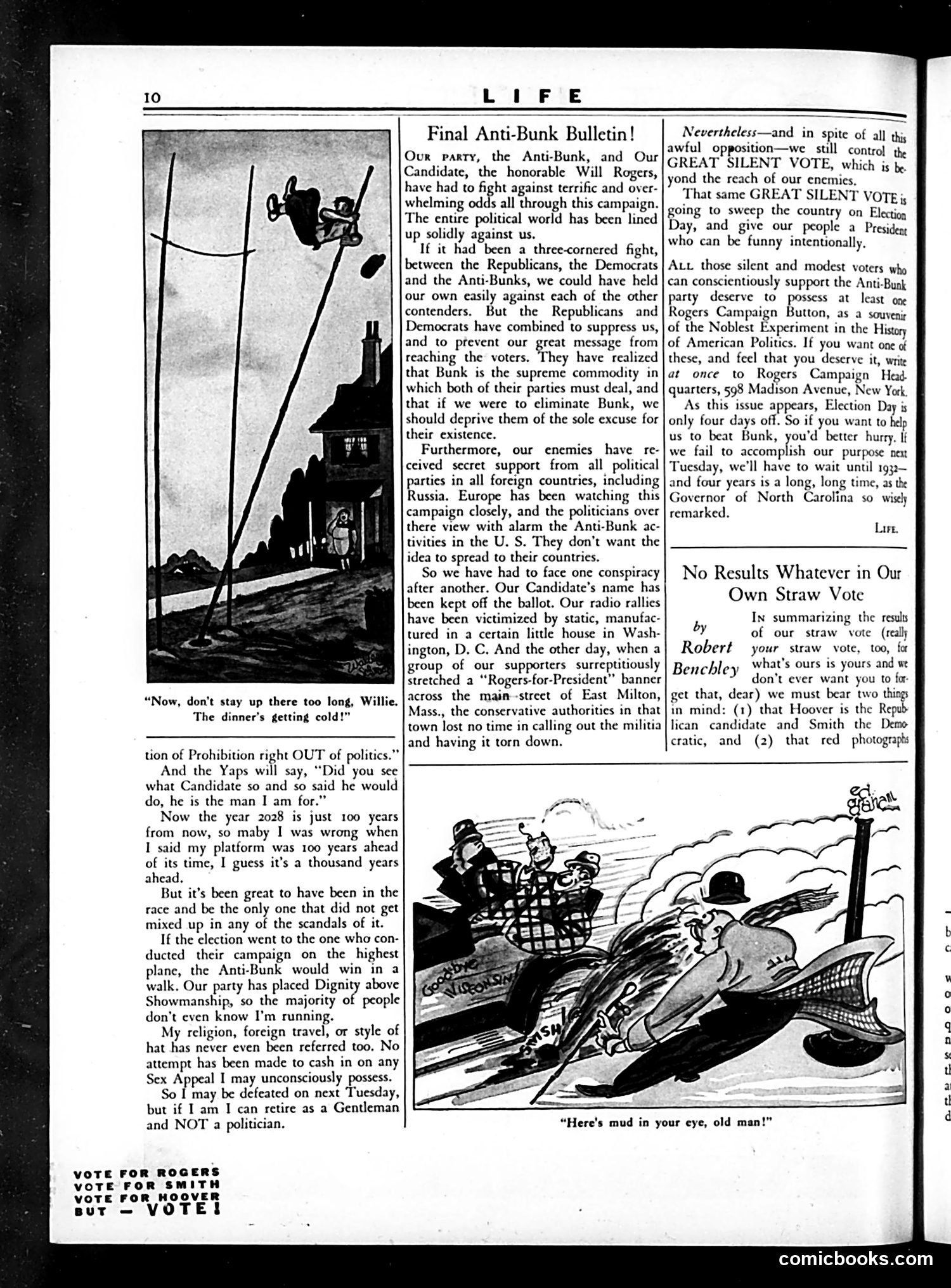
This page contains Anti-Bunk party campaign material supporting candidate Will Rogers for president. The top cartoon depicts a house being searched or attacked by authorities, illustrating the text's complaint that the Anti-Bunk campaign faces opposition from Republicans and Democrats who have "combined to suppress us." The bottom cartoon shows people in a car labeled "PROSPERITY" stuck in mud, with the caption "Here's mud in your eye, old man!" This satirizes mainstream political promises—suggesting that prosperity claims are illusory or mired in failure. The text argues that the Anti-Bunk platform, placed "100 years ahead of its time," emphasizes dignity over showmanship, contrasting with competitors' campaigns. The page criticizes political scandal-mongering while advocating for the "GREAT SILENT VOTE."
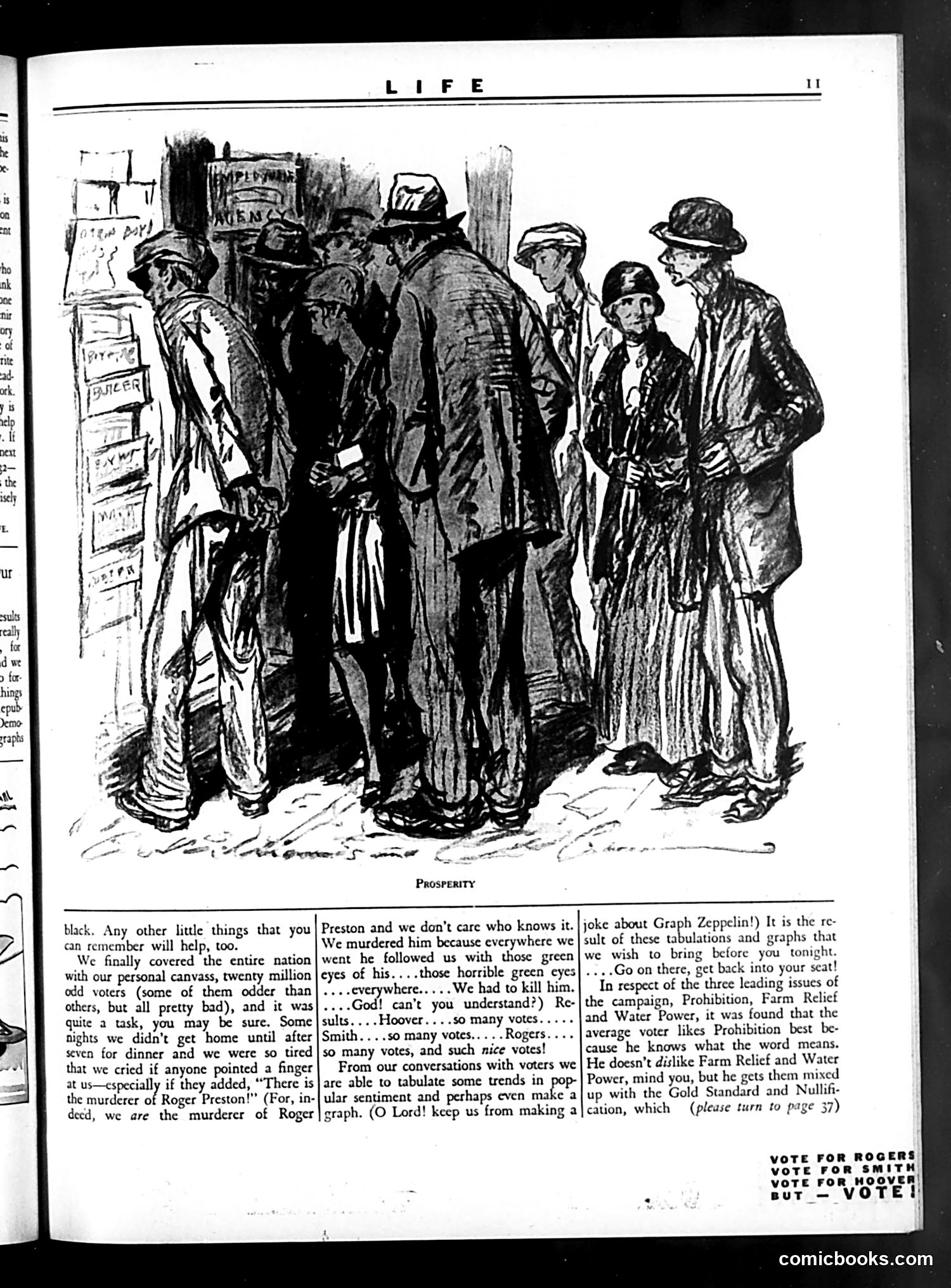
This satirical cartoon depicts a crowd of working-class men gathered around what appears to be a campaign poster or notice board (visible on the left). The illustration critiques claims of national "prosperity" during an election cycle. The accompanying text discusses voting fraud and campaign manipulation, referencing candidates Rogers, Smith, and Hoover. The article sarcastically describes how voters were "murdered" politically through deception, with repeated mentions of "votes" and manipulation. The bottom caption reads "VOTE FOR ROGERS / VOTE FOR SMITH / VOTE FOR HOOVER / BUT—VOTE!"—mocking how politicians compete while ordinary citizens feel powerless. The cartoon suggests that despite claims of national prosperity, ordinary workers were skeptical of political promises and cynical about electoral choices.
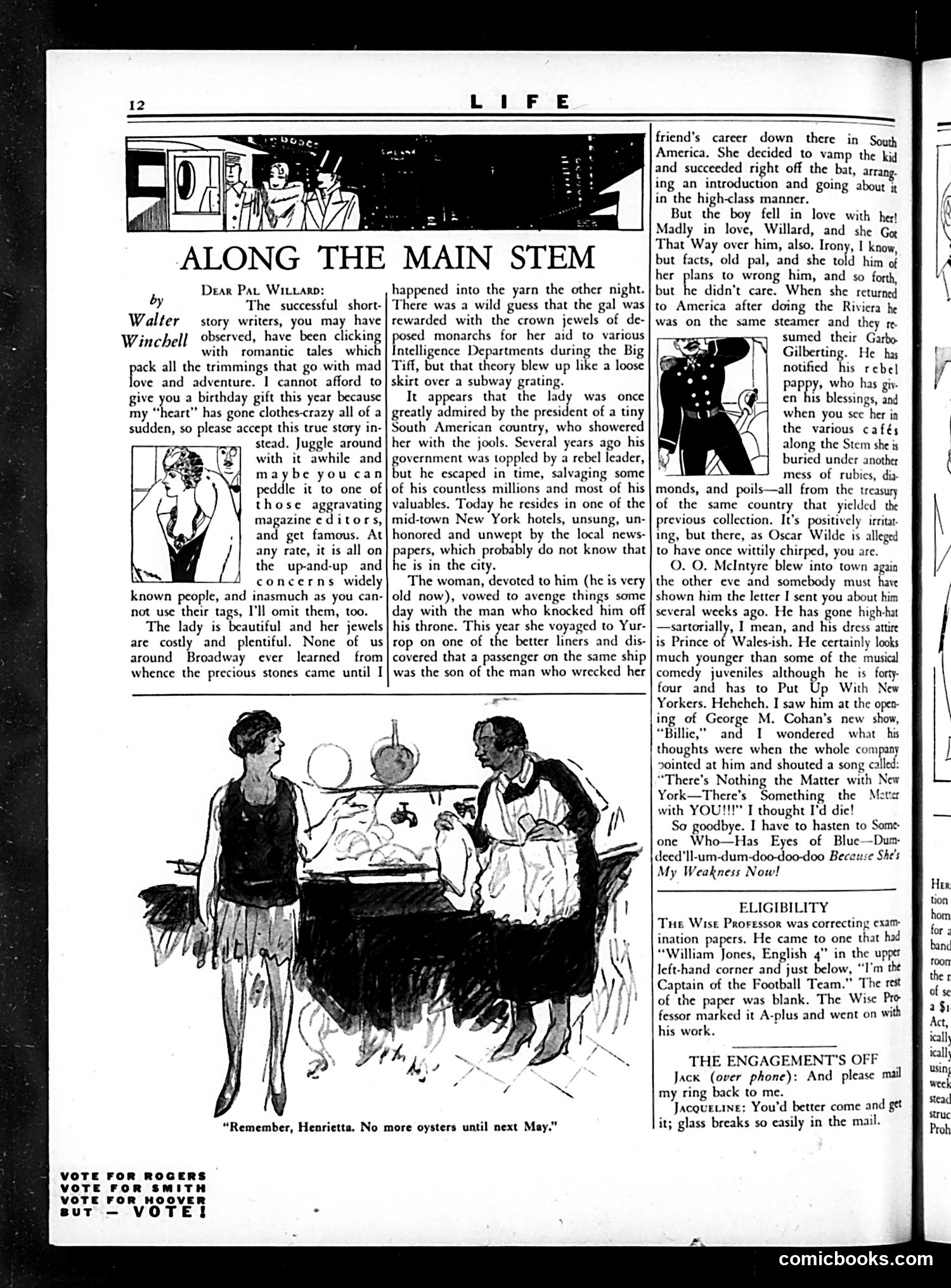
This page features a gossip column by Walter Winchell, a famous Broadway columnist. The main cartoon illustration shows two women at what appears to be a dining table, with the caption "Remember, Henrietta. No more oysters until next May." The joke references the old saying that oysters should only be eaten in months containing the letter "R" (September through April), as oysters in warm months were considered unsafe or unpalatable. The column itself discusses various theatrical figures and romantic entanglements on Broadway. The "Eligibility" and "Engagement's Off" sections are brief gossip items typical of Winchell's style—mixing theatrical news with society chitchat about relationships and engagements.
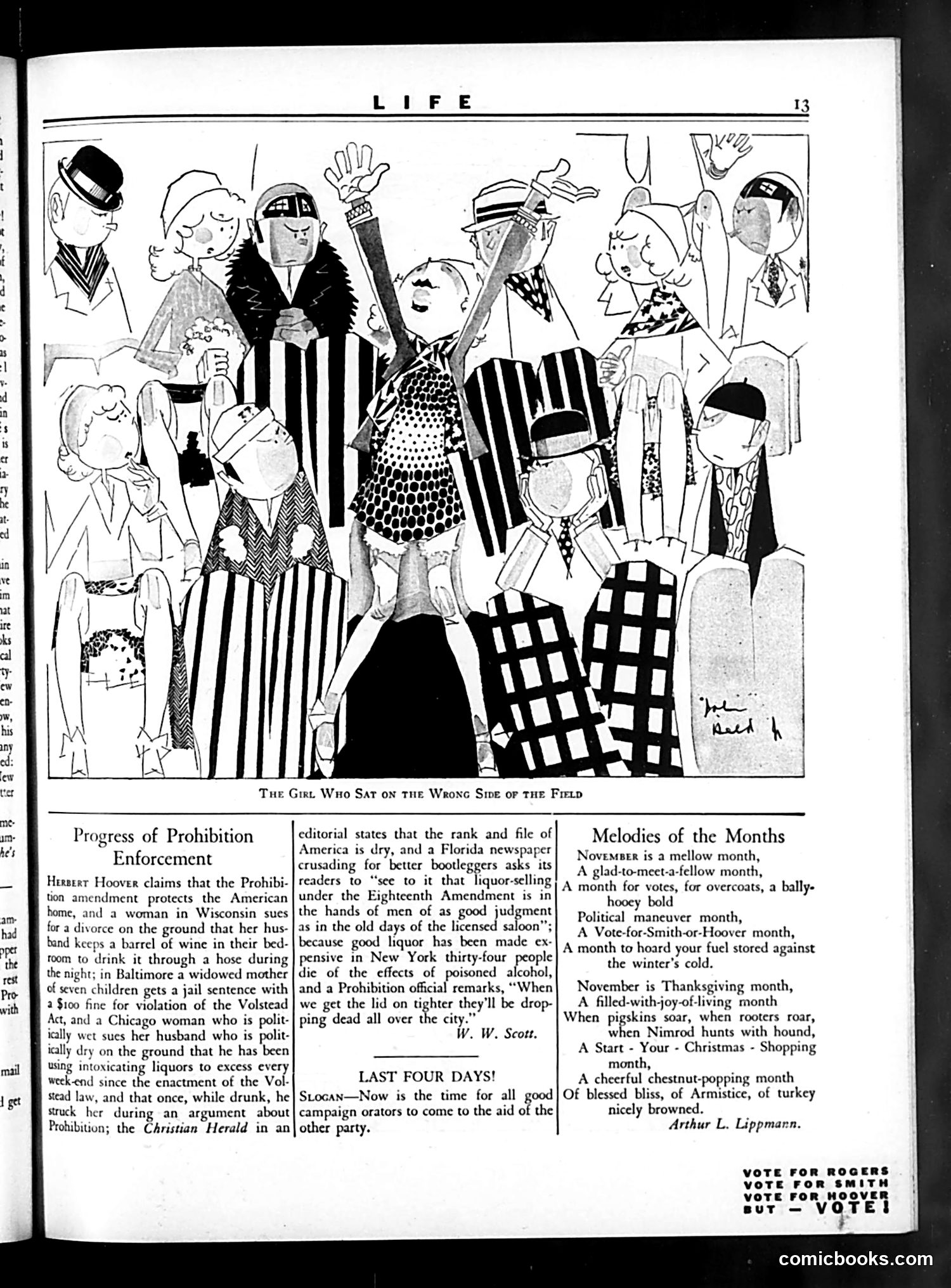
This cartoon satirizes a young woman at what appears to be a baseball game or sporting event, surrounded by enthusiastic male spectators in period dress (1920s style). The woman sits among men wearing striped uniforms (possibly umpires or officials) and is raising her arms enthusiastically, matching their excited gestures. The joke likely mocks either: - A woman attending a sporting event "inappropriately" or entering male-dominated spaces - Overly enthusiastic female sports fans during the era when women's participation in sports culture was still novel The accompanying articles address Prohibition enforcement and the 1928 election ("Vote for Rogers/Smith/Hoover"), reflecting contemporary political debates of the period.
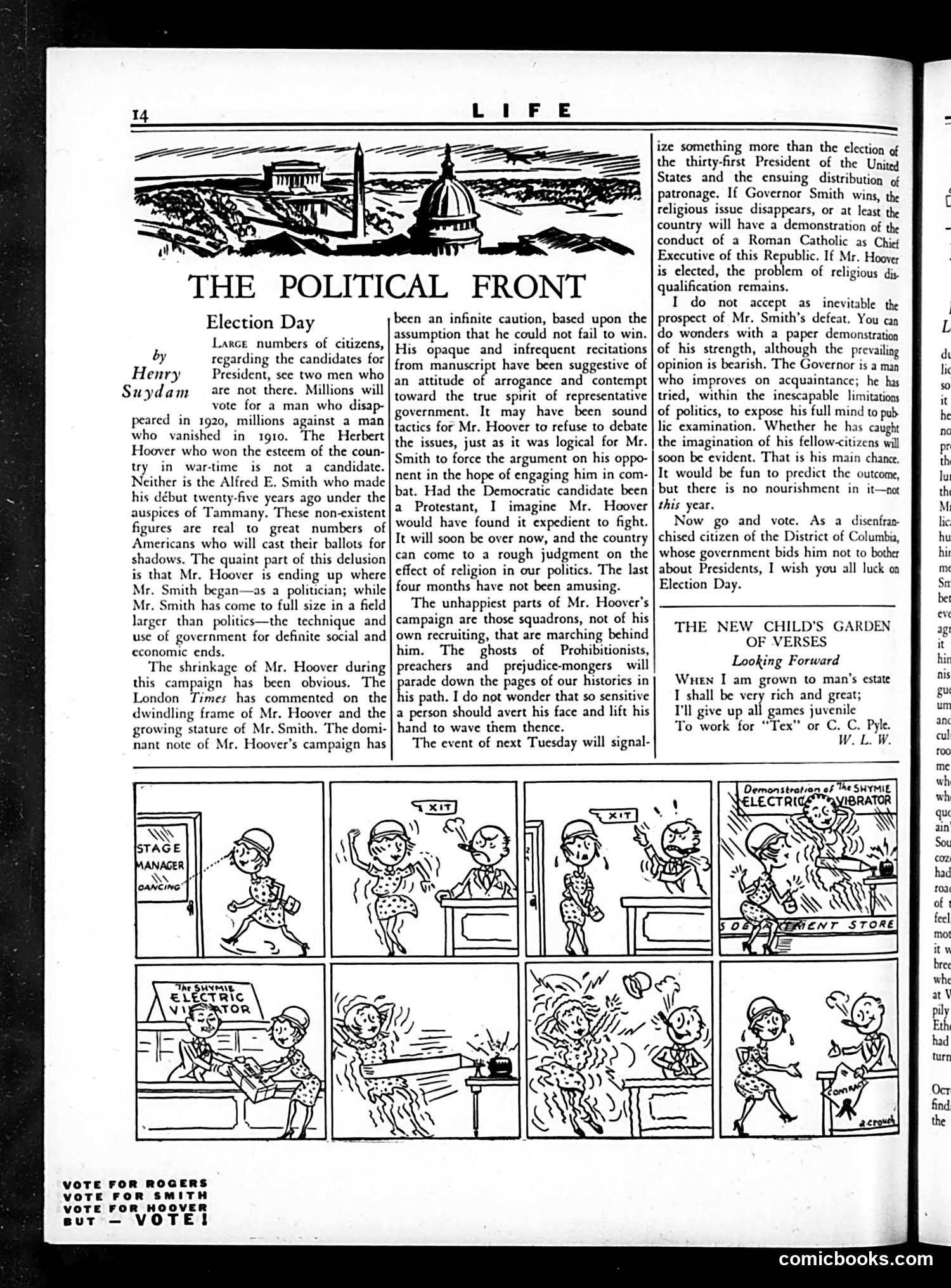
This Life magazine page addresses the 1928 U.S. presidential election. Henry Suydam's article discusses candidates Rogers, Smith, and Hoover, arguing that Smith (a Roman Catholic) faces religious prejudice that overshadows substantive political debate. The comic strip below satirizes the chaos of election season—showing a "stage manager" overwhelmed as candidates literally run amok through various campaign venues (a store, voting location). The figures become increasingly frenzied, suggesting elections descend into carnival-like disorder rather than serious deliberation. The bottom text emphasizes voting's importance regardless of candidate choice, countering the article's implication that religious bias clouds voters' judgment. Together, the content critiques how personality and prejudice, not policy, dominate American elections.
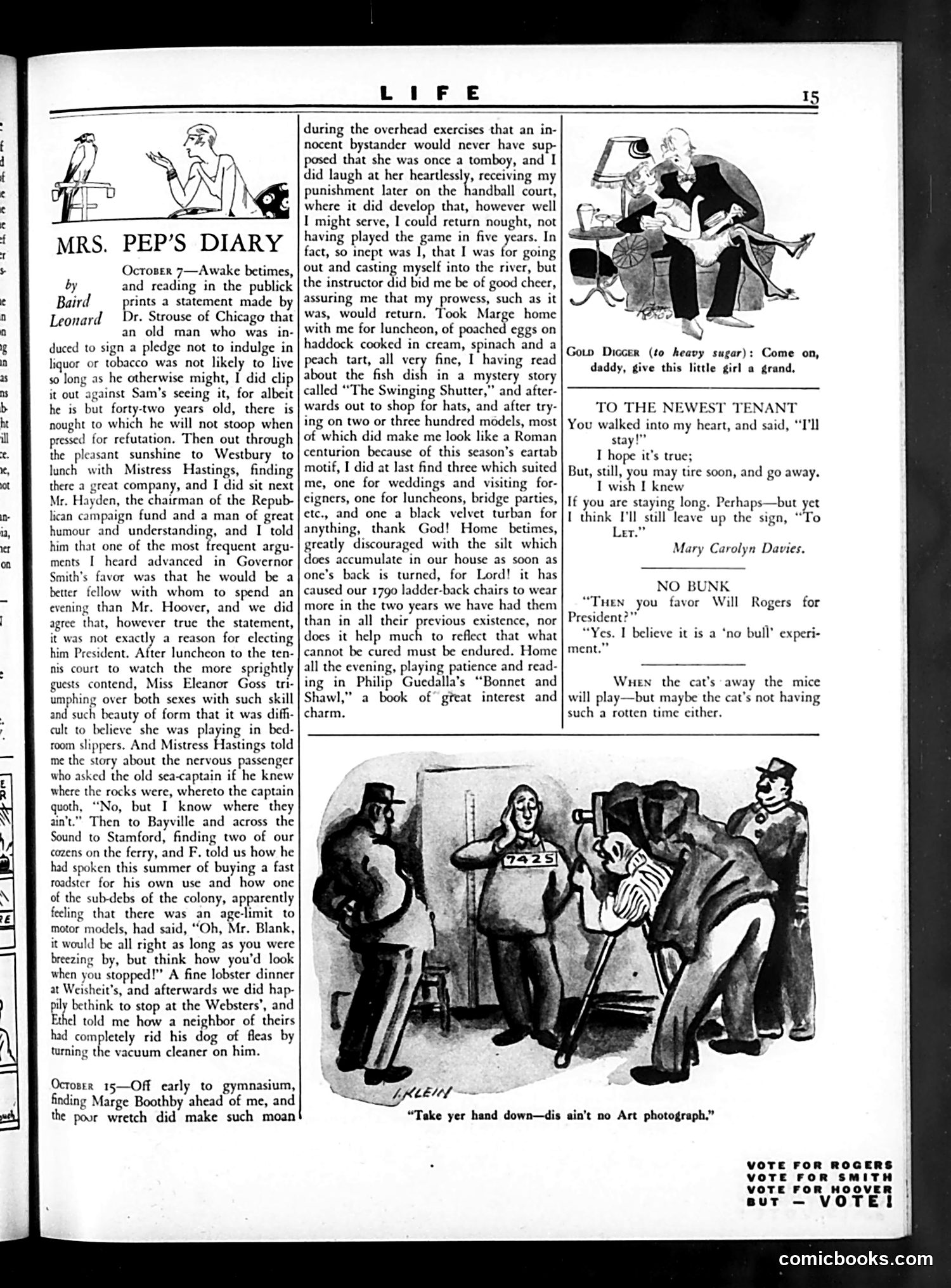
This page contains "Mrs. Pep's Diary" by Darrell Leonard, a satirical domestic column, and two unrelated cartoon/joke sections. The main cartoon shows three well-dressed men confronting a woman at what appears to be a social gathering. The caption reads: "Take yer hand down—dis ain't no Art photograph." The joke satirizes pretentious artistic posing—the woman is striking an exaggerated "artistic" pose for what she assumes is a formal portrait, but the men are indicating her behavior is inappropriately theatrical for the social occasion. The bottom section advertises voting for "Rogers," "Smith," "Hoover"—likely referencing the 1928 U.S. presidential election, with Hoover being Herbert Hoover, the Republican candidate who won that year. The diary entries and poetry are typical period social satire about domestic life and romantic scenarios.
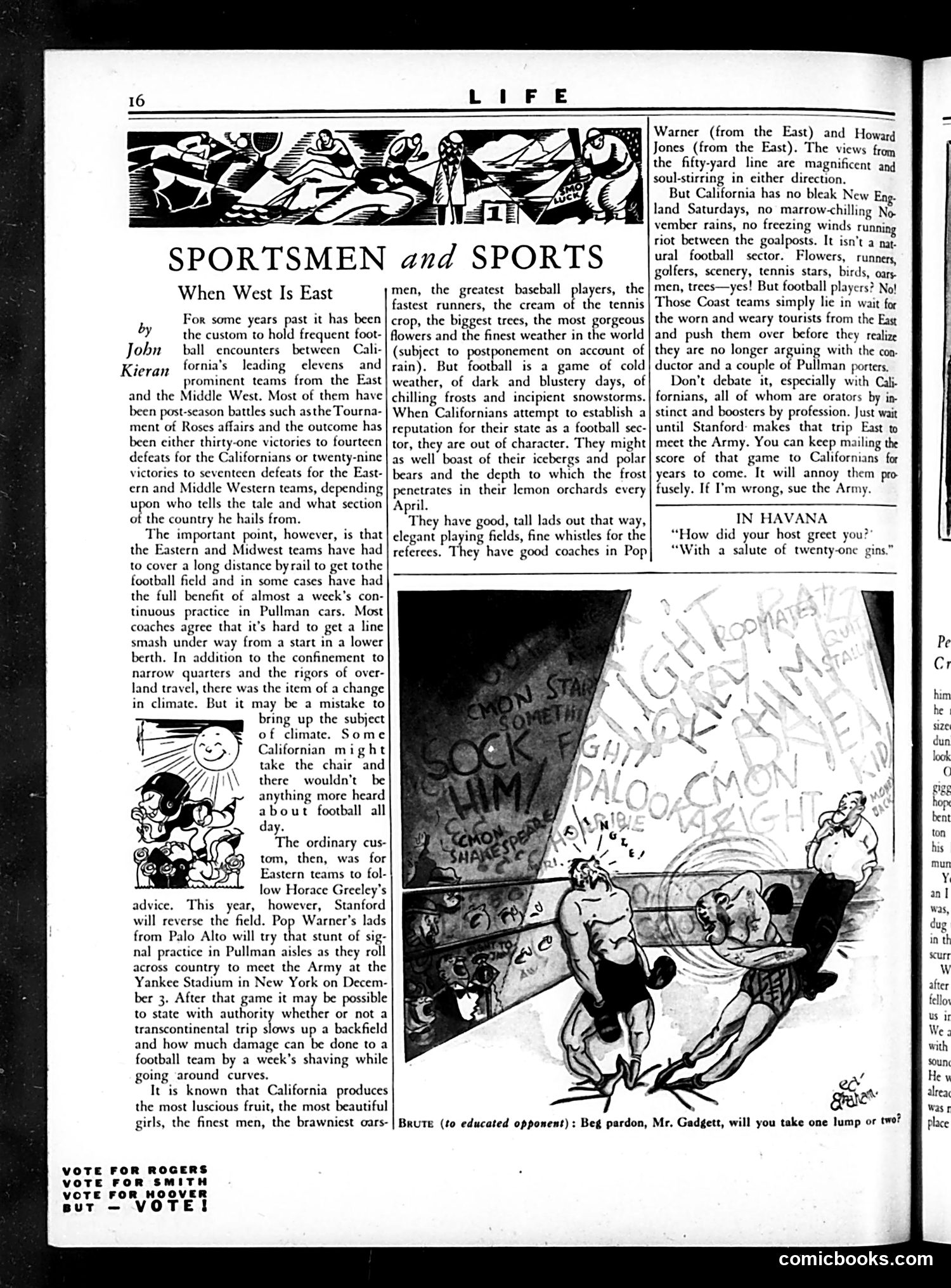
This satirical piece by John Kieran compares Eastern and Western football teams, arguing that California football lacks the competitive rigor of Eastern teams. The author claims Western teams are unprepared for Eastern conditions—suggesting they're soft, unaccustomed to cold weather and difficult travel. The main cartoon depicts what appears to be an "educated opponent" (labeled "Brute") being offered "lumps" of sugar, satirizing the notion that Western teams coddle their players compared to the tougher Eastern approach. The piece is primarily sports commentary rather than political satire, though it reflects regional rivalry stereotypes common in early 20th-century American sports writing. The bottom includes voting instructions unrelated to the article's content.
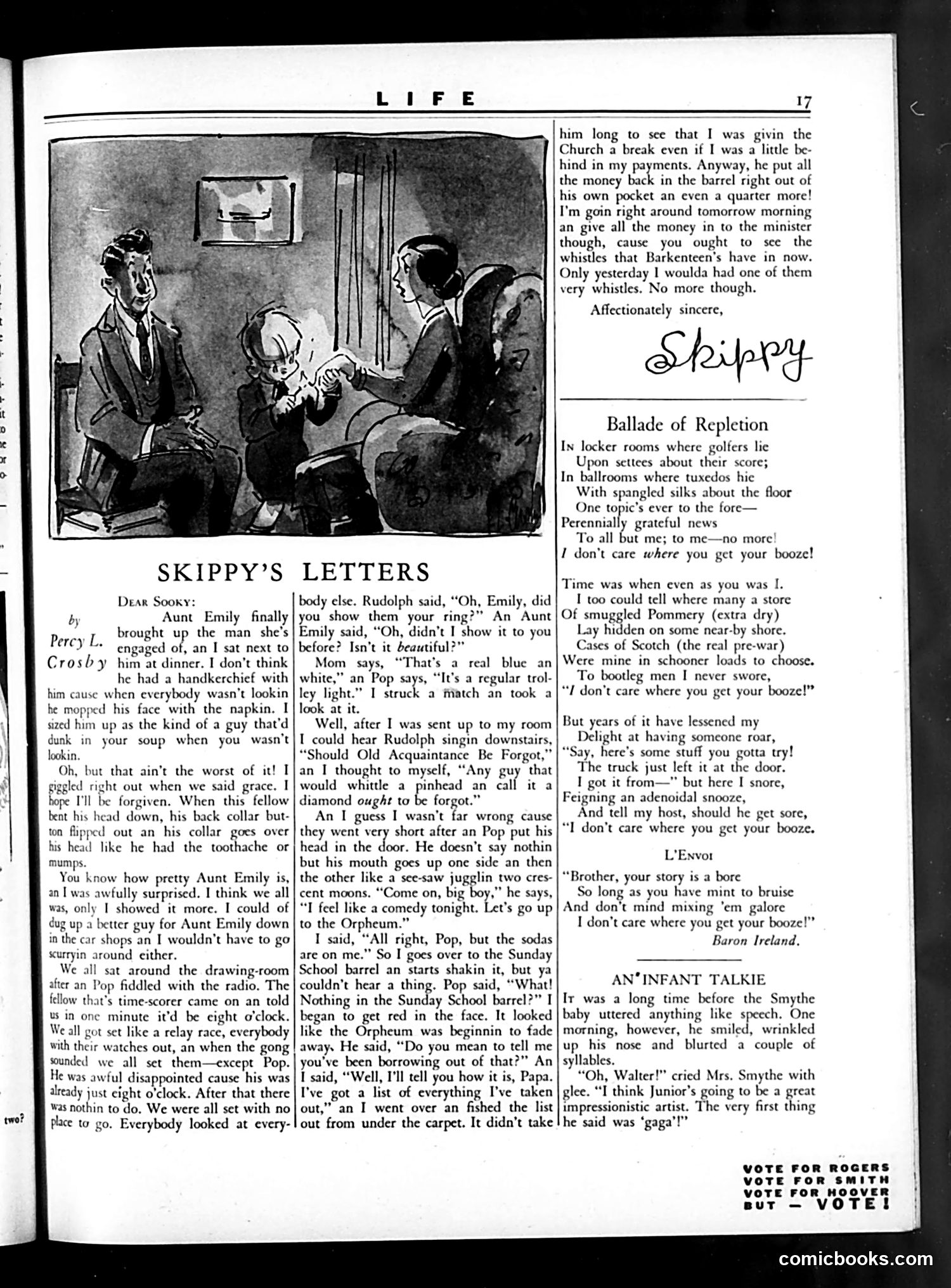
This page features "Skippy's Letters," a humorous column where a character named Skippy recounts embarrassing family moments. The main cartoon depicts Skippy's Aunt Emily being caught in a social mishap during a formal gathering. The satire targets upper-class propriety and decorum. Skippy describes how Aunt Emily's head "dunk[ed]" into her soup at a dinner party, and how his uncle tried covering this embarrassment. The humor derives from the gap between genteel pretense and messy reality—a staple of American satirical magazines mocking wealthy society's obsession with appearances. The accompanying poems ("Ballade of Repletion," "L'Envoi," "An Infant Talkie") continue this theme of social awkwardness and pretension among the well-to-do.
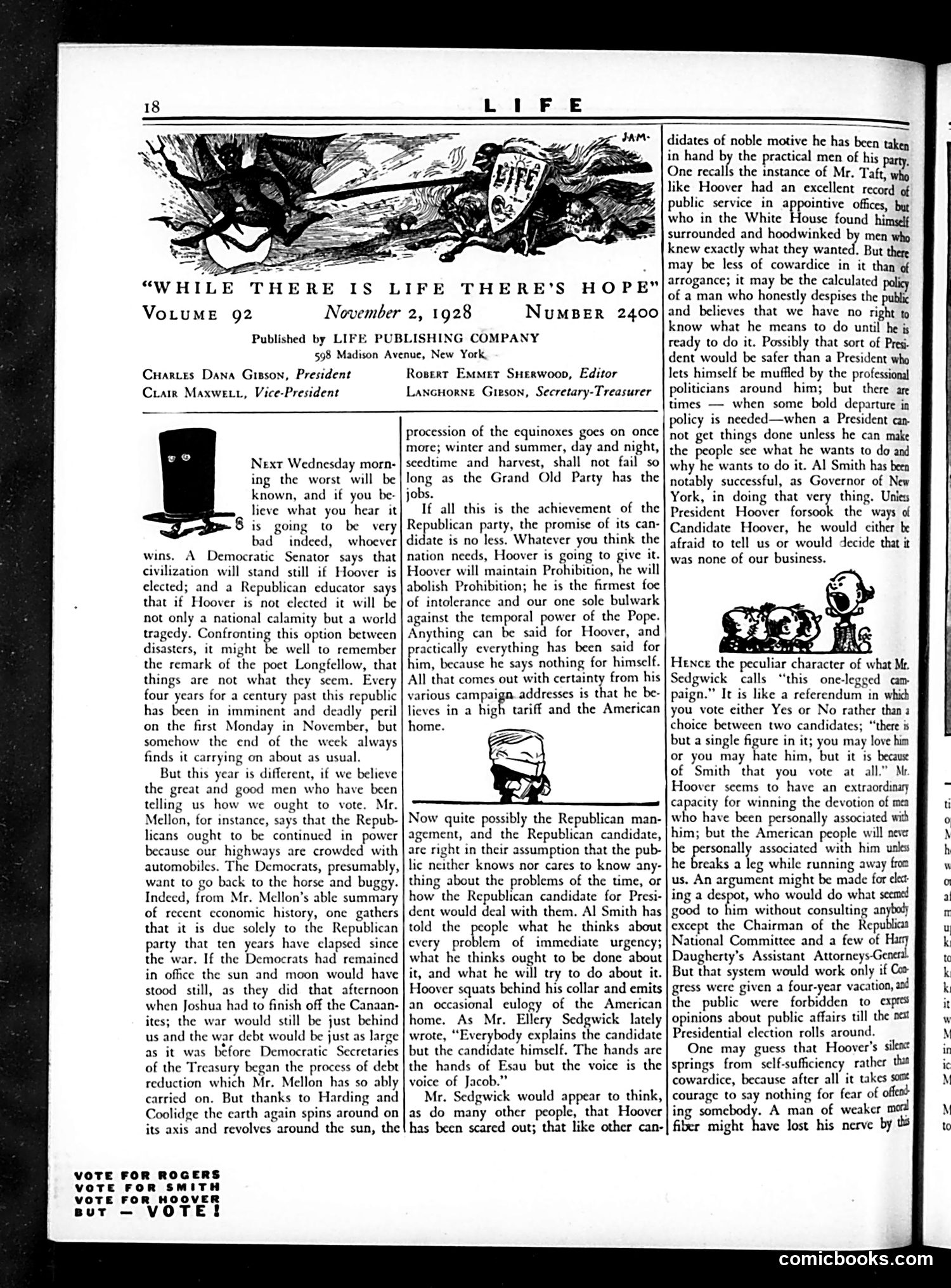
This is *Life* magazine's commentary on the November 1928 U.S. presidential election between Herbert Hoover (Republican) and Al Smith (Democrat). The editorial mocks both parties' campaign rhetoric as hyperbolic—claiming each side suggests civilization will collapse if their candidate loses. The author sarcastically suggests Republicans credit their party with literally keeping the Earth's rotation functioning ("the procession of the equinoxes"). The piece criticizes Hoover specifically for his vague campaign messaging. It quotes editor Ellery Sedgwick's famous comparison: "The hands are the hands of Esau but the voice is the voice of Jacob"—meaning Hoover's speeches sound prepared by others, not authentically his own. By contrast, Smith has clearly stated his positions on issues. The cartoon shows Hoover as an empty vessel—a figure who says nothing of substance, hiding behind his collar. The satirical point: voters should demand candidates actually explain their intentions, not hide behind platitudes about "the American home."
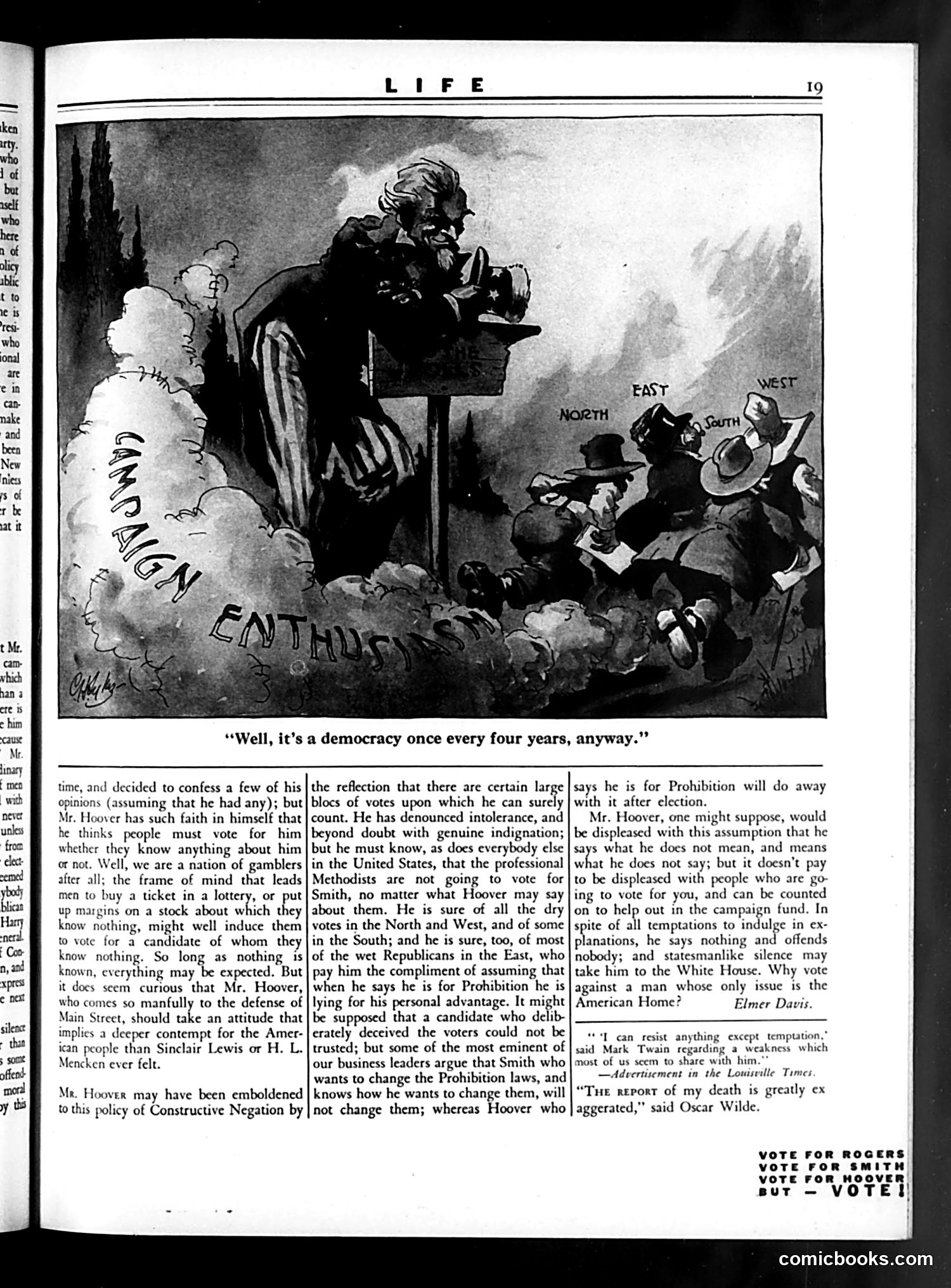
This 1928 election cartoon satirizes voter apathy and manipulation during presidential campaigns. The central figure appears to be a political manipulator or campaign operator peering through a telescope at regional voting blocs labeled "North," "East," "South," and "West"—suggesting candidates strategically target predictable voter groups rather than engaging the broader electorate. The accompanying text by Elmer Davis critiques Herbert Hoover's campaign strategy of saying nothing substantive ("Constructive Negation"), instead relying on assumed voting blocs: Methodists opposed to Catholic candidate Al Smith, "dry" (Prohibition-supporting) voters, and wet Republicans who assume Hoover won't actually enforce Prohibition despite claiming support. The cartoon's title cynically observes that American democracy functions only quadrennially—every four years—implying voters exercise minimal real influence between elections. The satire targets how candidates exploit predictable demographics and voter assumptions rather than genuinely persuading citizens.
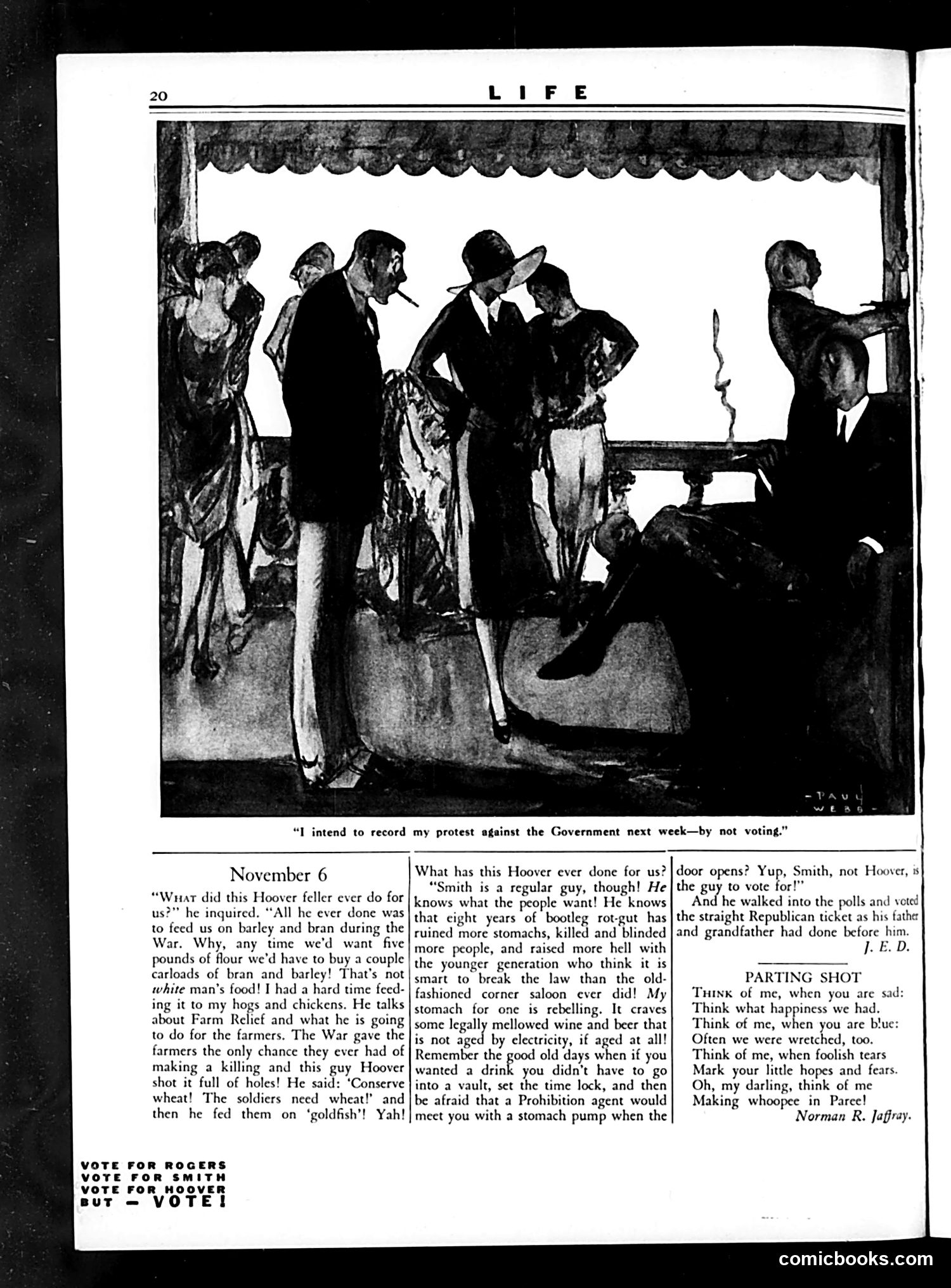
This Life magazine page from **November 6** (appears to be 1928, an election year) satirizes voter hypocrisy during Prohibition and the presidential race between **Herbert Hoover** (Republican incumbent) and **Al Smith** (Democrat). **The Cartoon's Point:** A farmer complains bitterly about Hoover's wartime food rationing and opposes Prohibition, praising Smith as someone who "knows what people want"—implying Smith would relax alcohol restrictions. The farmer declares he'll protest by "not voting." **The Irony:** The caption reveals he then votes the straight Republican ticket anyway, following family tradition despite his stated grievances. **Historical Context:** This mocks voters who claim discontent but lack conviction, and reflects the 1920s Prohibition debate. The "goldfish" reference suggests soldiers were fed unusual rations. Smith, a Catholic from wet New York, represented anti-Prohibition sentiment; Hoover represented enforcement. **The satire:** Voters talk reform but default to habit.
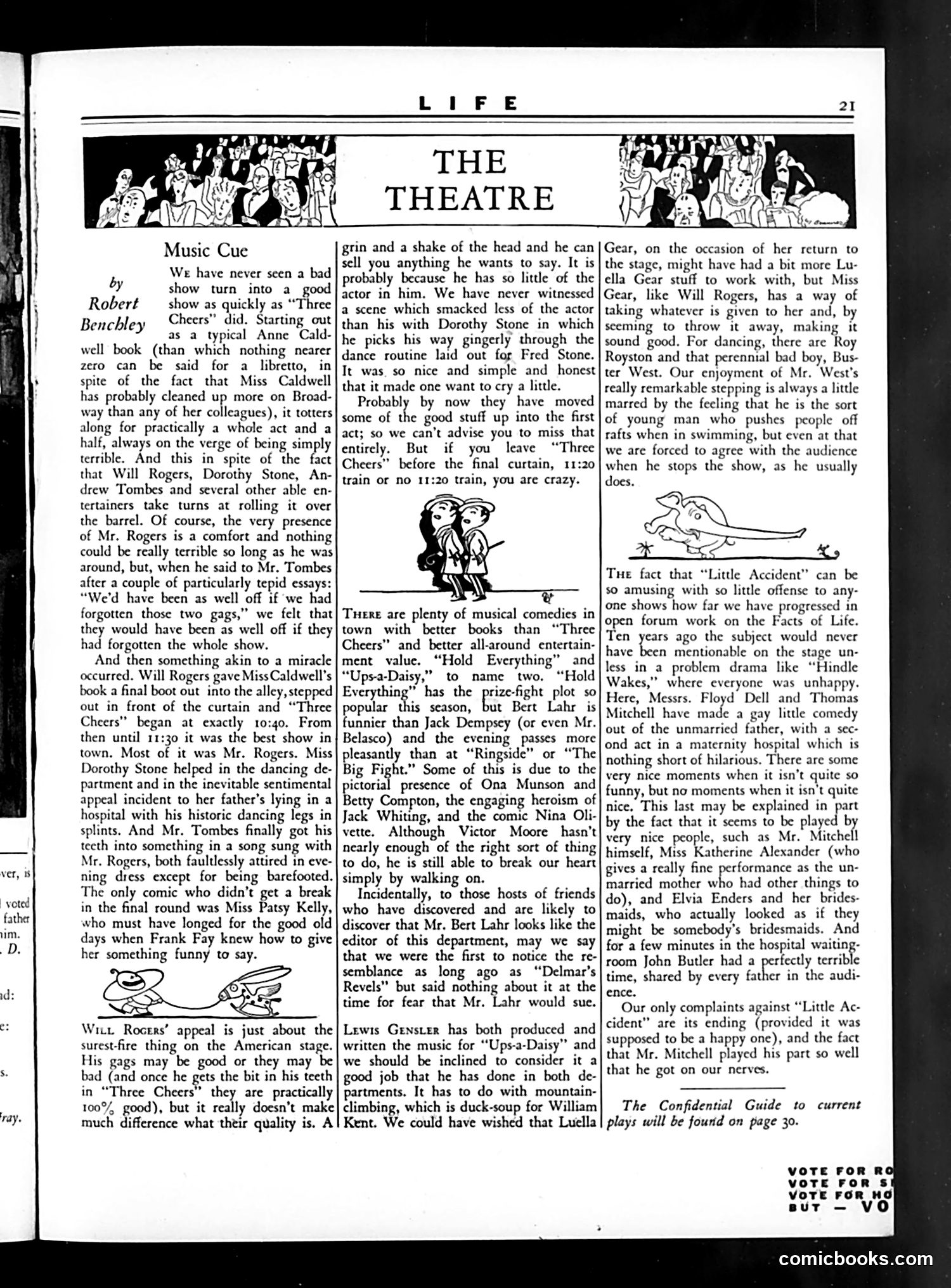
This is **Robert Benchley's theater review** of the Broadway musical "Three Cheers" (circa 1928). The page contains no political cartoons—it's a satirical drama critique illustrated with small comedic sketches. **The Main Point:** Benchley argues that "Three Cheers" is a mediocre show with a terrible script by Anne Caldwell, yet becomes excellent in its final act almost entirely because of **Will Rogers' charisma**. Rogers was so naturally likeable and funny that he could "sell you anything," transforming terrible material into entertainment simply through his personality and minimal acting style. **Key Names:** Will Rogers, Dorothy Stone, and Andrew Tombes are the entertainers carrying the show. Benchley compares it favorably to competing musicals like "Hold Everything" and "Ups-a-Daisy." **The Satire:** Benchley mocks both the weak libretto and the oddly-barefooted performers, while praising Rogers' ability to make audiences overlook bad writing through pure star power and honest, unaffected delivery. The small illustrations are generic vaudeville-style figures, not specific caricatures.
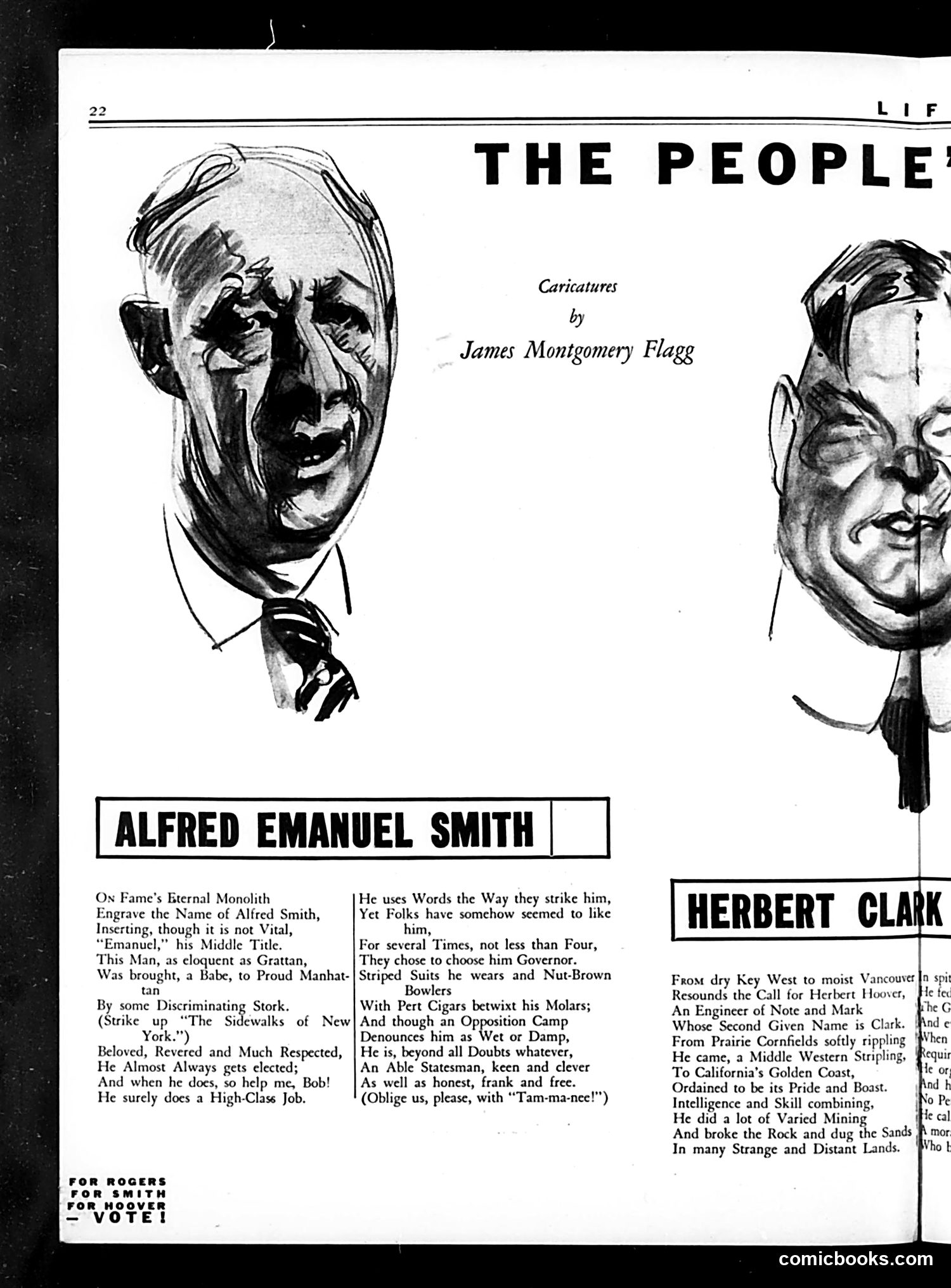
This page features caricatures by James Montgomery Flagg of two prominent figures, likely from an election context (indicated by the "FOR ROGERS FOR SMITH FOR HOOVER—VOTE!" box). **Alfred Emanuel Smith** is praised as an eloquent New York politician ("Sidewalks of New York" reference) elected governor multiple times. The text humorously describes his distinctive style: striped suits, bowler hats, and cigars. The satire gently mocks his casual speech patterns ("uses Words the Way they strike him") while affirming his competence and honesty. The "Tammany" reference suggests New York machine politics associations. **Herbert Clark** appears to be a self-made westerner—an engineer who worked in mining across distant lands before coming to California's coast, representing prairie-to-prosperity success. The caricatures exaggerate facial features in Flagg's characteristic style. The overall tone is affectionate mockery of political personalities rather than sharp attack, typical of Life's satirical approach to election coverage.
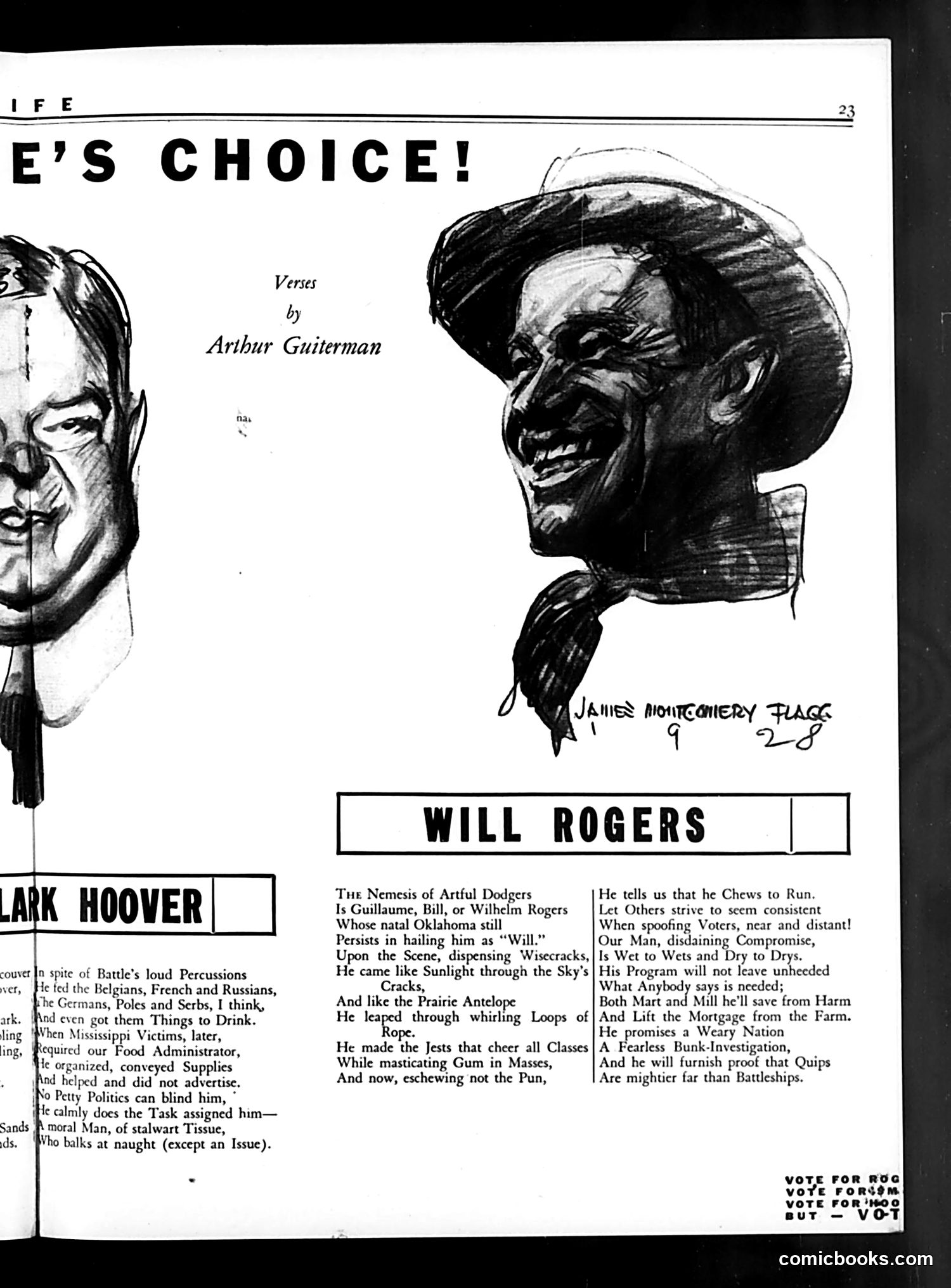
This page presents **humorous mock endorsements** of two figures as presidential candidates, written by poet Arthur Guiterman. The left panel praises **Clark Hoover** (likely Herbert Hoover, Secretary of Commerce) as a practical, apolitical "moral man" who organized food relief without self-promotion during WWI and the Mississippi floods. The right panel satirizes **Will Rogers**, the famous Oklahoma humorist and entertainer known for chewing gum, performing rope tricks, and making political jokes. The verses mock Rogers' contradictory positions ("Wet to Wets and Dry to Drys"—pandering to both Prohibition supporters and opponents), his vague promises to fix everything, and his claim that "quips are mightier than battleships." The satire's point: Rogers offers empty charm and wisecracks rather than serious policy. The bottom text ("VOTE FOR RUG / VOTE FOR SAM / VOTE FOR HOO / BUT—VOTE!") mocks the absurdity of these non-serious candidates while encouraging actual voting. This appears to be pre-election satire from Life magazine's tradition of political commentary.
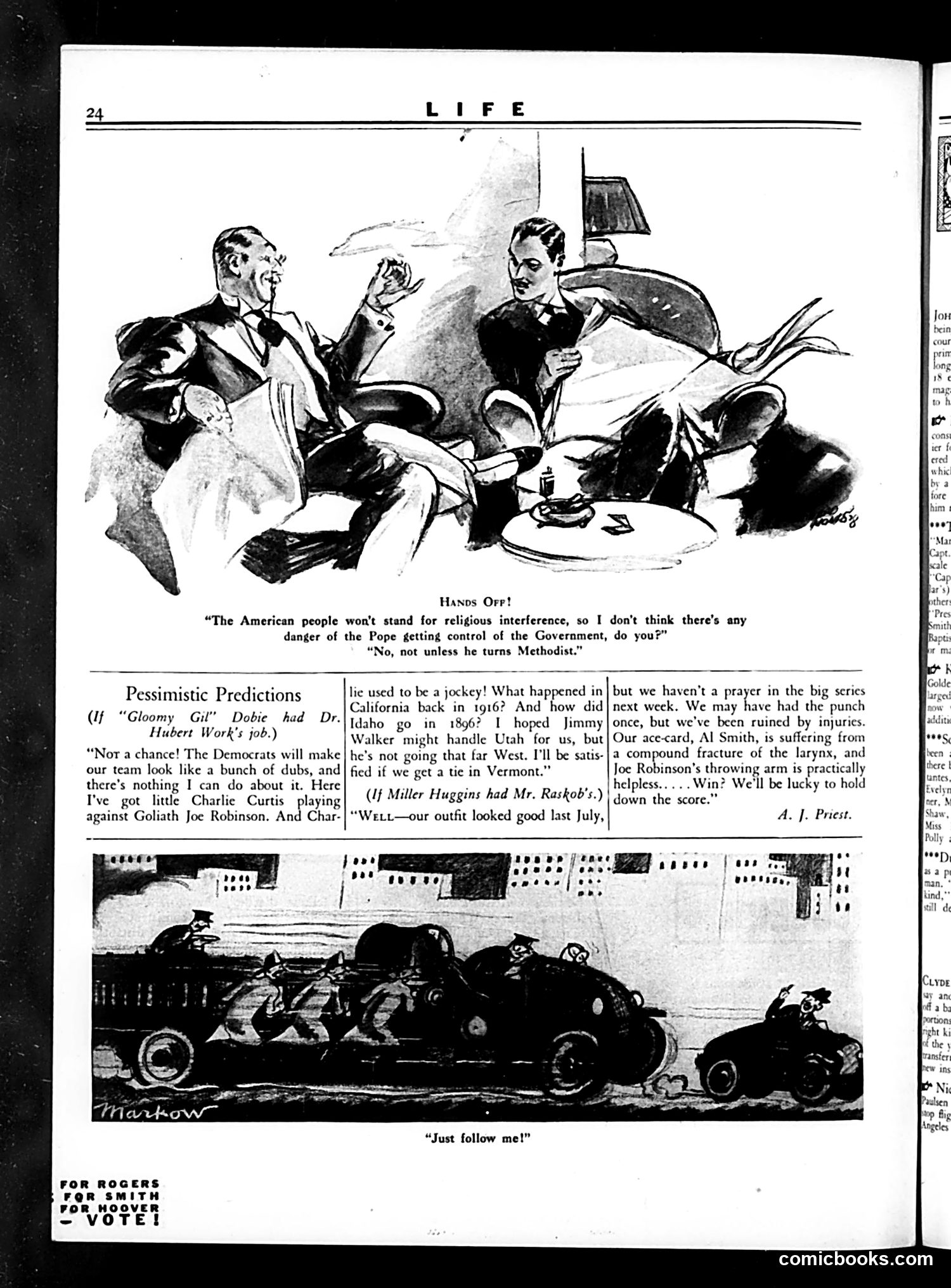
This page contains political humor from the 1928 U.S. presidential election season. The top cartoon jokes about Catholic concerns—referencing fears that Pope influence over government was impossible unless he "turns Methodist" (converting to Protestantism), mocking Protestant anxieties about Catholic political power. The "Pessimistic Predictions" section uses sports metaphors to mock Republican campaign confidence. References to "Gloomy Gil" Dobie, Charlie Curtis (Republican VP candidate), Joe Robinson (Democratic VP candidate), and Jimmy Walker (NYC Mayor) suggest GOP strategists pessimistically assessing their electoral chances despite predicted dominance. The bottom cartoon, "Just follow me!", depicts vehicles in procession—likely satirizing blind political loyalty or campaign momentum. The closing advertisement promotes voting for "Rogers, Smith, Hoover"—endorsing the Republican ticket despite the preceding satirical doubts about their viability.
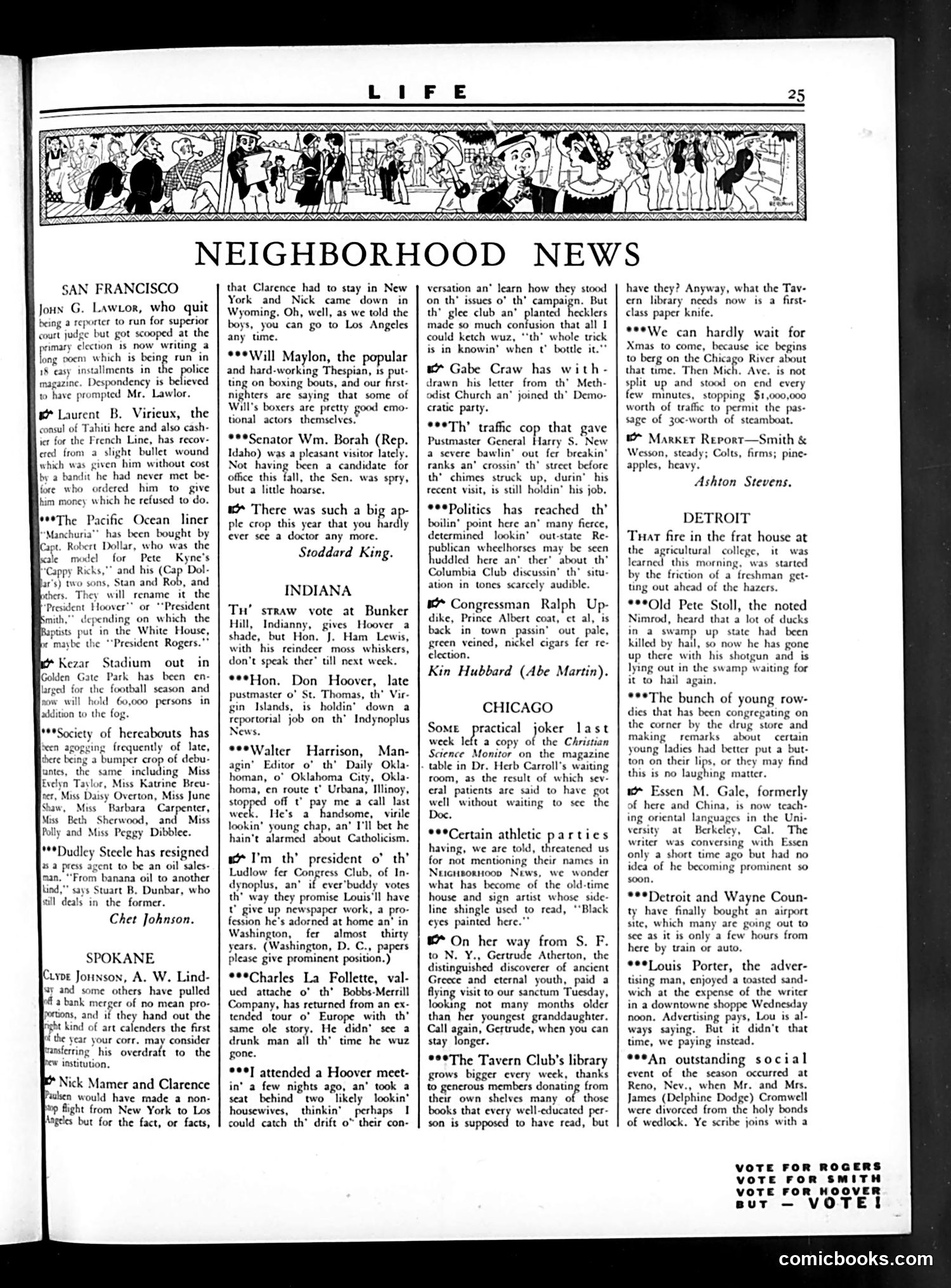
This is a "Neighborhood News" gossip column page from *Life* magazine, not a political cartoon. The page collects brief, humorous anecdotes from San Francisco, Spokane, Indiana, Detroit, and Chicago. The political content appears at the bottom: references to the 1928 presidential election. Senator William Borah (Republican, Idaho) is mentioned as a visitor; there are jokes about straw polls favoring Herbert Hoover; and a mention of "Ludlow fer Congress Club." The final advertisement urges voting for "Rogers," "Smith," and "Hoover"—the major 1928 candidates. The humor is gentle small-town gossip: people's career changes, visiting dignitaries, local improvements (Kezar Stadium expansion), and social events. The tone is folksy and affectionate toward local personalities. This was typical *Life* content before the magazine shifted toward serious photojournalism in the 1930s.
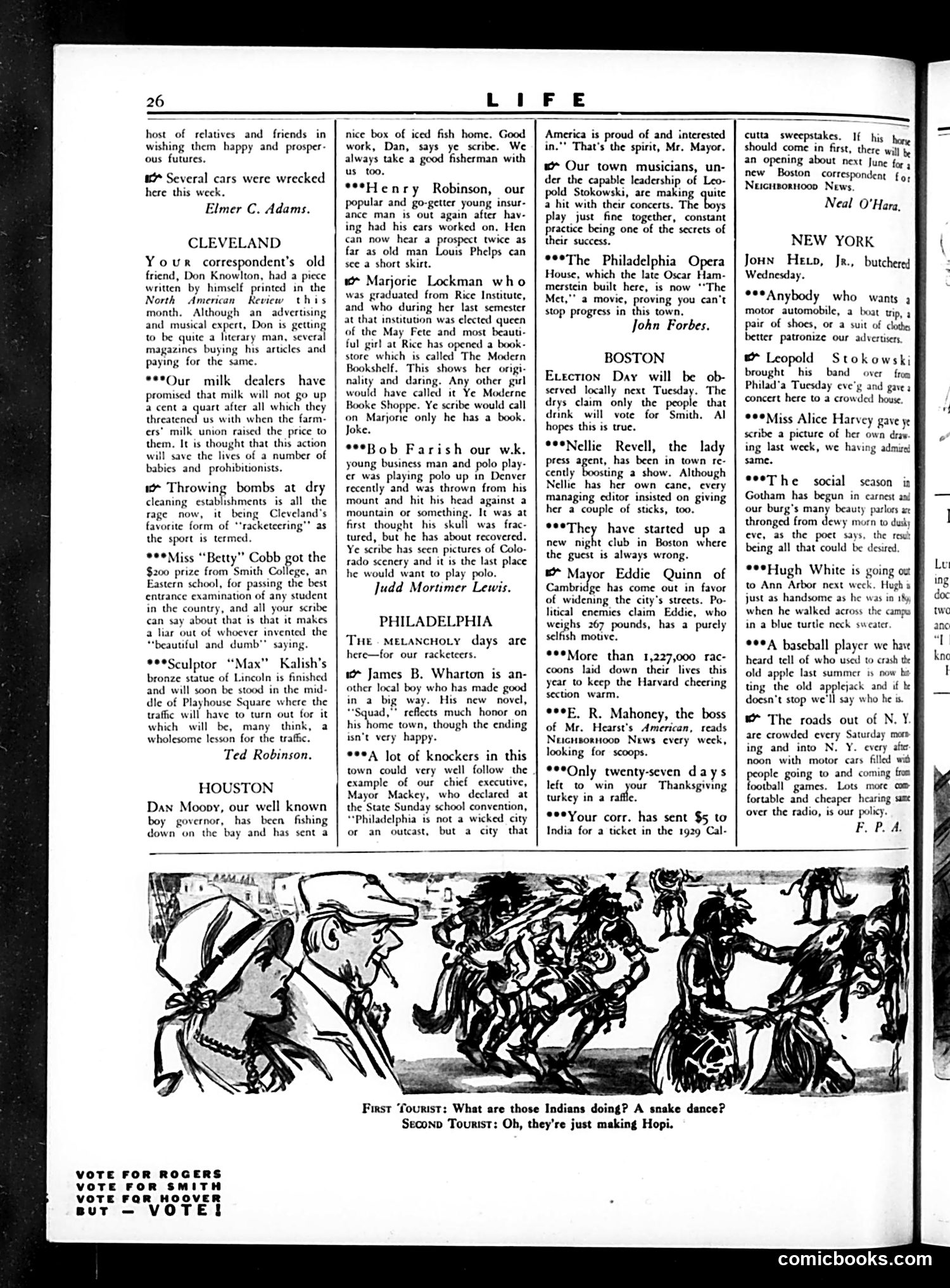
This page from Life's "departments" section collects local news and humor from American cities. The bottom cartoon depicts tourists observing Native Americans performing a traditional dance, with the joke hinging on cultural misunderstanding: the first tourist mistakes a "Hopi" (the tribal name) for a "snake dance," while the second corrects him, saying they're "just making Hopi." The page's local gossip items—notes about engagement announcements, business ventures, and minor scandals in Cleveland, Houston, and Philadelphia—reflect Life's satirical commentary on small-town American life. References to "racketeering" (gang violence from Prohibition-era organized crime), mentions of "prohibitionists" (alcohol ban supporters), and jokes about modernization reveal 1920s preoccupations. The voting prompt at bottom urges readers to "VOTE FOR HOOVER"—Herbert Hoover's 1928 presidential campaign. The page essentially mixes light social satire with period-specific political advocacy in Life's characteristic style.
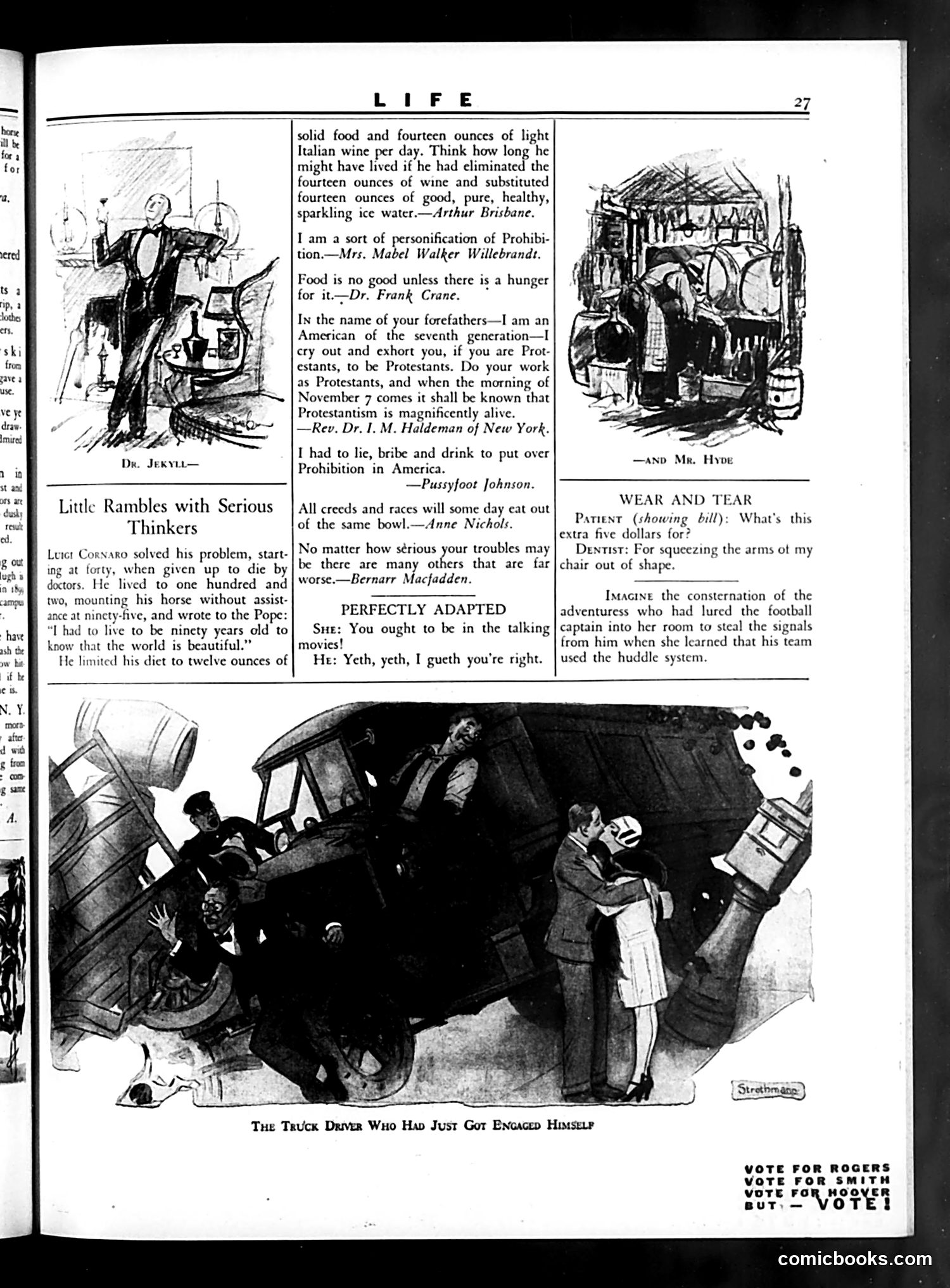
This page satirizes **Prohibition** (the 1920-1933 ban on alcohol) through multiple angles. The top sections feature quotes from prominent figures—notably "Pussyfoot" Johnson, a famous Prohibition enforcer, who admits he "had to lie, bribe and drink to put over Prohibition in America." This is the page's sharpest jab: the hypocrisy of those who championed alcohol prohibition while themselves drinking. The "Dr. Jekyll" illustration contrasts a refined gentleman with a drunken mess, mocking Prohibition's premise that eliminating alcohol improves society. The large cartoon at bottom depicts a truck driver who "just got engaged himself"—likely commenting on working-class life and social upheaval during Prohibition's era. The voting appeal at bottom ("Vote for Rogers, Smith, Hoover") suggests this is from a 1928 election context, when Prohibition remained a contentious political issue.
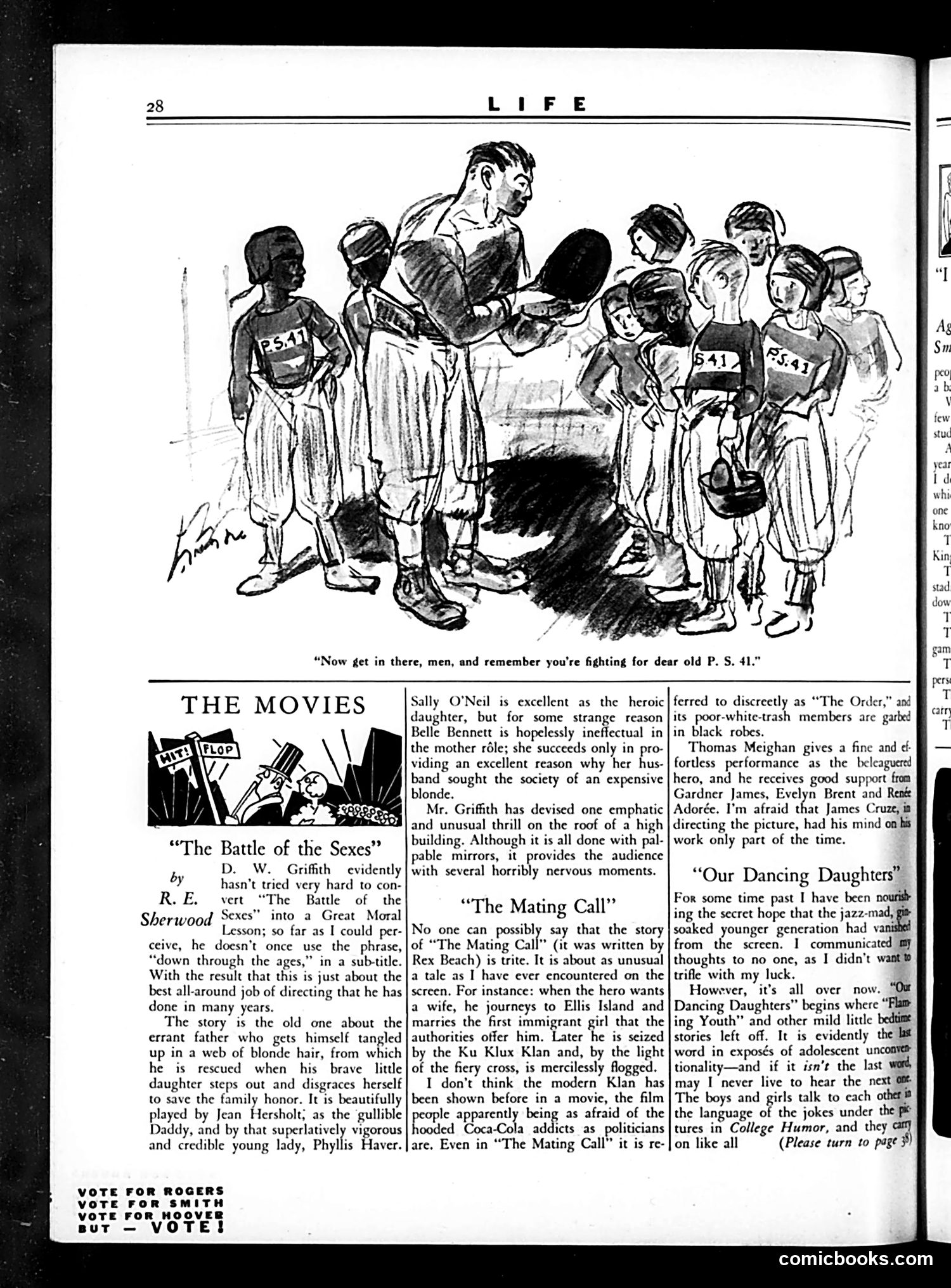
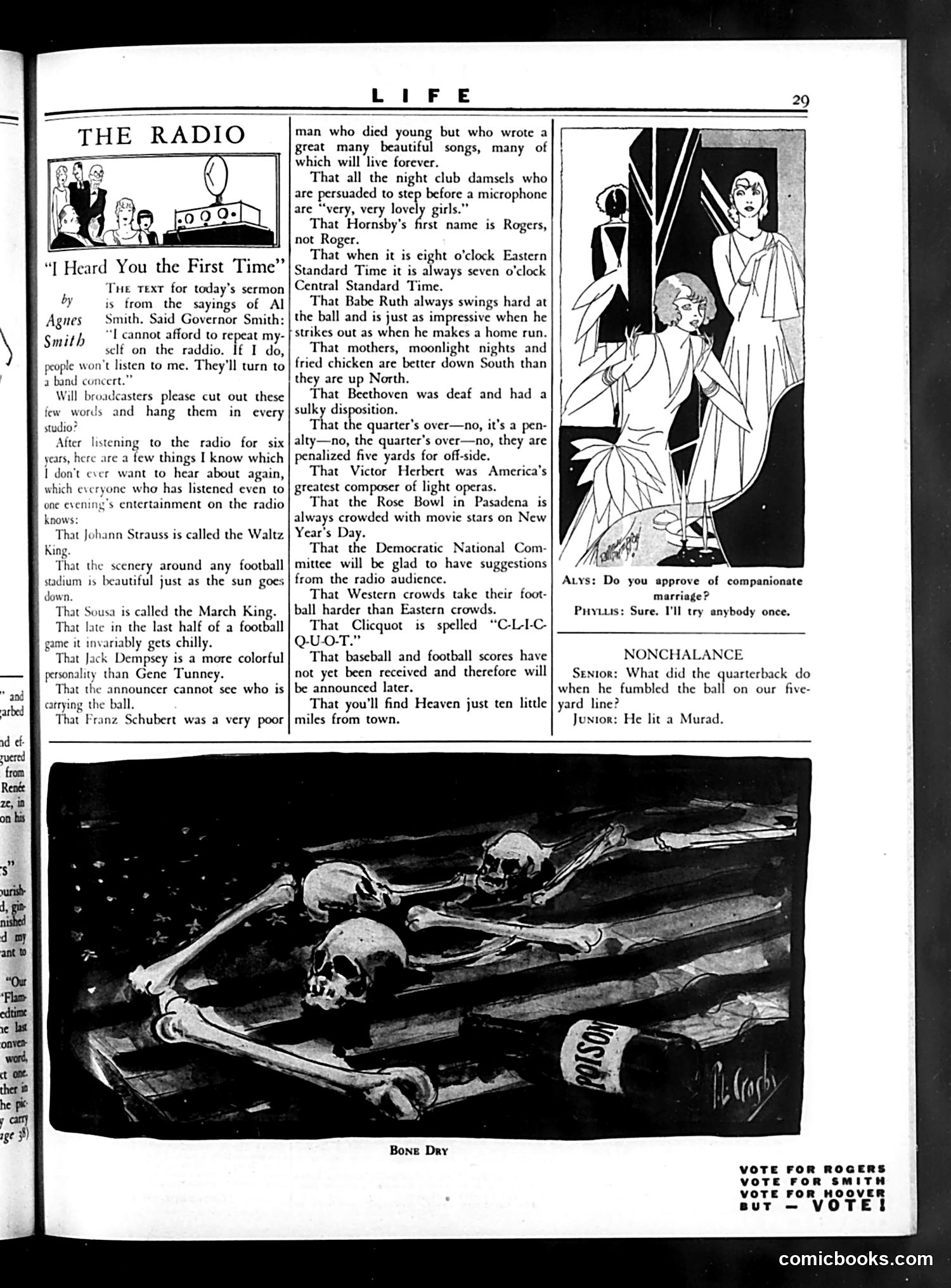
This page satirizes **radio broadcasting clichés** circa the 1920s. Agnes Smith (likely referencing Governor Al Smith, a 1928 presidential candidate) complains he won't repeat himself on radio because listeners will tune out. The column then lists exhausted radio tropes: Johann Strauss as "Waltz King," Sousa as "March King," Babe Ruth's batting habits, Beethoven's deafness, and overused descriptions of Southern fried chicken. The satire mocks both repetitive broadcasters and the advertising/entertainment industry's predictable formulas. The bottom image ("Bone Dry") references **Prohibition**, showing skeletons—perhaps criticizing alcohol's illegality. The closing voting appeals ("VOTE FOR ROGERS / VOTE FOR SMITH / VOTE FOR HOOVER") likely reference the **1928 election**, encouraging political participation. This is *Life* magazine's characteristic blend of cultural observation and political messaging.
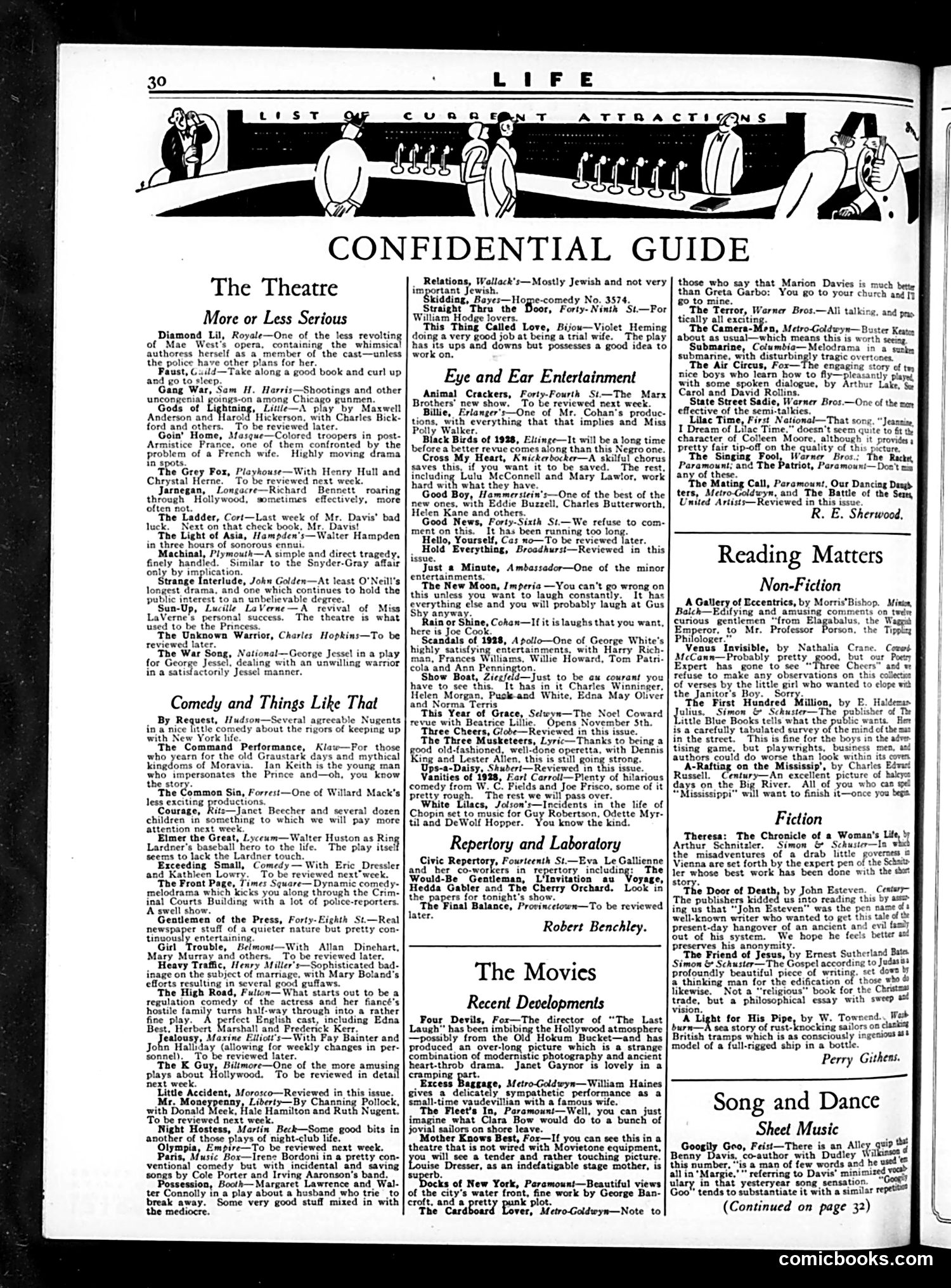
This page is primarily a **theater review guide** rather than political satire. It's a practical entertainment listing for New York theatergoers, organized by tone (serious dramas, comedies, etc.). Notable content includes: - **Mae West's "Diamond Lil"**: The reviewer's snide comment "unless the police have other plans for her" refers to West's real legal troubles for obscenity—she faced censorship and arrest for her sexually provocative performances. - **"Machinal"**: Described as similar to the "Snyder-Gray affair"—a famous 1920s murder trial that scandalized America. - The reviews adopt a gossipy, irreverent tone typical of Life's satirical style, with caustic one-liners about performers and productions. Rather than political cartooning, this demonstrates **Life's role as cultural critic**, using light mockery to comment on Broadway's offerings and contemporary celebrity controversies. The "Confidential" framing suggests insider theatrical knowledge.
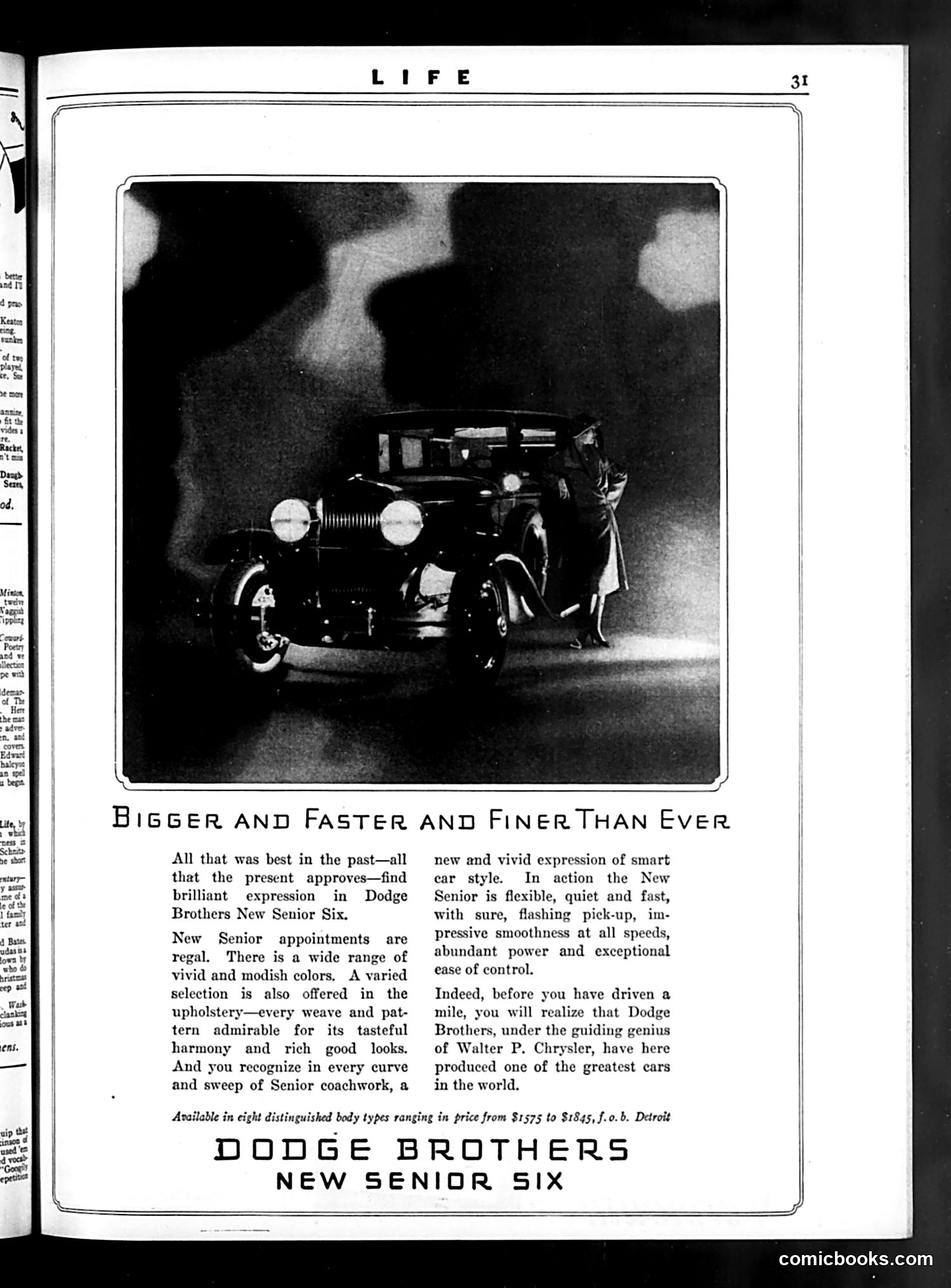
This is **not a cartoon or satire**—it's a straightforward automobile advertisement from Life magazine's pages. The page promotes the **Dodge Brothers New Senior Six**, a car manufactured under Walter P. Chrysler's leadership. The advertisement uses typical marketing language of the era, claiming the vehicle combines "all that was best in the past" with modern style and performance features: flexibility, quietness, speed, and ease of control. The dark photograph shows the car in atmospheric lighting, emphasizing its sleek design. The ad emphasizes luxury appointments, color/upholstery variety, and performance specifications while listing eight body types priced between $1,575–$1,845 (f.o.b. Detroit). This represents standard automotive advertising from the early-to-mid 20th century, appealing to consumers seeking both tradition and modernity in their vehicles.
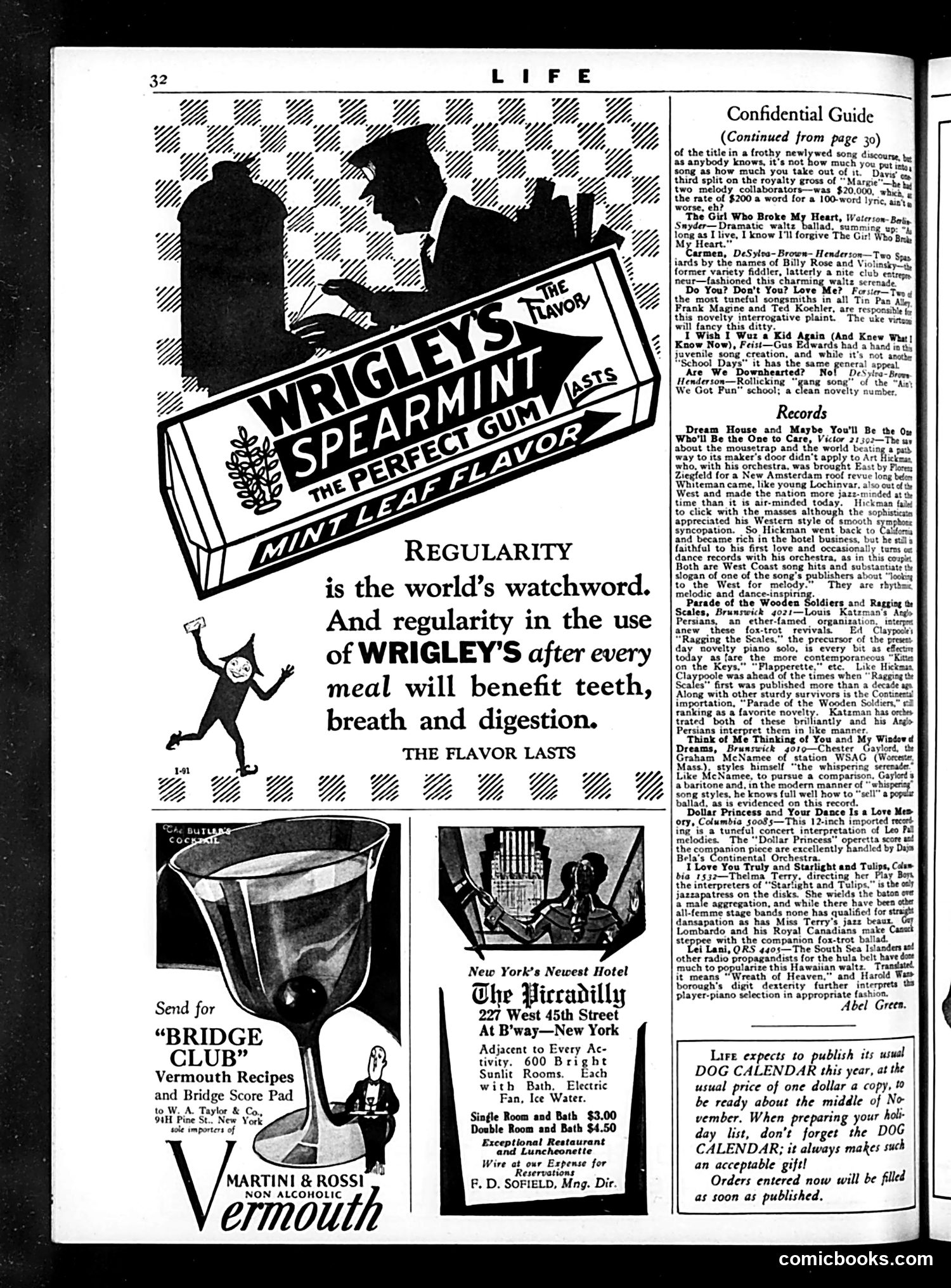
This page is primarily **advertising and entertainment industry content** rather than political satire. The main elements are: **The Wrigley's Spearmint Gum Advertisement** (center-top): Shows silhouetted figures at a desk with the slogan "Regularity is the world's watchword." This is a straightforward commercial promoting the habit of chewing gum after meals for dental and digestive health—a common marketing claim of the 1920s era. **Supporting Content**: The page includes music industry "Confidential Guide" listings discussing popular songs and their composers, hotel advertisements (The Piccadilly), and vermouth/vermut ads—typical Life magazine filler. **The Humor/Context**: The juxtaposition of discussing "regularity" in gum-chewing alongside dense entertainment industry gossip creates mild irony, but this appears incidental rather than intentional satire. This is essentially a **commercial advertising page** with entertainment columns, not a satirical cartoon requiring historical context.
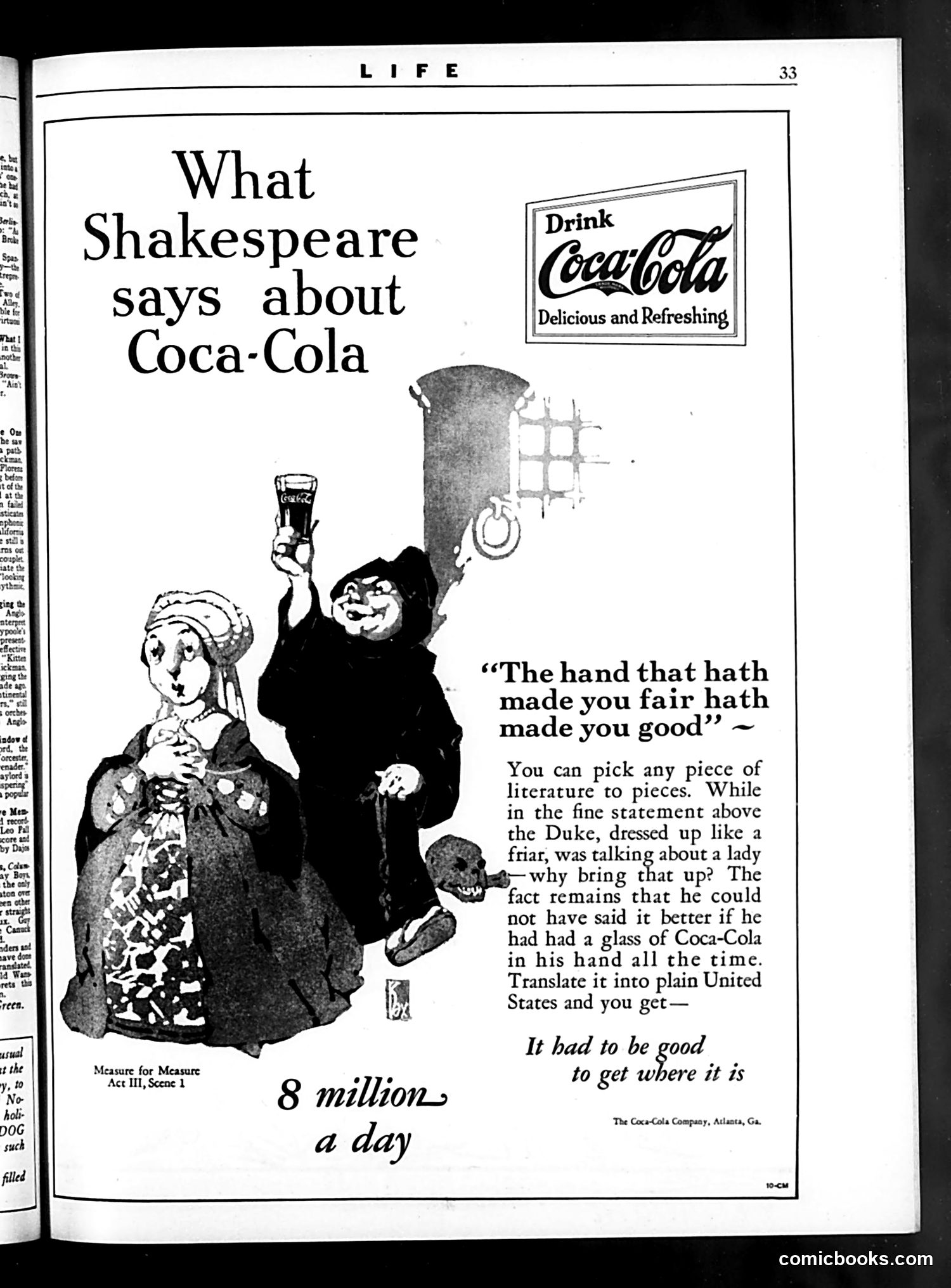
This is a **Coca-Cola advertisement** disguised as literary commentary. The ad references Shakespeare's *Measure for Measure* (Act III, Scene 1), where a Duke disguised as a friar compliments a woman's virtue. The joke: The ad claims Shakespeare's eloquent praise—"The hand that hath made you fair hath made you good"—would be better expressed simply as an endorsement of Coca-Cola. It's a tongue-in-cheek suggestion that the drink is so universally good it could replace even the Bard's finest compliments. The illustration shows **period-costumed Shakespearean characters** (the Duke in friar's robes and a lady) alongside a Coca-Cola bottle, visually merging literature with the product. **The sales pitch**: The closing line "8 million a day" claims this many Coca-Colas are consumed—implying such success proves the product's inherent quality. This is early 20th-century advertising that uses cultural prestige (Shakespeare) to sell a mass-market beverage.
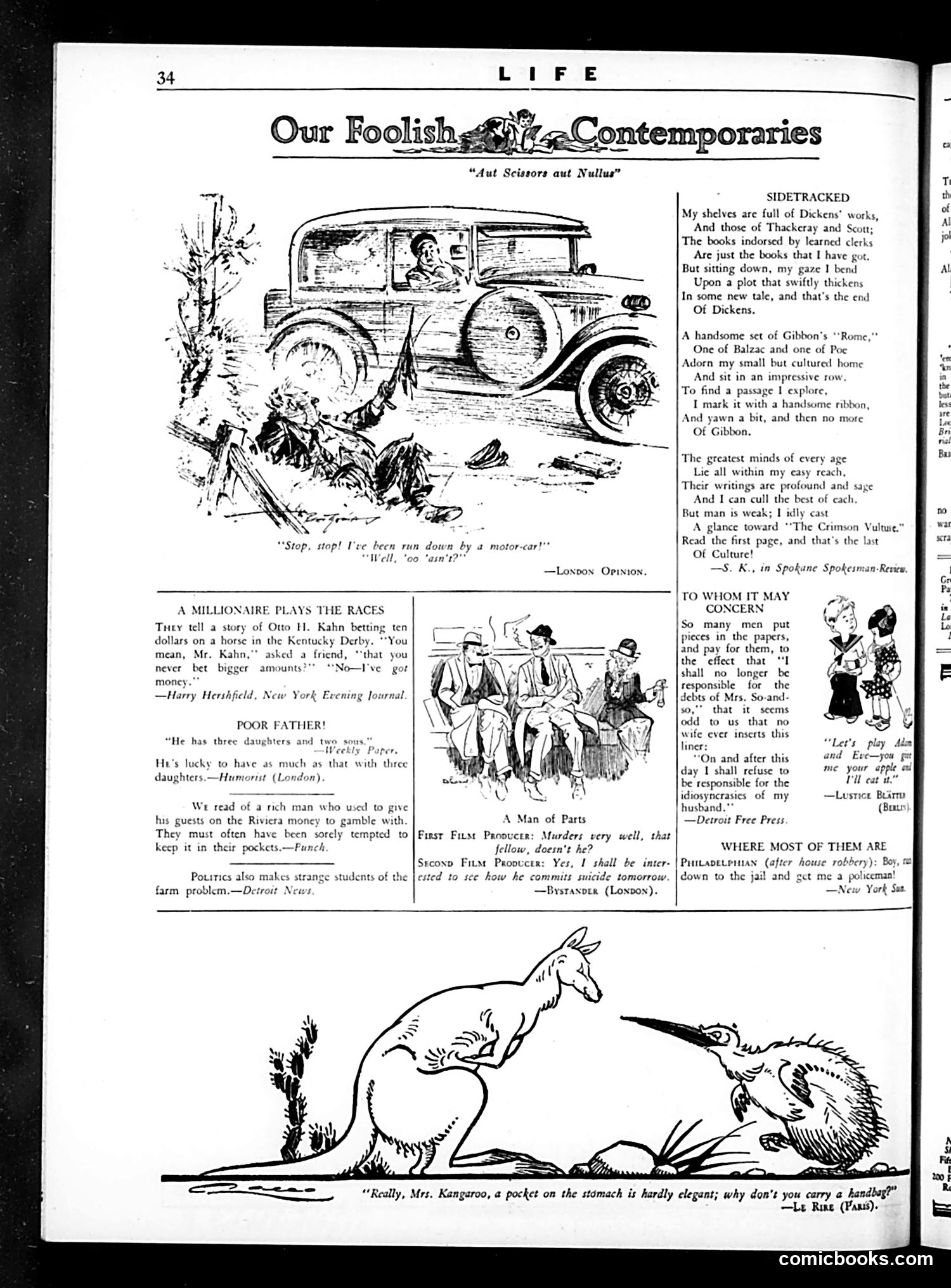
This page collects satirical commentary on contemporary American life circa early 20th century. **Main cartoons:** 1. **Motor-car accident**: A pedestrian hit by an early automobile quips "Well, 'oo 'asn't?" — mocking how common such accidents had become with the newfangled technology. 2. **Otto Kahn story**: Satirizes wealthy financier Otto H. Kahn's gambling habits, suggesting the ultra-rich bet casually on horse races in amounts ordinary people find shocking. 3. **Literary pretension ("Sidetracked")**: Mocks educated readers who own impressive classics (Dickens, Gibbon) but abandon them for cheap sensational fiction like "The Crimson Vulture" — criticizing shallow cultural consumption. 4. **Wife's disclaimer**: Jokes about men avoiding financial responsibility by having wives publicly renounce their debts in newspapers. The final cartoon about Mrs. Kangaroo appears purely whimsical. **Overall tone**: Gentle mockery of modern American excess, new technologies, class pretension, and frivolous reading habits.
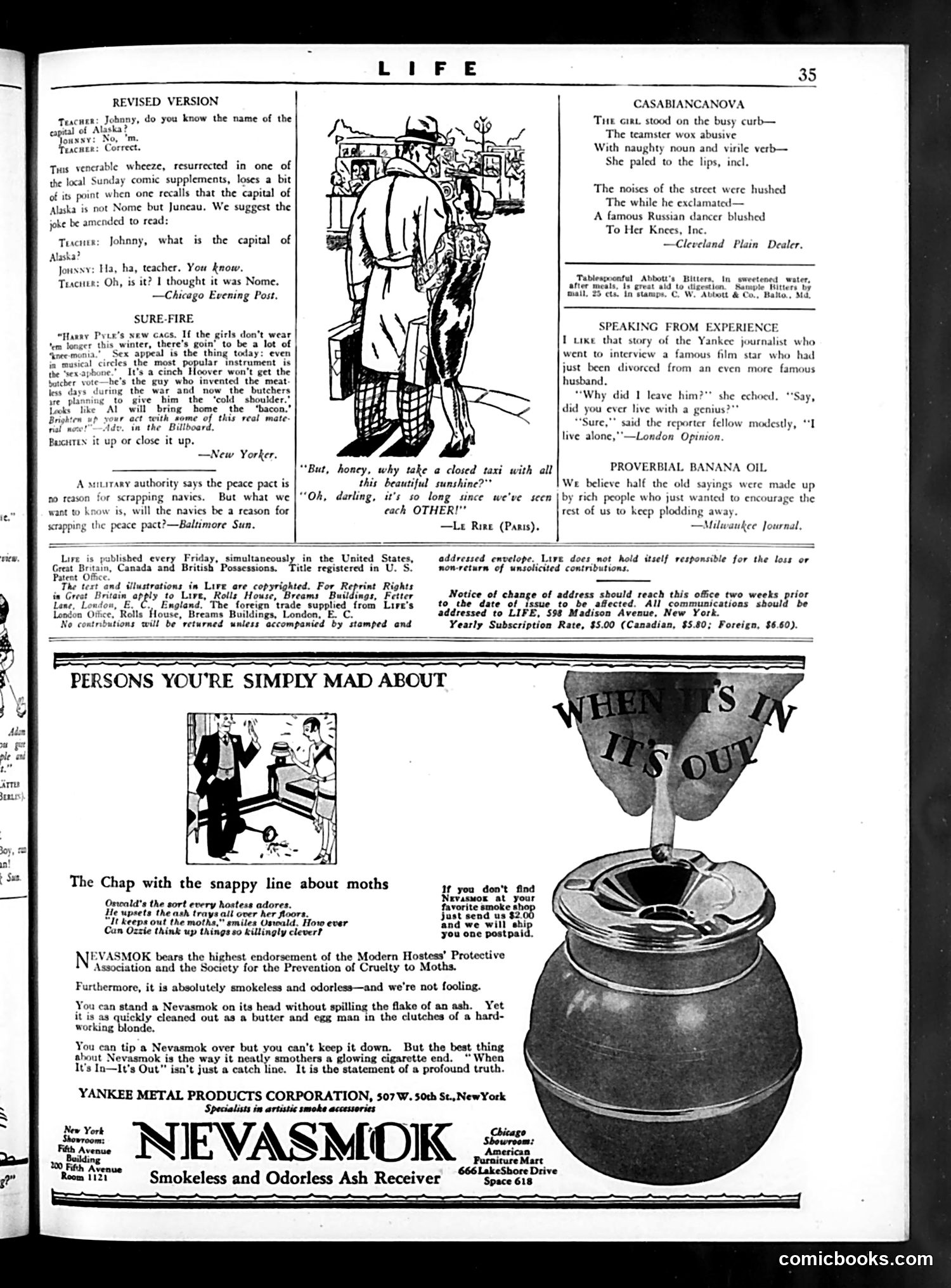
This page contains several brief humorous items typical of 1920s-30s Life magazine: **The "Alaska Capital" joke** references an outdated riddle where "Nome" was the punchline. The editors note this is no longer funny since Juneau is actually Alaska's capital, suggesting the joke needs updating. **"Sure-Fire"** satirizes 1920s fashion trends and politics—mocking women's hemlines, sex appeal as a marketing tool, and Herbert Hoover's unpopularity (he'd allegedly invented meatless days during WWI, antagonizing butchers). **The Casablanca/Russian Dancer item** is a brief humorous poem about a street confrontation. **The Nevasmok advertisement** dominates the lower half. It's a mock-serious pitch for an ash receiver shaped like a covered dish, presented as endorsed by a "Modern Hostess' Protective Association" and a "Society for the Prevention of Cruelty to Moths"—obviously fictional organizations used for comedic effect. The humor lies in treating a simple smoking accessory as solving major household problems. The page is primarily **advertising disguised as editorial humor**, which was common in Life.
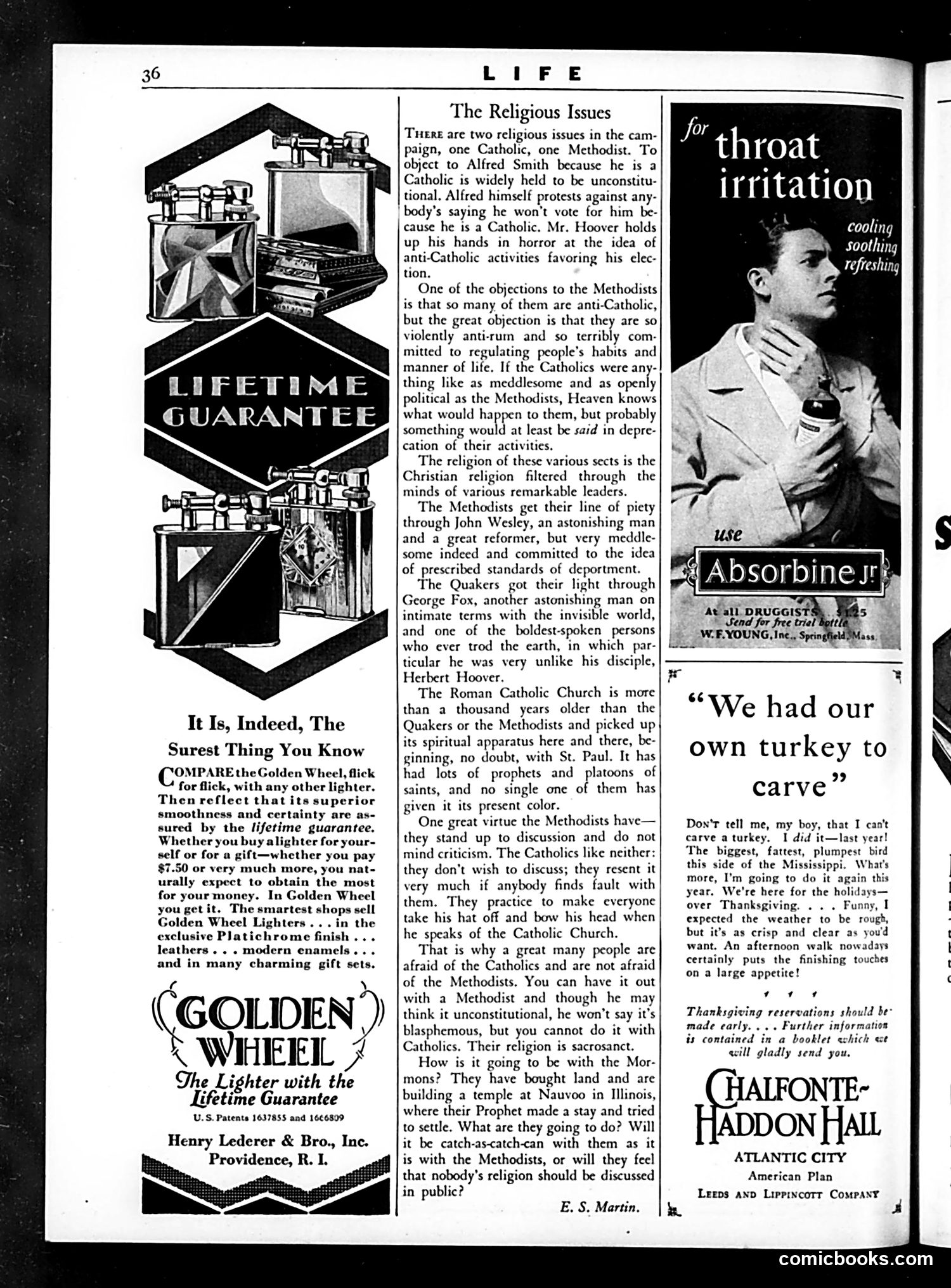
This page contains editorial commentary by E.S. Martin on the 1928 U.S. presidential election, which featured Catholic Democratic nominee Alfred Smith against Protestant Republican Herbert Hoover. Martin discusses two competing religious controversies: anti-Catholic sentiment favoring Hoover, and Methodist objections to Smith's Catholicism—particularly Methodist opposition to alcohol (relevant given Prohibition debates). The satire targets Methodist "meddlesomeness" in regulating personal behavior while noting the Catholic Church's refusal to tolerate criticism of itself. Martin characterizes Methodist founder John Wesley and Quaker George Fox as reformers, then pointedly notes Hoover (a Quaker) is "very unlike his disciple" Fox—implying Hoover hypocritically distances himself from his tradition's boldness. The piece questions whether Mormons (building a temple in Illinois) will face similar religious scrutiny, exposing the election's underlying sectarian tensions masked by constitutional rhetoric. The remainder of the page contains unrelated product advertisements.
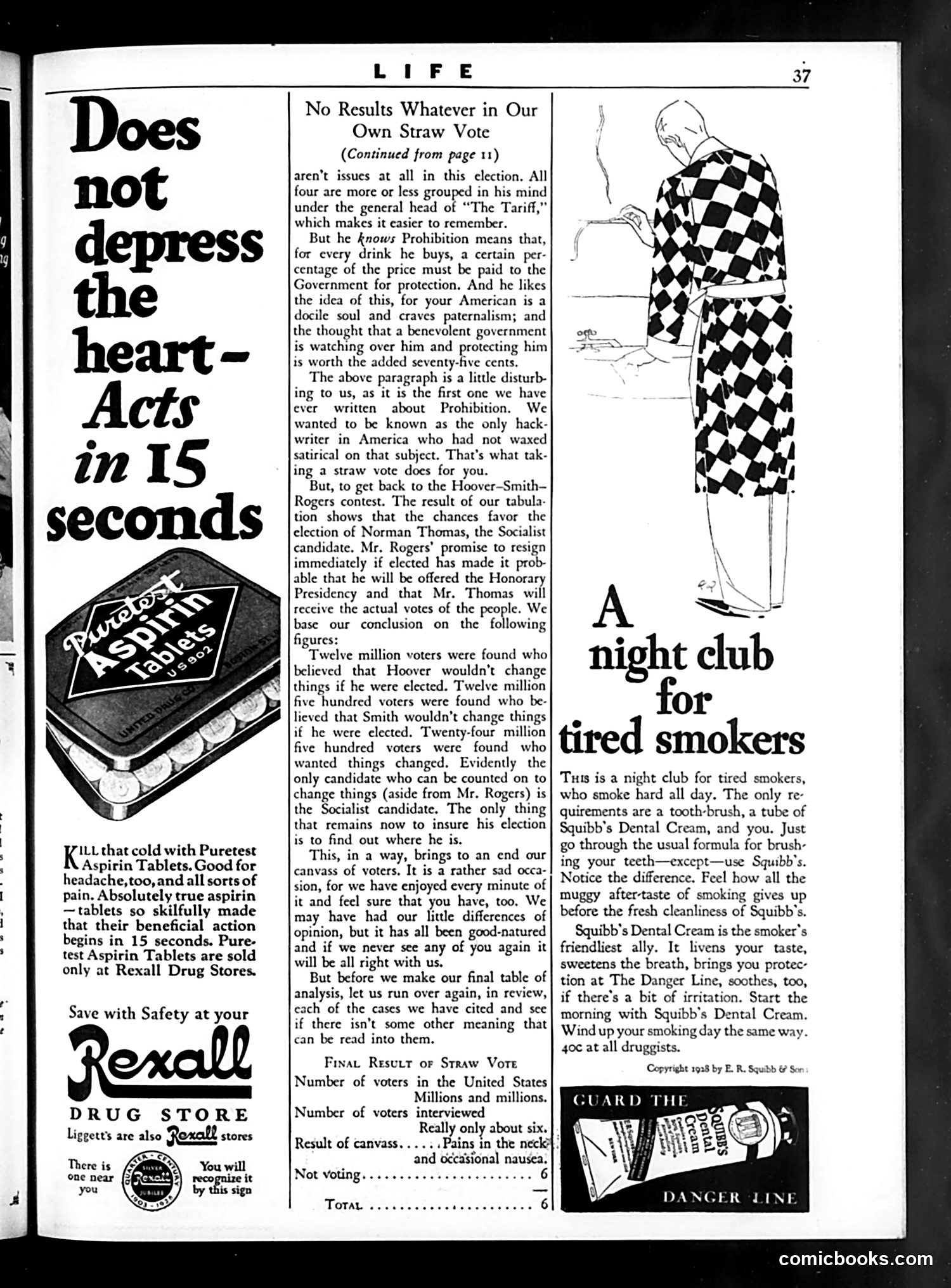
This 1928 page satirizes a straw poll conducted by *Life* magazine about the presidential election. The text mocks the results: voters split between those believing Hoover wouldn't change things, those believing Smith wouldn't, and those wanting change—leading to the absurd conclusion that Norman Thomas, the Socialist candidate, would win by default (since he's the only one promising change). The joke is that the poll is meaningless: only about six people were actually interviewed out of millions of voters. The page also features period advertisements for Puretest Aspirin and Squibb's Dental Cream. The latter includes a cartoon of a woman smoking, advertising toothpaste as a solution for smokers' breath and "muggy after-taste"—treating heavy smoking as a normal, acceptable habit requiring only cosmetic remedies. This reflects 1920s attitudes toward tobacco before health warnings existed.
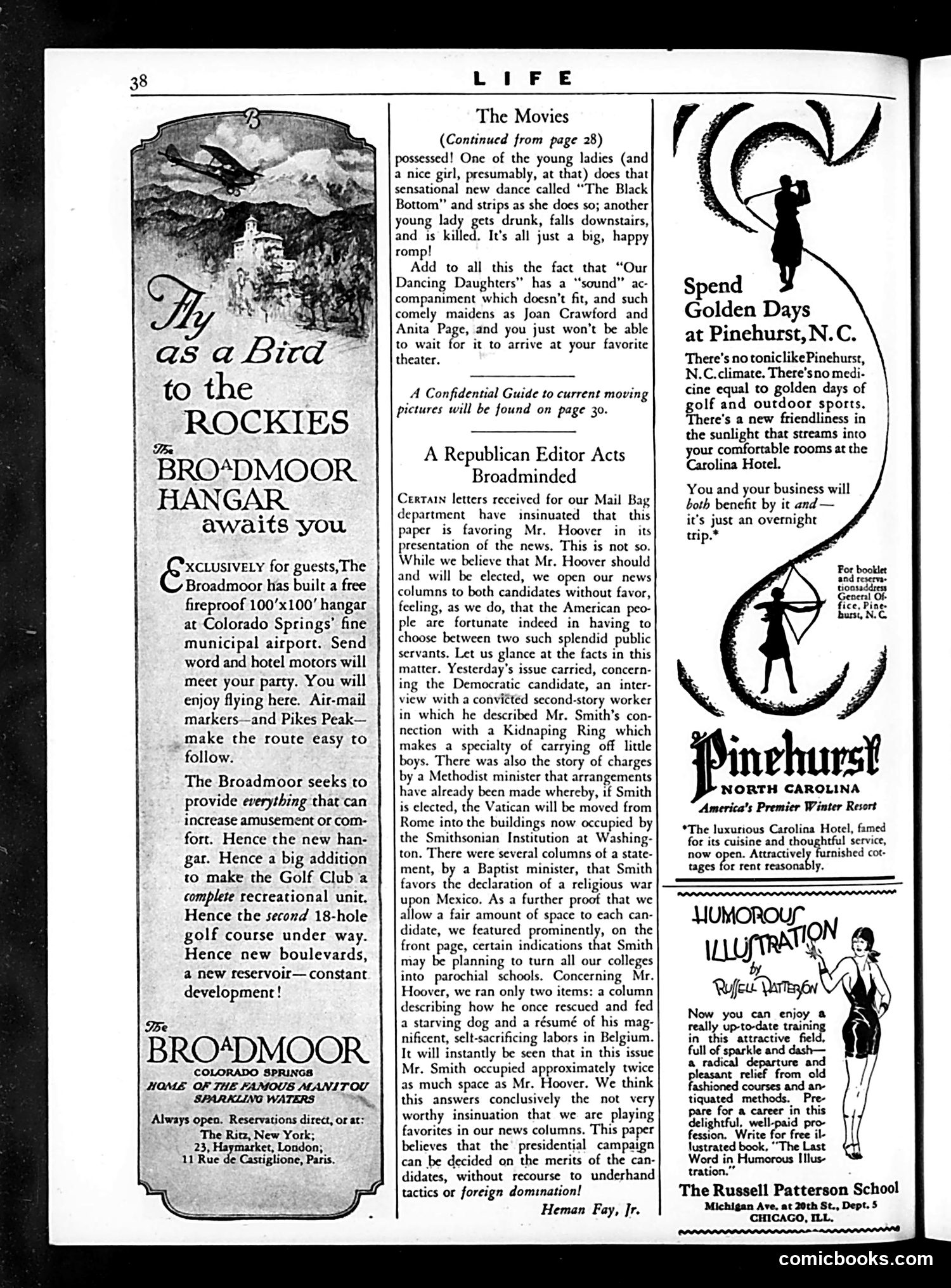
This page contains a biting satirical editorial titled "A Republican Editor Acts Broadminded" by Heman Fay, Jr. The satire targets a newspaper editor (likely representing Republican-leaning press) who claims editorial neutrality while practicing obvious partisan bias favoring Herbert Hoover over Democratic candidate Al Smith. The joke: the editor demonstrates "fairness" by listing egregious smears against Smith—including false allegations that he's connected to kidnapping rings, that the Vatican will relocate if he wins, and that he'll convert colleges to parochial schools. In contrast, Hoover received only positive coverage (rescuing a dog, Belgian relief work). The editor then absurdly claims Smith received *more* space, therefore proving balanced coverage. The satire exposes how propagandistic newspapers could claim neutrality while engaging in transparent character assassination. This likely reflects actual 1928 campaign coverage, where Smith (a Catholic Democrat) faced significant religious prejudice and baseless rumors.
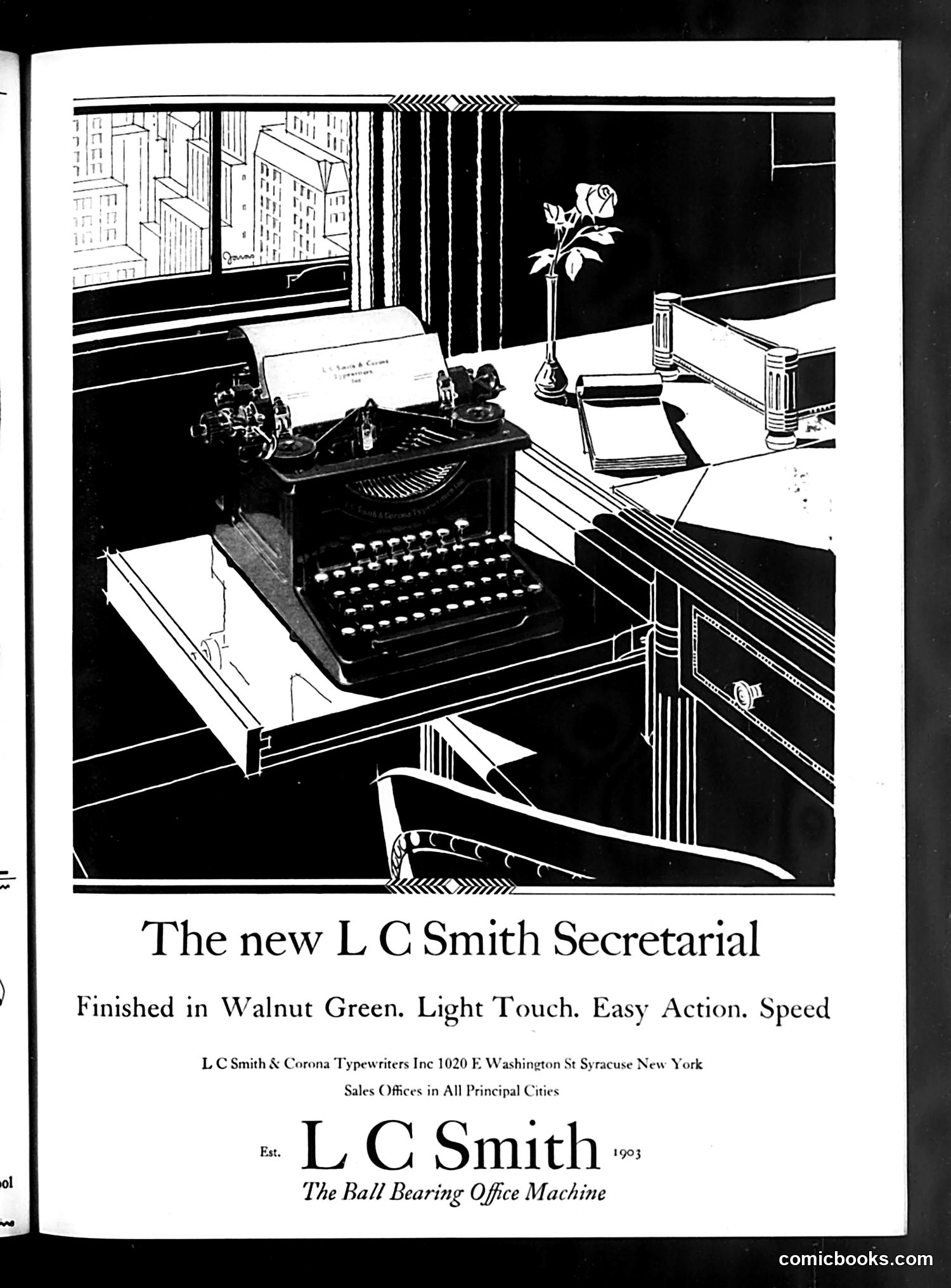
This is a **full-page advertisement**, not a satirical cartoon. It promotes the L.C. Smith typewriter (established 1903), marketed as "The Ball Bearing Office Machine." The illustration depicts a 1920s office desk setup featuring the typewriter in an open drawer, alongside papers, a rose in a vase, and a window overlooking a city skyline. The ad emphasizes the machine's features: walnut green finish, light touch, easy action, and speed—qualities marketed to appeal to secretaries and office workers of the era. The imagery reflects the period's modernist aesthetic and the growing professionalization of office work, particularly as women entered secretarial positions. There is no satire or political commentary present; this is straightforward commercial messaging targeting business customers.
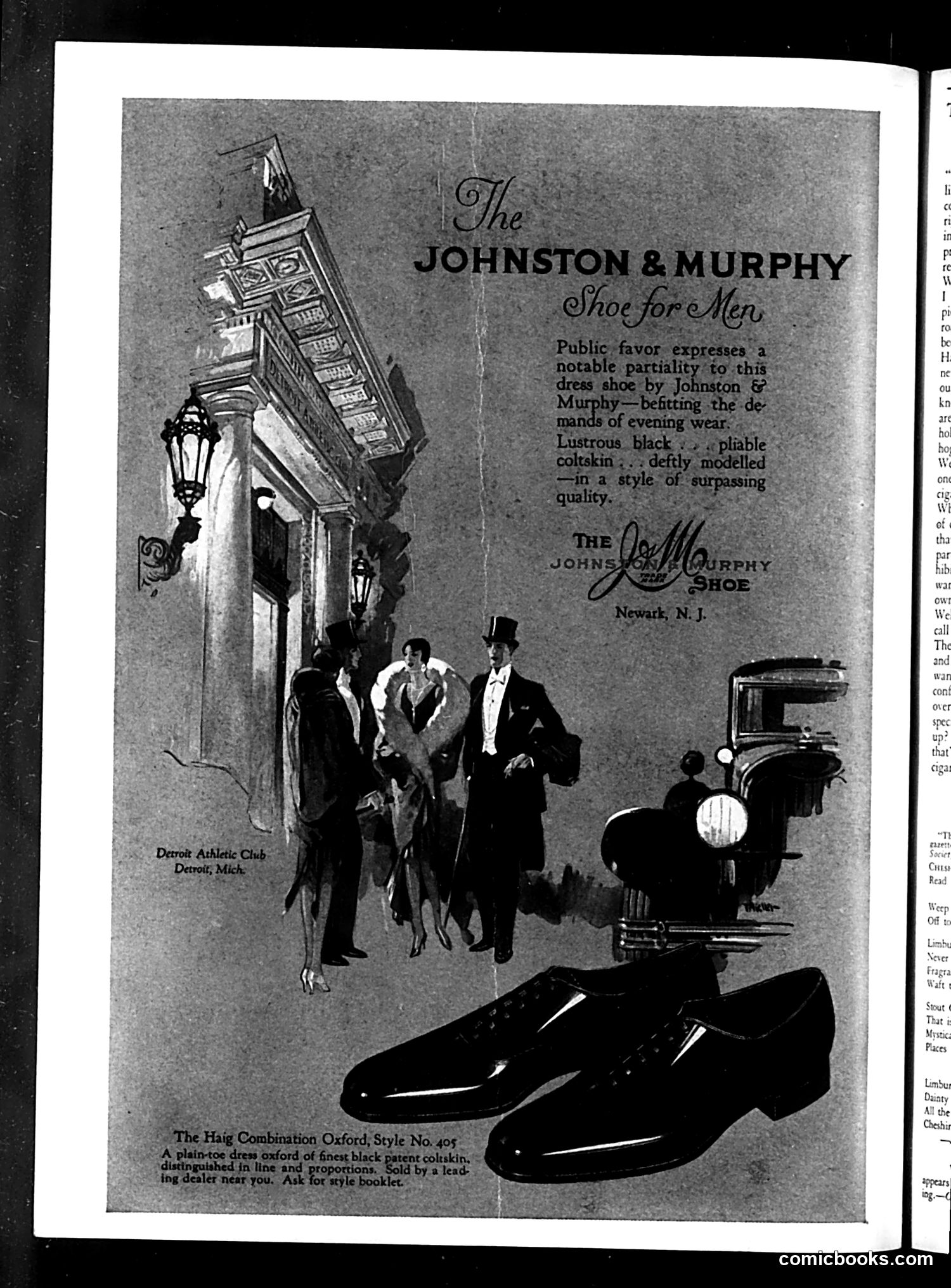
This is a **full-page advertisement**, not political satire. It promotes the "Johnston & Murphy Shoe for Men" from Newark, N.J., targeting evening wear with a dress oxford shoe ("The Hair Combination Oxford, Style No. 408"). The advertisement uses a sophisticated visual narrative: well-dressed men in formal attire (top hats, tuxedos) arriving at what appears to be an upscale venue (the Detroit Athletic Club is labeled). An elegant automobile and architectural details suggest wealth and social status. The shoe itself is displayed prominently at the bottom. The marketing message emphasizes **quality and luxury**—the shoes are described as having "surpassing quality" and made of "finest black patent coltskin." The advertisement appeals to aspirational consumers by associating the product with formal evening events and refined society.
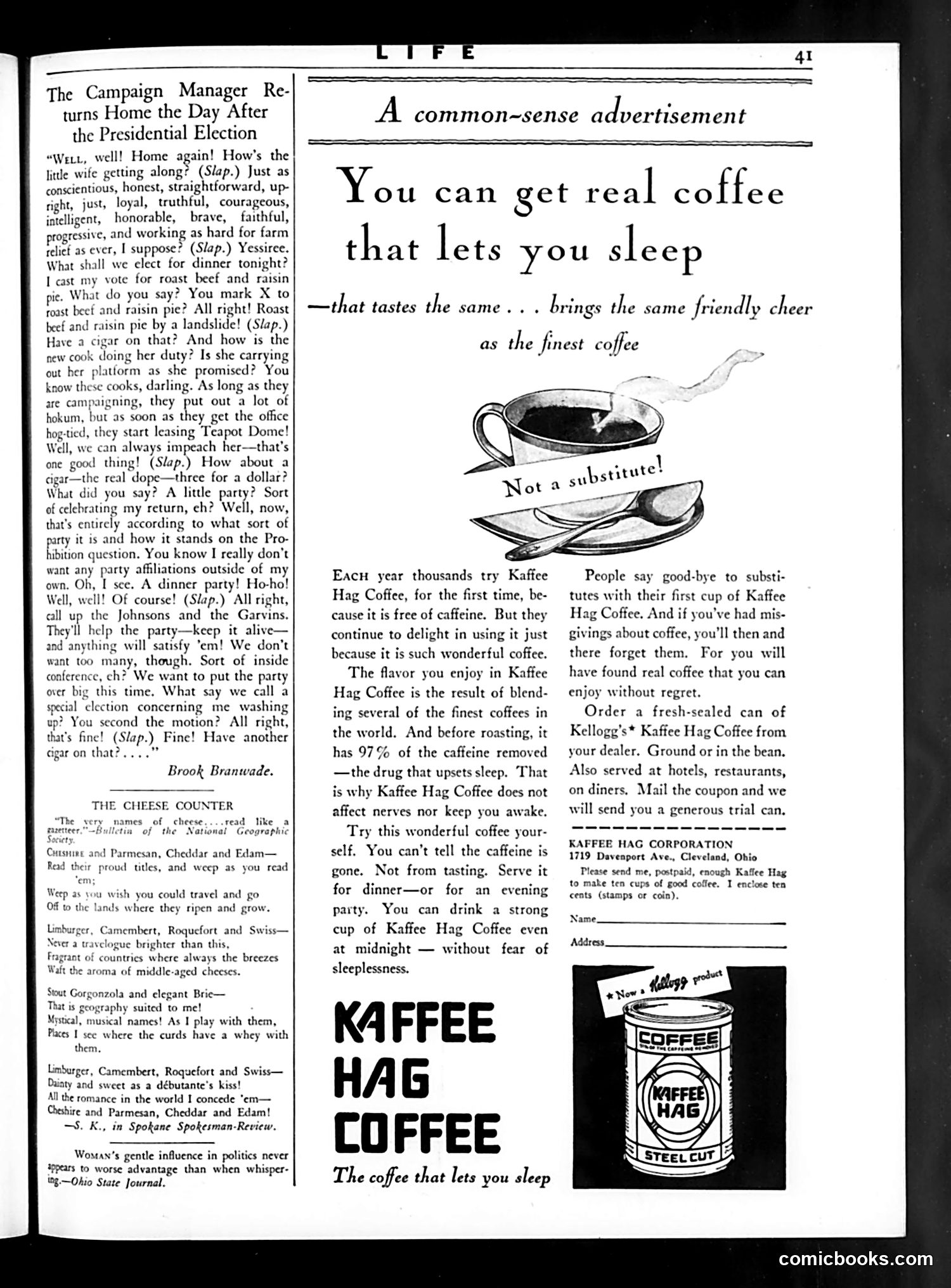
This page contains two satirical pieces and an advertisement. **The main cartoon** depicts a campaign manager returning home after a presidential election, speaking condescendingly to his wife. The satire mocks political hypocrisy: he praises her virtues using the flowery language politicians use during campaigns ("loyal, truthful, courageous"), then immediately treats her dismissively, asking about dinner like she's a servant. He applies campaign logic absurdly to household matters—calling a dinner decision a "landslide" vote, threatening to "impeach" the cook for not maintaining her promised platform, and wanting to hold a "special election" about laundry. The joke is that politicians abandon their lofty campaign rhetoric the moment they gain power, revealing their true nature. **"The Cheese Counter"** is light verse celebrating cheese varieties by name and origin. **The Kaffee Hag advertisement** promotes decaffeinated coffee, emphasizing it tastes identical to regular coffee but won't disrupt sleep—a practical appeal to consumers concerned about caffeine's effects.
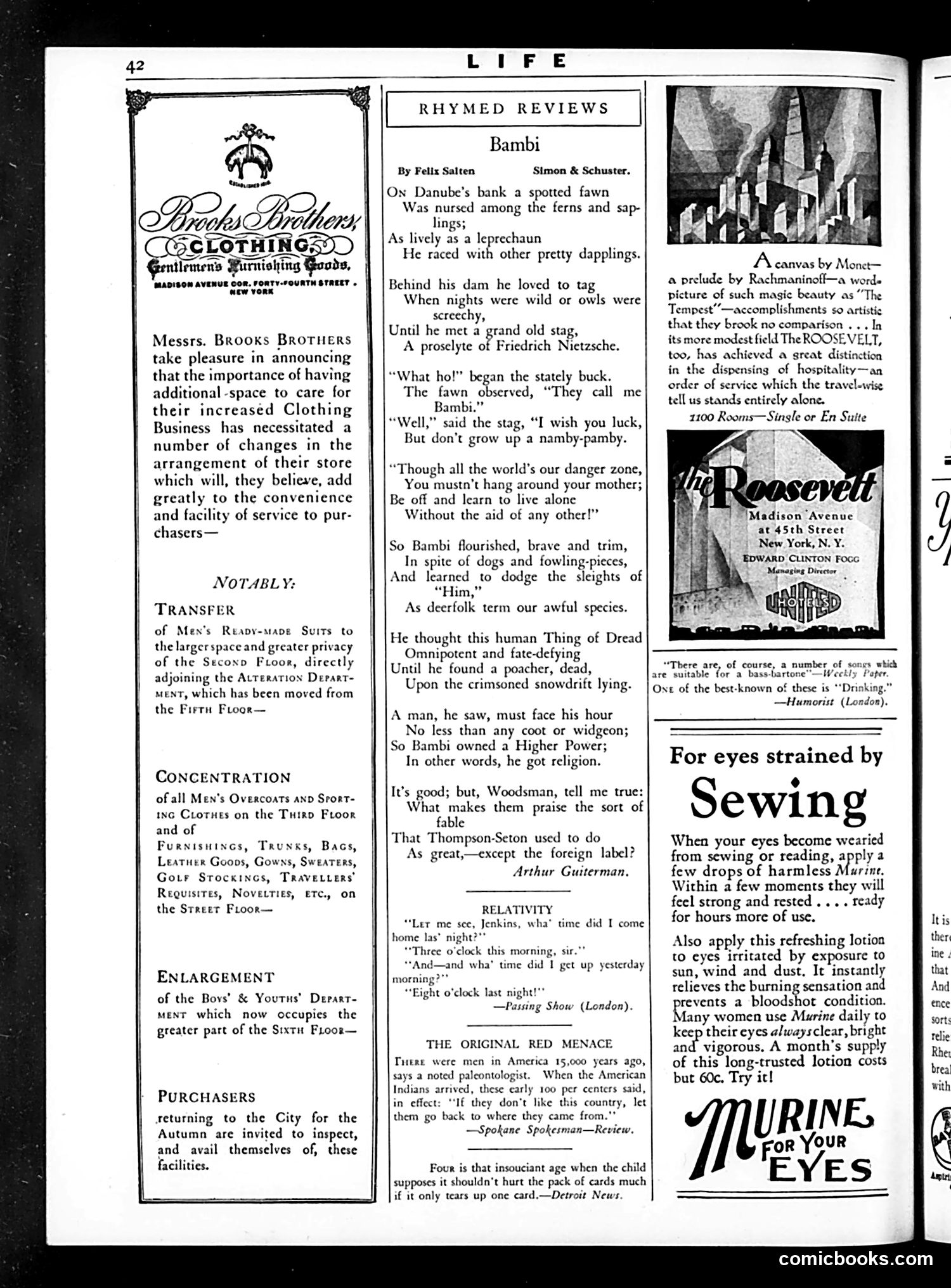
This page is primarily **commercial advertising** for Brooks Brothers clothing store, announcing interior reorganization and expansion. The actual editorial content consists of three short humor pieces: **"Bambi" Review**: A satirical poem by Arthur Guiterman reviewing Felix Salten's children's book. The satire mocks the story's heavy-handed moralizing—a deer learns independence from a Nietzschean stag, discovers humans are mortal, and gains "religion." Guiterman's joke: why praise this derivative tale just because it's translated from German, when American authors like Thompson-Seton wrote similar stories? **"Relativity" & "The Original Red Menace"**: Brief, unattributed humor pieces. The first plays on confused timing. The second sarcastically notes that 15,000-year-old Americans would have told later arrivals to leave—an ironic commentary on anti-immigrant sentiment by implying modern xenophobes are themselves "invaders." The page also includes a **Murine eye lotion advertisement**, leveraging reader fatigue from sewing. Overall, this is a typical Life magazine format: light satire mixed with retail announcements and patent medicine ads.
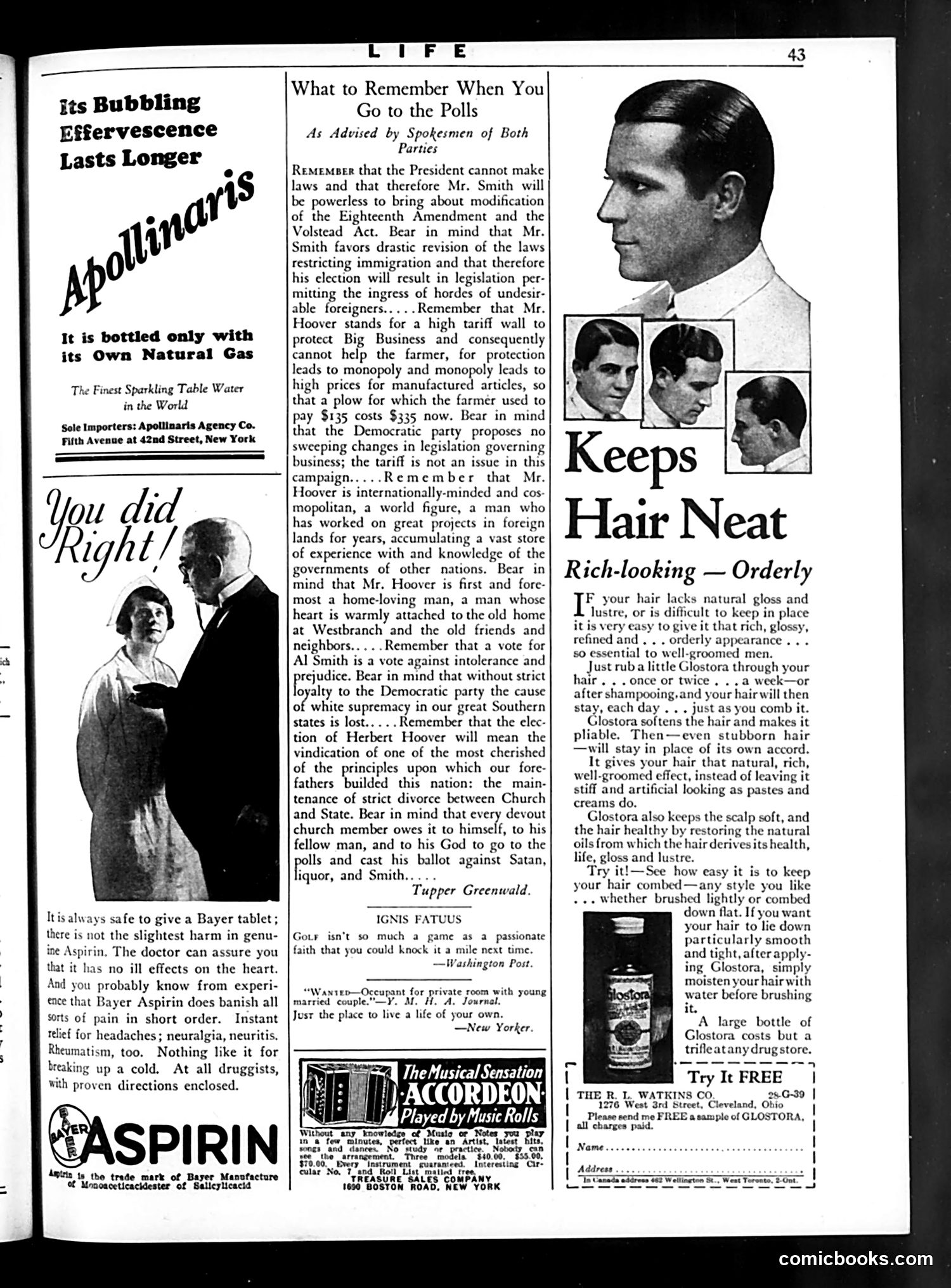
This satirical piece (bylined Tupper Greenwald) lampoons the 1928 U.S. presidential election between Herbert Hoover and Al Smith. The joke is that both parties offer contradictory talking points voters should "remember"—each argument immediately undercut by its opposite. For instance: voters are told Smith cannot modify Prohibition (presidency can't make laws), yet his election will flood the country with "undesirable foreigners." Similarly, Hoover is simultaneously portrayed as a cosmopolitan world figure *and* a provincial homebody attached to his small hometown. The satire targets the absurdity of campaign rhetoric. The piece highlights real 1928 anxieties: immigration restrictions, tariffs protecting business over farmers, Church-State separation (Smith was Catholic, a major issue), and Prohibition enforcement. The final absurdist touch—voting against "Satan, liquor, and Smith"—underscores how campaigns reduced complex policy to emotional appeals and religious prejudice. This is purely political commentary; the page's other content (Apollinaris water, Aspirin, Glostora hair product advertisements) is unrelated commercial material typical of 1920s magazine layout.
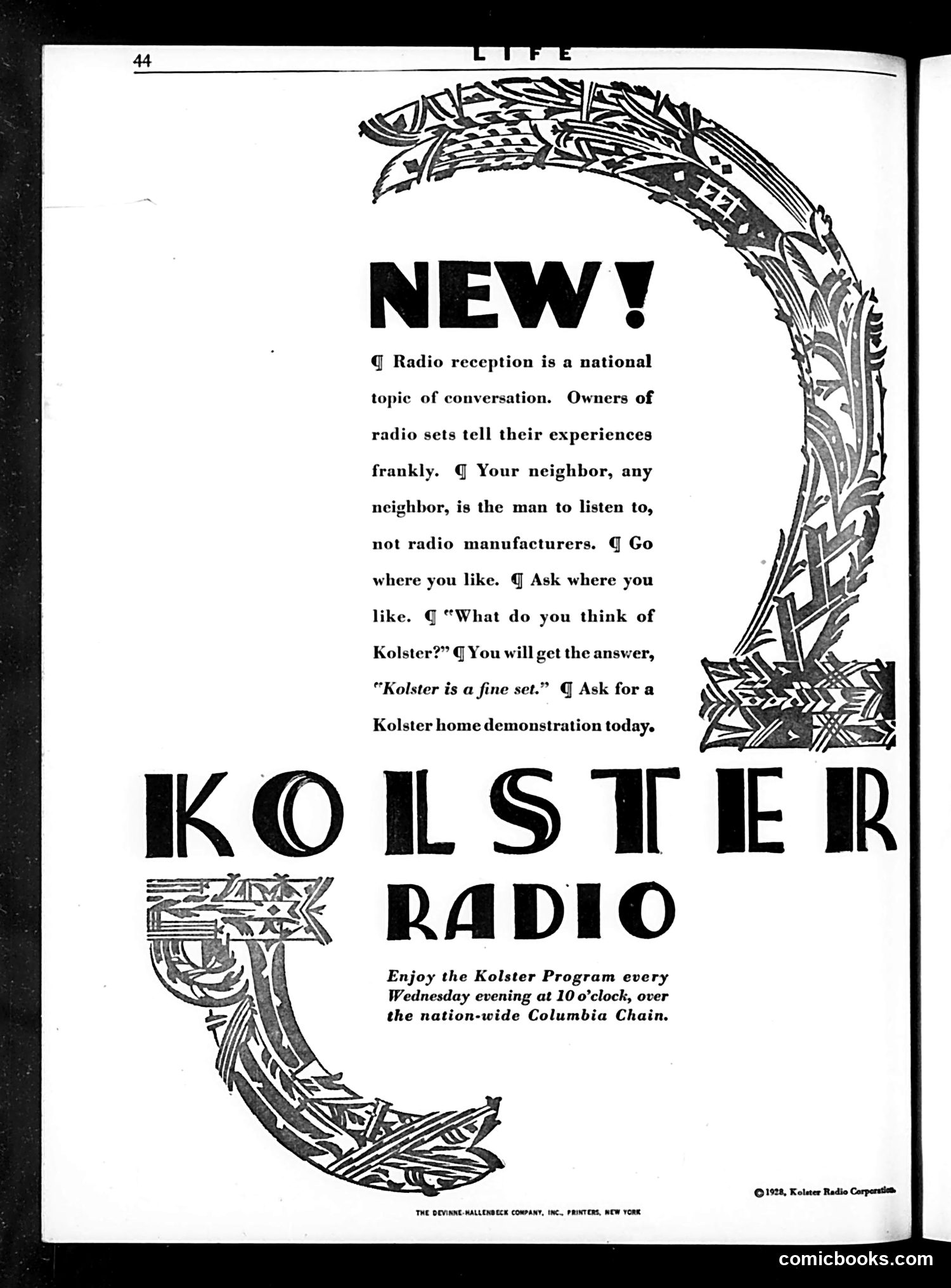
This is a **product advertisement**, not political satire. It promotes Kolster brand radios during the early radio era when home reception quality was a widespread consumer concern. The ad's strategy targets potential buyers by suggesting they should trust **neighbor testimonials over manufacturer claims**—a marketing appeal to authenticity and peer recommendation. The decorative Art Deco border frames the pitch, which emphasizes that asking neighbors "What do you think of Kolster?" will reliably produce praise: "Kolster is a fine set." The ad also promotes the **Kolster Program**, a weekly broadcast on the Columbia radio chain (Wednesdays at 10 PM), which served as branded content to drive set sales. Context for modern readers: this reflects 1920s radio's novelty status, when radio sets were expensive home purchases and reception quality genuinely varied widely. Word-of-mouth validation was considered more persuasive than advertising claims.
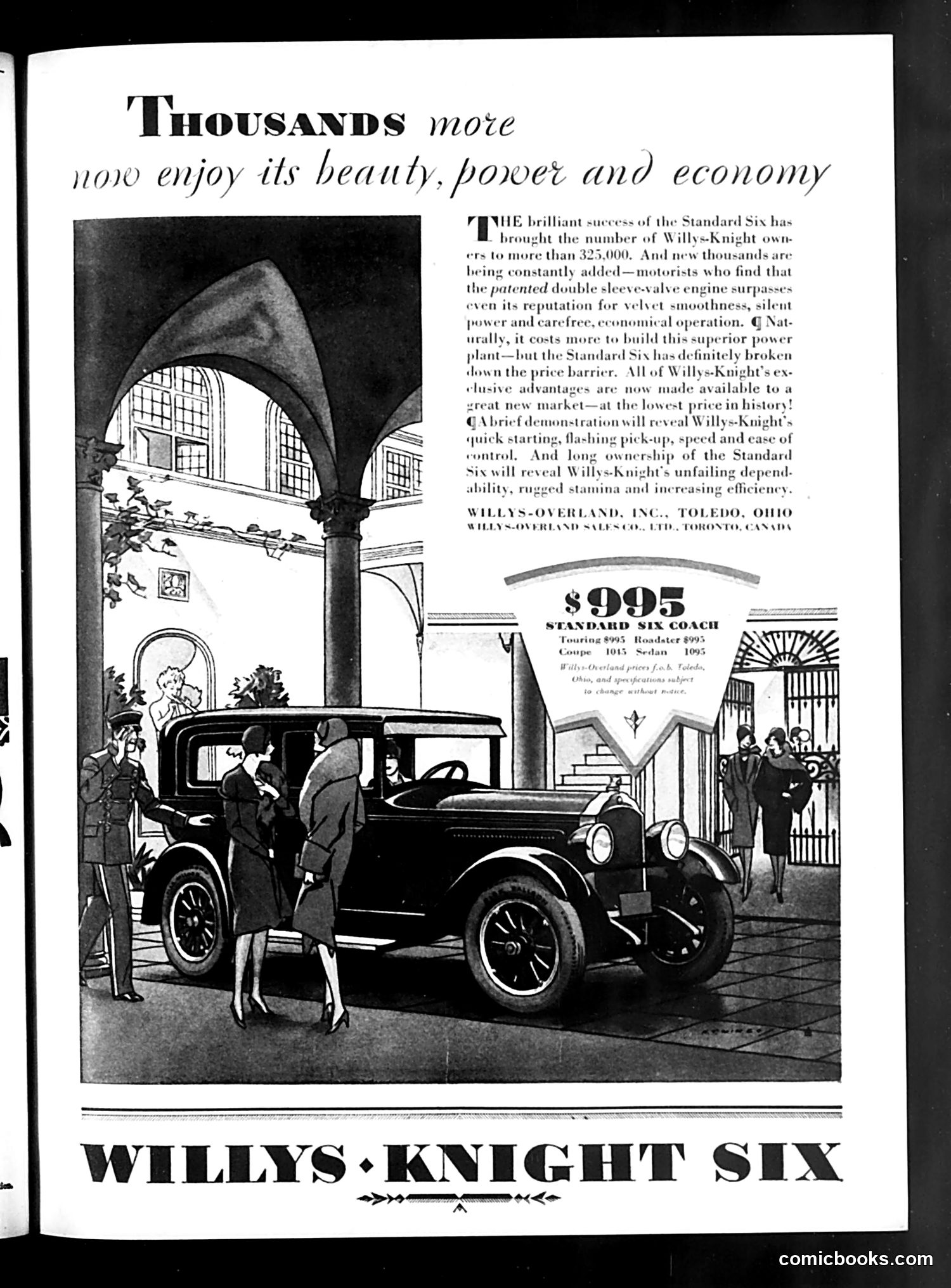
This is a **car advertisement**, not political satire. It promotes the Willys-Knight Six automobile, priced at $995. The page features an illustration of an elegant 1920s sedan parked before a classical building with arched entryways. Well-dressed figures in period clothing admire the vehicle, establishing aspirational lifestyle messaging common to luxury car advertising of the era. The text emphasizes the car's technical superiority—specifically its patented "double sleeve-valve engine"—claiming over 325,000 owners. The marketing pitch highlights beauty, power, economy, and reliability while positioning the vehicle as affordable luxury at "the lowest price in history" for its class. **For modern readers**: This represents early automotive advertising strategy emphasizing engineering innovation and social status. The classical architectural setting and formally-dressed figures suggest the car appeals to affluent, cultured consumers.
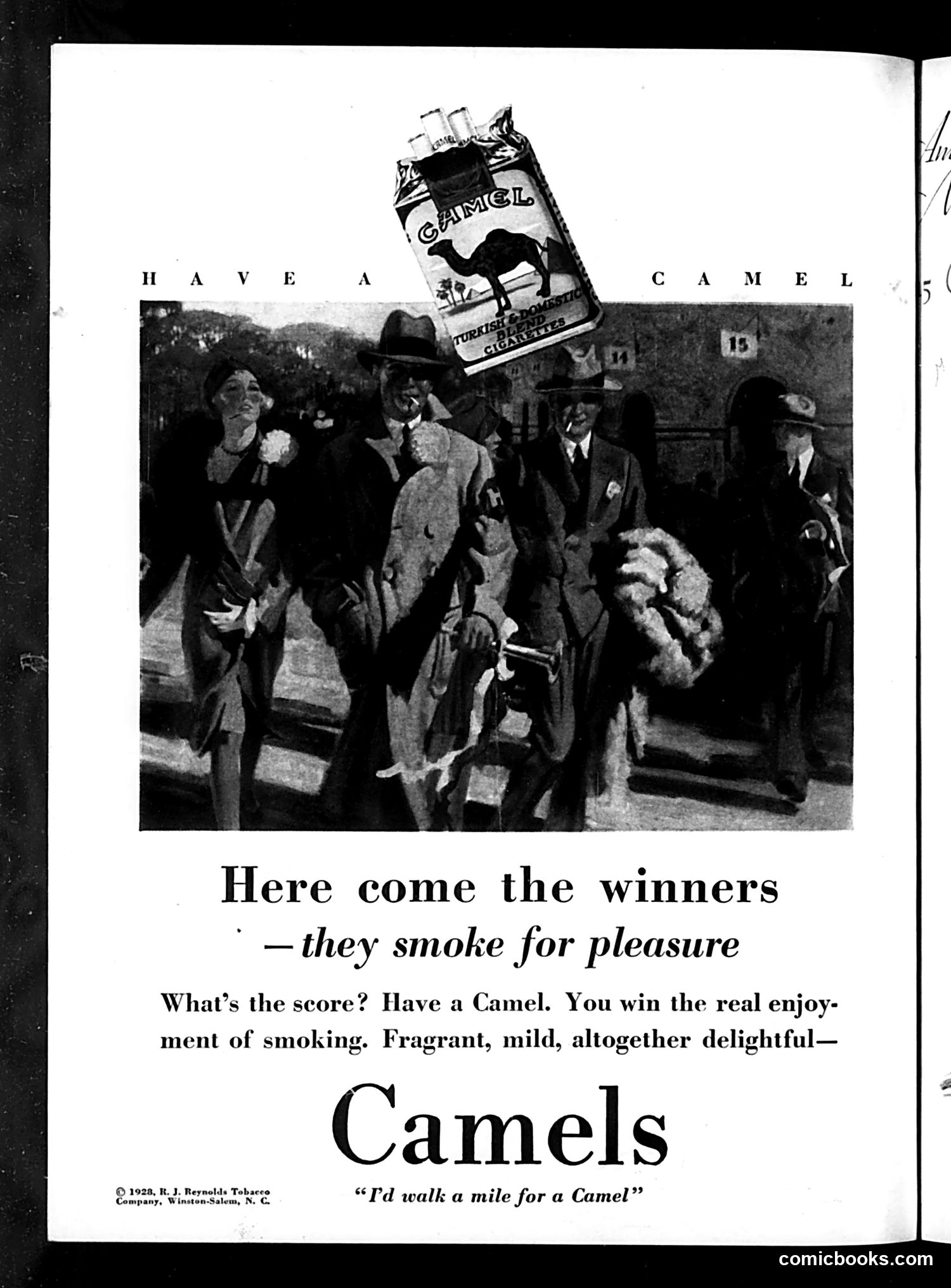
This is a Camel cigarette advertisement, not political satire. The ad depicts a group of formally dressed men (appearing to be at some kind of sporting event or competition, given the "What's the score?" reference) celebrating as "winners" who smoke Camels "for pleasure." The large Camel package looms above them. The accompanying text promises that Camels deliver "real enjoyment of smoking"—describing them as "fragrant, mild, altogether delightful." The famous slogan "I'd walk a mile for a Camel" appears at bottom. This reflects early-20th-century advertising that associated cigarette smoking with sophistication, success, and masculine achievement, before health warnings existed. The ad is dated 1928 and published by H.J. Reynolds Tobacco Company.