
Life, 1928-11-02 · page 23 of 48
Life — November 2, 1928 — page 23: what you’re looking at
What you’re looking at
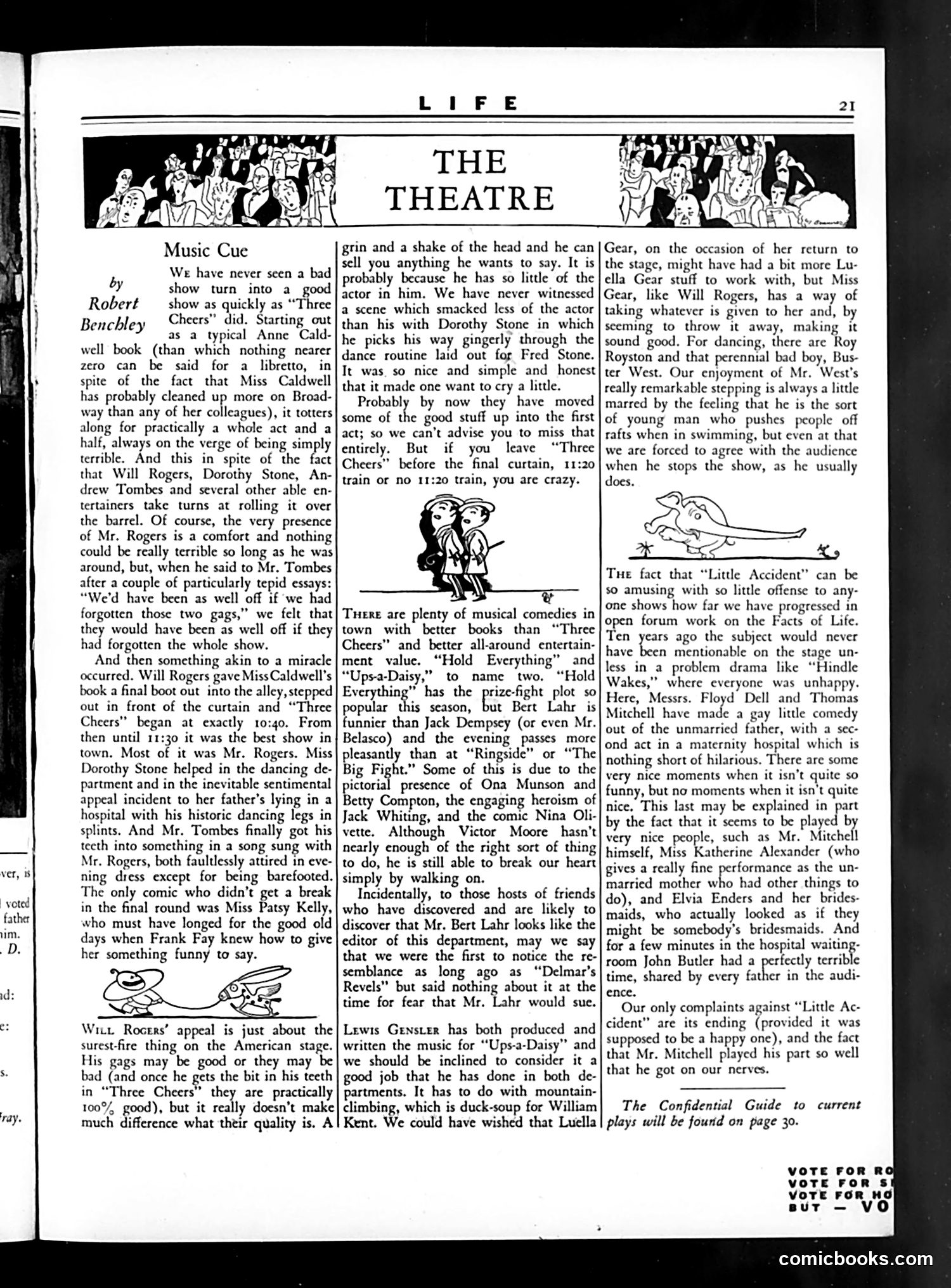
This is **Robert Benchley's theater review** of the Broadway musical "Three Cheers" (circa 1928). The page contains no political cartoons—it's a satirical drama critique illustrated with small comedic sketches. **The Main Point:** Benchley argues that "Three Cheers" is a mediocre show with a terrible script by Anne Caldwell, yet becomes excellent in its final act almost entirely because of **Will Rogers' charisma**. Rogers was so naturally likeable and funny that he could "sell you anything," transforming terrible material into entertainment simply through his personality and minimal acting style. **Key Names:** Will Rogers, Dorothy Stone, and Andrew Tombes are the entertainers carrying the show. Benchley compares it favorably to competing musicals like "Hold Everything" and "Ups-a-Daisy." **The Satire:** Benchley mocks both the weak libretto and the oddly-barefooted performers, while praising Rogers' ability to make audiences overlook bad writing through pure star power and honest, unaffected delivery. The small illustrations are generic vaudeville-style figures, not specific caricatures.
📄 Transcribed text from this page (OCR, searchable)
Machine-transcribed from the original scan — historical spelling and the odd misread are preserved.
Music Cue We have never seen a bad show turn into a good show as quickly as “Three Cheers” did. Starting out as a typical Anne Cald- well book (than which nothing nearer zero can be said for a libretto, in spite of the fact that Miss Caldwell has probably cleaned up more on Broad- way than any of her colleagues), it totters along for practically a whole act and a half, always on the verge of being simply terrible. And this in spite of the fact that Will Rogers, Dorothy Stone, An- drew Tombes and several other able en- tertainers take turns at rolling it over the barrel. Of course, the very presence of Mr. Rogers is a comfort and nothing could be really terrible so long as he was around, but, when he said to Mr. Tombes after a couple of particularly tepid essays: “We'd have been as well off if we had forgotten those two gags,” we felt that they would have been as well off if they had forgotten the whole show. And then something akin to a miracle occurred. Will Rogers gave Miss Caldwell’s book a final boot out into the alley, stepped out in front of the curtain and “Three Cheers” began at exactly 10:40. From then until 11:30 it was the best show in town. Most of it was Mr. Rogers. Miss Dorothy Stone helped in the dancing de- partment and in the inevitable sentimental appeal incident to her father’s lying in a hospital with his historic dancing legs in splints. And Mr. Tombes finally got his teeth into something in a song sung with Mr. Rogers, both faultlessly attired in eve- ning dress except for being barefooted. The only comic who didn’t get a break in the final round was Miss Patsy Kelly, who must have longed for the good old days when Frank Fay knew how to give her something funny to say. by Robert Benchley Wit Rocers’ appeal is just about the surest-fire thing on the American stage. His gags may be good or they may be bad (and once he gets the bit in his teeth in “Three Cheers” they are practically 100°, good), but it really doesn’t make much difference what their quality is. A grin and a shake of the head and he can sell you anything he wants to say. It is probably because he has so little of the actor in him. We have never witnessed a scene which smacked less of the actor than his with Dorothy Stone in which he picks his way gingerly through the dance routine laid out for Fred Stone. It was. so nice and simple and honest that it made one want to cry a little. Probably by now they have moved some of the good stuff up into the first act; so we can’t advise you to miss that entirely. But if you leave “Three Cheers” before the final curtain, 11:20 train or no 11:20 train, you are crazy. Tuere are plenty of musical comedies in town with better books than “Three Cheers” and better all-around entertain- ment value. “Hold Everything” and “Ups-a-Daisy,” to mame two. “Hold Everything” has the prize fight plot so popular this season, but Bert Lahr is funnier than Jack Dempsey (or even Mr. Belasco) and the evening passes more pleasantly than at “Ringside” or “The Big Fight.” Some of this is due to the pictorial presence of Ona Munson and Betty Compton, the engaging heroism of Jack Whiting, and the comic Nina Oli- vette. Although Victor Moore hasn't nearly enough of the right sort of thing to do, he is still able to break our heart simply by walking on. Incidentally, to those hosts of friends who have discovered and are likely to discover that Mr. Bert Lahr looks like the editor of this department, may we say that we were the first to notice the re- semblance as long ago as “Delmar’s Revels” but said nothing about it at the time for fear that Mr. Lahr would sue, Lewis Genster has both produced and written the music for “Ups-a-Daisy” and we should be inclined to consider it a good job that he has done in both de- partments. It has to do with mountain- climbing, which is duck-soup for William Kent. We could have wished that Luella Gear, on the occasion of her return to the stage, might have had a bit more Lu- ella Gear stuff to work with, but Miss Gear, like Will Rogers, has a way of taking whatever is given to her and, by seeming to throw it away, making it sound good. For dancing, there are Roy Royston and that perennial bad boy, Bus- ter West. Our enjoyment of Mr. West's really remarkable stepping is always a little marred by the feeling that he is the sort of young man who pushes people off rafts when in swimming, but even at that we are forced to agree with the audience when he stops the show, as he usually Tue fact that “Little Accident” can be so amusing with so little offense to any- one shows how far we have progressed in open forum work on the Facts of Life. Ten years ago the subject would never have been mentionable on the stage un- less in a problem drama like “Hindle Wakes,” where everyone was unhappy. Here, Messrs. Floyd Dell and Thomas Mitchell have made a gay little comedy out of the unmarried father, with a sec- ond act in a maternity hospital which is nothing short of hilarious. There are some very nice moments when it isn’t quite so funny, but no moments when it isn’t quite nice, This last may be explained in part by the fact that it seems to be played by very nice people, such as Mr. Mitchell himself, Miss Katherine Alexander (who gives a really fine performance as the un- married mother who had other things to do), and Elvia Enders and her brides- maids, who actually looked as if they might be somebody's bridesmaids. And for a few minutes in the hospital waiting room John Butler had a perfectly terribl time, shared by every father in the audi- ence. Our only complaints against “Little Ac- cident” are its ending (provided it was supposed to be a happy one), and the fact that Mr. Mitchell played his part so well that he got on our nerves. The Confidential Guide to current plays will be fourid on page 30. VOTE FOR RO VOTE FOR §$ VOTE FOR HO BuT — °o comicbooks.com