
Life, 1928-11-02 · page 21 of 48
Life — November 2, 1928 — page 21: what you’re looking at
What you’re looking at
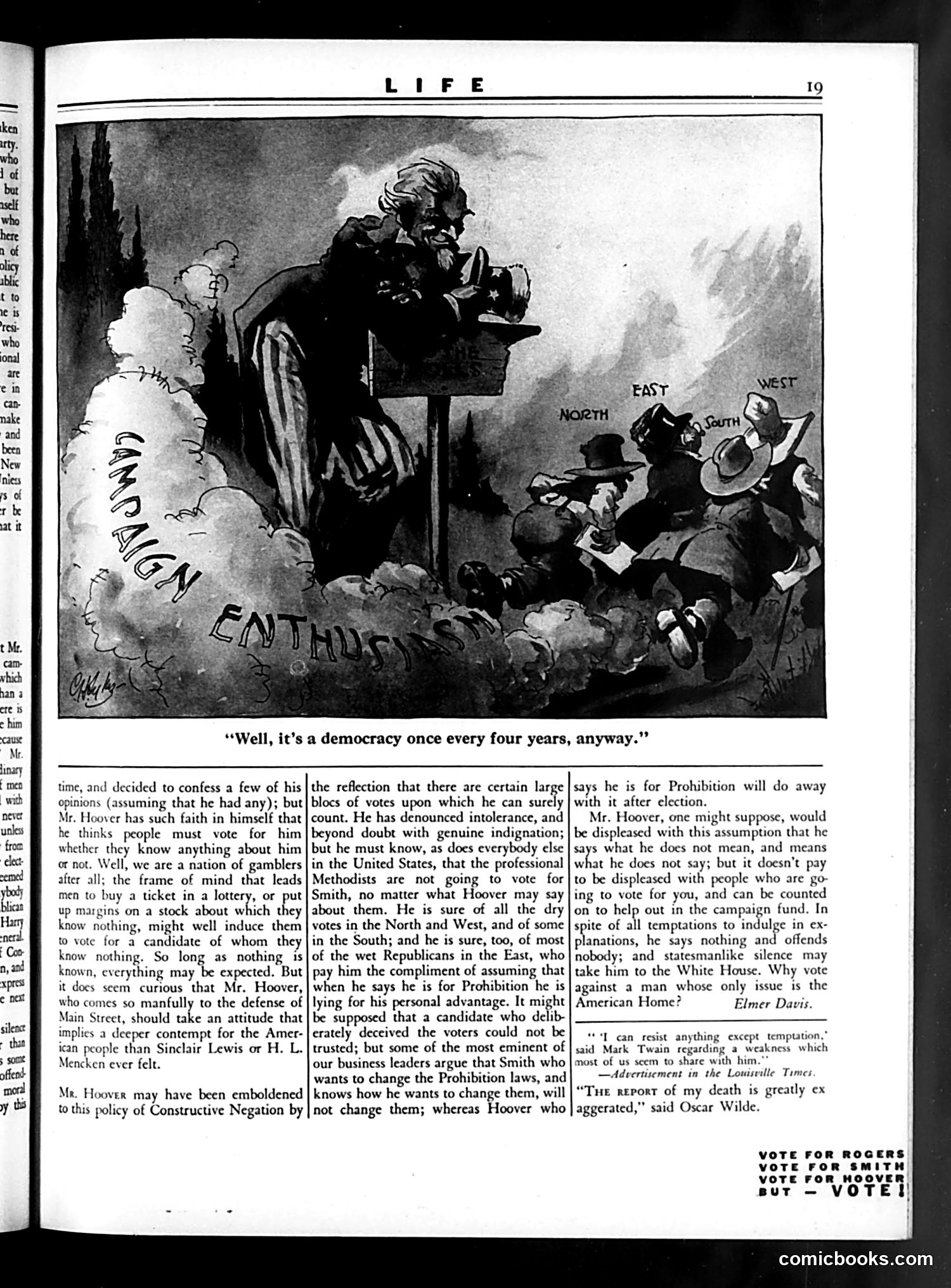
This 1928 election cartoon satirizes voter apathy and manipulation during presidential campaigns. The central figure appears to be a political manipulator or campaign operator peering through a telescope at regional voting blocs labeled "North," "East," "South," and "West"—suggesting candidates strategically target predictable voter groups rather than engaging the broader electorate. The accompanying text by Elmer Davis critiques Herbert Hoover's campaign strategy of saying nothing substantive ("Constructive Negation"), instead relying on assumed voting blocs: Methodists opposed to Catholic candidate Al Smith, "dry" (Prohibition-supporting) voters, and wet Republicans who assume Hoover won't actually enforce Prohibition despite claiming support. The cartoon's title cynically observes that American democracy functions only quadrennially—every four years—implying voters exercise minimal real influence between elections. The satire targets how candidates exploit predictable demographics and voter assumptions rather than genuinely persuading citizens.
📄 Transcribed text from this page (OCR, searchable)
Machine-transcribed from the original scan — historical spelling and the odd misread are preserved.
ai FkTes2 8 Il Ra ‘Well, it’s a democracy once every four years, anyway.” time, and decided to confess a few of his opinions (assuming that he had any); but Mr. Hoover has such faith in himself that he thinks people must vote for him whether they know anything about him or not. Well, we are a nation of gamblers after all; the frame of mind that leads men to buy a ticket in a lottery, or put up margins on a stock about which they know nothing, might well induce them to vote for a candidate of whom they know nothing. So long as nothing is known, everything may be expected. But it does seem curious that Mr. Hoover, who comes so manfully to the defense of Main Street, should take an attitude that implies a deeper contempt for the Amer- ican people than Sinclair Lewis or H. L. Mencken ever felt. Mr. Hoover may have been emboldened to this policy of Constructive Negation by the reflection that there are certain large blocs of votes upon which he can surely count. He has denounced intolerance, and beyond doubt with genuine indignation; but he must know, as does everybody else in the United States, that the professional Methodists are not going to vote for Smith, no matter what Hoover may say about them. He is sure of all the dry votes in the North and West, and of some in the South; and he is sure, too, of most of the wet Republicans in the East, who pay him the compliment of assuming that when he says he is for Prohibition he is lying for his personal advantage. It might be supposed that a candidate who delib- erately deceived the voters could not be trusted; but some of the most eminent of our business leaders argue that Smith who wants to change the Prohibition laws, and knows how he wants to change them, will not change them; whereas Hoover who says he is for Prohibition will do away with it after election. Mr. Hoover, one might suppose, would be displeased with this assumption that he er what he does not mean, and means what he does not say; but it doesn’t pay to be displeased with people who are go- ing to vote for you, and can be counted on to help out in the campaign fund. In spite of all temptations to indulge in ex- planations, he says nothing and offends nobody; and statesmanlike silence may take him to the White House. Why vote against a man whose only issue is the American Home? Elmer Davis. “"L can resist: anything except temptation,” said Mark Twain regarding a weakness which most of us seem to share with him.” —Advertisement in the Louisville Times “Tue report of my death is greatly ex aggerated,” said Oscar Wilde. VOTE FOR ROGERS VOTE FOR SMITH VOTE FOR HOOVER put — VOTE!) comicbooks.com