
Life, 1928-11-02 · page 32 of 48
Life — November 2, 1928 — page 32: what you’re looking at
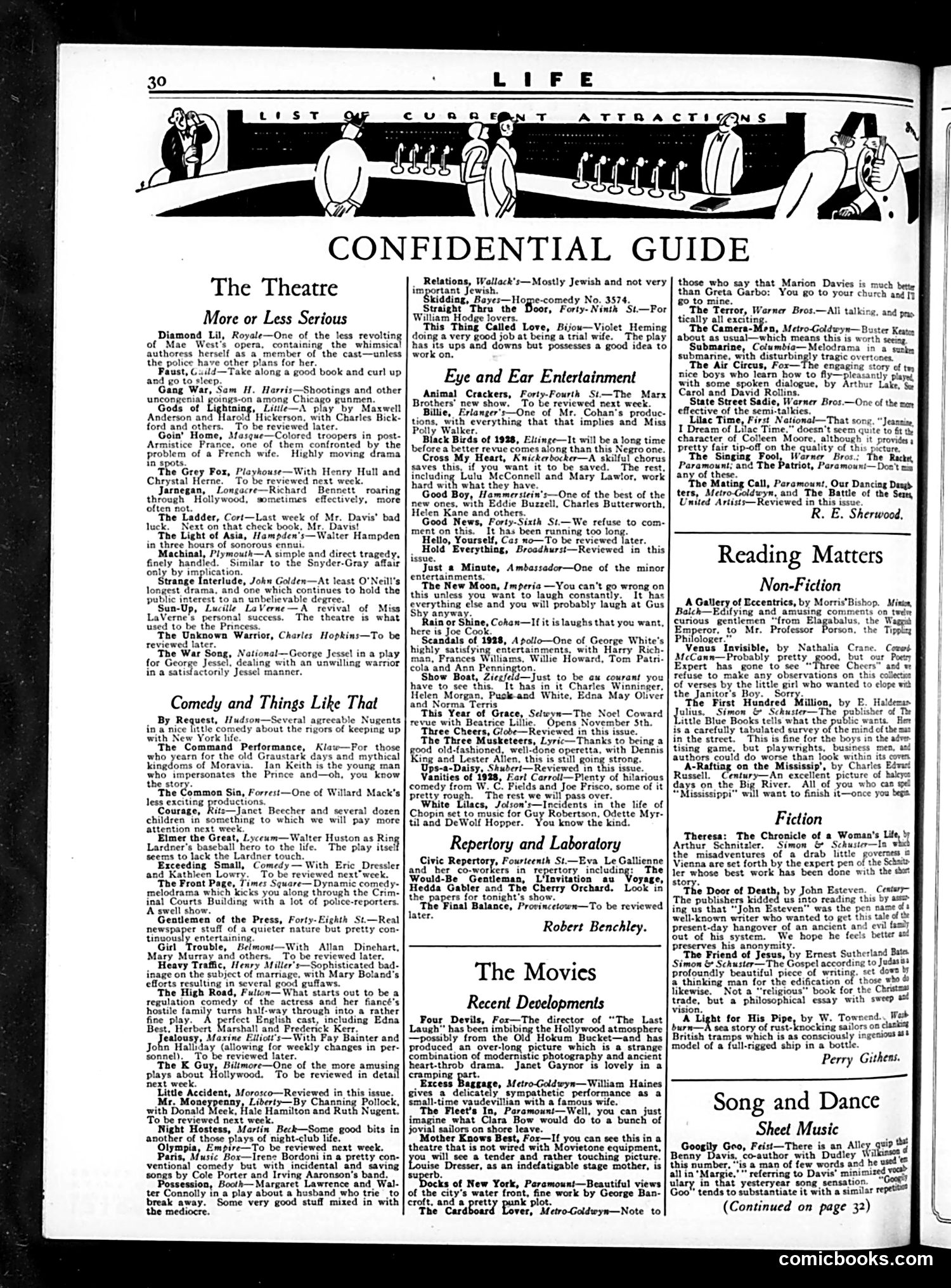
What you’re looking at
This page is primarily a **theater review guide** rather than political satire. It's a practical entertainment listing for New York theatergoers, organized by tone (serious dramas, comedies, etc.). Notable content includes: - **Mae West's "Diamond Lil"**: The reviewer's snide comment "unless the police have other plans for her" refers to West's real legal troubles for obscenity—she faced censorship and arrest for her sexually provocative performances. - **"Machinal"**: Described as similar to the "Snyder-Gray affair"—a famous 1920s murder trial that scandalized America. - The reviews adopt a gossipy, irreverent tone typical of Life's satirical style, with caustic one-liners about performers and productions. Rather than political cartooning, this demonstrates **Life's role as cultural critic**, using light mockery to comment on Broadway's offerings and contemporary celebrity controversies. The "Confidential" framing suggests insider theatrical knowledge.
📄 Transcribed text from this page (OCR, searchable)
Machine-transcribed from the original scan — historical spelling and the odd misread are preserved.
CONFIDENTIAL GUIDE The Theatre More or Less Serious Diamond Lil, Royale—One of the less revolting of Mae West's opera, containing the whimsical authoress herself as a ‘member of the cast—unless the police have other plans for her. F ild—Take along a good book and curl up Sam H. Harris—Shootings and other uncongenial goings-on among Chicago gunmen. Gods of Lightning, Litie—A play by Maswell Anderson and Harold ‘Hickerson, with Charles Bick- ford and others. To be reviewed later. Goin’ Home, Masque—Colored troopers ii Armistice France, one of them confronted bj problem of a Prench wife. Highly moving In spots. The Grey Fox, Playkouse—With Henry Hull and Chrystal Herne. ' To be reviewed next week. Jarnegan, Longacre—Richard Bennett roaring through Hollywood, sometimes effectively, more often not. The Ladder, Cort—Last week of Mr. Davis’ bad luck, Next on that check book, Mr. Davis! The Light of Asia, Hampden’s—Walter Hampden in three hours of sonorous ennui. Machinal, Plymouth—A simple and direct tragedy. finely handled. Similar to the Snyder-Gray affair only by implication. Strange Interlude, John Golden—At least O'Neill's longest drama, and one which continues to hold the public interest to an unbelievable degree. Sun-Up, Lucille LaVerne—A revival of Miss LaVerne's personal success. The theatre is what used to be the Princess. The Unknown Warrior, Charles Hopkins—To be reviewed later. The War Song, National—George Jessel in a play for George Jessel, dealing with an unwilling warrior in a satisfactorily Jessel manner. Comedy and Things Like That By Request, //udson veral agreeable Nugents in a nice little comedy about the rigors of keeping up with New York life. The Command Performance, Klaw—Por those who yearn for the old Graustark days and mythical kingdoms of Moravia. Ian Keith is the young man who impersonates the Prince and—oh, you know the story. ' ‘The Common Sia, Forrest—One of Willard Mack's less exciting productions. Courage, Rits—Janet Beecher and several dozen children in something to which we will pay more attention next week. Elmer the Great, Lyceum—Walter Huston as Rinj Lardner’s baseball hero to the life. The play itsel seems to lack the Lardner touch. Exceeding Small, Comedy— With Eric Dressler and Kathleen Lowry. To be reviewed next"week. The Front Page, Times Square—Dynamic comedy- melodrama which kicks you along through the Crim- inal Courts Building with a lot of police-reporters. A swell show. Gentlemen of the Press, Forty-Eighth St.—Real newspaper stuff of a quieter nature but pretty con- tinuously entertaining Girl Trouble, Belmont—With Allan Dinehart, Mary Murray and others. To be reviewed later. Heavy Traffic, Henry AMiller's—Sophisticated bad- inage on the subject of marriage, with Mary Boland’s efforts resulting in several good guffaws. The High Road, Fulion—What starts out to be a regulation comedy of the actress and her fianct’s hostile {amily turns half-way through into. a rather fine play. A perfect English cast, including Edna Best, Herbert Marshall and Prederick Kerr. jealousy, Maxine Elliott’s—With Pay Bainter and John Halliday (allowing for weekly changes in per- sonnel). To be reviewed later. The K Guy; Bilimore—Qne of the. more amusin plays about Hollywood. To be reviewed in detai next week. a Little Accident, Morosco—Reviewed in this issue. Mr. Moneypenny, Liberty—By Channing Pollock, with Do eek, Hale Hamilton and Ruth Nugent. To be reviewed next week. Night Hostess, Martin Beck—Some good bits in another of those plays of night-club life. Olympia, Empire—To be reviewed next week. Paris, Music Box—Irenz Bordoni in a pretty con- ventional comedy but with incidental and saving songs by Cole Porter and Irving Aaronson’s band. Possession, Booth—Margaret Lawrence and Wal- ter Connolly ina play about a husband who trie to break away. Some very good stuff mized in with the mediocre. post- the rama Relations, Waellack's—Mostly Jewish and not very important Jewish. kidding, Bayes—Hogme-comedy No. 3574. Straight Thru the Door, Forty-Ninth St.—For William Hodge lovers. This Thing Called Lor Bijou—Violet Heming doing a very good job at being a trial wife. The pl has i ups and downs but possesses a good idea to work on, Eye and Ear Entertainment Animal Crackers, Forty-Fourth St—The Marx Brothers’ new show. To be reviewed next week. Billie, Erlanger's—One of Mr. Cohan's produc- tions, with everything that that implies and Miss Polly Walker. Black Birds of 1928, Elinge—lIt will be a long time before a better revue comes along than this Negro one. Cross My Heart, Knickerbocker—A skilful chorus saves this, if you ‘want it to be saved, The rest. including Lulu McConnell and Mary Lawlor, work hard with what they have. Good Boy, Hammersicin's—One of the best of the new ones, with Eddie Buzzell, Charles Butterworth, Helen Kane and others. Good News, Forty-Sixth St—We refuse to com- ment on this. "It has been running too long. Hello, Yourself, Cas no—To be reviewed later. Hold Everything, Broadhurst—Reviewed in this issue. Just a Minute, Ambassador—One of the minor entertainments. The New Moon, mperia —You can't go wrong on this unless you want to laugh constantly. It has everything else and you will probably laugh at Gus Shy anyway. Rain or Shine, Cohan—I it is laughs that you want here is Joe Cook. Scandals of 1928, A pollo—One of George White's highly satisfying entertainments, with Harry Rich- man, Prances Williams, Willie Howard, Tom Patni- cola and Ann Pennington. Show Boat, Ziecfeid—Just to be ou courant you have to see this. It has in it Charles Winninger, Helen Morgan, Puck-and White, Edna May Olver and Norma Terris This Year of Grace, Selwyn—The Noel Coward revue with Beatrice Lillie. Opens November Sth. Three Cheers, Globe—Reviewed in this issue. The Three Musketeers, Lyric—Thanks to being a good old-fashioned, well-done operetta, with Dennis King and Lester Allen, this is still going strong. Ups-a-Daisy, Shubert—Reviewed in this issue. Vanities of 1928, Fart Carroll—Pienty of hilarious comedy from W. C. Fields and Joe Frisco, some of it pretty rough. The rest we will pass over. White Lilacs, Jolson's—Incidents in the life of Chopin set to music for Guy Robertson, Odette Myr- tiland DeWolf Hopper. You know the kind. Repertory and Laboratory Civic Repertory, Fourteenth St—Eva Le Gallienne and ber coworkers in repertory, including: The Would-Be Gentleman, Lilnvitation au Voyage, Hedda Gabler and The Cherry Orchard. Look in the papers for tonight's show. The Final Balance, Provincetown—To be reviewed later. Robert Benchley. The Movies Recent Developments For—The director of “The Last imbibing the Hollywood atmosphere —possibly from the Old Hokum Bucket—and has produced an over-long picture which is a strange combination of modernistic photography and ancient heart-throb drama. Janet Gaynor is lovely in a cramping ie, Metro-Goldwyn—William Haines gi ely’ sympathetic performance as a small-time vaudevillian with a famous wife. | The Fleet's In, Paramouni—Well, you can just imagine what Clara Bow would do to a bunch of jovial sailors on shore leave. Mother Knows Best, For—If you can see this in a theatre that is not wired with Movietone equipment, ou will see a tender and rather touching picture. ‘ise Dresser, as an indefatigable stage mother, is of New York, Paramount—Beautiful views of the city’s water front, fine work by George Ban- croft, and a prett: ‘k plot. The Cardboard. wer, MetroGoldwyn—Note to those who say that Marion Davies i than Greta Garbo: You go to your church aft 0 to mine. The Terror, Werner Bros.—Ali talking, and pay tically all exciting Thi 1a, Metro-Goldwyn—B: about as usual—which means this is worth Submarine, Columbia—Melodrama in a sutie submanie, with disturbingly tragic .The Air Circus, Fox—The engagi nice boys who lear bow to fly—plea with some spoken dialogue, by Arth Carol and David Rollin State Street Sadie, Warner Bros. effective of the semi-talkies. Lilac Time, First National—That song. “Jeas I Dream of Lilac Time,” doesn't seem quite to ft te character of Colleen Moore, although it provides « pretty fair tip-off on the quality of this picture. The Singing Fool, Warner Bros.: The Racket, Paramount; and The Patriot, Paramouni—Doc't ma any of these. e Mating Call, Paramount, Our Dancing ters, Metro-Goldwyn, and The Battle of the Ser, United Artists—Reviewed in this issue R. E. Sherwood, Reading Matters Non-Fiction A Gallery of Eccentrics, by Morris'Bishop. Minix, Balch—Edifying and amusing comments on tedn curious gentlemen “from Elagabalus, the Wagm Emperor, to Mr. Professor Porson, the Tippy Philologer. Venus Invisible, by Nathalia Crane. McCann—Probably_ pretty good, but Expert has gone to see “Three Cheers refuse to make any observations on thi of verses by the little girl who wanted to elope wi itors Boy. | Sorry, The First Hundred Million, by E. Halden» {ulus Simon & Schuster— The publisher of Te Little Blue Books tells what the public is a carefully tabulated survey of the in the strect. This is fine for the boys in the adver tising game, but playwrights, business men, as! authors could do worse than look within its coven A-Rafting on the Mississip’, by Charles Edm Russell. Century—An excellent picture of haley: son the Big River. All of you who ca ge ississippi"’ will want to finish it—once you beps Fiction Theresa: The Chronicle of a Woman's Life ¥ Arthur Schnitzier. Simon & Schuster—Ia wht the misadventures of a drab little governess & Vienna are set forth by the expert pen of the Schaitp ler whose best work has been done with the shot story. The Door of Death, by John Esteven. Centwr- The publishers kidded us into reading this by a= ing us that “John Esteven” was the pen name dt well-known writer who wanted to get this tale of te present-day hangover of an ancient and evil fs) out of his system. We hope he fecis better se! preserves his anonymity The Friend of Jesus, by Ernest Sutherland Bata Simon & Schuster—The Gospel according to Judass profoundiy beautiful piece of writing, set dows a thinking man for the edification of those who & likewise. Not a “religious" book for the Christ trade, but a philosophical essay with sweep vision. . a ‘A Light for His Pipe, by W. Townend... W burn—A sea story of rust-knocking sailors on ¢ British tramps which is as consciously ingesious at model of a full-rigged ship in a bottle. Perry Githens. Song and Dance Sheet Music ist—’ i Alley quip 8 300, Feist—There is an Bas od he used co-author with Dudley & man of few words and allin“Margie."" referring to Davis’ minimized yen, wl in that yesteryear song sensation. Gok tends to substantiate it with a similar rope (Continued on page 32) comicbooks.com