
A complete issue · 44 pages · 1928
Life — September 6, 1928
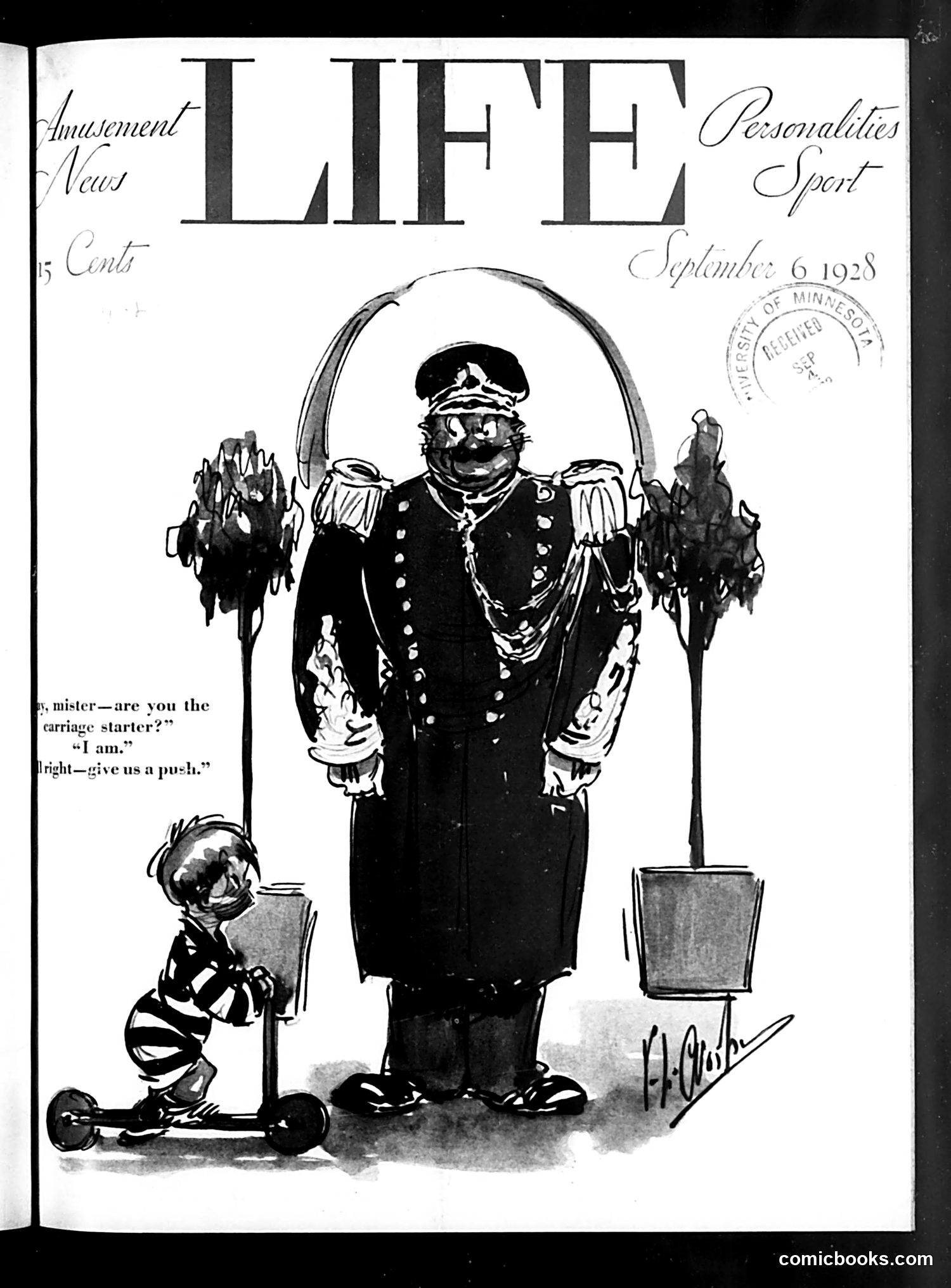
This satirical cartoon depicts a large uniformed military or police officer (identifiable by epaulettes, medals, and military dress) acting as a "carriage starter" — someone who manually pushes vehicles to start them, a common occupation in the 1920s before reliable electric starters. A small child in a toy car asks: "Say, mister—are you the carriage starter?" The officer replies: "I am, right—give us a push." The joke appears to mock someone of apparent authority or importance being reduced to manual labor. Without additional context, the specific political reference is unclear, though it may satirize a public figure or comment on economic/social conditions of 1928.
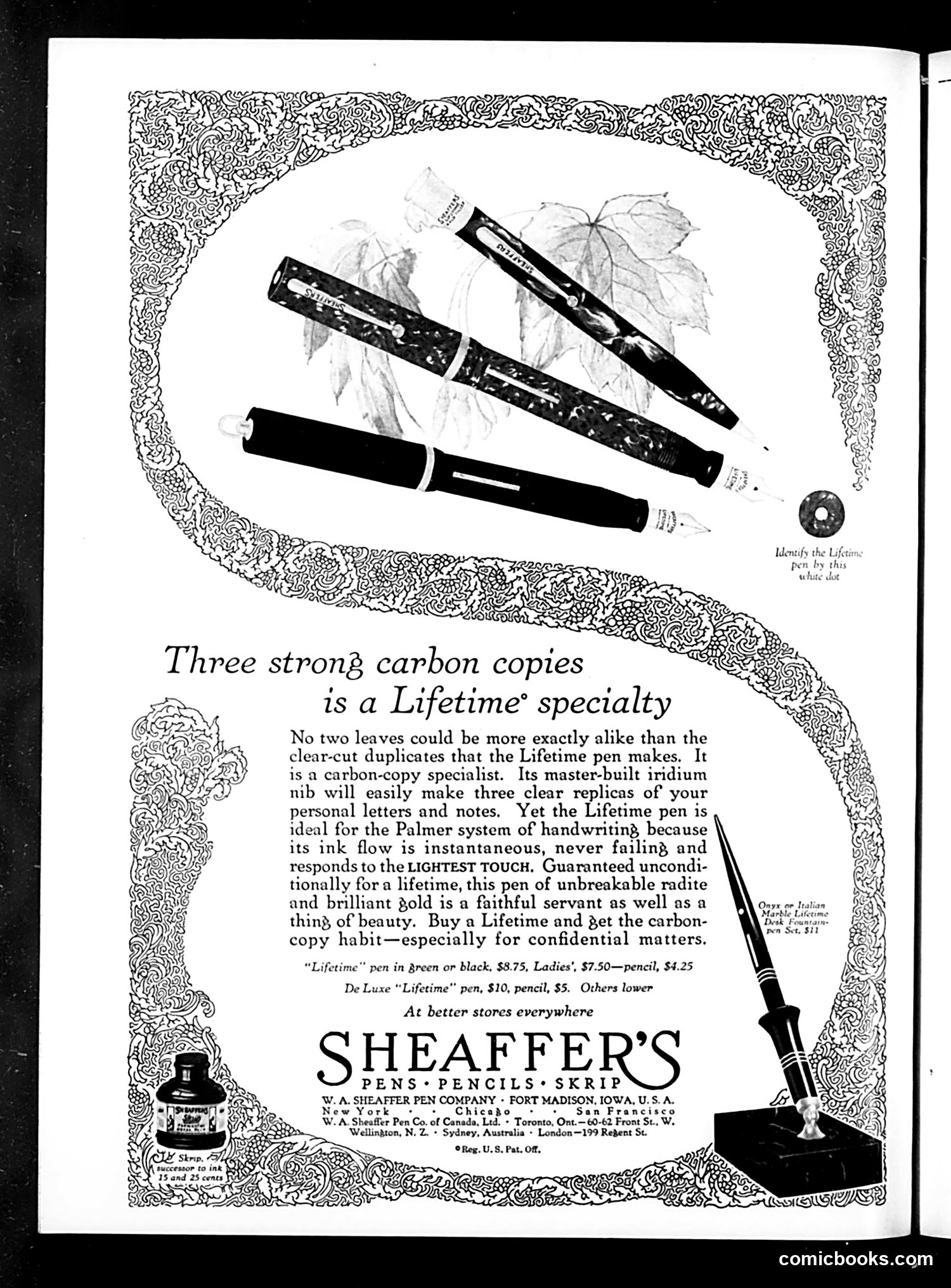
This is a **vintage advertisement**, not political satire. It promotes Sheaffer's "Lifetime" fountain pens, highlighting their carbon-copy capability—the pens could supposedly make three identical duplicates simultaneously while writing. The ad emphasizes the pen's reliability ("responds to the LIGHTEST TOUCH"), durability ("Guaranteed unconditionally for a lifetime"), and aesthetic appeal ("brilliant gold"). It targets affluent customers, particularly women, suggesting the pen is ideal for personal correspondence and confidential matters. The ornate decorative border and leaf imagery convey luxury and sophistication typical of 1920s-30s advertising design. Prices listed ($3.75-$10) indicate this was a premium product. The ad ran in *Life* magazine, which carried both satirical content and upscale advertising.
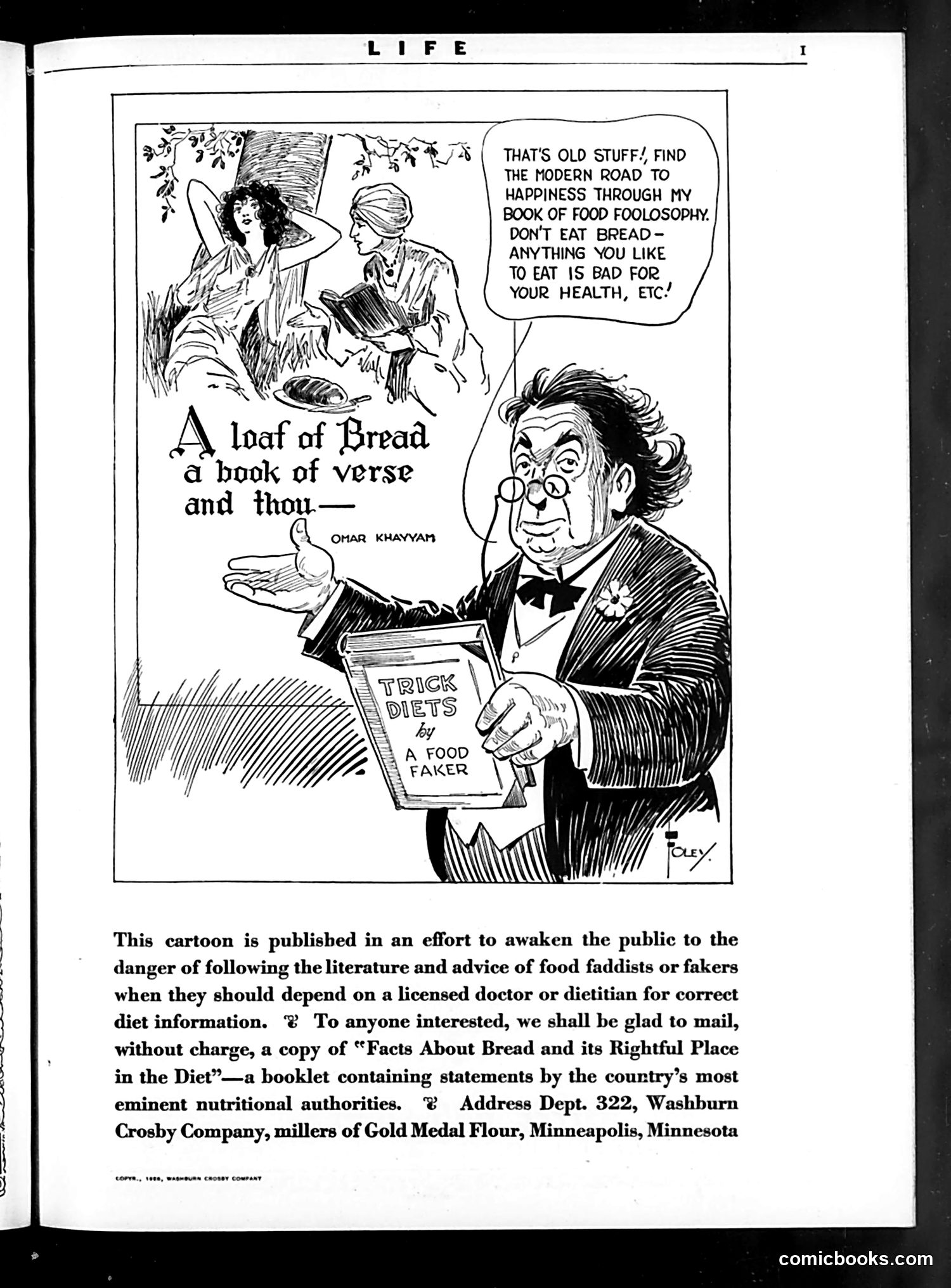
This is primarily **advertising disguised as satire**—a public health message from Washburn Crosby Company (Gold Medal Flour). The cartoon mocks "food faddists" and diet book authors as charlatans. The well-dressed man on the right, holding "Trick Diets by a Food Faker," dismisses traditional wisdom (represented by the pastoral couple and Omar Khayyam's poetic line about bread). His exaggerated expression and formal attire mark him as a fraudulent expert. The accompanying text explicitly warns readers against believing diet literature or unqualified advisors, directing them instead to licensed doctors and dietitians. The irony is that Crosby Company is using this anti-fad message to promote bread consumption—positioning their product as legitimate nutrition, not a "fad." This reflects early 20th-century anxieties about pseudoscientific diet trends.
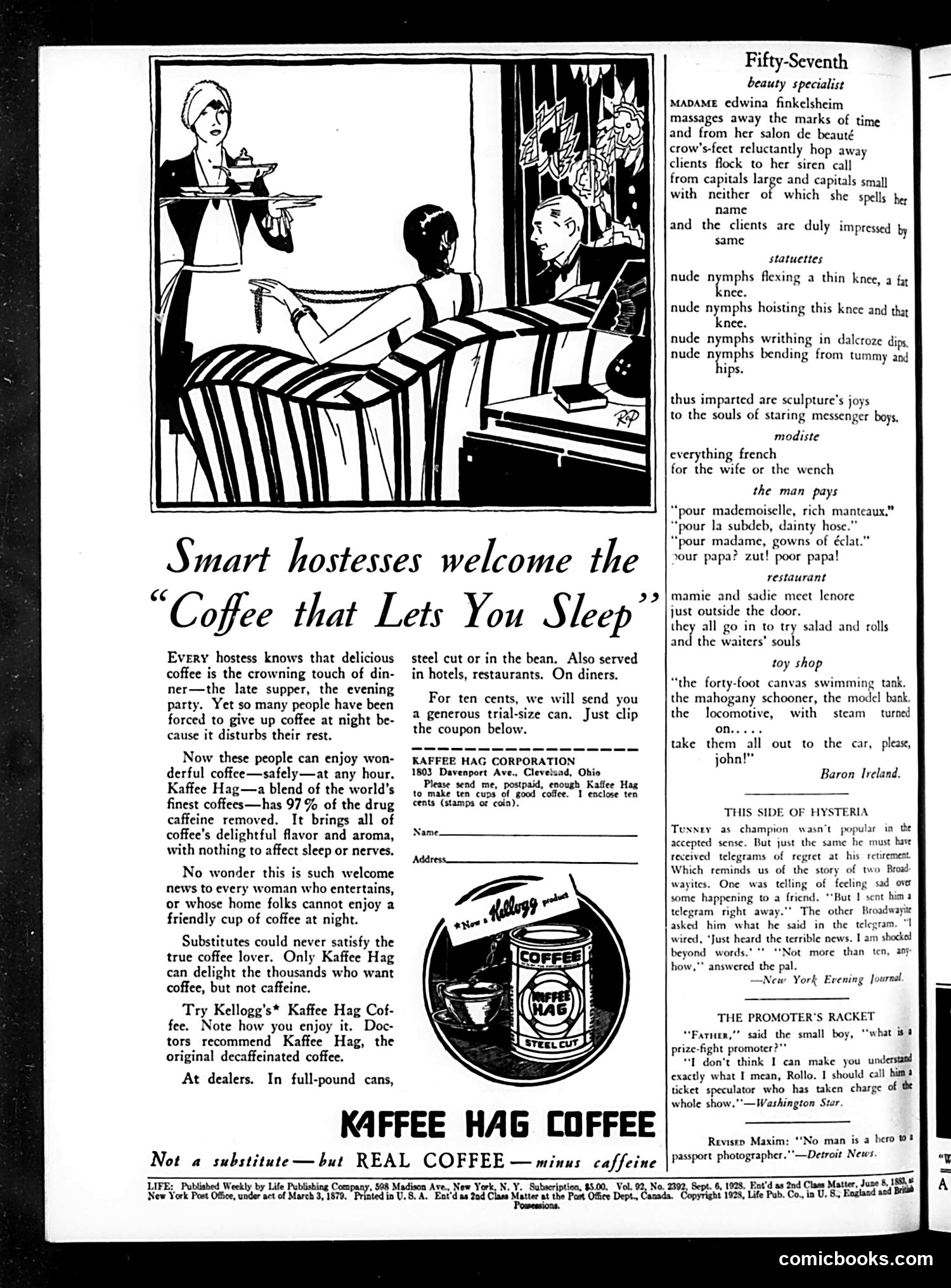
This page is primarily **advertising**, not political satire. The main content promotes Kaffee Hag decaffeinated coffee through a lifestyle illustration showing a woman relaxing in bed while a maid serves her. The satirical content is minimal—limited to brief humor pieces on the right side, including jokes about French phrases, restaurant situations, and a swimming pool anecdote. These are light social observations rather than political commentary. The illustration's message is straightforward marketing: decaffeinated coffee allows leisure and rest without sleep disruption, positioning it as ideal for affluent households. The maid and bedroom setting emphasize luxury and comfort. The coupon offer encourages trial purchase. This reflects 1920s advertising strategy: lifestyle imagery selling not just the product but an aspirational social position.
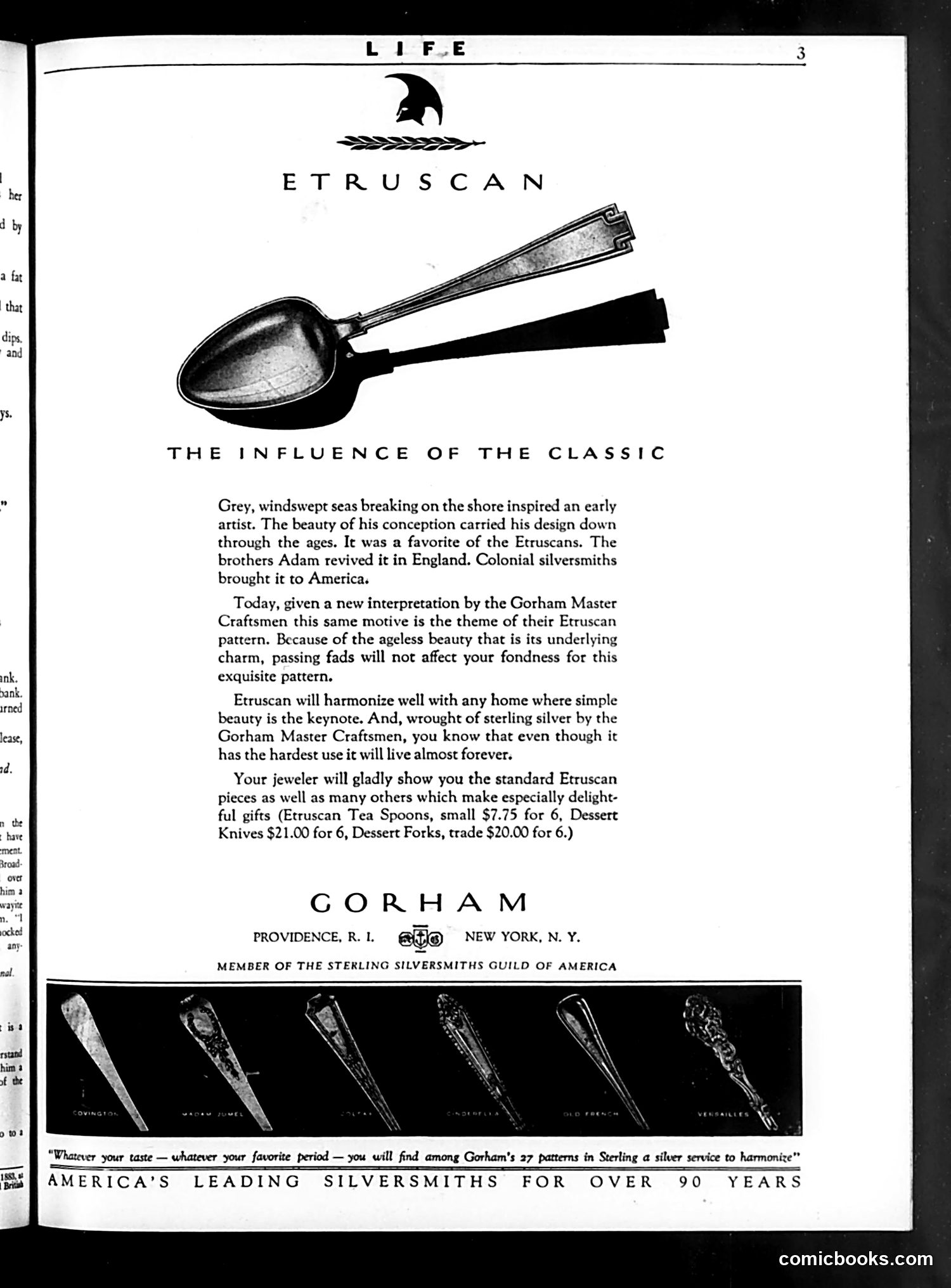
This page is **primarily an advertisement**, not satire or political commentary. It's a Gorham silverware company ad promoting their "Etruscan" pattern flatware and serving pieces. The ad uses classical design heritage as a selling point—the text references how an early artist's seascape design inspired Etruscan artisans, was revived in England, and came to colonial America. Gorham is marketing their modern interpretation as timeless and durable sterling silver. The image shows an ornate spoon at top and six different knife/fork patterns at bottom, displaying design variety. The ad emphasizes quality craftsmanship and includes pricing for tea spoons ($7.75 for 6) and dessert pieces. This is straightforward product advertising using historical prestige rather than humor or political messaging.
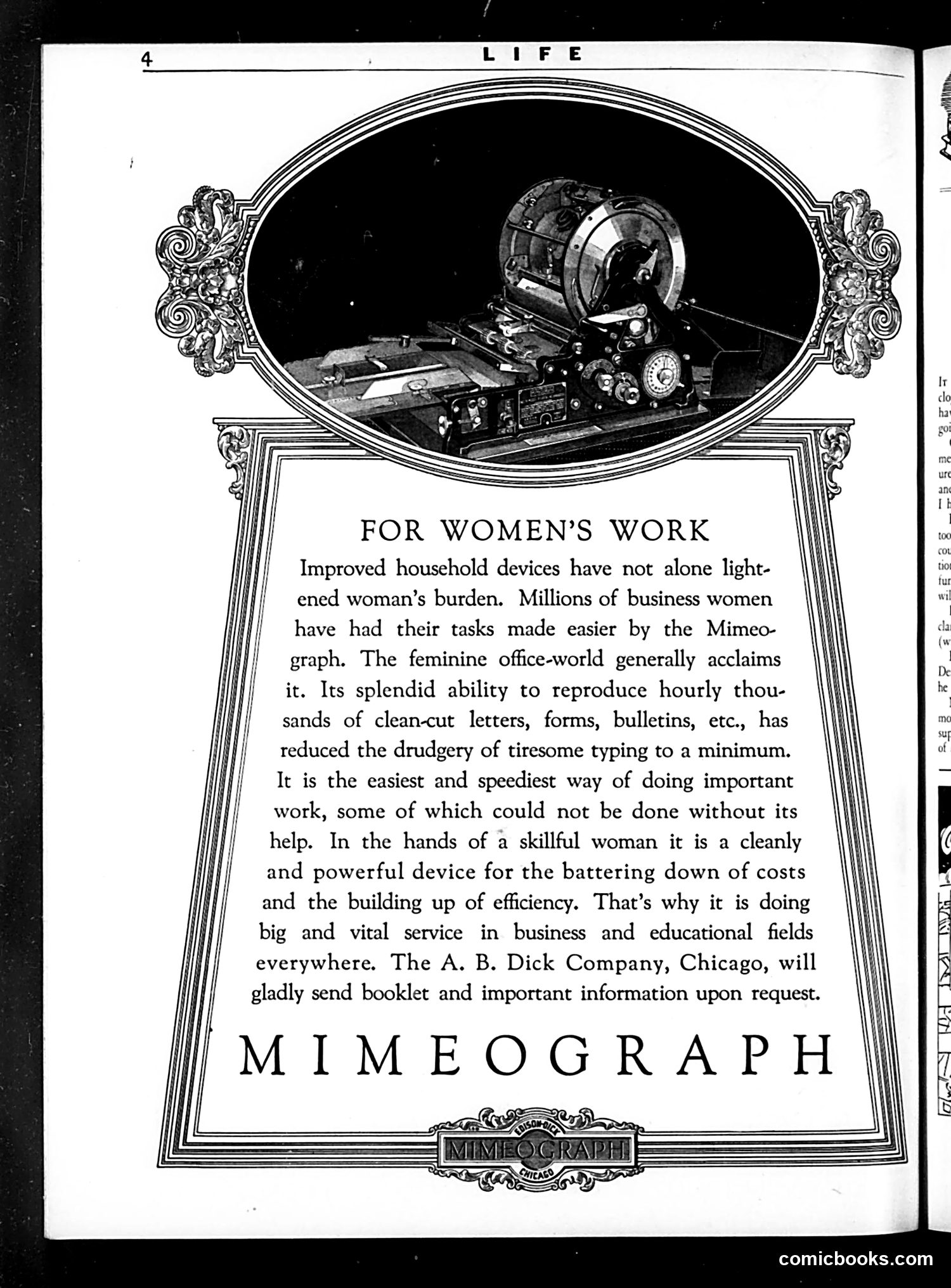
This is primarily a **product advertisement**, not satire or political commentary. The page promotes the Mimeograph machine by the A.B. Dick Company of Chicago. The ad is titled "FOR WOMEN'S WORK" and frames the mimeograph as a labor-saving device specifically for female office workers and business professionals. It claims the machine reduces "drudgery of tiresome typing" and enables efficient document reproduction—thousands of "clean-cut letters, forms, bulletins, etc." hourly. The ornate decorative border and formal layout are typical of early 20th-century advertising style. The image shows the mechanical device itself. The gendered marketing language ("feminine office-world," emphasis on women's efficiency) reflects period assumptions about female clerical labor, positioning the mimeograph as technology that empowers women's workplace productivity.
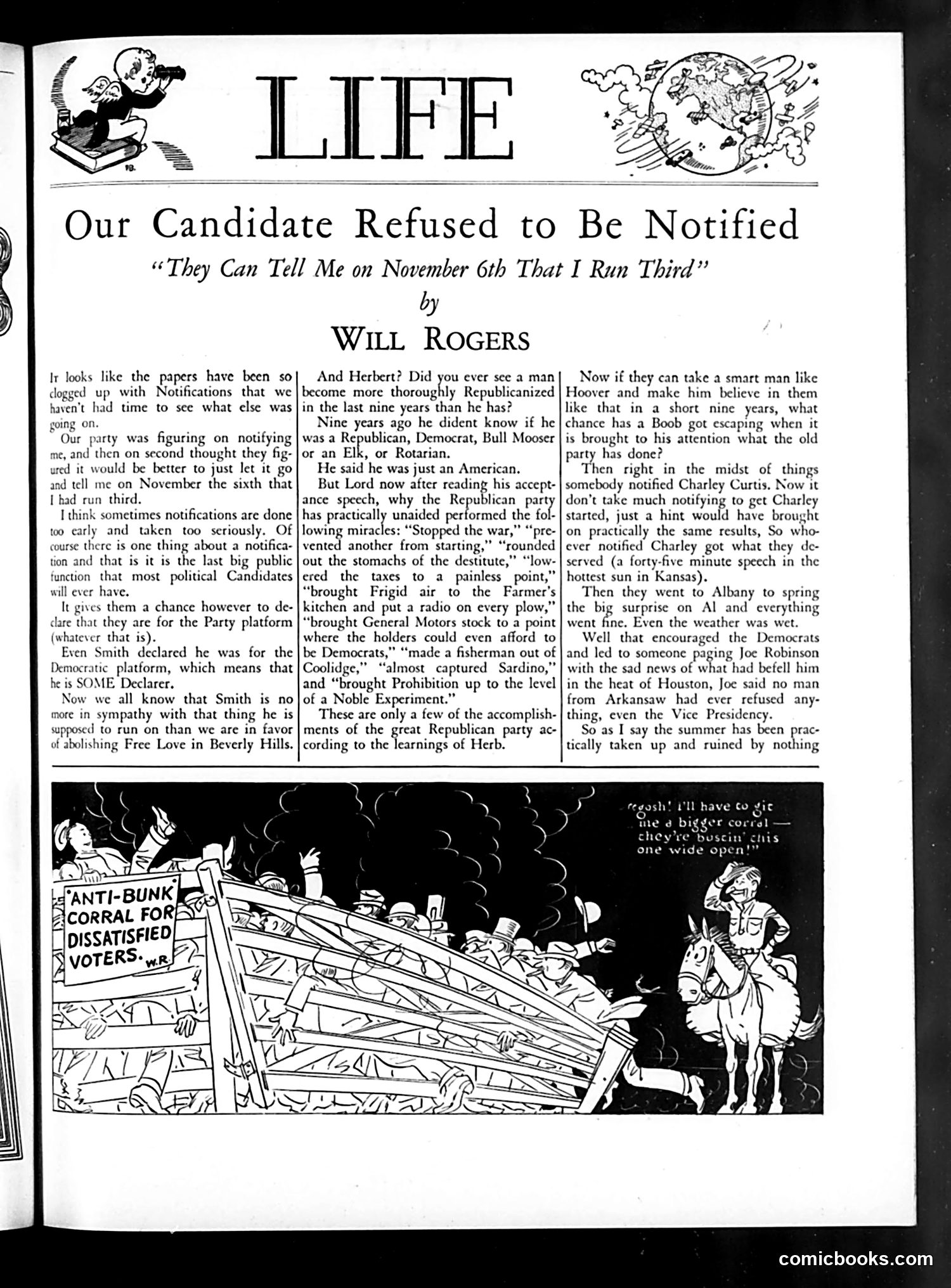
This article by Will Rogers satirizes early political notification practices, suggesting candidates shouldn't be formally notified of their nomination until November 6th (Election Day). Rogers mocks the Republican Party's recent efforts to convert figures like Herbert Hoover into party loyalists. He references specific Republican campaign claims—"stopped the war," "prevented another from starting," "rounded out the stomachs of the destitute"—implying exaggerated boasts about accomplishments. The accompanying cartoon depicts an overturned "Anti-Bunk Corral for Dissatisfied Voters," suggesting Republican messaging deliberately contains false claims to mislead voters. The satire criticizes both early notification ceremonies as unnecessary political theater and the Republican Party's tendency toward propaganda.
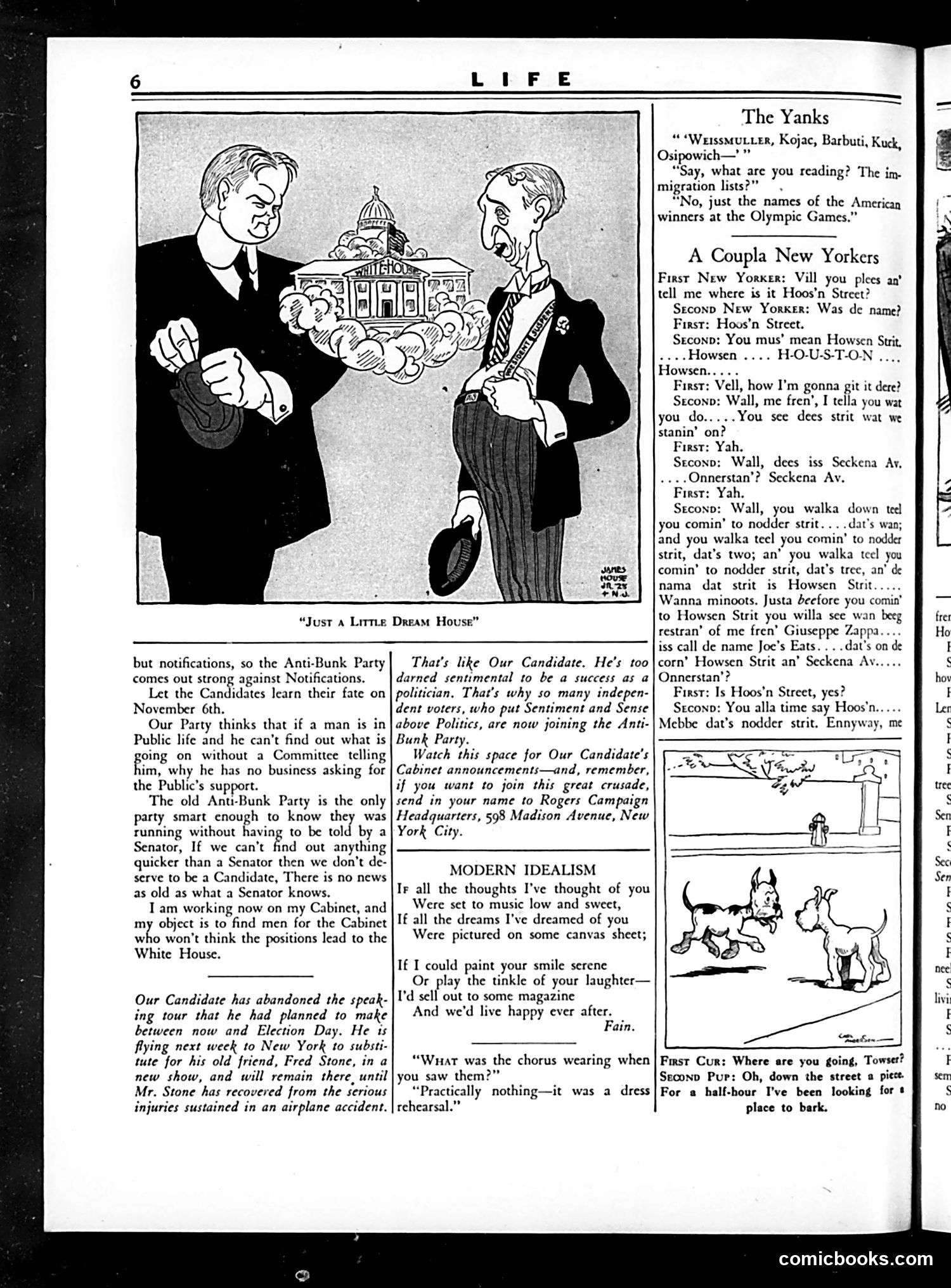
This cartoon satirizes the Anti-Bunk Party's candidate, depicted as overly sentimental and impractical for politics. One figure presents an idealized Capitol building floating on clouds—a "dream house"—to another man, mocking the candidate's naive, sentiment-driven approach to governance. The accompanying text criticizes that the candidate is "too darned sentimental to be a success as a politician" and lacks the hardened pragmatism voters expect. The satire suggests that while sentiment and idealism appeal to voters emotionally, they won't actually solve governmental problems. The Anti-Bunk Party is portrayed as the only "smart" party, understanding that successful politics requires practical calculation, not romantic notions about democracy and public service.
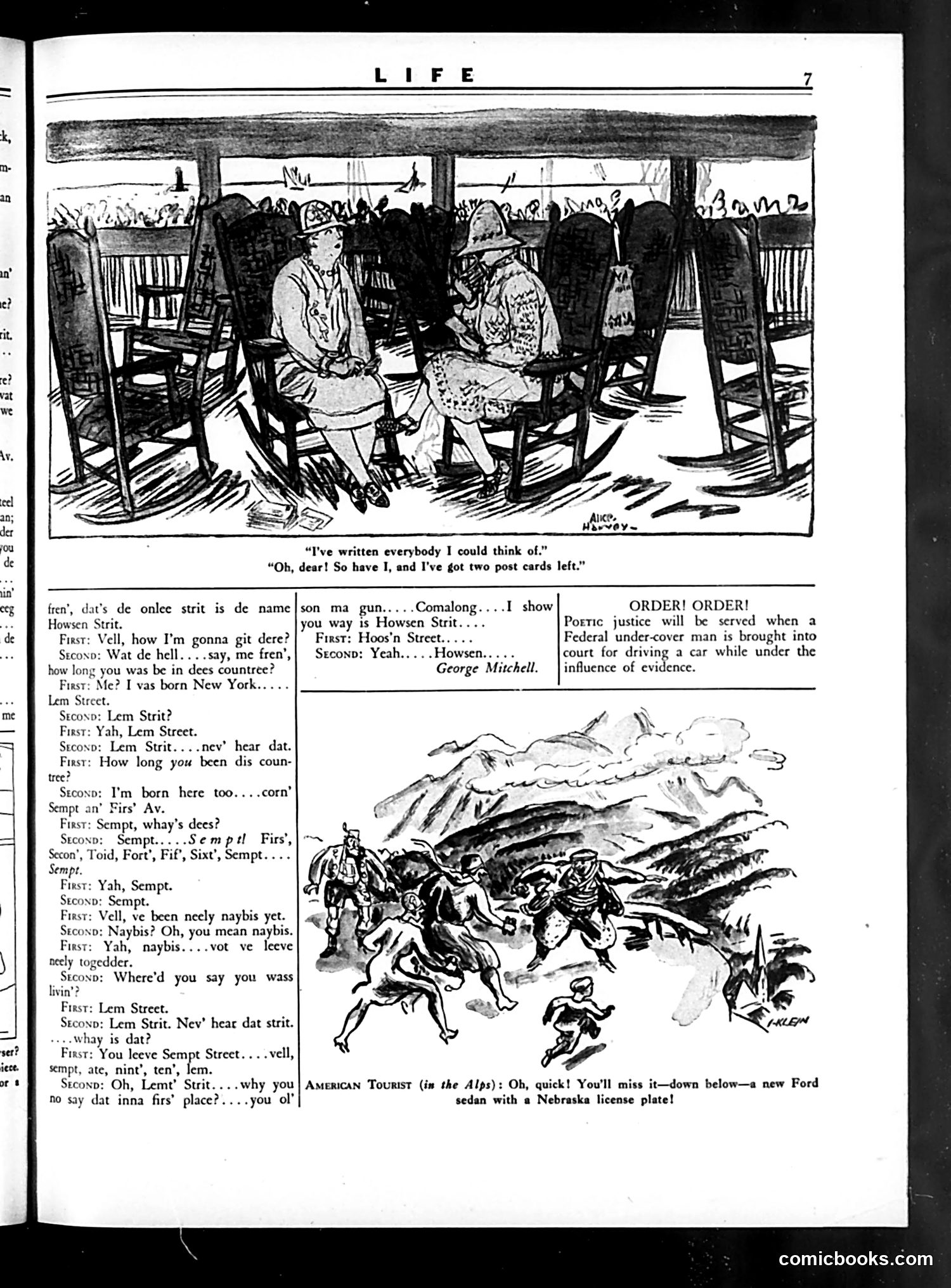
**Top Cartoon:** Two tourists on a porch are exchanging postcards. One says "I've written everybody I could think of," while the other replies "Oh dear! So have I, and I've got two post cards left." This is a mild joke about the tedium of vacation postcard-writing—a social obligation of the era. **Middle Section:** Dialogue appears to be in dialect, depicting what seems to be Irish or immigrant street characters (references to "Howsen Strit," "Lem Street," "Sempt"). The humor relies on phonetic spelling of working-class speech patterns, typical of early 20th-century comedy that often mocked immigrant accents. **Bottom Cartoon:** Captioned "American Tourist (in the Alps)," showing someone about to miss a new Ford automobile—a joke about American car culture and tourist distractions.
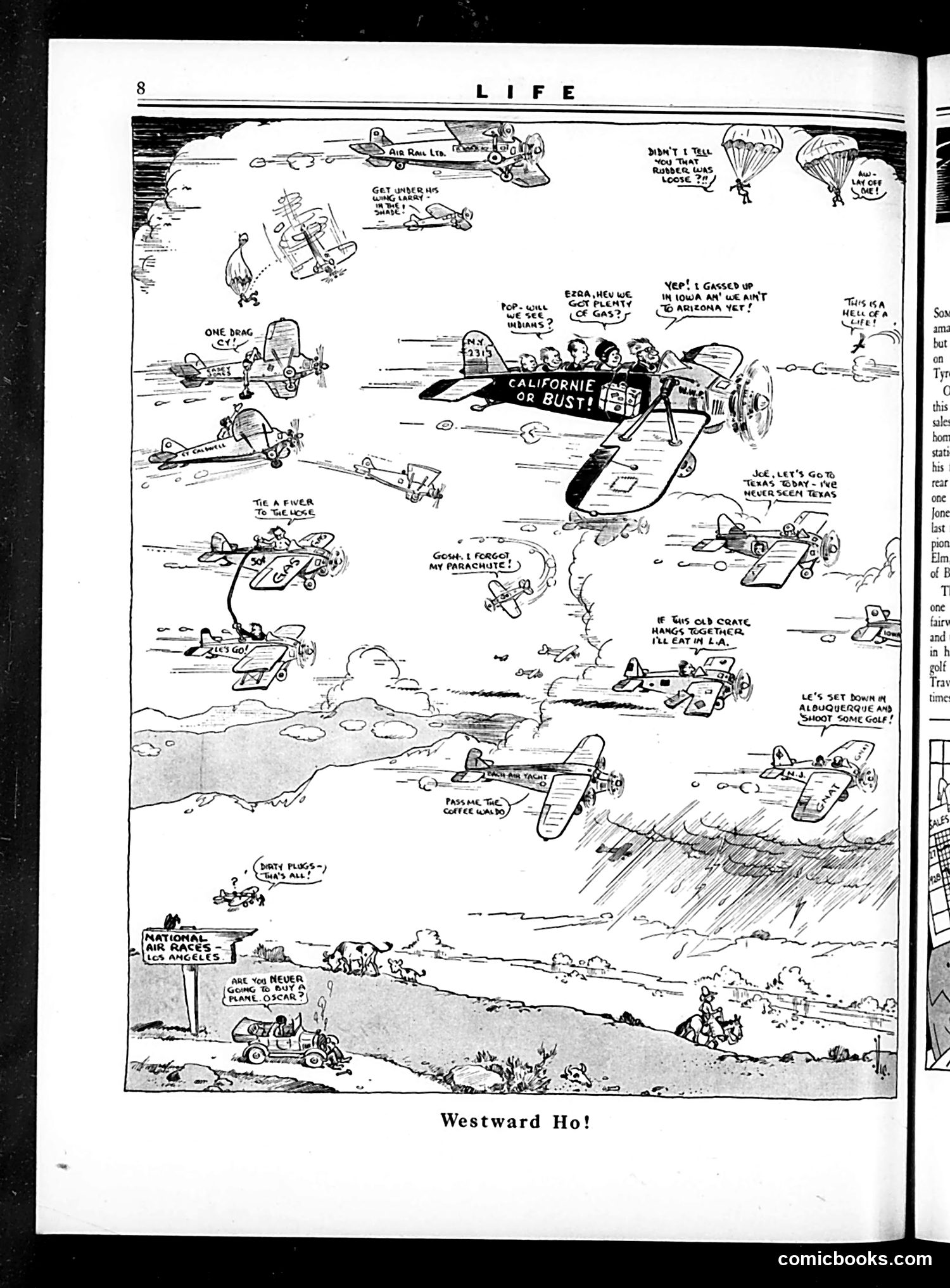
This satirical cartoon depicts the California Gold Rush migration. A large vehicle labeled "CALIFORNIE or BUST!" carries prospectors heading westward, with smaller airplanes and vehicles scattered around showing various mishaps and failed attempts at reaching California. The humor targets the chaotic, desperate nature of gold rush fever—people using improvised aircraft, vehicles breaking down, and individuals getting injured or lost in pursuit of California wealth. Speech bubbles reference ice gas shortages, parachute failures, and the promise of riches ("Texas today—I've never seen Texas"), satirizing both the optimism and recklessness of westward migration. The title "Westward Ho!" references the historical expansion slogan, while the cartoon mocks modern 1920s-era prospectors' equally frantic, poorly-planned scramble for fortune.
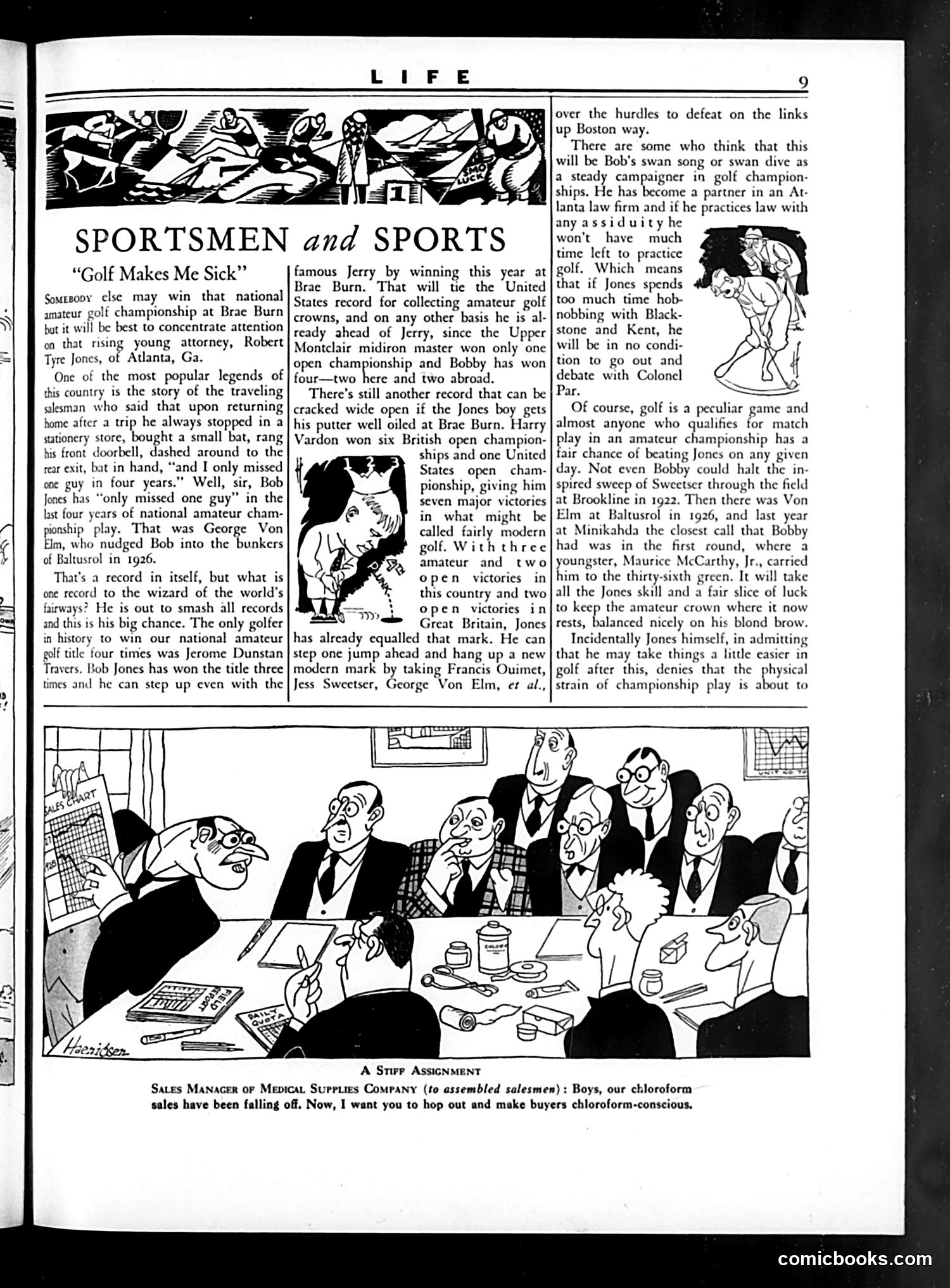
The page contains two distinct pieces: **Top section: "Golf Makes Me Sick"** discusses amateur golfer Robert Tyre Jones of Atlanta, Georgia. The article chronicles Jones's record-breaking achievements in golf championships, comparing him favorably to other champions like Jerome Dunstan Travers. The piece celebrates Jones as a dominant force in American golf. **Bottom cartoon: "A Stiff Assignment"** satirizes corporate sales culture. A sales manager addresses assembled salesmen, instructing them to make customers "chloroform-conscious" by promoting chloroform products. The joke mocks absurd corporate sales tactics and the disconnect between management directives and realistic market demands—suggesting the company is asking salesmen to create demand for a product with dubious consumer appeal. Both pieces reflect 1920s American commercial and sporting culture.
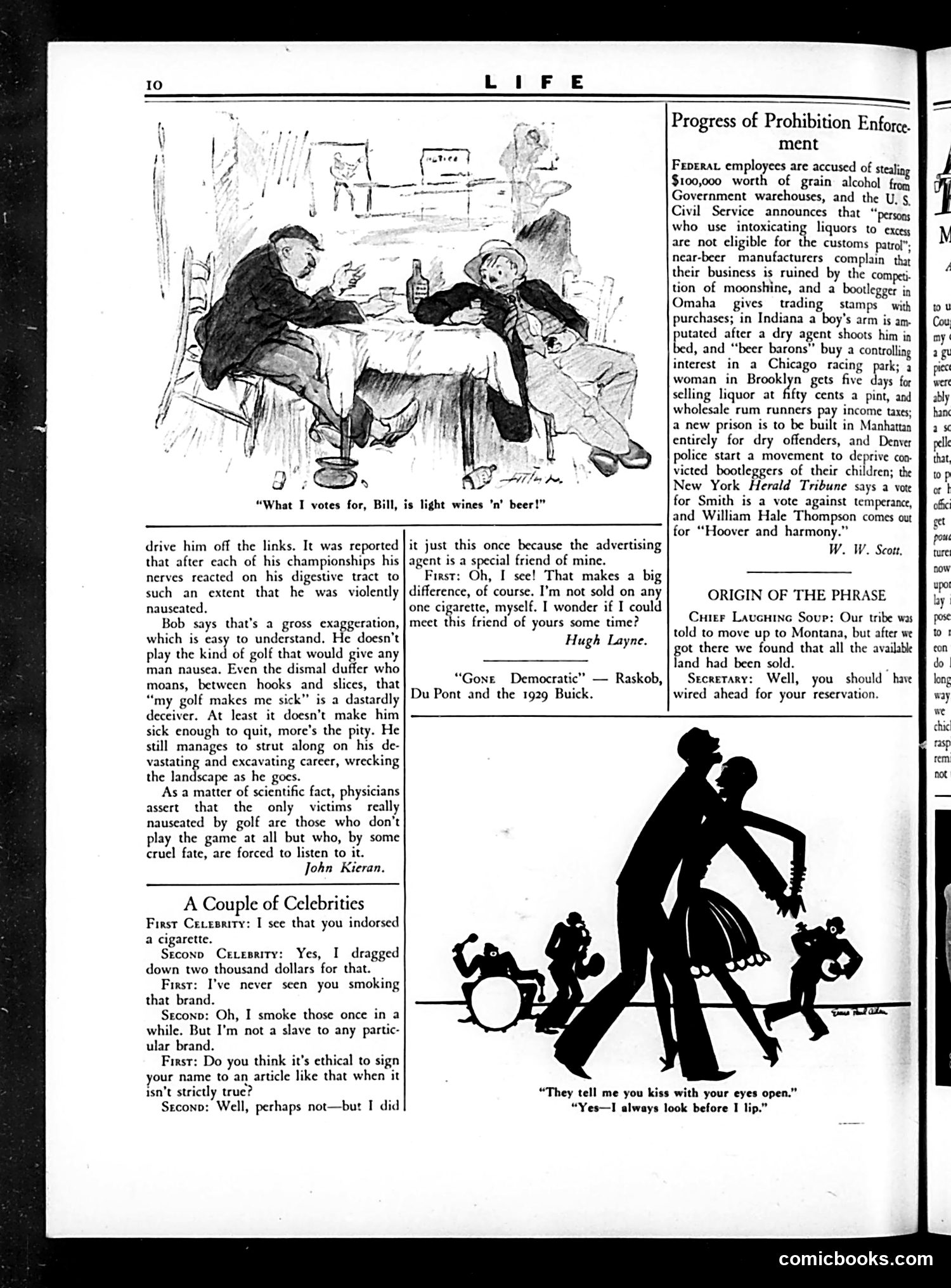
The top cartoon depicts three sick men in bed with bottles nearby, captioned "What I votes for, Bill, is light wines 'n' beer!" This satirizes Prohibition enforcement under the Volstead Act. The men appear intoxicated despite—or because of—prohibition laws, mocking the policy's failure to eliminate drinking. The sidebar "Progress of Prohibition Enforcement" documents real violations: federal employees stealing grain alcohol, bootleggers operating openly, and police corruption. It presents actual scandal headlines alongside the cartoon's dark humor. The lower silhouette cartoon about kissing with eyes open serves as unrelated entertainment content. Together, the page critiques Prohibition as ineffective policy that created criminals, destroyed legitimate businesses, and failed to stop alcohol consumption—a common satirical position in 1920s America.
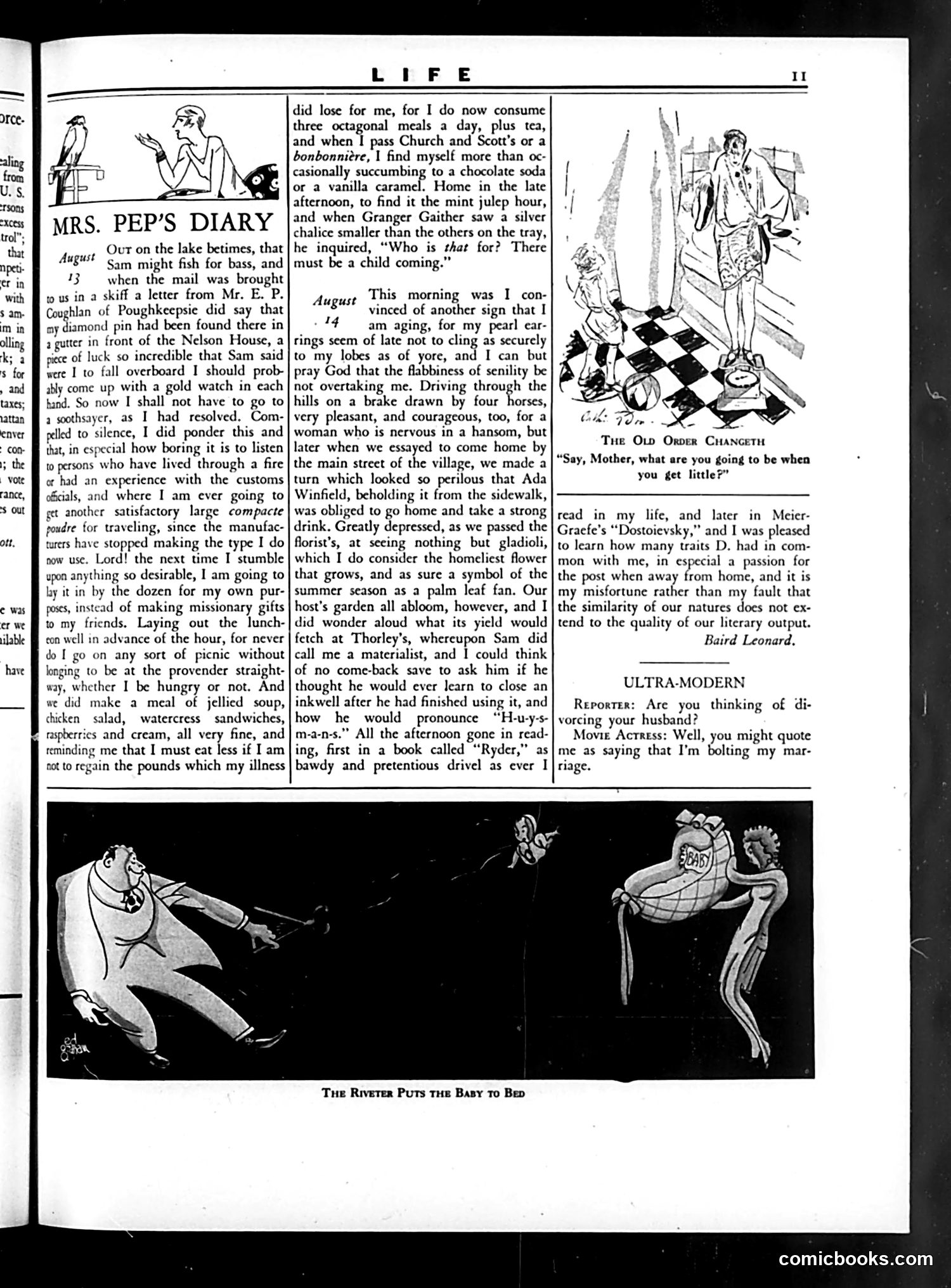
This page contains **Mrs. Pep's Diary**, a humorous column about aging and physical decline. The diarist notes signs of getting older—her wedding rings fitting loosely, her senility increasing—and describes a carriage ride through hills where a nervous woman clutched the side, making the author feel better about her own condition. The bottom cartoon, **"The Riveter Puts the Baby to Bed,"** depicts a man using a riveting tool (an industrial/construction implement) to put a baby to sleep—absurdist humor playing on the loud, violent nature of riveting work as a lullaby method. The "Ultra-Modern" section contains a brief joke about a movie actress considering divorcing her husband. Overall, the page satirizes modernity, aging, and changing social roles through gentle domestic humor typical of 1910s American satire.
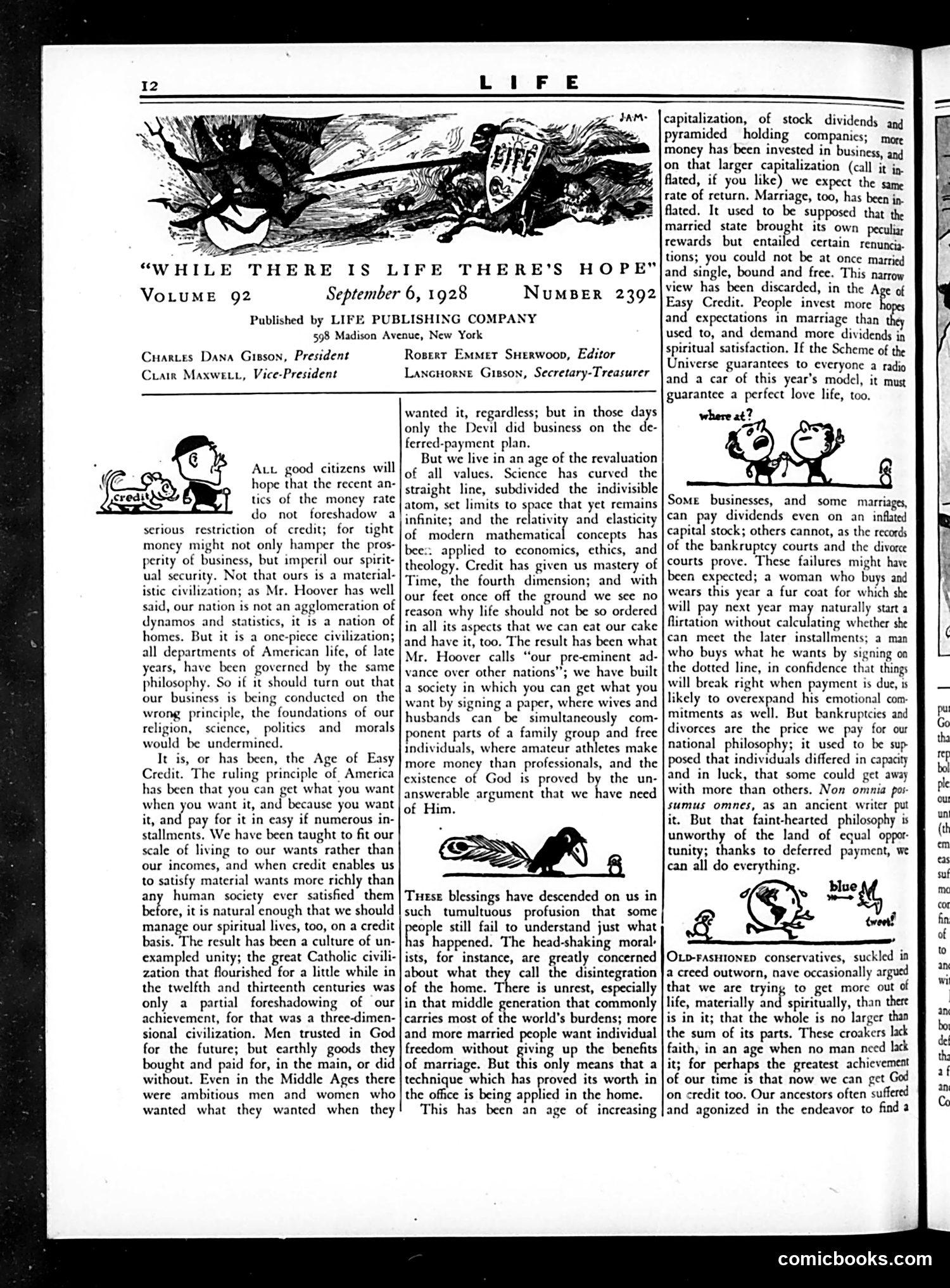
This editorial page critiques the "Age of Easy Credit"—the 1920s consumer lending boom. The masthead shows Life's leadership under Charles Dana Gibson and Robert Sherwood. The main cartoon (top left) depicts a figure labeled "Credit" as a devil-like character, satirizing how Americans have adopted easy-payment schemes to live beyond their means. The accompanying text warns that while credit has democratized consumption, allowing ordinary people to buy homes and goods previously unattainable, it has fundamentally altered social values and personal responsibility. The editorial argues this shift—from saving for purchases to buying on installment—has corrupted American character and spirituality, enabling overconsumption while undermining the virtues of thrift and delayed gratification that supposedly built earlier American civilization.
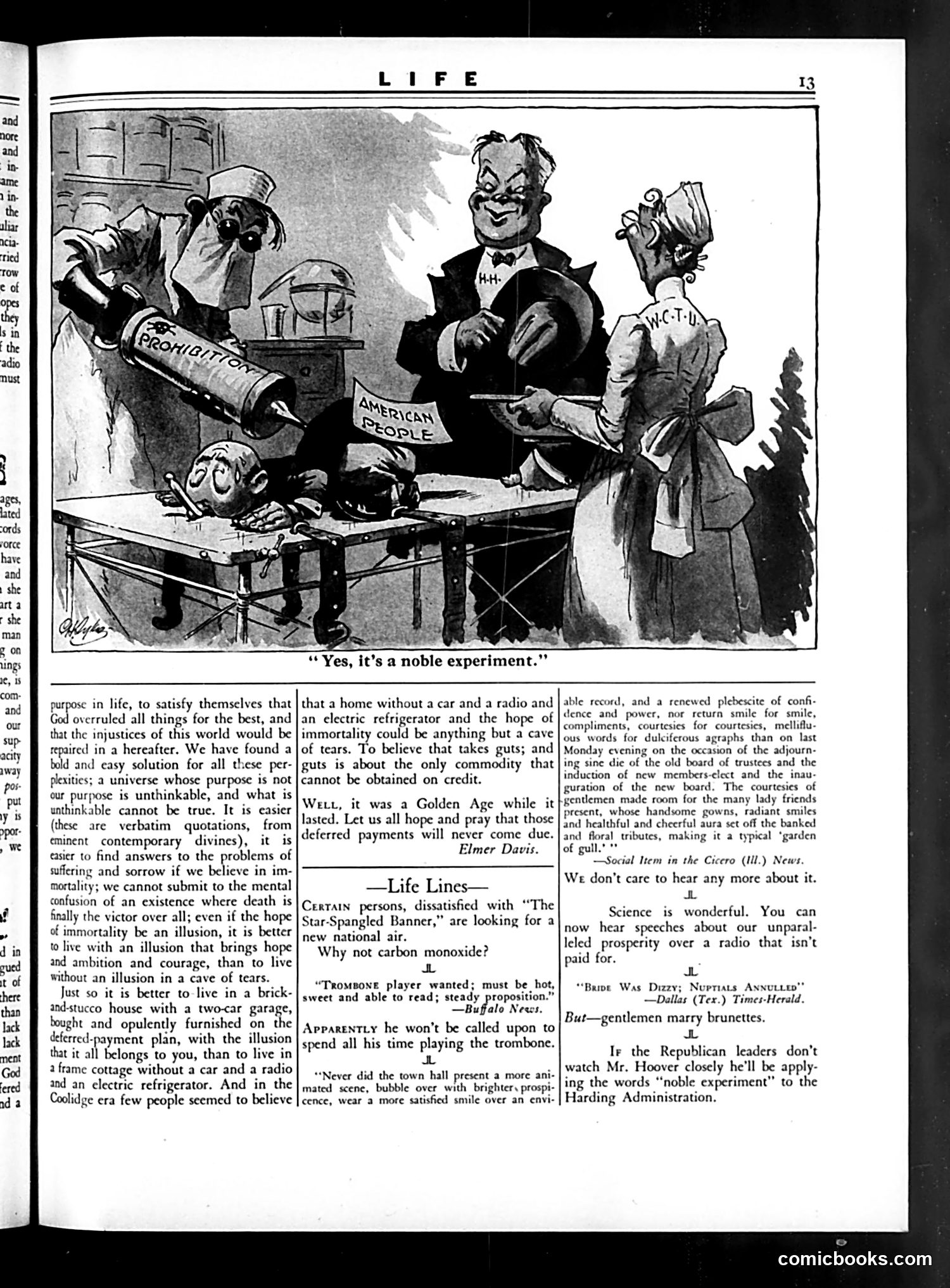
This cartoon satirizes **Prohibition** (the ban on alcohol sales, 1920-1933). The central figure, labeled "American People," represents the public being used as a test subject by prohibition advocates. The caption "Yes, it's a noble experiment" mocks the era's characterization of Prohibition as a social experiment. The cartoon depicts: - A sinister experimenter conducting tests on an unwilling subject - A "Prohibition" bottle/container, suggesting alcohol enforcement - Two figures (likely women) supporting the experiment, possibly representing temperance activists The satire criticizes Prohibition's coercive nature and questions whether imposing such sweeping legislation on the populace—without genuine consent—constitutes ethical policy. The dehumanizing "experiment" imagery emphasizes the public's lack of agency in the matter.
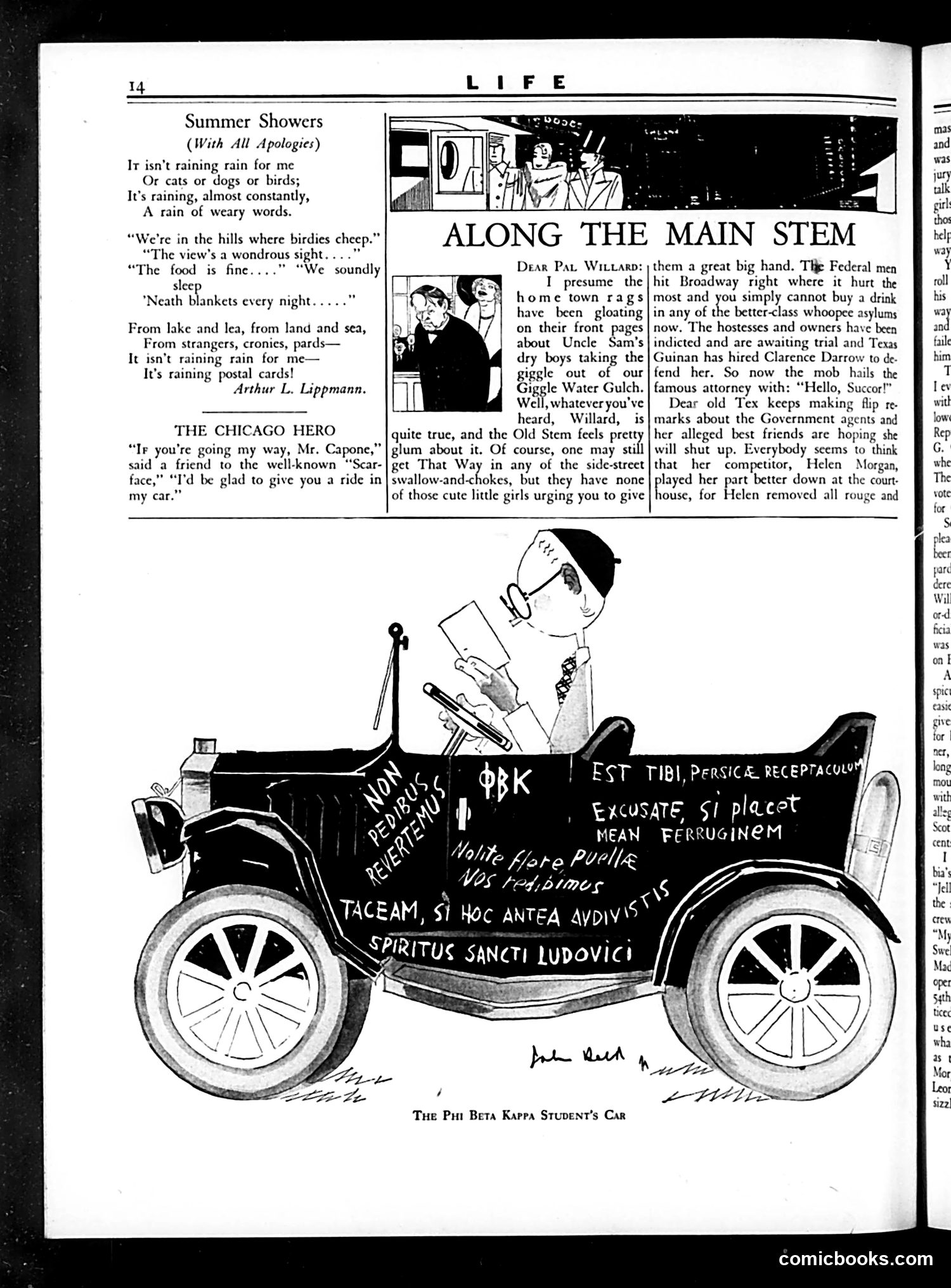
This Life magazine page contains two satirical pieces: **"Summer Showers"** is a humorous poem by Arthur L. Lippmann about rain, using playful wordplay ("raining postal cards"). **"The Chicago Hero"** jokes about Al Capone, the infamous Chicago gangster, offering him a ride—a darkly comic reference to his criminal notoriety during Prohibition. **The main cartoon** depicts a Phi Beta Kappa fraternity car decorated with mock-Latin phrases and scholarly-sounding inscriptions ("Spiritus Sancti Ludovici," etc.). The humor lies in the contrast: college honor students displaying their academic prestige while driving what appears to be a deliberately absurd, over-decorated vehicle, satirizing pretentious fraternity culture and the gap between intellectual claims and actual behavior. The page satirizes American society, crime, and collegiate vanity through humor and caricature.
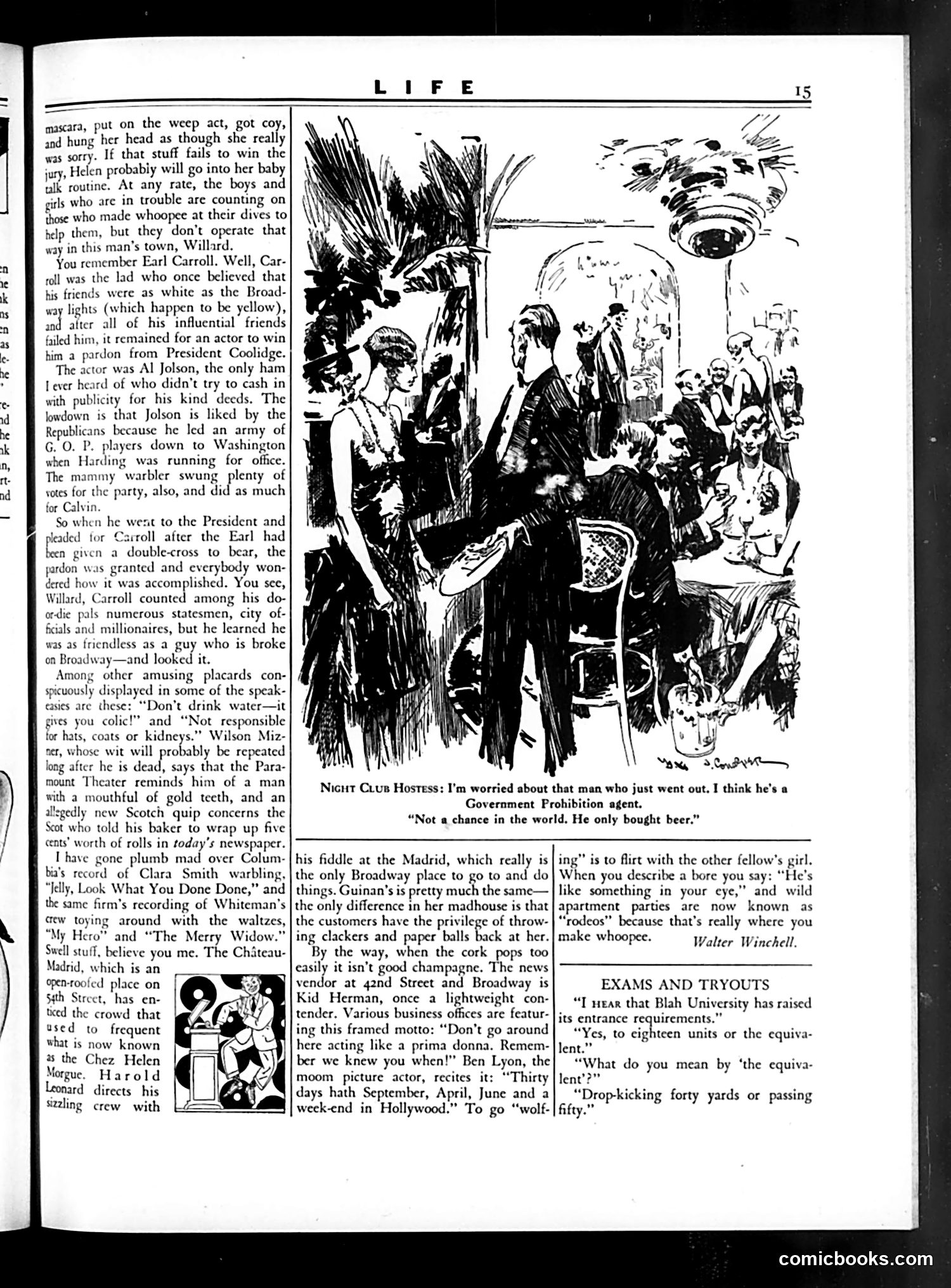
The main cartoon depicts a **Night Club Hostess** warning another woman: "I'm worried about that man who just went out. I think he's a Government Prohibition agent. Not a chance in the world. He only bought beer." This is **Prohibition-era satire** (roughly 1920s-1930s). The joke relies on the irony that a genuine federal Prohibition agent—sent to enforce the alcohol ban—would be so suspicious that he'd buy beer to avoid detection, while actual patrons drink whatever they want. The accompanying text discusses theatrical personalities and includes references to **Earl Carroll** and various Broadway figures, likely critiquing entertainment-world hypocrisy during Prohibition. The satirical thrust: Prohibition enforcement was so corrupt and ineffective that even undercover agents couldn't be identified from ordinary drinkers.
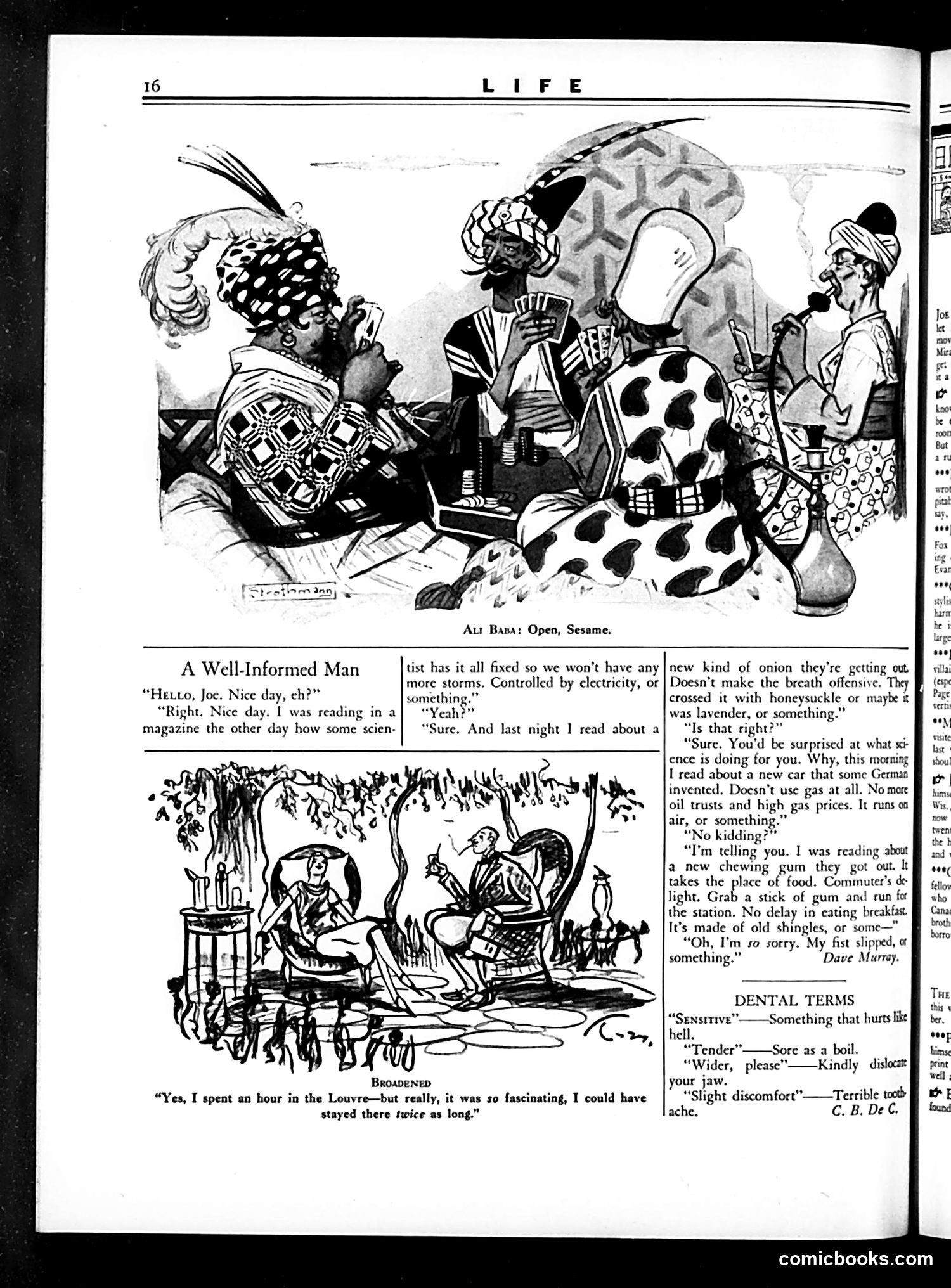
**Top Cartoon ("Ali Baba: Open, Sesame"):** This illustration depicts figures in elaborate, patterned clothing examining what appears to be exotic or foreign goods. The title references the Arabian Nights tale, suggesting satire about Western fascination with orientalism or foreign culture during this era. **"A Well-Informed Man" Comic:** A dialogue joke where one character boasts of reading about scientific innovations—a new car running on air instead of gas, and chewing gum as food substitute. The humor mocks credulous acceptance of dubious technological claims or misinformation spread through magazines. **"Broadened" Comic:** Shows figures relaxing under a tree, with someone claiming the Louvre museum visit was "so fascinating" they could have stayed twice as long—satirizing superficial tourism and cultural pretension.
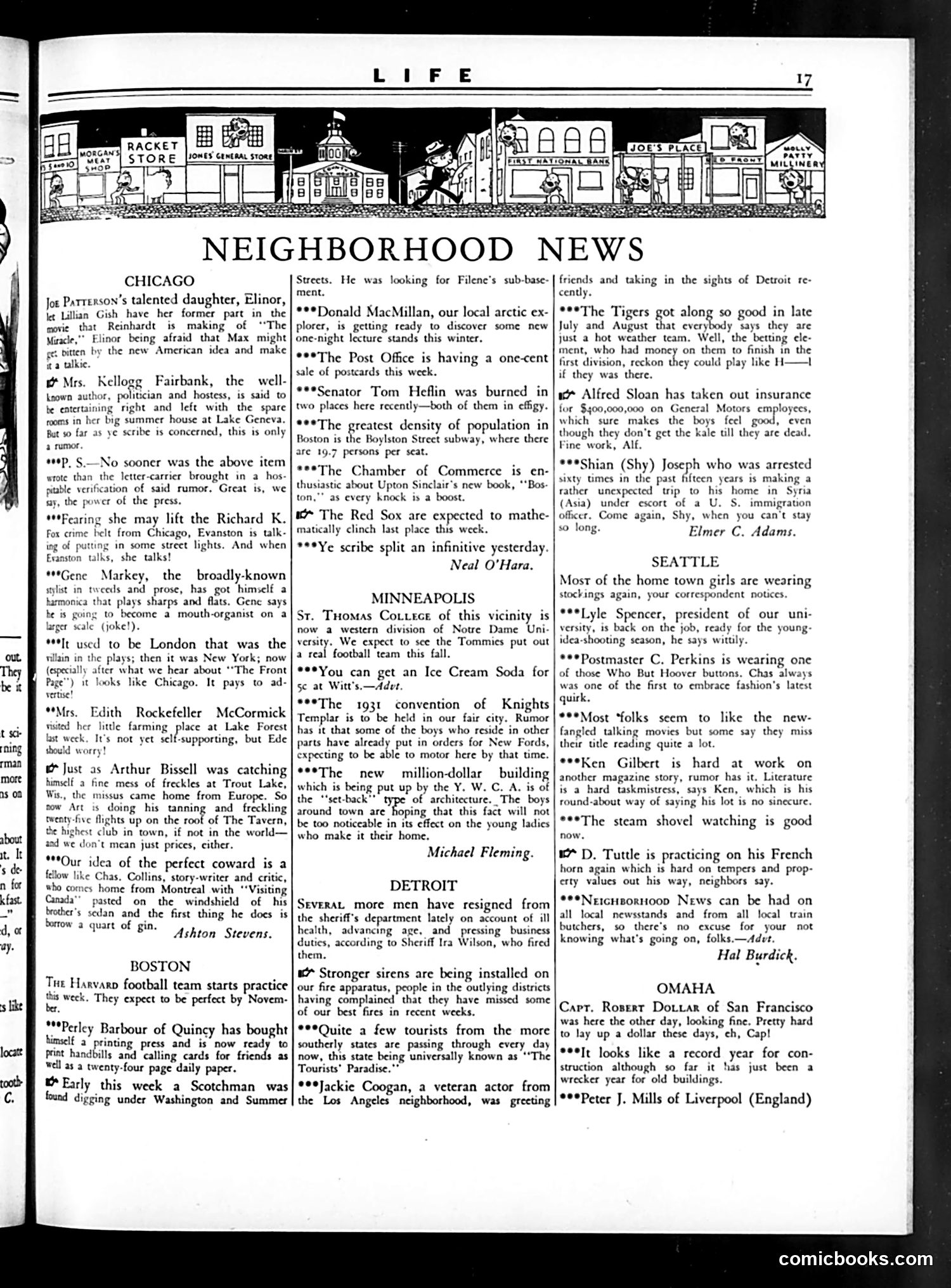
This page is primarily **text-based "Neighborhood News"** — a column of brief local gossip and announcements from various American cities (Chicago, Minneapolis, Detroit, Boston, Seattle, Omaha). The small cartoon strip at the **top of the page** depicts a typical 1920s-30s small-town street with storefronts (Racket Store, Joe's Place, etc.) and townspeople, appearing to illustrate the "neighborhood" concept. The content itself isn't satirical — it's a humorous gossip column format, reporting on civic events, local personalities, sports teams, and quirky happenings. References include baseball (Red Sox), colleges, and everyday community life. The charm lies in the parochial, small-town perspective rather than political commentary.
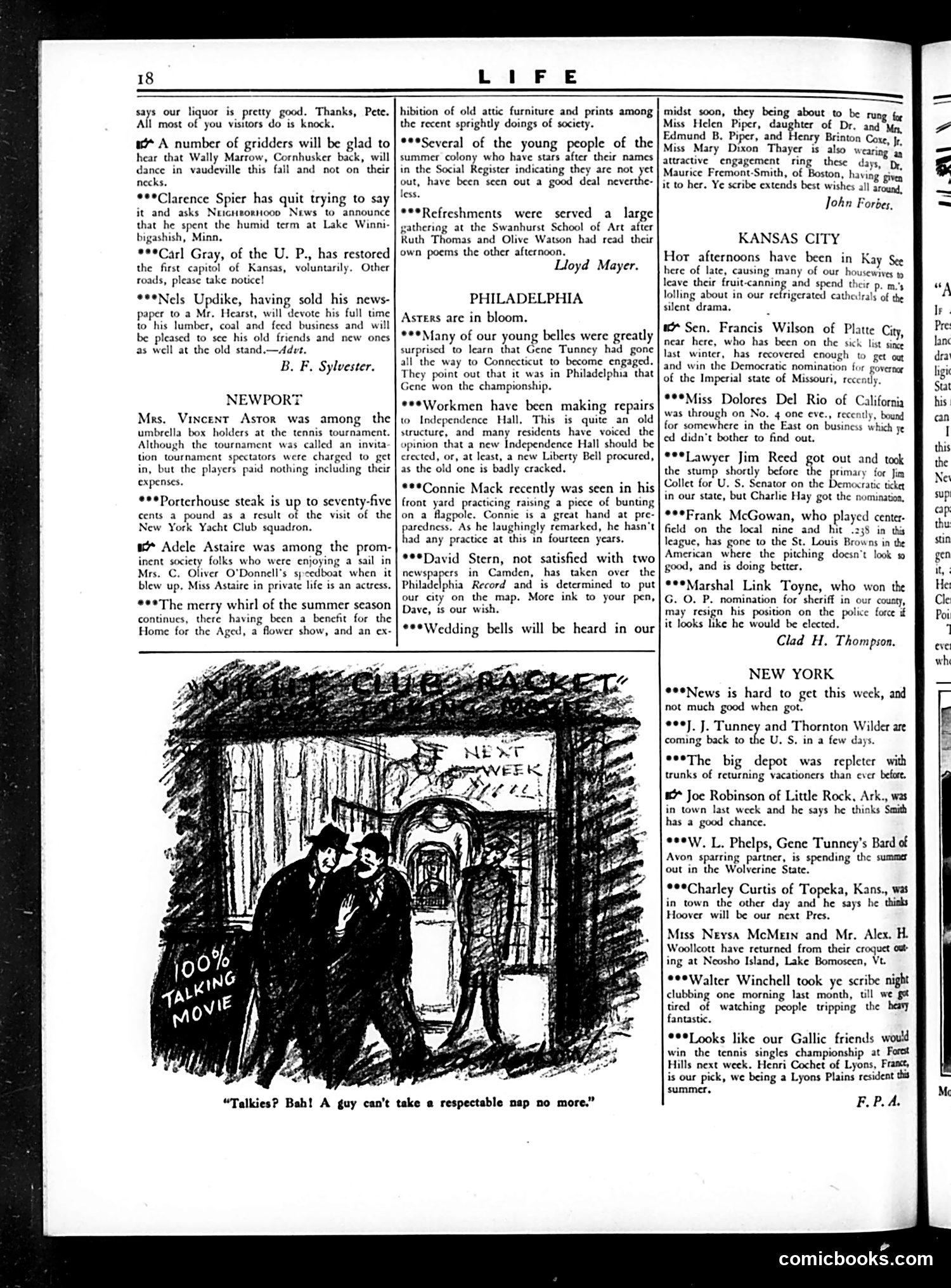
This page from Life magazine (a satirical weekly) contains gossip columns and social commentary from various American cities, plus one cartoon about "talking pictures" (early sound films). **The Main Cartoon:** Shows two men in a movie theater. One is sleeping soundly while the other tries to wake him. The caption reads: "Talkies? Bah! A guy can't take a respectable nap no more." **The Joke:** This satirizes the recent introduction of sound to cinema (the "talkies"). Previously, silent films allowed audience members to doze off undisturbed. Dialogue-heavy talking pictures make sleep impossible—the sound forces attention. It's both mocking the new technology as disruptive and gently poking fun at moviegoers who attended primarily to nap rather than watch. **The Gossip Sections:** Brief, witty notes about society figures, athletes (Gene Tunney, Connie Mack), and local happenings in Newport, Philadelphia, and Kansas City, written in a tone of lighthearted mockery of wealthy and prominent people's activities.
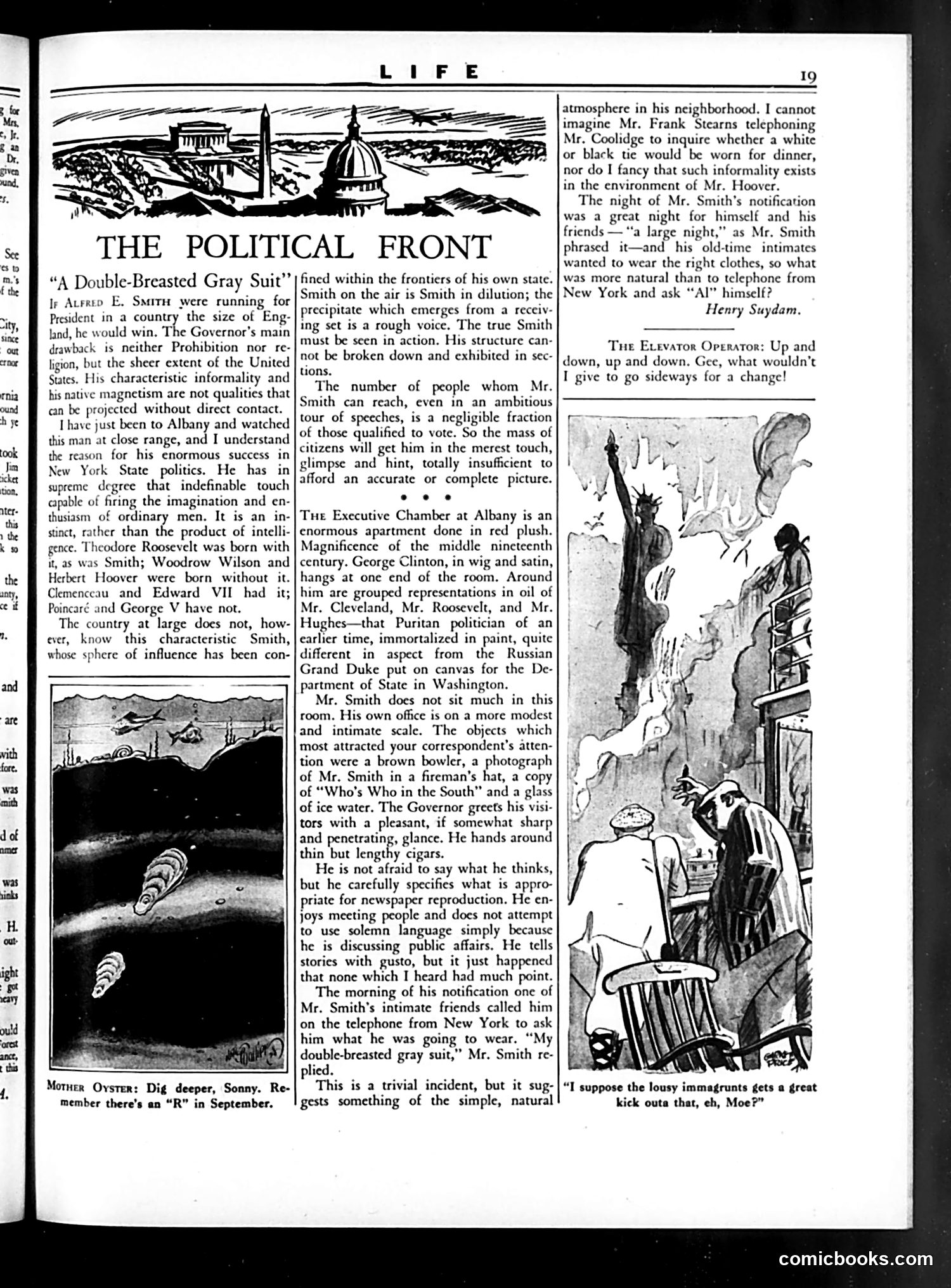
This article profiles **Al Smith**, Democratic presidential candidate, contrasting his personal charisma with his inability to project that appeal nationally. Smith was governor of New York; the piece argues his "indefinable touch" and informality—comparable to Theodore Roosevelt's—cannot translate across the vast United States via radio or campaign tours. The humor centers on Smith's unpretentious nature: when asked what suit to wear to his nomination notification, he simply answered "my double-breasted gray suit," illustrating his lack of political affectation. The author contrasts this with **Calvin Coolidge** and **Herbert Hoover**, suggesting their formality would prevent such casual exchanges. The cartoons are unrelated: "Mother Oyster" is a nonsense joke about the letter R in "September"; "The Elevator Operator" depicts working-class dialect humor. The article's point: Smith's greatest political strength—authentic, direct communication—is paradoxically useless in a large nation where voters never meet him personally.
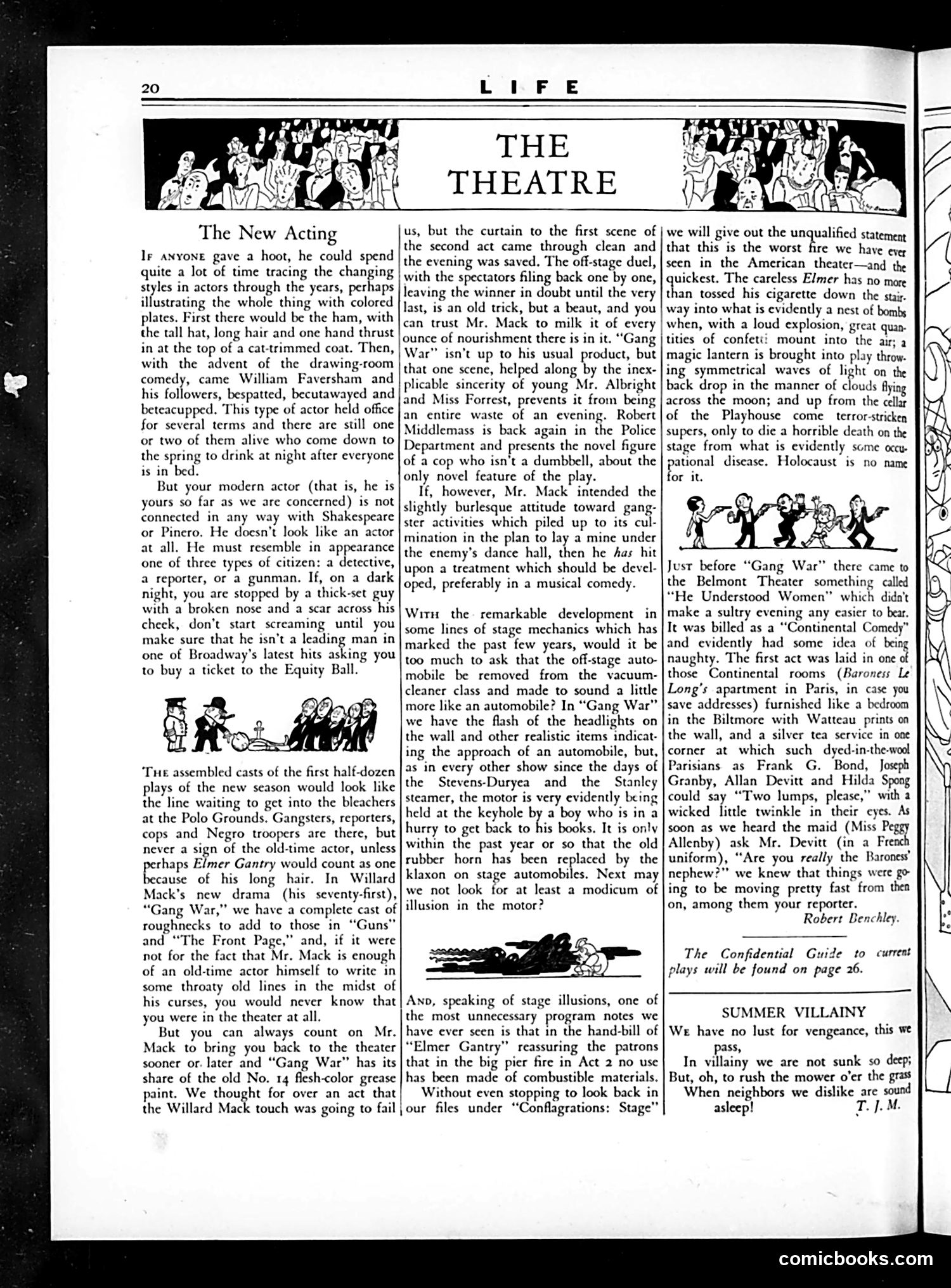
This page from *Life* magazine reviews contemporary Broadway plays, particularly critiquing the shift in modern acting styles. The critic observes that 1920s actors no longer resemble traditional theatrical "hams" in formal dress, but instead portray ordinary working-class types: detectives, reporters, and gangsters. The main subject is Willard Mack's play "Gang War," which the reviewer finds mediocre but salvaged by one effective off-stage duel scene—a traditional theatrical trick Mack executes skillfully. The reviewer praises young actors Albright and Forrest for their sincerity. The small cartoons illustrate the contrast between old theatrical conventions and modern realistic staging. A notable complaint concerns sound effects: despite advances in stage mechanics, productions still unconvincingly simulate automobile engines using outdated methods (holding a motor at a keyhole). The piece reflects 1920s theatrical debates about authenticity versus artifice, and the influence of naturalistic American drama on performance style.
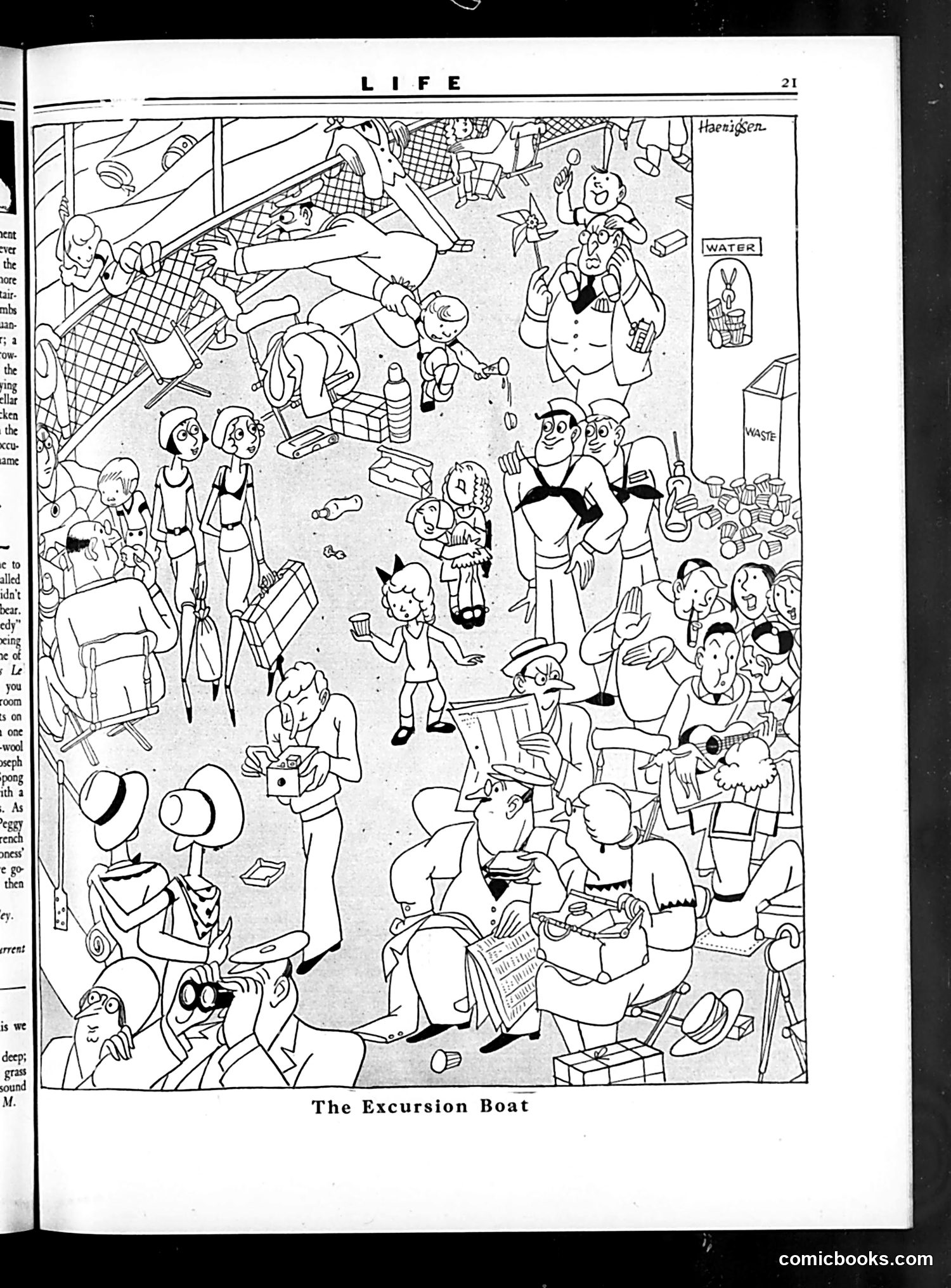
This cartoon satirizes the chaos and poor conditions of a crowded pleasure boat excursion—likely depicting a common early-20th-century American recreational experience. The scene shows dozens of people packed onto a vessel in disarray: children running wild, adults lounging and eating, trash scattered about, and general disorder everywhere. The satire targets the contrast between the *promise* of a leisure excursion and its *reality*—overcrowding, lack of sanitation (note the "WASTE" label), inadequate facilities, and poor management. The labeled "WATER" bottle and waste containers suggest concerns about hygiene. The drawing style, credited to "Haessigen," employs exaggeration to mock both the commercial operators who oversold capacity and middle-class tourists who tolerated such conditions for affordable entertainment. It's social commentary on unregulated entertainment industries and consumer acceptance of substandard public services.
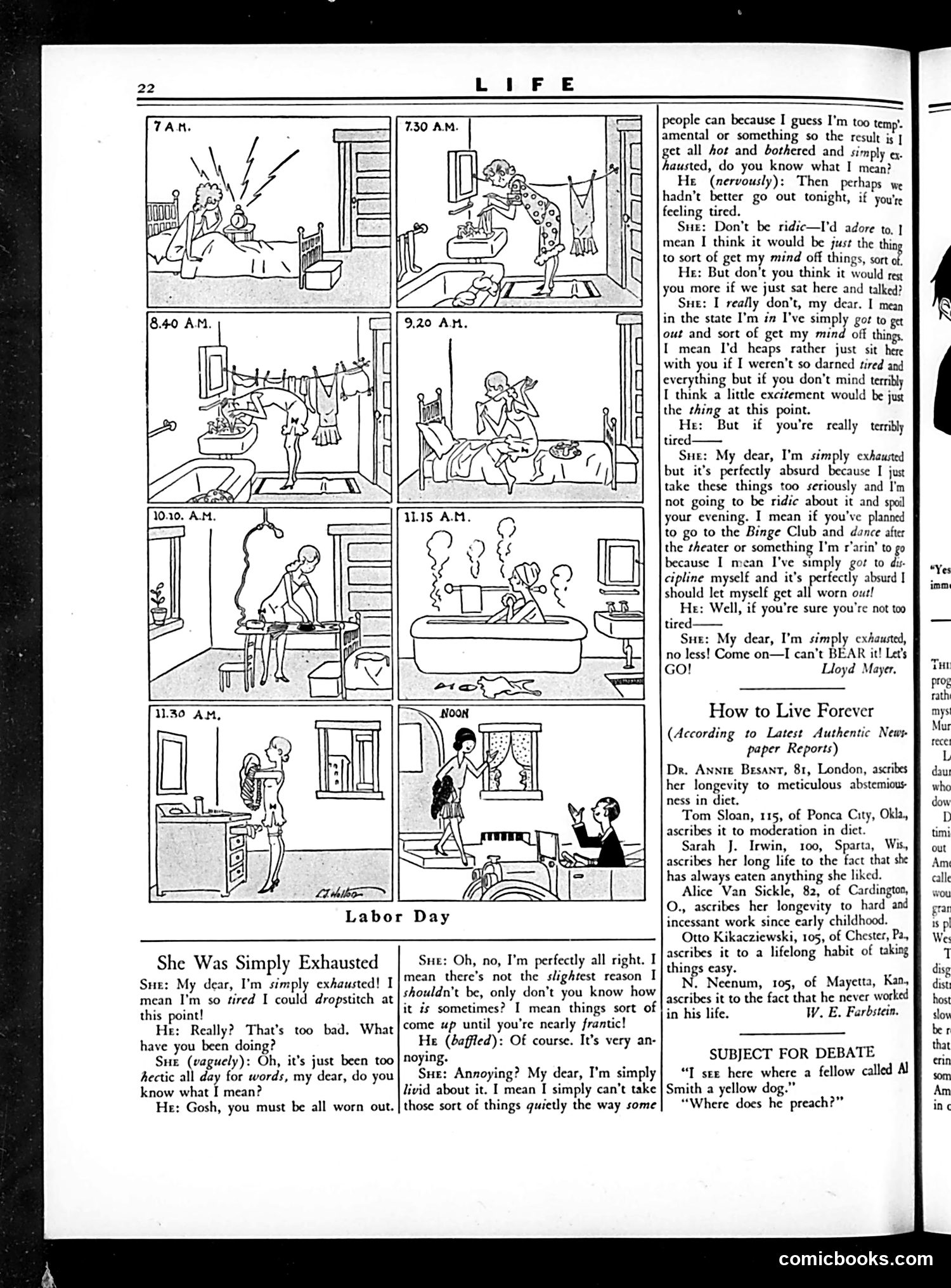
This page contains a satirical comic strip and humor pieces from Life magazine's "Labor Day" issue. **The Main Comic: "She Was Simply Exhausted"** The satire mocks a specific female social type: a woman who claims to be exhausted but contradicts herself repeatedly. Though tired, she insists on going out to nightclubs and dancing rather than resting at home. Her speech is filled with vague emotional language ("terribly," "simply," "hectic") and contradictions—she's too tired to stay home but energetic enough for evening entertainment. The joke targets upper-class women's performative exhaustion and emotional dramatics. She uses fatigue as conversational currency while actively rejecting rest, suggesting her complaints are less about genuine tiredness than about maintaining a certain image or emotional volatility. Her partner grows increasingly baffled by her illogical demands. **Secondary Content:** Below is a humorous list of centenarians whose longevity tips wildly contradict each other (strict diet vs. eating anything; hard work vs. taking it easy), satirizing pseudo-scientific newspaper health reporting that claims to explain longevity while providing no consistent answers.
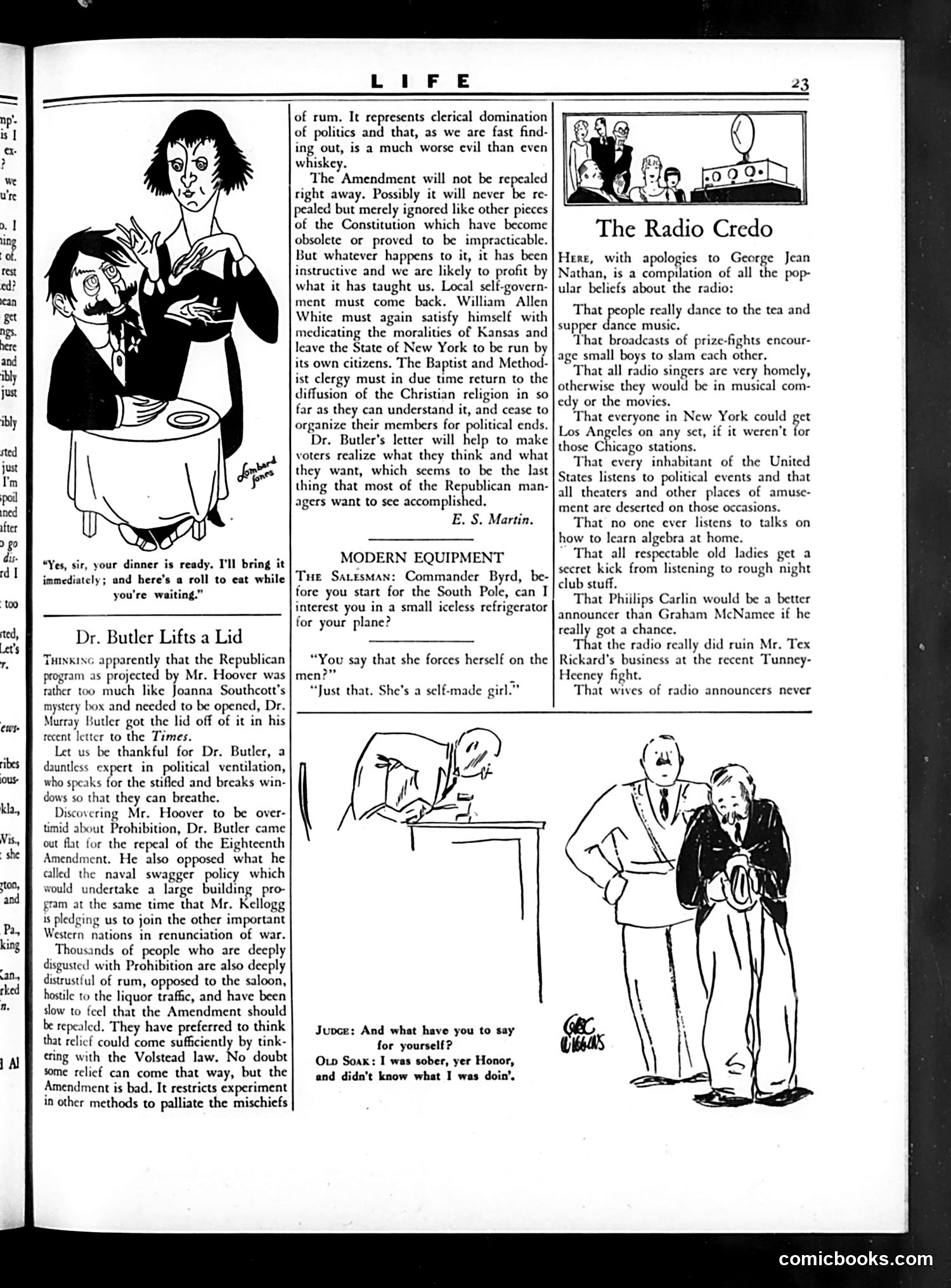
This page contains political and social satire from the Prohibition era (appears to be late 1920s). **"Dr. Butler Lifts a Lid"**: Satirizes Dr. Murray Butler's public letter challenging President Hoover's cautious Republican platform, particularly on Prohibition repeal. The "lid" metaphor suggests Butler is opening up secretive party strategy. The cartoon shows a servant presenting dinner while the master waits—a visual pun on "lifting the lid" on hidden truths. **"Modern Equipment"**: A one-liner mocking a salesman's absurd pitch to Commander Byrd (the famous polar explorer) about selling an "iceless refrigerator" for a South Pole expedition. **"The Radio Credo"**: A humorous compilation of popular beliefs and misconceptions about radio broadcasting—that radio drives juvenile delinquency, that all singers are unattractive, that everyone listens to political broadcasts, and that respectable ladies secretly enjoy rough nightclub content. The page satirizes contemporary American attitudes toward technology, politics, and social pretension during the early radio era.
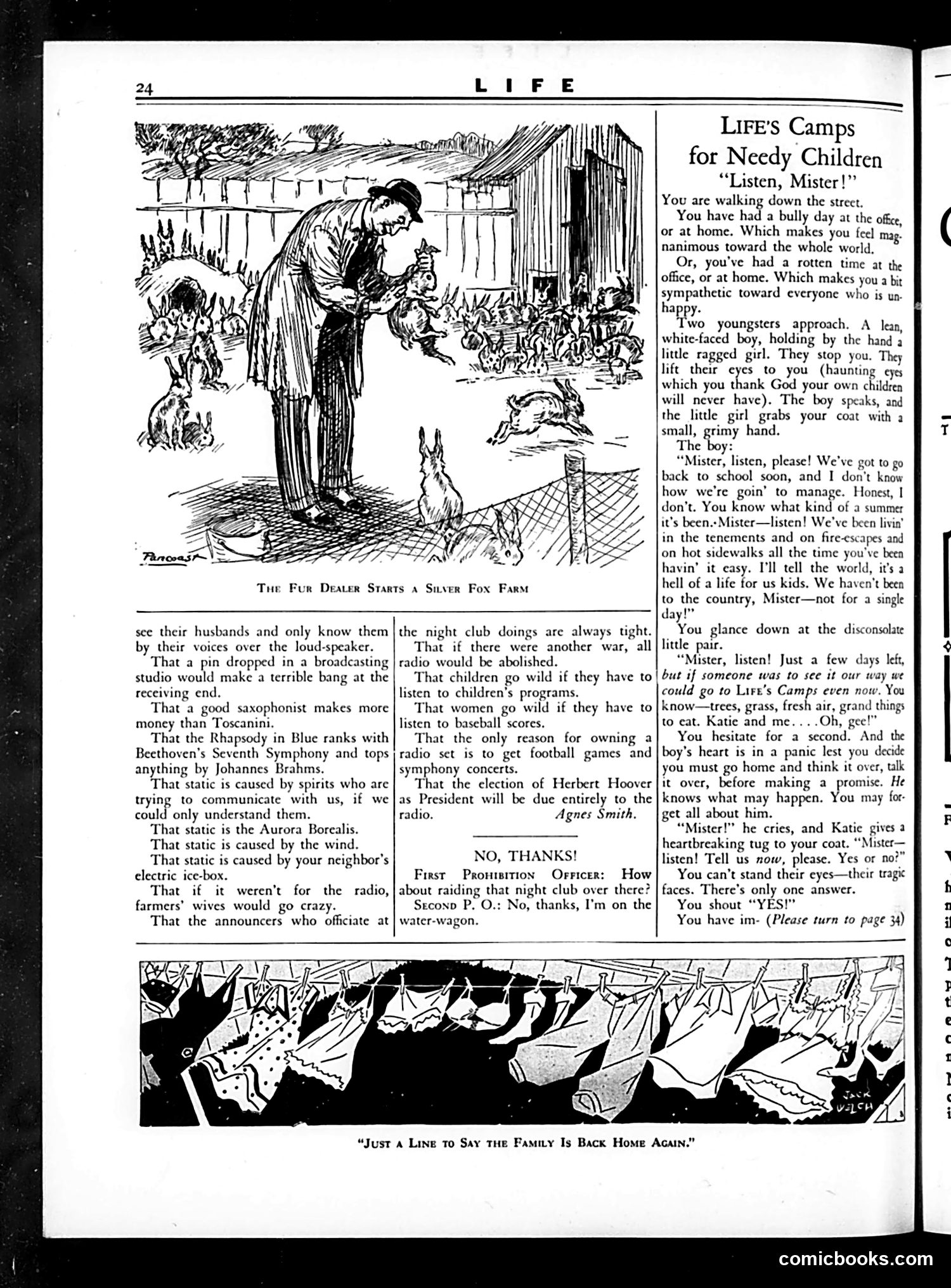
**Left cartoon:** A fur dealer holds small animals while children watch from a farmyard. The caption suggests ironic entrepreneurship—likely mocking the 1920s craze for silver fox farming as a get-rich-quick scheme, often promoted to naive investors. **Text below:** A humorous list of false beliefs about radio technology and broadcasting—satirizing public confusion about this new medium. Jokes about static being "spirits communicating," farmers' wives going crazy without radio, and absurdly claiming Hoover's presidential election depends entirely on radio coverage. The humor targets both radio's actual technical mysteries and society's exaggerated faith in its importance. **Right side:** "Life's Camps for Needy Children" describes street children appealing for camp donations—a charitable appeal using emotional narrative. The "No, Thanks!" exchange mocks Prohibition-era hypocrisy: a police officer refuses to raid a speakeasy because he's "on the water-wagon" (pledged sobriety). These pieces reflect 1920s concerns: new technology confusion, charitable impulses toward urban poor, and Prohibition's contradictions.
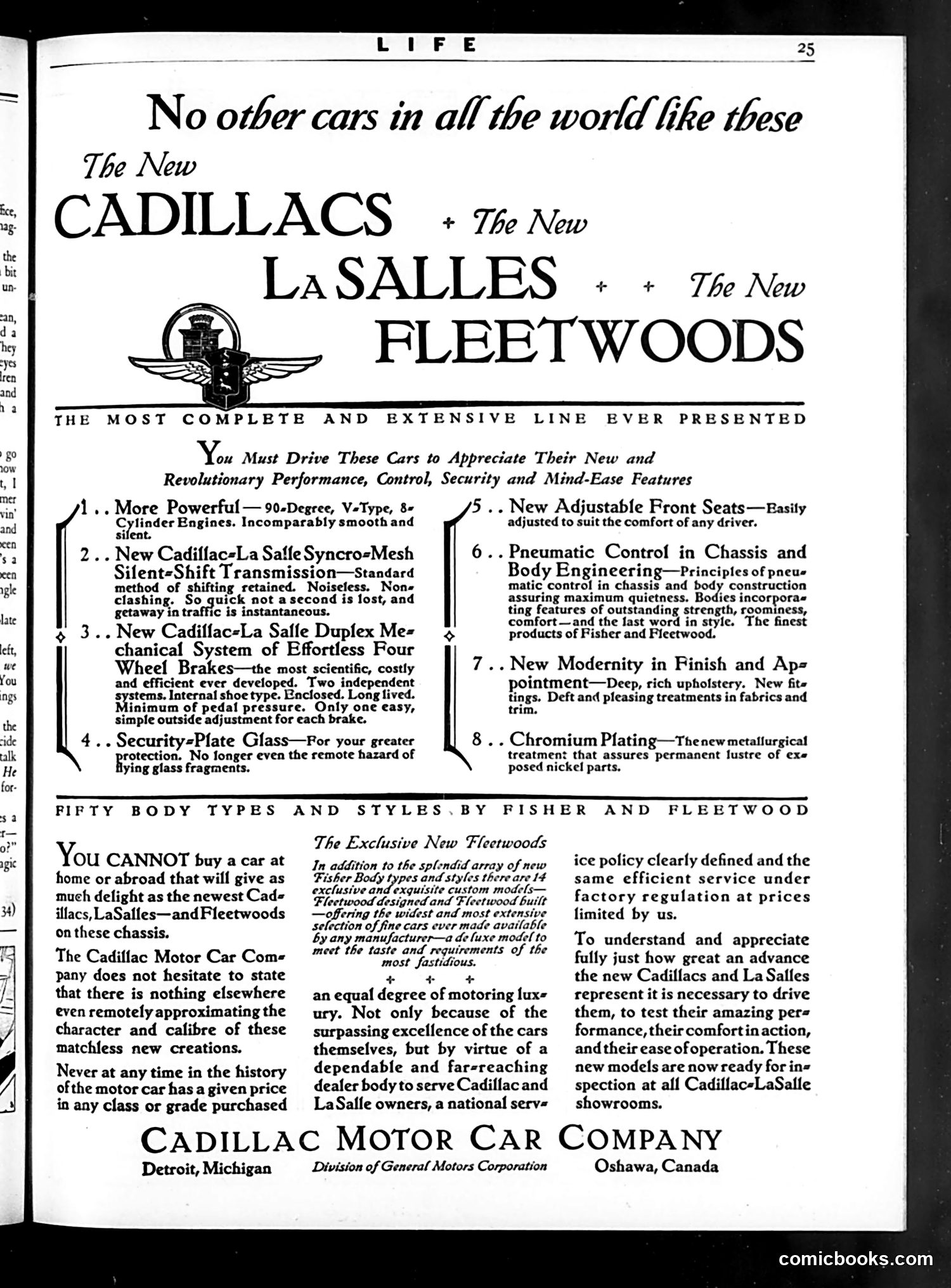
This is **not a cartoon or satirical content** — it's a straightforward automobile advertisement from Life magazine's advertising section. The page promotes three luxury car lines from General Motors: Cadillacs, LaSalles, and Fleetwoods. It lists eight technical features emphasizing engineering innovations (V-8 engines, synchronized transmissions, mechanical brakes, pneumatic controls) and luxury appointments (adjustable seats, chromium plating, custom upholstery). The ad's tone is boastful corporate messaging typical of 1920s-30s luxury marketing: "No other cars in all the world like these" and claims no competitor offers equivalent value at any price point. It emphasizes exclusivity, craftsmanship by Fisher and Fleetwood body makers, and a nationwide dealer network. There is no satire, political commentary, or humor intended. This represents genuine period advertising rhetoric celebrating American automotive engineering and status-symbol consumption.
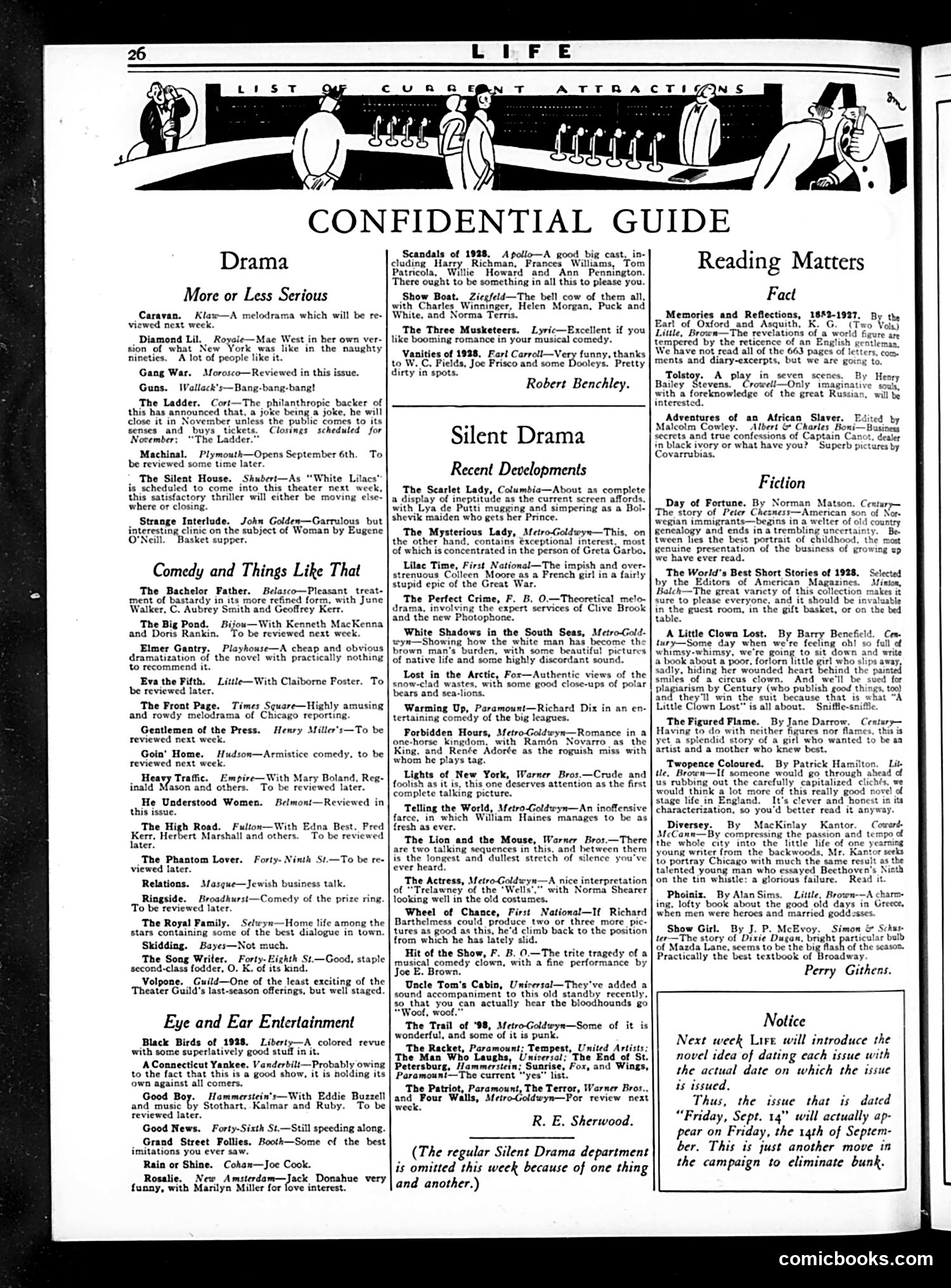
This page is a **theatrical entertainment guide** rather than a political cartoon. It's a "Confidential Guide" reviewing Broadway shows currently running, organized by category: drama, comedy, musicals, and "Eye and Ear Entertainment" (vaudeville/revue). The reviews are brief, witty critiques typical of Life's satirical style. For example, *The Ladder* gets mocked for requiring public support to stay open ("unless the public comes to its senses"), while *Show Boat* is praised as "the bell cow of them all." Notable references include Mae West's *Diamond Lil*, Eugene O'Neill's *Strange Interlude*, and adaptations like *Connecticut Yankee* and *Elmer Gantry*. The guide also lists musicals like *Good News* and *Rosalie*. The tone is dismissive toward mediocre productions ("cheap and obvious," "not much") while recommending stronger offerings. This reflects Life's role as cultural arbiter for educated, theater-going readers in the Jazz Age.
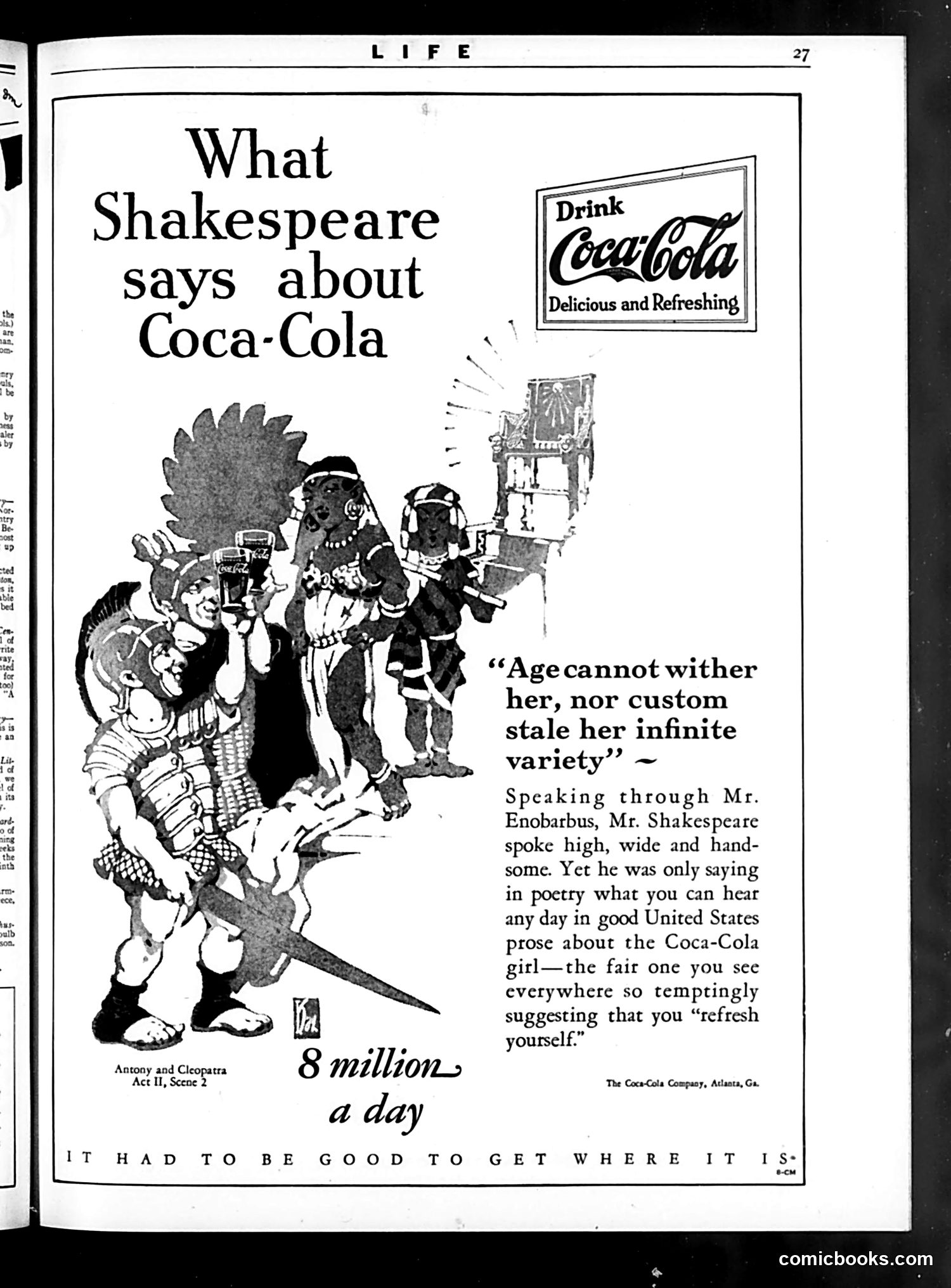
This is a **Coca-Cola advertisement** disguised as literary satire. The page quotes Shakespeare's *Antony and Cleopatra* (Act II, Scene 2)—Enobarbus's famous description of Cleopatra: "Age cannot wither her, nor custom stale her infinite variety." The ad's joke: Shakespeare was unknowingly praising Coca-Cola, not Cleopatra. The copy claims the famous line applies equally well to the "Coca-Cola girl"—the attractive woman featured in the company's advertising campaigns. The illustration shows costumed figures (appearing to represent Antony and Cleopatra) alongside modern characters drinking Coke, visually collapsing the ancient world into contemporary America. The satire is gentle and self-aware: by yoking high literature to commercial product promotion, Life mocks both Shakespeare-worship and advertising's absurd claims. The final stat ("8 million a day") grounds the literary flourish in sales figures—profit, not poetry, is the real story.
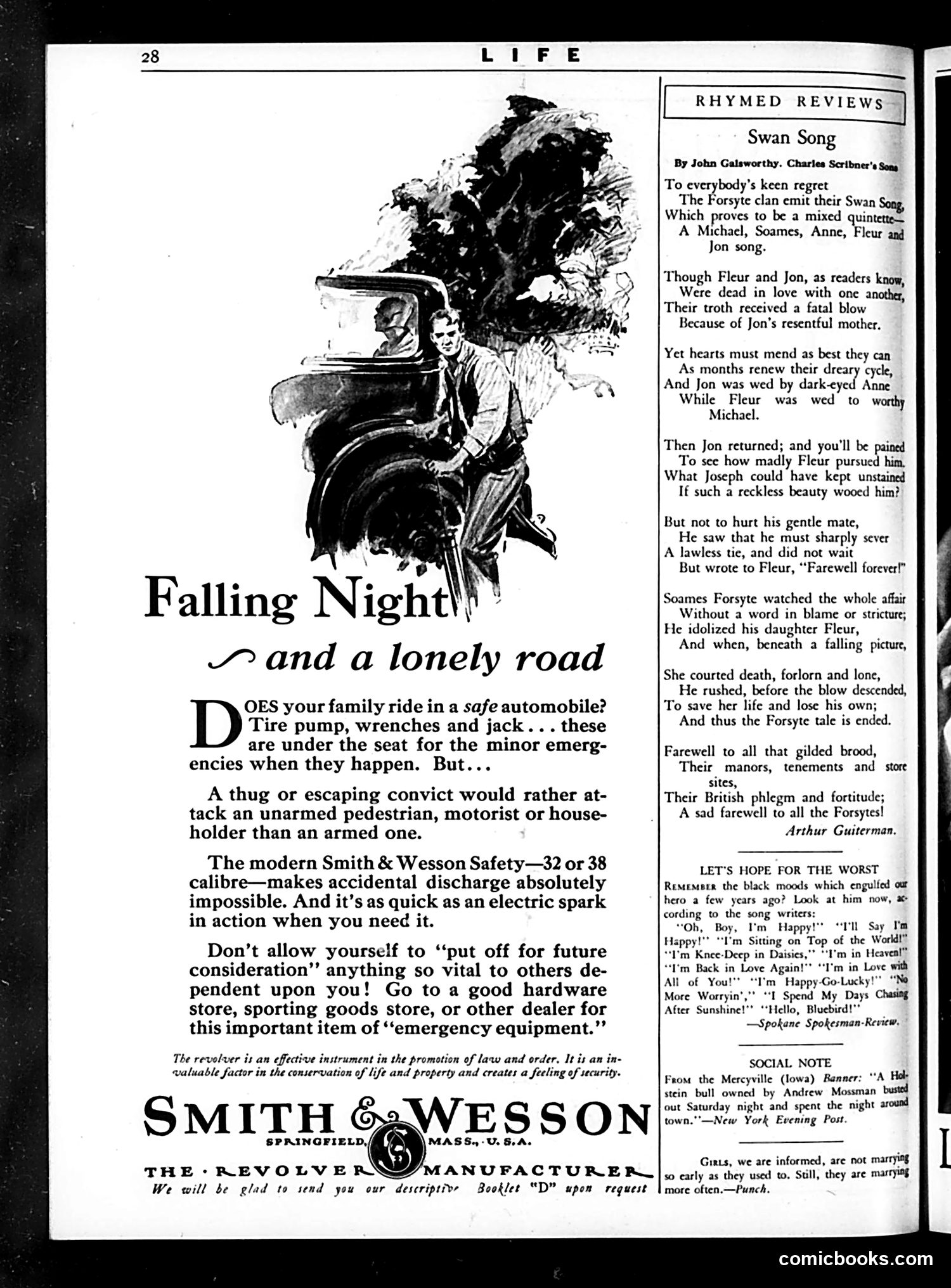
This page is primarily a **Smith & Wesson revolver advertisement** disguised as public safety advice. The illustration shows a motorist with a broken-down car at night—a vulnerable situation. The ad's pitch exploits fear: criminals supposedly prefer attacking unarmed people, so citizens should carry handguns for "emergency equipment." The language about "law and order" and "security" frames gun ownership as a moral duty to dependents. The accompanying text claims accidental discharge is "absolutely impossible"—a safety claim meant to address contemporary concerns about firearms accidents. The right column contains unrelated literary and social content (a poem about Galsworthy's novel, song titles, and brief humor notes), typical of Life magazine's miscellaneous format. This 1920s-era ad reflects early mass-market firearm marketing that normalized civilian gun ownership by appeals to protection and responsibility.
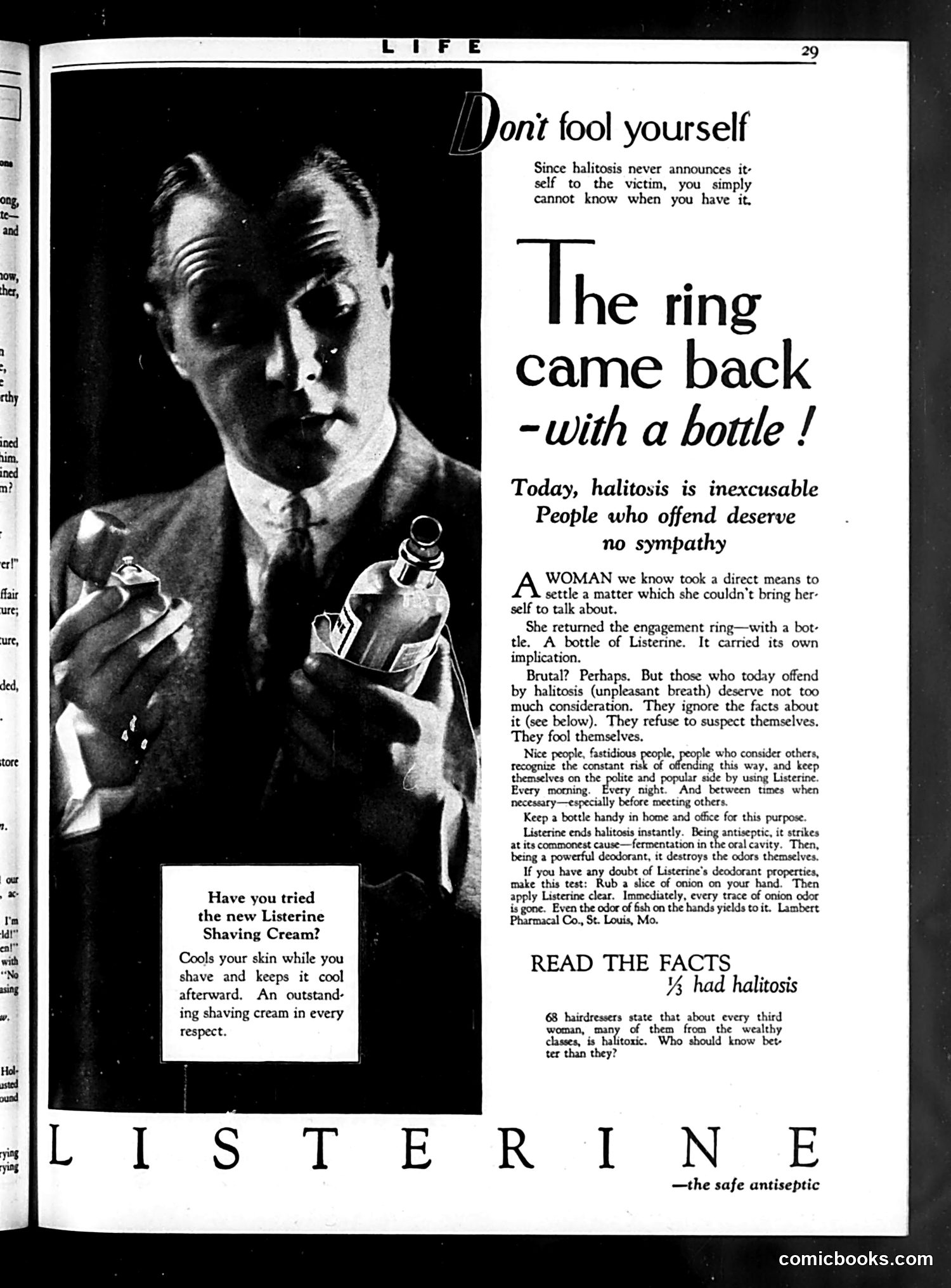
This is primarily a **commercial advertisement**, not political satire. It promotes Listerine mouthwash by addressing the social embarrassment of halitosis (bad breath). The central narrative depicts a woman returning an engagement ring accompanied by a bottle of Listerine—a dramatic, humorous scenario illustrating that poor oral hygiene is socially unacceptable and grounds for rejecting a romantic partner. The headline "The ring came back—with a bottle!" frames this as a cautionary tale. The ad employs shame and social pressure as marketing tactics, claiming that "nice people" use Listerine daily and that those with halitosis "deserve no sympathy." It includes testimonials from hairdressers (presumably authority figures on personal hygiene) stating one in three wealthy women suffer from halitosis. A secondary advertisement for Listerine Shaving Cream appears below. The satire, if any exists, targets the absurdity of using a mouthwash bottle as a relationship rejection message—but the ad presents this seriously as acceptable behavior.
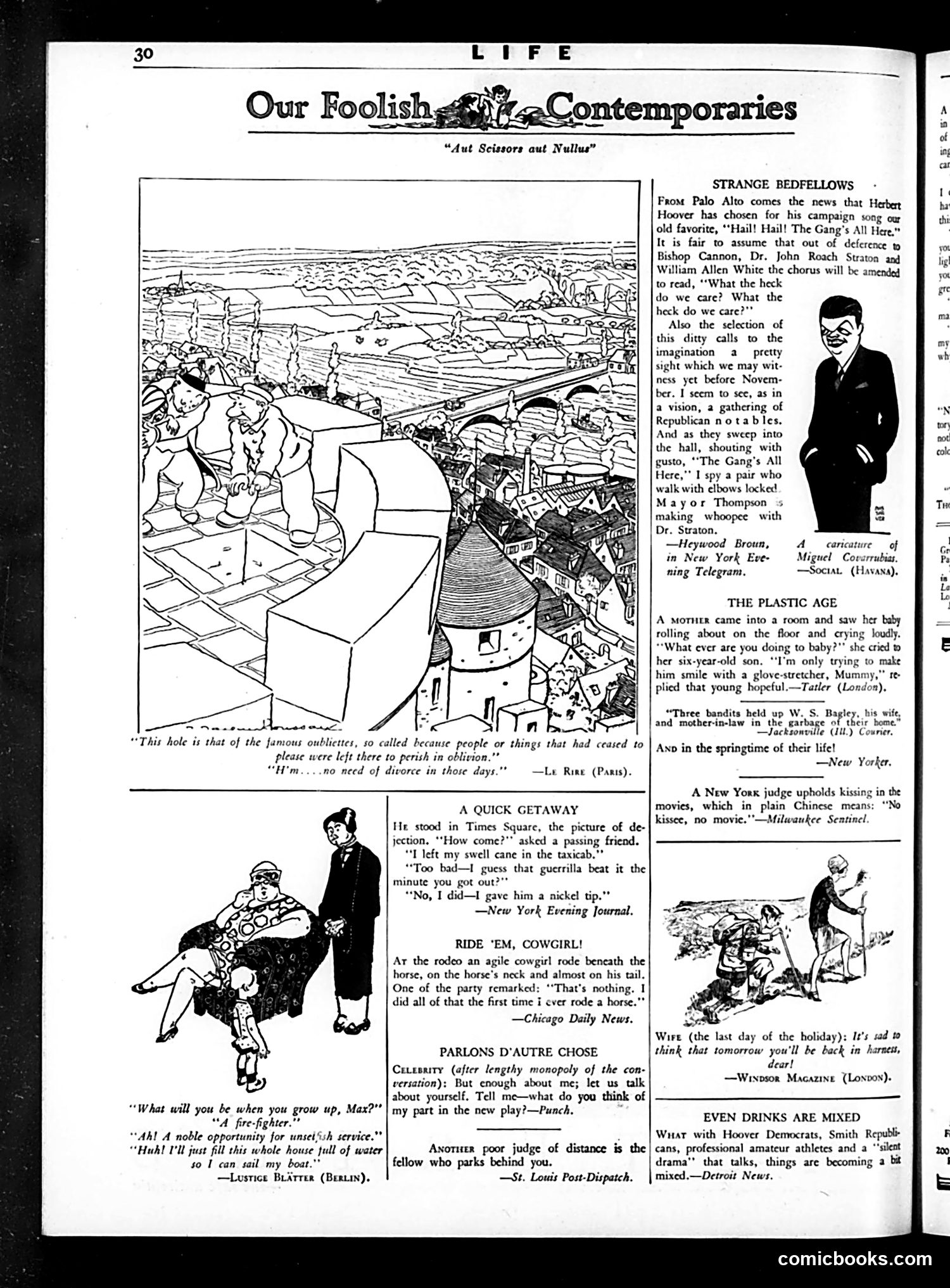
This page collects brief humorous anecdotes and social commentary typical of Life's satirical format. Key items include: **"Strange Bedfellows"**: References Herbert Hoover's 1928 campaign choice of "Hail! Hail! The Gang's All Here" as his song. The satire suggests that Bishop Cannon, Dr. John Roach Straton, and William Allen White (prominent Republicans with moral/religious authority) would demand the chorus be changed to avoid secular implications—a jab at Republican hypocrisy and these figures' influence. **Other jokes** mock everyday absurdities: a child wanting to fill a house with water while becoming a firefighter; a man tipping a taxi driver who stole his cane; parking etiquette; celebrity self-absorption. **"The Plastic Age"** humorously depicts modern parenting and childhood mischief. The overall tone satirizes 1920s American politics, morality, and social behavior—particularly Republican pretentiousness during the Hoover era. The "Contemporaries" framing suggests these are foolish examples of current society worthy of ridicule.
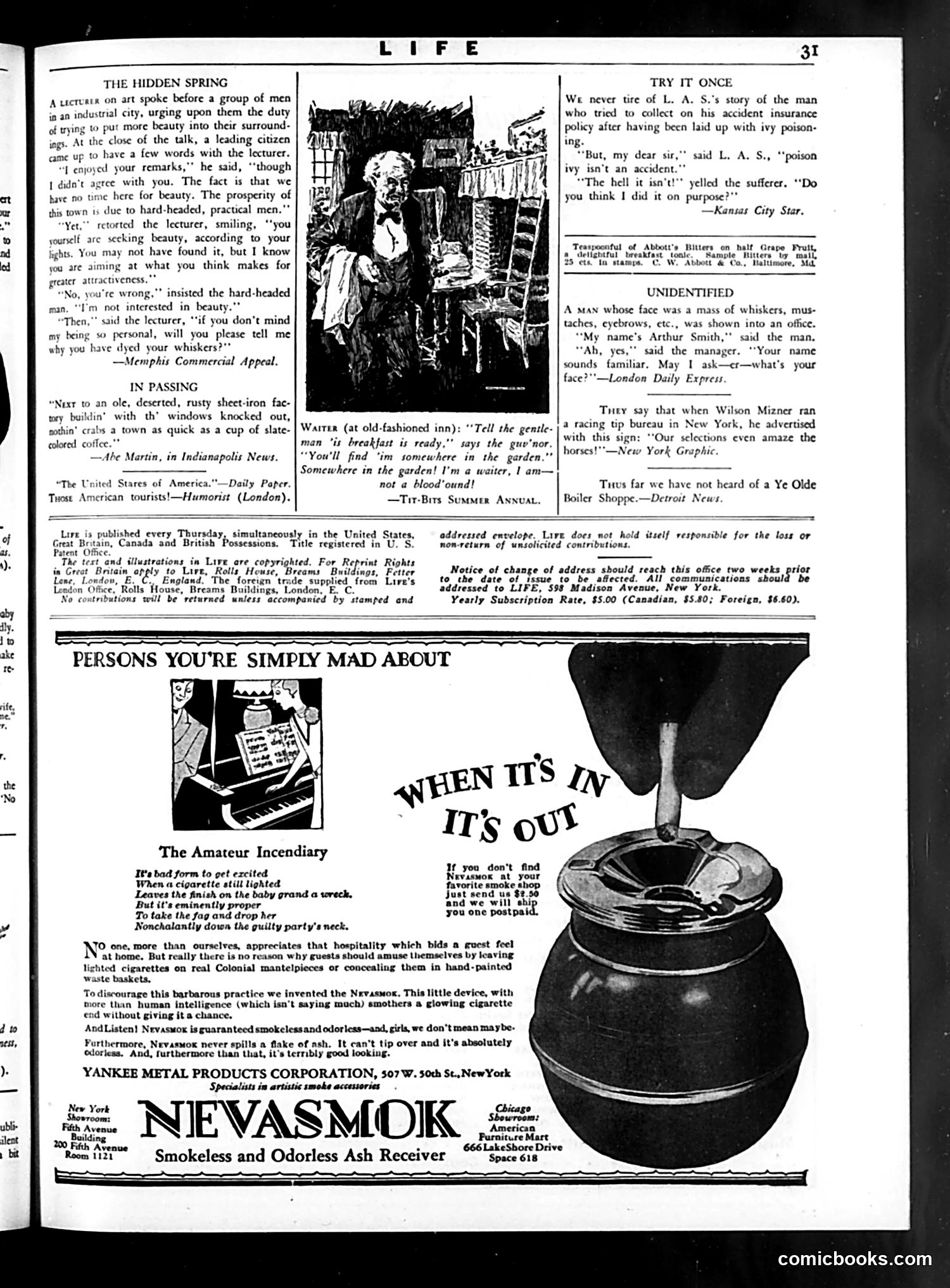
This page consists primarily of **humorous short anecdotes and advertisements** rather than political cartoons. The humor pieces mock various social absurdities: a businessman denies caring about beauty while having dyed his whiskers (hypocrisy); a man claims poison ivy poisoning qualifies as an "accident" for insurance purposes (legal/logical absurdity); a waiter refuses to search for a guest, saying he's "not a bloodhound" (class commentary on service industry dignity). One anecdote references **Wilson Mizner's racing tip bureau** in New York, which advertised humorously that even horses were amazed by their selections—a joke about dubious business practices. The major advertisement promotes the **Nevasmok ash receiver**, a device designed to contain cigarette smoke and ash indoors without spilling. The copy emphasizes it prevents guests from leaving ash on furniture—reflecting **1920s anxieties about smoking etiquette** in homes. Overall, this is a general-interest satirical magazine page targeting middle-class American readers with jokes about social pretension, business fraud, and domestic propriety.
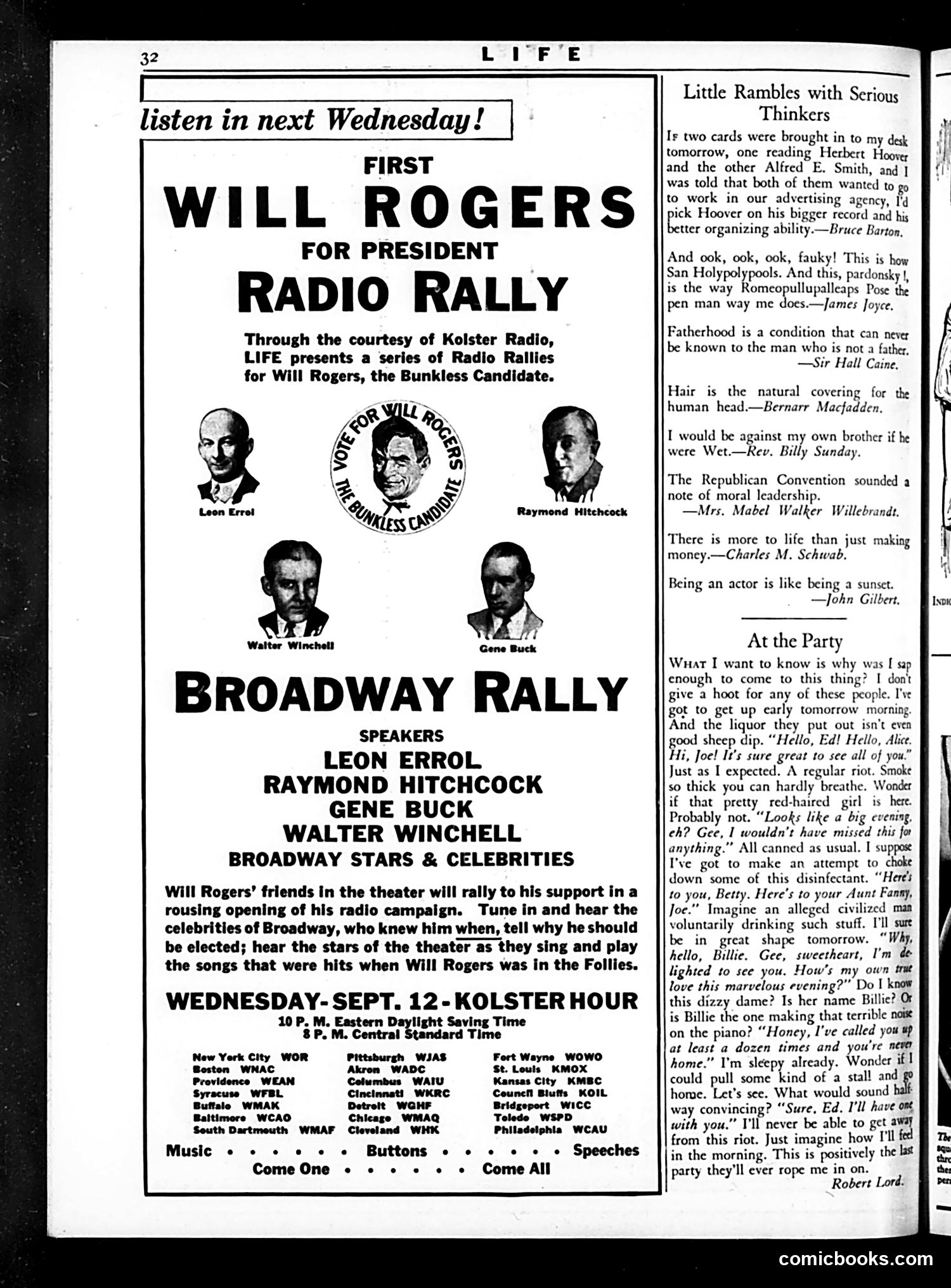
This 1928 page promotes a satirical "Will Rogers for President" radio campaign. Will Rogers was a famous humorist and actor—the text describes him as "the Bunkless Candidate," mocking his lack of political pretense. The rally features Broadway celebrities (Leon Errol, Raymond Hitchcock, Gene Buck, Walter Winchell) supporting Rogers in a humorous challenge to the actual 1928 presidential race between Herbert Hoover and Alfred E. Smith. The right column contains unrelated satirical quotes from celebrities on trivial topics ("Hair is the natural covering for the human head"—Bernarr Macfadden), mocking their tendency to pontificate on everything. The bottom section, "At the Party," is comedic fiction about someone reluctantly attending a social event—complaints about early mornings, bad liquor, and forgetting people's names. This represents Life magazine's 1920s satirical style: mocking both politics (through Rogers) and celebrity culture simultaneously.
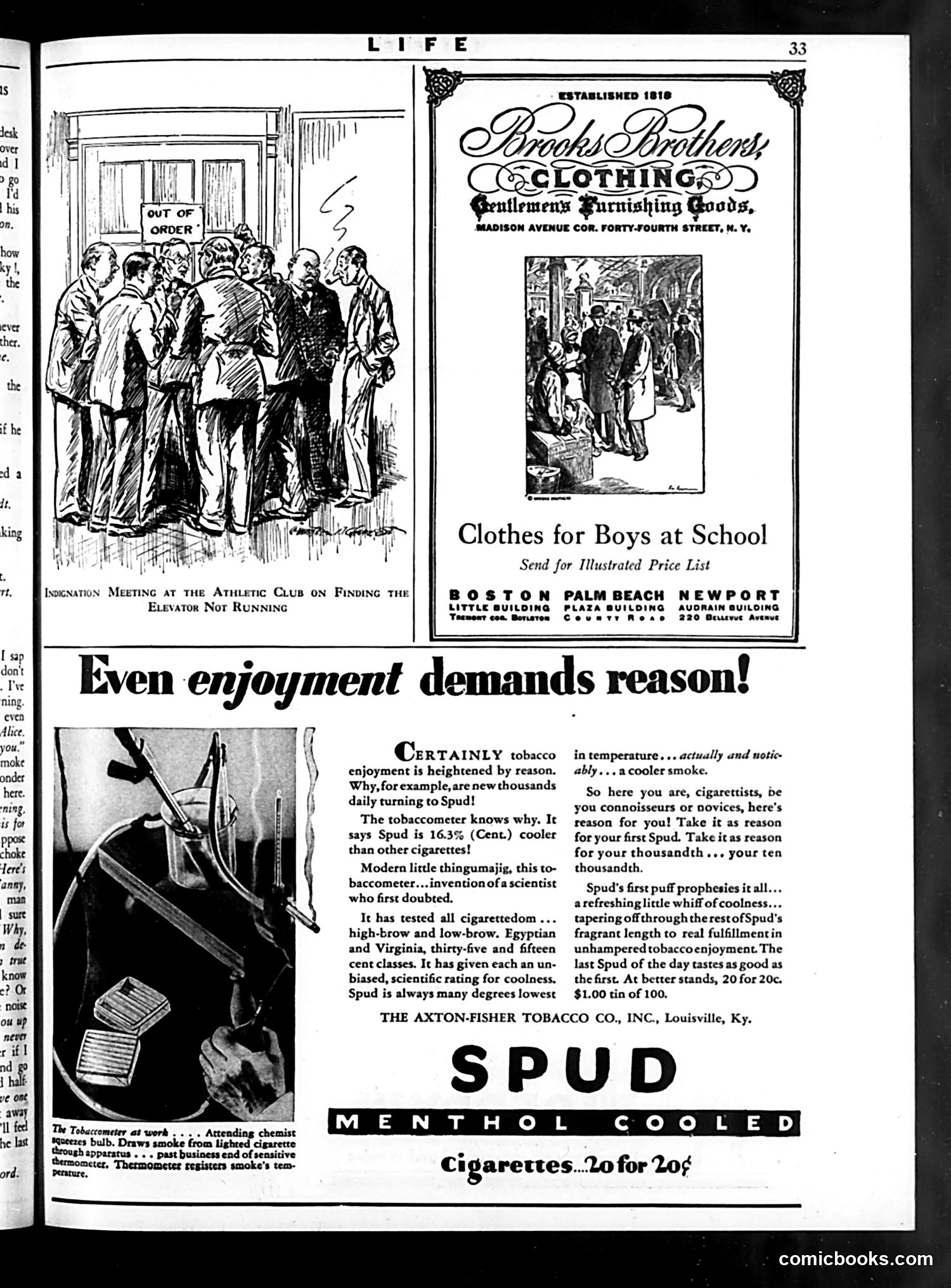
This page contains two distinct elements: **Top Left Cartoon**: Depicts men crowded outside a door marked "OUT OF ORDER" at what appears to be an athletic club. The caption references "Indignation Meeting at the Athletic Club on Finding the Elevator Not Running." The joke satirizes the petty grievances of wealthy club members—they're so indignant about a broken elevator that they've organized a formal meeting, treating a minor inconvenience as a major crisis. It mocks the self-importance of the affluent. **Advertisements**: The remainder is commercial content—Brooks Brothers clothing and Spud menthol cigarettes. The Spud ad features pseudo-scientific marketing, claiming a "tobaccometer" proves Spud is 16.3% cooler than competitors. This represents early 20th-century advertising's use of invented scientific-sounding claims to sell products, particularly tobacco. The juxtaposition is typical of *Life* magazine's blend of satirical commentary and commercial content.
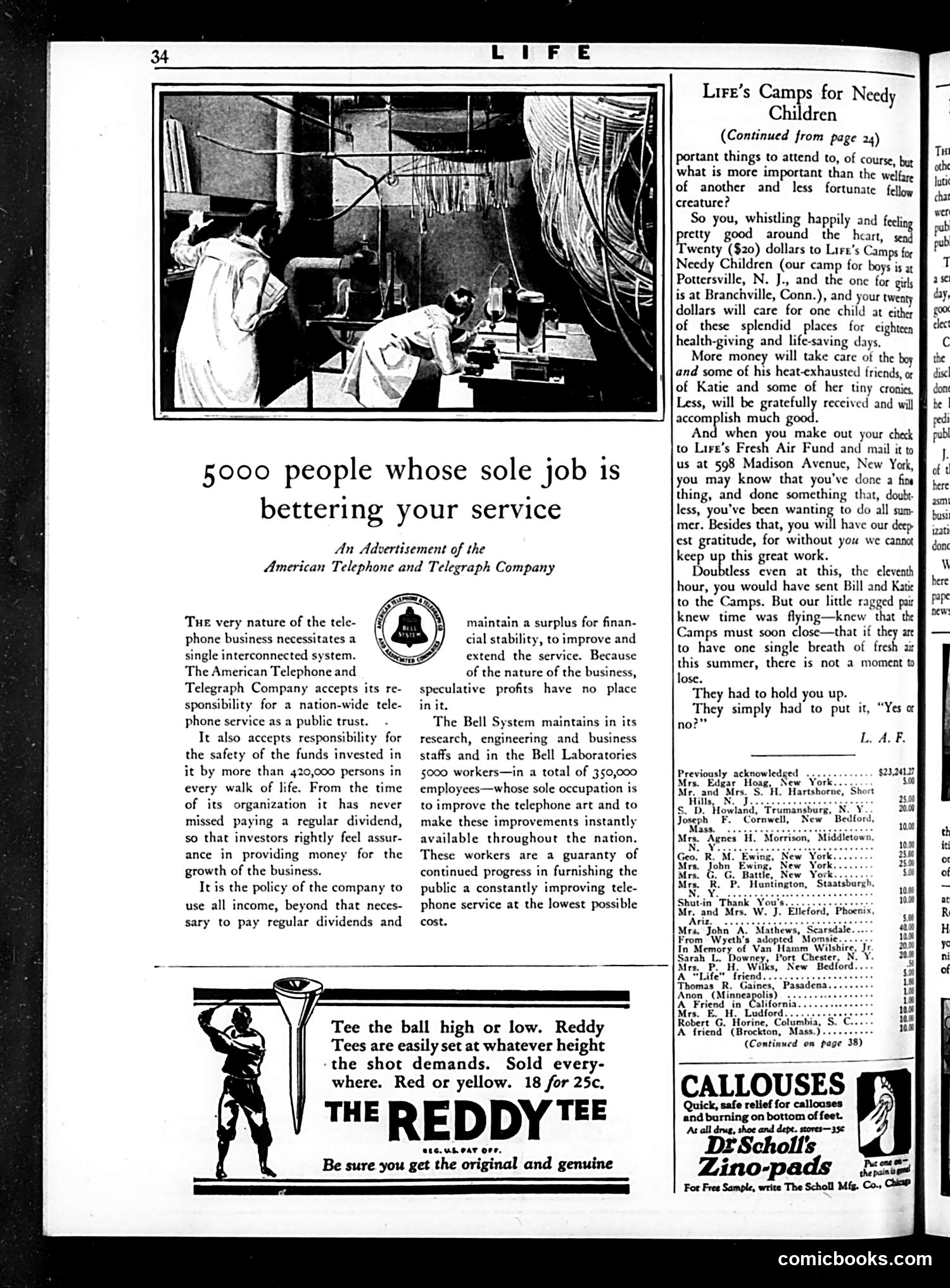
This page is primarily **corporate advertising** for the American Telephone and Telegraph Company (AT&T), positioned as public-service messaging. **Main Advertisement:** AT&T claims that 5,000 of its 350,000 employees work solely on research and improvement of telephone service. The company emphasizes its reliability to investors—never missing dividend payments—and argues that profits beyond dividends are reinvested in service improvements rather than speculation. This is defensive messaging, likely responding to Progressive-era criticism of monopolistic practices and unfair profits. **Secondary Content:** The page also includes a charitable appeal for "Life's Camps for Needy Children" (summer camps in New Jersey and Connecticut), soliciting donations to send underprivileged children to the camps. This reflects early 20th-century philanthropic concerns about poor urban children's welfare. **Smaller Ads:** The Reddy Tee (golf equipment) and Dr. Scholl's Zino-pads (foot care) advertisements round out the commercial content. The AT&T ad represents corporate image-building during an era of antitrust scrutiny.
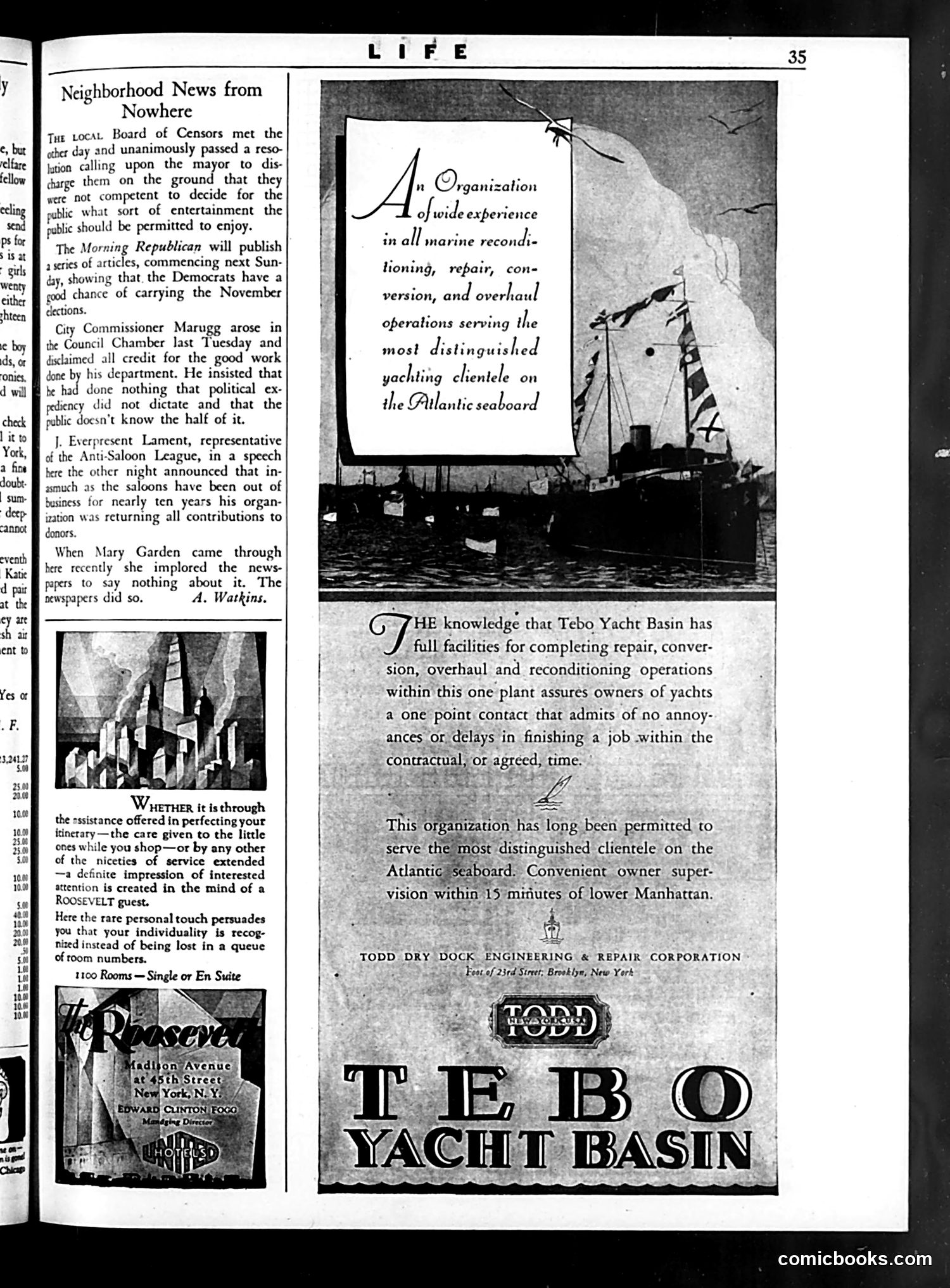
This page mixes satirical local news with advertisements. The "Neighborhood News from Nowhere" section uses absurdist humor to mock civic institutions and hypocrisy: - A **Board of Censors** admits incompetence to decide public entertainment - A **newspaper** claims Democrats can win elections (likely satirizing partisan optimism) - A **City Commissioner** disclaims credit for departmental work, blaming "political expediency" - An **Anti-Saloon League representative** announces returning donations since saloons closed a decade ago (Prohibition-era satire) - **Mary Garden** (a famous opera singer) requests press silence, which the papers honor The satire targets municipal incompetence, political dishonesty, and institutional absurdity. The final anecdote about Garden is the gentlest joke—a brief reversal of expectation. The remainder is straightforward advertising for **Tebo Yacht Basin** in Brooklyn, emphasizing marine repair services for wealthy yacht owners.
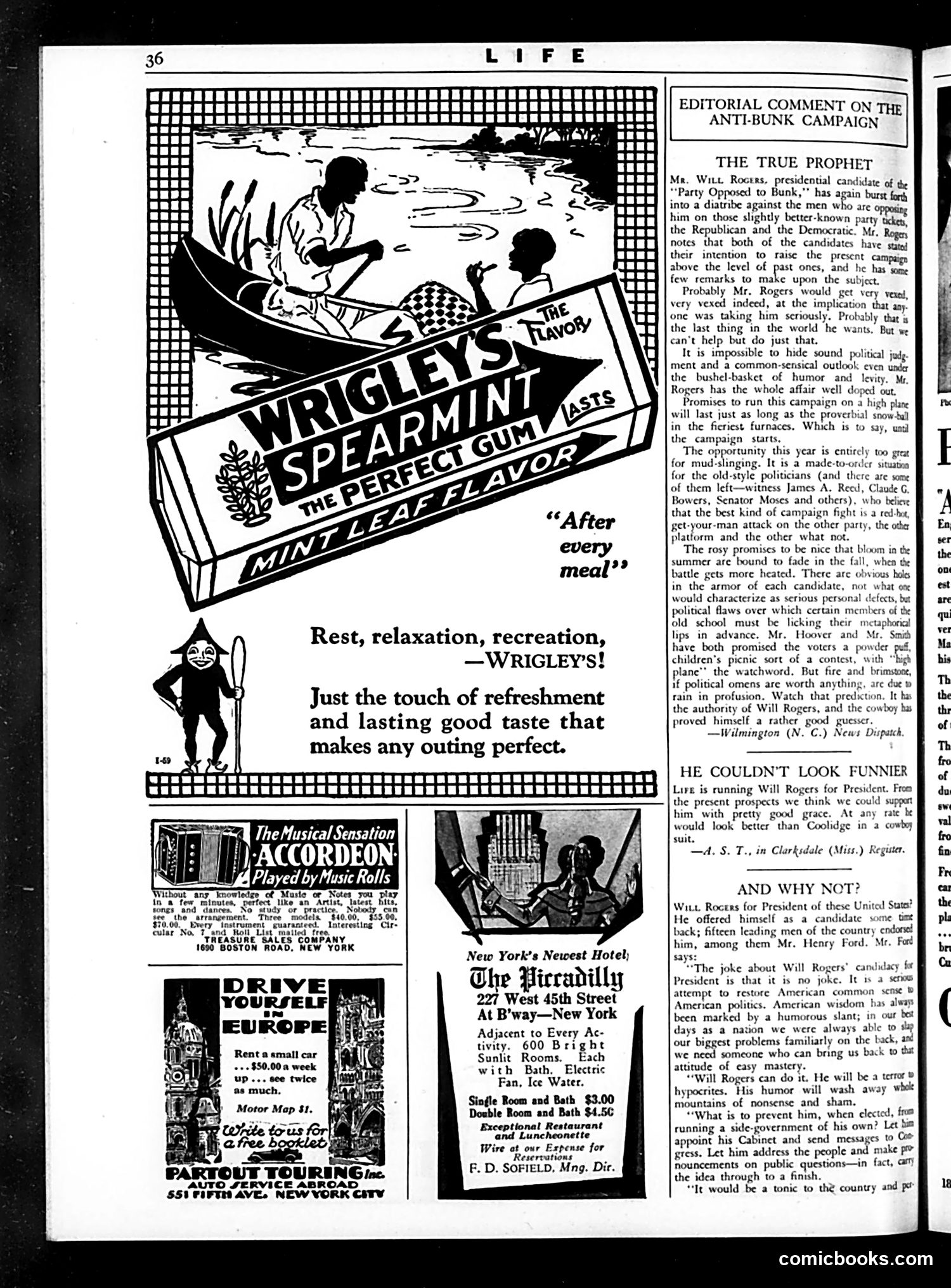
This Life magazine page satirizes Will Rogers' humorous 1928 presidential candidacy through editorial commentary. The main cartoon depicts Rogers in a boat labeled "The Flavor" advertising Wrigley's gum—a visual pun equating his campaign to commercial product marketing. The accompanying editorials argue Rogers offers genuine political insight despite (or through) his humor. They reference his "Party Opposed to Bunk" platform, suggesting both major parties' candidates—likely Herbert Hoover and Al Smith—will abandon campaign promises of civility once voting begins. The editors praise Rogers' common sense while acknowledging he doesn't expect serious support. They predict mud-slinging will inevitable replace "high plane" politics, validating Rogers' cynical observations about American democracy. The reprinted endorsement from Henry Ford adds credibility, claiming Rogers' candidacy is "no joke"—it represents legitimate political commentary wrapped in entertainment. The page contrasts Rogers' satirical truth-telling against conventional politicians' empty promises.
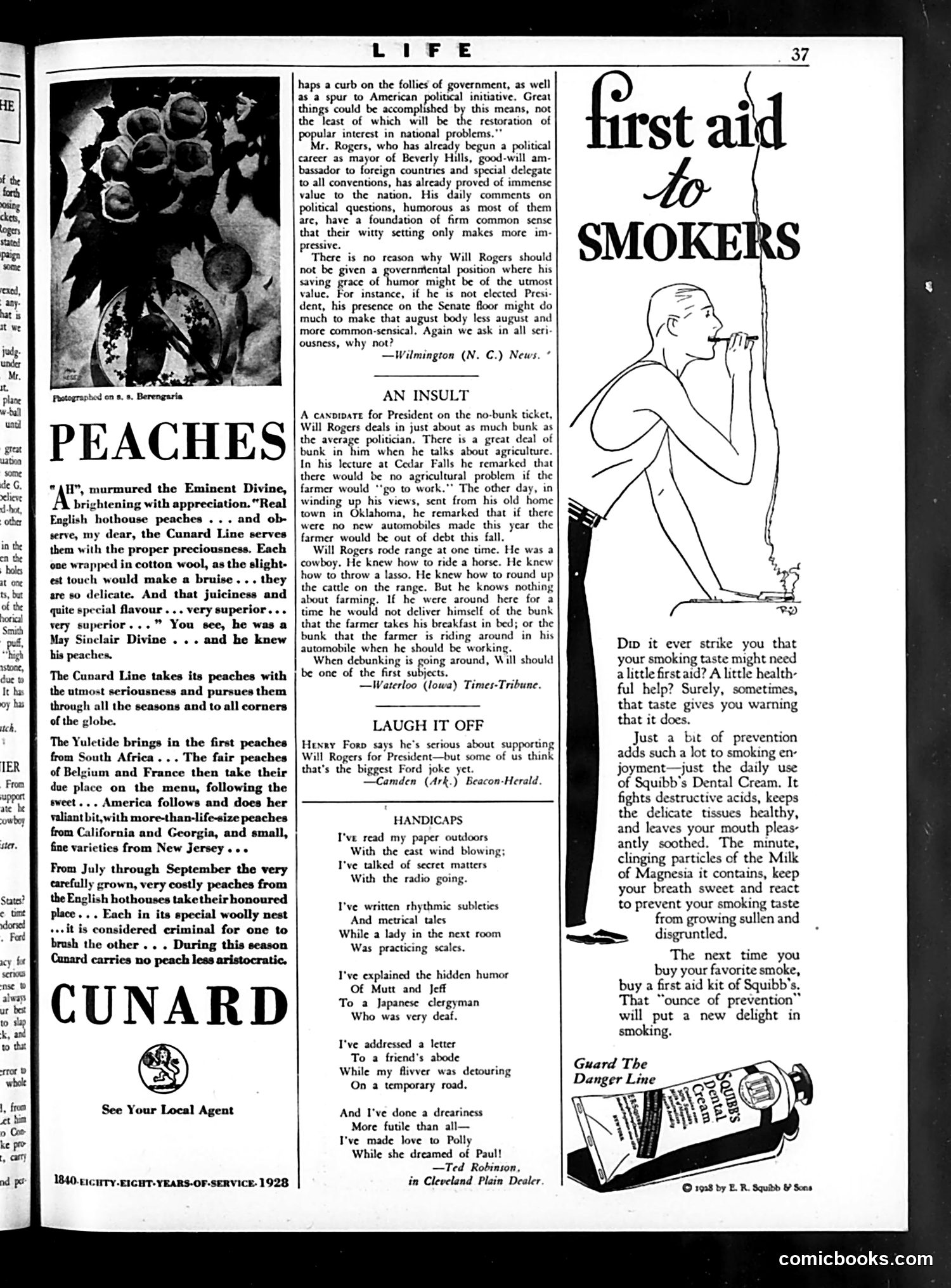
This page contains **advertisements and editorial commentary about Will Rogers' potential presidential candidacy**. The **Cunard shipping line advertisement** (left) depicts their luxurious peach service—a satirical celebration of transatlantic excess, with peaches wrapped individually in cotton wool, treated as precious cargo. The main content concerns **Will Rogers**, the famous humorist and entertainer. Multiple newspapers are quoted debating whether Rogers should run for President. The *Wilmington News* endorses the idea, praising his humor as politically valuable. However, the *Waterloo Times-Tribune* dismisses his agricultural commentary as "bunk," claiming his cowboy background doesn't qualify him to speak about farming. The *Camden Beacon-Herald* jokes that Henry Ford's support for Rogers is Ford's "biggest joke yet." The right side features a **Squibb's Dental Cream advertisement** using smoking prevention as its hook. The satire targets Rogers' celebrity-turned-politician aspirations and the absurdity of treating entertainment fame as political qualification—still a recognizable concern today.
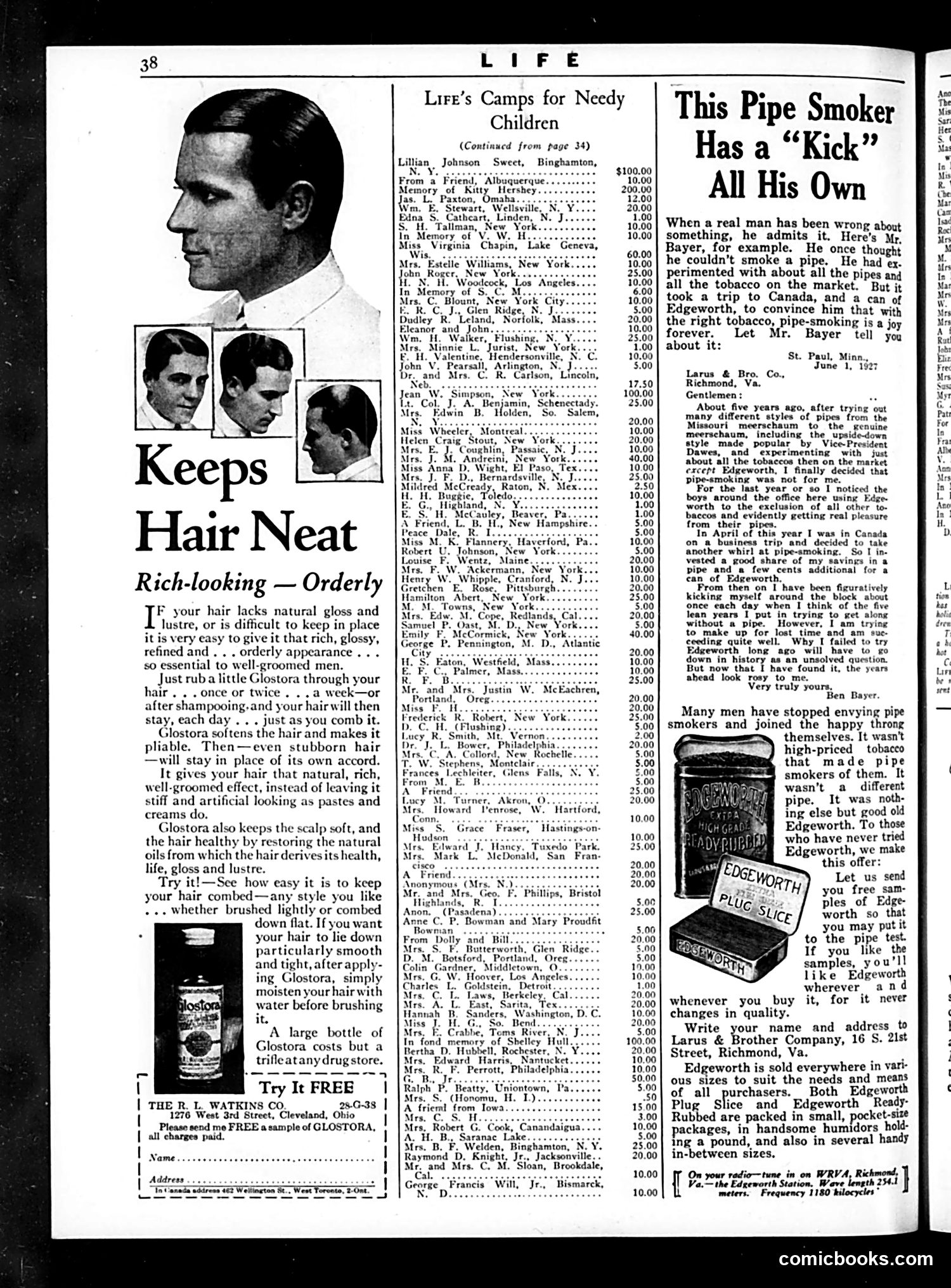
This page contains two distinct elements: **Left side:** A Glostora hair product advertisement featuring male head profiles demonstrating the product's grooming benefits. The ad promises natural-looking, orderly hair that stays in place—targeting men concerned with appearing well-groomed and refined. **Right side:** A testimonial advertisement for Edgeworth pipe tobacco. A man writes to the manufacturer claiming he was skeptical about pipe smoking until trying Edgeworth. He describes being converted from cigarettes, attributing his change to finding "the right tobacco." The ad emphasizes that Edgeworth made pipe-smoking "a joy forever" and includes product images and purchasing information. **Center:** A continuation of Life's charitable "Camps for Needy Children" donation list, showing contributors' names and amounts. The page juxtaposes masculine grooming (hair product) with masculine leisure (pipe smoking)—both appealing to early 20th-century ideals of the refined, well-presented man. The testimonial format lends credibility to the product claim, a common advertising technique of the era.
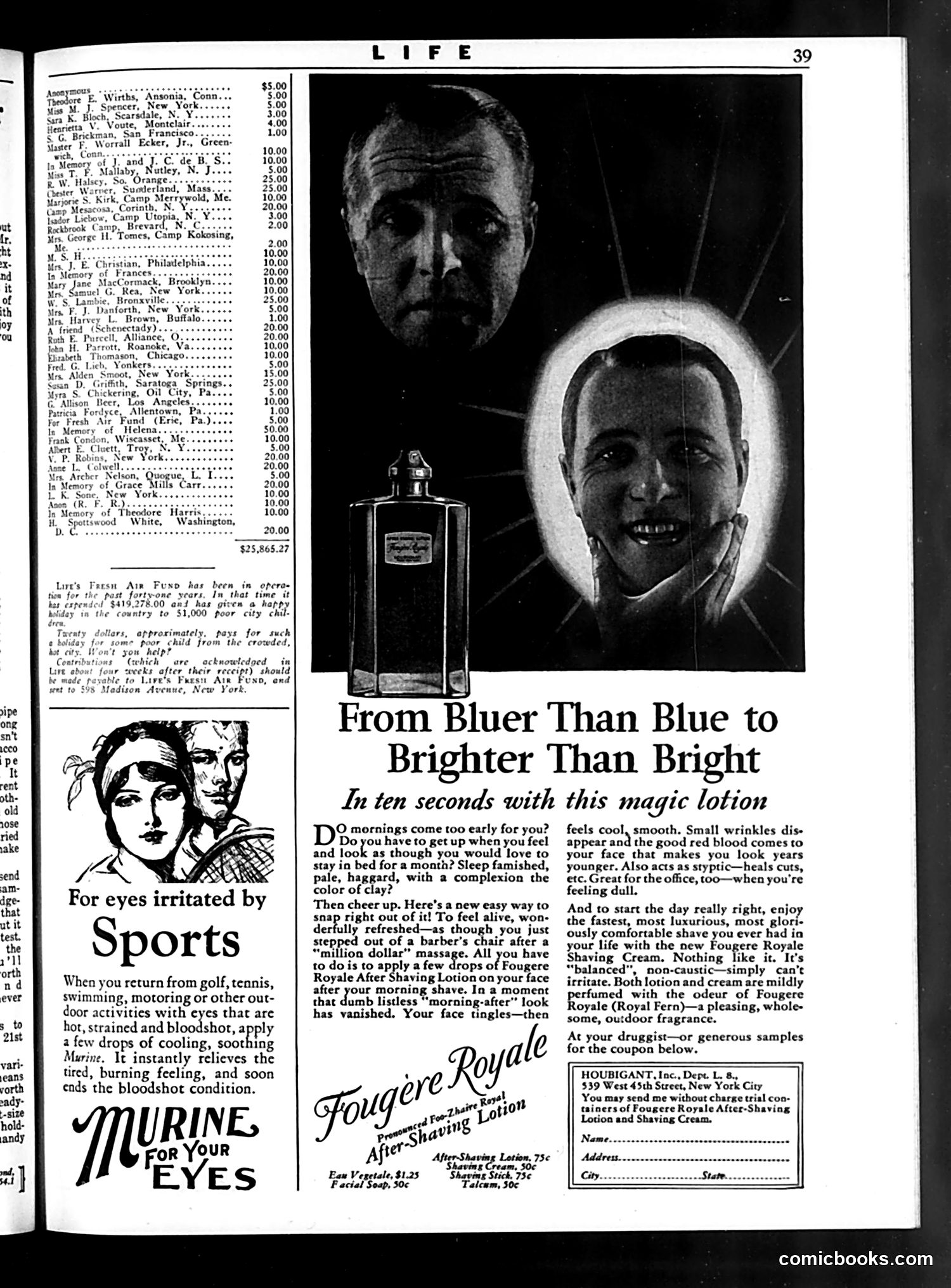
This page is primarily **advertising**, not political satire. It contains two product advertisements: 1. **Murine for Eyes** (left): An ad for eyedrops targeting sports enthusiasts. The small illustration shows two faces—likely representing before/after or male/female—promoting relief for tired, bloodshot eyes from outdoor activities. 2. **Fougere Royale After-Shaving Lotion** (center/right): The dominant advertisement features two men's faces (one bearded above, one clean-shaven below) promoting a grooming product. The headline promises transformation "From Bluer Than Blue to Brighter Than Bright" in ten seconds—exaggerated marketing language claiming the lotion revitalizes tired morning appearance. The left column contains a **charitable fundraising list** for Life's Fresh Air Fund, showing donations from readers across America to support poor city children. There is **no political cartoon or satire** on this page. It's a straightforward commercial advertising page typical of 1920s-era magazines, alongside charitable solicitation.
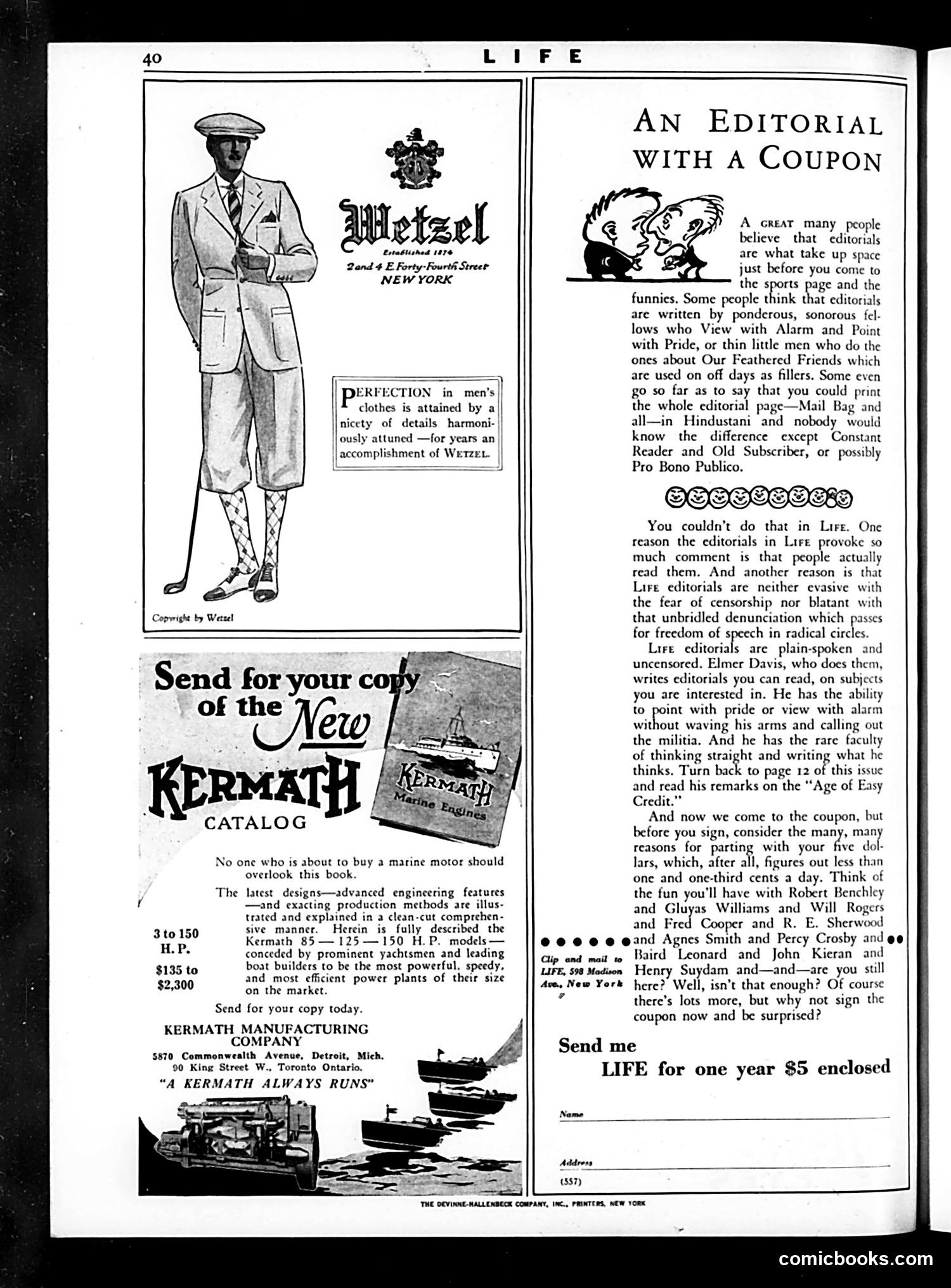
This page mixes advertising with editorial content promoting Life magazine itself. **Left side:** A Wetzel clothing advertisement featuring a well-dressed man in a suit, promoting men's fashion through refined tailoring details. **Center:** A Kermath Manufacturing Company ad for marine motors, targeting yacht owners and boat builders. **Right side:** "An Editorial with a Coupon" is a self-promotional piece satirizing common perceptions of editorials as dull filler content written by predictable writers who "View with Alarm and Point with Pride"—mocking clichéd editorial tropes. Life distinguishes itself by claiming its editorials (written by Elmer Davis) are actually readable, uncensored, and plain-spoken rather than evasive or radically denounciatory. The piece then lists Life's popular contributors—Robert Benchley, Will Rogers, Fred Cooper, Percy Crosby, and others—to entice subscription at $5/year (about one-third cent daily). The humor lies in the page ironically using a tedious editorial format to argue that Life's editorials *aren't* tedious.
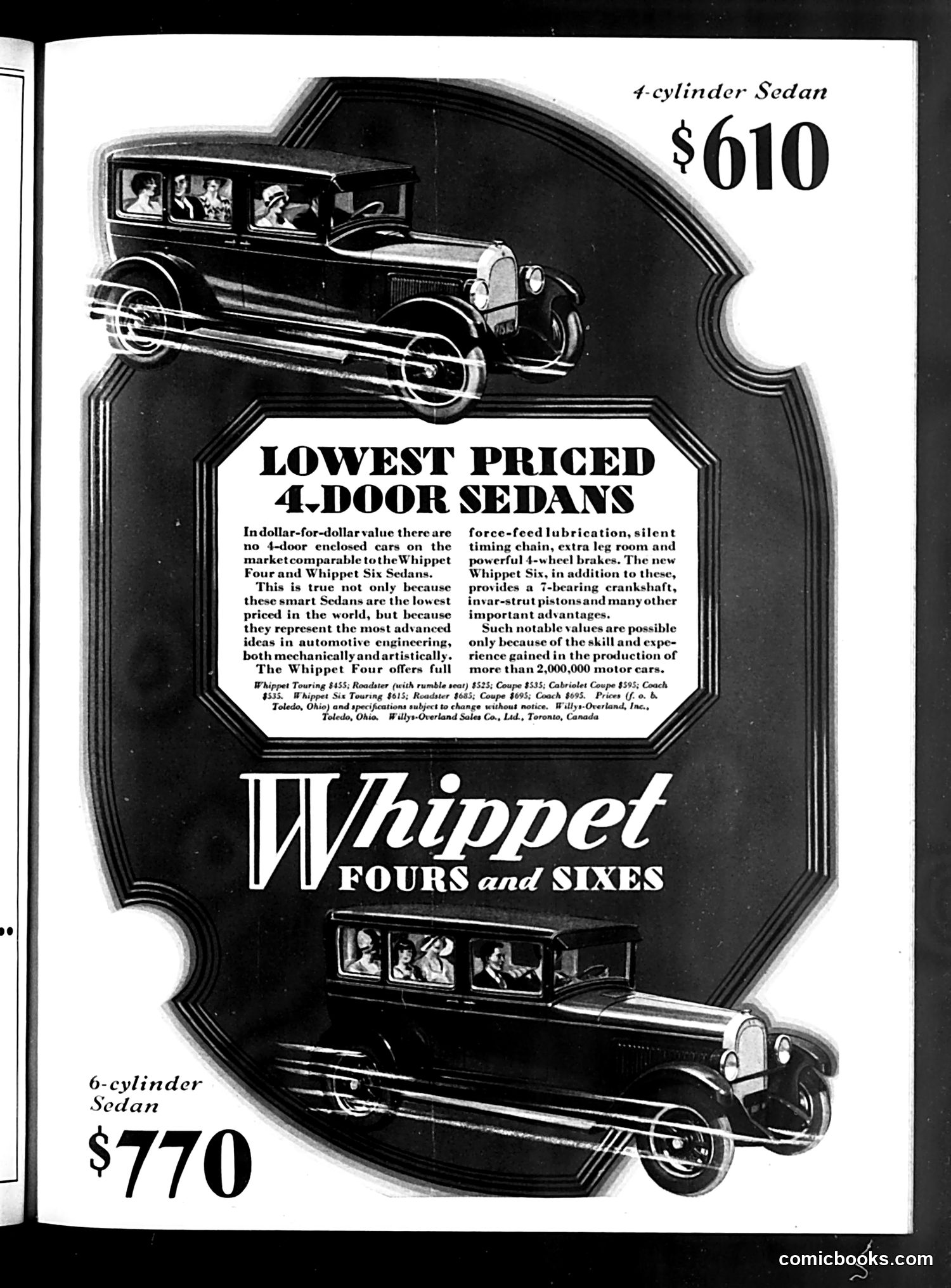
This is not a cartoon or satire—it's a **straightforward automobile advertisement** for Whippet cars, made by Willys-Overland. The page promotes two sedan models: a 4-cylinder priced at $610 and a 6-cylinder at $770. The central text argues these are "lowest priced 4-door sedans" on the market while offering advanced engineering features (force-feed lubrication, silent timing chains, powerful brakes). The ad emphasizes value and manufacturering credibility, claiming Whippet's experience building "more than 2,000,000 motor cars" justifies the competitive pricing. Two vintage car illustrations show the vehicles with passengers visible through windows—typical 1920s advertising imagery meant to suggest modern comfort and respectability. This reflects the era's intense automobile competition and mass-production marketing strategies targeting middle-class buyers.
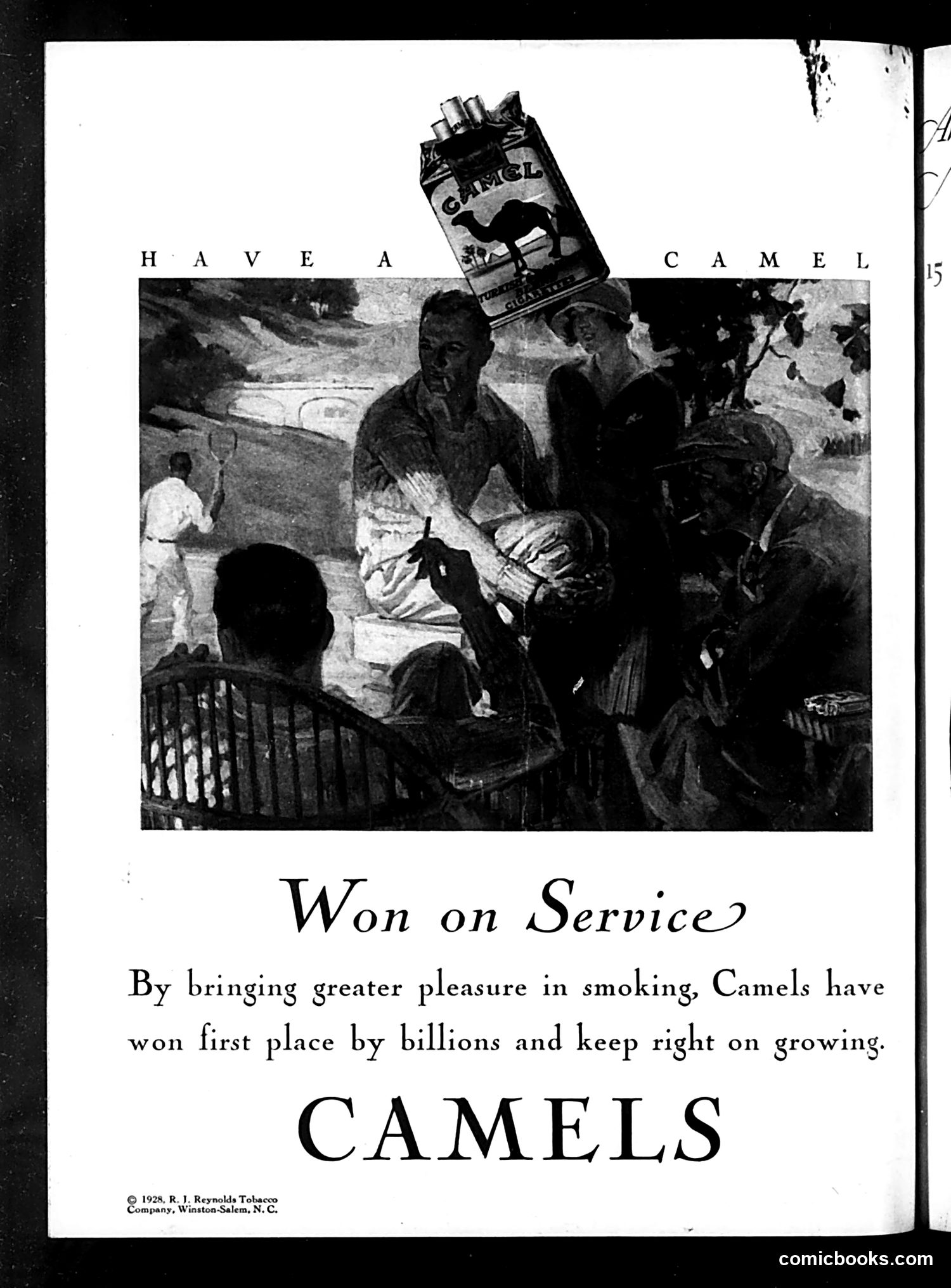
This is a 1928 Camel cigarette advertisement, not political satire. The image shows a group of men gathered around what appears to be a serviceman or worker in casual conversation, with a Camel cigarette package prominently displayed above. The ad's tagline claims Camels have "won first place by billions" through superior smoking pleasure. The "Won on Service?" headline suggests the product's popularity stems from delivering customer satisfaction. The scene depicts ordinary working men—likely representing the general public—endorsing the product through their apparent enthusiasm and casual social interaction. This was a common advertising strategy of the era: using relatable, everyday scenarios to build brand credibility and suggest widespread consumer approval. The copyright date places this firmly in the 1928 marketing landscape, before cigarette health warnings became standard.