
Life, 1928-09-06 · page 28 of 44
Life — September 6, 1928 — page 28: what you’re looking at
What you’re looking at
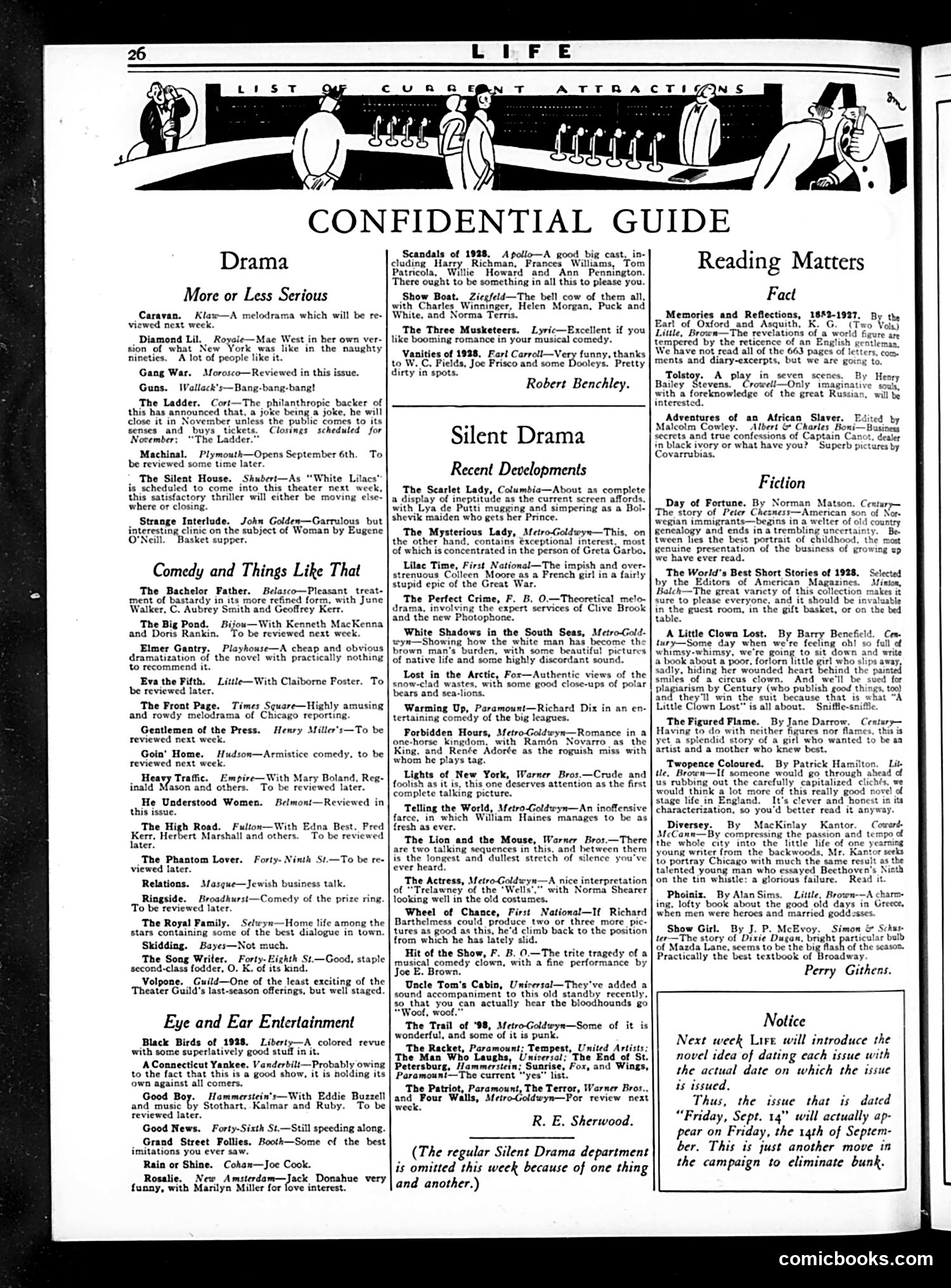
This page is a **theatrical entertainment guide** rather than a political cartoon. It's a "Confidential Guide" reviewing Broadway shows currently running, organized by category: drama, comedy, musicals, and "Eye and Ear Entertainment" (vaudeville/revue). The reviews are brief, witty critiques typical of Life's satirical style. For example, *The Ladder* gets mocked for requiring public support to stay open ("unless the public comes to its senses"), while *Show Boat* is praised as "the bell cow of them all." Notable references include Mae West's *Diamond Lil*, Eugene O'Neill's *Strange Interlude*, and adaptations like *Connecticut Yankee* and *Elmer Gantry*. The guide also lists musicals like *Good News* and *Rosalie*. The tone is dismissive toward mediocre productions ("cheap and obvious," "not much") while recommending stronger offerings. This reflects Life's role as cultural arbiter for educated, theater-going readers in the Jazz Age.
📄 Transcribed text from this page (OCR, searchable)
Machine-transcribed from the original scan — historical spelling and the odd misread are preserved.
CONFIDENTIAL GUIDE Drama More or Less Serious Caravan. Klaw—A melodrama which will be re- viewed next week. Diamond Lil. Royaie—Mae West in her own ve: sion of what New York was like in the naught nineties. A lot of people like it. Gang War. Guns. |Wallack's—Bang-bang-bang! The Ladder. Cort—The philanthropic backer of this has announced that, a joke being a joke, he will close it in November unless the public comes to its senses and buys tickets. Closings scheduled for November; “The Ladder.” Machinal. Plymouth—Opens September 6th. To be reviewed some time later. The Silent House. Shuderi—As “White Lilacs” is scheduled to come into this theater next week, this satisfactory thriller will either be moving else- where or closing. Strange Interlude. John Golden—Garrulous but interesting clinic on the subject of Woman by Eugene O'Neill. Basket supper. Comedy and Things Like That The Bachelor Father. Belasco—Pleasant treat- ment of bastardy in its more refined form, with June Walker, C. Aubrey Smith and Geoffrey Kerr. The Big Pond. Bijou—With Kenneth MacKenna and Doris Rankin. To be reviewed next week. Elmer Gantry, Playkouse—A cheap and obvious dramatization of the novel with practically nothing to recommend it. Eva the Fifth. be reviewed later. The Front Page. Times Square—Highly amusing and rowdy melodrama of Chicago reporting. Gentlemen of the Press. Henry Miller's—To be reviewed next week. Goin’ Home. Hudson—Armistice comedy, to be reviewed next week. , Heavy Traffic. Empire—With Mary Boland, Reg- inald Mason and others. To be reviewed later. He Understood Women. this issue, The High Road. Fulton—With Edna Best. Pred Ker. Herbert Marshall and others. To be reviewed later. The Phantom Lover. viewed later. Relations. Ringside. Broadhurst—Comedy of the prize ring. To be reviewed later. The Royal Family. Selteyn—Home life among the stars containing some of the best dialogue in town. Skidding. Bayes—Not much. The Song Writer. Forty. Eighth St—Good, staple second-class fodder, O. K. of its kind. Volpone. Guild—One of the least exciting of the Theater Guild's last-season offerings, but well staged. Morosco—Reviewed in this issue. Little—With Claiborne Poster. To Belmont—Reviewed in Forty- Ninth St.—To be re- Masque—Jewish business talk. Eye and Ear Entertainment Black Birds of 1928. Liberty—A colored revue with some superlatively good stuif in it. AConnecticut Yankee. Vanderbilt—Probably owing to the fact that this is a good show, it is nolding its own against all comers, Good Boy. Hammerstein's—With Eddie Buzzell and music ty Stothart, Kalmar and Ruby. To be reviewed later. Good News. Forty-Sixth St.—Still speeding along. Grand Street Follies. Booth—Some cf the best imitations you ever saw. Rain or Shine. Cohan—Joe Cook. Rosalie. New Amsterdam—Jack Donahue very funny, with Marilyn Miller for fove interest. Scandals of 1928, A pollo—A good big cast, in- cluding Harry Richman, Frances, Williams, Tom Patnicola, Willie Howard and Ann Pennington. There ought to be something in all this to please you. Show Boat. Zicgfeld—The bell cow of them all, with Charles Winninger, Helen Morgan, Puck and White, and Norma Terns. The Three Musketeers. Lyric—Excellent if you like booming romance in your musical comedy. Vanities of 1928. Fart Carroll—Vi to W. C. Pields, Joe Frisco and some dirty’ in spots. funny, thanks jooleys. Pretty Robert Benchley. Silent Drama Recent Developments The Scarlet Lady, Columbia—About as complete a display of ineptitude as the current screen affords, with Lya de Putti mugging and simpering as a Bol- shevik maiden who gets her Prince. The Mysterious Lady, Metro-Goldwyx—This, on the other hand, contains xceptional interest, most of which is concentrated in the person of Greta Garbo, Lilac Time, First National—The impish and over- strenuous Colleen Moore as a French girl in a fairly stupid epic of the Great War. The Perfect Crime, F. B. 0.—Theoretical melo- drama, involving the expert services of Clive Brook and the new Photophone. White Shadows in the South Seas, MetroGold- wyn—Showing how the white man has become the brown man’s burden, with some beautiful pictures of native life and some highly discordant sound, Lost in the Arctic, For—Authentic views of the snow-clad wastes, with some good close-ups of polar bears and sea-lions. Warming Up, Paramount—Richard Dix in an en- tertaining comedy of the big leagues. Forbidden Hours, MetroGoldwyn—Romance in a one-horse kingdom, with Ramén Novarro as the King, and Renée Ador¢e as the roguish miss with whom he plays tag. Lights of New York, Warner Bros.—Crude and foolish as it is, this one deserves attention as the first complete talking picture. Telling the World, Metro-Goldwyn—An inoffensive farce, in which William Haines manages to be as fresh as ever. The Lion and the Mouse, Warner Bros.—There are two talking sequences in this. and hetween them is the longest and dullest stretch of silence you've ever heard. The Actress, Metro-Goldwy of “Trelawney of the ‘Wells’, looking well in the old costumes. Wheel of Chance, First National—If Richard Barthelmess could produce two or three more pic- tures as good as this, he'd climb back to the position from which he has lately slid. Hit of the Show, F. B. 0.—The trite tragedy of a musical comedy clown, with a fine performance by Joe E. Brown. Uncle Tom's Cabin, Unirersal—They've added a sound accompaniment to this old standby recently, so that you can actually hear the bloodhounds go “Woof, woof.” The Trail of 98, MetroGoldwyn—Some of it is wonderful, and some of it is punk. The Racket, Paramount; Tempest, United Artists; The Man Who Laughs, Universal; ‘The End of St Petersburg, Hammerste Sunri: Fox, and Wings, Paramount—The current “yes™ lis The Patriot, Paramount, The Terror, Warner Bros.. and Four Walls, Metro-Goldwyn—Por review next week. R. E. Sherwood. nice interpretation with Norma Shearer (The regular Silent Drama department is omitted this week because of one thing and another.) Reading Matters Fact Memories and Reflections, 182-1927. By the Ear! of Oxford and Asquith, K. G. (Two Vols) Little, Brown—The revelations of a world figure are tempered by the reticence of an English gentlem: We have not read all of the 663 pages of letters, com. ments and diary-excerpts, but we are going to. Tolstoy. A play in seven scenes. Bailey Stevens. rowell—Only imagin: with a foreknowledge of the great Russi interested. y Henry Adventures of an African Slaver. Malcolm Cowley. Albert & Charles Bor! secrets. and true confessions of Captain C. in black ivory or what have you? Superb Covarrubias. Fiction Day of Fortune. By Norman Matson. Century The story of Peter Chesness—American son of Nor wegian immigrants—begins in a welter of old country genealogy and ends ina trembling uncertainty. Be- tween lies the best portrait of childhood. the most genuine presentation of the business of growing up we have ever read. The World's Best Short Stories of 1928. Selected by the Editors of American Magazines. Minton, Balch—The great vancty of this collection makes it sure to please everyone, and it should be ii ble in the guest room, in the gift basket, or on the bed table. A Little Clown Lost. By Barry Beneficld. Cen tury—Some day when we're feeling oh! so full of whimsy-whimsy, we're going to sit down and write a book about a poor, forlorn little girl who slips away, sadly, hiding her wounded heart behind the painted smiles of a circus clown. And we'll be for plagiarism by Century (who publish good t and they'll win the suit because that is what “A Little Clown Lost” is all about. Sniffle-snifile. The Figured Flame. By Jane Darrow. Century— Having to do with neither figures nor flames, this is yet a splendid story of a girl who wanted to be aa artist and a mother who knew best. Twopence Coloured. By Patrick Hamilton, tle, Browen—If someone would go throug! us rubbing out the carefully capitalized cliché would think a lot more of this really good stage life in England. It's clever characterization, so you'd better r Diversey. By McCann—By compressing the passion ar the whole city into the little life of one young wniter from the backwoods, Mr. Ka to portray Chicago with much the same re: talented young man who essayed Beethove on the tin whistle: a glorious failure. Read i Phoiniz. By Alan Sims. Little, Brown-—A charm ing. lofty book about the good old days in Greece, when men were heroes and married goddesses. Show Girl. By J. P. McEvoy. Simon & Schus- ter—The story of Dixie Dugan, bright particular bulb of Mazda Lane, seems to be the big flash of the season. Practically the best textbook of Broadway. Perry Githens. MacKinlay Kantor. Notice Next week Lire will introduce the novel idea of dating each issue with the actual date on which the issue ts issued, Thus, the issue that is dated “Friday, Sept. 14” will actually ap- pear on Friday, the 14th of Septem- ber. This is just another move in the campaign to eliminate bunk. comicbooks.com