
Life, 1928-09-06 · page 12 of 44
Life — September 6, 1928 — page 12: what you’re looking at
What you’re looking at
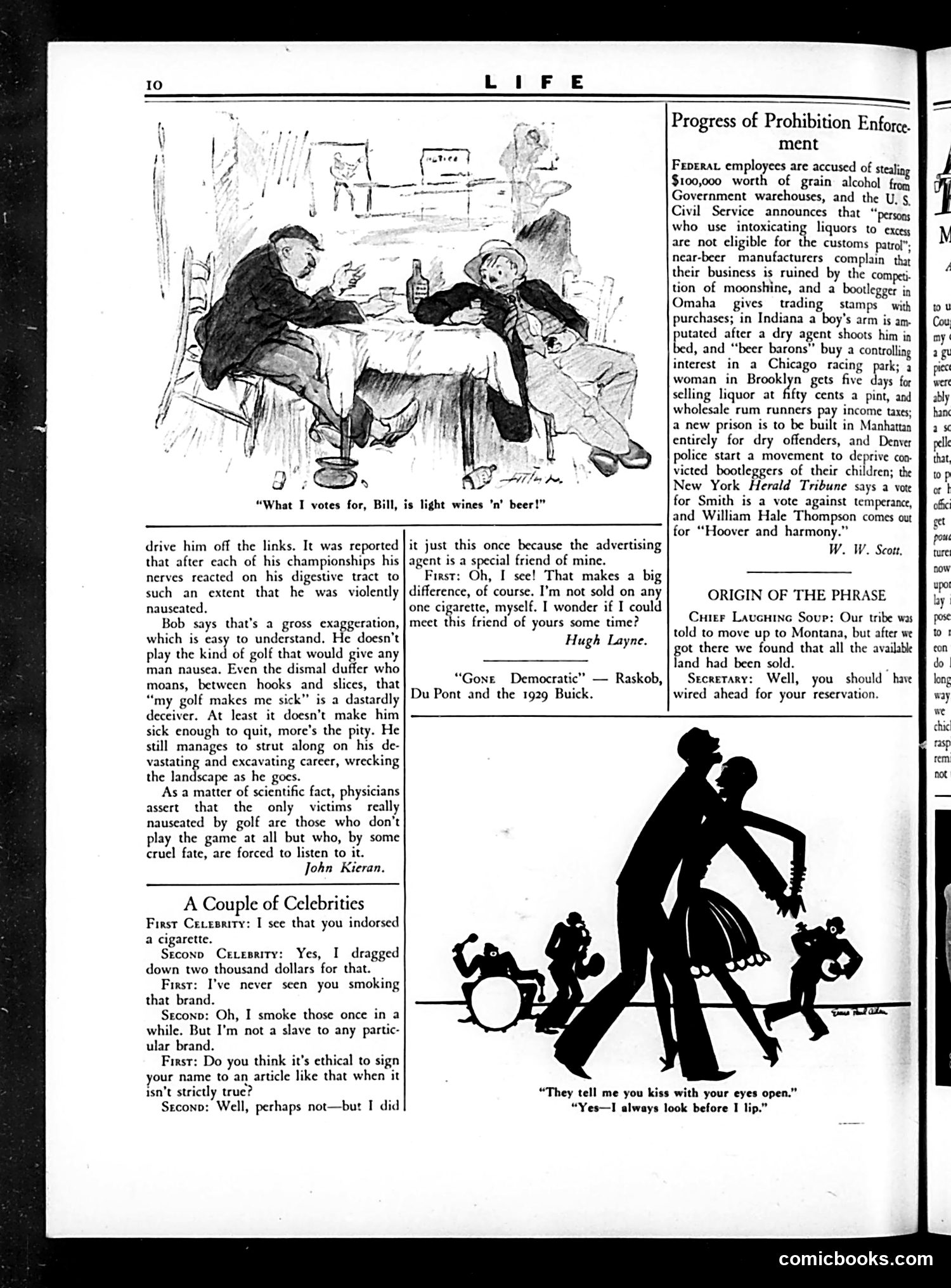
The top cartoon depicts three sick men in bed with bottles nearby, captioned "What I votes for, Bill, is light wines 'n' beer!" This satirizes Prohibition enforcement under the Volstead Act. The men appear intoxicated despite—or because of—prohibition laws, mocking the policy's failure to eliminate drinking. The sidebar "Progress of Prohibition Enforcement" documents real violations: federal employees stealing grain alcohol, bootleggers operating openly, and police corruption. It presents actual scandal headlines alongside the cartoon's dark humor. The lower silhouette cartoon about kissing with eyes open serves as unrelated entertainment content. Together, the page critiques Prohibition as ineffective policy that created criminals, destroyed legitimate businesses, and failed to stop alcohol consumption—a common satirical position in 1920s America.
📄 Transcribed text from this page (OCR, searchable)
Machine-transcribed from the original scan — historical spelling and the odd misread are preserved.
2 “What I votes for, Bill, is light wines 'n’ beer!” drive him off the links. It was reported that after cach of his championships his nerves reacted on his digestive tract to such an extent that he was violently nauseated, Bob says that’s a gross exaggeration, which is easy to understand. He doesn’t play the kind of golf that would give any man nausea. Even the dismal duffer who moans, between hooks and slices, that “my golf makes me sick” is a dastardly deceiver. At least it doesn't make him sick enough to quit, more’s the pity. He still manages to strut along on his de- vastating and excavating career, wrecking the landscape as he goes. As a matter of scientific fact, physicians assert. that the only victims really nauseated by golf are those who don’t play the game at all but who, by some cruel fate, are forced to listen to it. John Kieran. A Couple of Celebrities First Cevesrity: I see that you indorsed a cigarette. Seconp Cevesrity: Yes, I dragged down two thousand dollars for that. First: I've never seen you smoking that brand. Seconp: Oh, I smoke those once in a while. But I’m not a slave to any partic- ular brand. First: Do you think it’s ethical to sign your name to an article like that when it isn’t strictly true? Seconp: Well, perhaps not—but I did it just this once because the advertising agent is a special friend of mine. First: Oh, I see! That makes a big difference, of course. I’m not sold on any one cigarette, myself. I wonder if I could meet this friend of yours some time? Hugh Layne. “Gone Democratic’ — Raskob, Du Pont and the 1929 Buick. Progress of Prohibition En ment Feprrat. employees are accused of stealin, $100,000 worth of grain alcohol from Government warehouses, and the U, § Civil Service announces that “persons who use intoxicating liquors to exces are not cligible for the customs patrol”; near-beer manufacturers complain that their business is ruined by the competi- tion of moonshine, and a bootlegger in Omaha gives trading stamps — with purchases; in Indiana a boy's arm is am. putated after a dry agent shoots him in d, and “beer barons” buy a controlling interest in a Chicago racing park; a woman in Brooklyn gets five days for selling liquor at fifty cents a pint, and wholesale rum runners pay income taxes; a new prison is to be built in Manhattan entirely for dry offenders, and Denver police start a movement to deprive coa- victed bootleggers of their children; the New York Herald Tribune says a vor for Smith is a vote against temperance, and William Hale Thompson comes out for “Hoover and harmony.” W. W. Scott, ORIGIN OF THE PHRASE Cuter Laucuine Soup: Our tribe was told to move up to Montana, but after we pot there we found that all the availabk land had been sold. Secretary: Well, you should have wired ahead for your reservation. “They tell me you kiss with your eyes open.” “Yes—I always look before I lip.” comicbooks.com