
Life, 1928-09-06 · page 21 of 44
Life — September 6, 1928 — page 21: what you’re looking at
What you’re looking at
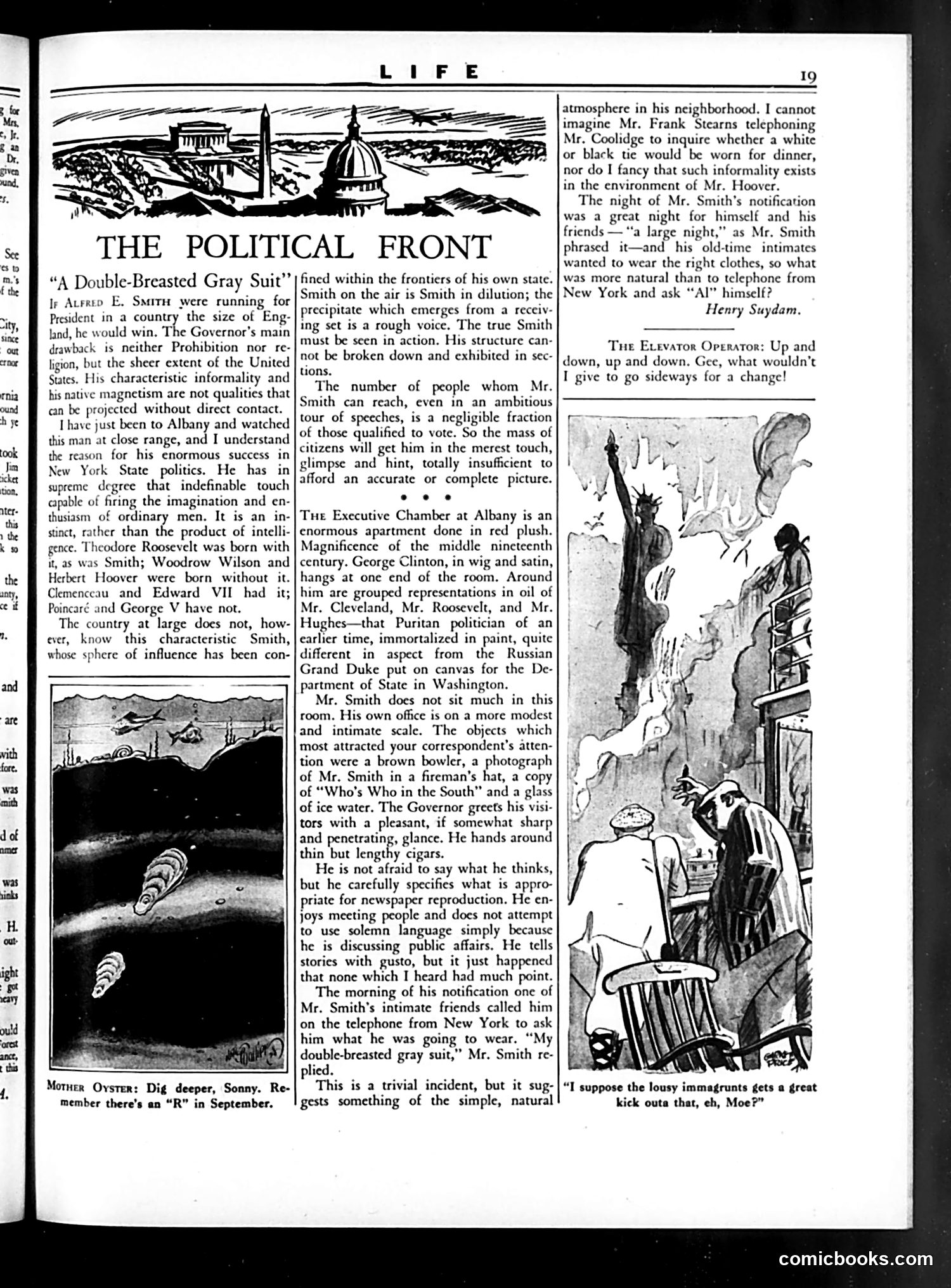
This article profiles **Al Smith**, Democratic presidential candidate, contrasting his personal charisma with his inability to project that appeal nationally. Smith was governor of New York; the piece argues his "indefinable touch" and informality—comparable to Theodore Roosevelt's—cannot translate across the vast United States via radio or campaign tours. The humor centers on Smith's unpretentious nature: when asked what suit to wear to his nomination notification, he simply answered "my double-breasted gray suit," illustrating his lack of political affectation. The author contrasts this with **Calvin Coolidge** and **Herbert Hoover**, suggesting their formality would prevent such casual exchanges. The cartoons are unrelated: "Mother Oyster" is a nonsense joke about the letter R in "September"; "The Elevator Operator" depicts working-class dialect humor. The article's point: Smith's greatest political strength—authentic, direct communication—is paradoxically useless in a large nation where voters never meet him personally.
📄 Transcribed text from this page (OCR, searchable)
Machine-transcribed from the original scan — historical spelling and the odd misread are preserved.
Ba Se 8 ‘a g RG Sas 8x ES & ial: I9 THE POLITICAL FRONT “A Double-Breasted Gray Suit” Ir Avrreo E, SairH were running for President in a country the size of Eng- land, he would win. The Governor’s main drawback is neither Prohibition nor re- ligion, but the sheer extent of the United States. His characteristic informality and his native magnetism are not qualities that can be projected without direct contact. Ihave just been to Albany and watched this man at close range, and I understand the reason for his enormous success in New York State politics. He has in supreme degree that indefinable touch capable of firing the imagination and en- thusiasm of ordinary men. It is an in- stinct, rather than the product of intelli- gence. Theodore Roosevelt was born with it, as was Smith; Woodrow Wilson and Herbert Hoover were born without it. Clemenceau and Edward VII had it; Poincaré and George V have not. The country at large does not, how- ever, know this characteristic Smith, whose sphere of influence has been con- Mother Oyster: Dig deeper, Sonny. Re- member there's an “R” in September. fined within the frontiers of his own state. Smith on the air is Smith in dilution; the precipitate which emerges from a receiv- ing set is a rough voice, The true Smith must be seen in action. His structure can- not be broken down and exhibited in sec- tions. The number of people whom Mr. Smith can reach, even in an ambitious tour of speeches, is a negligible fraction of those qualified to vote. So the mass of citizens will get him in the merest touch, glimpse and hint, totally insufficient to afford an accurate or complete picture. oe e Tue Executive Chamber at Albany is an enormous apartment done in red plush. Magnificence of the middle nineteenth century. George Clinton, in wig and satin, hangs at one end of the room. Around him are grouped representations in oil of Mr. Cleveland, Mr. Roosevelt, and Mr. Hughes—that Puritan politician of an earlier time, immortalized in paint, quite different in aspect from the Russian Grand Duke put on canvas for the De- partment of State in Washington. Mr. Smith does not sit much in this room. His own office is on a more modest and intimate scale. The objects which most attracted your correspondent’s atten- tion were a brown bowler, a photograph of Mr. Smith in a fireman’s hat, a copy of “Who's Who in the South” and a glass of ice water. The Governor greets his visi- tors with a pleasant, if somewhat sharp and penetrating, glance. He hands around thin but lengthy cigars. He is not afraid to say what he thinks, but he carefully specifies what is appro- priate for newspaper reproduction. He en- joys meeting people and does not attempt to use solemn language simply because he is discussing public affairs. He tells stories with gusto, but it just happened that none which I heard had much point. The morning of his notification one of Mr. Smith's intimate friends called him on the telephone from New York to ask him what he was going to wear. “My double-breasted gray suit,” Mr. Smith re- lied. ‘ This is a trivial incident, but it sug- gests something of the simple, natural atmosphere in his neighborhood. I cannot imagine Mr. Frank Stearns telephoning Mr. Coolidge to inquire whether a white or black tie would be worn for dinner, nor do I fancy that such informality exists in the environment of Mr. Hoover. The night of Mr. Smith's notification was a great night for himself and his friends — “‘a large night,” as Mr. Smith phrased it—and his old-time intimates wanted to wear the right clothes, so what was more natural than to telephone from New York and ask “Al” himself? Henry Suydam, Tue Evevator Operator: Up and down, up and down. Gee, what wouldn't I give to go sideways for a change! “I suppose the lousy immagrunts gets a great kick outa that, eh, Moe?” comicbooks.com