
Life, 1928-09-06 · page 14 of 44
Life — September 6, 1928 — page 14: what you’re looking at
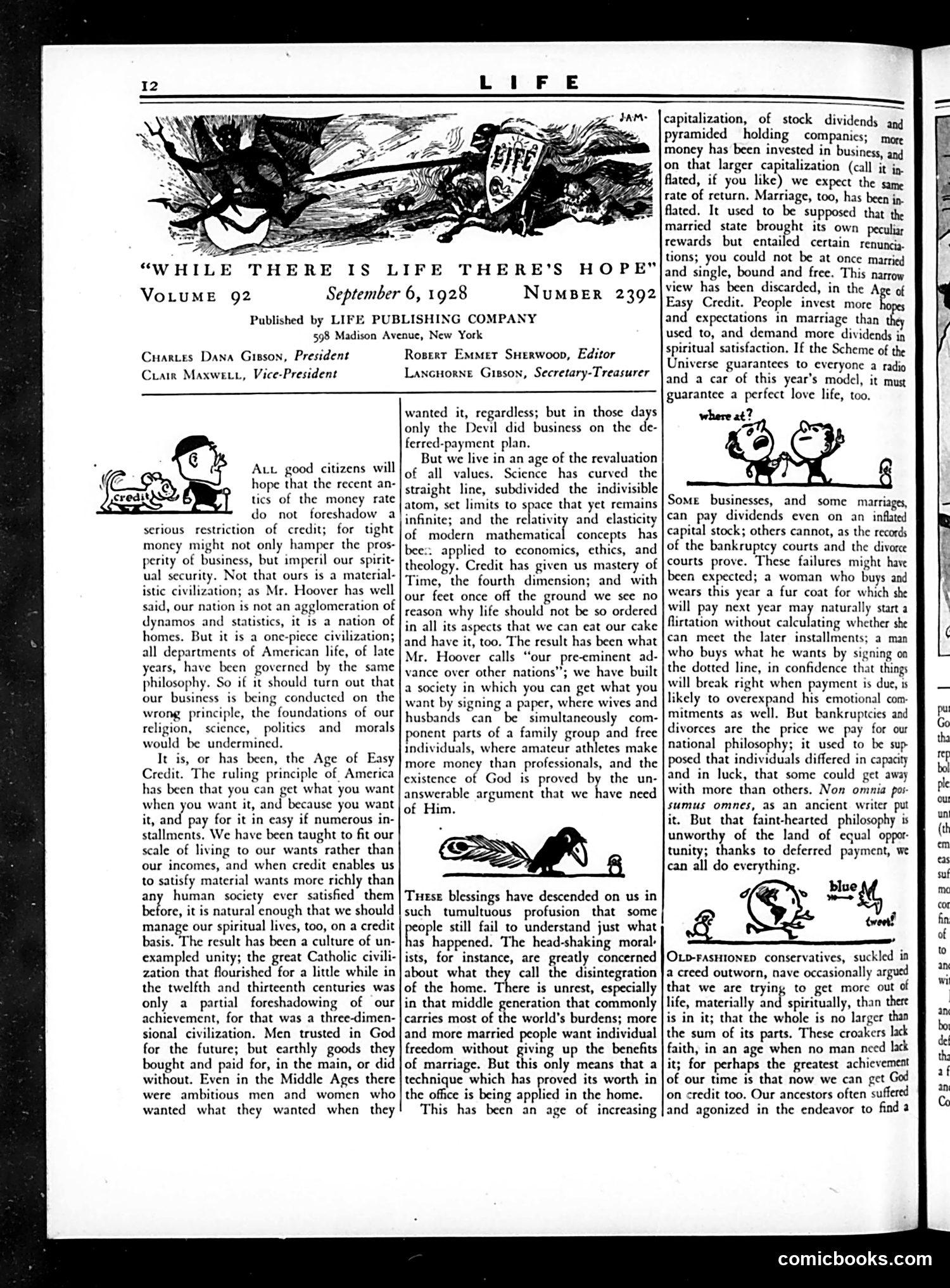
What you’re looking at
This editorial page critiques the "Age of Easy Credit"—the 1920s consumer lending boom. The masthead shows Life's leadership under Charles Dana Gibson and Robert Sherwood. The main cartoon (top left) depicts a figure labeled "Credit" as a devil-like character, satirizing how Americans have adopted easy-payment schemes to live beyond their means. The accompanying text warns that while credit has democratized consumption, allowing ordinary people to buy homes and goods previously unattainable, it has fundamentally altered social values and personal responsibility. The editorial argues this shift—from saving for purchases to buying on installment—has corrupted American character and spirituality, enabling overconsumption while undermining the virtues of thrift and delayed gratification that supposedly built earlier American civilization.
📄 Transcribed text from this page (OCR, searchable)
Machine-transcribed from the original scan — historical spelling and the odd misread are preserved.
s x “WHILE THERE IS LIFE THERE'S HOPE" VOLUME 92 September 6, 1928 NuMBER 2392 Published by LIFE PUBLISHING COMPANY 598 Madison Avenue, New York Cuartes Dana Ginson, President Crain Maxwett, Vice-President Aut good citizens will hope that the recent an- tics of the money rate do not foreshadow a serious restriction of credit; for tight money might not only hamper the pros- perity of business, but imperil our spirit- ual security. Not that ours is a material- istic civilization; as Mr. Hoover has well said, our nation is not an agglomeration of dynamos and statistics, it 1s a nation of homes. But it is a one-piece civilization; all departments of American life, of late years, have been governed by the same philosophy. So if it should turn out that our business is being conducted on the wrong principle, the foundations of our religion, science, politics and morals would be undermined. It is, or has been, the Age of Easy Credit. The ruling principle of, America has been that you can get what you want when you want it, and because you want it, and pay for it in easy if numerous in- stallments. We have been taught to fit our scale of living to our wants rather than our incomes, and when credit enables us to satisfy material wants more richly than any human society ever satisfied them before, it is natural enough that we should manage our spiritual lives, too, on a credit basis. The result has been a culture of un- exampled unity; the great Catholic civili- zation that flourished for a little while in the twelfth and thirteenth centuries was only a partial foreshadowing of our achievement, for that was a three-dimen- sional civilization. Men trusted in God for the future; but earthly goods they bought and paid for, in the main, or did without. Even in the Middle Ages there were ambitious men and women who wanted what they wanted when they Rosert Emmet Suerwoop, Editor LancHorne Gisson, Secretary-Treasurer wanted it, regardless; but in those days only the Devil did business on the de- ferred-payment plan. But we live in an age of the revaluation of all values. Science has curved the straight line, subdivided the indivisible atom, set limits to space that yet remains infinite; and the velativit and elasticity of modern mathematical concepts has bees: applied to economics, ethics, and theology. Credit has given us mastery of Time, the fourth dimension; and with our feet once off the ground we see no reason why life should not be so ordered in all its aspects that we can eat our cake and have it, too. The result has been what Mr. Hoover calls “our pre-eminent ad- vance over other nations’; we have built a society in which you can get what you want by signing a paper, where wives and husbands can be simultaneously com- ponent parts of a family group and free individuals, where amateur athletes make more money than professionals, and the | PO existence of God is proved by the un- answerable argument that we have need Tues blessings have descended on us in such tumultuous profusion that some people still fail to understand just what as happened. The head-shaking moral: ists, for instance, are greatly concerned about what they call the disintegration of the home. There is unrest, especially in that middle generation that commonly carries most of the world’s burdens; more and more married people want individual freedom without giving up the benefits of marriage. But this only means that a technique which has proved its worth in the office is being applied in the home. This has been an age of increasing capitalization, of stock dividends ang pyramided holding companies; more money has been invested in business, and on that larger capitalization (call jt in- flated, if you like) we expect the same rate of return. Marriage, too, has been in. flated. It used to be supposed that the married state brought its own peculiar rewards but entailed certain renuncia- tions; you could not be at once married and single, bound and free. This narrow view has been discarded, in the Age of Easy Credit. People invest more eS and expectations in marriage than used to, and demand more dividends in spiritual satisfaction. If the Scheme of the Universe guarantees to everyone a radio and a car of this year’s model, it mus guarantee a perfect love life, too. where at? 0 -) Some businesses, and some marriages, can pay dividends even on an inflated capital stock; others cannot, as the records of the bankruptcy courts and the divorce courts prove. These failures might have been expected; a woman who buys and wears this year a fur coat for which she will pay next year may naturally start a flirtation without caleulaciog whether she can meet the later installments; a man who buys what he wants by signing oo the dotted line, in confidence that things will break right when payment is due, is likely to overexpand his emotional com- mitments as well. But bankruptcies and divorces are the price we pay for our national philosophy; it used to be sup sed that individuals differed in capacity and in luck, that some could get away with more than others. Non omnia pos- sumus omnes, as an ancient writer put it. But that faint-hearted philosophy is unworthy of the land of equal oppor- tunity; thanks to deferred payment, we can all do everything. Otp-rastitonep conservatives, suckled in a creed outworn, nave occasionally argued that we are trying to get morc out of life, materially and spiritually, than there is in it; that the whole is no larger than the sum of its parts. These croakers lack faith, in an age when no man need lack it; for perhaps the greatest achievement of our time is that now we can get on credit too. Our ancestors often suff and agonized in the endeavor to find a comicbooks.com