
Life, 1928-09-06 · page 25 of 44
Life — September 6, 1928 — page 25: what you’re looking at
What you’re looking at
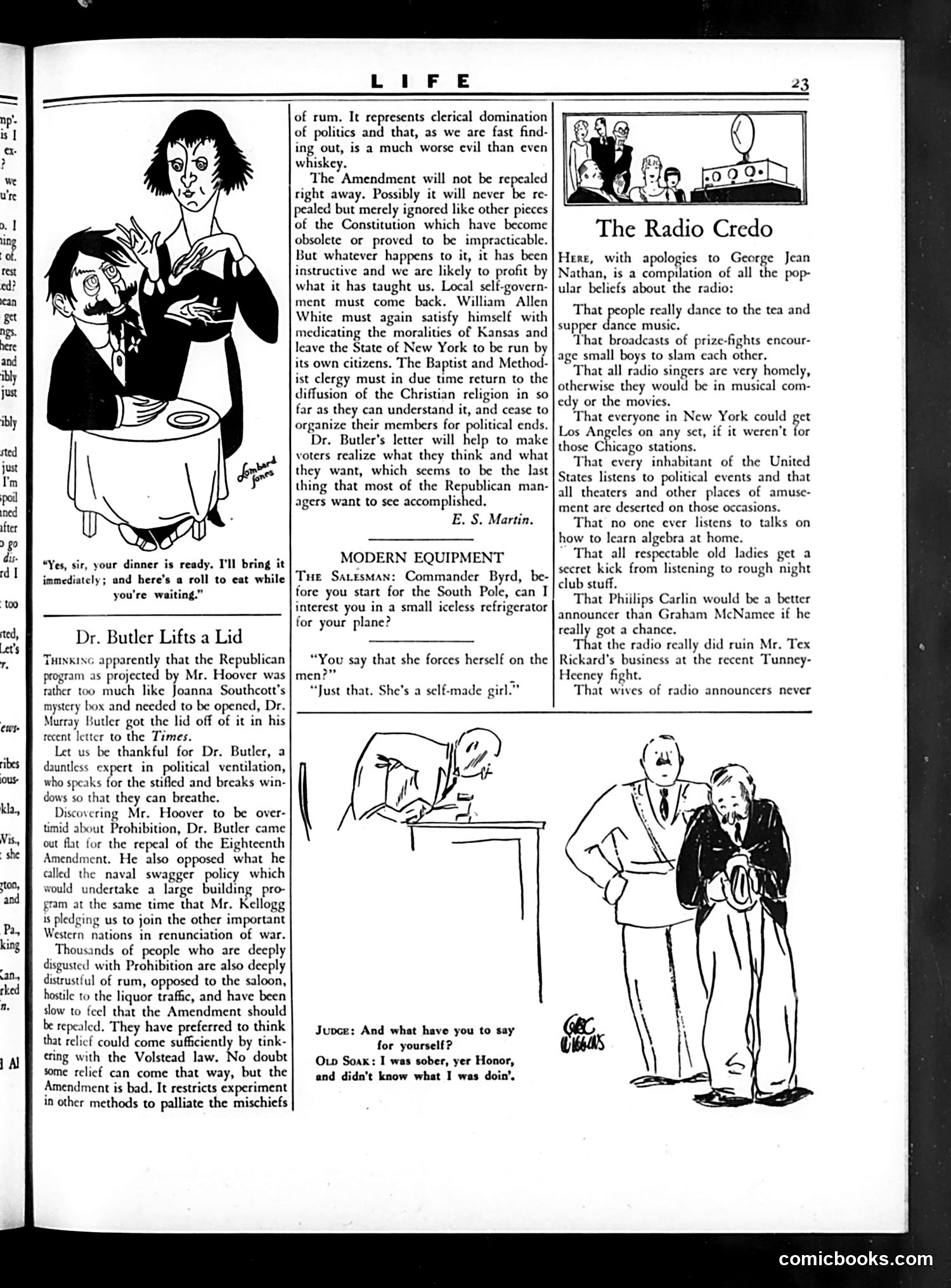
This page contains political and social satire from the Prohibition era (appears to be late 1920s). **"Dr. Butler Lifts a Lid"**: Satirizes Dr. Murray Butler's public letter challenging President Hoover's cautious Republican platform, particularly on Prohibition repeal. The "lid" metaphor suggests Butler is opening up secretive party strategy. The cartoon shows a servant presenting dinner while the master waits—a visual pun on "lifting the lid" on hidden truths. **"Modern Equipment"**: A one-liner mocking a salesman's absurd pitch to Commander Byrd (the famous polar explorer) about selling an "iceless refrigerator" for a South Pole expedition. **"The Radio Credo"**: A humorous compilation of popular beliefs and misconceptions about radio broadcasting—that radio drives juvenile delinquency, that all singers are unattractive, that everyone listens to political broadcasts, and that respectable ladies secretly enjoy rough nightclub content. The page satirizes contemporary American attitudes toward technology, politics, and social pretension during the early radio era.
📄 Transcribed text from this page (OCR, searchable)
Machine-transcribed from the original scan — historical spelling and the odd misread are preserved.
king LIFE “Yes, sir, your dinner is ready. I'll bring it immediately; and here's a roll to eat while you're waiting.” Dr. Butler Lifts a Lid THINKING apparently that the Republican program as projected by Mr. Hoover was rather too much like Joanna Southcott'’s mystery box and needed to be opened, Dr. Murray Butler got the lid off of it in his recent letter to the Times. Let us be thankful for Dr. Butler, a dauntless expert in political ventilation, who speaks for the stifled and breaks win- dows so that they can breathe. Discovering Mr. Hoover to be over- timid about Prohibition, Dr. Butler came out flat for the repeal of the Eighteenth Amendment. He also opposed what he called the naval swagger policy which would undertake a large building pro- gram at the same time that Mr. Kellogg 1s pledging us to join the other important Western nations in renunciation of war. Thousands of people who are deeply disgusted with Prohibition are also deeply distrustful of rum, opposed to the saloon, hostile to the liquor traffic, and have been slow to feel that the Amendment should be repealed. They have preferred to think that relicf could come sufficiently by tink- ering with the Volstead law. No doubt some relief can come that way, but the Amendment is bad. It restricts experiment in other methods to palliate the mischiefs of rum. It represents clerical domination of politics and that, as we are fast find- ing out, is a much worse evil than even whiskey. The Amendment will not be repealed right away. Possibly it will never be re- pealed but merely ignored like other pieces of the Constitution which have become obsolete or proved to be impracticable. But whatever happens to it, it has been instructive and we are likely to profit by what it has taught us. Local self-govern- ment must come back. William Allen White must again satisfy himself with medicating the moralities of Kansas and leave the State of New York to be run by its own citizens. The Baptist and Method- ist clergy must in due ume return to the diffusion of the Christian religion in so far as they can understand it, and cease to organize their members for political ends. Dr. Butler's letter will help to make voters realize what they think and what they want, which seems to be the last thing that most of the Republican man- agers want to see accomplished. E, S. Martin. MODERN EQUIPMENT Tue Saresman: Commander Byrd, be- fore you start for the South Pole, can I interest you in a small iceless refrigerator for your plane? “You say that she forces herself on the men?” . “Just that. She's a self-made girl.” Jupvce: And what have you to say for yourself? Ovp Soak: I was sober, yer Honor, and didn't know what I was doin’. The Radio Credo Here, with apologies to George Jean Nathan, is a compilation of all the pop- ular beliefs about the radio: That people really dance to the tea and supper dance music. That broadcasts of prize-fights encour- age small boys to slam each other. That all radio singers are very homely, otherwise they would be in musical com- edy or the movies. That everyone in New York could get Los Angeles on any set, if it weren't for those Chicago stations. That every inhabitant of the United States listens to political events and that all theaters and other places of amuse- ment are deserted on those occasions. That no one ever listens to talks on how to learn algebra at home. That all respectable old ladies get a secret kick from listening to rough night club stuff. That Phiilips Carlin would be a better announcer than Graham McNamee if he really got a chance. That the radio really did ruin Mr. Tex Rickard’s business at the recent Tunney- Heeney fight. That wives of radio announcers never comicbooks.com