
Life, 1928-09-06 · page 22 of 44
Life — September 6, 1928 — page 22: what you’re looking at
What you’re looking at
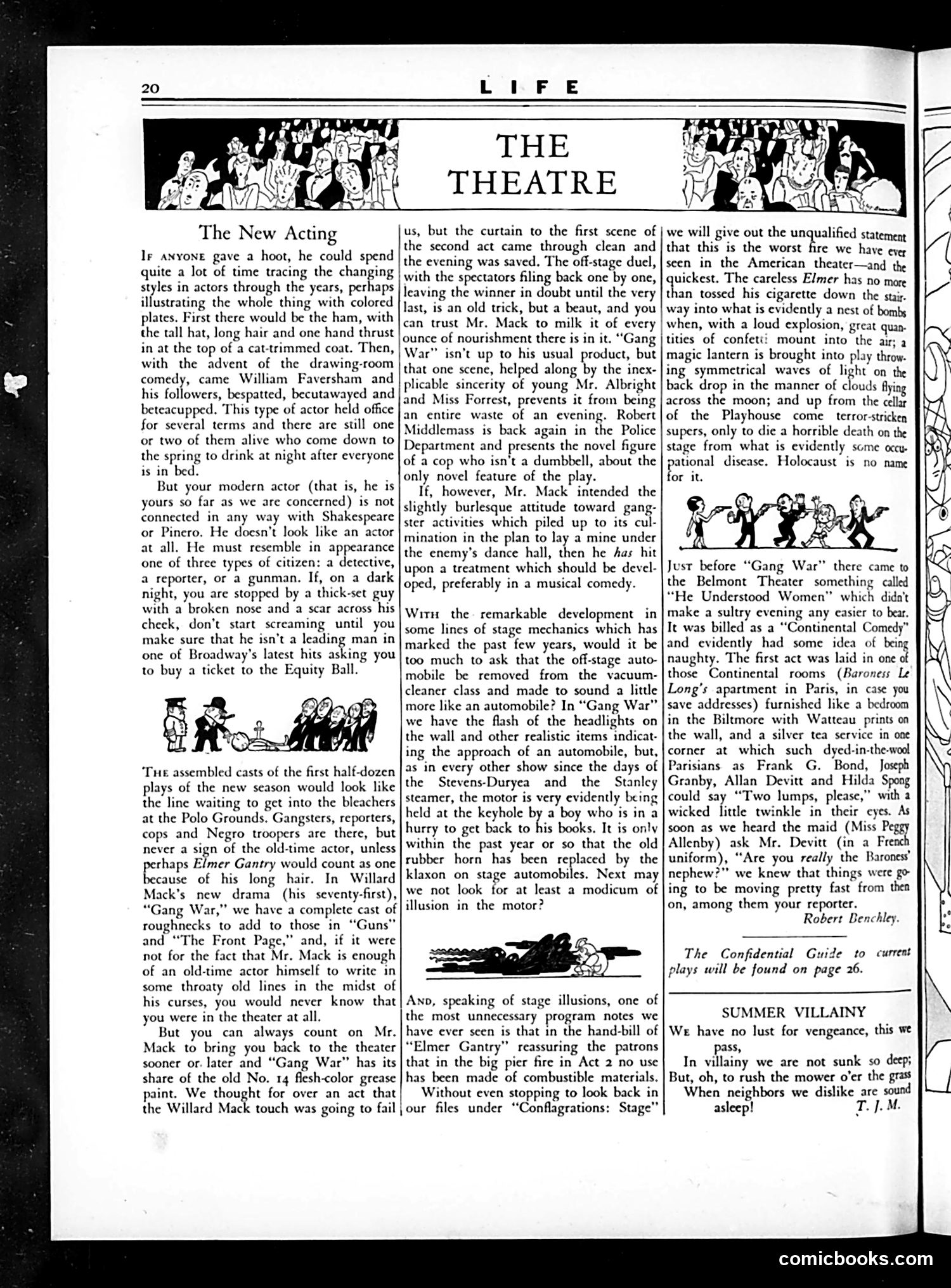
This page from *Life* magazine reviews contemporary Broadway plays, particularly critiquing the shift in modern acting styles. The critic observes that 1920s actors no longer resemble traditional theatrical "hams" in formal dress, but instead portray ordinary working-class types: detectives, reporters, and gangsters. The main subject is Willard Mack's play "Gang War," which the reviewer finds mediocre but salvaged by one effective off-stage duel scene—a traditional theatrical trick Mack executes skillfully. The reviewer praises young actors Albright and Forrest for their sincerity. The small cartoons illustrate the contrast between old theatrical conventions and modern realistic staging. A notable complaint concerns sound effects: despite advances in stage mechanics, productions still unconvincingly simulate automobile engines using outdated methods (holding a motor at a keyhole). The piece reflects 1920s theatrical debates about authenticity versus artifice, and the influence of naturalistic American drama on performance style.
📄 Transcribed text from this page (OCR, searchable)
Machine-transcribed from the original scan — historical spelling and the odd misread are preserved.
THE THEATRE Ir aNyone gave a hoot, he could spend quite a lot of time tracing the changing styles in actors through the years, perhaps illustrating the whole thing with colored plates. First there would be the ham, with the tall hat, long hair and one hand thrust in at the top of a cat-trimmed coat. Then, with the advent of the drawing-room comedy, came William Faversham and his followers, bespatted, becutawayed and beteacupped. This type of actor held office for several terms and there are still one or two of them alive who come down to the spring to drink at night after everyone is in bed. But your modern actor (that is, he is yours so far as we are concerned) is not connected in any way with Shakespeare or Pinero. He doesn’t look like an actor at all. He must resemble in appearance one of three types of citizen: a detective, a reporter, or a gunman. If, on a dark night, you are stopped by a thick-set guy with a broken nose and a scar across his check, don’t start screaming until you make sure that he isn’t a leading man in one of Broadway's latest hits asking you to buy a ticket to the Equity Ball. ‘Tue assembled casts of the first half-dozen plays of the new season would look like the line waiting to get into the bleachers at the Polo Grounds. Gangsters, reporters, cops and Negro troopers are there, but never a sign of the old-time actor, unless thaps Elmer Gantry would count as one Because of his long hair. In Willard Mack’s new drama (his seventy-first), “Gang War,” we have a complete cast of roughnecks to add to those in “Guns” and “The Front Page,” and, if it were not for the fact that Mr. Mack is enough of an old-time actor himself to write in some throaty old lines in the midst of his curses, you would never know that you were in the theater at all. But you can always count on Mr. Mack to bring you back to the theater sooner or. later and “Gang War" has its share of the old No. 14 flesh-color grease paint. We thought for over an act that us, but the curtain to the first scene of the second act came through clean and the evening was saved. The off-stage duel, with the spectators filing back one by one, leaving the winner in doubt until the very last, is an old trick, but a beaut, and you can trust Mr. Mack to milk it of every | ounce of nourishment there is in it. “Gang | War” isn’t up to his usual product, but that one scene, helped along by the inex- plicable sincerity of young Mr. Albright and Miss Forrest, prevents it from being an entire waste of an evening. Robert Middlemass is back again in the Police Department and presents the novel figure of a cop who isn’t a dumbbell, about the only novel feature of the play. If, however, Mr. Mack intended the slightly burlesque attitude toward gang- ster activities which piled up to its cul- mination in the plan to lay a mine under the enemy's dance hall, then he Aas hit upon a treatment which should be devel- oped, preferably in a musical comedy. Wit the. remarkable development in some lines of stage mechanics which has marked the past few years, would it be too much to ask that the off-stage auto- mobile be removed from the vacuum- cleaner class and made to sound a little more like an automobile? In “Gang War” we have the flash of the headlights on the wall and other realistic items indicat- ing the approach of an automobile, but, as in every other show since the days of the Stevens-Duryea and the Stanley steamer, the motor is very evidently being held at the keyhole by a boy who is in a hurry to get back to his books. It is only within the past year or so that the old rubber horn has been replaced by the klaxon on stage automobiles. Next may we not look for at least a modicum of illusion in the motor? a Ano, speaking of stage illusions, one of the most unnecessary program notes we have ever seen is that in the hand-bill of “Elmer Gantry” reassuring the patrons that in the big pier fire in Act 2 no use has been made of combustible materials. Without even stopping to look back in the Willard Mack touch was going to fail| our files under ‘“Conflagrations: Stage” we will give out the unqualified statement that this is the worst fire we have ever seen in the American theater—and the uickest, The careless Elmer has no more than tossed his cigarette down the stair. way into what is evidently a nest of bombs when, with a loud explosion, great quan- tities of confetti mount into the air; a magic lantern is brought into play throw. ing symmetrical waves of light on the back drop in the manner of clouds Alyin, across the moon; and up from the cellar of the Playhouse come terror-stricken supers, only to die a horrible death on the stage from what is evidently some occu. pational disease. Holocaust is no name Just before “Gang War" there came to the Belmont Theater something called “He Understood Women” which didn’t make a sultry evening any easier to bear. Tt was billed as a “Continental Comedy” and evidently had some idea of being naughty. The first act was laid in one of those Continental rooms (Baroness Le Long's apartment in Paris, in case you save addresses) furnished like a bedroom in the Biltmore with Watteau prints on the wall, and a silver tea service in one corner at which such dyed-in-the-wool Parisians as Frank G. Bond, Joseph Granby, Allan Devitt and Hilda Spong could say “Two lumps, please,” with a wicked little twinkle in their eyes. As soon as we heard the maid (Miss Pessy Allenby) ask Mr. Devitt (in a Frenc uniform), “Are you really the Baroness’ nephew?” we knew that things were go ing to be moving pretty fast from then on, among them your reporter. Robert Benchley. The Confidential Guide to current plays will be found on page 26. SUMMER VILLAINY We have no lust for vengeance, this we pass, In villainy we are not sunk so deep; But, oh, to rush the mower o'er the grass When neighbors we dislike are sound asleep! T. J. M. comicbooks.com