
A complete issue · 36 pages · 1928
Life — August 30, 1928
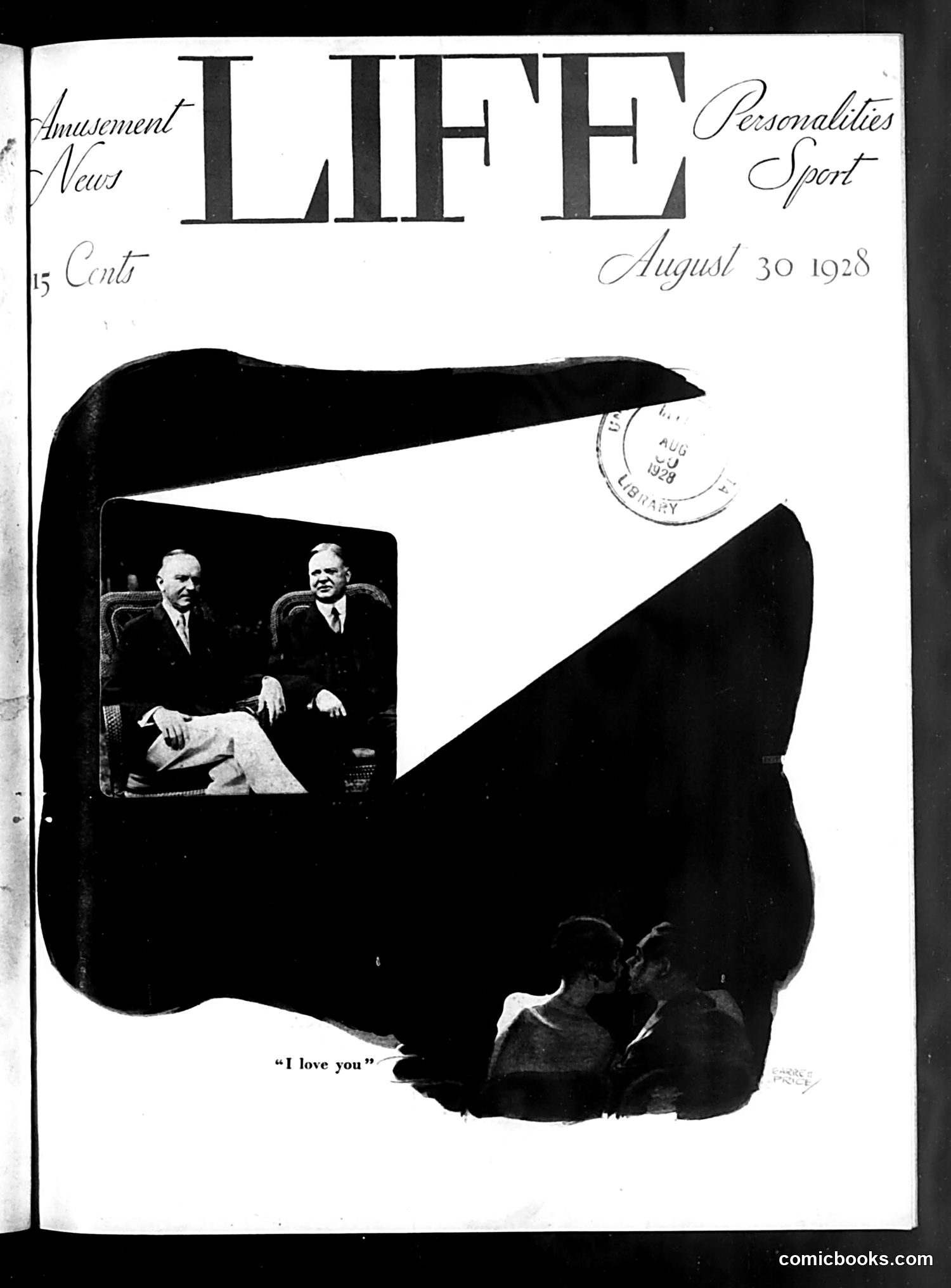
This satirical cover depicts a romantic or intimate scene framed within the silhouette of a cat's head—a visual pun on the phrase "I love you." The image shows two men in suits seated together indoors, appearing to share an affectionate moment. The cover likely references a contemporary scandal or gossip involving public figures, using the cat silhouette as a clever device to make a pointed joke about the subjects' relationship. Without identifying the specific individuals, the satire appears to mock or comment on either a romantic entanglement or some form of questionable behavior between prominent men of the era. The "Personalities" subtitle suggests these were recognizable public figures whose private lives were fair game for Life's satirical humor.
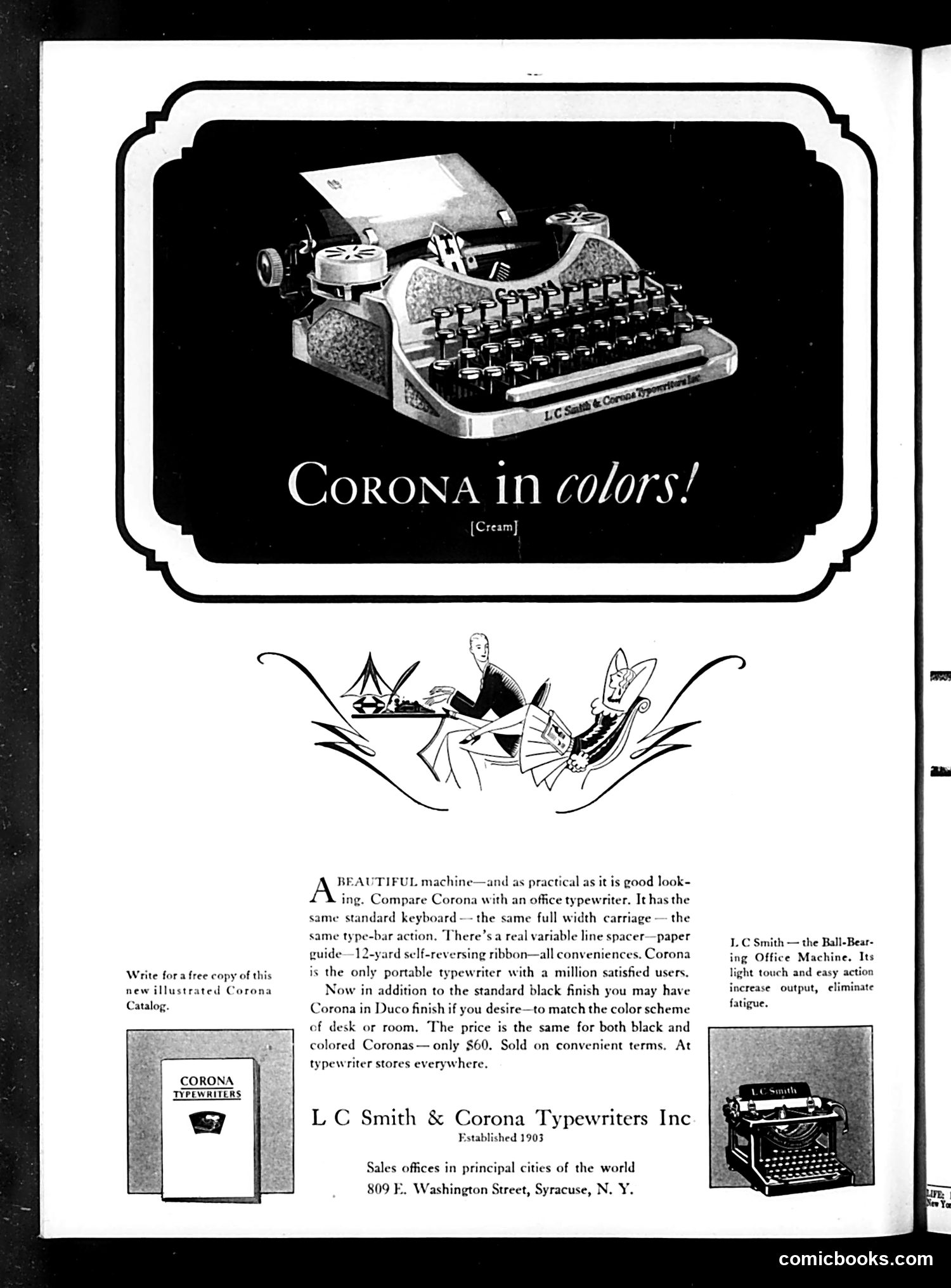
This page is primarily a **product advertisement**, not political satire. It promotes the Corona typewriter, manufactured by L.C. Smith & Corona Typewriters Inc (established 1901). The ad emphasizes Corona's practical features: standard keyboard, full-width carriage, and self-reversing ribbon. The key innovation highlighted is that Corona now offers a **"Duco finish"** option in cream color—matching contemporary desk décor—in addition to standard black, both priced at $60. The decorative illustration below the main product photo shows a man and woman in leisure activities (appears to be 1920s-era styling), suggesting the typewriter appeals to modern, stylish consumers. This reflects the era's marketing strategy: positioning typewriters as desirable consumer goods for progressive households, not merely office equipment.
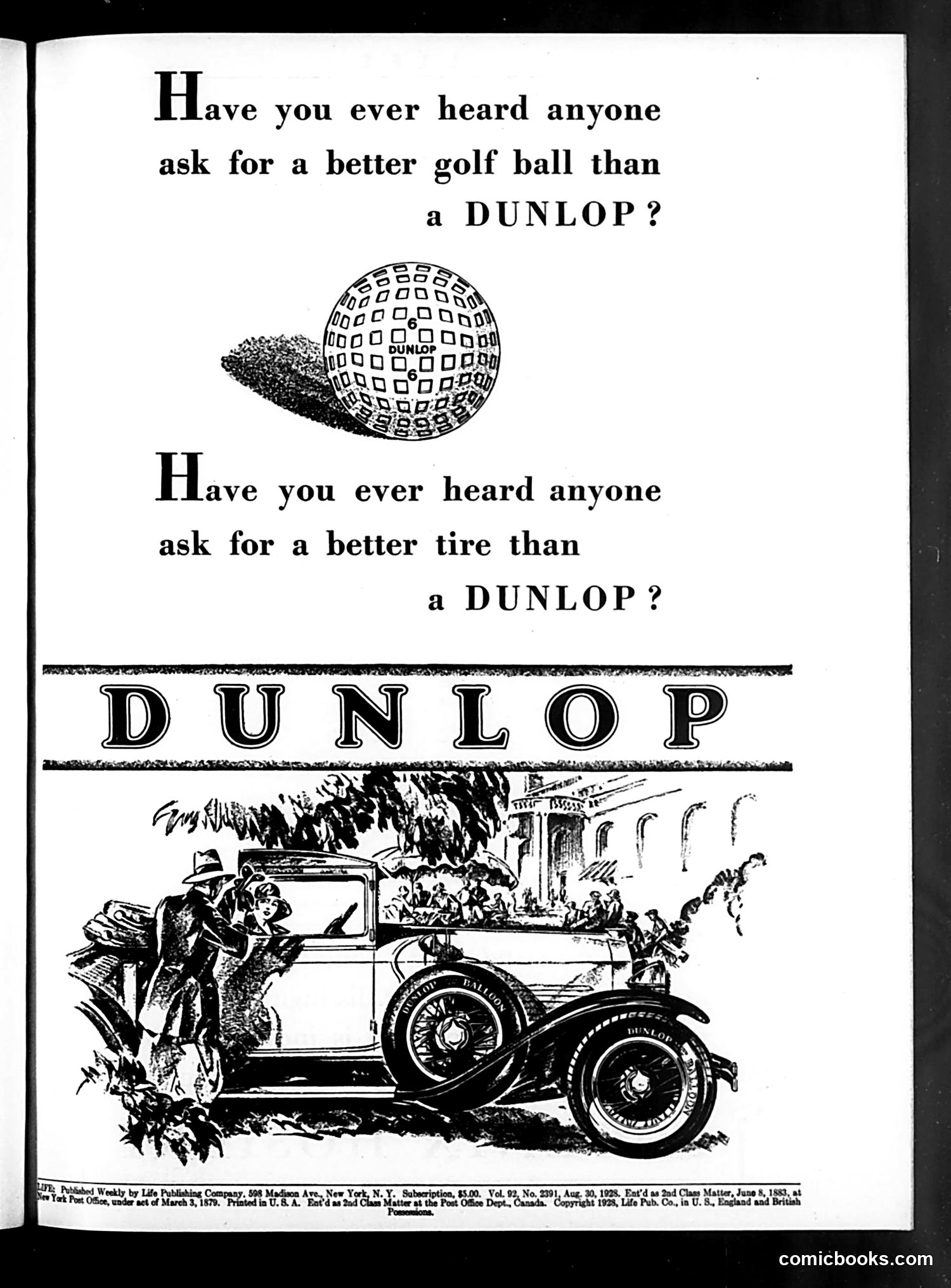
This is a **Dunlop tire and golf ball advertisement** from Life magazine (dated August 20, 1925, based on the footer). The ad uses a clever parallel structure: it asks rhetorically whether anyone has ever requested a better golf ball or tire than a Dunlop product. The implication is that Dunlop's quality is so universally recognized and trusted that customers wouldn't think to ask for alternatives. The accompanying illustration shows a vintage automobile from the 1920s, emphasizing that Dunlop tires are the standard choice for vehicles of the era. This is **not political satire** but rather commercial advertising designed to establish Dunlop as the premium, unquestioned brand choice for both sporting equipment and automotive tires during the prosperous 1920s.
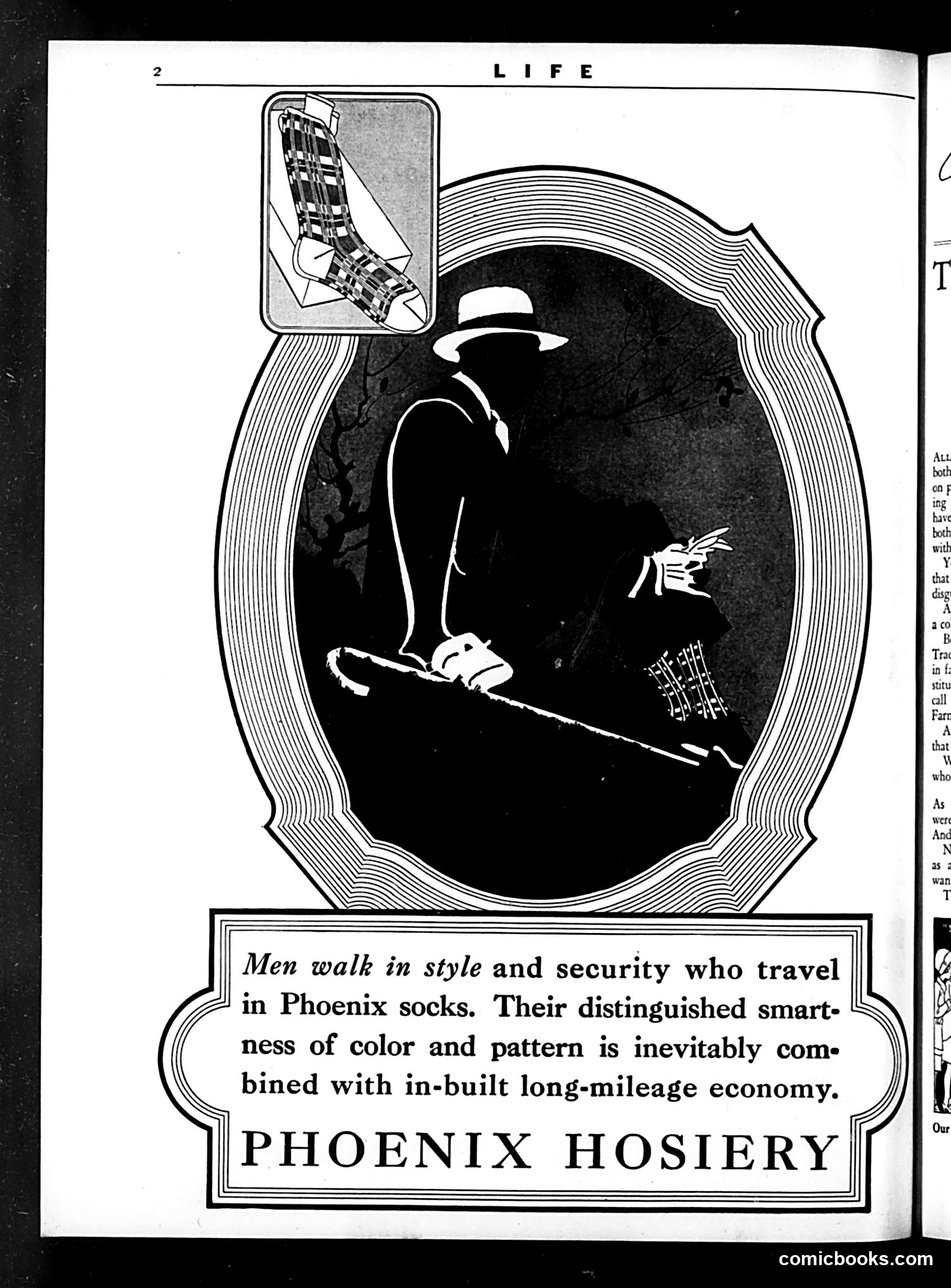
This page is primarily a **Phoenix Hosiery advertisement**, not political satire. The image shows a silhouetted man in a hat and suit examining socks, with an inset illustration of a detailed sock pattern in the upper left. The advertisement's text claims that men who wear Phoenix brand socks demonstrate both style and practicality—combining "distinguished smartness of color and pattern" with durability ("long-mileage economy"). There is **no political cartoon or satire present** on this page. It's a straightforward early-20th-century product advertisement using the silhouette illustration style popular in that era. The emphasis on the sock's pattern and the gentleman's refined appearance reflects period marketing that equated quality hosiery with respectability and good taste.
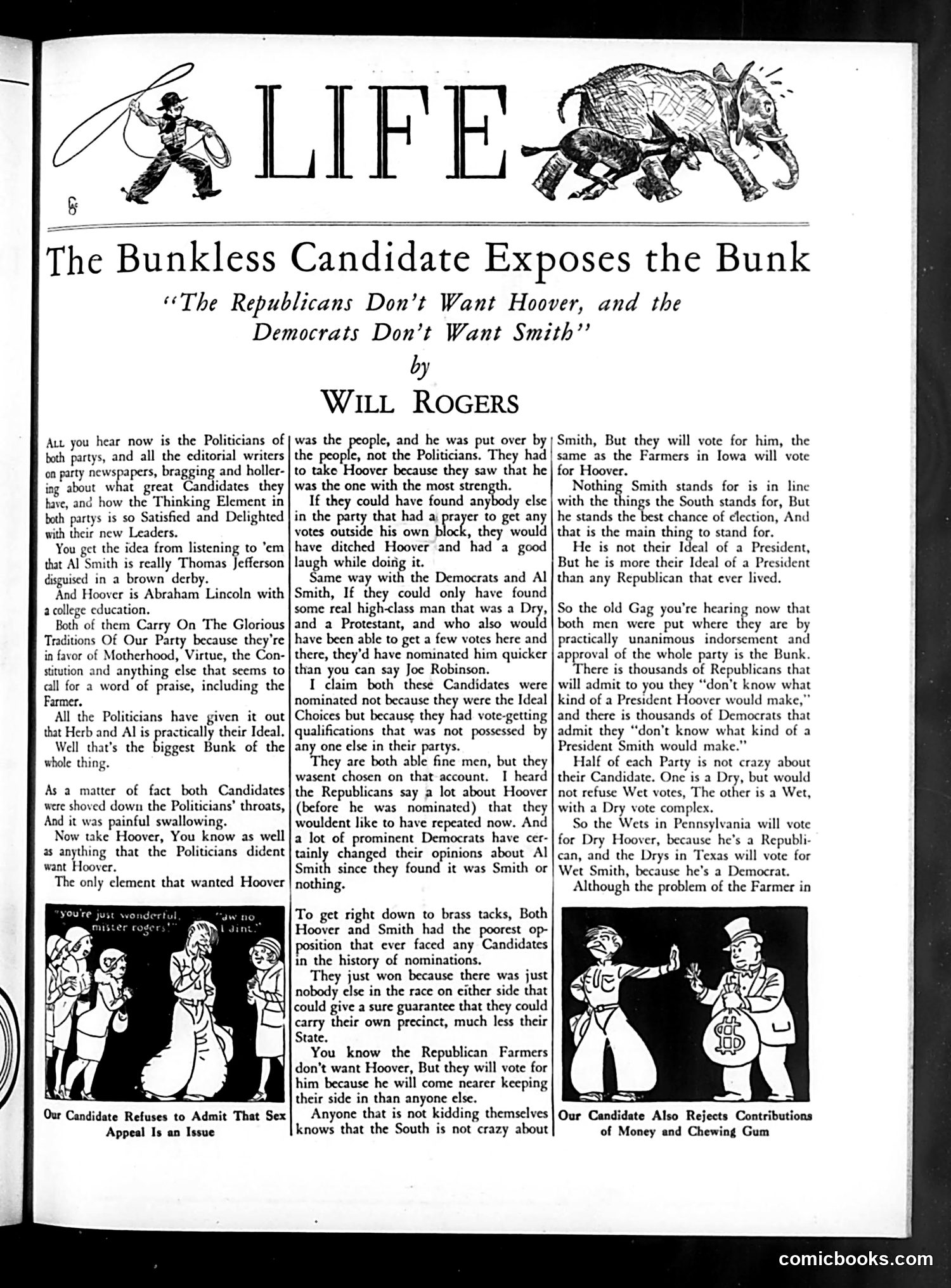
This satirical piece by Will Rogers critiques the 1928 presidential election, likely referencing Herbert Hoover (Republican) and Al Smith (Democrat). Rogers mocks both major parties for nominating candidates they secretly opposed—farmers don't want Hoover but will vote for him; Democrats dislike Smith but will support him anyway. The cartoon's central joke: both candidates are weak compromises chosen through party politics rather than merit. Rogers sarcastically notes that "half of each Party is not crazy about their Candidate" yet voters remain trapped in binary choices. The accompanying cartoons mock candidates who reject contributions ("sex appeal") and dismiss bribery concerns (money and chewing gum), exposing the hypocrisy between stated ideals and political reality.
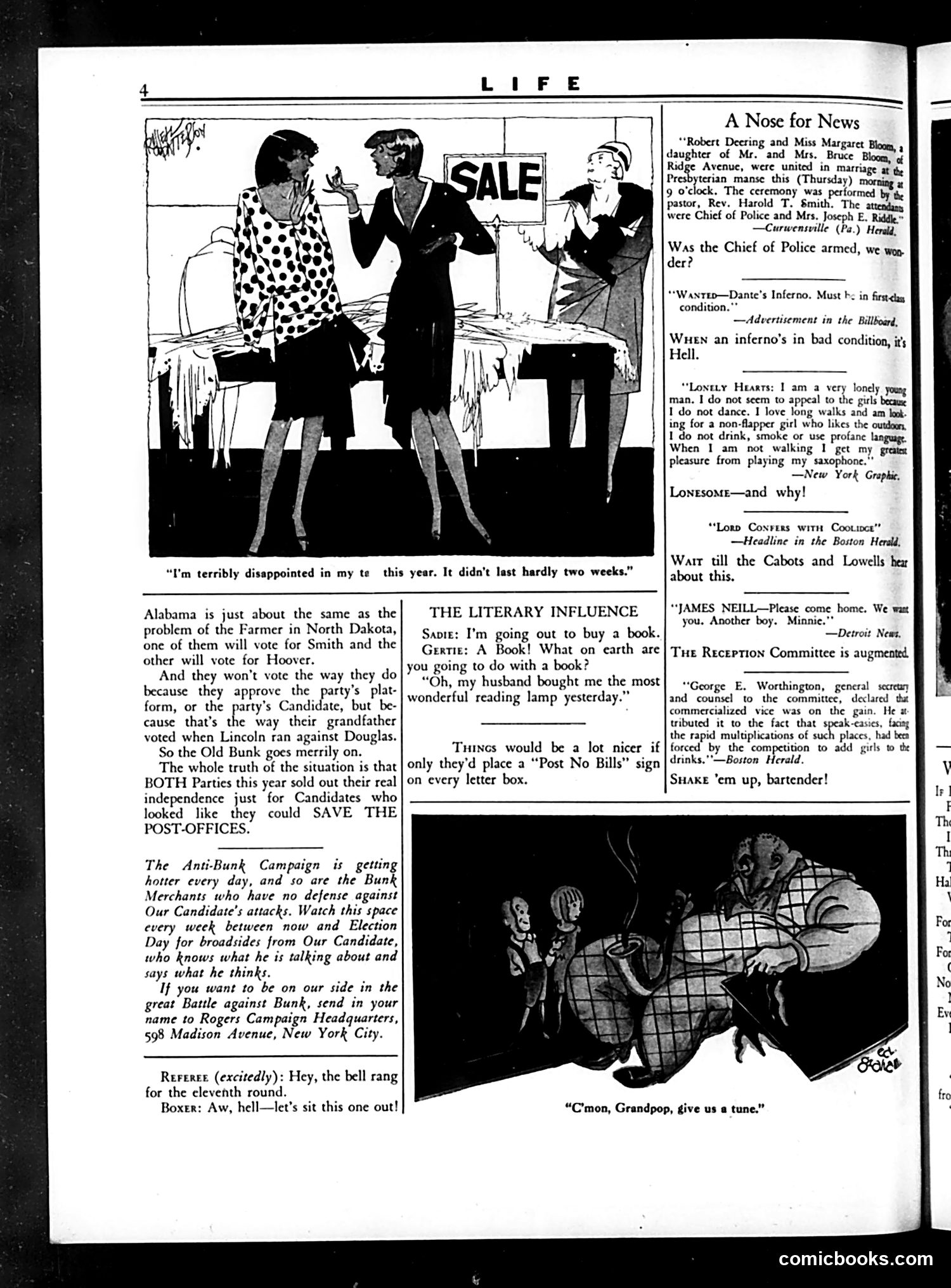
The top cartoon satirizes women's fashion disappointment. A woman complains her dress "didn't last hardly two weeks," while a salesman and another figure observe. This mocks the poor quality and brief lifespan of contemporary women's clothing—a consumer complaint about disposable fashion. Below, the text discusses the 1928 election, criticizing both major parties for abandoning their principles to appeal to voters. It argues they've sold out their "real independence" to support candidates merely to win post offices. The lower cartoon shows a boxer-referee scene with the caption "C'mon, Grandpop, give us a tune"—likely satirizing an elderly authority figure being pressured to participate in modern entertainment. The overall page critiques consumer culture, political corruption, and generational conflict in 1920s America.
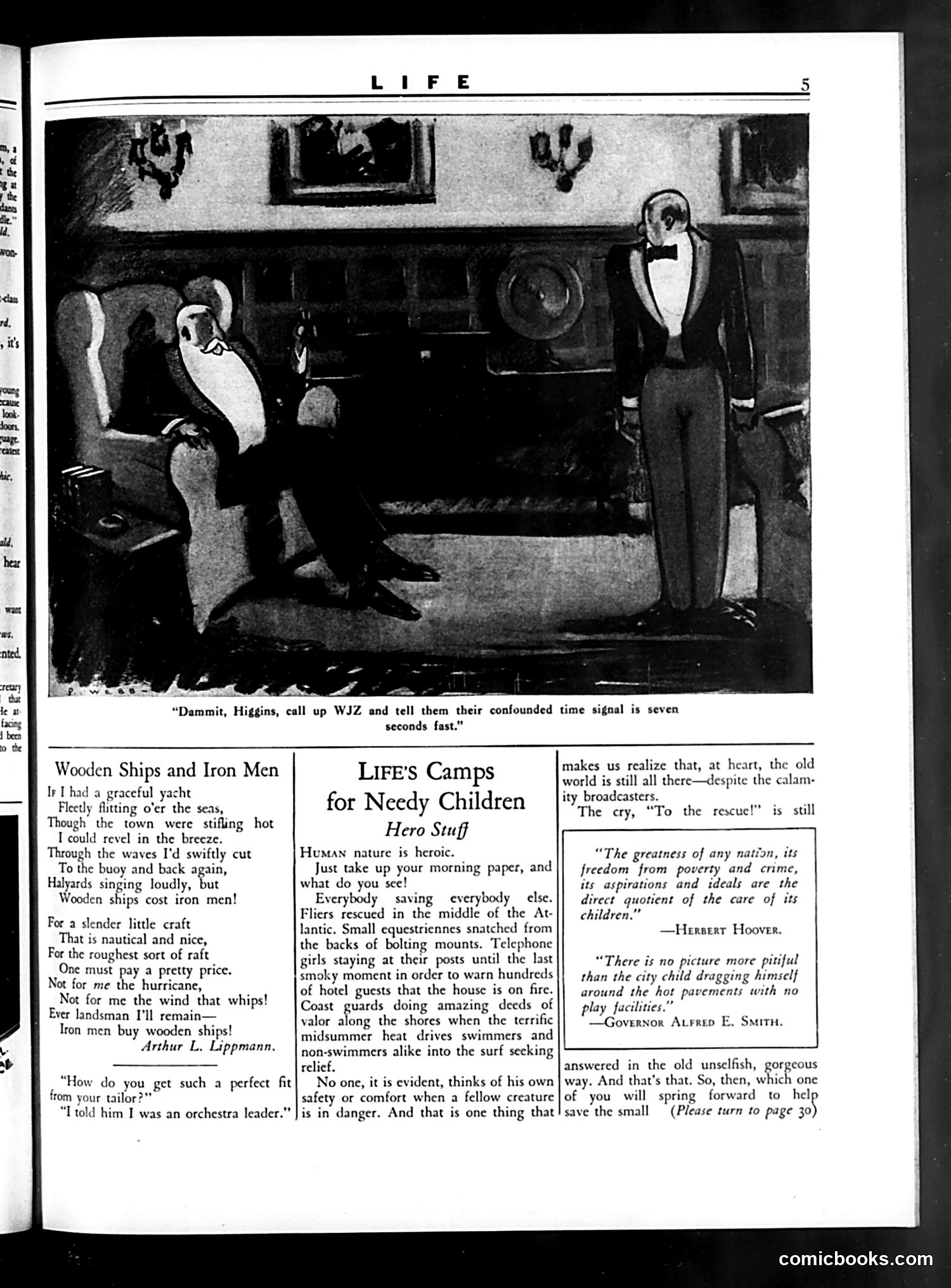
The cartoon at top shows two men in formal evening wear in what appears to be an elegant room. The caption reads: "Dammit, Higgins, call up WJZ and tell them their confounded time signal is seven seconds fast." This is satirizing the emerging radio technology of the 1920s—WJZ was a New York radio station known for broadcasting precise time signals. The joke targets how people were becoming absurdly dependent on radio for accurate timekeeping, to the point where even minor discrepancies (seven seconds) provoked frustration. It mocks the modern obsession with technological precision and synchronization, suggesting that listeners were losing trust in their own judgment and becoming slaves to mechanical accuracy.
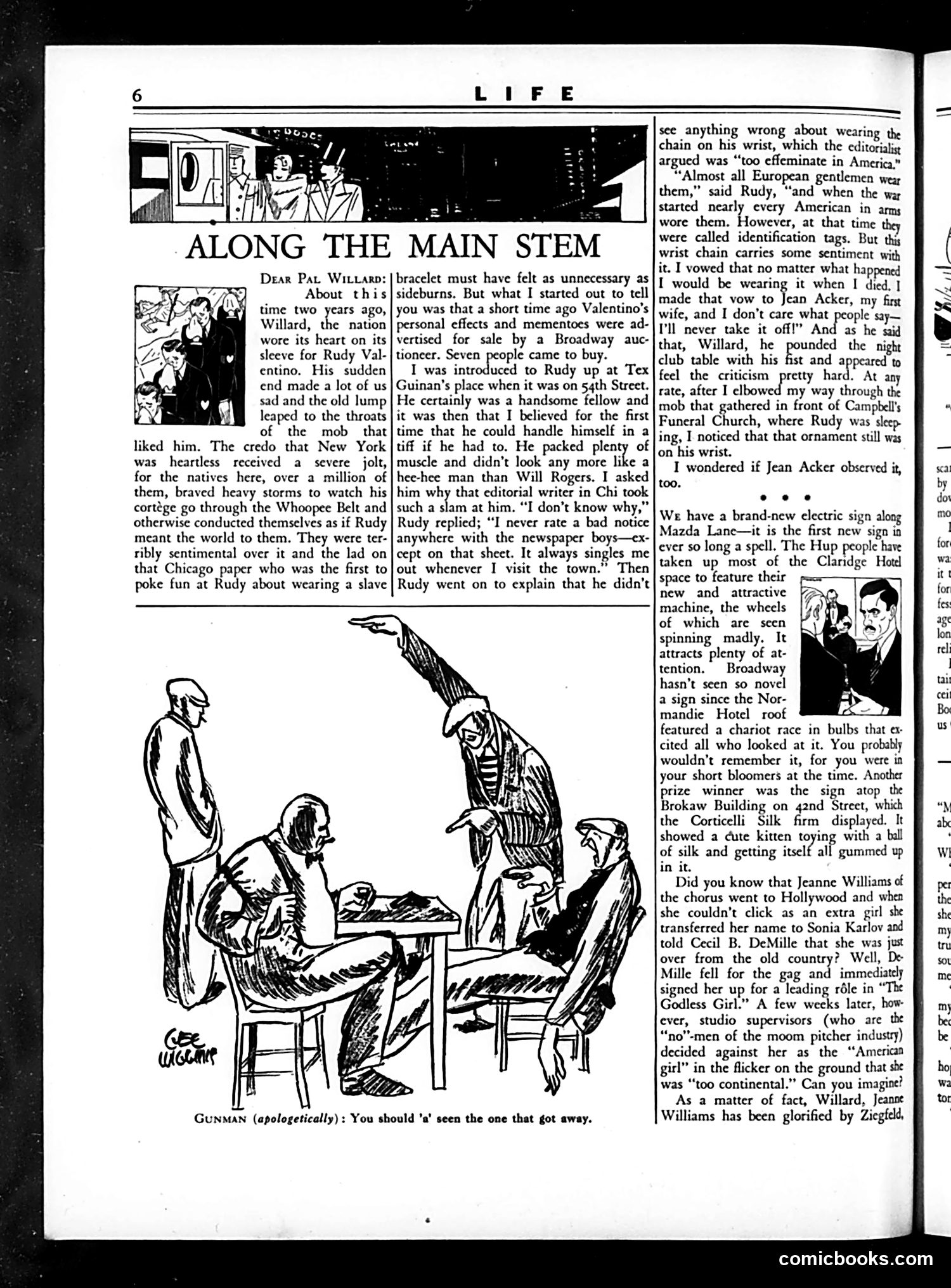
This page contains a gossip column by "Dear Pal Willard" discussing New York City social observations. The main cartoon, credited to Gunman, depicts a street scene where a gunman apologetically shoots someone, with the caption "You should 'a' seen the one that got away"—a dark joke playing on the common fishing phrase to satirize gun violence in 1920s New York. The column discusses various Broadway and Manhattan topics, including a new electric sign on Mazda Lane and references to theater personalities like Jeanne Williams. The overall tone mixes social satire with crime-era humor typical of Life's satirical approach during the Prohibition period.
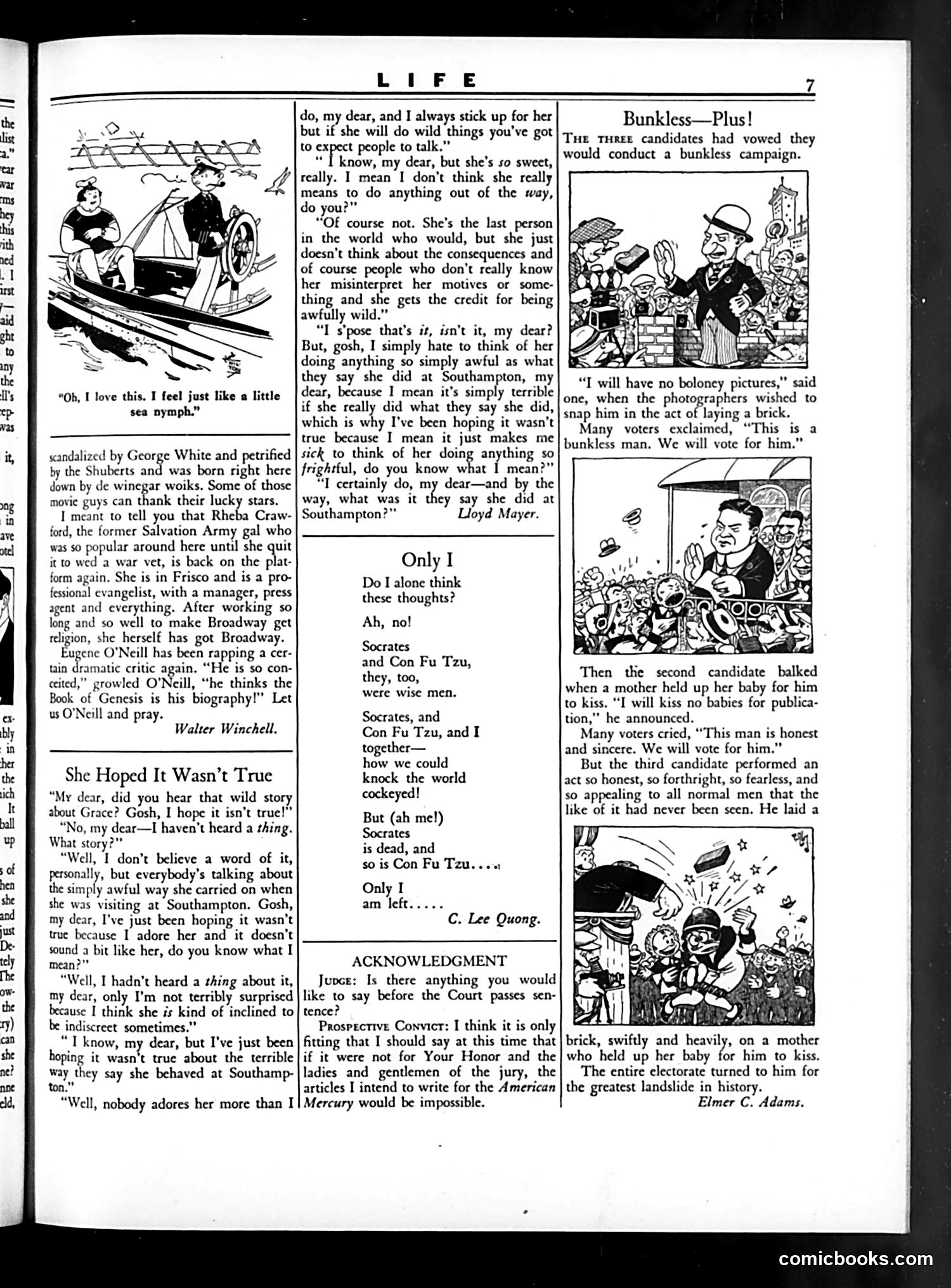
This cartoon satirizes a political campaign where three candidates compete for votes by making increasingly absurd promises. The first candidate promises a "bunkless campaign" (no lies). The second pledges to "kiss all babies for public relations"—mocking standard political theater. The third performs an acrobatic stunt, literally tumbling over a mother holding her baby, to demonstrate he's the most honest and appealing candidate. The satire targets political campaigning's inherent absurdity: candidates making exaggerated, performative gestures to win votes while claiming authenticity. The escalating ridiculousness—culminating in physical comedy—suggests that all campaign promises are equally hollow theater, regardless of sincerity claims. The electorate rewards the most entertaining performer, not the most truthful candidate.
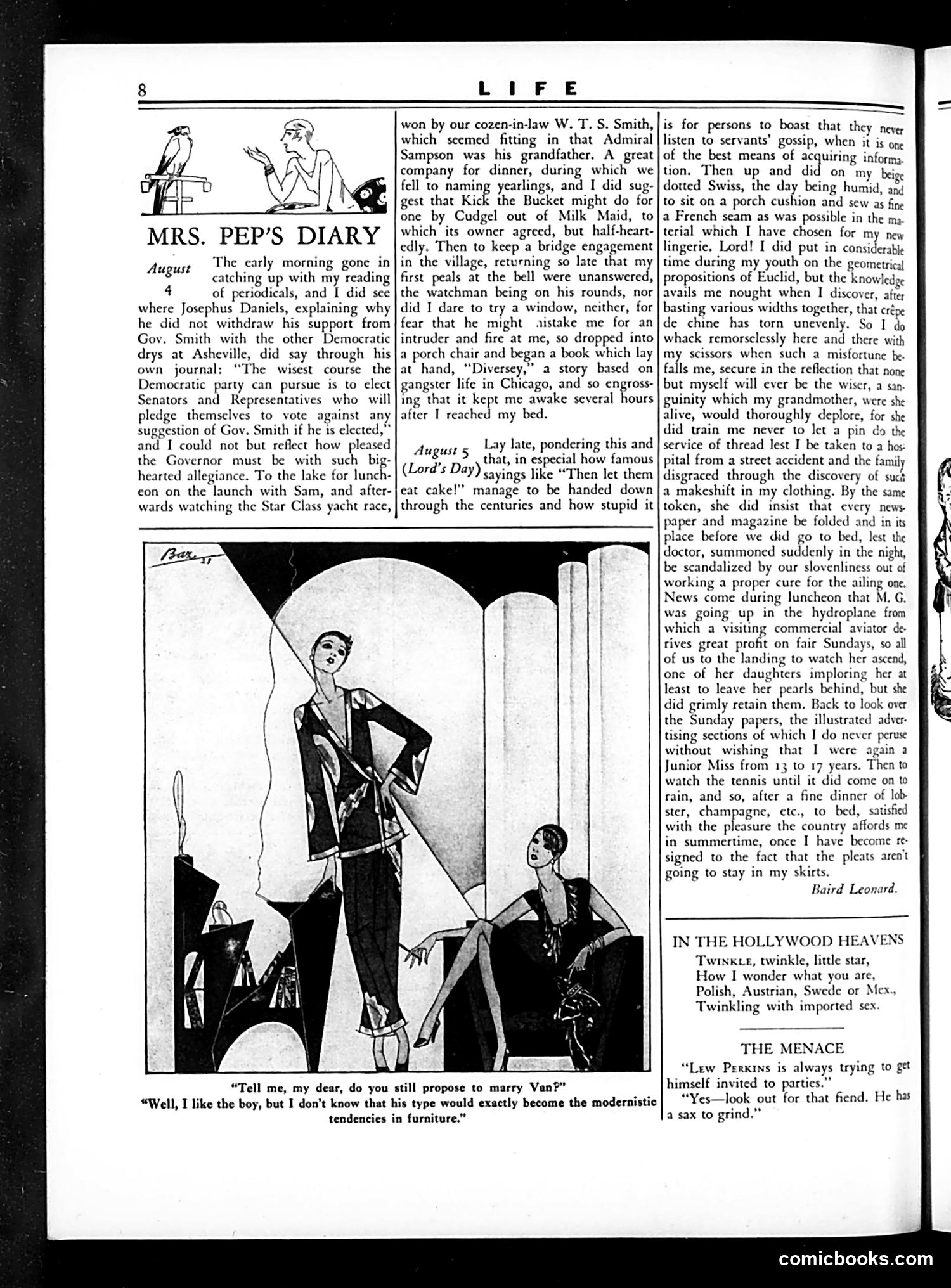
This is a **society gossip column** rather than political satire. The main illustration shows a woman fishing while a man proposes marriage, captioned: "Tell me, my dear, do you still propose to marry Van F?" Her response—"Well, I like the boy, but I don't know that his type would exactly become the modernistic tendencies in furniture"—satirizes upper-class women's superficial priorities. She's rejecting a suitor based on whether his aesthetic tastes match her home décor rather than genuine compatibility. The diary entries detail wealthy social activities: yachting, hydroplane visits, and tennis. The short satirical poems mock Hollywood starlets and social climbers (Lew Perkins). This reflects 1920s-era commentary on the frivolous concerns of affluent women during the Jazz Age, presenting them as materialistic and aesthetically obsessed rather than romantically or intellectually engaged.
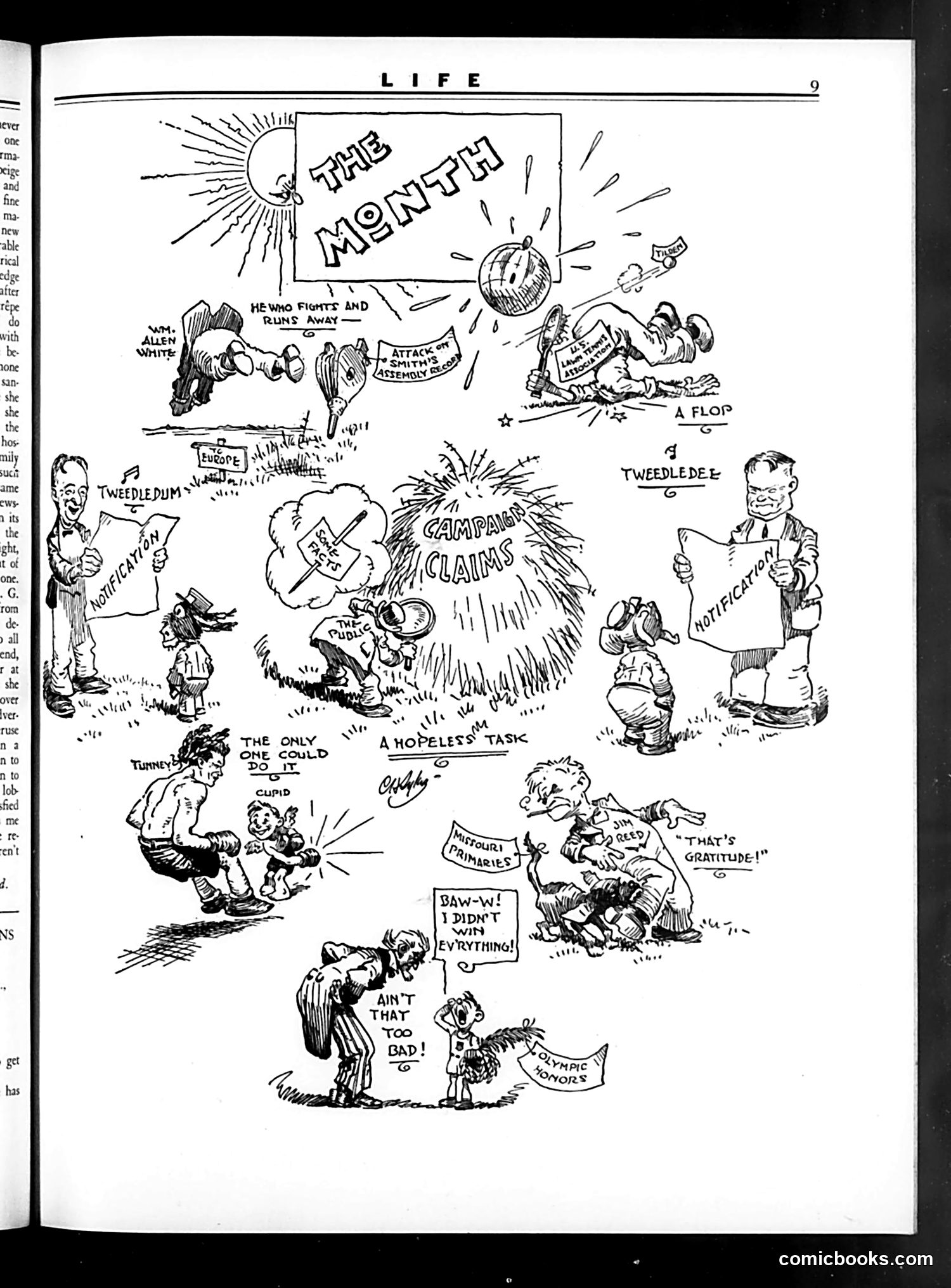
This satirical page from *Life* magazine depicts various political and social failures of a specific month (date unclear from image). The central figure labeled "Campaign Claims" represents exaggerated political promises that prove hollow. Key figures include: - **Allen White** (labeled, upper left) - appears involved in some scandal or failure - References to "Tweedledee" and "Tweedledee" suggest two indistinguishable political parties or candidates - "A Flop" and "A Hopeless Task" label failed initiatives - Small figures holding "Notification" documents represent political nominees or candidates The cartoon's overall message critiques campaign promises versus reality, political incompetence, and the circular failures of governance. The sun representing the month watches over these comedic disasters, suggesting systemic monthly political failures in American governance.
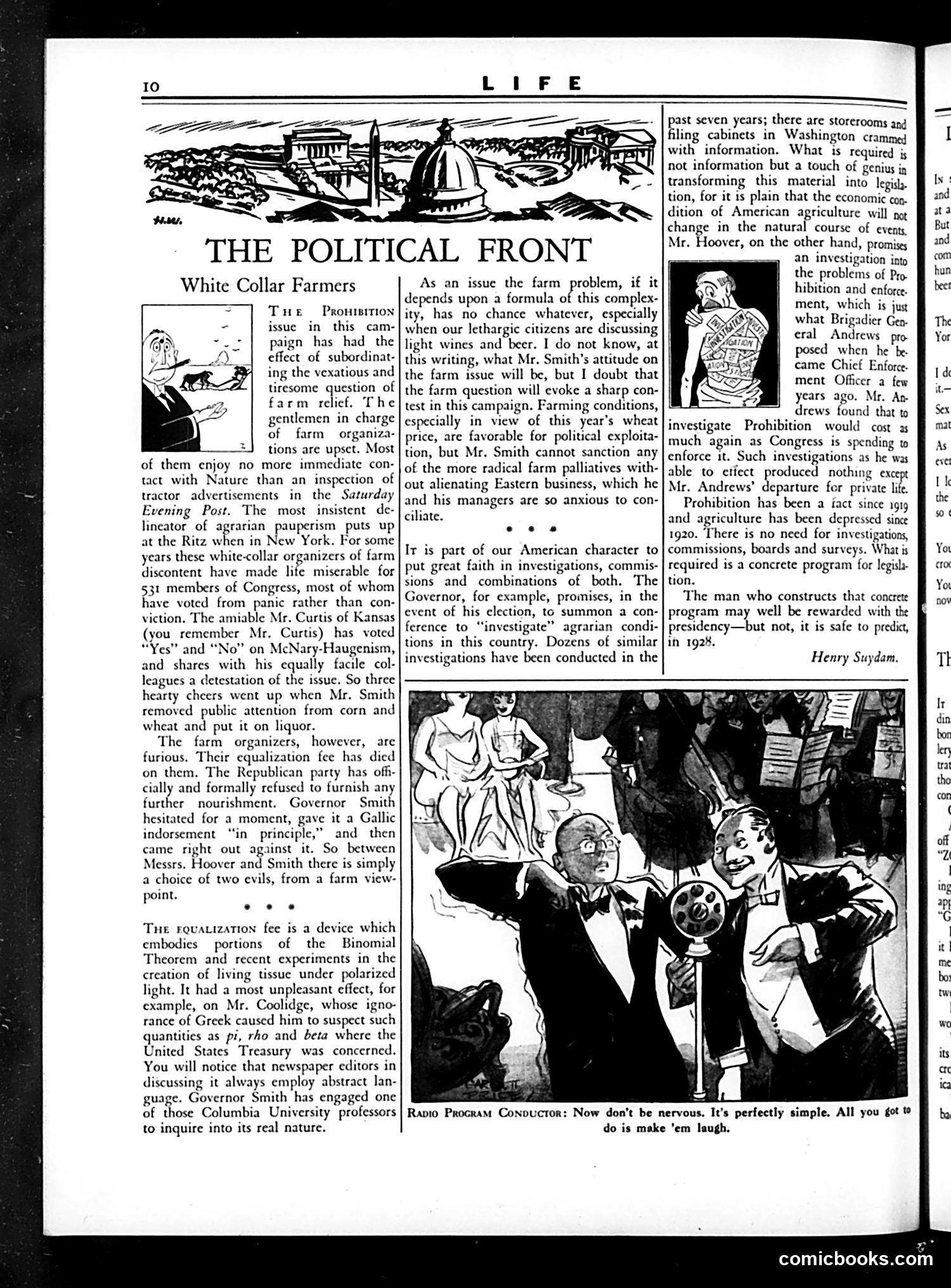
This page satirizes American farm policy debates during Prohibition-era politics. The main article criticizes how farm organizations have politicized agricultural relief, with three congressmen removed from office for their stance on the issue. The cartoon at bottom depicts a **Radio Program Conductor** instructing two men (likely politicians or entertainers) to "make 'em laugh" rather than address serious concerns—satirizing how politicians use entertainment and humor to distract voters from substantive policy problems like farm relief. The piece critiques Governor Smith's investigation into farm conditions as superficial gesture politics, while opposing any concrete legislative action. The overall message: politicians prefer entertaining the public over solving real agricultural crises caused by Prohibition's economic disruption.
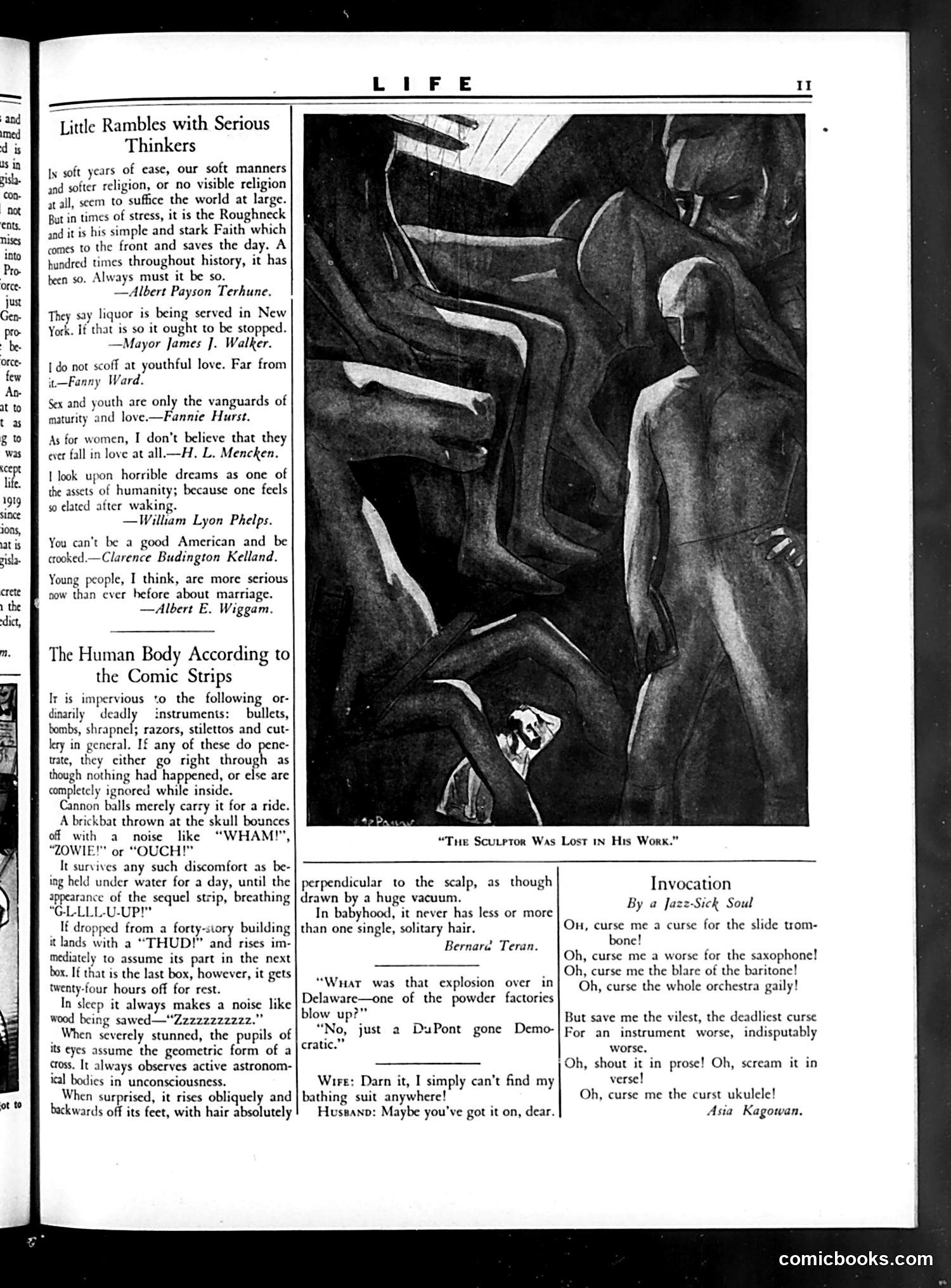
This page combines satirical quotes with an illustration titled "The Sculptor Was Lost in His Work." The image shows two figures in an intimate embrace, likely a commentary on artistic obsession or distraction. The left column features "Little Rambles with Serious Thinkers"—brief quotations on contemporary social issues: religion, temperance (Mayor Walker on liquor in New York), youth and romance, marriage seriousness, and the American character. These reflect 1920s-era debates. Below is "The Human Body According to the Cosmic Strips," a humorous piece about how comic strip characters defy physics—bullets pass through them without injury, they survive impossible falls. This satirizes the unrealistic conventions of popular comics. The right side includes a poem titled "Invocation" by "a Jazz-Sick Soul," mocking jazz music through exaggerated complaints about various instruments. The page blends social commentary with pop-culture satire typical of Life magazine's sophisticated humor.
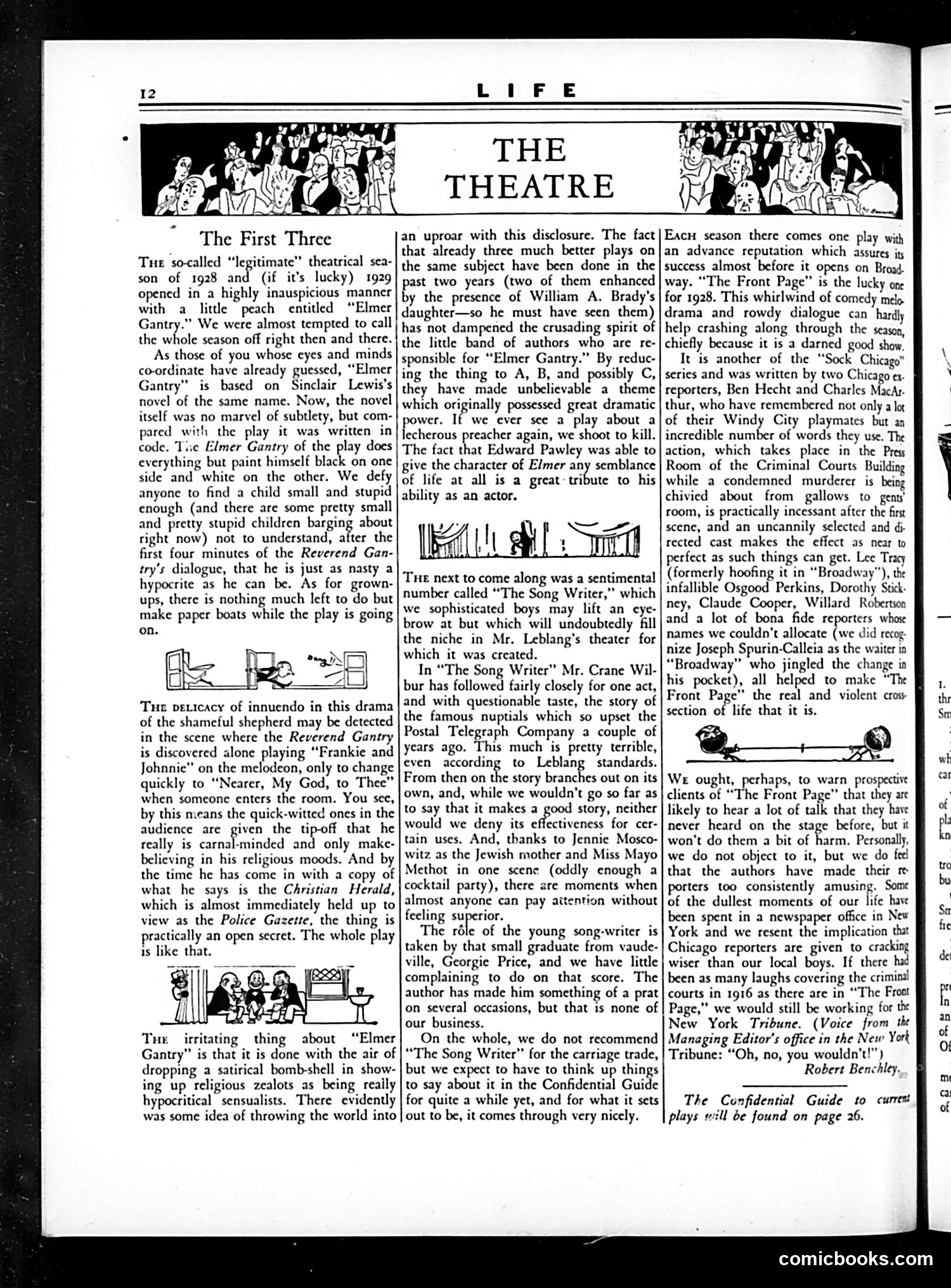
This page from *Life* magazine reviews three Broadway plays from the 1928-1929 season. The main focus is critiquing "Elmer Gantry," based on Sinclair Lewis's novel about a hypocritical preacher. The reviewer praises Edward Pawley's performance but notes the play lacks the novel's satirical bite. The cartoons illustrate specific theatrical moments—one shows a scene from "Elmer Gantry" where religious dialogue occurs, another depicts a domestic interior scene, likely from another reviewed play. The reviewer criticizes "The Song Writer" as sentimental and "The Front Page" (despite its vivid action) for crude language and sensationalism that may offend newspaper-reading audience members. The tone is sophisticated theater criticism aimed at educated *Life* readers familiar with Broadway productions.
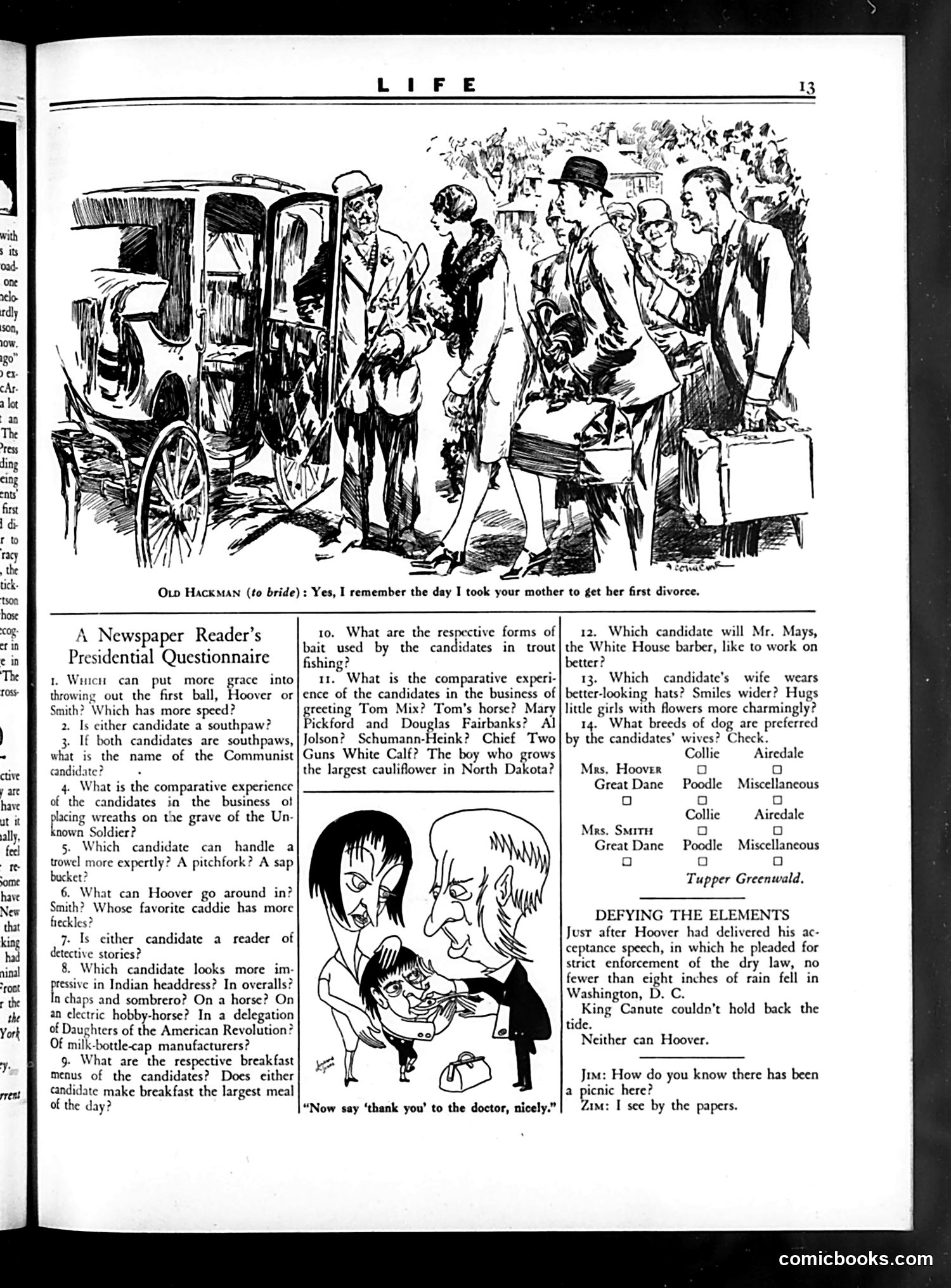
This page satirizes the 1928 U.S. presidential election through a "Newspaper Reader's Presidential Questionnaire" that poses absurd, character-focused questions about unnamed candidates rather than substantive policy issues. Questions ask which candidate can "handle a brawl more expertly," whose wife wears "better-looking hats," and which candidate's dog is "preferred by the candidates' wives." The top cartoon shows a taxi driver (labeled "Old Hackman") remarking to a bride about her mother's divorce history—likely a jab at modern social trends. The bottom cartoon mocks political superficiality with three caricatured figures and the caption "Now say 'thank you' to the doctor, nicely." Overall, the page criticizes how voters and media focus on personality and trivia rather than actual qualifications or policy positions during presidential campaigns.
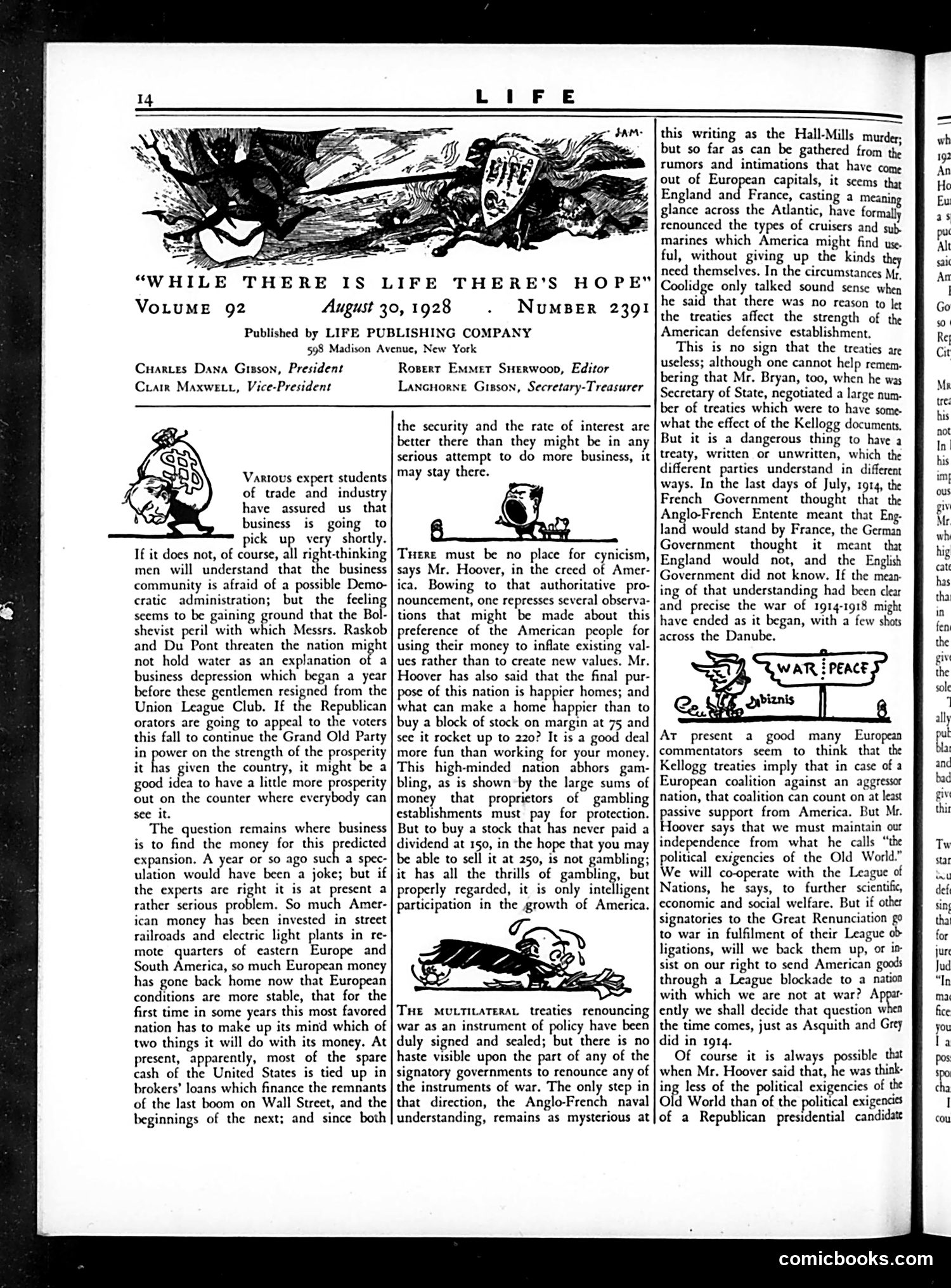
This page contains editorial commentary on business and international affairs rather than cartoon satire. The small illustrated vignettes (showing figures gambling or in conflict) are decorative rather than standalone political cartoons. The main content discusses American business optimism about economic expansion, with skepticism about whether this can be sustained. It also addresses the multilateral peace treaties recently signed (likely the Kellogg-Briand Pact of 1928), questioning their enforceability when nations lack genuine commitment to renouncing war as policy. The text references Herbert Hoover's statements about American prosperity and international cooperation, suggesting editorial doubt about whether such idealistic treaties could actually prevent future conflicts given competing national interests.
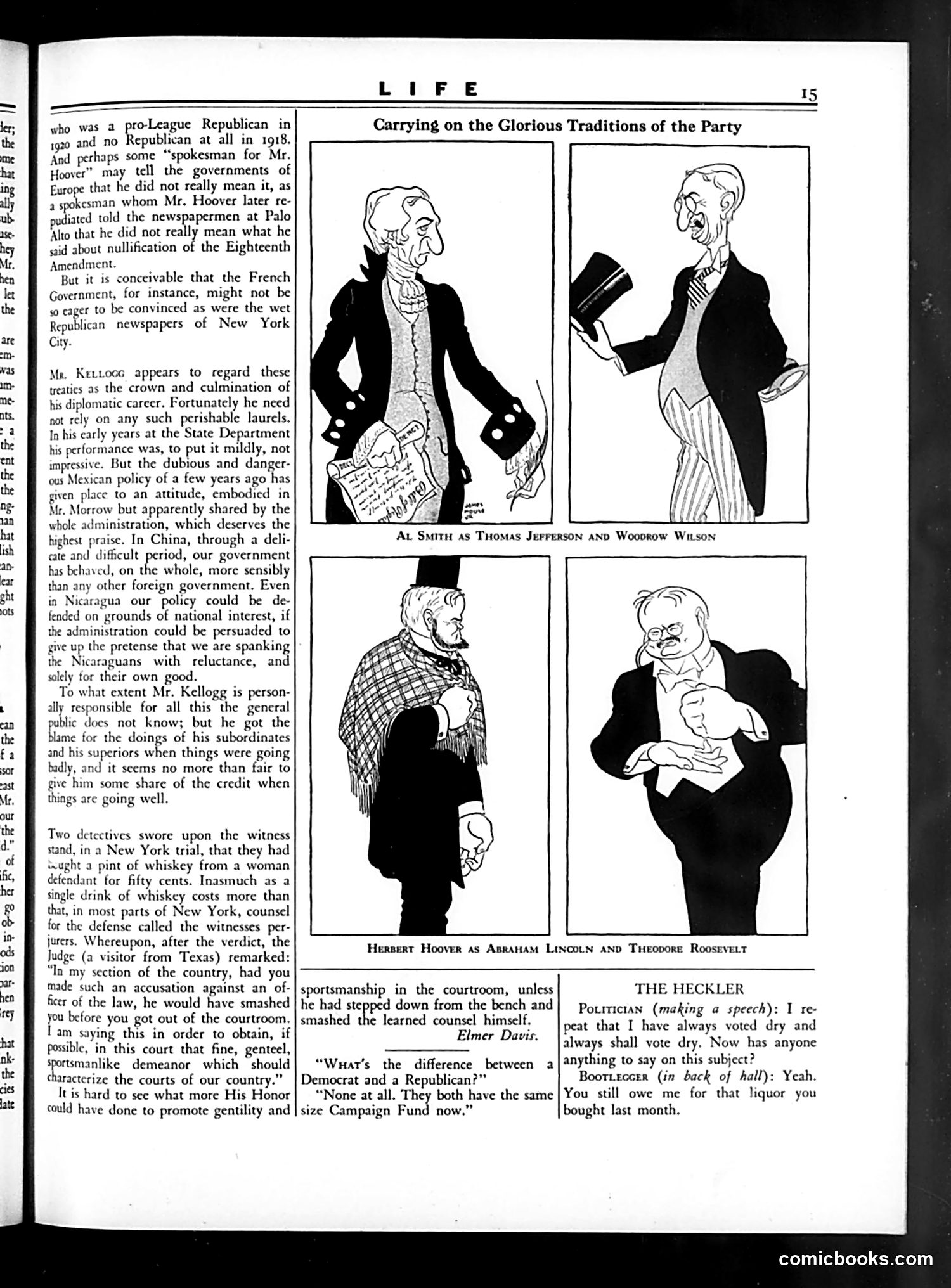
This page satirizes Secretary of State Frank B. Kellogg's diplomatic record through four caricatured impersonations by performer Al Smith. The cartoons mock Kellogg's handling of foreign policy, particularly his Mexican and Nicaraguan initiatives, which the article criticizes as ineffective or contradictory. The four panels show Smith impersonating Thomas Jefferson, Woodrow Wilson, Abraham Lincoln, and Theodore Roosevelt—presumably to contrast their diplomatic achievements with Kellogg's questionable record. Below the cartoons, "The Heckler" section contains a political joke distinguishing Democrats from Republicans based on campaign fund size, suggesting satire of partisan politics and fundraising practices of the era. The page overall presents Kellogg as unworthy of comparison to America's great statesmen.
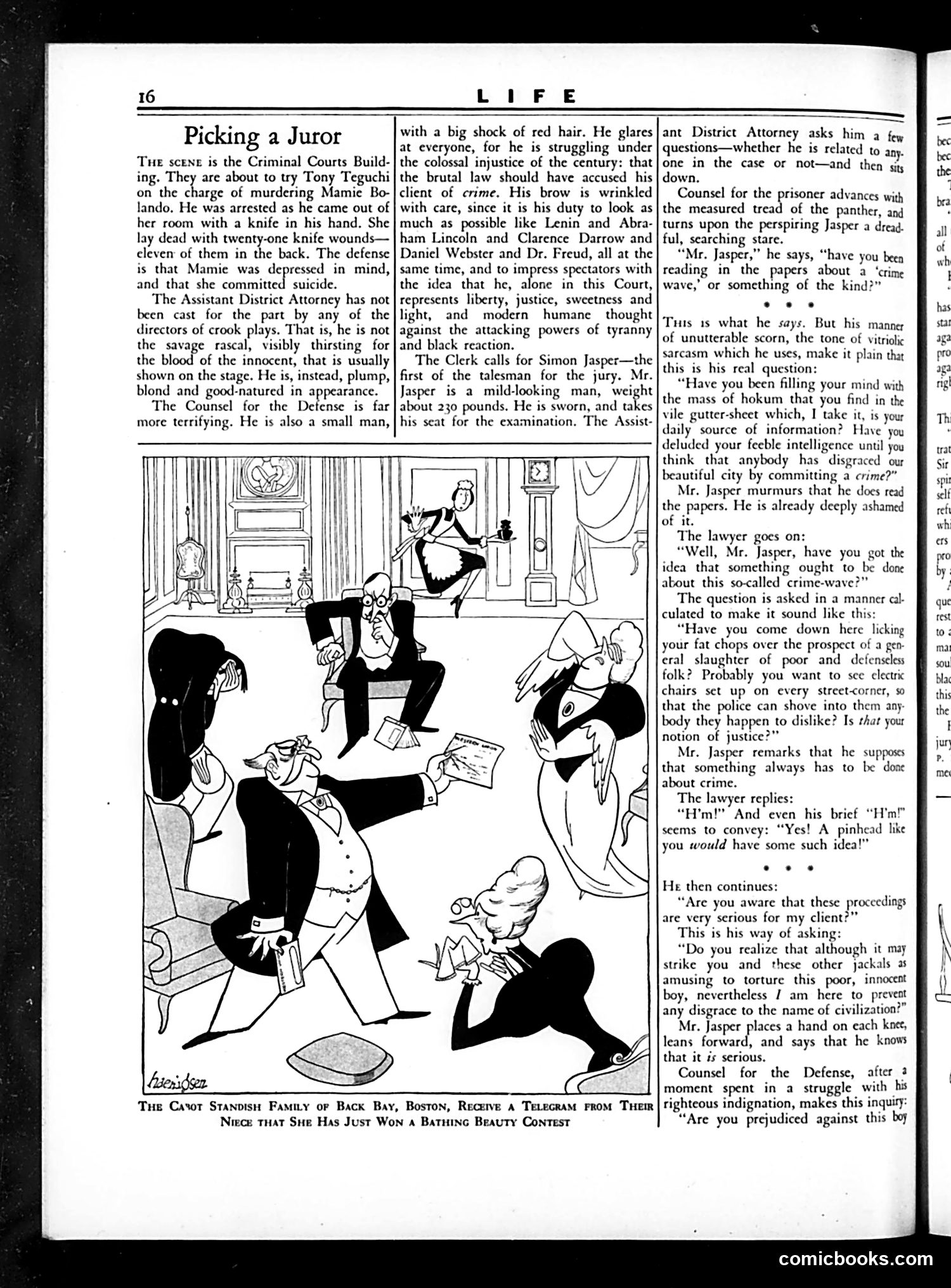
This page satirizes the jury selection process in a criminal court case. The cartoon depicts a chaotic courtroom scene where potential jurors are being questioned. The main illustration shows well-dressed figures in animated discussion—likely lawyers, judges, and jurors—with papers scattered about, suggesting the disorderly nature of jury examination. The accompanying article critiques how lawyers and judges question jurors, with extensive dialogue showing the Defense Counsel asking leading questions designed to bias jurors against the prosecution. The satire targets the manipulation tactics used during jury selection, where lawyers attempt to plant ideas and prejudices rather than seek impartial judgment. The illustration captures the theatrical absurdity of these legal proceedings from what appears to be the 1920s-1930s era.
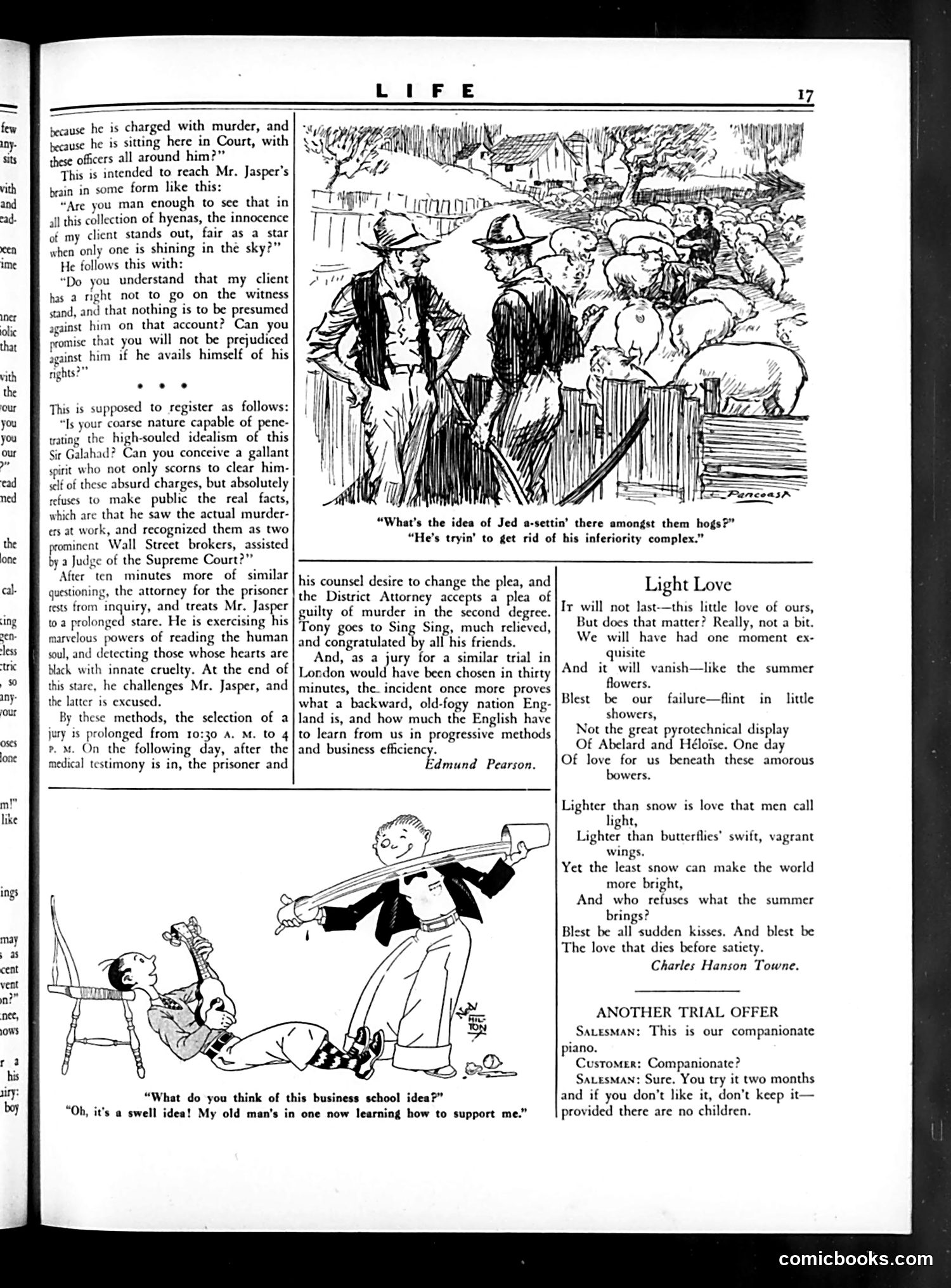
**Top Cartoon**: Shows men discussing a defendant named Jed in a trial context. The caption reads: "What's the idea of Jed a-settin' there amongst them hogs?" / "He's tryin' to get rid of his inferiority complexes." This satirizes the then-popular psychological concept of "inferiority complexes" (popularized by Adler). The joke equates a man's attempt to overcome psychological insecurity by associating with hogs—suggesting either that psychology is absurd, or that rural people are ignorant of proper mental health treatment. **Bottom Cartoon**: A child asks an adult about "business school idea," with the adult responding about his father learning "how to support me." This mocks Depression-era economic struggles and the questionable value of business education during economic hardship.
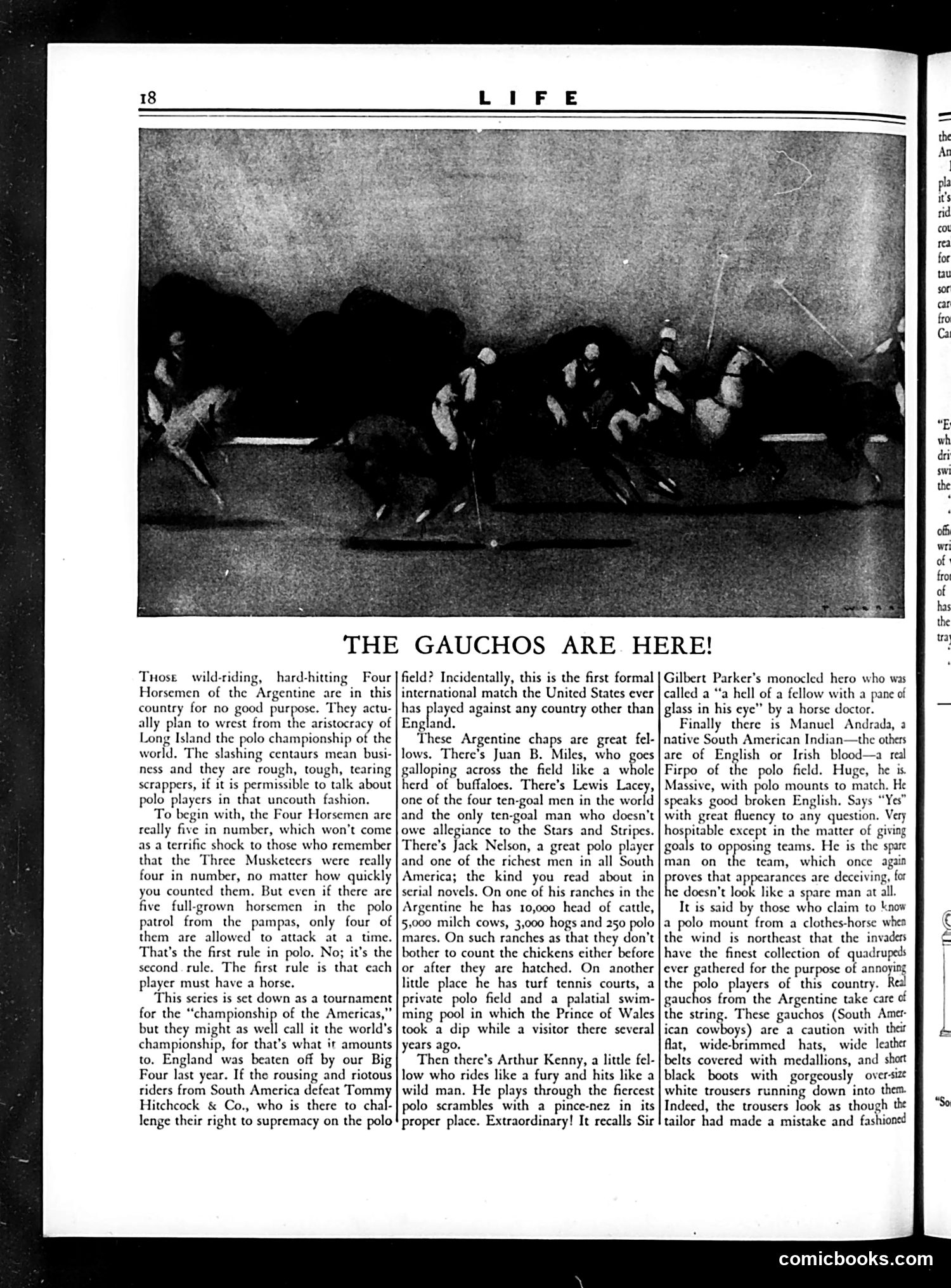
This 1920s Life magazine article humorously announces an Argentine polo team's visit to challenge American champions for the "championship of the Americas." The piece names five skilled Argentine players—Juan B. Miles, Lewis Lacey, Jack Nelson, Arthur Kenny, and Manuel Andrada—presenting them as formidable competitors threatening Long Island's polo aristocracy. The satire works on multiple levels: it mock-heroically elevates a sporting match to geopolitical significance, exaggerates the players' wealth and exotic backgrounds (Jack Nelson's vast ranches), and gently ridicules their appearance and habits (Andrada's indigenous heritage, the gauchos' flamboyant costume). The opening photograph shows players in action. The joke assumes readers recognize polo as an elite American pastime and enjoy the prospect of these colorful foreigners challenging established authority—a common early-20th-century American anxiety presented as comedic entertainment.
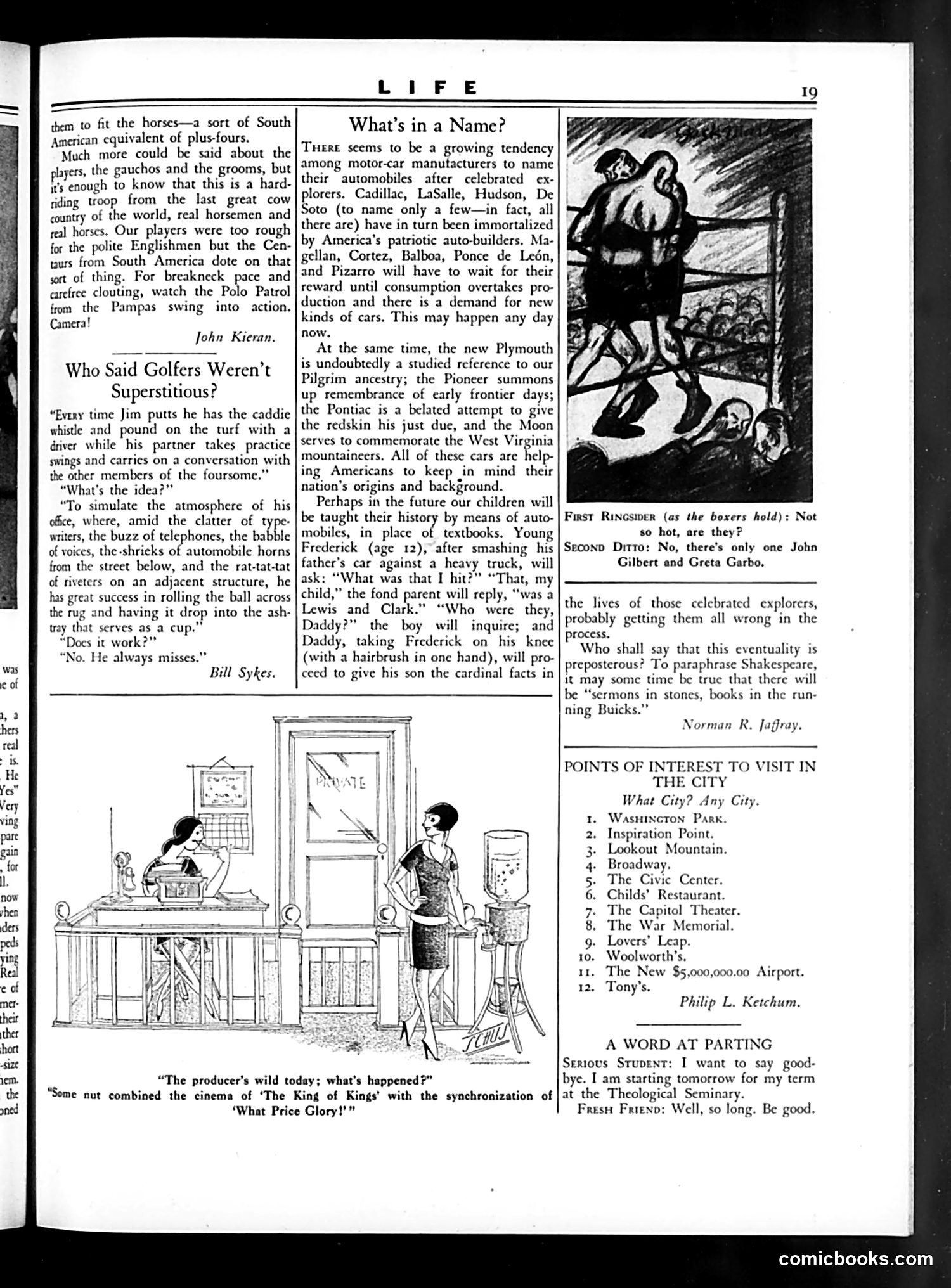
This page contains three satirical pieces: **"Who Said Golfers Weren't Superstitious?"** mocks a golfer's bizarre office-noise rituals on the golf course—his caddie must whistle and pound turf while partners create deliberate commotion to recreate his chaotic workplace environment. The joke: despite these elaborate superstitions designed to mimic his productive office chaos, he still misses his putts. **"What's in a Name?"** satirizes American automobile manufacturers naming cars after explorers (De Soto, Cadillac, Hudson, etc.). The author humorously suggests parents will soon teach history through car names—imagining a father explaining "Lewis and Clark" by referencing a car he crashed. The piece parodies American self-congratulation about patriotic branding while suggesting this commercial naming is ultimately trivial education. **The bottom cartoon** about boxers references John Gilbert and Greta Garbo, silent film stars, implying these current boxers lack their celebrity appeal. These pieces exemplify Life's satirical approach to contemporary American consumer culture and social pretension.
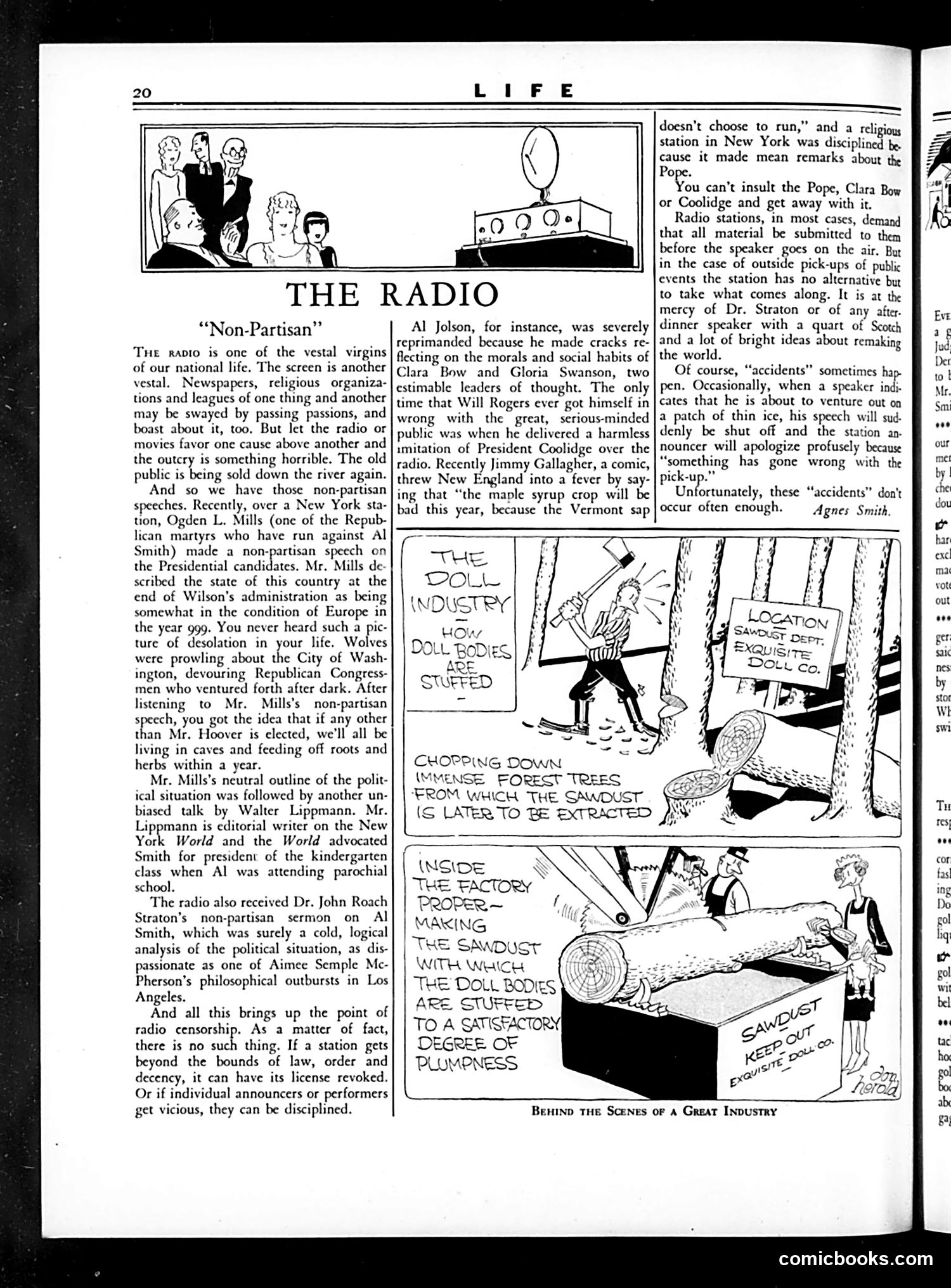
This page critiques **radio censorship and hypocrisy** in 1920s American broadcasting. The article argues that while radio claims neutrality, it actually enforces selective censorship based on power and propriety. The satire targets prominent figures who gave supposedly "non-partisan" speeches: **Ogden L. Mills** (Republican politician), **Walter Lippmann** (newspaper editor), and **Dr. John Roach Straton** (minister)—all presented as transparently biased despite claims of objectivity. The piece notes radio will punish celebrities like **Al Jolson**, **Clara Bow**, **Gloria Swanson**, and **Will Rogers** for minor infractions, yet has no mechanism to control live broadcasts of public events. The cartoon below satirizes the **doll manufacturing industry**, mocking its pretense of sophistication while showing the crude reality: chopping trees for sawdust used in doll bodies, presented as an "exquisite" process deserving sanitary precautions. The overall point: institutions claim high standards while serving commercial and political interests—a classic Life magazine exposé of hypocrisy.
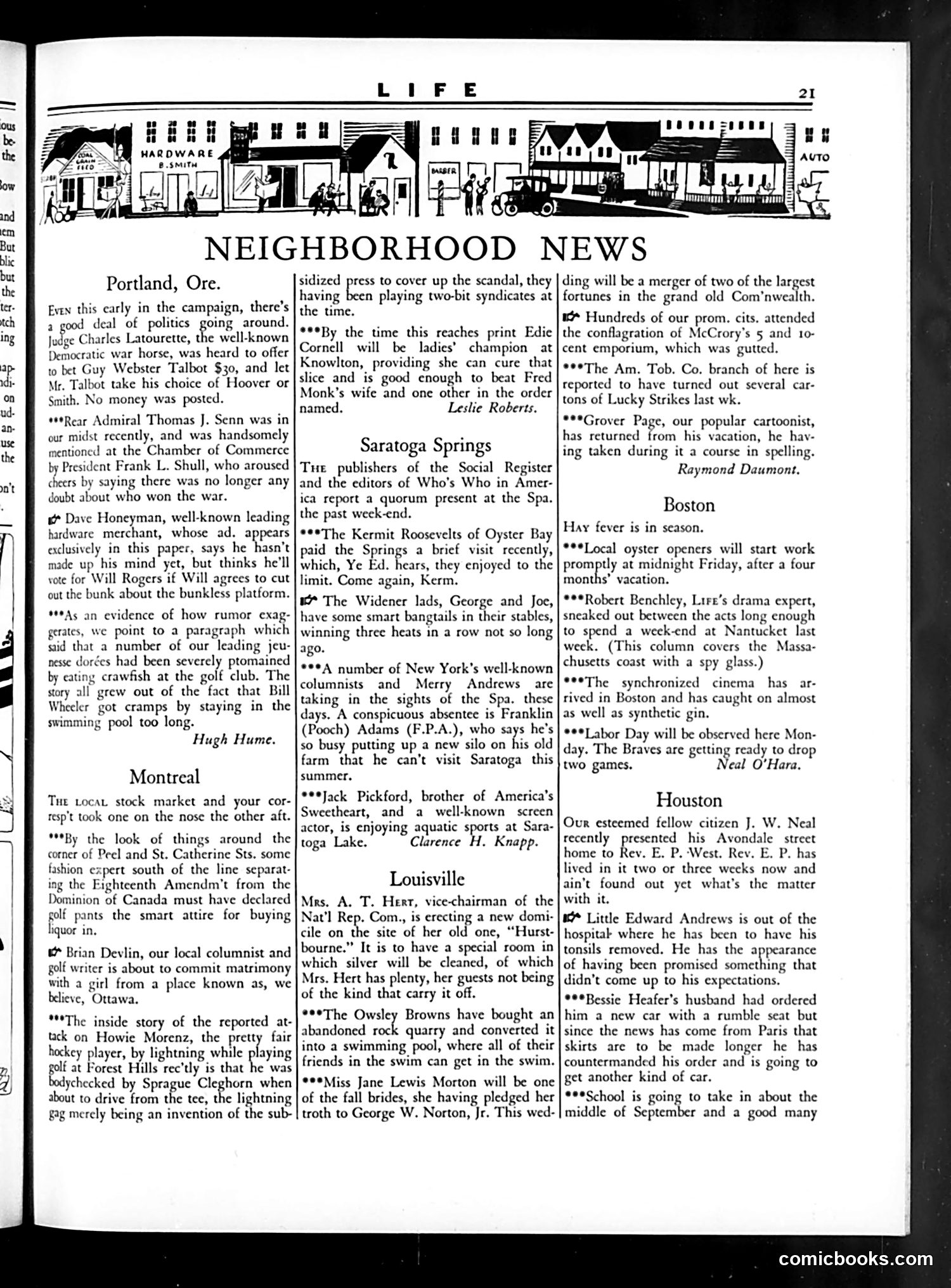
This page contains brief, gossipy social commentary from five cities—Portland, Saratoga Springs, Montreal, Boston, and Houston. The content reflects Life's satirical focus on high society and politics circa 1928. **Key references:** - **Portland section** jokes about 1928 presidential politics (Hoover vs. Smith), with a quip about voting for Will Rogers instead—mocking politicians' empty promises about the "bunkless platform." - **Montreal section** references Prohibition-era liquor smuggling across the US-Canada border, and alludes to hockey player Howie Morenz and athlete Sprague Cleghorn. - **Saratoga Springs** notes wealthy New Yorkers vacationing at the resort, including members of the Roosevelt and Pickford families. - **Louisville** mentions Mrs. A.T. Hert, a prominent Republican National Committee official. The satirical tone mocks the leisure activities and romantic entanglements of the wealthy elite while poking fun at contemporary political figures.
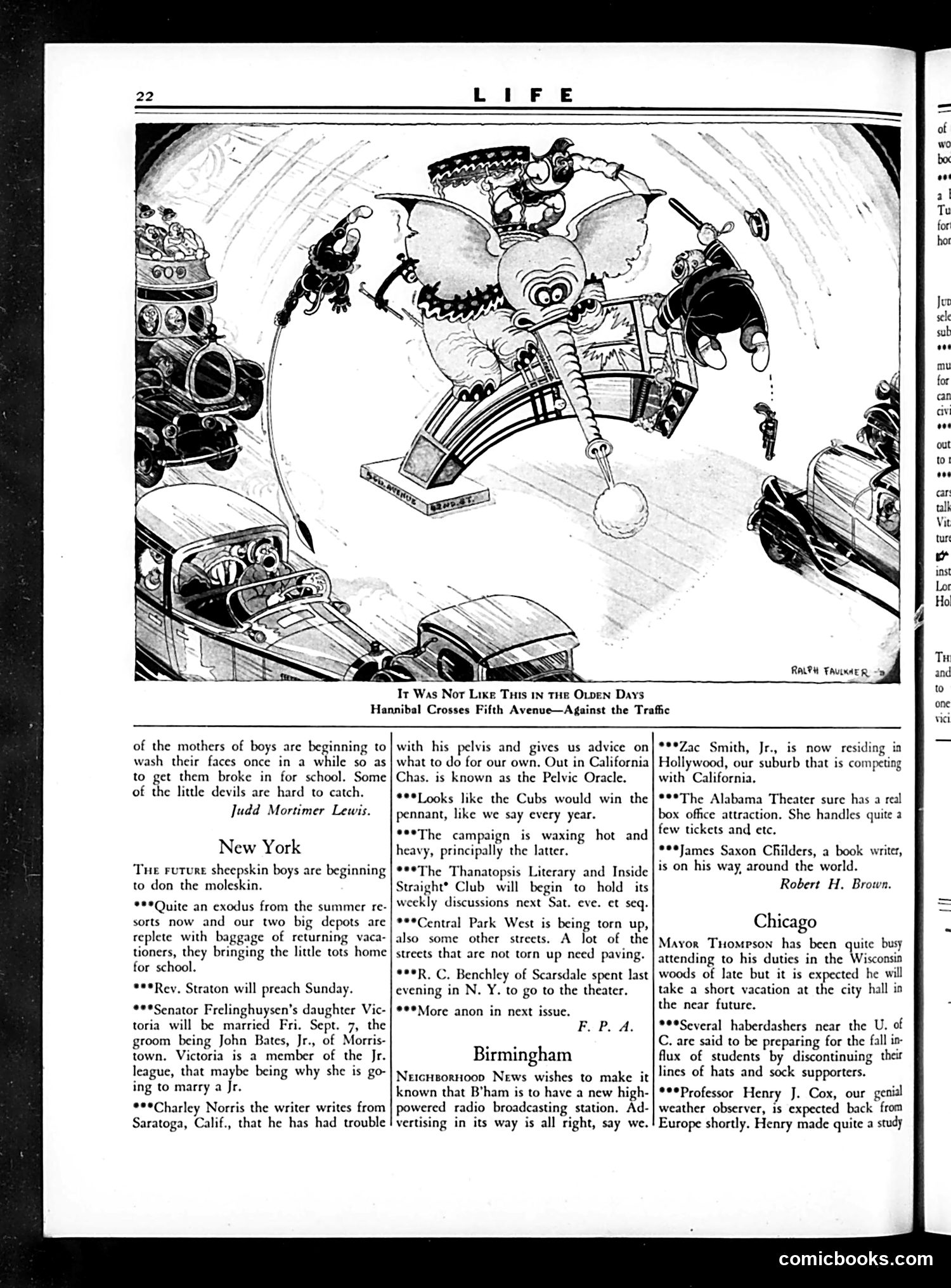
This cartoon by Ralph Barton satirizes New York City traffic chaos by depicting the ancient Carthaginian general Hannibal—famous for crossing the Alps with war elephants—attempting the seemingly impossible feat of crossing Fifth Avenue amid modern automobile traffic. The joke compares Hannibal's legendary military achievement to navigating NYC streets. The cartoon shows an elephant (Hannibal's iconic transport) struggling through congested traffic with vehicles everywhere, suggesting that modern Manhattan traffic is as formidable an obstacle as the Alps were in ancient times. The caption's ironic title emphasizes the absurdity: crossing Fifth Avenue has become more dangerous and difficult than historical military campaigns. This reflects genuine 1920s concerns about urban congestion and automobile-induced chaos in major cities, making the ancient general's struggle metaphorically relevant to contemporary urban life.
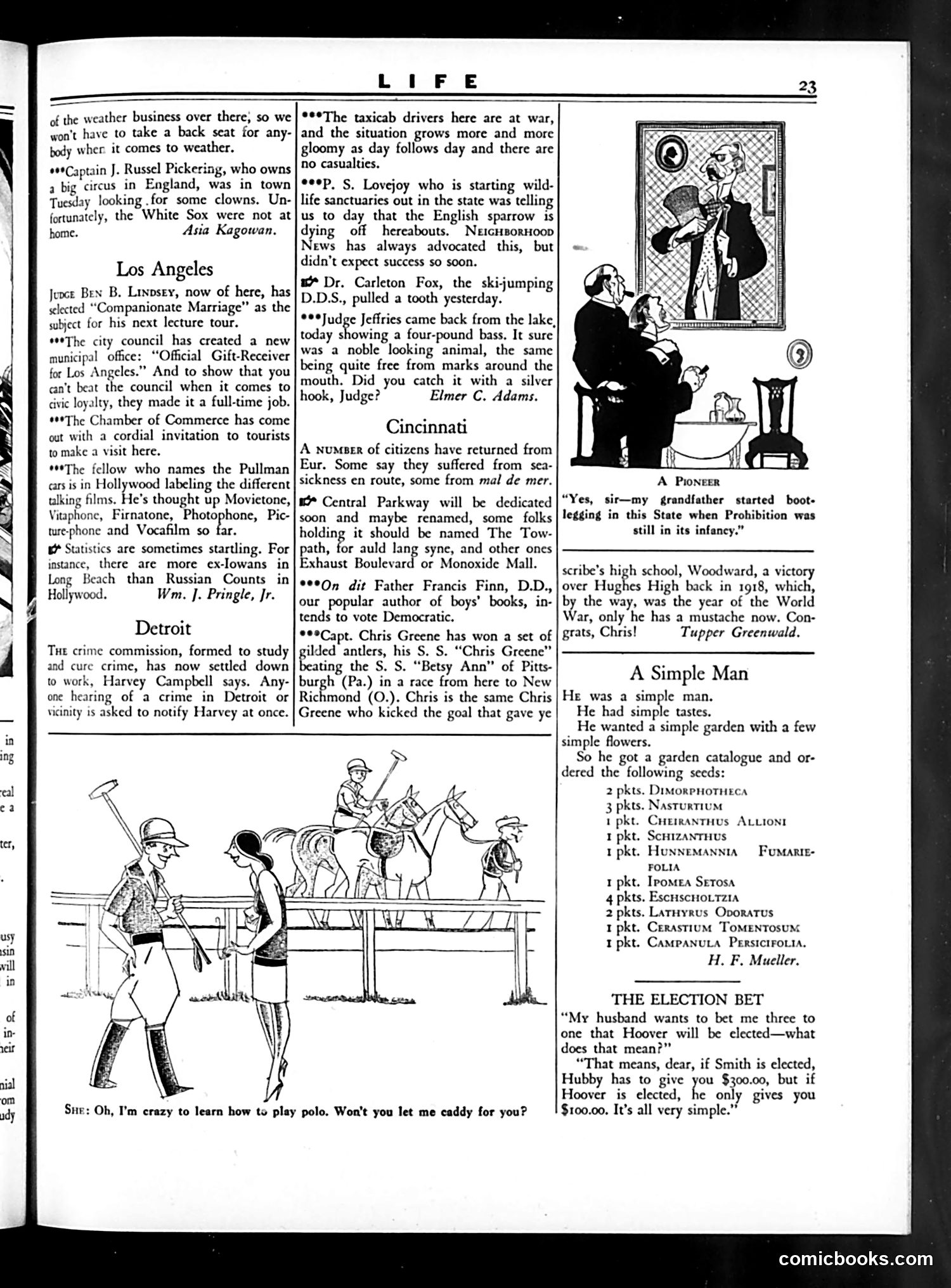
This page contains satirical news briefs and humor pieces from various American cities, typical of Life's format during the 1920s. **The Polo Cartoon**: A woman asks a man to let her caddy for him in polo. The joke relies on confusion—she likely misunderstands "caddy" (golf term) as related to polo, or the humor may involve her wanting to participate in an upper-class sport. The cartoon mocks either class pretensions or gender-role expectations of the era. **Political/Social Content**: References include Prohibition-era bootlegging (presented nostalgically as the "infancy" of the practice), the 1928 presidential election (Hoover vs. Smith), and "companionate marriage"—a 1920s debate about marriage based on companionship rather than traditional roles. **"The Election Bet"**: A woman doesn't understand betting odds. The joke satirizes both women's unfamiliarity with gambling and the intensity of 1928 election speculation among ordinary Americans. Overall, the page reflects Jazz Age America: prosperity, Prohibition, emerging women's roles, and political engagement.
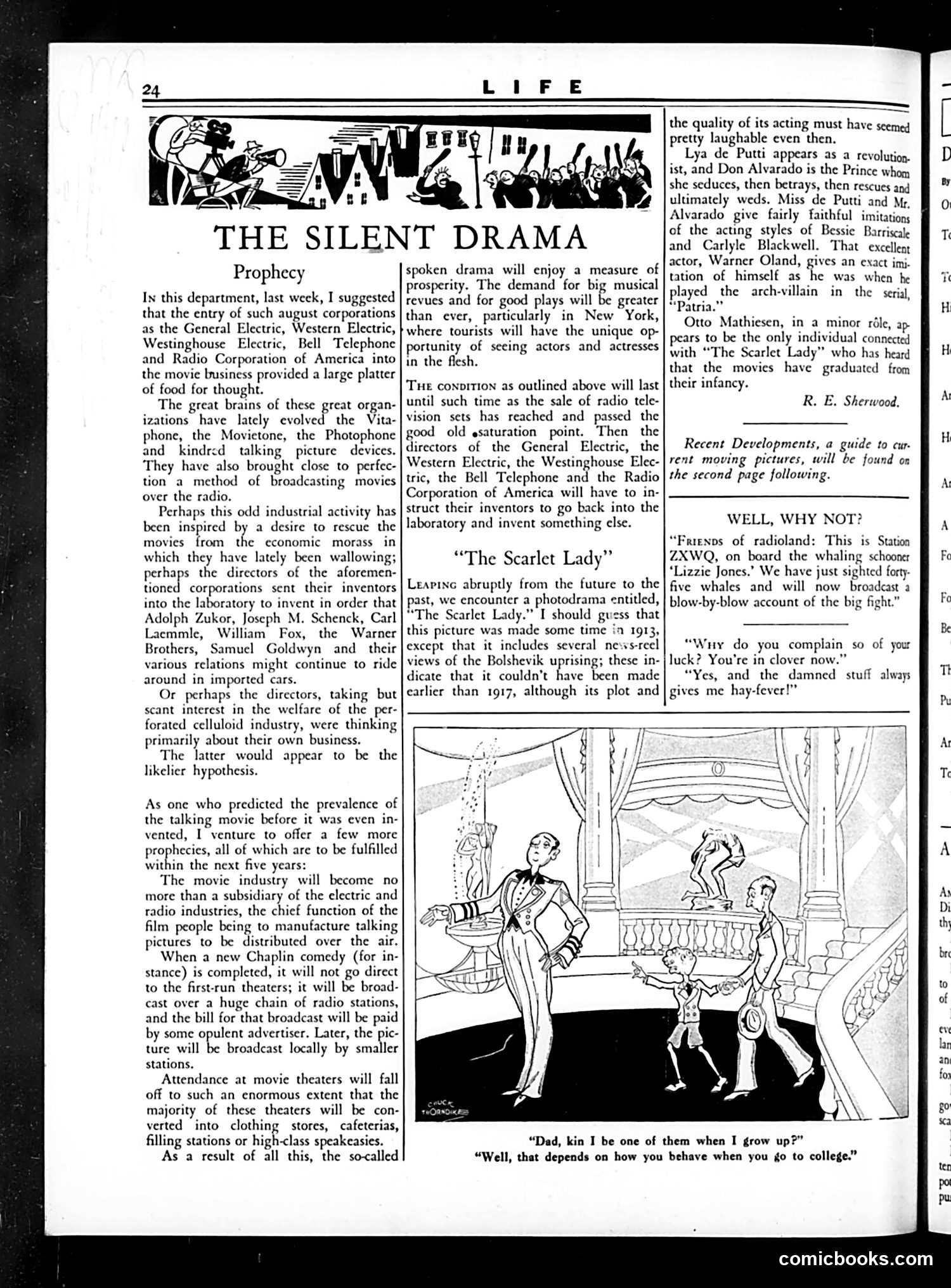
This page discusses the impending threat to silent films from newly-entered corporations (General Electric, Westinghouse, Bell Telephone, RCA) developing sound and radio broadcast technology. The author satirizes movie moguls like Adolph Zukor and Samuel Goldwyn, suggesting these corporations will ultimately make theaters obsolete by broadcasting films over radio. The prophecy mocks the industry's pretense: corporations claim to "rescue" cinema, but realistically seek profit for themselves. The author predicts movie theaters will convert to "clothing stores, cafeterias...or high-class speakeasies"—a sarcastic jab at Prohibition-era America. The cartoon below depicts a father and child discussing career ambitions, with the child asking to become a movie star. The father's reply—that success "depends on how you behave when you go to college"—suggests early 1920s anxiety about the film industry's moral reputation and uncertain future prospects.
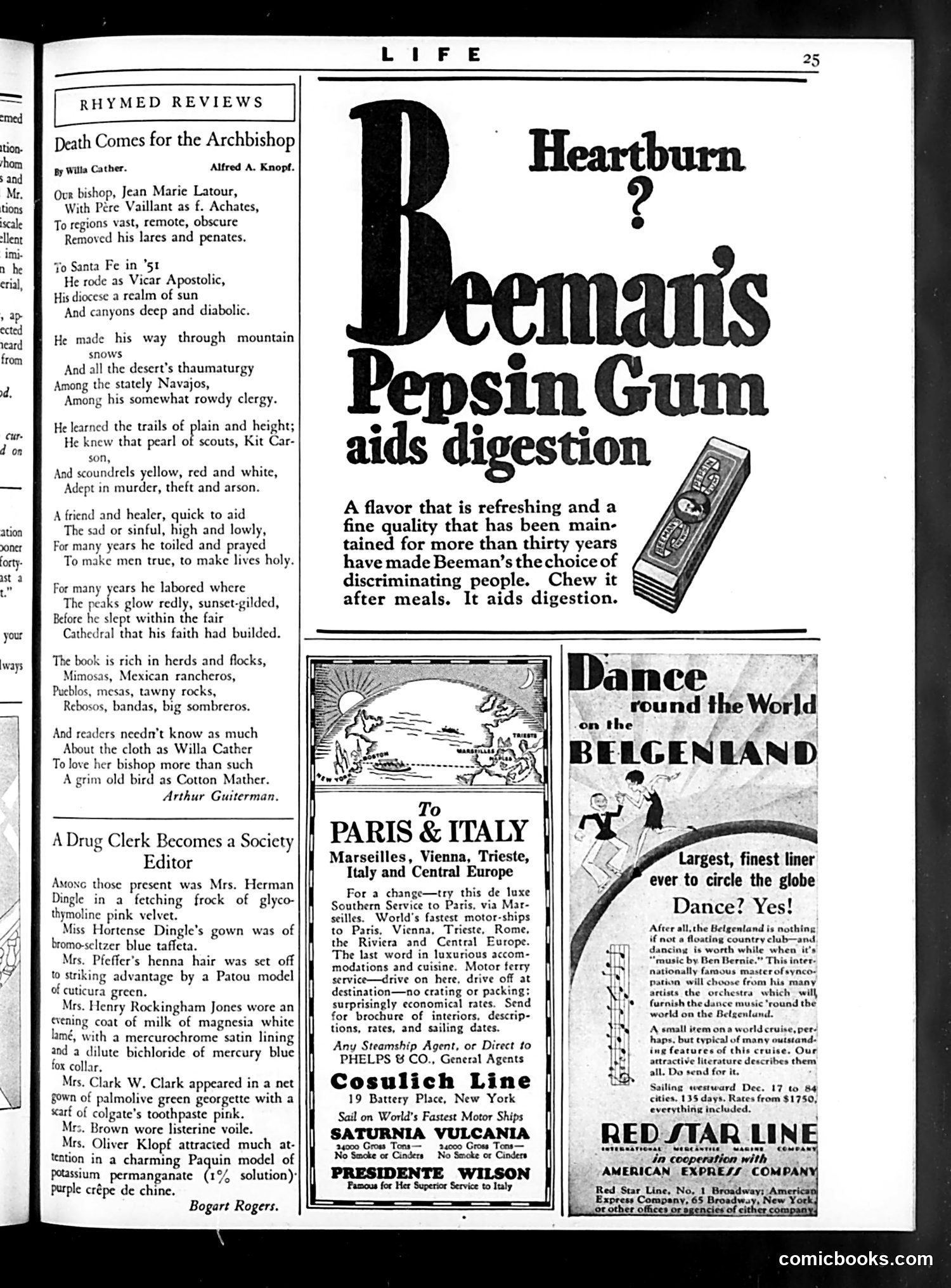
This page contains **book reviews in verse and humorous social commentary**, plus advertisements. The main satire is "A Drug Clerk Becomes a Society Editor" by Bogart Rogers. It mocks society page writing by describing women's evening wear using **pharmaceutical and drugstore brand names** instead of fabric descriptions: "glycothymoline pink velvet," "bromo-seltzer blue taffeta," "Listérine voile," etc. The joke targets the pretentiousness of society journalism—treating trivial fashion coverage with absurd seriousness—while also satirizing commercial advertising's invasion of everyday language. By substituting medicine/toiletry brands for elegant fabric names, Rogers suggests society pages are as superficial and commercially driven as drug-store product listings. The upper left reviews Willa Cather's *Death Comes for the Archbishop* in humorous verse, with the reviewer noting readers needn't understand religion to appreciate the novel—a gentle dig at both the book's accessibility and Cotton Mather's grimmer Puritanism. The right side contains period travel and shipping advertisements (cruises, ocean liners).
This page is a **theater review section** from Life magazine, not a political cartoon. It's a "Confidential Guide" to current Broadway shows (circa 1928, based on references like "A Connecticut Yankee"). The reviews use **sharp, satirical wit** typical of Life's style—for example, calling *Strange Interlude* a "five-hour peek into the soul of Cosmic Woman" that "could have been done in three," and mocking *The Ladder* by joking the backer wants to "float the Pompeii Telephone Co." Notable shows reviewed include Mae West's *Diamond Lil* (noted as "honky-tonk melodrama"), the first "gangster play" (*Guns*), and musicals like *Good News* and *Present Arms*. The tone assumes readers are sophisticated theatergoers familiar with Broadway. The guide's brevity and cutting commentary reflect 1920s entertainment journalism's irreverent style—entertainment criticism as entertainment itself.
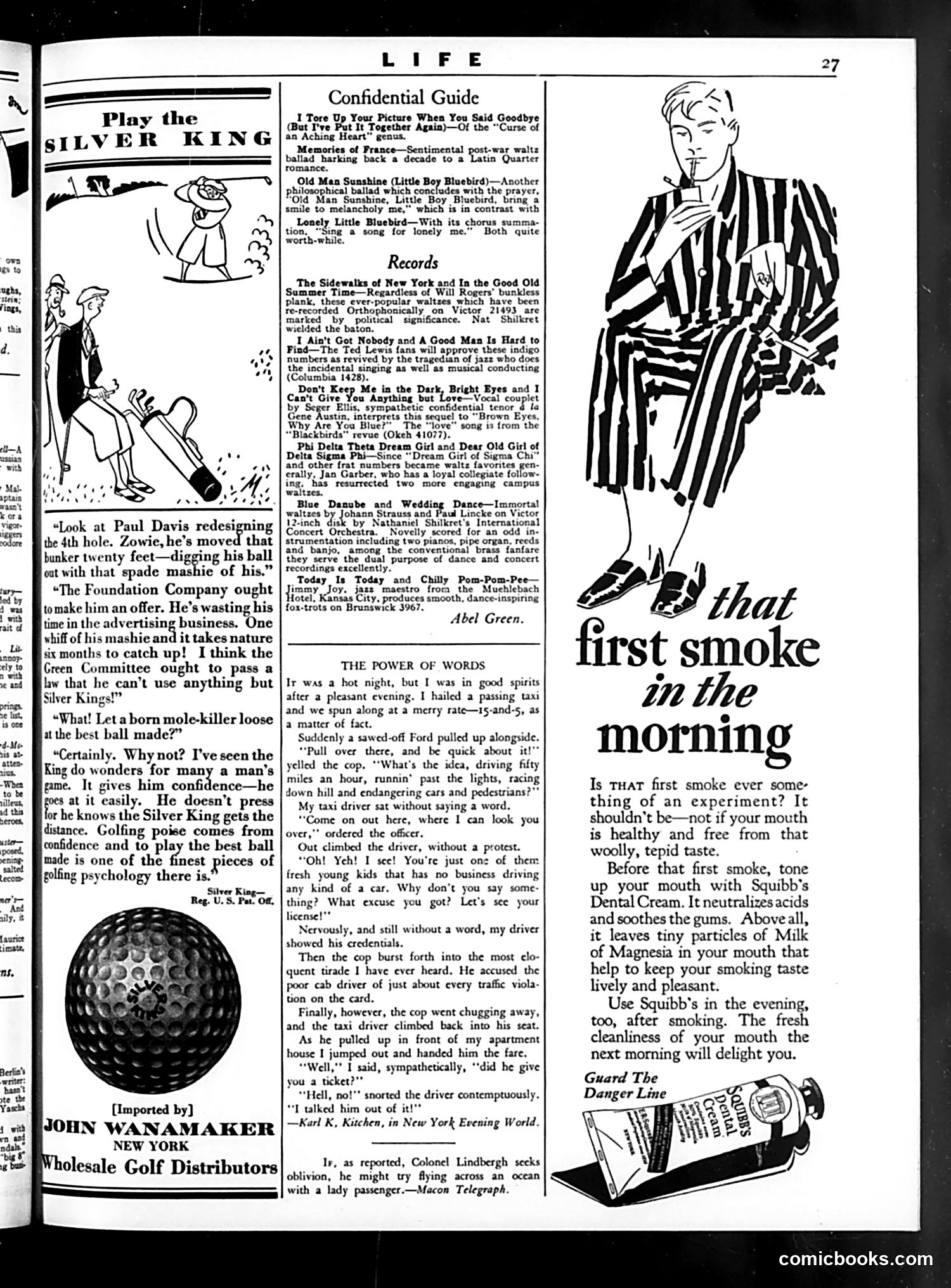
This page primarily contains **advertising and entertainment content**, not political satire. The main cartoon advertises **Silver King golf balls**. Two golfers discuss a man named Paul Davis who is redesigning a golf course's fourth hole. The joke is that Davis digs so aggressively with his golf club (spade mashie) that he's essentially doing the work of a mole—moving earth twenty feet. The humor is visual slapstick: one golfer suggests the Green Committee should restrict Davis to using only Silver King balls since this brand gives golfers such confidence they perform better. It's a light, product-focused joke promoting the golf balls' quality. The page also contains record reviews, music recommendations, and a short story titled "The Power of Words" about a taxi driver and a police officer—none of which are satirical or political in nature. The right side features an advertisement for **Squibb's Dental Cream**, with copy emphasizing oral hygiene after smoking.
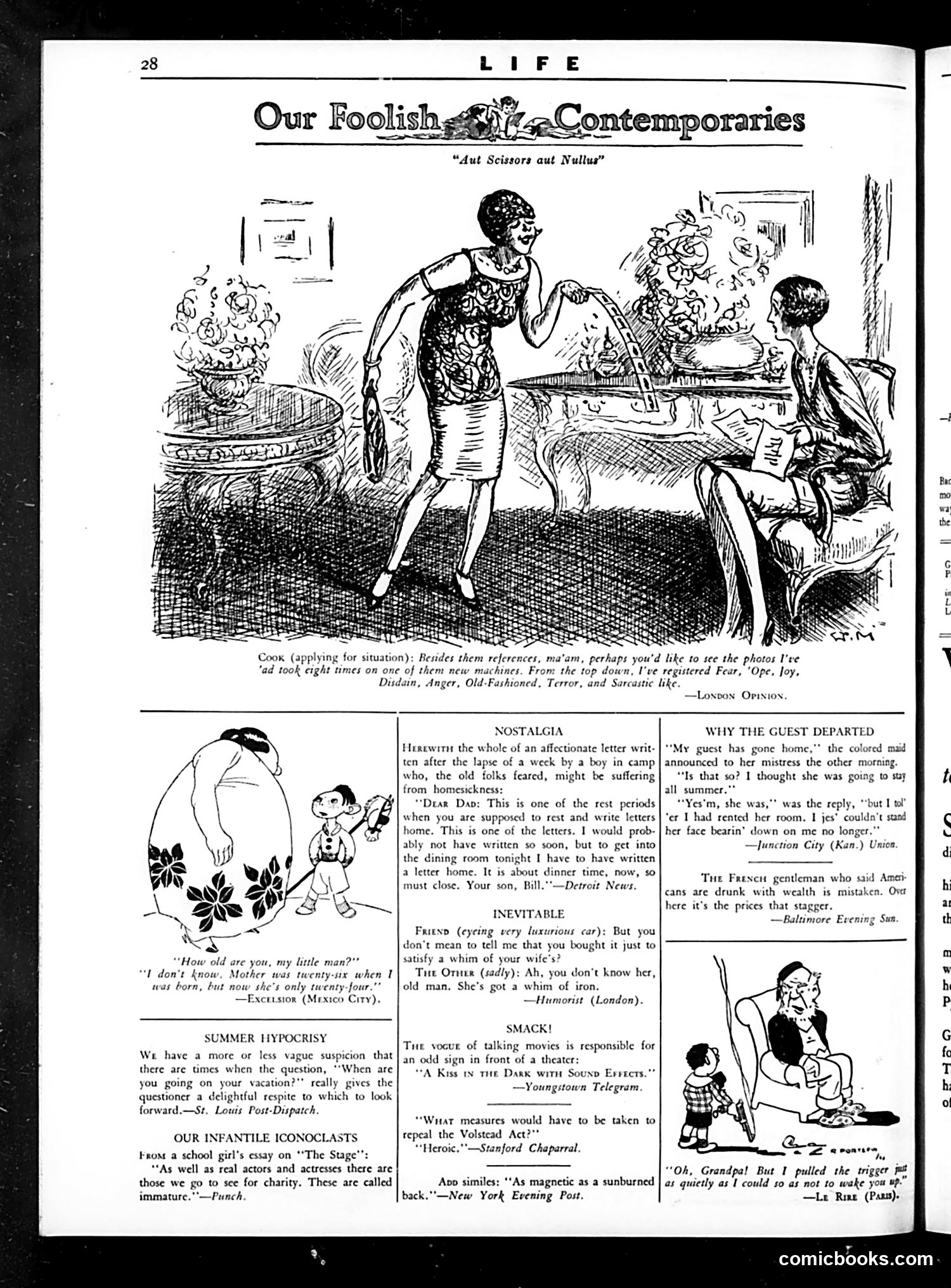
This page collects brief humorous anecdotes and jokes mocking contemporary social behaviors and attitudes. The main cartoon depicts a cook applying for work, claiming to have photographed himself displaying eight different emotional expressions—a joke about the newfangled "photo machines" (early cameras) and people's vanity in documenting themselves. The surrounding text snippets satirize various modern absurdities: a boy at camp reluctant to write home, a wife's irresistible whims over her husband's finances, the awkwardness of talking movies, the high cost of living masquerading as wealth, and a maid's blunt dismissal of a houseguest who overstayed her welcome. The humor targets 1920s-era pretensions, new technology, marital dynamics, and class interactions—all presented as examples of contemporary foolishness worthy of ridicule in Life's satirical tradition.
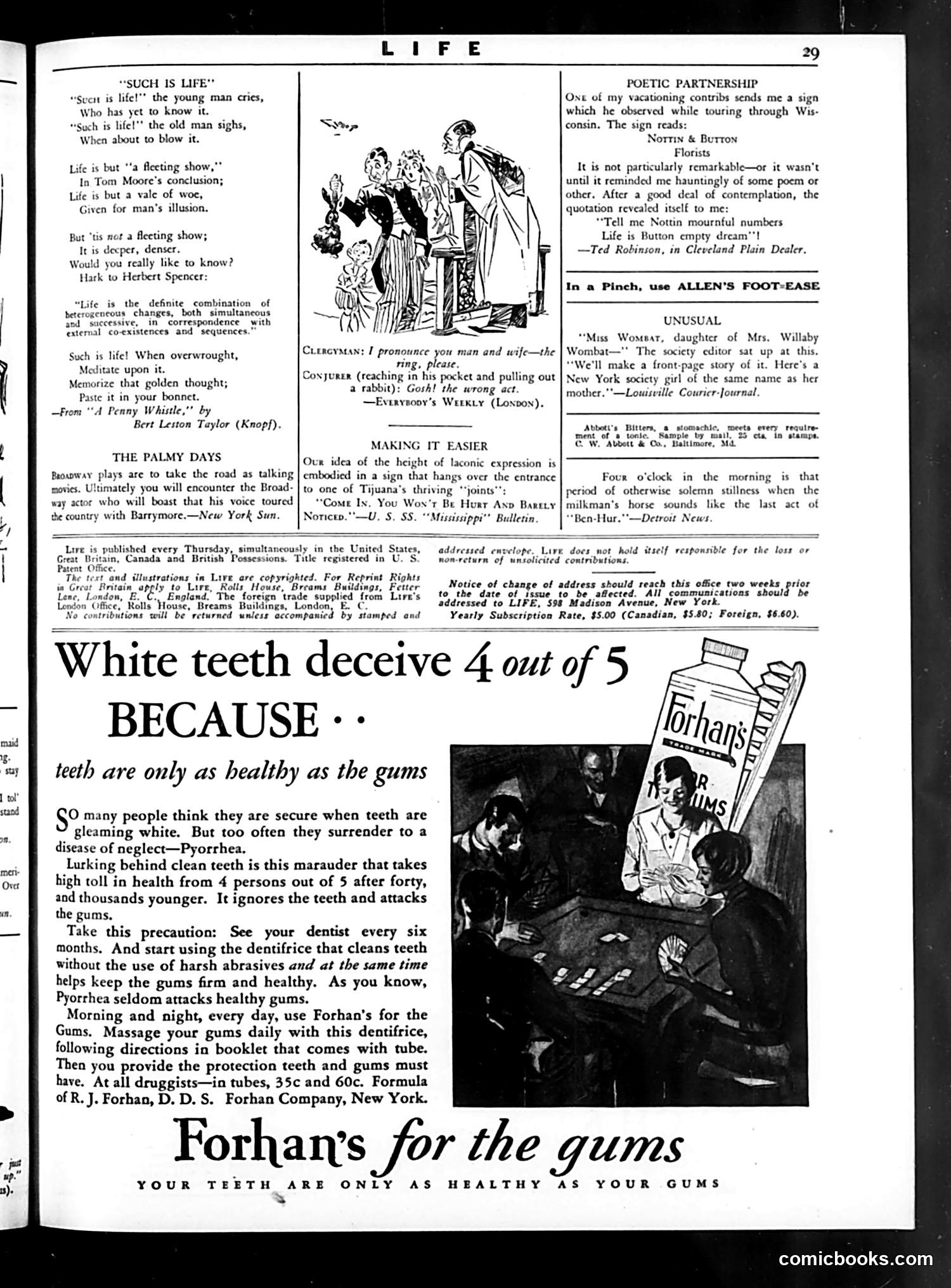
This page combines satirical poetry and humor pieces with a full-page advertisement for Forhan's toothpaste. The content is primarily literary—opening with philosophical musings on the meaning of life, followed by short comedic vignettes: **The cartoons/jokes** include: a clergyman accidentally producing a rabbit instead of a ring during a marriage ceremony (confusing stage magic with religious ritual); a Tijuana establishment's blunt signage; and wordplay connecting a Wisconsin florist sign ("Norrin & Burton") to Longfellow's "Tell me not in mournful numbers, Life is but an empty dream." **The advertisement** occupies the lower half, warning that 4 of 5 people with white teeth actually have gum disease (pyorrhea). It promotes Forhan's dentifrice as superior because it cleans without harsh abrasives while maintaining gum health—a health-conscious sales pitch typical of 1920s-30s advertising that exploited medical anxieties. The page reflects Life's editorial mix: literary humor for educated readers alongside emerging consumer health advertising.
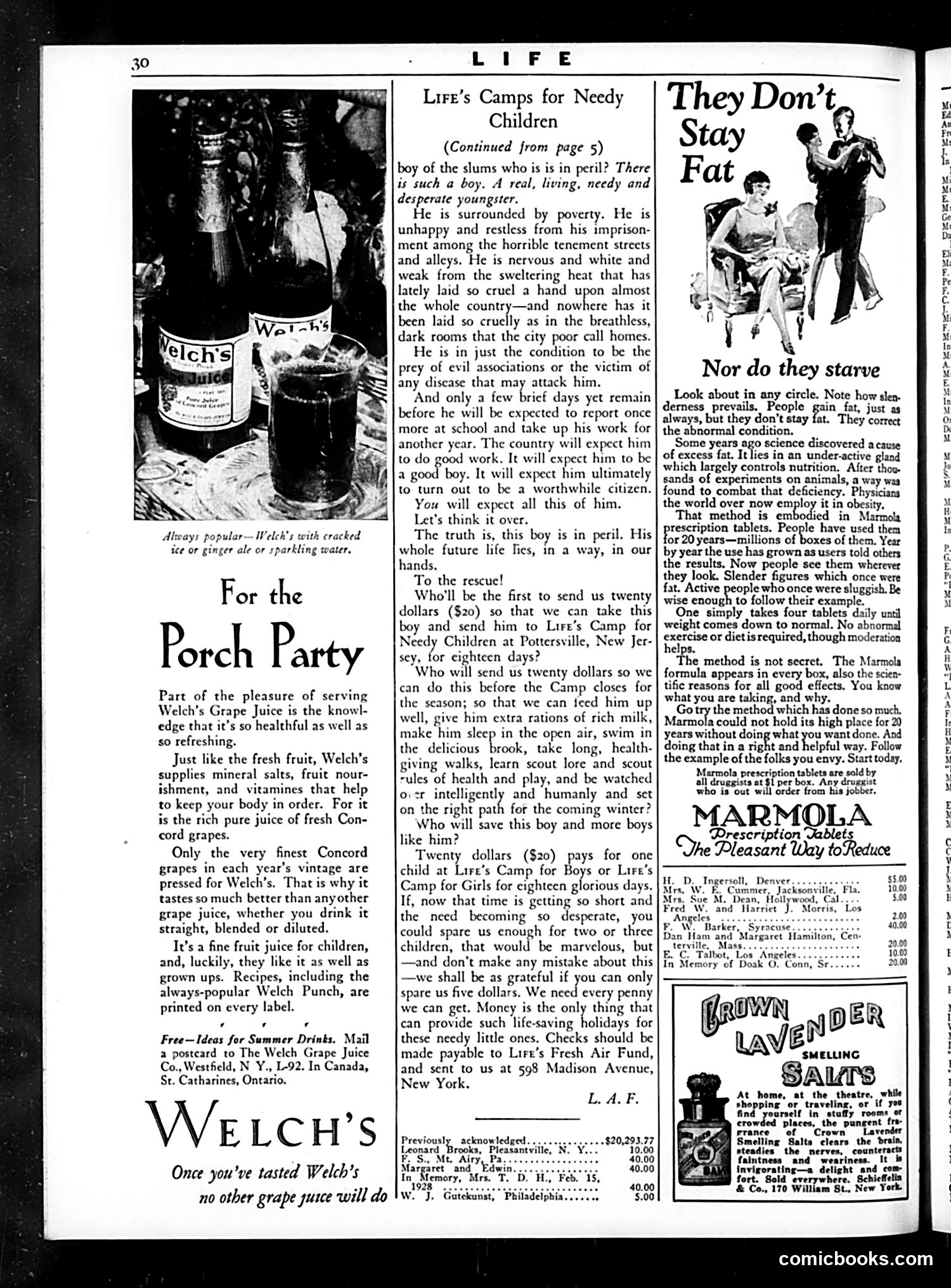
This Life magazine page (page 30) contains two main elements: **Left side:** An advertisement for Welch's Grape Juice, promoting it as a healthy, refreshing beverage for social gatherings ("porch parties"). The ad emphasizes its nutritional value and natural ingredients. **Right side:** An article titled "Life's Camps for Needy Children," a fundraising appeal for camps serving impoverished urban children. The text describes a desperate slum boy in peril from poverty and heat, arguing that $20 can send one child to camp for eighteen days for fresh air, food, swimming, and wholesome activity—potentially redirecting his life away from vice and disease. **Below:** An advertisement for "Marmola," a weight-loss product, claiming people naturally shed excess fat through its "secret formula." The juxtaposition is striking: luxury beverages and weight-loss remedies occupy the same page as urgent pleas for starving children's rescue. This reflects the social inequalities of the era—likely the 1920s based on styling—where affluent readers were simultaneously encouraged to consume and reduce while others lacked basic nutrition.
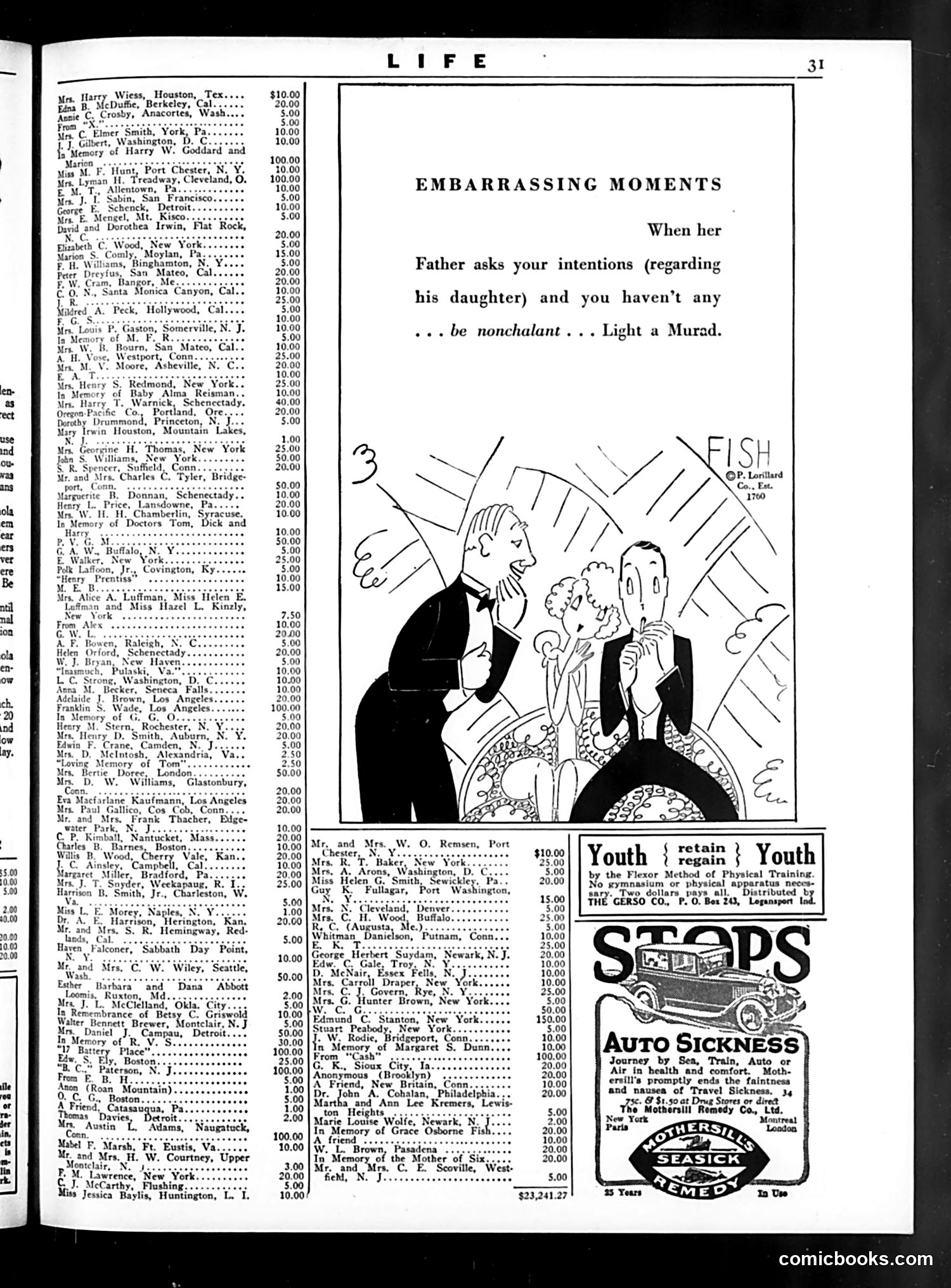
This single-panel cartoon illustrates a classic social awkwardness scenario from the early 20th century. It depicts a young man in formal attire (tuxedo) confronted by a girl's father asking about his intentions toward the man's daughter. The young man appears flustered and anxious—shown by his exaggerated facial expression and body language. The accompanying text offers satirical advice: to handle this mortifying situation, the man should "be nonchalant" and light a Murad cigarette (a brand being advertised). The humor stems from the absurdity of the solution—suggesting that smoking a cigarette somehow provides social composure and dignity when caught without romantic intentions. This reflects period courtship customs where fathers formally questioned suitors about marriage prospects. The cartoon satirizes both male anxiety about these confrontations and the era's faith in cigarettes as a marker of sophistication and calm.
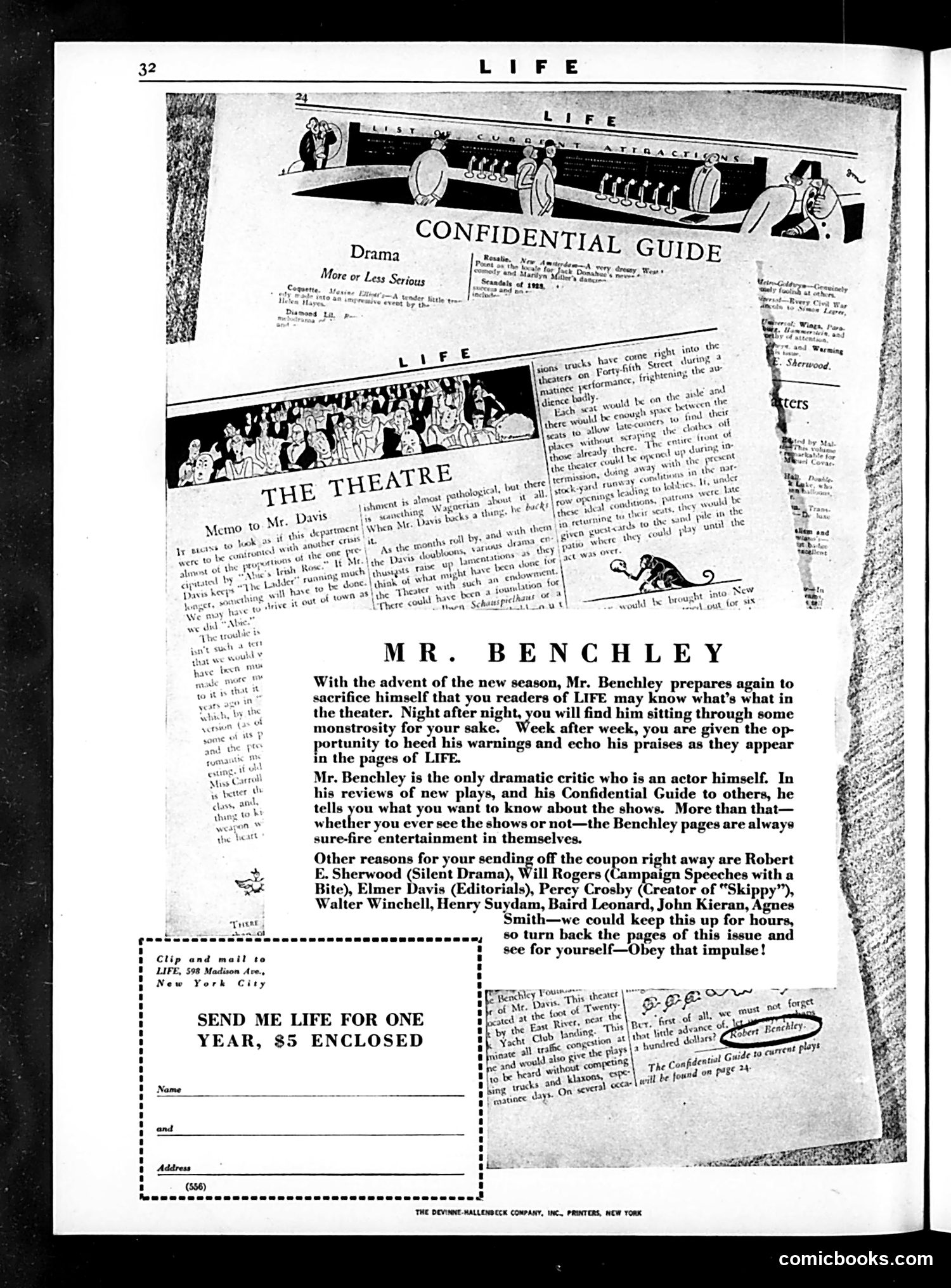
This page promotes Life magazine's theater coverage and solicits subscriptions. The main feature introduces **Robert Benchley**, a dramatic critic and actor, as Life's entertainment columnist. Benchley is positioned as uniquely qualified because he's both a theater professional and critic—giving him authority to review plays. The text emphasizes that readers should trust Benchley's weekly warnings about bad shows and praise for good ones. He also produces a "Confidential Guide" to theater—apparently a recurring feature helping readers decide what to see. The page lists other notable contributors to attract subscribers: Will Rogers (political commentary), Elmer Davis (editorials), Percy Crosby (cartoonist), and Walter Winchell (gossip columnist). The subscription offer at bottom-left—$5 for one year—was Life's main monetization during this era. The overall message: subscribe to Life for reliable theater guidance and entertaining commentary from well-known personalities. The specific date and Benchley's prominence suggest this is from early-to-mid 1920s, when Life was prominent and Benchley was a major entertainment figure.
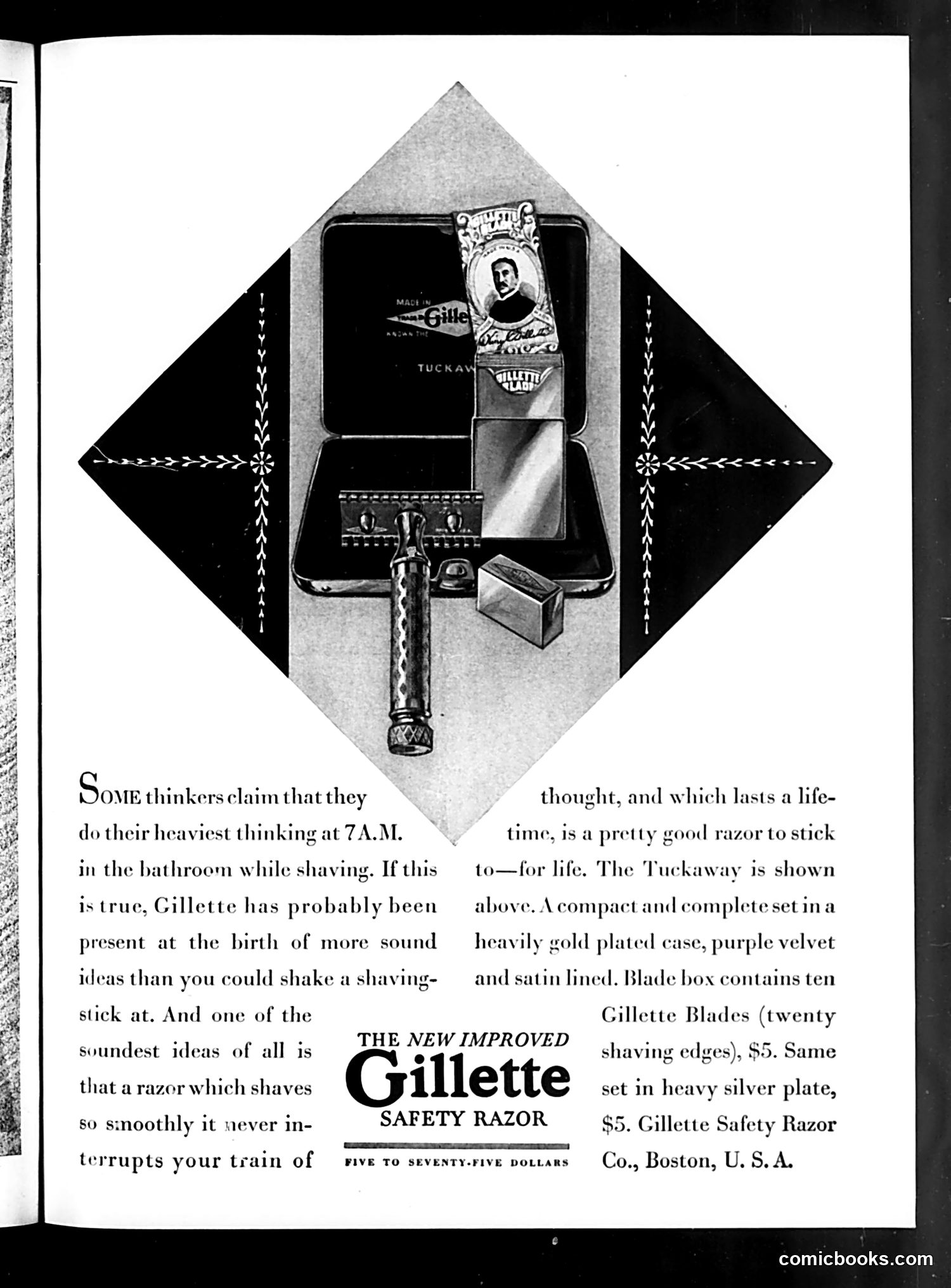
This is a **Gillette Safety Razor advertisement**, not political satire. The page promotes Gillette's "Tuckaway" razor model through a humorous premise: that serious thinking happens during morning bathroom shaving, so a quality razor that doesn't interrupt your concentration is valuable. The diamond-shaped image shows the razor product in its gold-plated or silver-plated case with velvet lining. The advertisement uses gentle comedy about male bathroom routines to pitch the razor as a lifetime investment ($5-$75 depending on case material). There are no political figures or satirical commentary present. This appears to be a standard early 20th-century lifestyle advertisement using wit to market a consumer product—typical of *Life* magazine's advertising content during this era.

This is **not a cartoon or satire**—it's a straightforward **product advertisement page** from Life magazine, likely from 1929. The page displays four Atwater Kent Radio models (40, 42, E-2 speaker, and 44) with photographs and promotional text. Each model emphasizes desirable features: the Model 40 boasts improved power and sensitivity; the Model 42 highlights reliability with no batteries needed; the E-2 speaker claims superior sound fidelity; and the Model 44 emphasizes durability and long-range reception. The ads reflect late 1920s consumer culture and radio's growing centrality to American homes. Notably, the Model 42 advertisement mentions "Atwater Kent Radio Hour—listen in!" suggesting the company sponsored popular programming. **For modern readers:** This represents how radio was marketed as cutting-edge home technology requiring ongoing model upgrades—similar to how smartphones or televisions are marketed today. The emphasis on reliability and performance indicates radio ownership was still novel enough to require reassurance.