
Life, 1928-08-30 · page 18 of 36
Life — August 30, 1928 — page 18: what you’re looking at
What you’re looking at
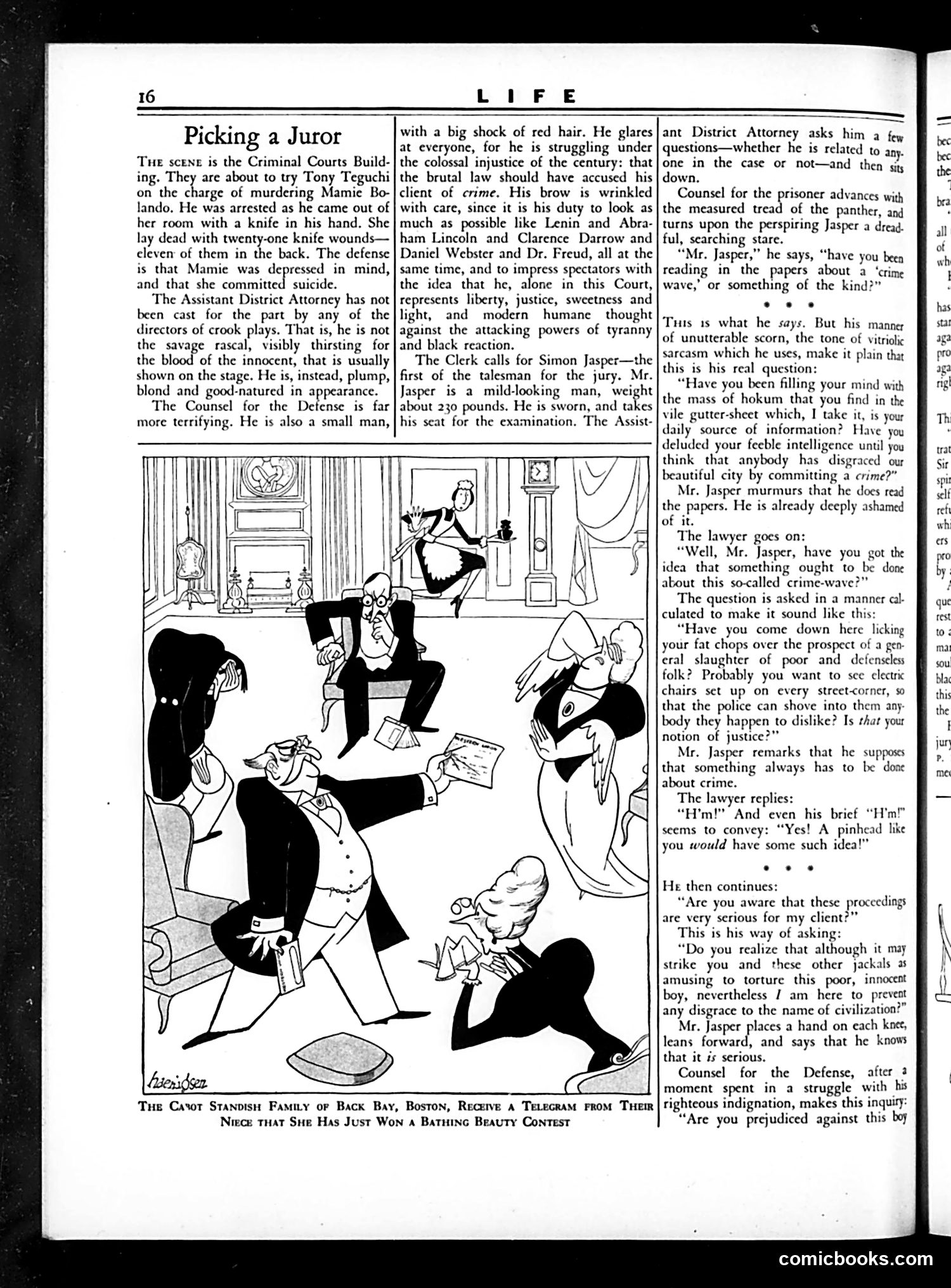
This page satirizes the jury selection process in a criminal court case. The cartoon depicts a chaotic courtroom scene where potential jurors are being questioned. The main illustration shows well-dressed figures in animated discussion—likely lawyers, judges, and jurors—with papers scattered about, suggesting the disorderly nature of jury examination. The accompanying article critiques how lawyers and judges question jurors, with extensive dialogue showing the Defense Counsel asking leading questions designed to bias jurors against the prosecution. The satire targets the manipulation tactics used during jury selection, where lawyers attempt to plant ideas and prejudices rather than seek impartial judgment. The illustration captures the theatrical absurdity of these legal proceedings from what appears to be the 1920s-1930s era.
📄 Transcribed text from this page (OCR, searchable)
Machine-transcribed from the original scan — historical spelling and the odd misread are preserved.
LIFE TT OO Picking a Juror Tue scene is the Criminal Courts Build- ing. They are about to try Tony Teguchi on the charge of murdering Mamie Bo- lando. He was arrested as he came out of her room with a knife in his hand, She lay dead with twenty-one knife wounds— clever of them in the back. The defense is that Mamie was depressed in mind, and that she committed suicide. The Assistant District Attorney has not been cast for the part by any of the directors of crook plays. That is, he is not the savage rascal, visibly thirsting for the blood of the innocent, that is usually shown on the stage. He is, instead, plump, ond and good-natured in appearance. The Counsel for the Detense is far nore terrifying. He is also a small man, with a big shock of red hair. He glares at everyone, for he is struggling under the colossal injustice of the century: that the brutal law should have accused his client of crime. His brow is wrinkled with care, since it is his duty to look as much as possible like Lenin and Abra- ham Lincoln and Clarence Darrow and Daniel Webster and Dr. Freud, all at the same time, and to impress spectators with the idea that he, alone in this Court, represents liberty, justice, sweetness and light, and modern humane thought against the attacking powers of tyranny and black reaction. The Clerk calls for Simon Jasper—the first of the talesman for the jury. Mr. Jasper is a mild-looking man, weight about 230 pounds. He is sworn, and takes his seat for the examination. The Assist- fiers Oger Tue Caxot Stanvisi Famity or Back Bay, Boston, Recetve A TeLecraMm FROM THEIR Niece THAT Sue Has Just Won A Batinc Beauty Contest ant District Attorney asks him a few questions—whether he is related to any. one in the case or not—and then Sits down. Counsel for the prisoner advances with the measured tread of the panther, and turns upon the perspiring Jasper a dread. ful, searching stare. “Mr. Jasper,” he says, “have you been reading in the papers about a ‘crime wave,’ or something of the kind?” eee Tus is what he says. But his manner of unutterable scorn, the tone of vitriolic sarcasm which he uses, make it plain that this is his real question: “Have you been filling your mind with the mass of hokum that you find in the vile gutter-sheet which, I take it, is your daily source of information? Have you deluded your feeble intelligence until you think that anybody has disgraced our beautiful city by committing a crime?” Mr. Jasper murmurs that he does read the papers. He is already deeply ashamed of it. The lawyer goes on: “Well, Mr. Jasper, have you got the idea that something ought to be done about this so-called crime-wave?” The question is asked in a manner cal- culated to make it sound like this: “Have you come down here licking your fat chops over the prospect of a gen- eral slaughter of poor and defenseless folk? Probably you want to sce electric chairs set up on every street-corner, $0 that the police can shove into them any- body they happen to dislike? Is shat your notion of justice?” Mr. Jasper remarks that he supposes that something always has to be done about crime. The lawyer replies: “H'm!"" And even his brief “H'm!” seems to convey: “Yes! A pinhead like you would have some such idea!” He then continues: “Are you aware that these proceedings are very serious for my client?” This is his way of asking: “Do you realize that although it may strike you and these other jackals as amusing to torture this poor, innocent boy, nevertheless / am here to prevent any disgrace to the name of civilization?” Mr. Jasper places a hand on each knee, leans forward, and says that he knows that it és serious. Counsel for the Defense, after 2 moment spent in a struggle with his righteous indignation, makes this inquity: “Are you prejudiced against this boy comicbooks.com Fez il