
Life, 1928-08-30 · page 26 of 36
Life — August 30, 1928 — page 26: what you’re looking at
What you’re looking at
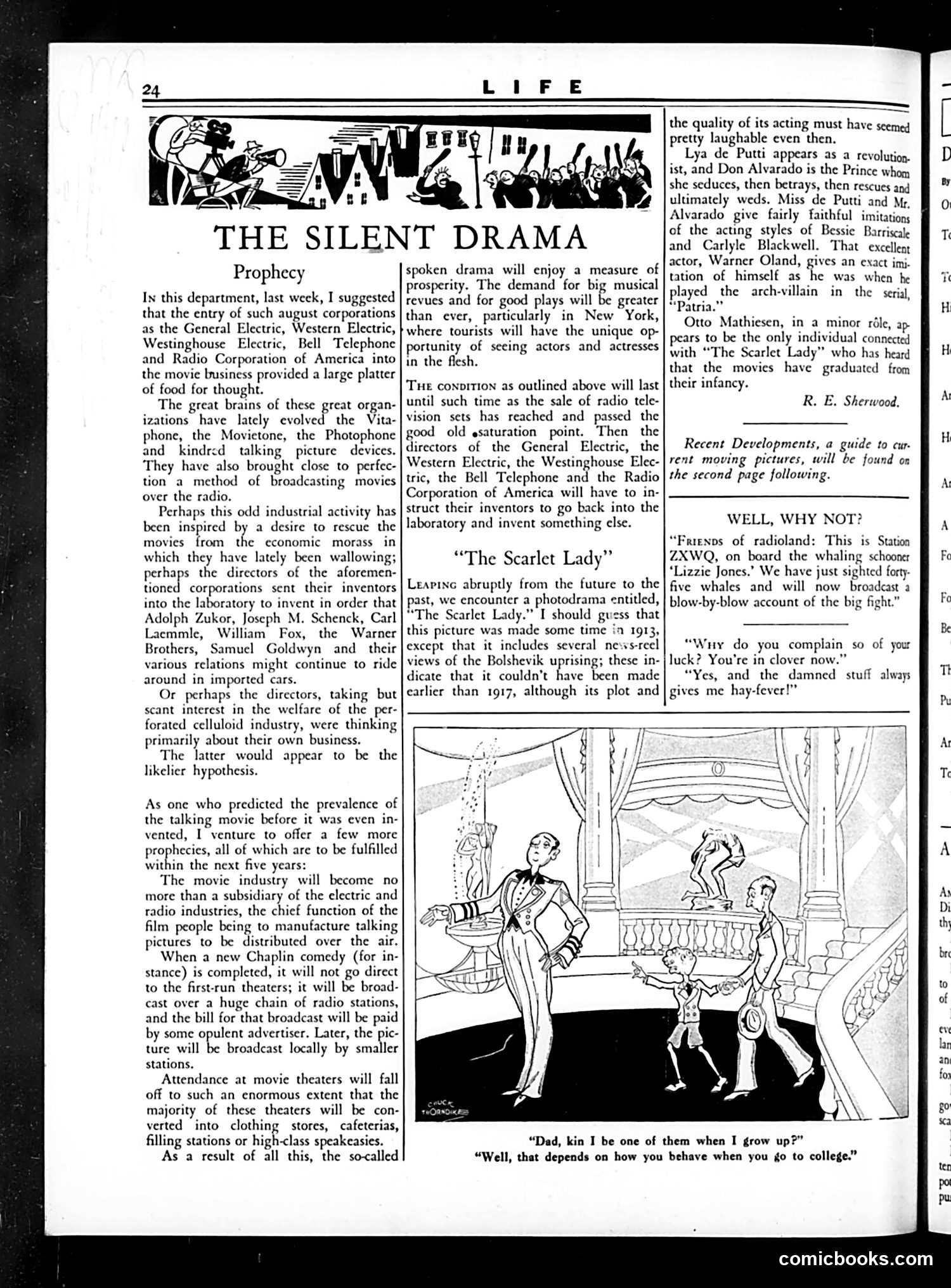
This page discusses the impending threat to silent films from newly-entered corporations (General Electric, Westinghouse, Bell Telephone, RCA) developing sound and radio broadcast technology. The author satirizes movie moguls like Adolph Zukor and Samuel Goldwyn, suggesting these corporations will ultimately make theaters obsolete by broadcasting films over radio. The prophecy mocks the industry's pretense: corporations claim to "rescue" cinema, but realistically seek profit for themselves. The author predicts movie theaters will convert to "clothing stores, cafeterias...or high-class speakeasies"—a sarcastic jab at Prohibition-era America. The cartoon below depicts a father and child discussing career ambitions, with the child asking to become a movie star. The father's reply—that success "depends on how you behave when you go to college"—suggests early 1920s anxiety about the film industry's moral reputation and uncertain future prospects.
📄 Transcribed text from this page (OCR, searchable)
Machine-transcribed from the original scan — historical spelling and the odd misread are preserved.
ge TH Prophecy In this department, last week, I suggested that the entry of such august corporations as the General Electric, Western Electric, Westinghouse Electric, Bell Telephone and Radio Corporation of America into the movie business provided a large platter of food for thought. The great brains of these great organ- izations have lately evolved the Vita- phone, the Movietone, the Photophone and kindred talking picture devices. They have also brought close to perfec- tion a method of broadcasting movies over the radio. Perhaps this odd industrial activity has been inspired by a desire to rescue the movies from the economic morass in which they have lately been wallowing; perhaps the directors of the aforemen- tioned corporations sent their inventors into the laboratory to invent in order that | P: Adolph Zukor, Joseph M. Schenck, Carl Laemmle, William Fox, the Warner Brothers, Samuel Goldwyn and their various relations might continue to ride around in imported cars. Or perhaps the directors, taking but scant interest in the welfare of the per- forated celluloid industry, were thinking primarily about their own business. The latter would appear to be the likelier hypothesis. As one who predicted the prevalence of the talking movie before it was even in- vented, I venture to offer a few more prophecies, all of which are to be fulfilled within the next five years: The movie industry will become no more than a subsidiary of the electric and radio industries, the chief function of the film people being to manufacture talking pictures to be distributed over the air. When a new Chaplin comedy (for in- stance) is completed, it will not go direct to the first-run theaters; it will be broad- cast over a huge chain of radio stations, and the bill for that broadcast will be paid by some opulent advertiser. Later, the pic- ture will be broadcast locally by smaller stations, Attendance at movie theaters will fall off to such an enormous extent that the majority of these theaters will be con- verted into clothing stores, cafeterias, filling stations or high-class speakeasies. As a result of all this, the so-called E SILENT DRAMA spoken drama will enjoy a measure of prosperity. The demand for big musical revues and for good plays will be greater than ever, particularly in New York, where tourists will have the unique op- portunity of seeing actors and actresses in the flesh. THE conpITIoN as outlined above will last until such time as the sale of radio tele- vision sets has reached and passed the good old esaturation point. Then the directors of the General Electric, the Western Electric, the Westinghouse Elec- tric, the Bell Telephone and the Radio Corporation of America will have to in- struct their inventors to go back into the laboratory and invent something else. “The Scarlet Lady” Leavine abruptly from the future to the ast, we encounter a photodrama entitled, “The Scarlet Lady.” I should guess that this picture was made some time in 1913, except that it includes several news-reel views of the Bolshevik uprising; these in- dicate that it couldn't have been made earlier than 1917, although its plot and the quality of its acting must have seemed pretty laughable even then, Lya de Putti appears as a revolution. ist, and Don Alvarado is the Prince whom she seduces, then betrays, then rescues and ultimately weds. Miss de Putti and Mr, Alvarado give fairly faithful imitations of the acting styles of Bessie Barriscale and Carlyle Blackwell. That excellent actor, Warner Oland, gives an exact imi- tation of himself as he was when he played the arch-villain in the serial, “Patria.” Otto Mathiesen, in a minor rile, ap pears to be the only individual connected with “The Scarlet Lady” who has heard that the movies have graduated from their infancy. R. E. Sherwood. Recent Developments, a guide to cur- rent moving pictures, will be found on the second page following. WELL, WHY NOT? “Frrenps of radioland: This is Station ZXWQ, on board the whaling schooner ‘Lizzie Jones.’ We have just sighted forty- five whales and will now broadcast a blow-by-blow account of the big fight.” “Why do you complain so of your luck? You're in clover now.” “Yes, and the damned stuff always gives me hay-fever!”” “Dad, kin I be one of them when I grow up?” “Well, that depends on how you behave when you go to college.” comicbooks.com