
Life, 1928-08-30 · page 20 of 36
Life — August 30, 1928 — page 20: what you’re looking at
What you’re looking at
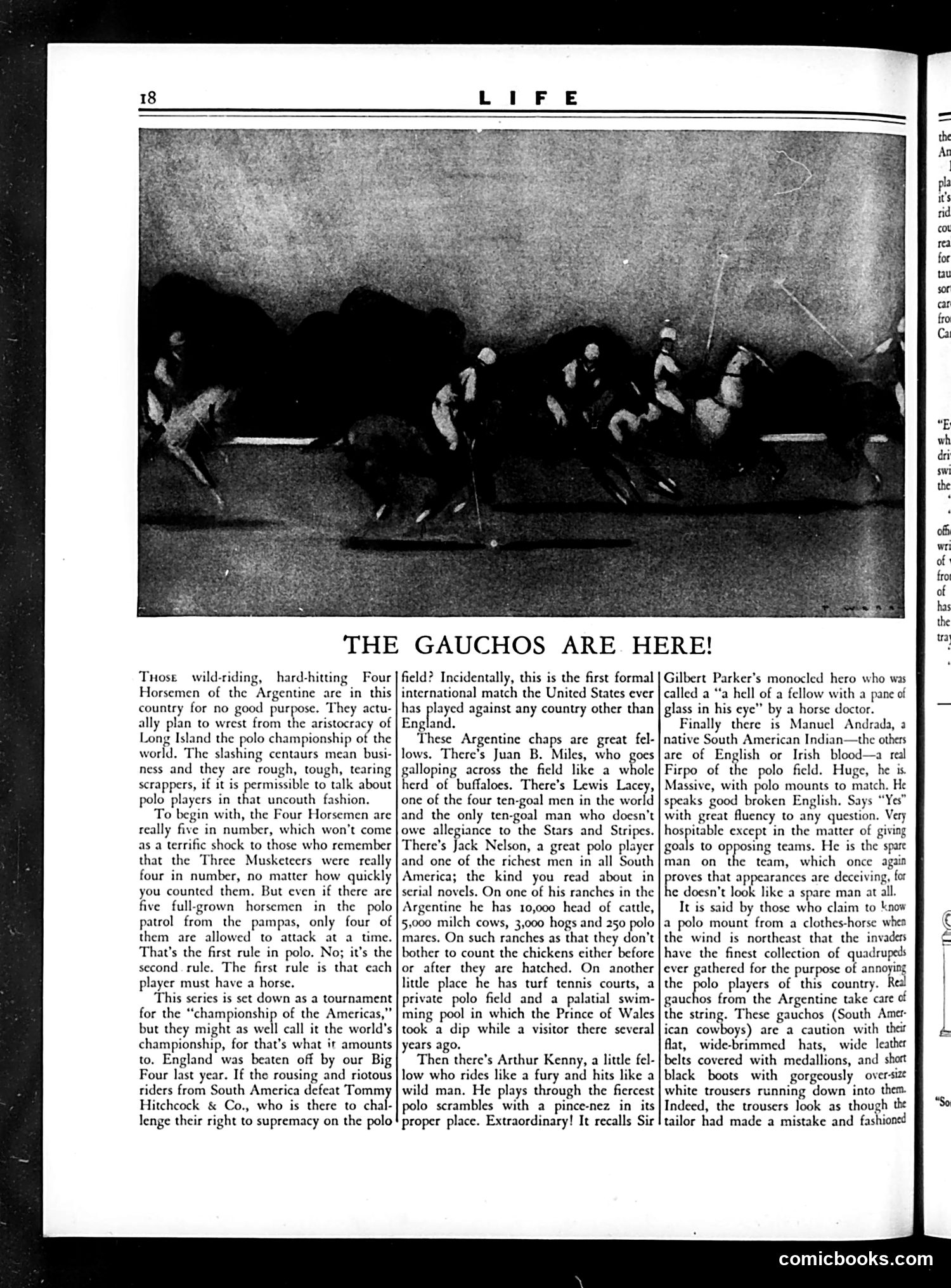
This 1920s Life magazine article humorously announces an Argentine polo team's visit to challenge American champions for the "championship of the Americas." The piece names five skilled Argentine players—Juan B. Miles, Lewis Lacey, Jack Nelson, Arthur Kenny, and Manuel Andrada—presenting them as formidable competitors threatening Long Island's polo aristocracy. The satire works on multiple levels: it mock-heroically elevates a sporting match to geopolitical significance, exaggerates the players' wealth and exotic backgrounds (Jack Nelson's vast ranches), and gently ridicules their appearance and habits (Andrada's indigenous heritage, the gauchos' flamboyant costume). The opening photograph shows players in action. The joke assumes readers recognize polo as an elite American pastime and enjoy the prospect of these colorful foreigners challenging established authority—a common early-20th-century American anxiety presented as comedic entertainment.
📄 Transcribed text from this page (OCR, searchable)
Machine-transcribed from the original scan — historical spelling and the odd misread are preserved.
THE Tuose wild-riding, hard-hitting Four Horsemen of the Argentine are in this country for no good purpose: They actu- ally plan to wrest from the aristocracy of Long Island the polo championship of the world. The slashing centaurs mean busi- ness and they are rough, tough, tearing scrappers, if it is permissible to talk about polo players in that uncouth fashion. To begin with, the Four Horsemen are really five in number, which won't come as a terrific shock to those who remember that the Three Musketeers were really four in number, no matter how quickly you counted them. But even if there are five full-grown horsemen in the polo patrol from the pampas, only four of them are allowed to attack at a time. That's the first rule in polo. No; it’s the second rule. The first rule is that cach player must have a horse. This series is set down as a tournament for the “championship of the Americas,” but they might as well call it the world’s championship, for that’s what it amounts to. England was beaten off by our Big Four last year. If the rousing and riotous riders from South America defeat Tomm' Hitchcock & Co., who is there to chal- lenge their right to supremacy on the polo GAUCHOS ARE. HERE! field? Incidentally, this is the first formal international match the United States ever has played against any country other than England. These Argentine chaps are great fel- lows. There’s Juan B. Miles, who goes galloping across the field like a whole herd of buffaloes. There’s Lewis Lacey, one of the four ten-goal men in the world and the only ten-goal man who doesn’t owe allegiance to the Stars and Stripes. There's Jack Nelson, a great polo player and one of the richest men in all South America; the kind you read about in serial novels. On one of his ranches in the Argentine he has 10,000 head of cattle, 5,000 milch cows, 3,000 hogs and 250 polo mares. On such ranches as that they don’t bother to count the chickens either before or after they are hatched. On another little place he has turf tennis courts, a private polo field and a palatial swim- ming pool in which the Prince of Wales took a dip while a visitor there several years ago. Then there’s Arthur Kenny, a little fel- low who rides like a fury and hits like a wild man. He plays through the fiercest polo scrambles with a pince-nez in its proper place. Extraordinary! It recalls Sir Gilbert Parker's monocled hero who was called a “‘a hell of a fellow with a pane of glass in his eye” by a horse doctor. Finally there is Manuel Andrada, a native South American Indian—the others are of English or Irish blood—a real Firpo of the polo field. Huge, he is. Massive, with polo mounts to match. speaks good broken English. Says with great fluency to any question. Very hospitable except in the matter of giving goals to opposing teams. He is the spare man on the team, which once again roves that appearances are deceiving, for ¢ doesn’t look like a spare man at all. It is said by those who claim to know a polo mount from a clothes-horse whea the wind is northeast that the invaders have the finest collection of quadrupeds ever gathered for the purpose of annoying the polo players of this country. Red gauchos from the Argentine take care ot the string. These gauchos (South Amer ican cowboys) are a caution with their flat, wide-brimmed hats, wide leather belts covered with medallions, and short black boots with gorgeously over-size white trousers running down into them. Indeed, the trousers look as though the tailor had made a mistake and fashioned comicbooks.com the An ! ‘So