
Life, 1928-08-30 · page 12 of 36
Life — August 30, 1928 — page 12: what you’re looking at
What you’re looking at
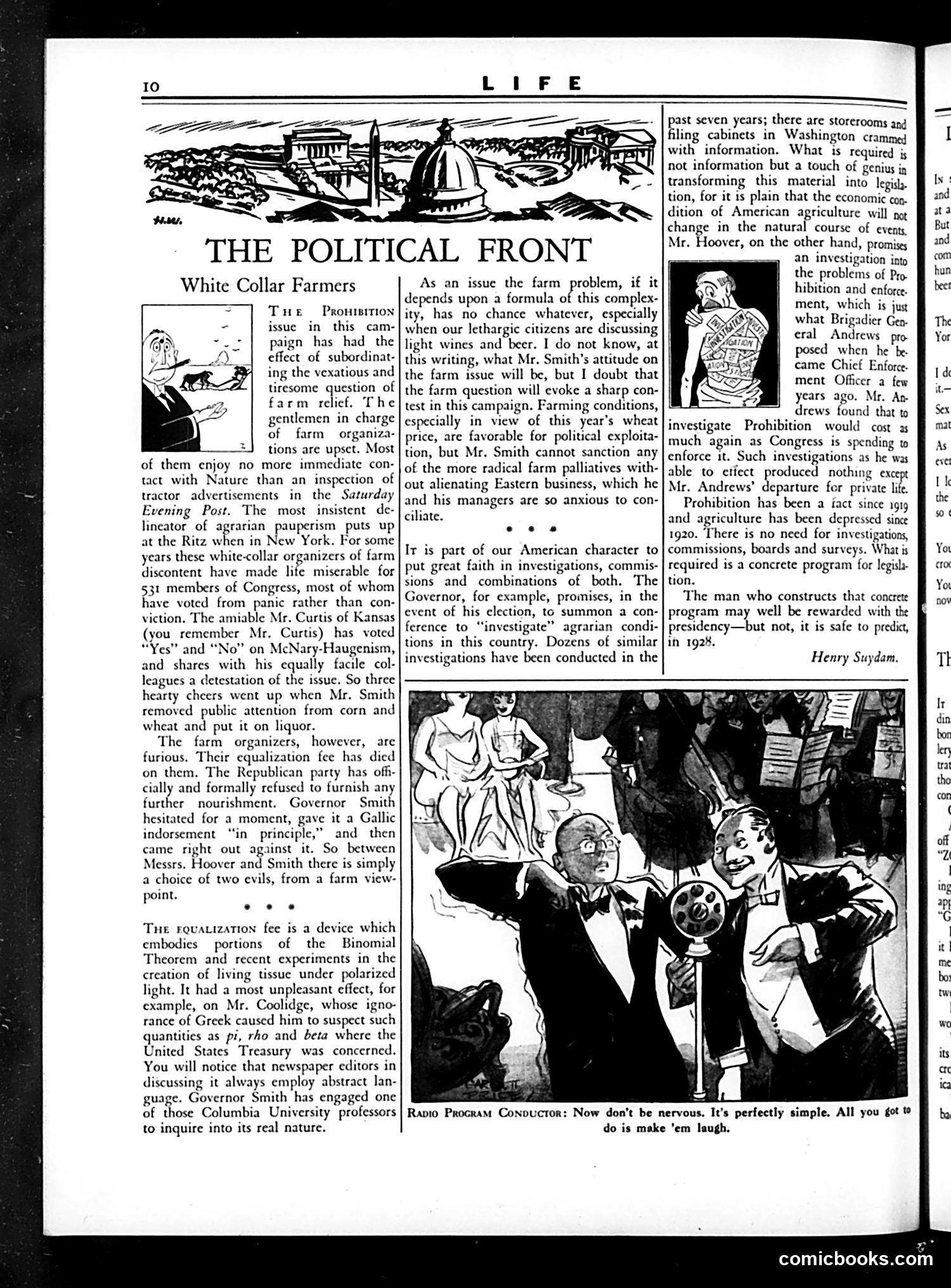
This page satirizes American farm policy debates during Prohibition-era politics. The main article criticizes how farm organizations have politicized agricultural relief, with three congressmen removed from office for their stance on the issue. The cartoon at bottom depicts a **Radio Program Conductor** instructing two men (likely politicians or entertainers) to "make 'em laugh" rather than address serious concerns—satirizing how politicians use entertainment and humor to distract voters from substantive policy problems like farm relief. The piece critiques Governor Smith's investigation into farm conditions as superficial gesture politics, while opposing any concrete legislative action. The overall message: politicians prefer entertaining the public over solving real agricultural crises caused by Prohibition's economic disruption.
📄 Transcribed text from this page (OCR, searchable)
Machine-transcribed from the original scan — historical spelling and the odd misread are preserved.
—— - g ~~ a) Os — ‘ White Collar Farmers Tue Prowtsrtion issue in this cam- paign has had the effect of subordinat- ing the vexatious and tiresome question of farm relief. The gentlemen in charge of farm organiza- tions are upset. Most of them enjoy no more immediate con- tact with Nature than an inspection of tractor advertisements in the Saturday Evening Post. The most insistent de- lineator of agrarian pauperism puts up at the Ritz shen in New York. For some years these white-collar organizers of farm discontent have made lite miserable for 531 members of Congress, most of whom have voted from panic rather than con- viction. The amiable Mr. Curtis of Kansas (you remember Mr. Curtis) has voted “Yes” and “No” on McNary-Haugenism, and shares with his equally facile col- leagues a detestation of the issue. So three hearty cheers went up when Mr. Smith removed public attention from corn and wheat and put it on liquor. The farm organizers, however, are furious. Their equalization fee has died on them. The Republican party has offi- cially and formally refused to furnish any further nourishment. Governor Smith hesitated for a moment, gave it a Gallic indorsement “in principle,” and then came right out against it. So between Messrs. Hoover and Smith there is simply a choice of two evils, from a farm view- point. eee Tue rovauization fee is a device which embodies portions of the Binomial Theorem and recent experiments in the creation of living tissue under polarized light. It had a most unpleasant effect, for example, on Mr. Coolidge, whose igno- rance of Greek caused him to suspect such quantities as pi, rho and beta where the United States Treasury was concerned. You will notice that newspaper editors in discussing it always employ abstract lan- guage. Governor Smith has engaged one of those Columbia University professors to inquire into its real nature. As an issue the farm depends upon a formula o} ity, has no chance whatever, especially when our lethargic citizens are discussing light wines and beer. I do not know, at this writing, what Mr. Smith's attitude on the farm issue will be, but I doubt that the farm question will evoke a sharp con- test in this campaign. Farming conditions, especially in view of this year’s wheat price, are favorable for political exploita- tion, but Mr. Smith cannot sanction any of the more radical farm palliatives with- out alienating Eastern business, which he and his managers are so anxious to con- ciliate. probes, if it eee Ir is part of our American character to put great faith in investigations, commis- sions and combinations of both. The Governor, for example, promises, in the event of his election, to summon a con- ference to “investigate” agrarian condi- tions in this country. Dozens of similar investigations have been conducted in the this complex- | past seven years; there are storerooms and ling cabinets in Washington crammed with information. What is required js not information but a touch of genius in transforming this material into legisla. tion, for it is plain that the economic con. dition of American agriculture will not change in the natural course of events, Mr. Hoover, on the other hand, promises an investigation into the problems of Pro hibition and enforce. ment, which is jus what Brigadier Gen- eral Andrews pro- posed when he be came Chief Enforce. ment Officer a few years ago. Mr. An- drews found that to investigate Prohibition would cost a much again as Congress is spending to enforce it. Such investigations as he was able to etiect produced nothing exce Mr. Andrews’ departure for private tik Prohibition has been a fact since igig and agriculture has been depressed since 1920. There is no need for investigations, commissions, boards and surveys. What is required is a concrete program for legisla tion, The man who constructs that concrete program may well be rewarded with the presidency—but not, it is safe to predict, Henry Suydam, | Rapio Procram Conouctor: Now don’t be nervous. It’s perfectly simple. All you got do is make ’em laugh. comicbooks.com