
Life, 1928-08-30 · page 8 of 36
Life — August 30, 1928 — page 8: what you’re looking at
What you’re looking at
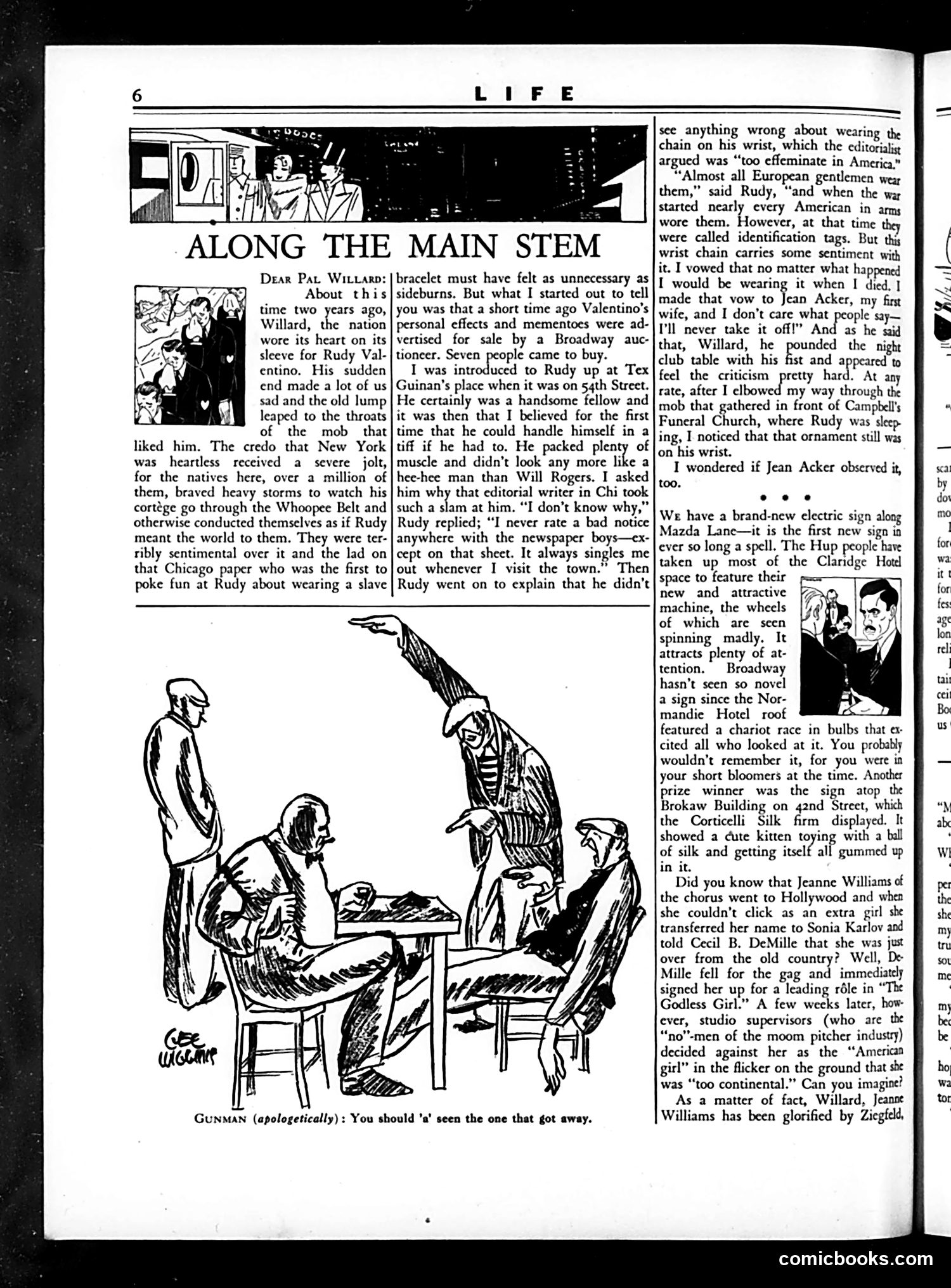
This page contains a gossip column by "Dear Pal Willard" discussing New York City social observations. The main cartoon, credited to Gunman, depicts a street scene where a gunman apologetically shoots someone, with the caption "You should 'a' seen the one that got away"—a dark joke playing on the common fishing phrase to satirize gun violence in 1920s New York. The column discusses various Broadway and Manhattan topics, including a new electric sign on Mazda Lane and references to theater personalities like Jeanne Williams. The overall tone mixes social satire with crime-era humor typical of Life's satirical approach during the Prohibition period.
📄 Transcribed text from this page (OCR, searchable)
Machine-transcribed from the original scan — historical spelling and the odd misread are preserved.
ALONG THE Dear Par Witvarp: About this time two years ago, Willard, the nation wore its heart on its sleeve for Rudy Val- entino. His sudden end made a lot of us sad and the old lump leaped to the throats of the mob that liked him. The credo that New York was heartless received a severe jolt, for the natives here, over a million of them, braved heavy storms to watch his cortége go through the Whoopee Belt and otherwise conducted themselves as if Rudy meant the world to them. They were ter- ribly sentimental over it and the lad on that Chicago paper who was the first to poke fun at Rudy about wearing a slave : eli ” a al bracelet must have felt as unnecessary as sideburns. But what I started out to tell you was that a short time ago Valentino's personal effects and mementoes were ad- vertised for sale by a Broadway auc- tioneer. Seven people came to buy. I was ceroduced to Rudy up at Tex Guinan’s place when it was on 54th Street. He certainly was a handsome fellow and it was then that I believed for the first time that he could handle himself in a uff if he had to. He packed plenty of muscle and didn’t look any more like a hee-hee man than Will Rogers. I asked him why that editorial writer in Chi took such a slam at him. “I don’t know why,” Rudy replied; “I never rate a bad notice anywhere with the newspaper boys—ex- cept on that sheet. It always singles me out whenever I visit the town.” Then Rudy went on to explain that he didn’t GuNMAN (apologetically): You should 'a’ seen the one that got away. see anything wrong about wearin; chain ps his pias hort the odes argued was “‘too effeminate in America,” “Almost all European gentlemen wea them,” said Rudy, “and when the war started nearly every American in ams wore them. However, at that time were called identification tags. But this wrist chain carries some sentiment with it. I vowed that no matter what happened I would be wearing it when I died, | made that vow to Jean Acker, my frst wife, and I don’t care what people say— [I'll never take it off!” And as he said that, Willard, he unded = the night club table with his fist and appeared to feel the criticism prey hard. At any rate, after I elbowed my way through the mob that gathered in front of Campbell's Funeral Church, where Rudy was si ing, I noticed that that ornament still was on his wrist. I wondered if Jean Acker observed it, too. eee We have a brand-new electric sign along Mazda Lane—it is the first new sign in ever so long a spell. The Hup people have taken up most of the Claridge Hotel space to feature their new and_ attractive machine, the wheels of which are seen spinning madly. It attracts plenty of at- tention. Broadway hasn’t seen so novel a sign since the Nor- mandie Hotel roof featured a chariot race in bulbs that ex cited all who looked at it. You probably wouldn’t remember it, for you were in your short bloomers at the time. Another prize winner was the sign atop the Brokaw Building on 42nd Street, which the Corticelli Silk firm displayed. It showed a cute kitten toying with a ball of silk and getting itself al gummed up in it. Did you know that Jeanne Williams of the chorus went to Hollywood and when she couldn't click as an extra girl she transferred her name to Sonia Karlov and told Cecil B. DeMille that she was just over from the old country? Well, De Mille fell for the gag and immediately signed her up for a leading réle in “The Godless Girl.” A few weeks later, how- ever, studio supervisors (who are the 'no”’-men of the moom pitcher industry) decided against her as the ‘American girl” in the flicker on the ground that she was “too continental.” Can you imagine? As a matter of fact, Willard, Jeanne Williams has been glorified by Ziegfeld, comicbooks.com