
Life, 1928-08-30 · page 14 of 36
Life — August 30, 1928 — page 14: what you’re looking at
What you’re looking at
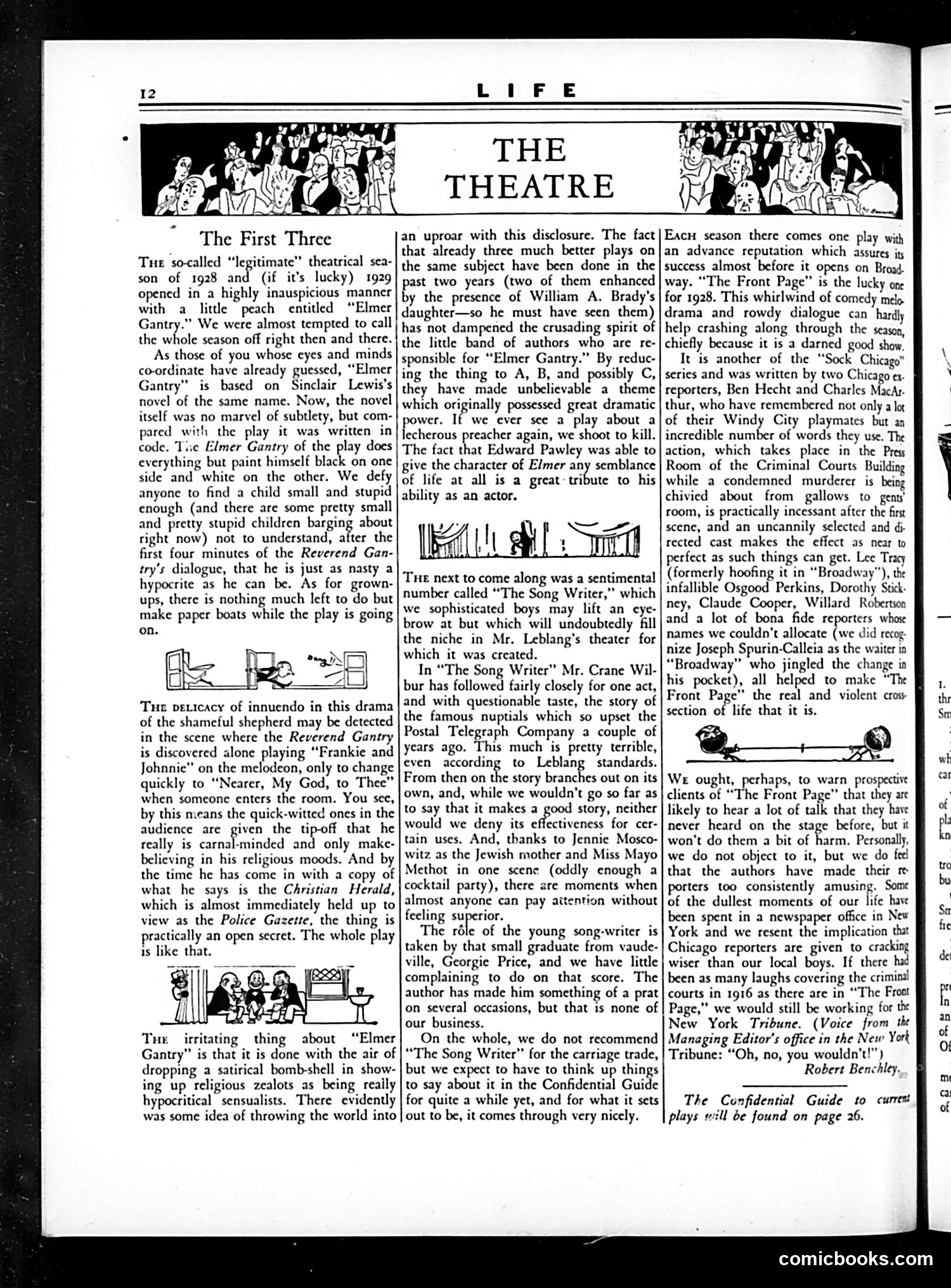
This page from *Life* magazine reviews three Broadway plays from the 1928-1929 season. The main focus is critiquing "Elmer Gantry," based on Sinclair Lewis's novel about a hypocritical preacher. The reviewer praises Edward Pawley's performance but notes the play lacks the novel's satirical bite. The cartoons illustrate specific theatrical moments—one shows a scene from "Elmer Gantry" where religious dialogue occurs, another depicts a domestic interior scene, likely from another reviewed play. The reviewer criticizes "The Song Writer" as sentimental and "The Front Page" (despite its vivid action) for crude language and sensationalism that may offend newspaper-reading audience members. The tone is sophisticated theater criticism aimed at educated *Life* readers familiar with Broadway productions.
📄 Transcribed text from this page (OCR, searchable)
Machine-transcribed from the original scan — historical spelling and the odd misread are preserved.
Tue so-called “legitimate” theatrical sea- son of 1928 and (if it’s lucky) 1929 opened in a highly inauspicious manner with a little peach entitled “Elmer Gantry.” We were almost tempted to call the whole season off right then and there. As those of you whose eyes and minds co-ordinate have already guessed, “Elmer Gantry” is based on Sinclair Lewis's novel of the same name. Now, the novel itself was no marvel of subtlety, but com- pared with the play it was written in code. Tie Elmer Gantry of the play does everything but paint himself black on one side and white on the other. We defy anyone to find a child small and stupid enough (and there are some pretty small and pretty stupid children barging about right now) not to understand, after the first four minutes of the Reverend Gan- try’s dialogue, that he is just as nasty a hypocrite as he can be. As for grown- ups, there is nothing much left to do but make paper boats while the play is going on. \ ty} mT) we 2B Tue veticacy of innuendo in this drama of the shameful shepherd may be detected in the scene where the Reverend Gantry is discovered alone playing ‘Frankie and Johnnie” on the melodeon, only to change quickly to ‘Nearer, My God, to Thee” when someone enters the room. You sec, by this means the quick-witted ones in the audience are given the tip-off that he really is carnal-minded and only make- believing in his religious moods. And by the time he has come in with a copy of what he says is the Christian Herald, which is almost immediately held up to view as the Police Gazette, the thing is practically an open secret. The whole play 1s like that. Tue irritating thing about “Elmer Gantry” is that it is done with the air of dropping a satirical bomb-shell in show- ing up religious zealots as being really hypocritical sensualists. There evidently was some idea of throwing the world into an uproar with this disclosure. The fact that already three much better plays on the same subject have been done in the past two years (two of them enhanced by the presence of William A. Brady's daughter—so he must have seen them) has not dampened the crusading spirit of the little band of authors who are re- sponsible for “Elmer Gantry.” By reduc- ing the thing to A, B, and possibly C, they have made unbelievable a theme which originally possessed great dramatic power. If we ever see a play about a lecherous preacher again, we shoot to kill. jae fact that Edward Pawley was able to give the character of Elmer any semblance of life at all is a great-tribute to his ability as an actor. Tue next to come along was a sentimental number called “The Song Writer,” which we sophisticated boys may lift an eye- brow at but which will undoubtedly fill the niche in Mr. Leblang’s theater for which it was created. In “The Song Writer” Mr. Crane Wil- bur has followed fairly closely for one act, and with questionable taste, the story of the famous nuptials which so upset the Postal Telegraph Company a couple of years ago. This much is pretty terrible, even according to Leblang standards. From then on the story besaches out on its own, and, while we wouldn't go so far as to say that it makes a good story, neither would we deny its effectiveness for cer- tain uses. And, thanks to Jennie Mosco- witz as the Jewish mother and Miss Mayo Methot in one scene (oddly enough a cocktail party), there are moments when almost anyone can pay aitention without feeling superior. The réle of the young song-writer is taken by that small graduate from vaude- ville, Georgie Price, and we have little complaining to do on that score. The author has made him something of a prat on several occasions, but that is none of our business. On the whole, we do not recommend “The Song Writer’ for the carriage trade, but we expect to have to think up things to say about it in the Confidential Guide for quite a while yet, and for what it sets out to be, it comes through very nicely. Eacxt season there comes one play with an advance reputation which assures its success almost before it opens on Broad. way. “The Front Page” is the lucky one for 1928. This whirlwind of comedy melo. drama and rowdy dialogue can hardly help crashing along through the season, chiefly because it is a darned good show. It is another of the “Sock Chicago” series and was written by two Chicago ex. reporters, Ben Hecht and Charles MacAr- thur, who have remembered not only a lot of their Windy City playmates but an incredible number of words they use. The action, which takes place in the Press Room of the Criminal Courts Building while a condemned murderer is being chivied about from gallows to gents’ room, is practically incessant after the firs scene, and an uncannily selected and di- rected cast makes the effect as near wo perfect as such things can get. Lee Tracy (formerly hoofing it in “Broadway”, the infallible Osgood Perkins, Dorothy Stick- ney, Claude Cooper, Willard Robertson and a lot of bona fide reporters whos names we couldn't allocate (we did recog- nize Joseph Spurin-Calleia as the waiter in “Broadway” who jingled the change in his pocket), all helped to make “The Front Page’ the real and violent cross section of life that it is. ey — —_ © We ought, perhaps, to warn_ prospective clients of “The Front Page” that they are likely to hear a lot of talk that they have never heard on the stage before, but it won't do them a bit of harm. Personally, we do not object to it, but we do feel that the authors have made their re porters too consistently amusing. Some of the dullest moments of our life have been spent in a newspaper office in New York and we resent the implication that Chicago reporters are given to cracking wiser than our local boys. If there had been as many laughs covering the criminal courts in 1916 as there are in “The Frost Page,” we would still be working for the New York Tribune. (Voice from the Managing Editor's office in the New York Tribune: “Oh, no, you wouldn’t!"”) Robert Benchley. The Confidential Guide to current plays will be found on page 26. comicbooks.com \\