
Life, 1928-08-30 · page 16 of 36
Life — August 30, 1928 — page 16: what you’re looking at
What you’re looking at
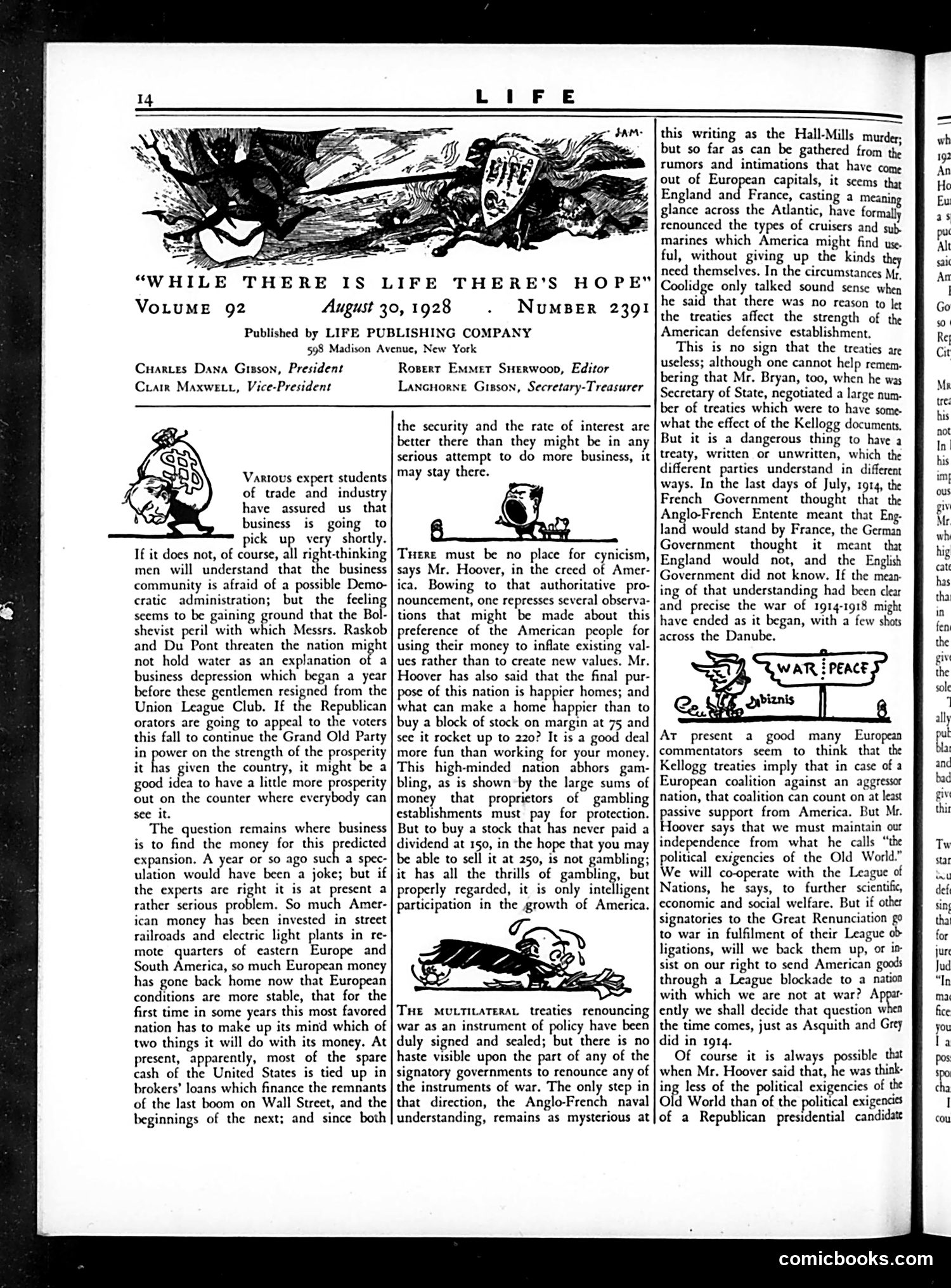
This page contains editorial commentary on business and international affairs rather than cartoon satire. The small illustrated vignettes (showing figures gambling or in conflict) are decorative rather than standalone political cartoons. The main content discusses American business optimism about economic expansion, with skepticism about whether this can be sustained. It also addresses the multilateral peace treaties recently signed (likely the Kellogg-Briand Pact of 1928), questioning their enforceability when nations lack genuine commitment to renouncing war as policy. The text references Herbert Hoover's statements about American prosperity and international cooperation, suggesting editorial doubt about whether such idealistic treaties could actually prevent future conflicts given competing national interests.
📄 Transcribed text from this page (OCR, searchable)
Machine-transcribed from the original scan — historical spelling and the odd misread are preserved.
“WHILE THERE IS LIFE THERE'S HOPE” VoLUME 92 August 30,1928 NuMBER 2391 Published by LIFE PUBLISHING COMPANY 598 Madison Avenue, New York Cuarces Dana Greson, President Crain Maxwett, Vice-President Various expert students of trade and industry have assured us that business is going to pick up very shortly. If it does not, of course, all right-thinking men will understand that the business community is afraid of a possible Demo- cratic administration; but the feelin seems to be gaining ground that the Bol- shevist peril with which Messrs. Raskob and Du Pont threaten the nation might not hold water as an explanation of a business depression which began a year before these gentlemen resigned from the Union League Club. If the Republican orators are going to appeal to the voters this fall to continue the Grand Old Party in power on the strength of the prosperity it has given the country, it might be a good idea to have a little more prosperity out on the counter where everybody can see it. The question remains where business is to find the money for this predicted expansion. A year or so ago such a spec- ulation would have been a joke; but if the experts are right it is at present a rather serious problem. So much Amer- ican money has been invested in street railroads and electric light plants in re- mote quarters of eastern Europe and South America, so much European money has gone back home now that European conditions are more stable, that for the first time in some years this most favored nation has to make up its mind which of two things it will do with its money. At present, apparently, most of the spare cash of the United States is tied up in brokers’ loans which finance the remnants of the last boom on Wall Street, and the beginnings of the next; and since both Rosert Emmet Suerwoon, Editor LancHorne Grason, Secretary-Treasurer the security and the rate of interest are better there than they might be in any serious attempt to do more business, it may stay there. Tuere must be no place for cynicism, says Mr. Hoover, in the creed of Amer- ica. Bowing to that authoritative pro- nouncement, one represses several observa- tions that might be made about this preference of the American people for using their money to inflate existing val- ues rather than to create new values. Mr. Hoover has also said that the final pur- pose of this nation is happier homes; and what can make a home happier than to buy a block of stock on margin at 75 and sec it rocket up to 220? It is a good deal more fun than working for your money. This high-minded nation abhors gam- bling, as is shown by the large sums of money that proprietors of gambling establishments must pay for protection. But to buy a stock that has never paid a dividend at 150, in the hope that you may be able to sell it at 250, is not gambling; it has all the thrills of gambling, but properly regarded, it is only intelligent participation in the growth of America. THE MULTILATERAL treaties renouncing war as an instrument of policy have been duly signed and sealed; but there is no haste visible upon the part of any of the signatory governments to renounce any of the instruments of war. The only step in that direction, the Anglo-French naval understanding, remains as mysterious at this writing as the Hall-Mills murder. but so far as can be gathered front rumors and intimations that have come out of European capitals, it seems that England and France, casting a meanin, glance across the Atlantic, have formal) renounced the types of cruisers and sub. marines which America might find use. ful, without giving up the kinds need themselves. In the circumstances Mr, Coolidge only talked sound sense when he said that there was no reason to let the treaties affect the strength of the American defensive establishment. This is no sign that the treaties are useless; although one cannot help remem. bering that Mr. Bryan, too, when he was Secretary of State, negotiated a large num- ber of treaties which were to have some. what the effect of the Kellogg documents, But it is a dangerous thing to have a treaty, written or unwritten, which the different parties understand in different ways. In the last days of July, 1914, the French Government thought that the Anglo-French Entente meant that Eng- land would stand by France, the German Government thought it meant that England would not, and the English Government did not know. If the mean- ing of that understanding had been clear and precise the war of 1914-1918 might have ended as it began, with a few shots across the Danube. At present a good many European commentators seem to think that the Kellogg treaties imply that in case of a European coalition against an aggressor nation, that coalition can count on at least passive support from America. But Mr. loover says that we must maintain our independence from what he calls “the political exigencies of the Old World.” We will co-operate with the League of Nations, he says, to further scientific, economic and social welfare. But if other signatories to the Great Renunciation go to war in fulfilment of their League ob ligations, will we back them up, or in sist on our right to send American goods through a League blockade to a nation with which we are not at war? Appat- ently we shall decide that question when the time comes, just as Asquith and Grey did in 1914. OF course it is always possible that when Mr. Hoover said that, he was think- ing less of the political exigencies of the Old World than of the political exigencies of a Republican presidential candidate comicbooks.com