
A complete issue · 38 pages · 1928
Life — June 21, 1928
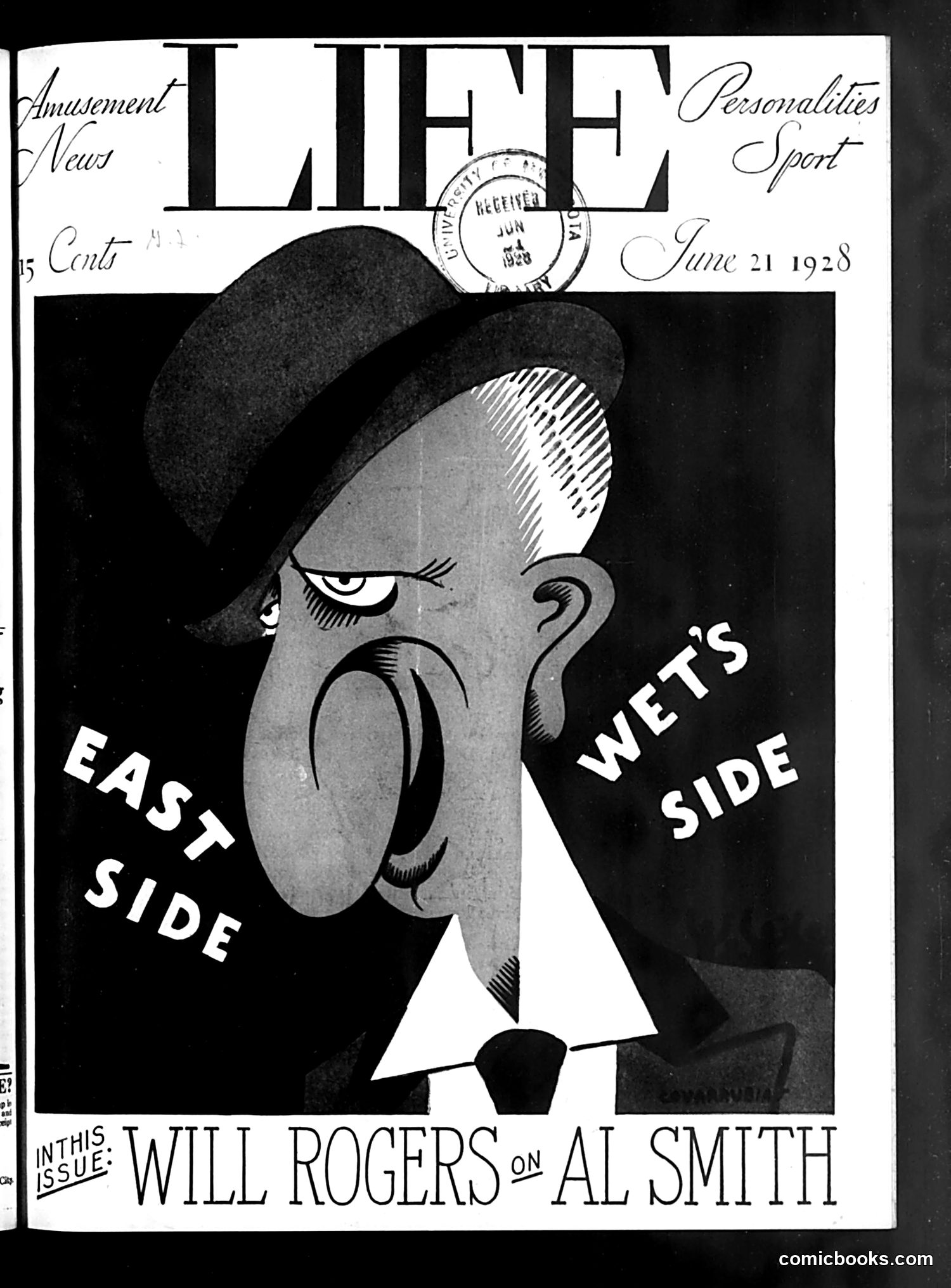
This is a Life magazine cover featuring a caricatured male face in profile, labeled "EAST SIDE" and "WEST'S SIDE," suggesting a divided personality or competing interests. The figure wears a distinctive hat and has exaggerated features typical of 1920s satirical illustration. The cover announces content about "WILL ROGERS ON AL SMITH," referencing Will Rogers (a famous humorist and social commentator of the era) discussing Al Smith, the 1928 Democratic presidential candidate. Smith, a New York politician associated with the "East Side" (immigrant communities), faced significant controversy during his campaign, partly due to anti-Catholic sentiment and regional prejudices. The "two sides" imagery likely satirizes Smith's political positioning or the divided opinions about his candidacy during this contentious election year.
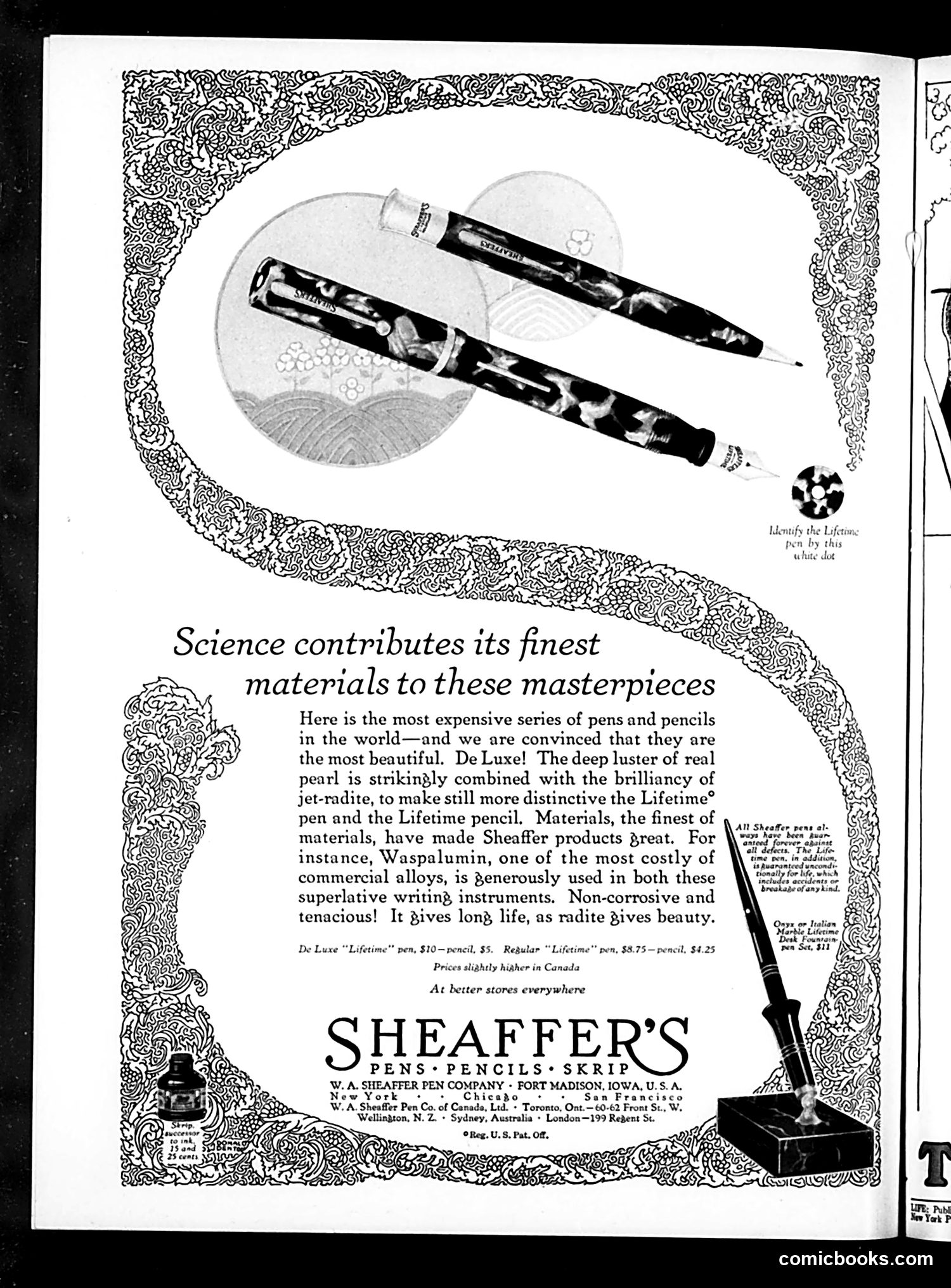
This is **not a political cartoon or satire page**—it's a **full-page advertisement for Sheaffer's pens and pencils**. The ad emphasizes luxury writing instruments, specifically the "De Luxe Lifetime" pen and pencil line. It highlights that these products use premium materials including real pearl and jet-radite (a commercial alloy), marketed as "the most expensive series of pens and pencils in the world." The ornate decorative border frames the product display at top, while the text claims scientific materials contribute to superior quality and longevity. A smaller product image appears on the right side. This represents typical *Life* magazine advertising from the early-to-mid 20th century, targeting affluent readers through appeals to luxury and durability rather than containing any satirical or political content.
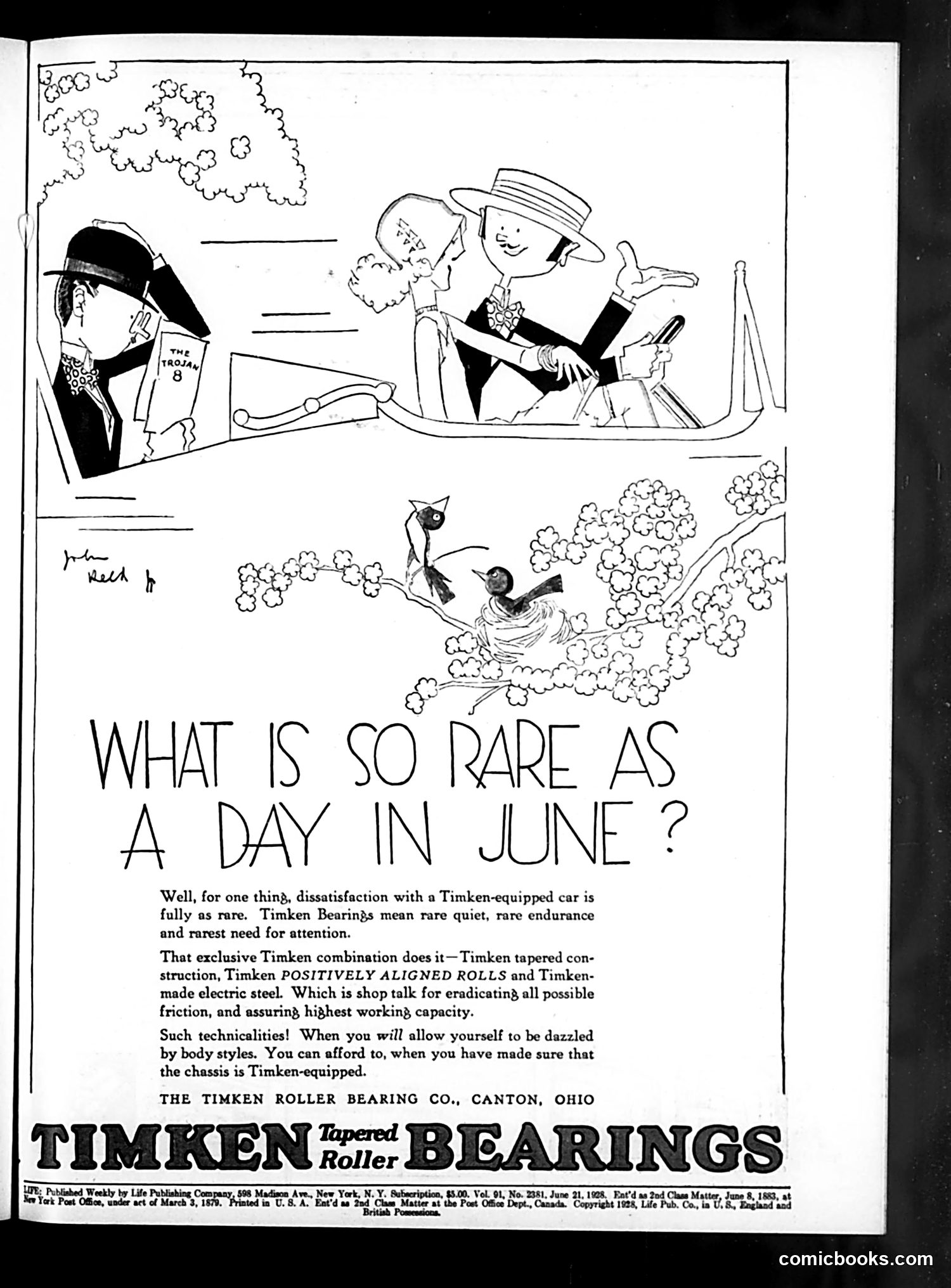
This is primarily a **Timken Roller Bearings advertisement**, not political satire. The page features a humorous cartoon illustrating the tagline "What is so rare as a day in June?" **The imagery:** The top panel shows a man reading a book titled "The Trojan" (likely referencing the Trojan War/classical literature) while a fashionable couple drives past in a convertible, carefree and enjoying summer weather. The bottom panel depicts people relaxing among flowering bushes and trees. **The advertising message:** Timken argues that a trouble-free day in a Timken-equipped car is equally rare and precious. The ad emphasizes that Timken tapered roller bearings provide "rare quiet," durability, and require minimal maintenance—making ownership worry-free and allowing drivers to enjoy summer outings without mechanical anxiety. This reflects 1920s automotive advertising's focus on reliability and leisure.
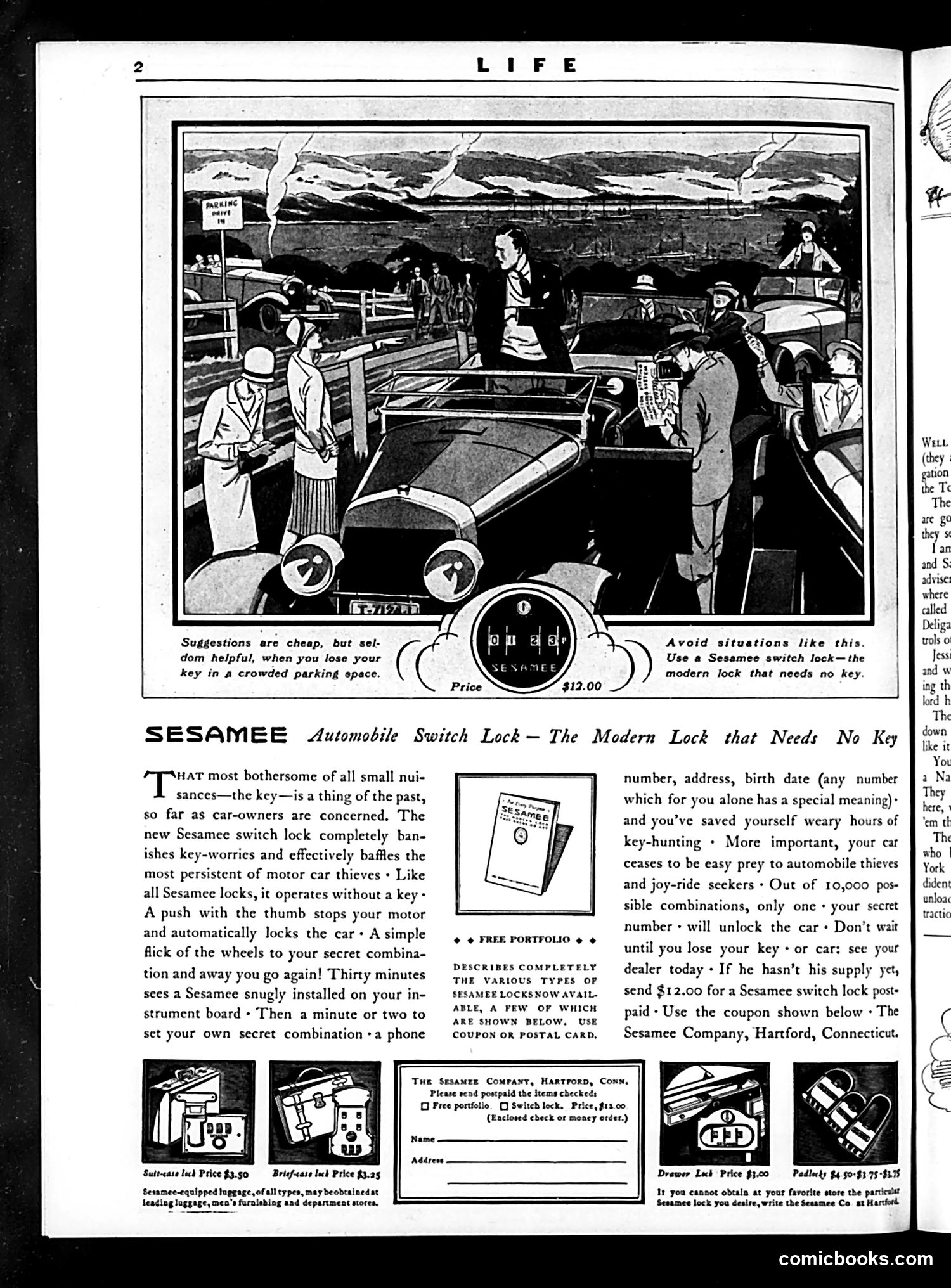
This page is primarily **advertising, not satire or political commentary**. The main illustration depicts a crowded parking lot where a man has lost his car keys—a "bothersome" problem the ad aims to solve. The image shows well-dressed 1920s-era figures amid parked automobiles, illustrating the advertised situation: losing keys in a crowded space. The Sesamee Automobile Switch Lock is presented as the modern solution. Instead of carrying keys, owners would use a secret number combination (from 10,000 possible options) to unlock their vehicles. The ad emphasizes convenience and security—no more key-hunting, and protection against thieves. The lower section offers a free portfolio describing various Sesamee lock types available, priced at $12.00, with ordering information for Hartford, Connecticut.
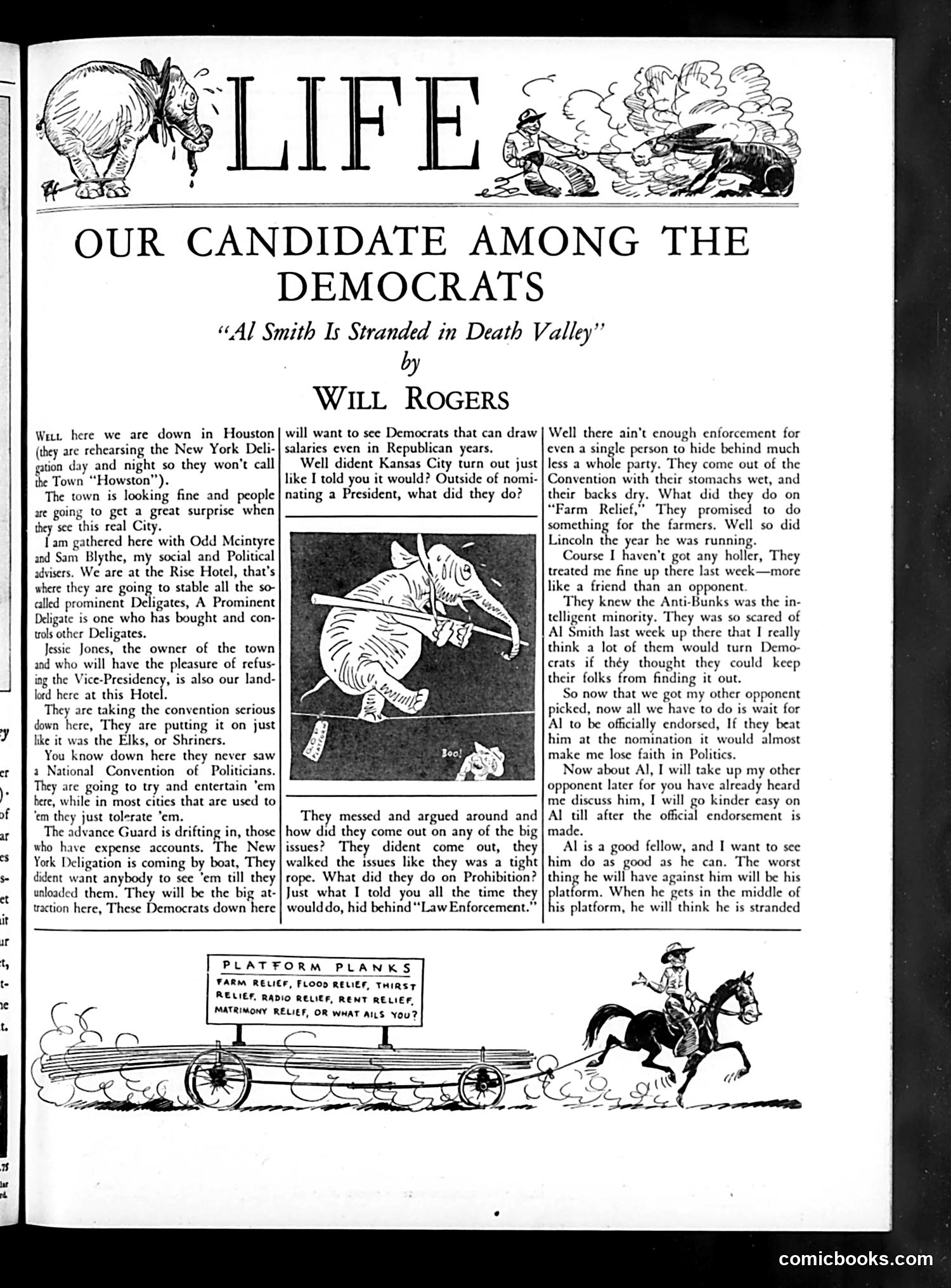
This page features Will Rogers satirizing the 1928 Democratic National Convention being held in Houston. Rogers critiques Democratic delegates as ineffectual—they lack the organizational power and enforcement mechanisms of Republicans, allowing factions to publicly quarrel without discipline. The central figure "Al Smith" (Al Smith, the Democratic presidential nominee) is depicted as vulnerable and "stranded in Death Valley"—a metaphor for his weak position. Rogers suggests Democrats are disunited on key issues like Prohibition and farm relief, unable to control their messaging. The "Platform Planks" cartoon mocks the party's vague, catch-all promises (farm relief, flood relief, rent relief, etc.)—depicted as literally flimsy cargo being pulled by a weak horse, unable to deliver concrete policy.
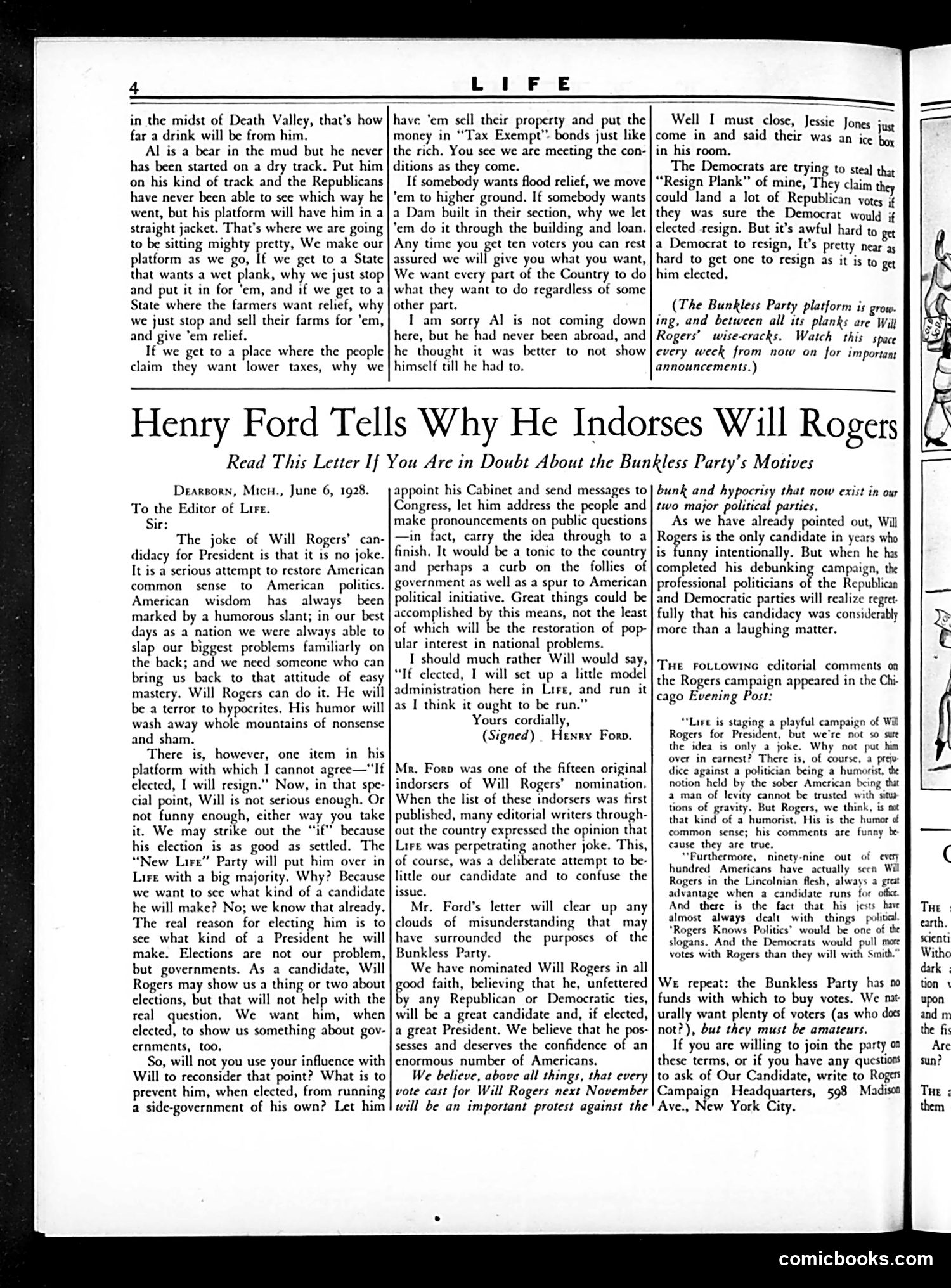
This page features Henry Ford's letter endorsing Will Rogers for President on the "Bunkless Party" ticket in the 1928 election. Ford argues Rogers' candidacy is serious—not a joke—because America needs someone outside the two major parties to address real problems like government waste and hypocrisy. The satire targets political gridlock: Ford suggests Rogers' humor and common sense make him a credible alternative to Republicans and Democrats, who've failed ordinary Americans. The "Bunkless Party" platform appears designed to mock both establishment parties' rhetoric. Ford emphasizes Rogers' credibility stems from his willingness to critique politicians honestly, positioning him as a genuine reform candidate despite the unconventional nomination.
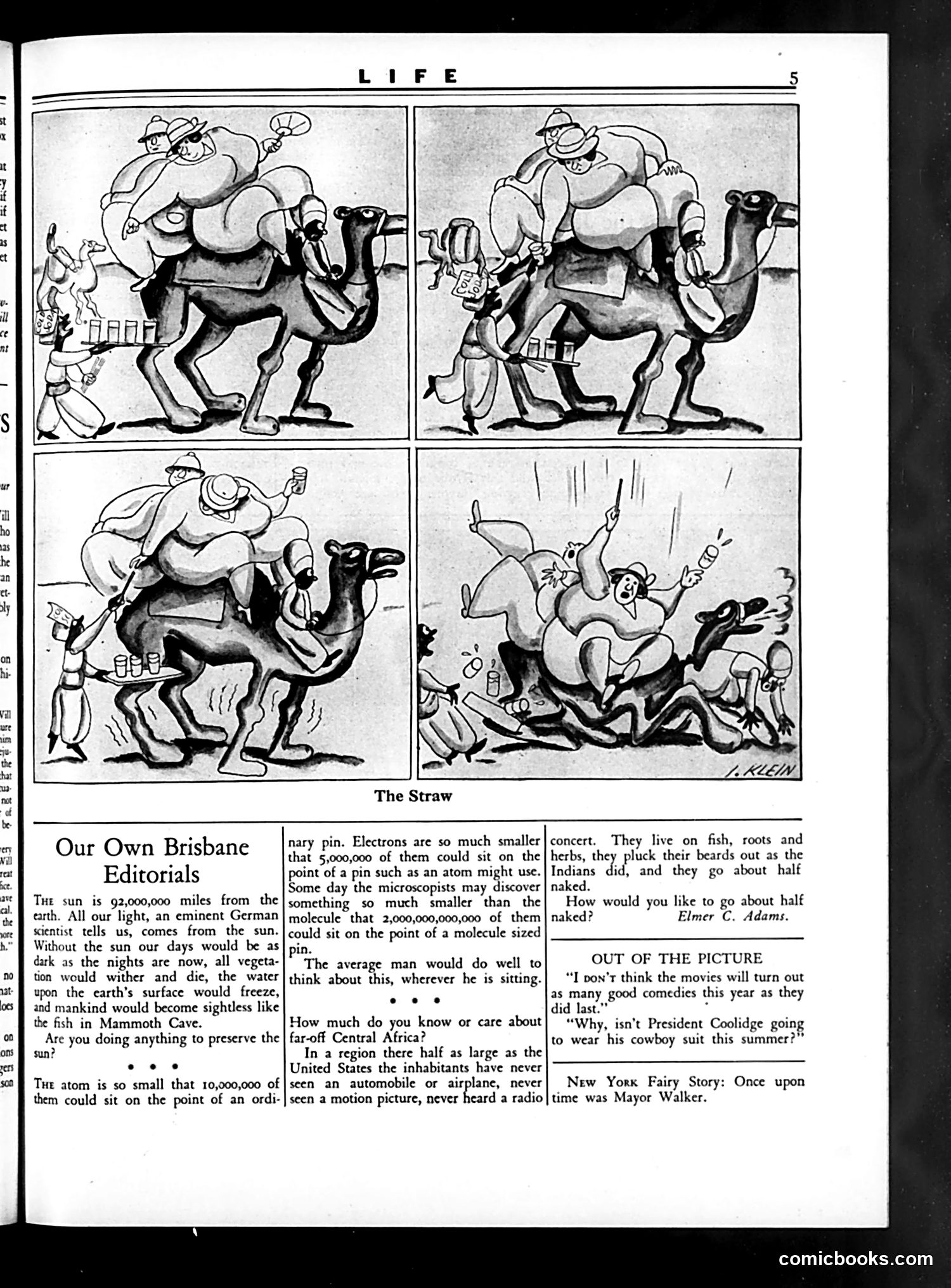
This four-panel cartoon by L. Klein depicts a camel repeatedly bucking off two fat tourists. The title "The Straw" references the idiom "the straw that broke the camel's back"—meaning a final, minor burden causing collapse after accumulated strain. The humor works through visual exaggeration: the rotund Western travelers (identifiable by their hats and clothing) are repeatedly thrown by the increasingly agitated camel. The cartoon satirizes tourist behavior, likely critiquing Western travelers' assumed entitlement or carelessness toward animals and local customs in colonial-era travel destinations. The accompanying editorial text discusses atoms and Central Africa, suggesting this appeared during a period of growing Western colonial presence and scientific advancement.
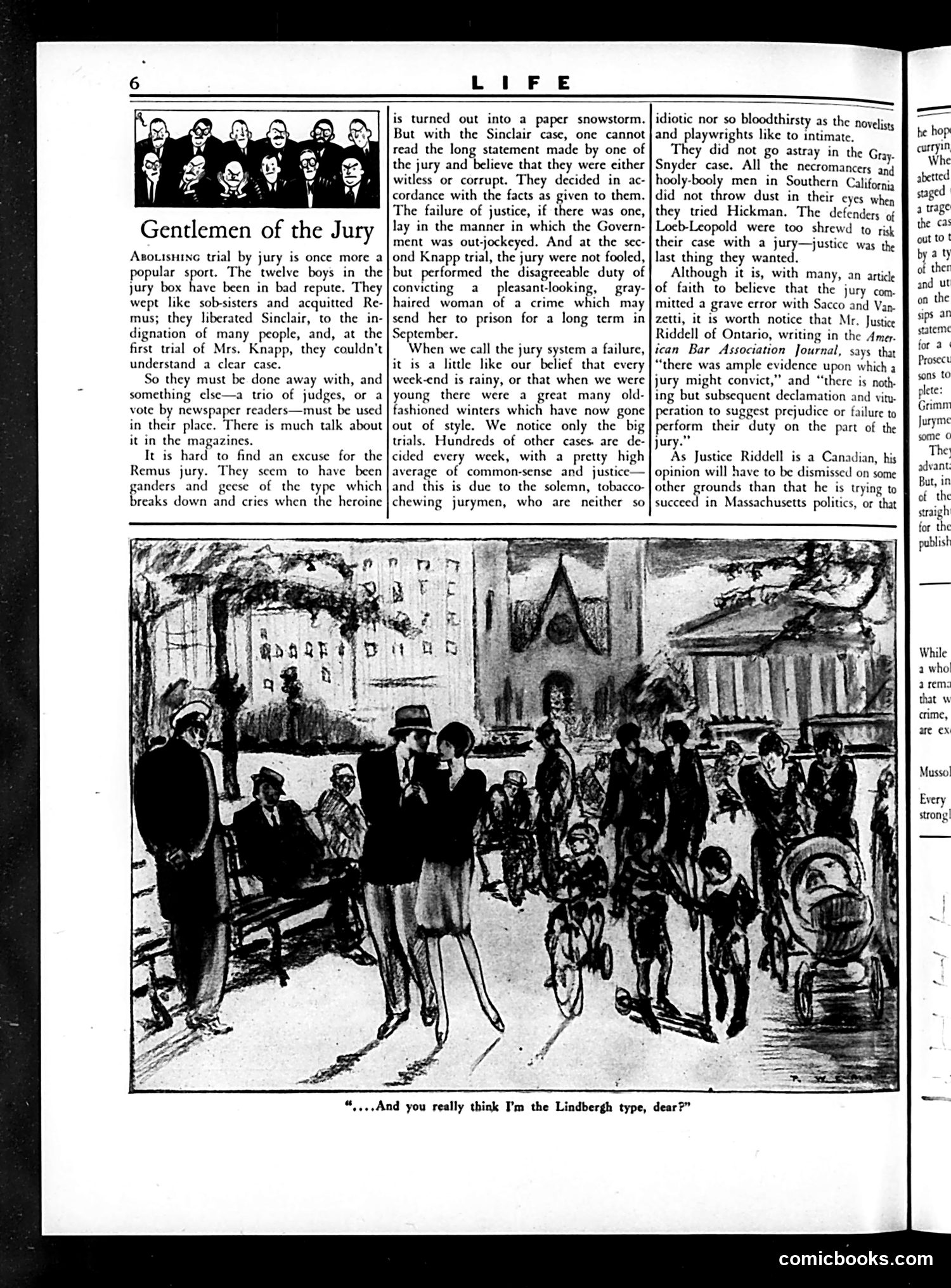
This page critiques the American jury system through text and a political cartoon. The article "Gentlemen of the Jury" argues that trial by jury has become outdated and ineffective, citing poor juror quality and questionable verdicts. It specifically references the Sacco-Vanzetti case (a controversial 1920s murder trial) and mentions Justice Riddell of Ontario criticizing jury failures. The cartoon below depicts a street scene where someone is sarcastically asking another, "And you really think I'm the Lindbergh type, dear?" This references the recent Lindbergh kidnapping case (1932), suggesting public anxiety about child abductions and ironically commenting on how ordinary people might be mistaken for criminals—reinforcing the article's point about jury unreliability and public hysteria influencing justice.
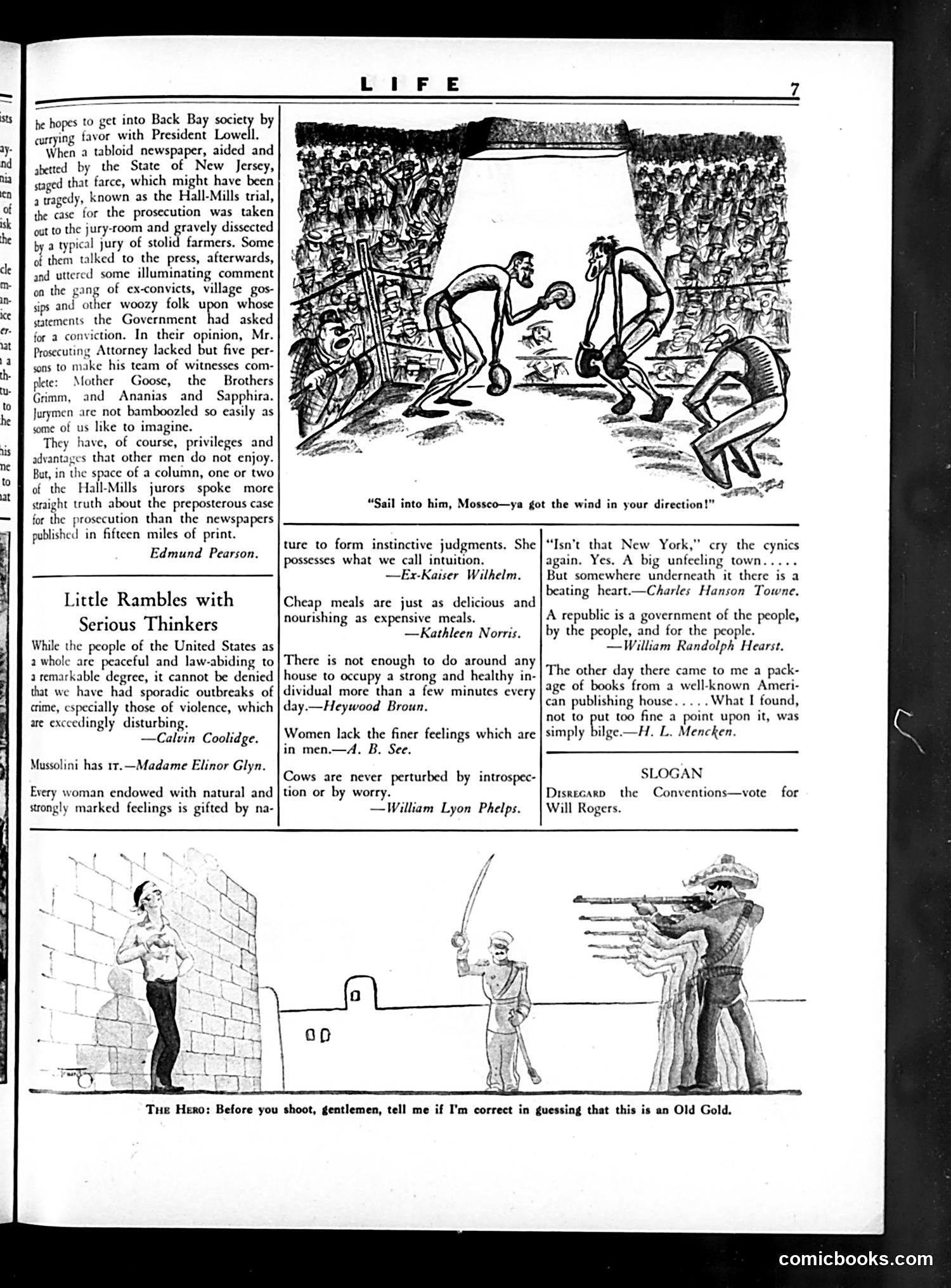
**Top Cartoon:** "Sail into him, Moscoe—ya got the wind in your direction!" depicts a boxing match before a large crowd. The reference to "Moscoe" (likely Moscow) suggests Cold War-era satire about Soviet-American conflict, metaphorically represented as a boxing match. The crowd represents public interest in this geopolitical struggle. **Bottom Cartoon:** Shows a hero confronting armed soldiers, saying "Before you shoot, gentlemen, tell me if I'm correct in guessing that this is an Old Gold." This advertises Old Gold cigarettes through humor—the "hero" attempts to distract executioners by discussing the brand, suggesting the product's appeal or ubiquity. The page also contains philosophical quotes attributed to various figures (Calvin Coolidge, Mussolini, etc.) and a slogan supporting Will Rogers for political office.
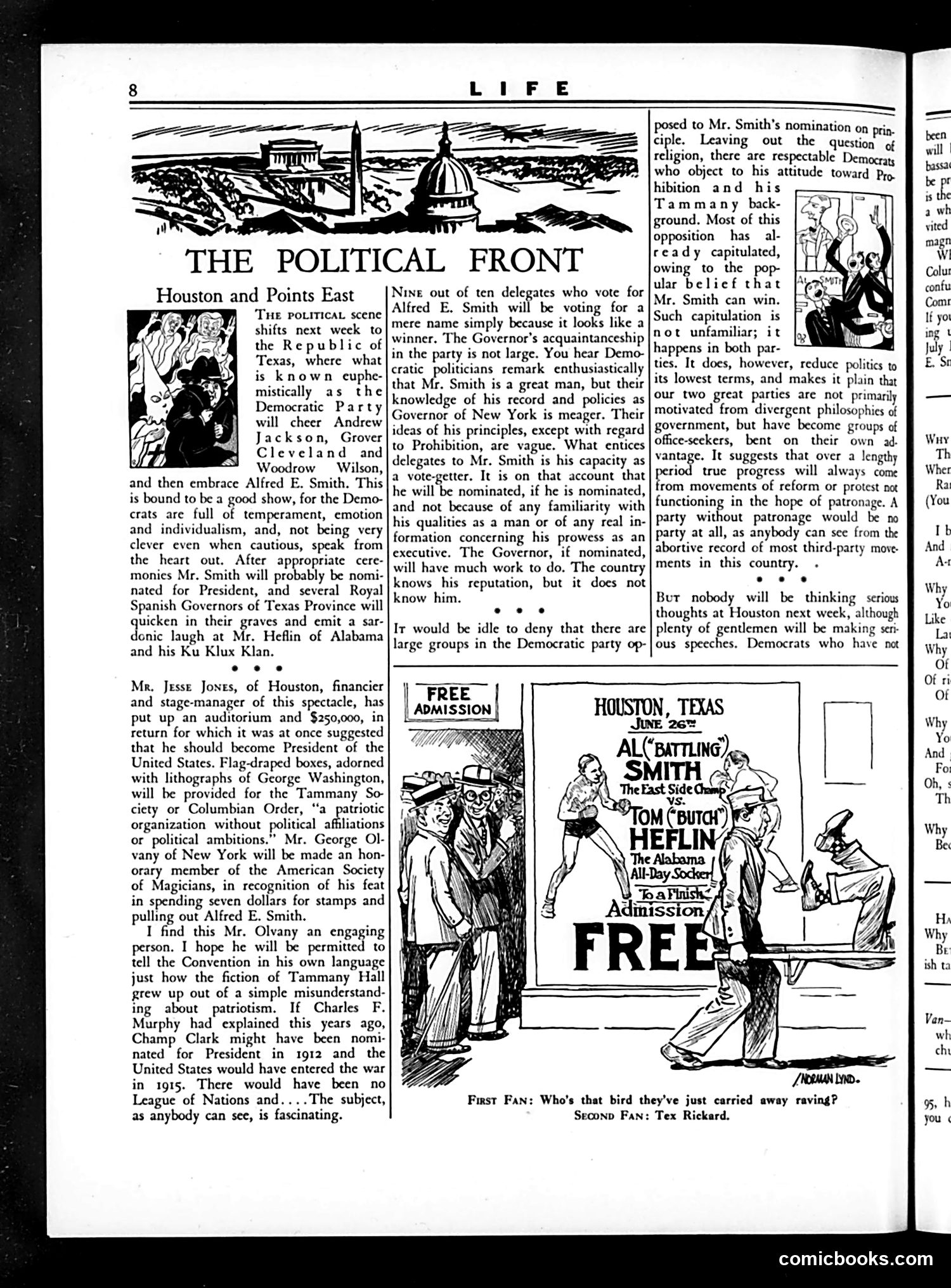
This Life magazine page satirizes the 1928 Democratic convention's competition to nominate a presidential candidate. The main article discusses Houston hosting the convention, where nine of ten delegates favor Alfred E. Smith despite Democratic resistance. The lower cartoon advertises a boxing match between "Al 'Battling' Smith" (the East Side Champ) and "Tom 'Dutch' Heflin" (The Alabama All-Day Socialite). This is political satire: Smith, a Catholic and anti-Prohibition Democrat from New York, faced opposition from conservative Democrats, particularly Senator Tom Heflin of Alabama—a Prohibitionist and Klan sympathizer. The boxing match metaphor visualizes their ideological conflict within the party. The joke's punchline involves a bird escaping during the bout.
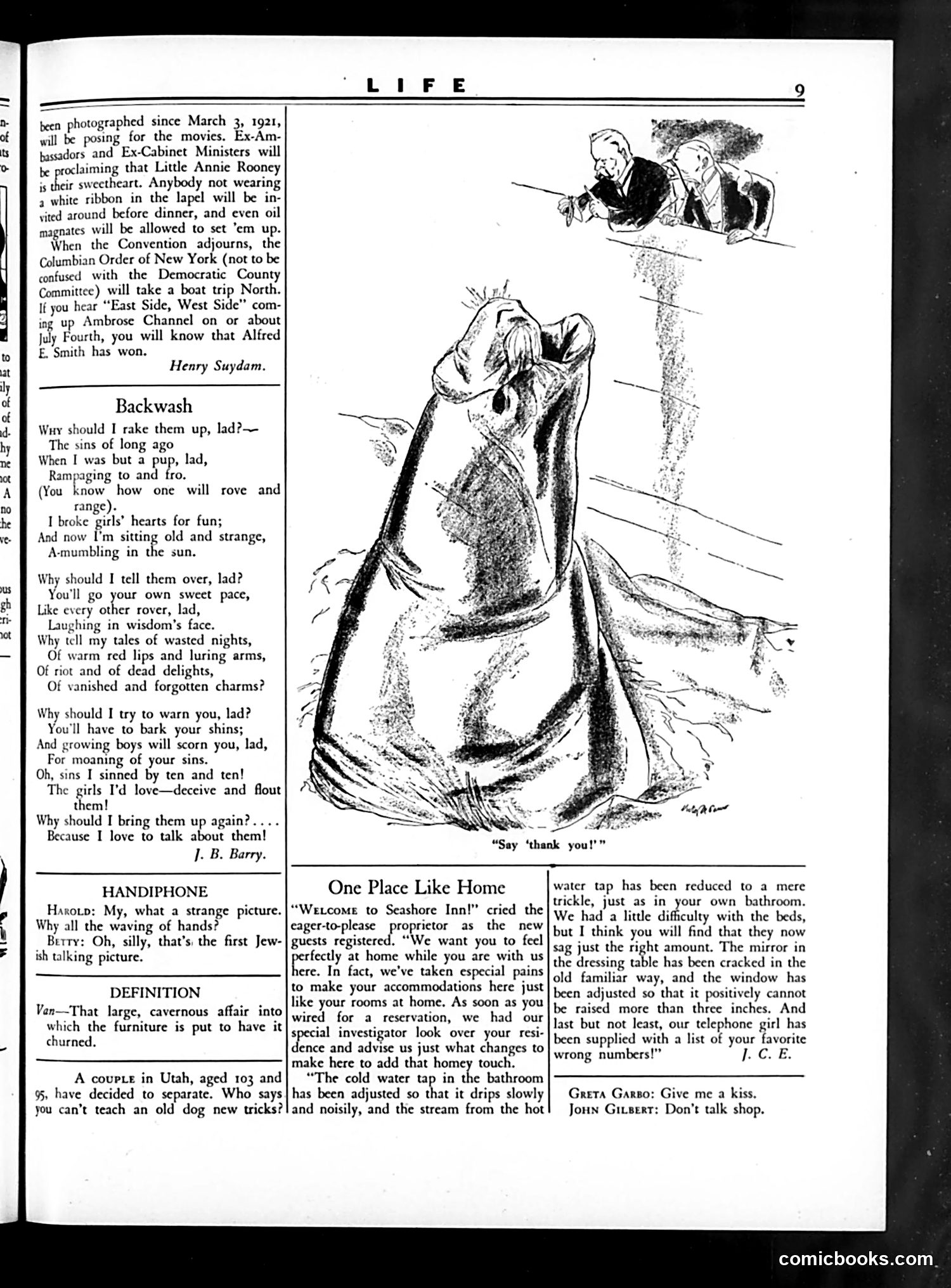
This untitled cartoon depicts two figures pouring what appears to be money or resources down onto a third figure below—likely representing taxpayers or citizens receiving government benefits or assistance. The caption "Say 'thank you!'" suggests ironic commentary on gratitude expectations. The drawing's style and the text references (including mentions of conventions and political figures like Alfred E. Smith) suggest this is 1920s-era satire, probably commenting on government spending or relief programs. The cartoon appears to critique either: 1. Forced or insincere gratitude demanded from aid recipients, or 2. The expectation that citizens should be grateful for government distribution of their own tax dollars The specific political context remains unclear without additional publication date confirmation.
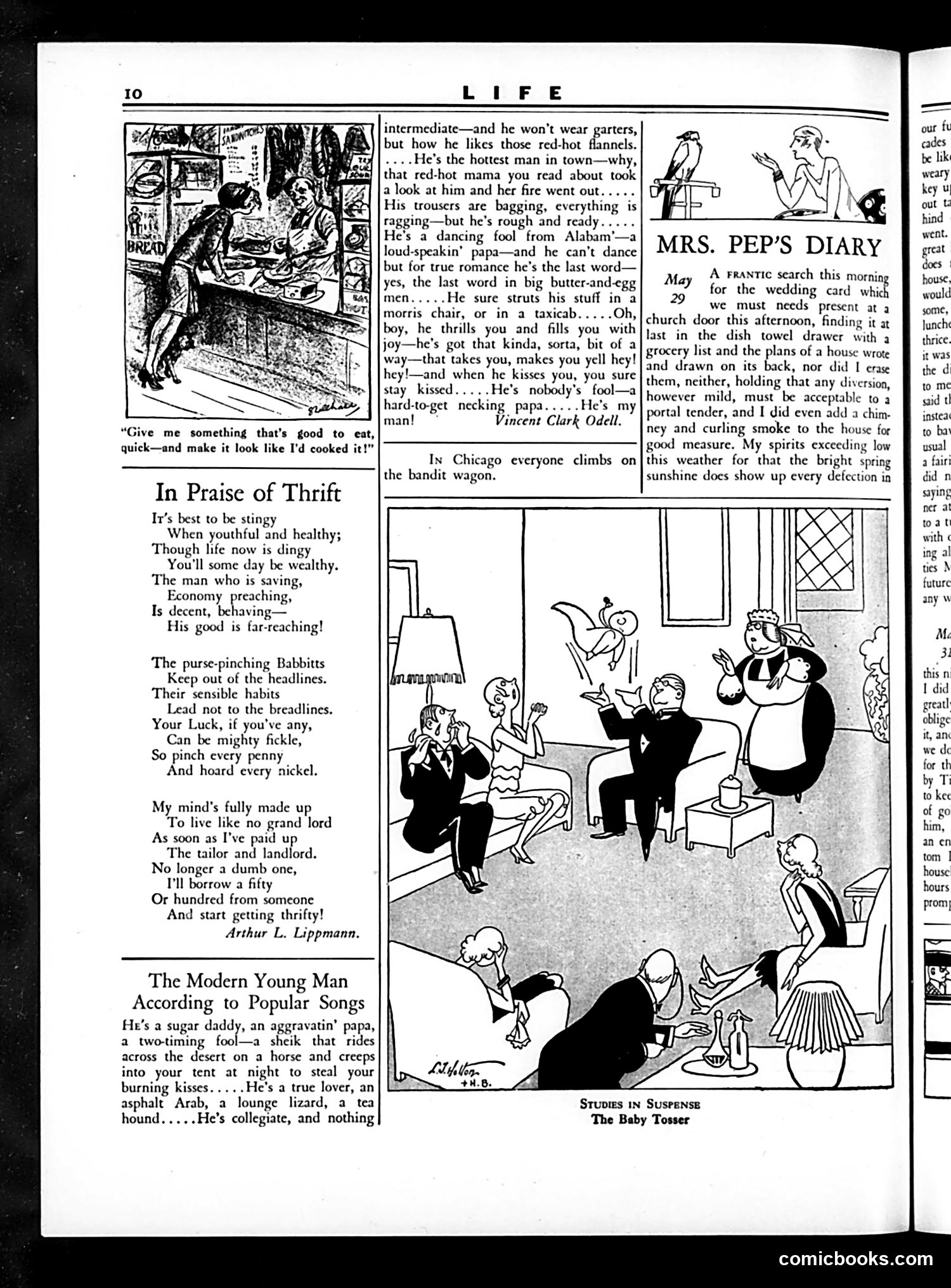
This page contains three distinct pieces: 1. **"In Praise of Thrift"** - A poem by Arthur L. Lippmann celebrating financial prudence and saving money, particularly relevant during economically tight times. It advocates restraint and accumulating wealth gradually. 2. **"Mrs. Pep's Diary"** (May 29) - A humorous domestic column where Mrs. Pep describes searching for a wedding card and worrying about house preparations, reflecting typical early 20th-century housewife concerns about propriety and household management. 3. **"Studies in Suspense: The Baby Tosser"** - A cartoon satirizing a chaotic domestic scene where adults appear to be tossing a baby around playfully, likely mocking either reckless parenting or exaggerated anxieties about child-rearing safety. The overall theme emphasizes financial responsibility and domestic life management.
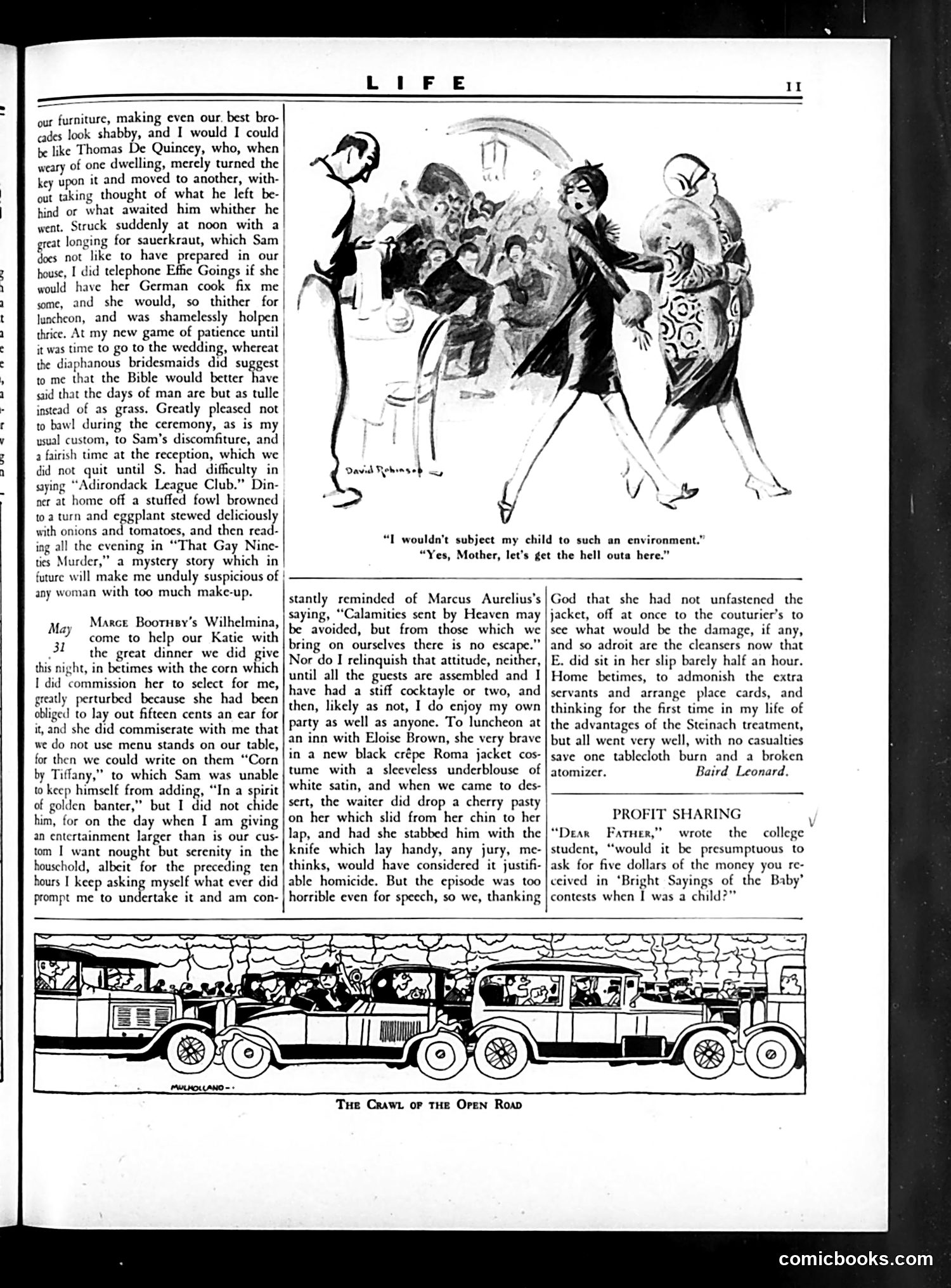
The main cartoon depicts a domestic scene where parents are ejecting a child from their home, saying "I wouldn't subject my child to such an environment" and "Yes, Mother, let's get the hell outa here." This satirizes parental hypocrisy—the mother objects to the child's "environment" while the parents themselves use crude language and appear to be fleeing chaotic circumstances. The joke mocks parents who claim moral superiority while behaving badly themselves. The bottom illustration, "The Crawl of the Open Road," shows an overcrowded bus filled with passengers, satirizing the reality of modern travel and tourism despite its promised freedom and adventure. Both cartoons reflect early 20th-century Life magazine's characteristic social satire targeting middle-class pretension and the gap between ideals and reality.
This page features editorial commentary on Sir Charles Higham's recent visit to America. The cartoon at top left shows a caricatured figure (likely Higham) with exaggerated features in a mocking pose, labeled "sing dong, etc!" The article criticizes Higham's negative observations about American life—specifically his complaints about unemployment, laws he found excessive, and what he perceived as lack of individual character among Americans. The editors defend American prosperity and social values against his critiques. The satire targets a visiting British commentator presuming to judge American society unfavorably. The piece defends American work ethic and prosperity while mocking Higham's condescension, suggesting his observations miss the point of American democratic spirit.
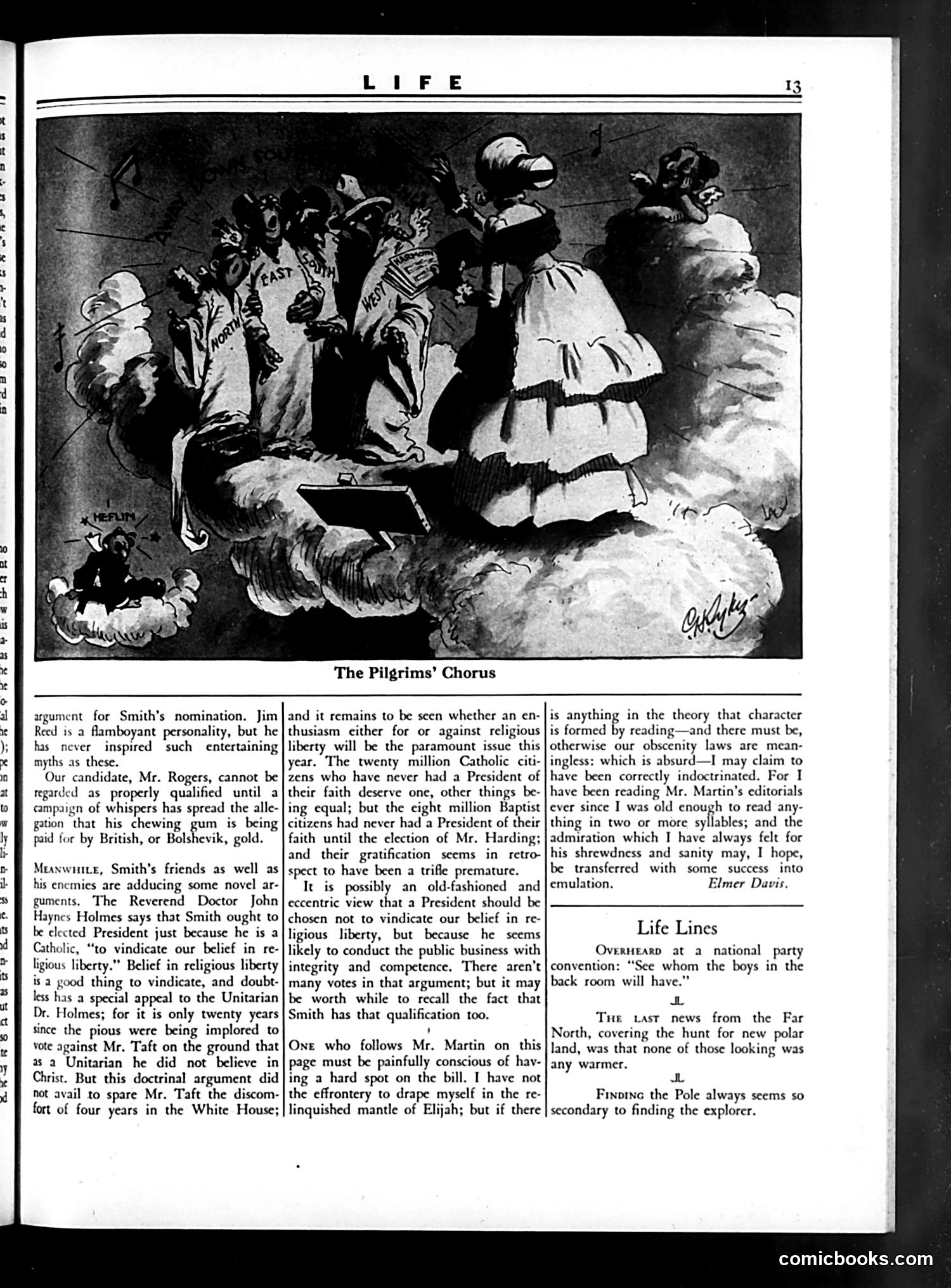
This cartoon satirizes the debate over Catholic presidential candidates. The text references "Smith's nomination" and discusses whether a Catholic should become President—a contentious 1920s-era issue. The pilgrims depicted represent early American Protestant settlers; they're shown gathered around what appears to be a voting box, with exaggerated features typical of period caricature. The satire contrasts the Pilgrims' historical struggle for religious liberty with contemporary resistance to Catholic political participation. The cartoon argues this opposition contradicts America's founding principles of religious freedom. The accompanying text debates whether character formed by Catholic reading differs from Protestant reading, ultimately defending religious tolerance in American civic life.
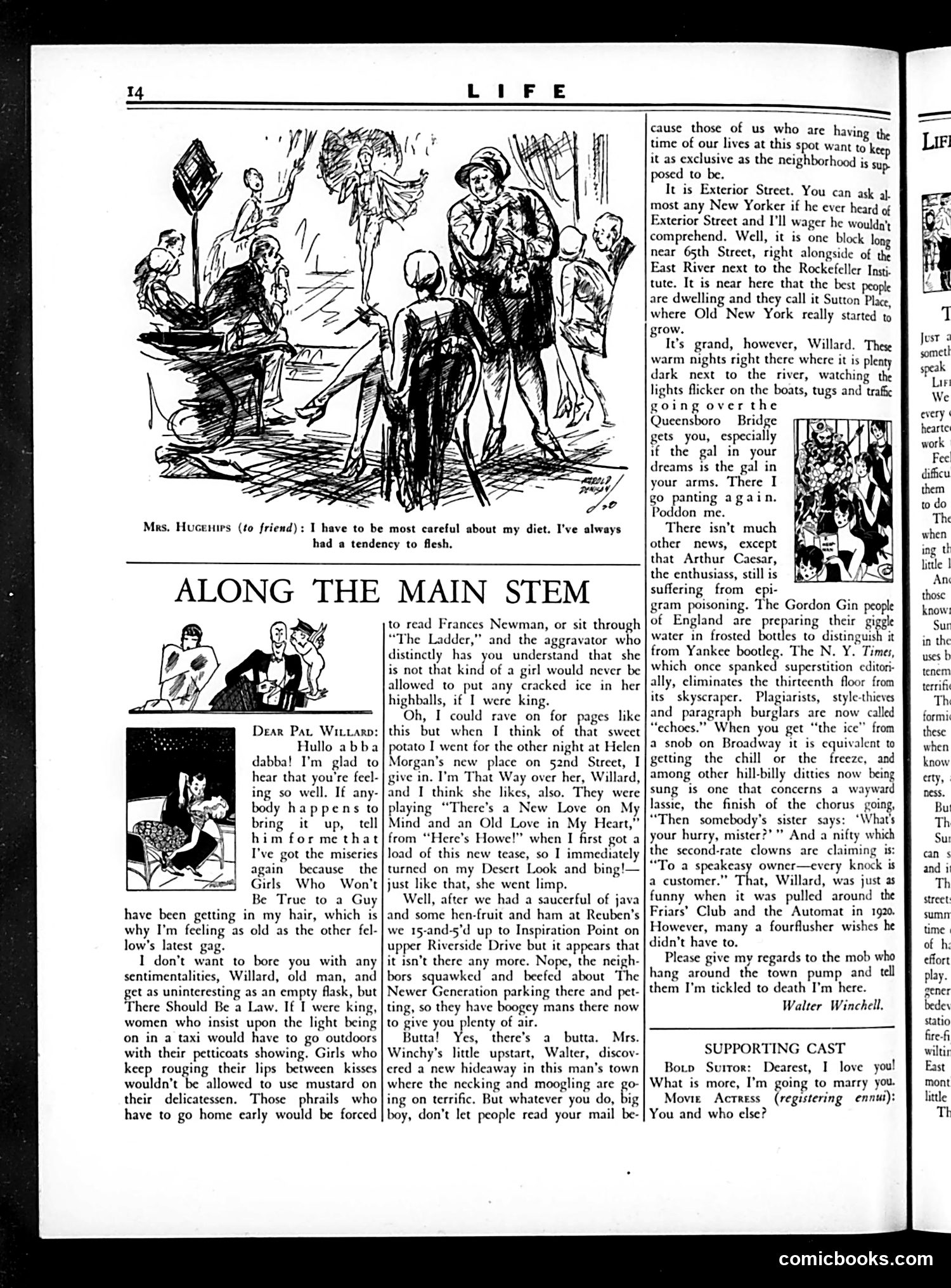
This page from *Life* magazine contains two main elements: **Top Cartoon**: Shows Mrs. Houghrie speaking to a friend about her diet, saying she has "always had a tendency to flesh." The joke is a visual pun—she appears as a skeletal figure, the opposite of someone with weight issues. **"Along the Main Stem" Column**: A satirical advice column by "Dear Pal Willard" discussing New York City nightlife and social venues. References include Helen Morgan's nightclub on 52nd Street and mentions of Prohibition-era speakeasies ("bootleg," "Inspiration Point"). The humor targets fashionable but morally questionable urban entertainment spots and their patrons' pretensions. The overall tone mocks both dieting vanity and Jazz Age excess in 1920s New York.
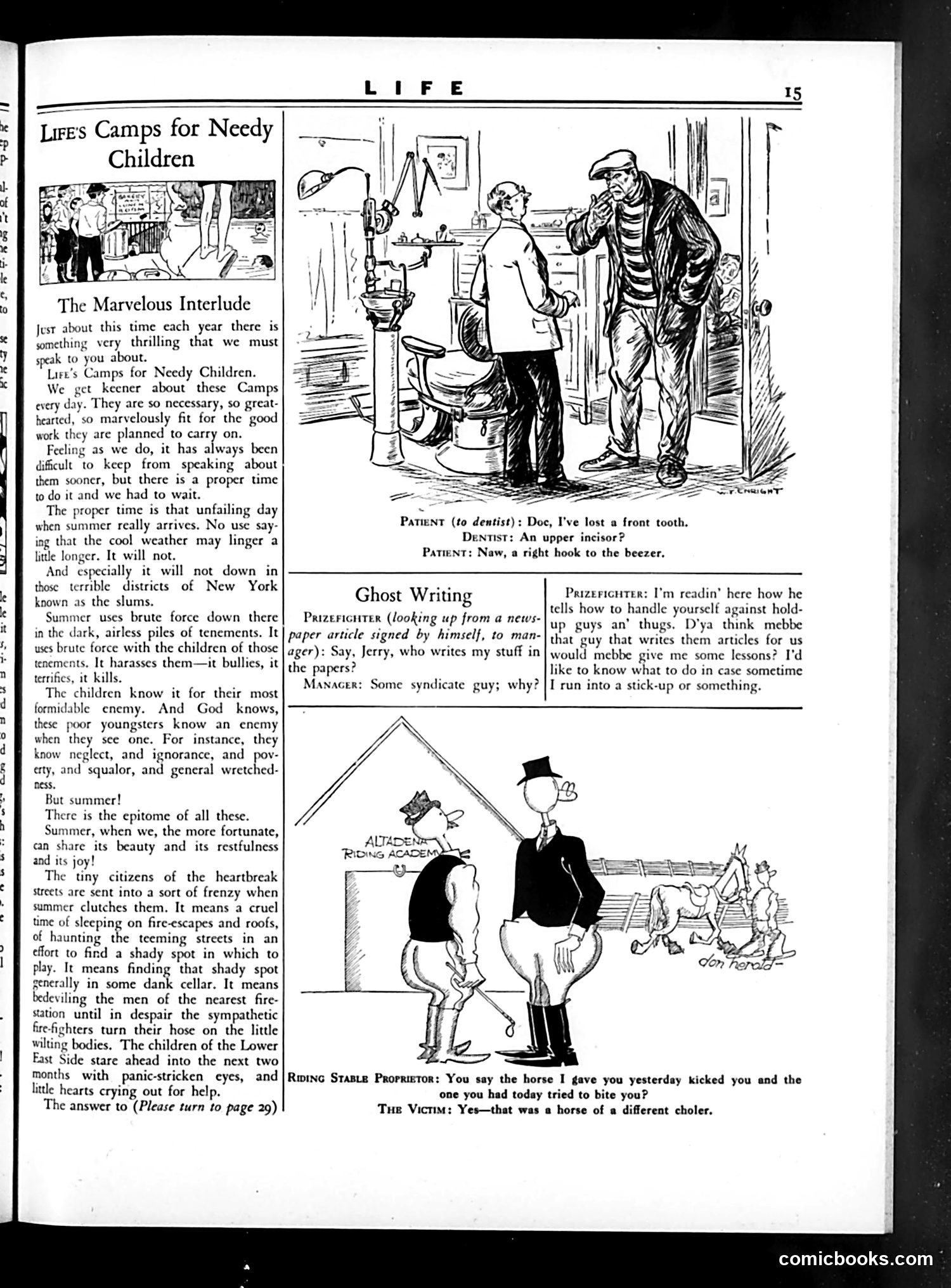
This page contains three separate humorous pieces: 1. **"Life's Camps for Needy Children"** (left): An editorial arguing for summer camps as relief for poor children in New York tenements, describing urban heat and overcrowding as serious hardships. 2. **"Ghost Writing"** (center): A brief joke about a prizefighter whose manager writes his newspaper column, with the fighter unaware of what's being published under his name. 3. **"Riding Stables Proprietor"** (bottom): A cartoon depicting a riding instructor and victim discussing a horse incident, with the punchline implying the victim was kicked by a different horse than the one he rode yesterday—satirizing dishonest stable operators or sloppy record-keeping. All three pieces use humor to critique social conditions or human dishonesty common to early 20th-century urban America.
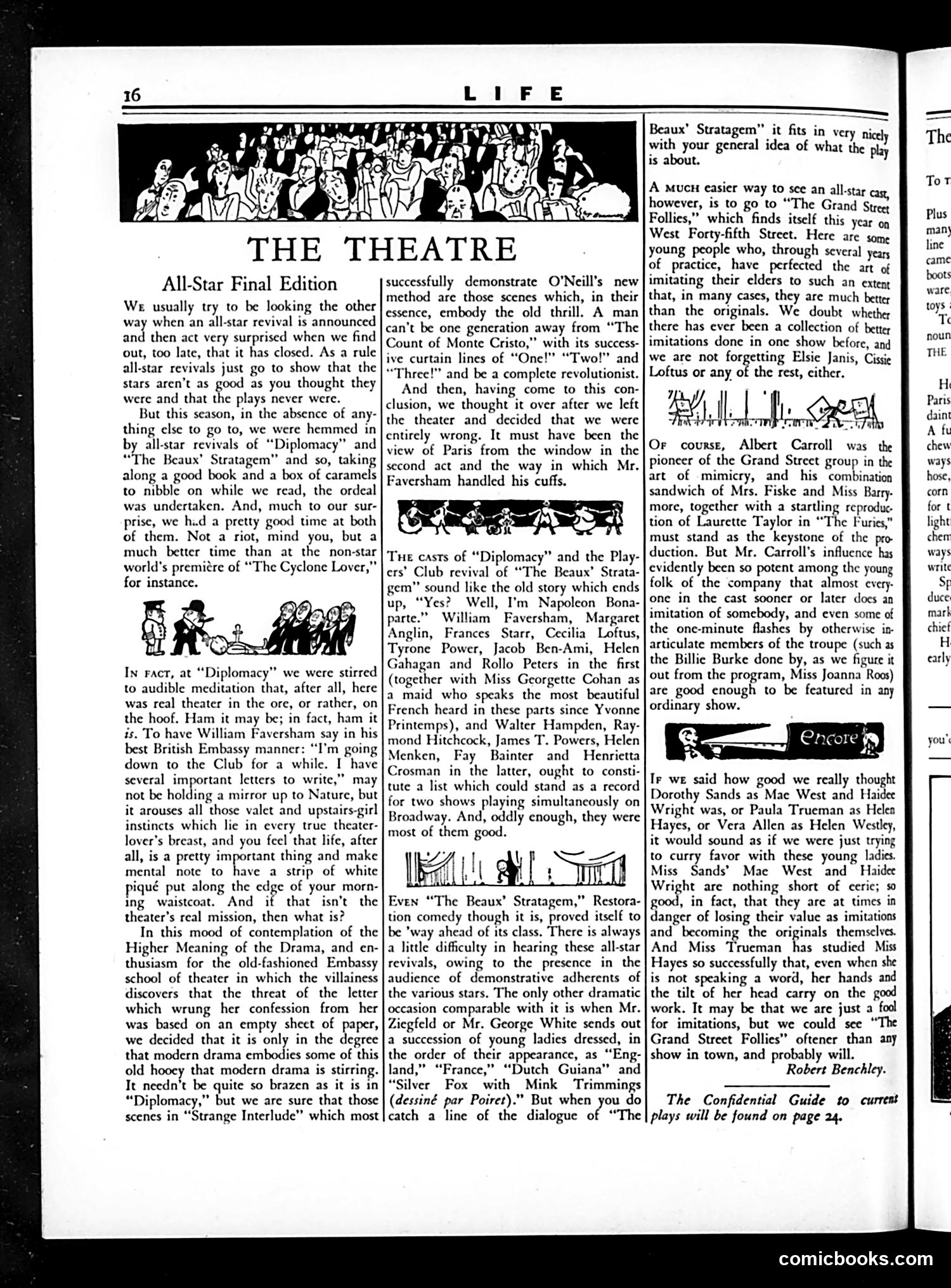
This is a theater criticism column reviewing Broadway productions. The page discusses several shows including "Diplomacy" and "The Beaux' Stratagem," praising an all-star revival featuring William Faversham, Margaret Anglin, and others. The small illustrations appear to be decorative theatrical vignettes rather than political cartoons. The main illustration shows a crowded theater audience in a simplified line-drawing style, typical of Life's humorous theatrical coverage. The critic (Robert Benchley, per the byline) uses witty commentary to discuss theatrical performances, comparing amateur imitations to originals and praising Dorothy Sands and Haide Wright's performances. The tone is satirical toward both pretentious theater-goers and mediocre productions, characteristic of Life's sophisticated humor during this era.
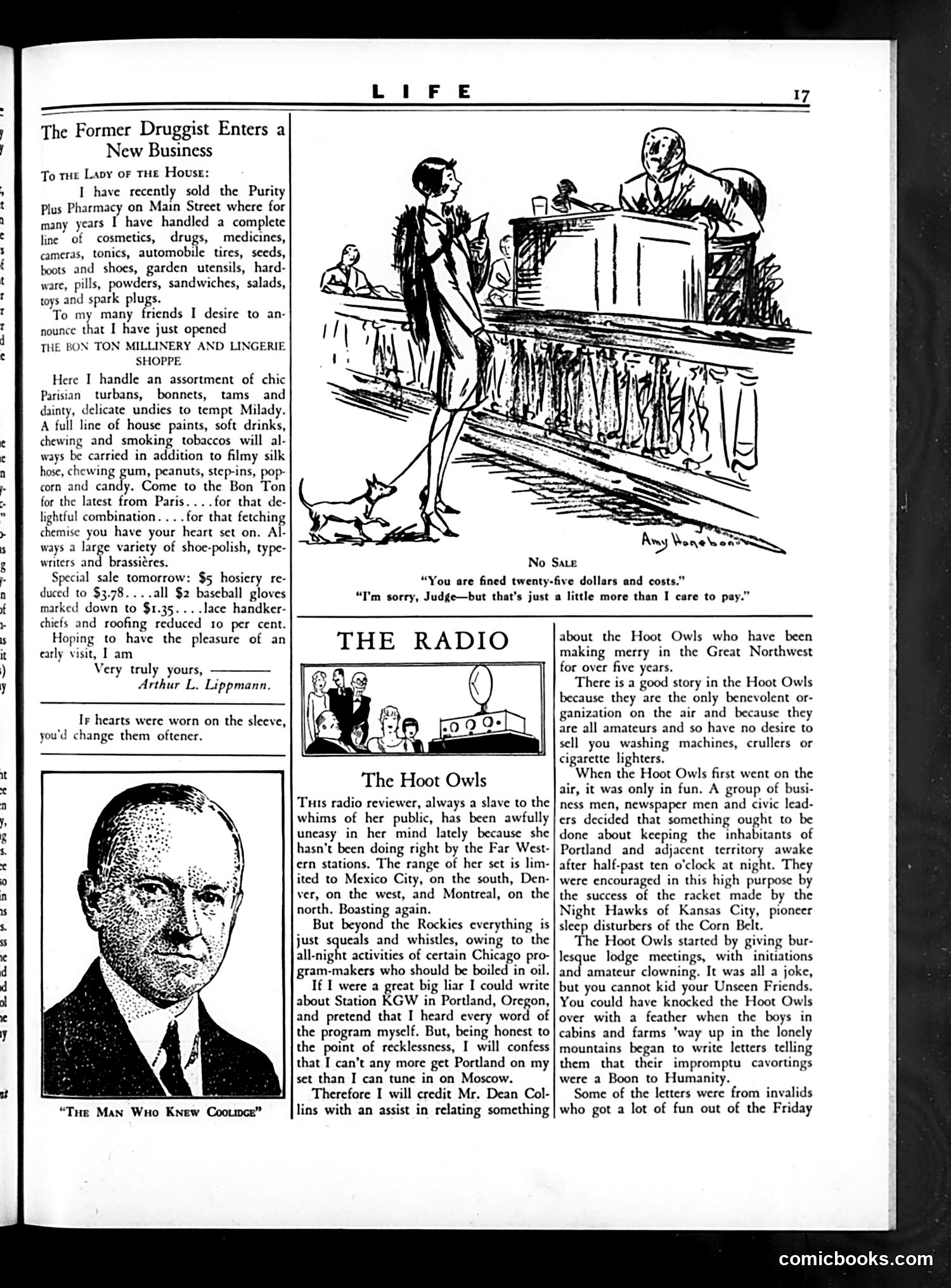
This cartoon depicts a courtroom scene where a judge fines a man "$25 dollars and costs." The defendant responds, "I'm sorry, Judge—but that's just a little more than I care to pay." The satire targets the absurdity of casual contempt for legal authority during Prohibition-era America. The man's flippant response to judicial punishment—suggesting the fine is merely an inconvenient expense rather than a serious consequence—mocks both the defendant's disrespect for the court and implicitly critiques how ineffective such minor penalties were at deterring illegal activity. The cartoon suggests that Prohibition enforcement was undermined by penalties so trivial that violators viewed them as acceptable business costs rather than genuine punishment.
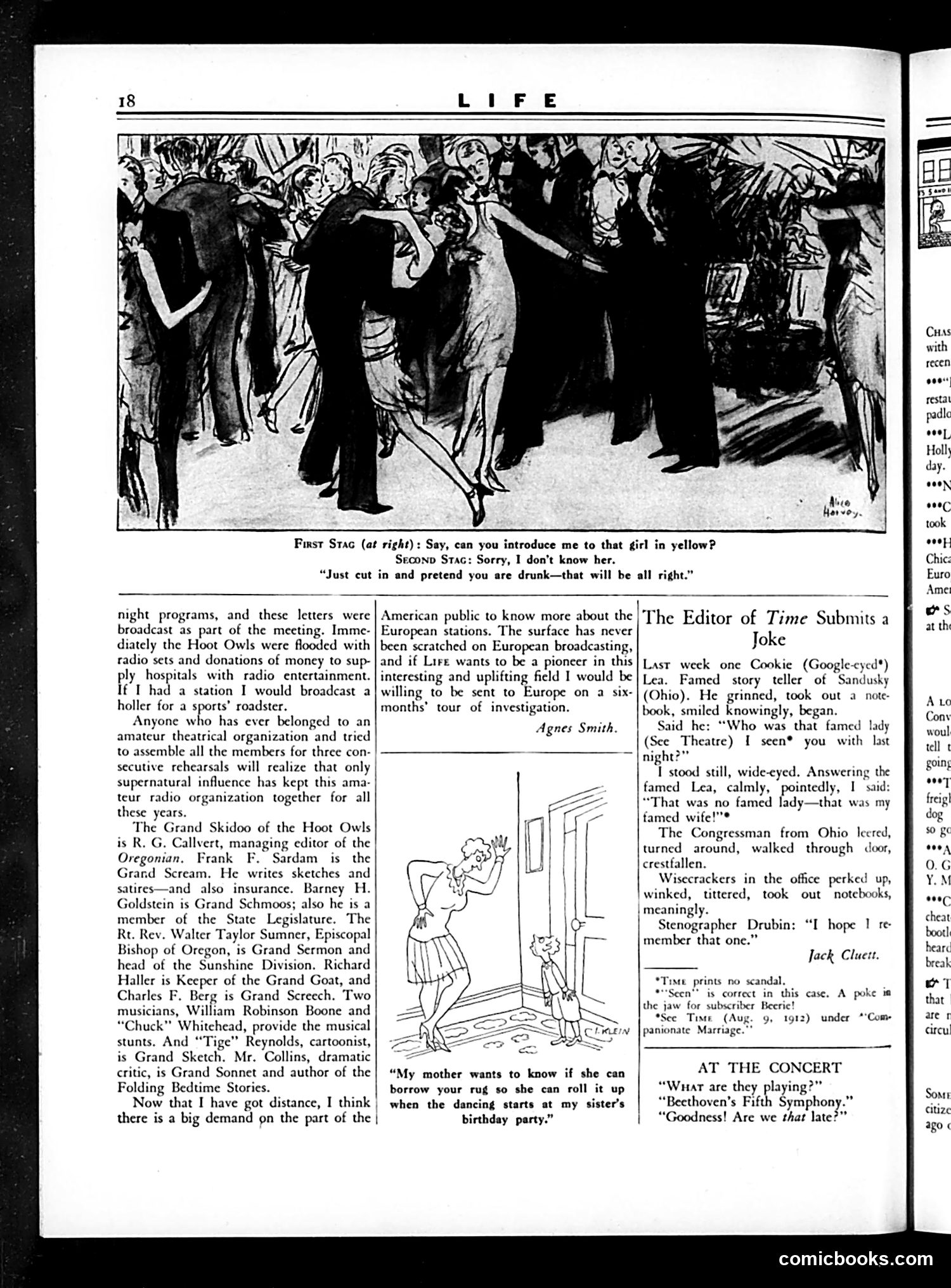
This page contains three distinct humorous pieces typical of early 20th-century satirical magazine content: **Top Cartoon:** A social commentary on party etiquette. Two men at what appears to be a dance discuss approaching an unknown woman. The second man's advice—"Just cut in and pretend you are drunk—that will be all right"—satirizes how intoxication was used as social cover for otherwise inappropriate behavior at parties. The joke reflects period attitudes about alcohol and male social conduct. **Middle Section:** An article about the "Hoot Owls," an amateur radio theatrical organization in Oregon, listing prominent local members (newspaper editor, bishop, legislator, etc.). It's mostly a puff piece about their charitable radio broadcasts. **Bottom Jokes:** Two brief comedic anecdotes—one about a congressman's wife being mistaken for someone else, another about arriving late to a concert. These are light, inoffensive humor typical of the magazine's filler content. The page represents Life's mix of social satire, local interest pieces, and clean comedy aimed at middle-class readers.
This page collects gossipy local tidbits from major American cities—Chicago, Pittsburgh, St. Paul, Spokane, Los Angeles, and Birmingham—presented as social commentary disguised as casual news items. The satire operates through **juxtaposition and understated irony**. Items mixing the mundane with the absurd highlight social contradictions: Chicago police raids on speakeasies ("government padlock"), bootleggers complaining that officials visit Canada ("foreign parts"), and Criminal Court packed with "ballot cheaters" while divorce cases break records. References to famous figures (actor Lon Chaney, Al Jolson, Will Rogers) appear trivialized—their activities no more noteworthy than sock prices or a train being on time. The **implicit critique**: American society is morally compromised (Prohibition flouted openly), politically corrupt (ballot cheating), and obsessed with celebrity trivia. By treating major social problems identically to gossip, Life suggests readers' indifference to serious issues. The tone is **wry, mocking, and weary**—characteristic of 1920s-era satirical magazines critiquing post-war American excess and hypocrisy.
This page contains **regional gossip and social notes** from various North American cities (Ottawa, Boston, Philadelphia, Newport, Detroit, and New York)—a standard feature of Life magazine during this era. The content is typical lighthearted society reporting: mentions of local citizens' travels, engagements, business activities, and humorous observations. Notable references include: - **Tom Heflin/Will Smith**: Political figures mentioned regarding Alabama politics and religious tensions (Smith was famously opposed by the KKK over his Catholicism) - **"The Jazz Singer"**: The groundbreaking 1927 film being shown in Birmingham - **Charles Lindbergh**: Referenced in Newport notes as an anticipated visitor - **Independence Day timing joke**: Philadelphia's note that Independence Day will be "celebrated here next month, the nation having been born in this place" is local pride humor The satire is gentle—poking fun at small-town pretension, misplaced advertising money, and local celebrities. This gossip format was Life's primary content during the 1920s-30s, mixing genuine news with comedic social commentary for educated, middle-class readers.
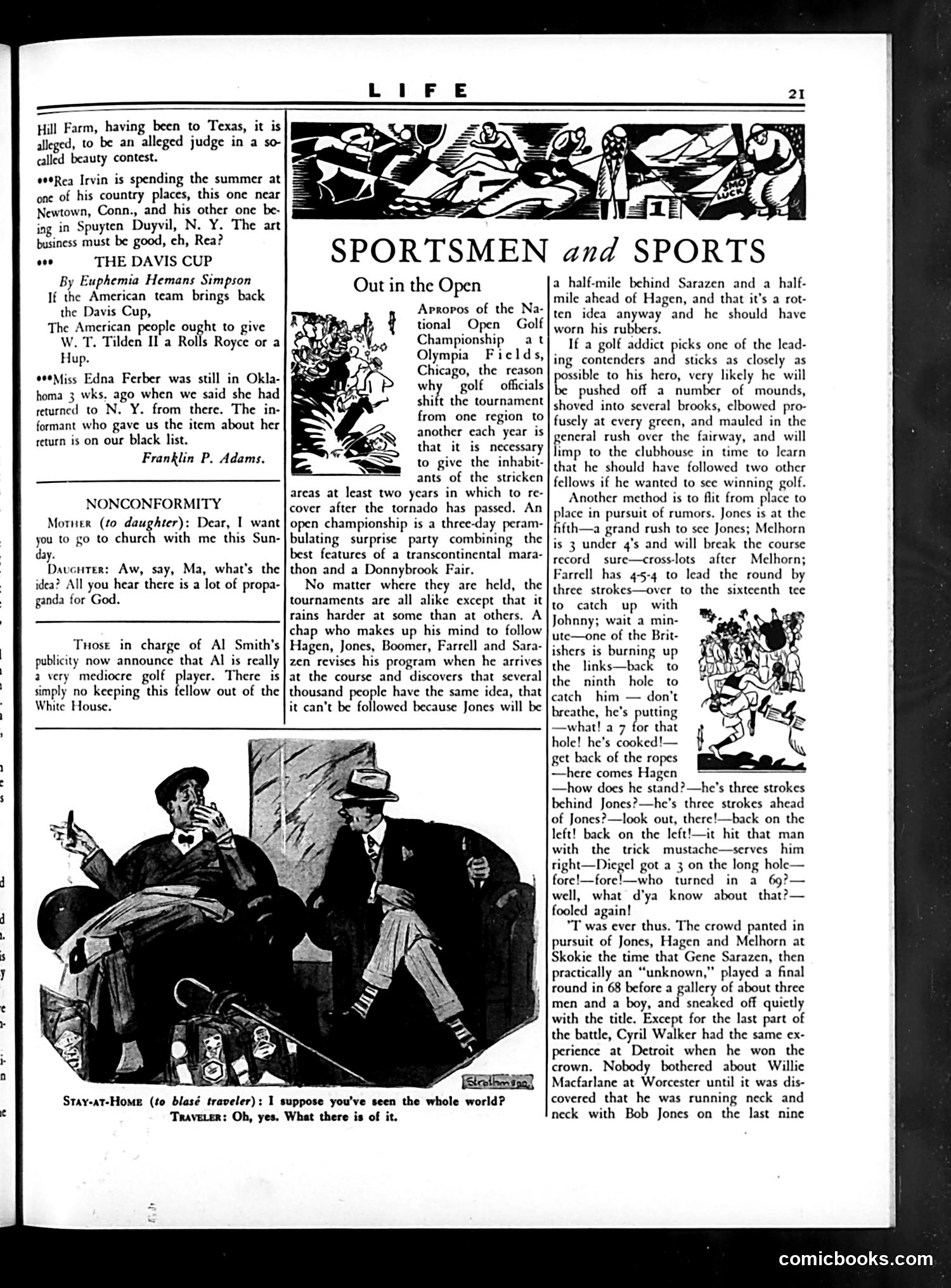
This page from Life magazine satirizes golf tournaments and celebrity gossip circa the 1920s. **The cartoons:** The main illustration depicts a stay-at-home person questioning a world traveler, mocking travel pretension with the rejoinder "What there is of it." **The "Sportsmen and Sports" column** humorously describes the chaos of following the National Open Golf Championship. It names real golfers of the era (Jones, Hagen, Sarazen, Farrell, Melhorn) and mockingly details how spectators get trampled, pushed into brooks, and lose track of their chosen contenders while chasing rumors across the course. The satire peaks when Gene Sarazen, then "practically an 'unknown,'" shot a competitive 68—proving that obsessive crowd-following of famous names is futile. **The gossip items** target celebrities: W.T. Tilden (tennis star), Al Smith (politician), and Edna Ferber (author), using lighthearted ribbing about their whereabouts and accomplishments. The "Nonconformity" joke mocks a daughter's irreverent dismissal of church as "propaganda for God." The overall tone is witty, gossipy, and gently satirical about American leisure culture.
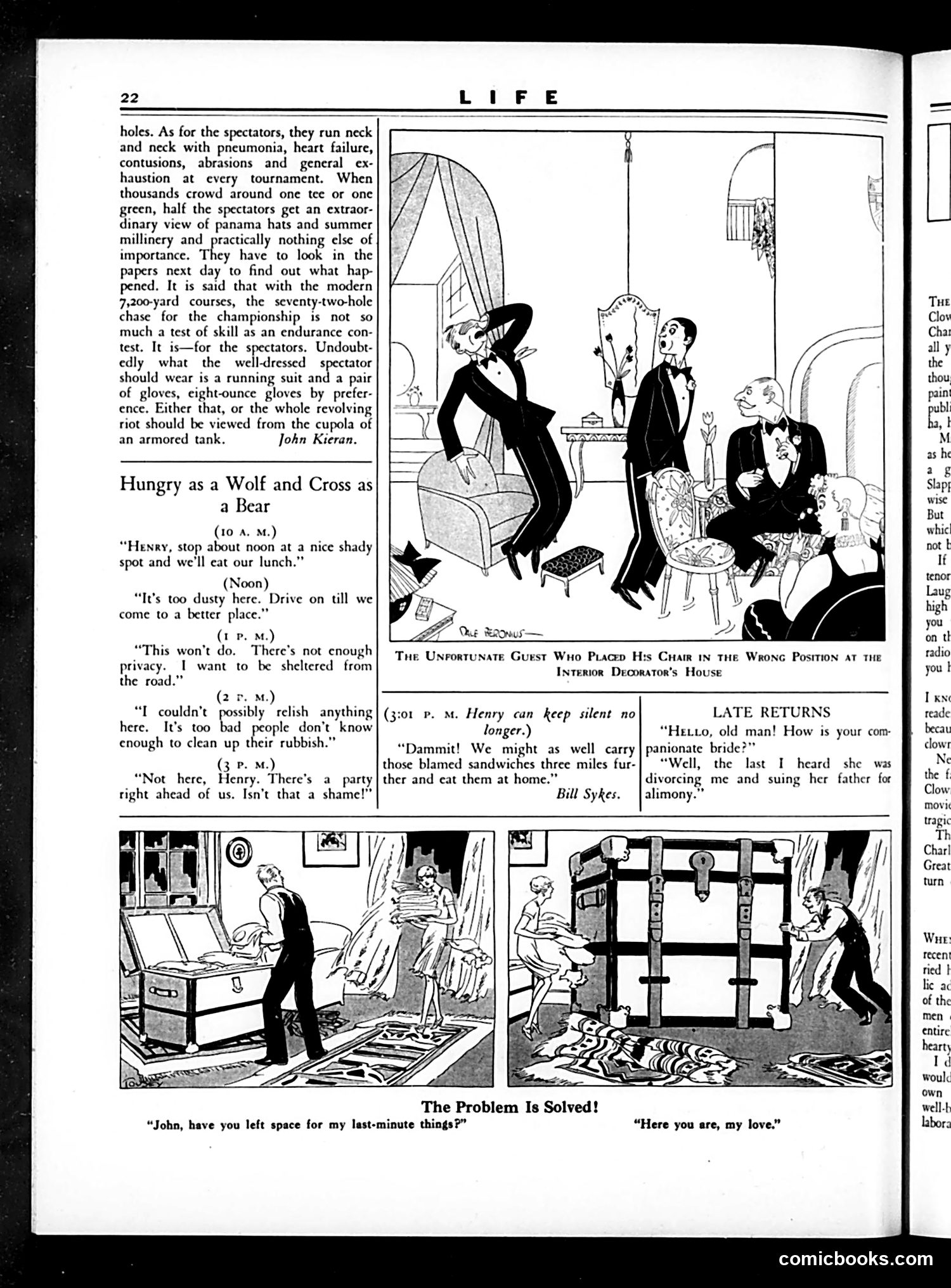
This page contains three satirical pieces typical of 1920s-30s American humor: **"Hungry as a Wolf and Cross as a Bear"**: A couple's car trip devolves into comic complaints. The wife finds each proposed lunch spot inadequate—too dusty, too public, too dirty—until finally at 3 p.m. she gives up. The humor targets indecisive, perpetually dissatisfied travelers (likely wives, given period gender dynamics). **"The Unfortunate Guest"**: A man at an interior decorator's home sits in a chair positioned awkwardly against decorative panels, creating an absurd visual. The humor mocks both his obliviousness and interior design pretension. **"The Problem Is Solved!"**: Two panels show a husband frantically packing a trunk, then his wife appearing with more luggage. The joke: there's never enough space for a woman's "last-minute things"—a common marital complaint about female shopping habits and overpacking. The opening text by John Kieran critiques golf spectators' experiences—blocked views and exhaustion—suggesting golf tournaments were fashionable social events where attendance mattered more than actual enjoyment.
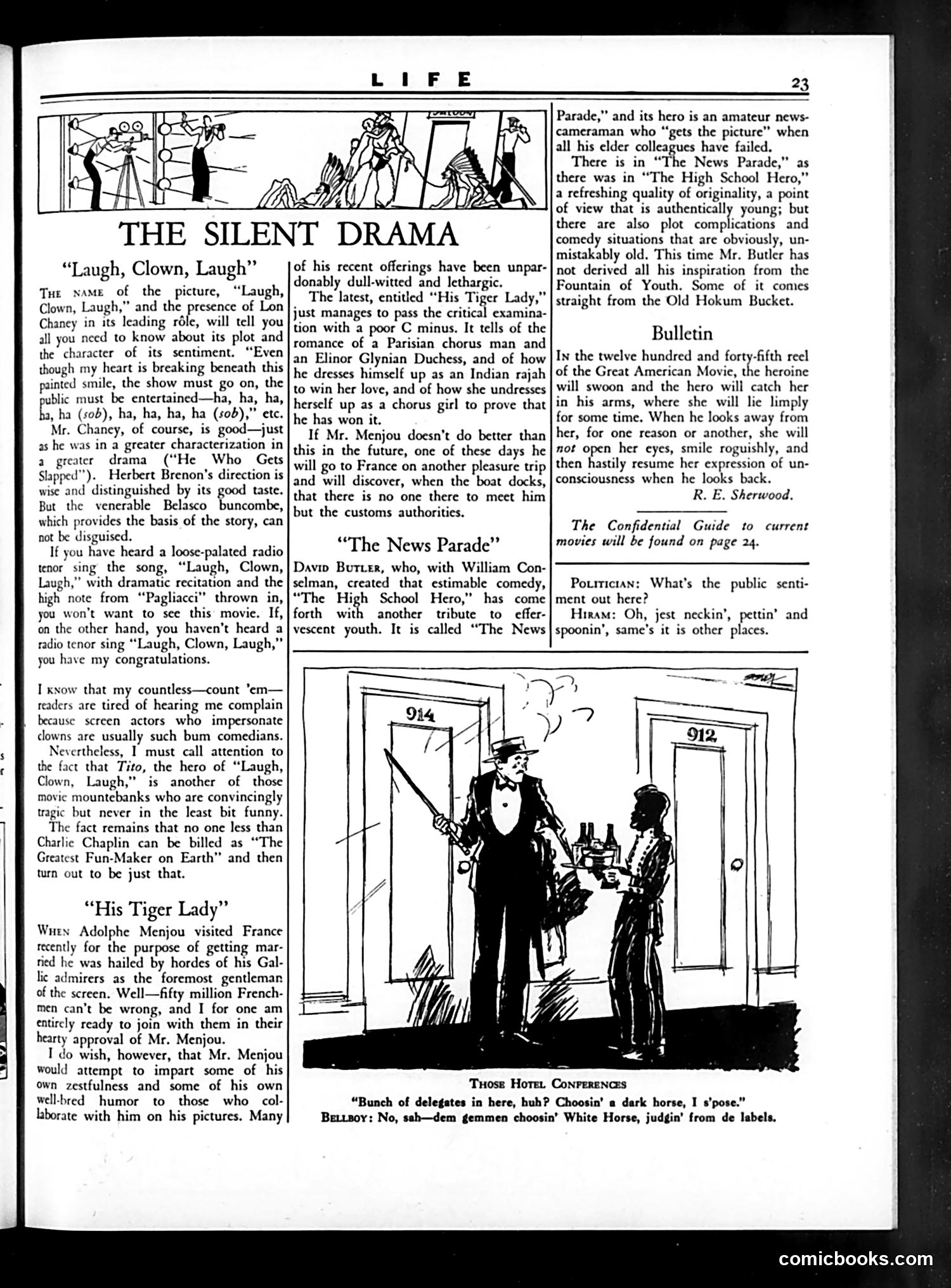
This page reviews three silent films from the 1920s. The main cartoon depicts a hotel hallway scene with two men in formal wear discussing hotel delegates, using dialect humor ("choosin' a dark horse," "White Horse"). The text reviews "Laugh, Clown, Laugh" (starring Lon Chaney), criticizing how screen clowns fail to be genuinely funny despite playing tragic roles convincingly. The reviewer dismisses "His Tiger Lady" with Adolphe Menjou as dull, though praising Menjou's French popularity. "The News Parade" receives qualified praise for originality despite recycled plot devices. The satire targets silent film conventions: the tired "tragic clown" trope, formulaic plots dressed in exotic settings, and predictable melodrama. The cartoonist mocks both the films' pretensions and contemporary audiences' fascination with them. The piece exemplifies how Life magazine critiqued popular entertainment through witty, irreverent commentary—the magazine's trademark approach.
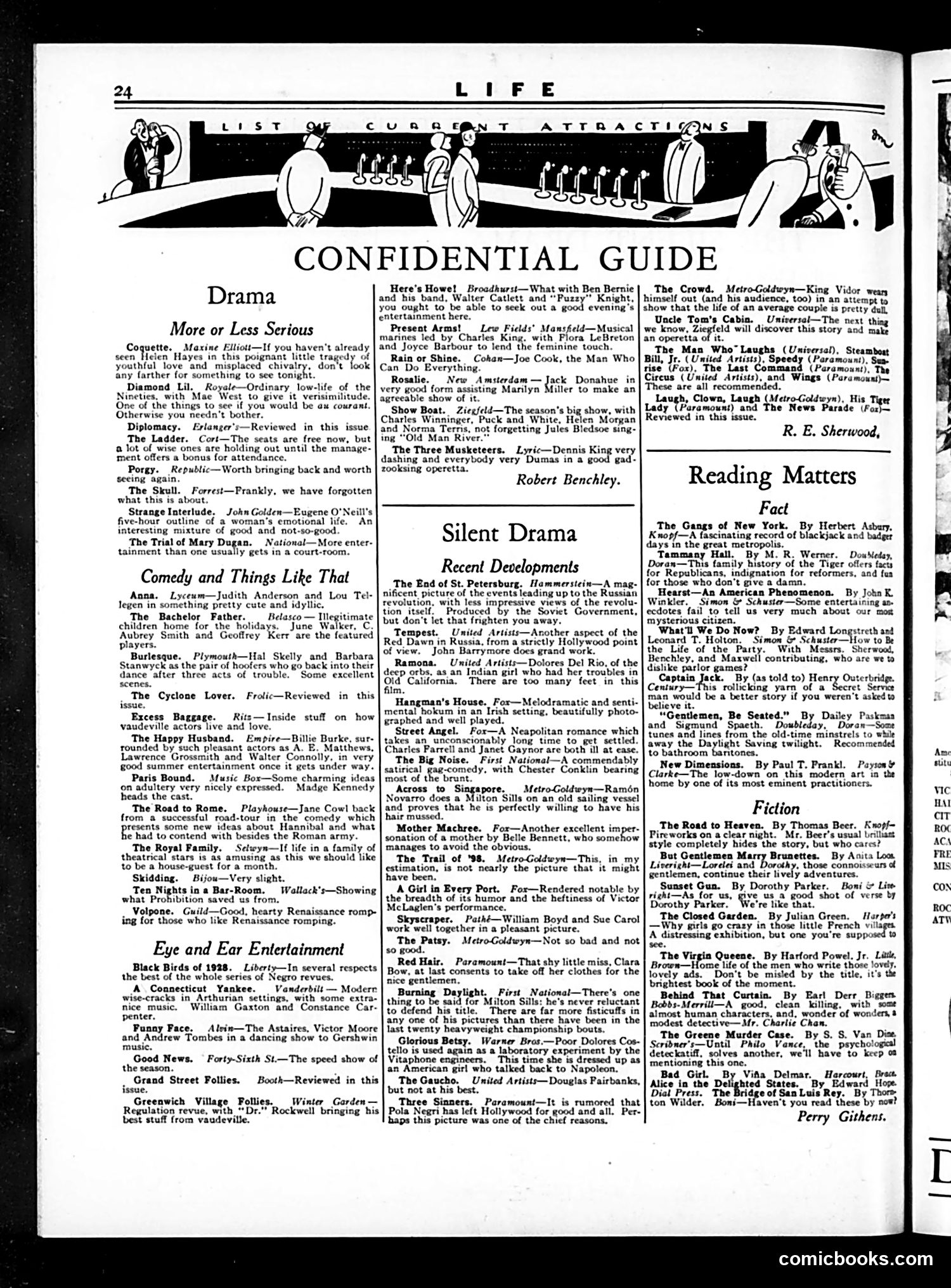
This page is a theater review guide from Life magazine's entertainment section, not a political cartoon. It provides brief, witty capsule reviews of current Broadway productions (circa late 1920s, based on references to shows like "Show Boat" and "A Connecticut Yankee"). The reviews use sardonic humor typical of Life's style—dismissing some shows as forgettable ("Frankly, we have forgotten what this is about"), offering backhanded compliments ("The seats are free now"), and praising others like Helen Hayes in *Coquette* and Mae West in *Diamond Lil*. The comedic voice is cynical about commercial theater while championing serious drama and innovative work like Eugene O'Neill's *Strange Interlude*. There are no political references or caricatures—this is simply entertainment criticism written with the magazine's characteristic snark and brevity, aimed at sophisticated New York theatergoers deciding what to see.
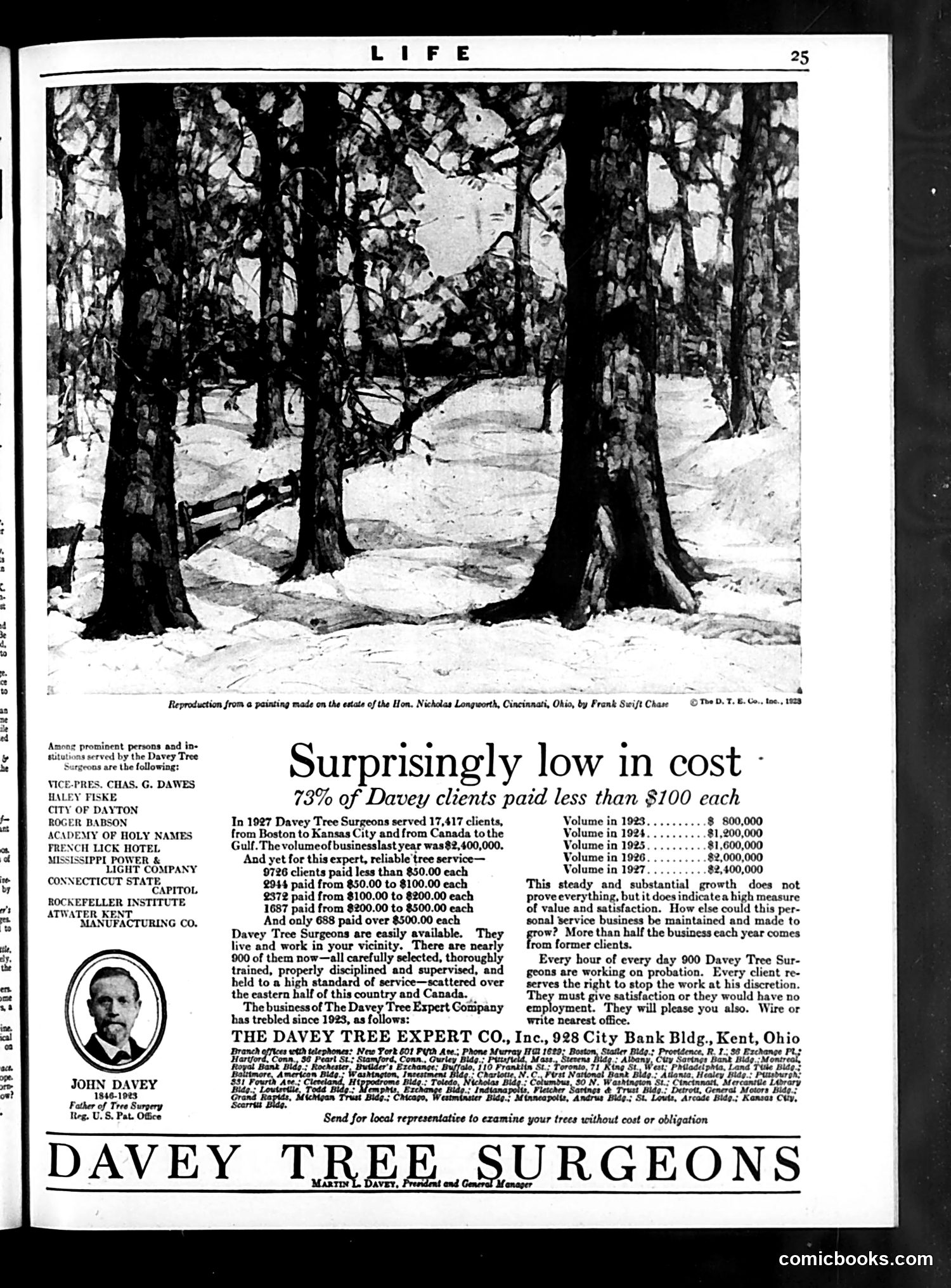
This is **not a cartoon or satire**, but rather a full-page advertisement for the Davey Tree Expert Company, appearing in *Life* magazine circa 1923-1927. The ad promotes tree surgery services—a relatively new professional field pioneered by founder John Davey (1846-1923, pictured). The image shows a snowy forest scene, likely from a painting commissioned on the estate of prominent Cincinnati resident Nicholas Longworth. The advertisement's key pitch: tree surgery is "surprisingly low in cost," with 73% of clients paying under $100. It emphasizes the company's rapid growth (business tripled since 1923), nationwide reach (900 trained surgeons across the eastern U.S. and Canada), and client satisfaction (half return annually). The long list of prominent clients—including Vice President Charles Dawes, industrialists, and institutions—serves as social proof of respectability and legitimacy for this emerging service industry. This reflects early-20th-century American commercialism: professional expertise marketed through prestigious endorsements.
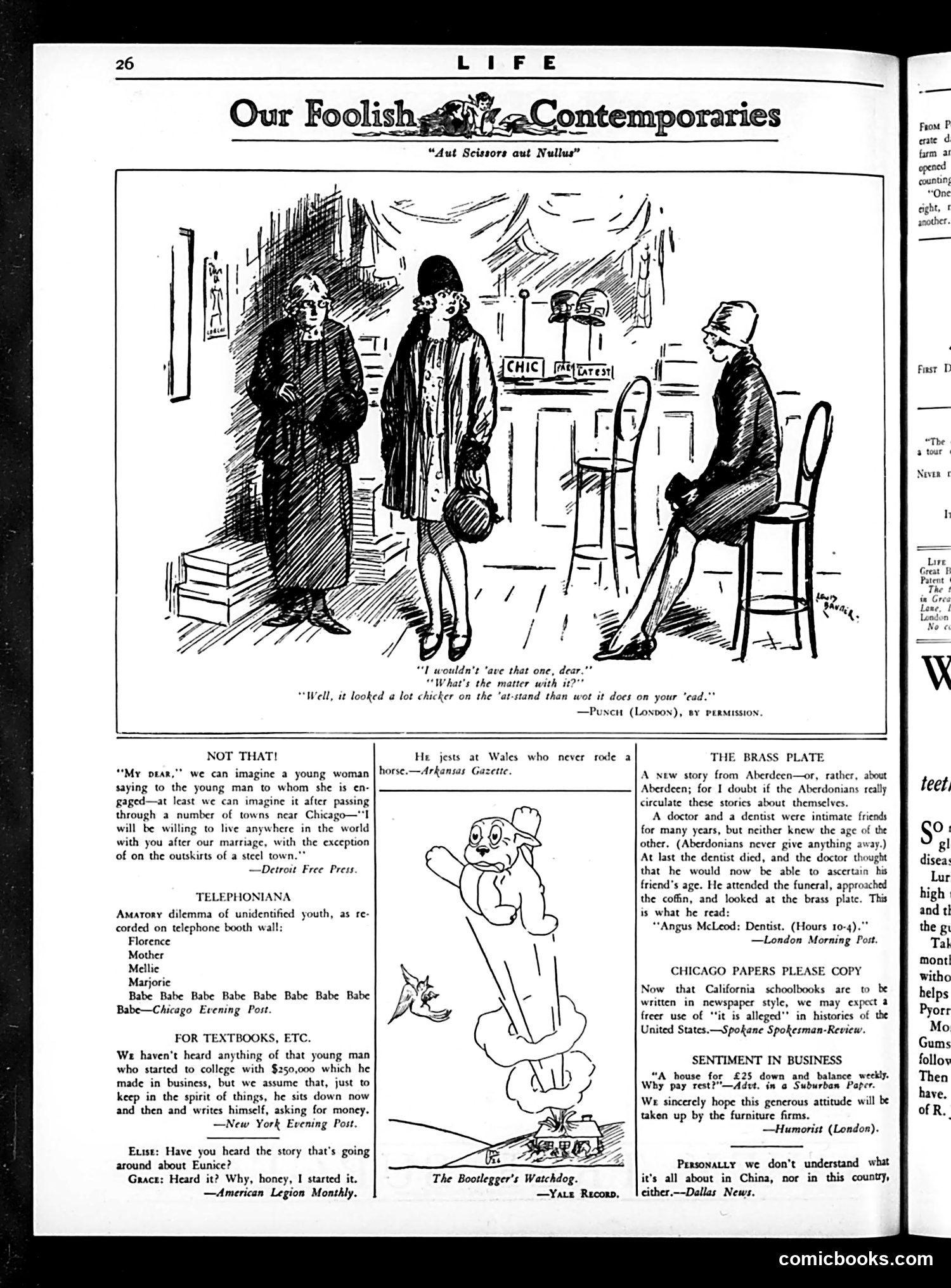
This page collects humorous anecdotes and jokes mocking contemporary society and human folly. The main cartoon depicts a hat-shop scene where a young woman rejects a hat, complaining it looks better on the display stand than on her head—satirizing poor consumer judgment or vanity. The surrounding text includes brief comedic items: a woman from Chicago refusing to live near steel mills after marriage; a youth's romantic confusion (listing multiple women's names in a phone booth); a wealthy college student presumed to be panhandling himself for tuition; and an Aberdeen story where a doctor learns his deceased friend's age only from his coffin's brass nameplate, mocking Scottish stinginess. Additional items mock California's newspaper-style textbooks, cheap housing advertisements, and general confusion about international affairs. The humor targets middle-class pretension, regional stereotypes (particularly Scottish frugality), and the absurdities of modern life in early 20th-century America.
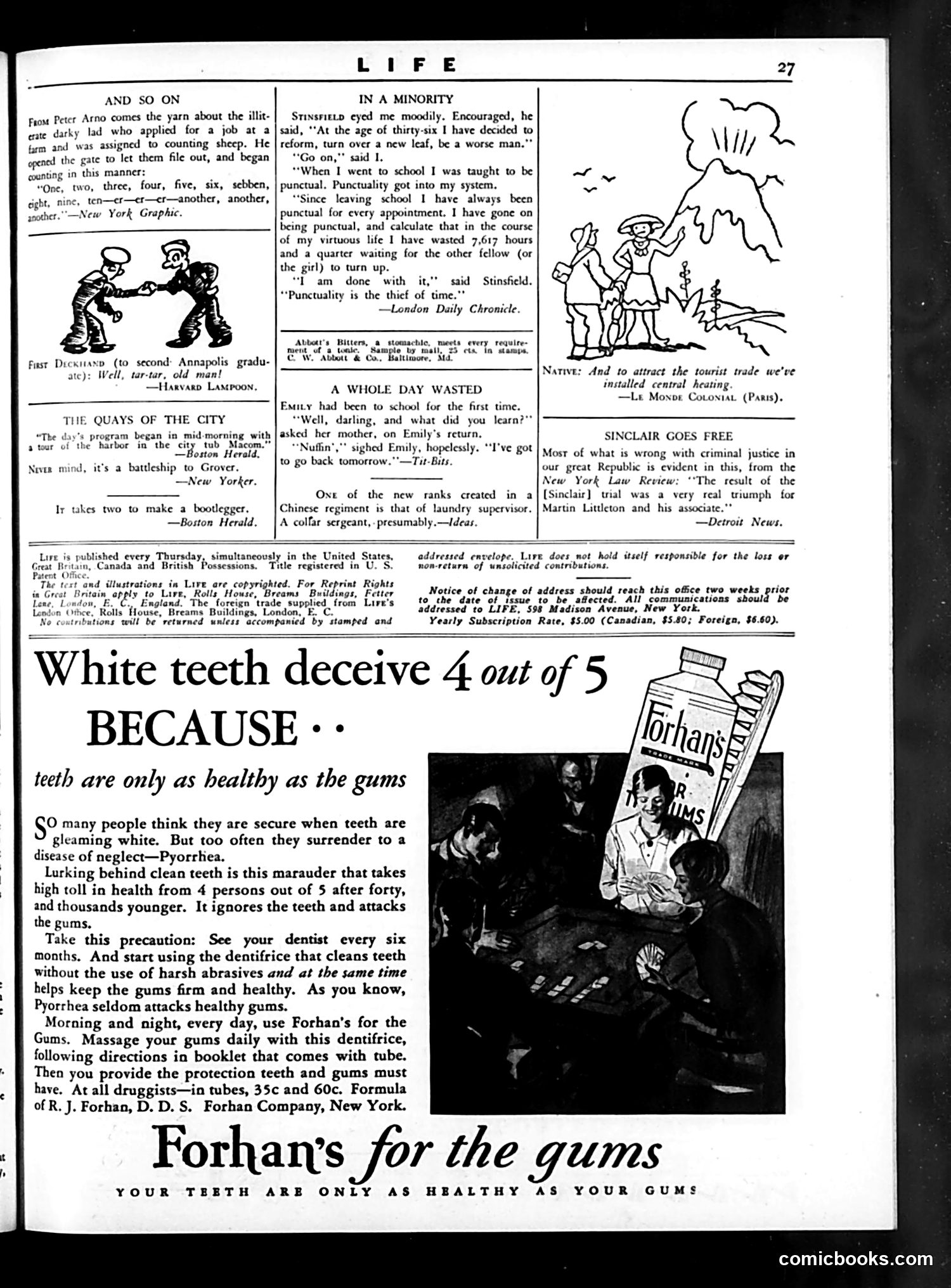
This page mixes brief satirical items with advertising. The cartoons and jokes target early 20th-century social absurdities: **"AND SO ON" section**: Short humorous anecdotes, including one using a racist caricature of a Black farmworker counting sheep with non-standard English ("sebben" for seven). This reflects the casual racial humor common in period publications. **Other jokes** mock bureaucratic pretension ("The Quays of the City" confusing a harbor tour with military terminology) and Prohibition-era bootlegging. **"IN A MINORITY"**: A man ironically claims he'll "reform" by becoming *worse*—abandoning punctuality because waiting for unpunctual others has wasted his life. It's satirizing social conformity and the absurdity of virtue. **The Sinclair reference**: Appears to critique a trial outcome where a lawyer's "triumph" matters more than justice itself. **Lower half**: A Forhan's toothpaste advertisement claiming white teeth deceive people about gum health—using fear-based marketing about pyorrhea (gum disease). The page exemplifies Life's mix of satirical commentary and period advertising, with racial stereotypes reflecting contemporary attitudes.
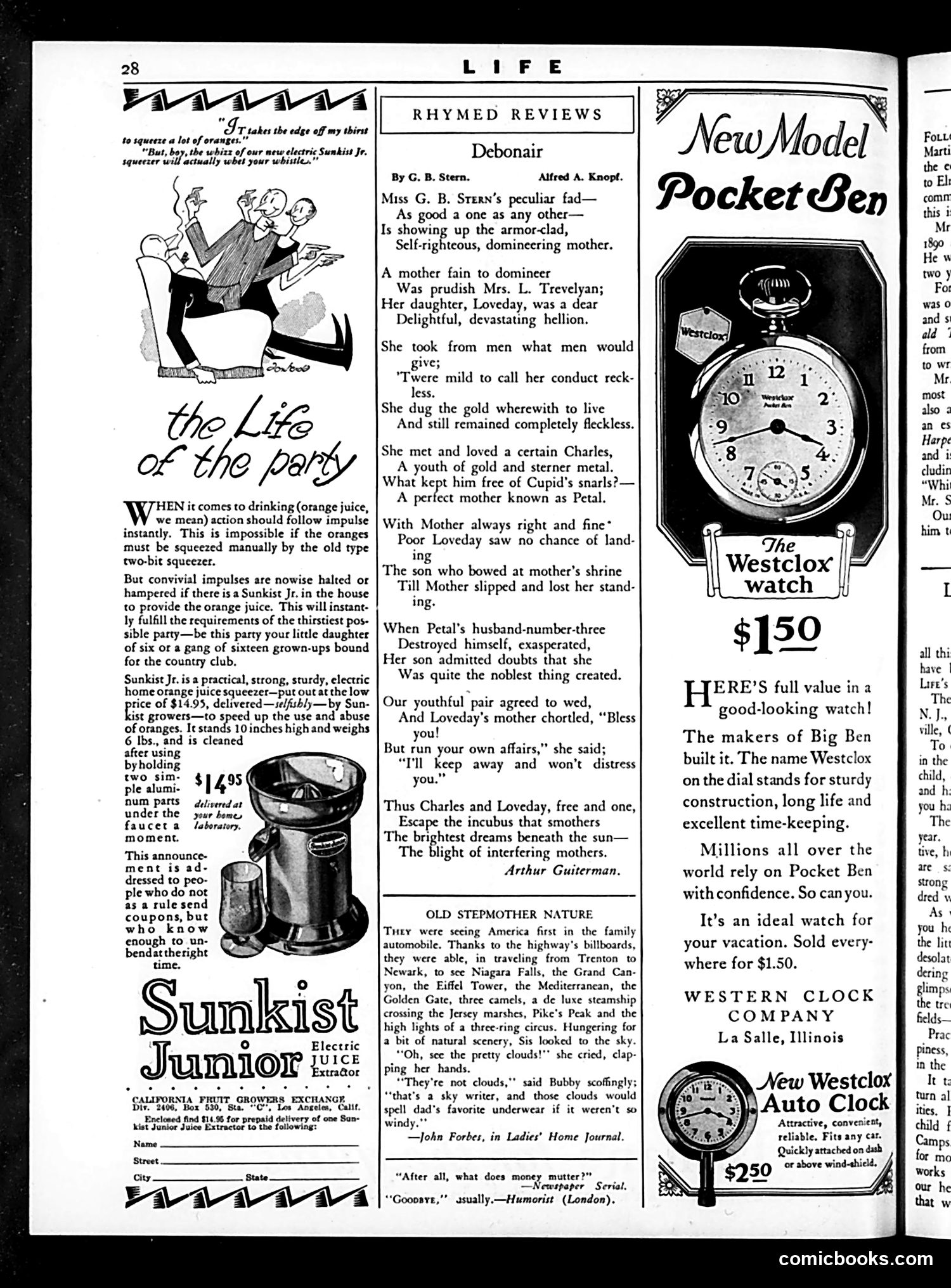
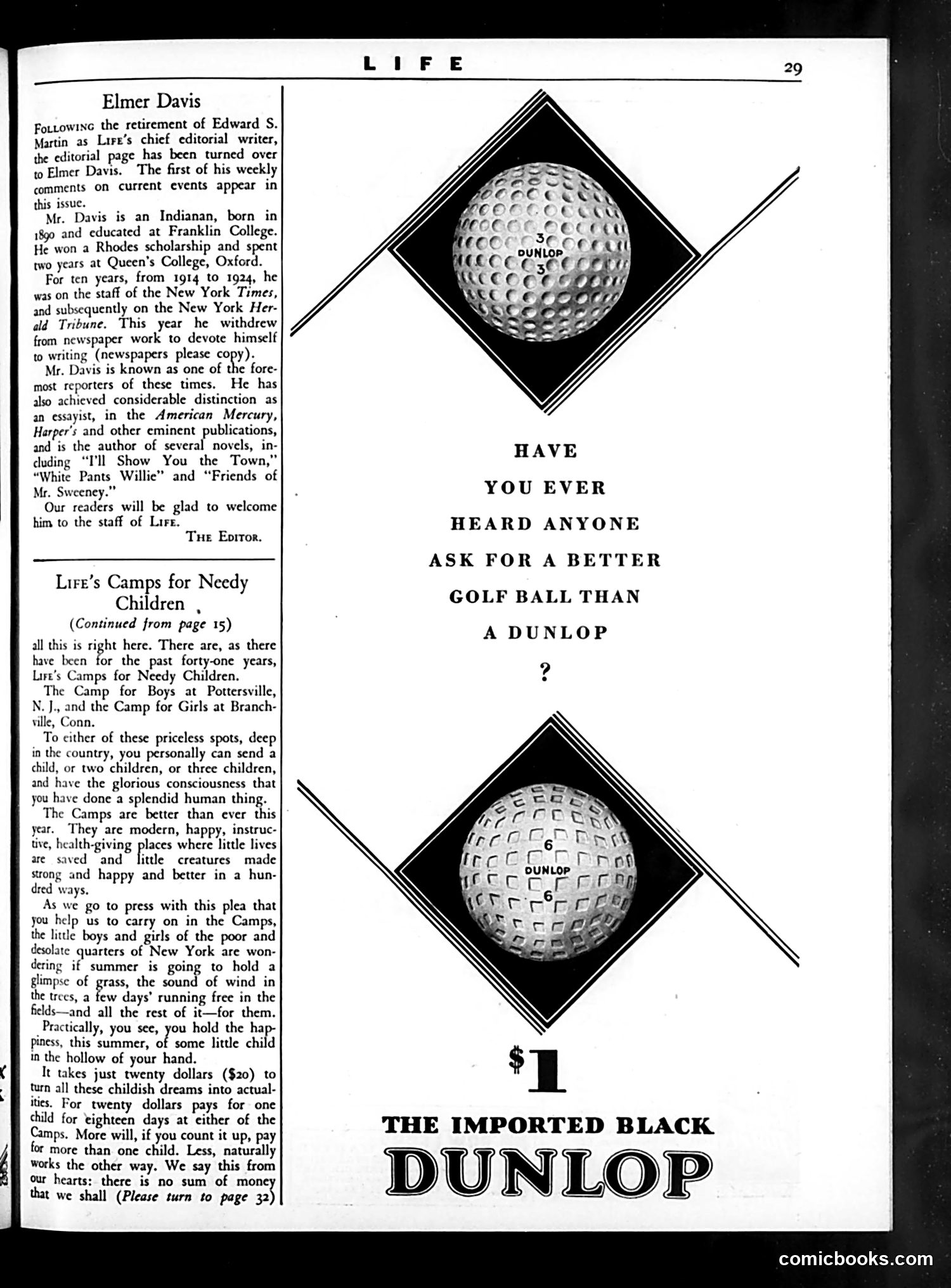
This page is primarily **advertising and administrative content**, not political satire. The top section announces Elmer Davis as Life's new chief editorial writer, replacing Edward S. Martin. Davis was a respected journalist from the New York Times and Herald Tribune who left newspaper work to focus on writing essays and novels. Below that is a fundraising appeal for "Life's Camps for Needy Children"—charitable summer camps in New Jersey and Connecticut for poor urban children. The editor solicits $20 donations to send children to these camps for eighteen days, emphasizing the camps' educational and health benefits for disadvantaged youth. The remaining space contains a **Dunlop golf ball advertisement** with two product images and a rhetorical question: "Have you ever heard anyone ask for a better golf ball than a Dunlop?" This is straightforward product promotion, not satire. The page reflects 1920s-era Life magazine's mix of serious editorial content, charitable advocacy, and upscale advertising aimed at affluent readers.
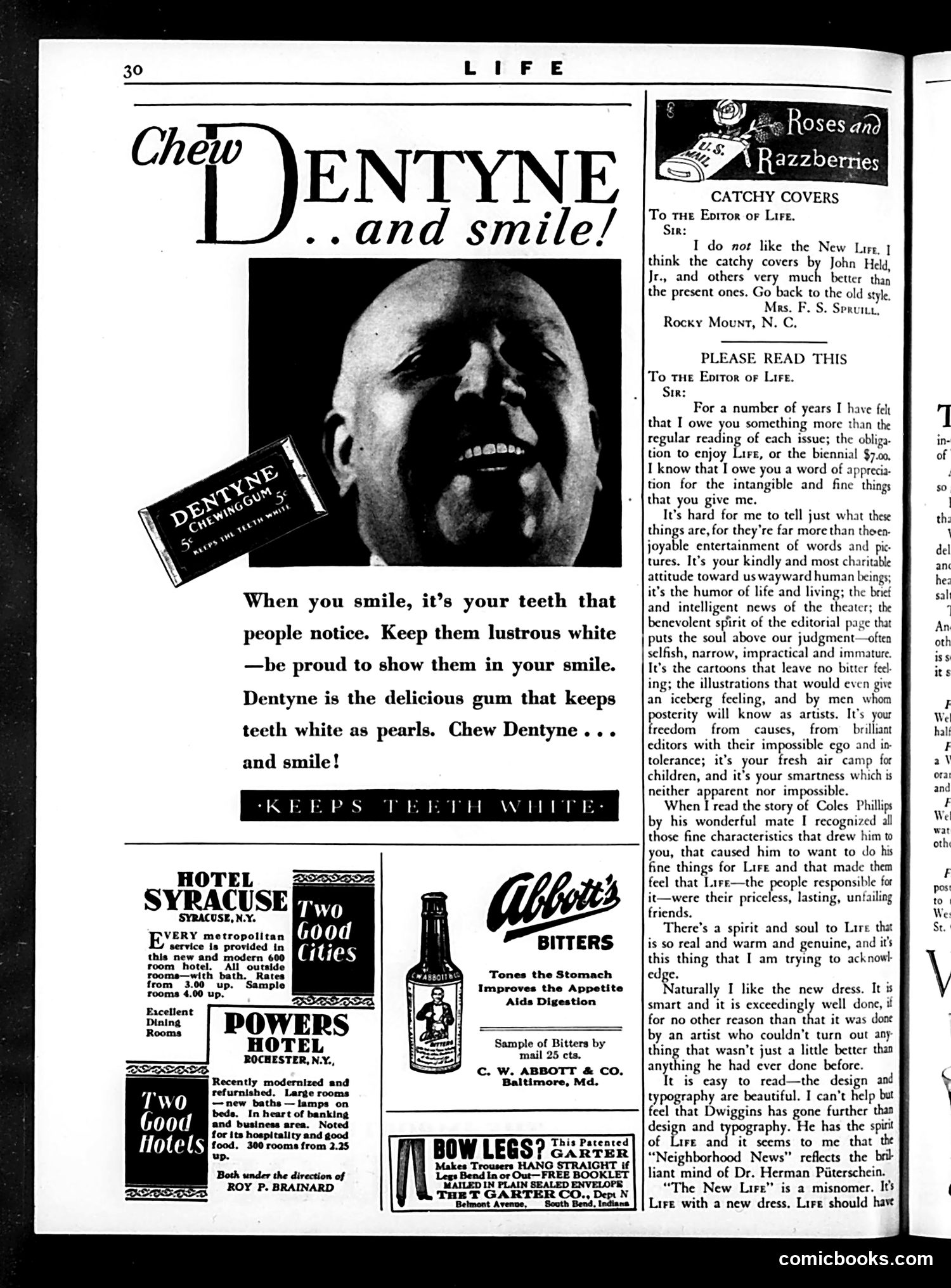
This page is primarily **advertising and reader correspondence**, not political satire. The main content features a **Dentyne chewing gum advertisement** with a large photograph of a smiling man's face, emphasizing teeth whiteness. The ad's message—"keep them lustrous white"—reflects early 20th-century consumer culture's emphasis on personal grooming and appearance. Below are hotel and patent medicine ads typical of the era (Abbott's Bitters, Powers Hotel, Syracuse Hotel). The right column contains **reader letters to Life's editor**. One complains about the magazine's new cover designs by John Held Jr., preferring the old style. Another praises Life's editorial spirit, humor, and new visual design by W.A. Dwiggins, calling it smart and well-executed while denying it represents fundamental change—"a new dress" on the same magazine. The page reflects **1920s consumer advertising norms** and magazine reader engagement, not political commentary.
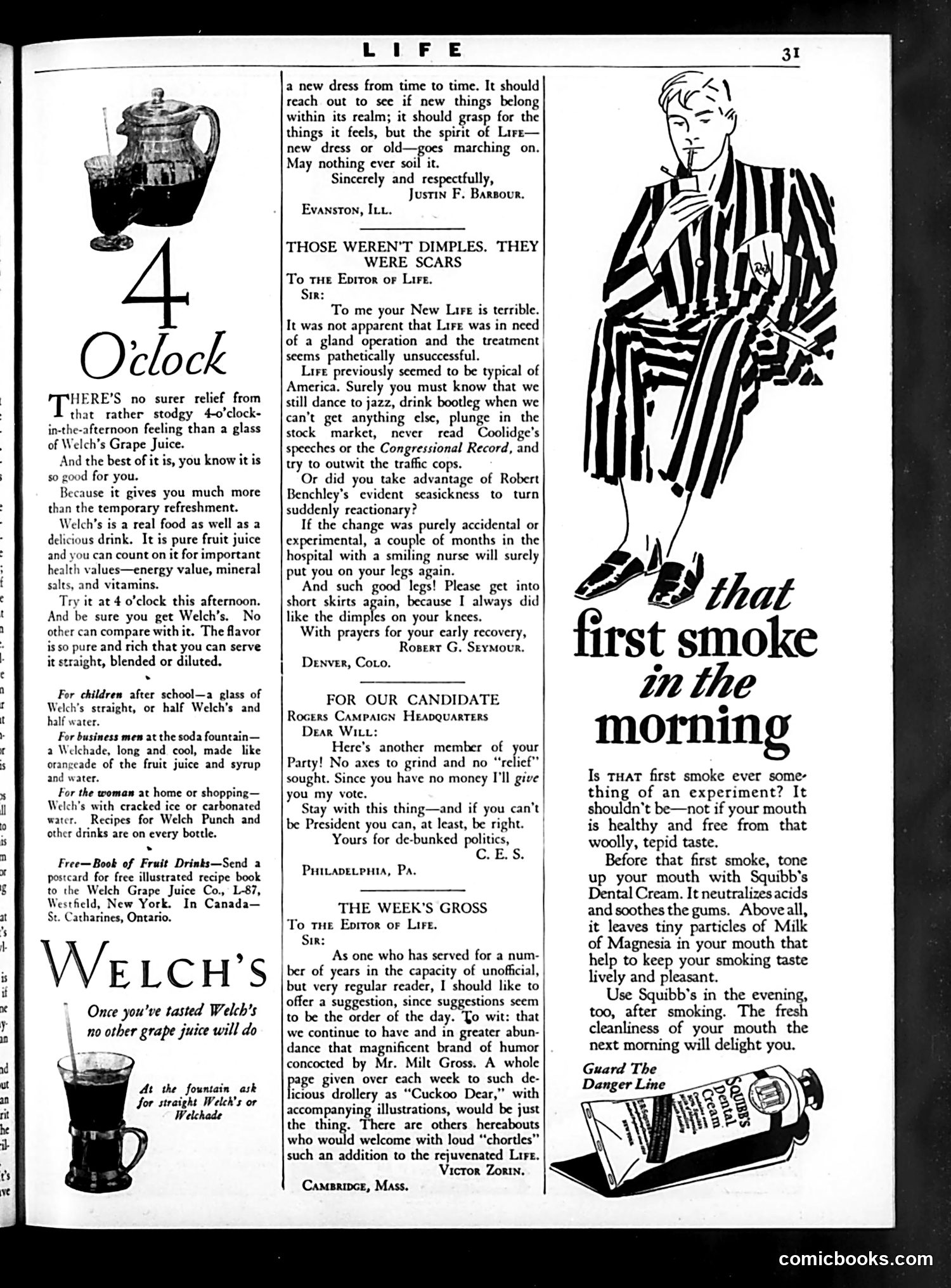
This page contains **advertisements and reader letters** rather than editorial cartoons. The main content includes: **Advertisements:** - Welch's Grape Juice (4 o'clock refreshment drink) - Squibb's Dental Cream (with illustration of man smoking) **Reader Letters to the Editor** criticizing Life magazine's recent redesign: 1. **Justin Barbour** praises Life's evolution while maintaining its spirit 2. **Robert Seymour** (Denver) complains the "new Life is terrible"—attacking it as too reactionary and abandoning Life's typical American character (jazz, bootleg drinking, stock market speculation, evading traffic cops). He references Robert Benchley's "seasickness," sarcastically suggesting Life underwent unnecessary "gland operation" surgery. 3. A campaign supporter urges continuance of current direction 4. **Victor Zorin** (Cambridge) requests more humor from cartoonist Milt Gross **Context:** This reflects 1920s debates over Life's editorial direction—readers disagreed whether recent changes represented improvement or unwelcome conservatism.
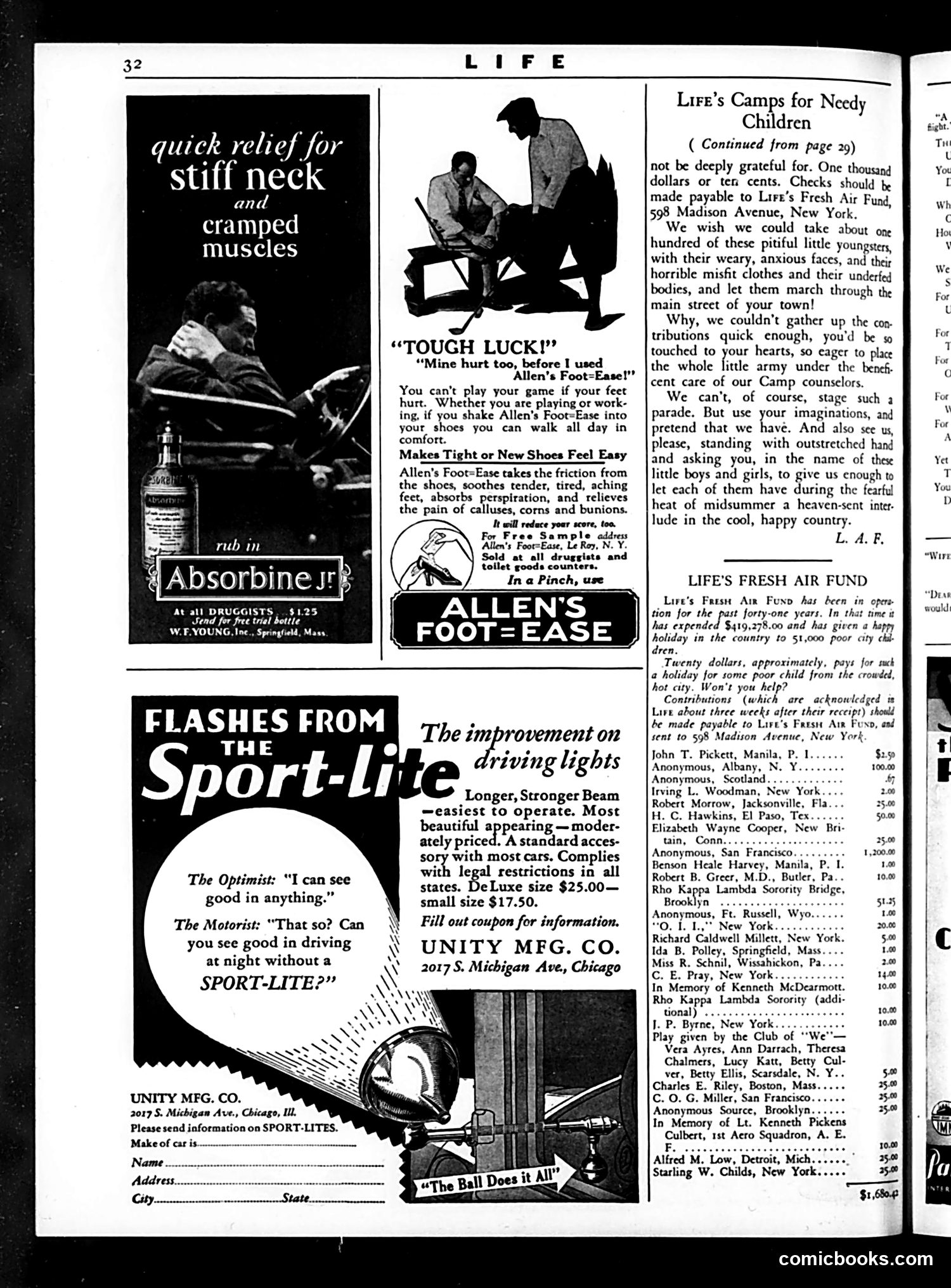
This page is primarily **advertisements and fundraising appeals**, not political satire. The main content includes product ads (Absorbine liniment for muscle pain, Allen's Foot-Ease powder, Sport-Lite driving lights) paired with brief comic dialogue showcasing their benefits. These use a simple "problem-solution" humor format typical of 1920s advertising. The significant editorial content is **Life's Fresh Air Fund campaign** — a charitable initiative sending poor urban children to countryside camps. The article describes "pitiful little youngsters" from crowded cities needing respite, soliciting donations. A detailed list of contributors (ranging from $1 to $100+) follows, including organizations like Rho Kappa Lambda Sorority and various named individuals. The fund, established 41 years prior (making this circa 1930s), had distributed over $419,000 and served 51,000 children. Twenty dollars could fund one child's holiday. This reflects **Progressive Era charity concerns** — urban poverty, children's welfare, and the countryside as moral/physical restoration — but is sincere advocacy rather than satire.
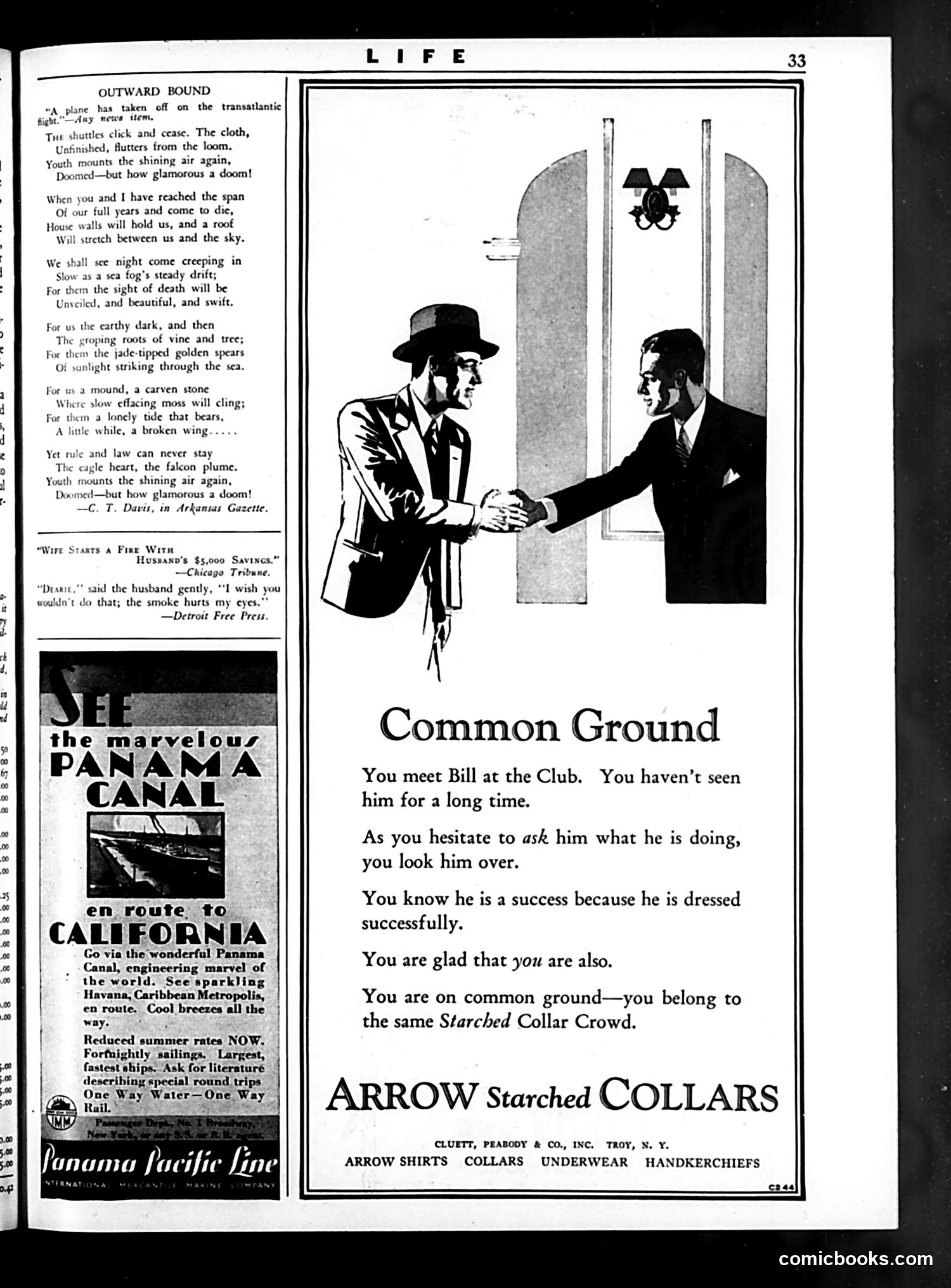
This page contains a poem and an advertisement rather than traditional satire. **"Outward Bound"** is a serious poem contrasting youth's romantic, fatal transatlantic flight with the mundane death awaiting ordinary people. It romanticizes early aviation's danger—a topical concern when transatlantic flights were novel and perilous. The poem laments that young aviators achieve glamorous deaths, while ordinary mortals face earthbound decay. **"Common Ground"** is an Arrow Collars advertisement using social commentary as marketing. It depicts two well-dressed men meeting at a club, suggesting that shared success—measured by proper dress and "starched collars"—creates social equality across class lines. The ad appeals to aspirational middle-class men: wearing Arrow collars signals you belong to a successful, exclusive group. It's not satirical but rather uses subtle class anxiety to sell conformity through proper attire. The page reflects 1920s-30s attitudes: aviation's exotic danger, rigid class consciousness masked as meritocracy, and the belief that consumer goods signify social status.
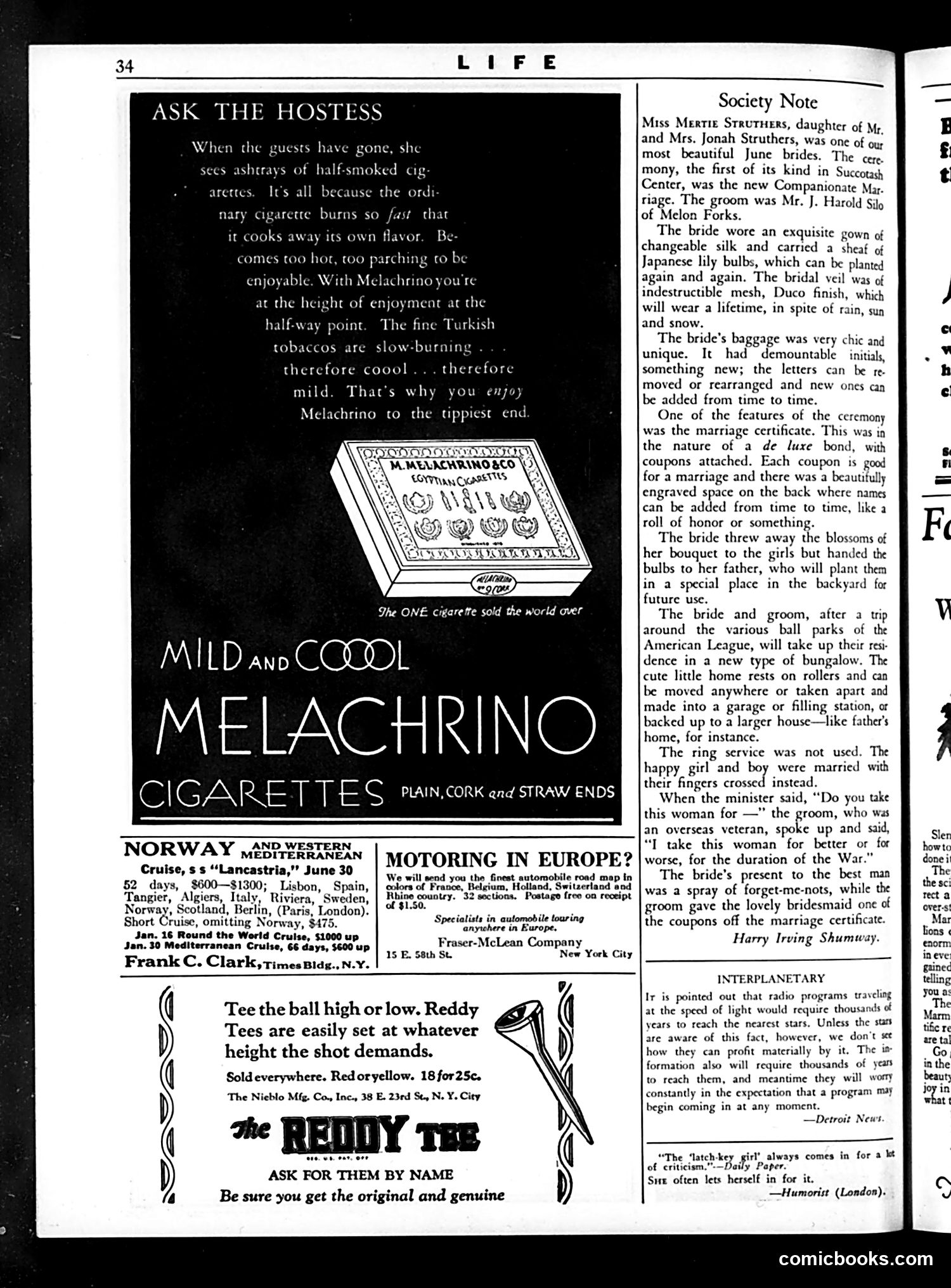
This page is primarily **advertising and society content** rather than political satire. The main elements are: **"Ask the Hostess"** section: Advertises Melachrino cigarettes by framing smoking as sophisticated etiquette—the headline addresses a relatable hostess problem (ashtrays of half-smoked cigarettes after guests leave), then pivots to praising these Turkish tobacco cigarettes as "slow-burning" and therefore superior. **Society Note**: Satirizes the "Companionate Marriage" trend—a 1920s concept emphasizing partnership over tradition. The humor lies in exaggerated modern details: a removable-letter monogrammed suitcase, a marriage certificate with detachable "coupons," bulbs instead of flowers, and a portable bungalow on rollers. The bride and groom's vow "for the duration of the War" mocks how provisional even marriage has become. **Other ads**: Travel cruises, automobiles, tees, and cigarettes fill the remaining space. The satire targets modernity's obsession with convenience and efficiency infiltrating even sacred institutions like marriage.
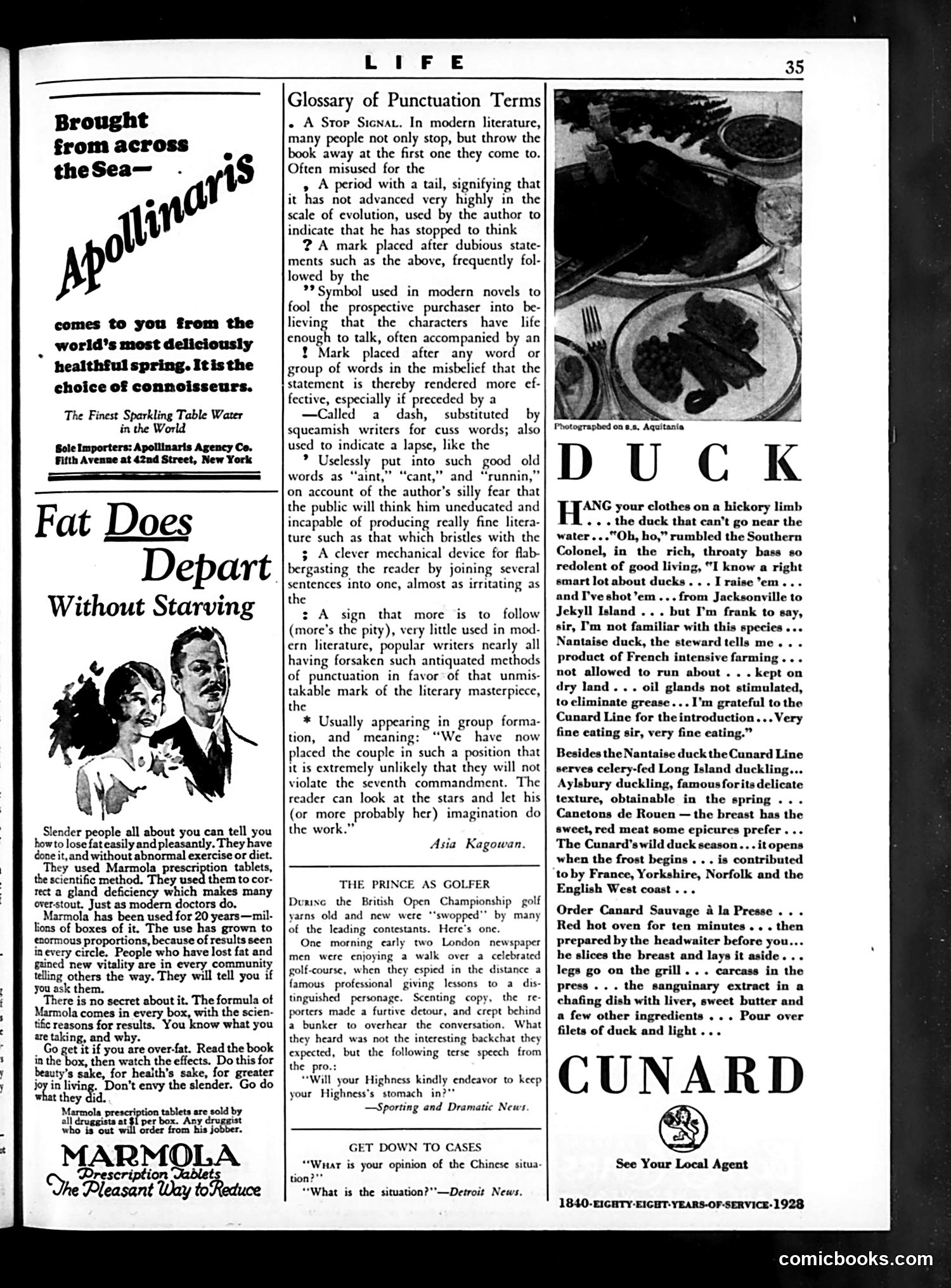
This page contains mostly **advertisements and editorial content**, not political cartoons. The main satirical piece is the "**Glossary of Punctuation Terms**"—a mock-serious guide mocking modern literary trends. It ridicules contemporary authors for overusing punctuation marks (exclamation points, dashes, ellipses) as lazy shortcuts for genuine writing skill. The author critiques how modern novels use these devices to artificially create drama or emotion—for instance, using multiple exclamation points (!!) to convince readers characters are lively, or dashes instead of proper language. The page also includes advertisements for **Marmola diet tablets** and **Apollinaris water**, typical 1920s wellness products. The small illustration accompanying "Fat Does Depart Without Starving" shows a before/after transformation. A brief anecdote about "**The Prince as Golfer**" discusses the British Open Championship, though the text cuts off mid-story. The satirical thrust targets **pretentious modern writing conventions** rather than political figures or events.
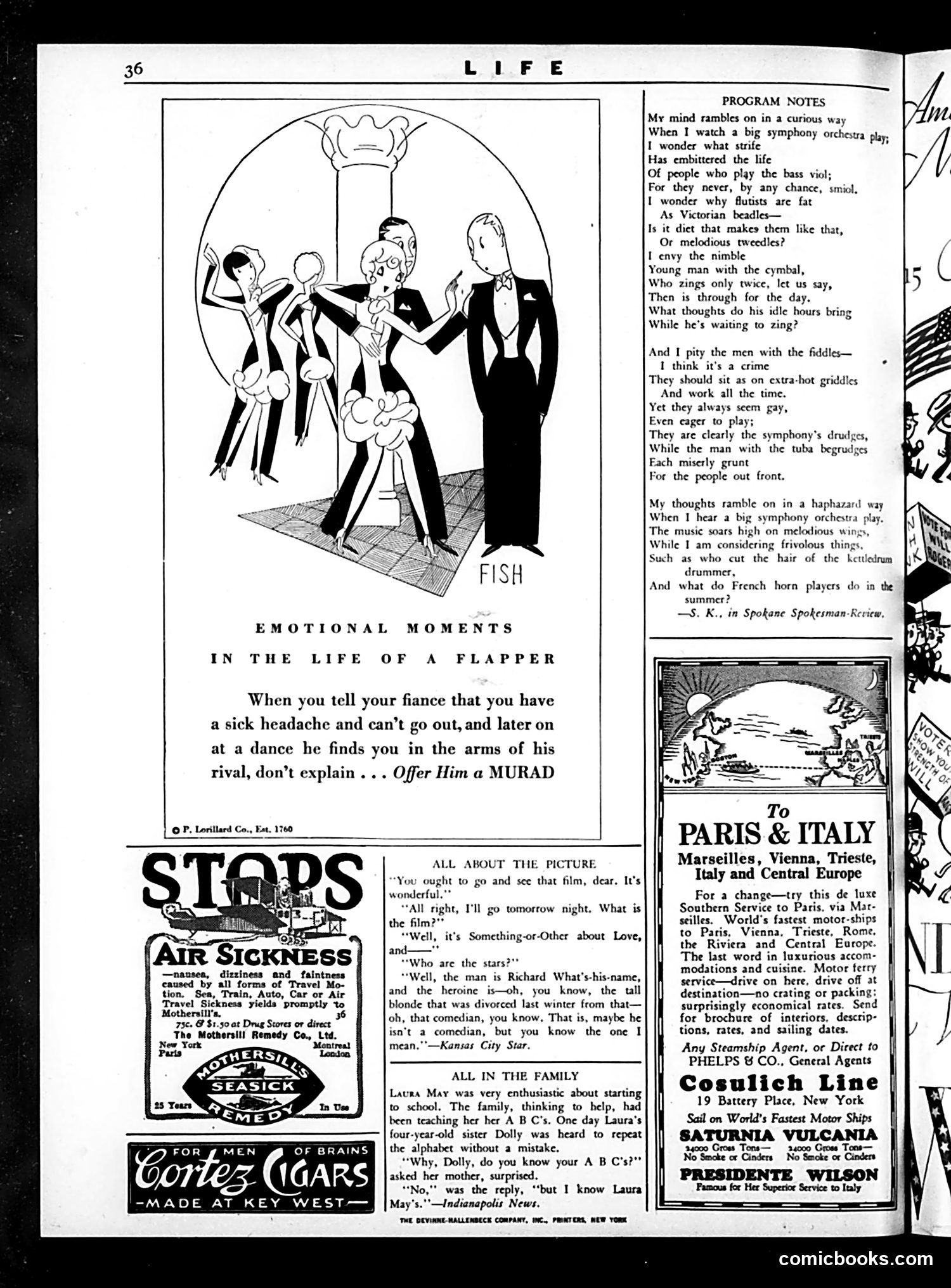
This cartoon satirizes 1920s dating deception. It depicts a young woman (a "flapper") caught in a social contradiction: she told her fiancé she had a headache to avoid going out, but he later finds her dancing with a rival at a social event. The cartoon's caption advises the man not to ask for explanation—just offer her a Murad cigarette, implying that a gift will smooth over the dishonesty. The satire targets both parties: the woman's obvious lie about illness, and the tacit acceptance that minor deceptions were part of flapper-era courtship rituals. The "solution" (cigarettes) mocks how easily romantic conflicts were supposedly resolved through consumer goods rather than honest communication. The illustration style—with exaggerated, caricatured figures—emphasizes the absurdity of the situation.