
Life, 1928-06-21 · page 18 of 38
Life — June 21, 1928 — page 18: what you’re looking at
What you’re looking at
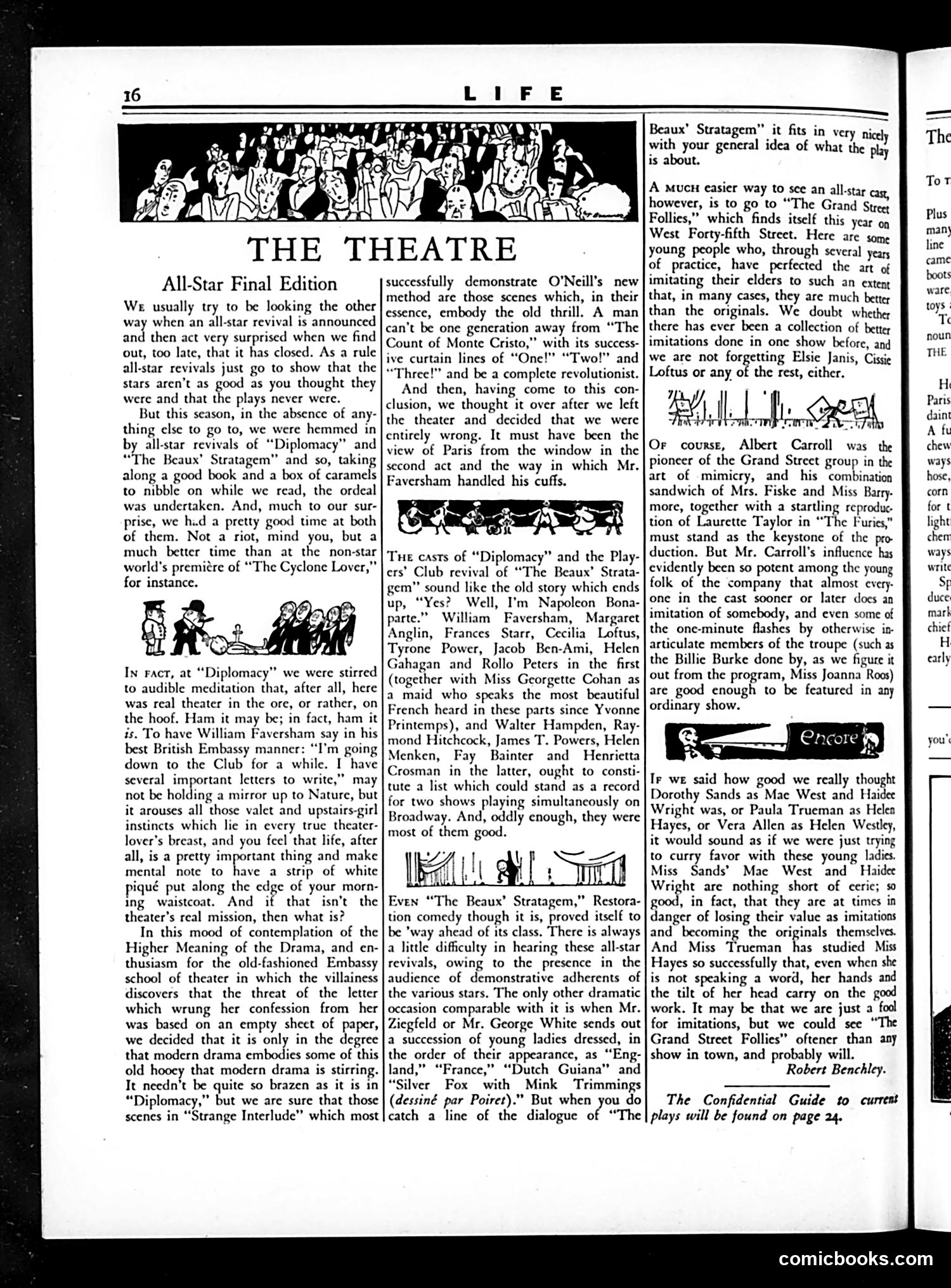
This is a theater criticism column reviewing Broadway productions. The page discusses several shows including "Diplomacy" and "The Beaux' Stratagem," praising an all-star revival featuring William Faversham, Margaret Anglin, and others. The small illustrations appear to be decorative theatrical vignettes rather than political cartoons. The main illustration shows a crowded theater audience in a simplified line-drawing style, typical of Life's humorous theatrical coverage. The critic (Robert Benchley, per the byline) uses witty commentary to discuss theatrical performances, comparing amateur imitations to originals and praising Dorothy Sands and Haide Wright's performances. The tone is satirical toward both pretentious theater-goers and mediocre productions, characteristic of Life's sophisticated humor during this era.
📄 Transcribed text from this page (OCR, searchable)
Machine-transcribed from the original scan — historical spelling and the odd misread are preserved.
Pia yyy aaa g | ys (f] Eh Walle 23 | Ps as THE THEATRE All-Star Final Edition We usually try to be looking the other way when an all-star revival is announced and then act very surprised when we find out, too late, that it has closed. As a rule all-star revivals just go to show that the stars aren’t as good as you thought they were and that the plays never were. But this season, in the absence of any- thing else to go to, we were hemmed in by all-star revivals of “Diplomacy” and “The Beaux’ Stratagem” and so, taking along a good book and a box of caramels to nibble on while we read, the ordeal was undertaken. And, much to our sur- prise, we hid a pretty good time at both of them. Not a riot, mind you, but a much better time than at the non-star world’s premiére of “The Cyclone Lover,” for instance. In Fact, at “Diplomacy” we were stirred to audible meditation that, after all, here was real theater in the ore, or rather, on the hoof. Ham it may be; in fact, ham it is. To have William Faversham say in his best British Embassy manner: “I’m going down to the Club for a while. I have several important letters to write,” may not be holding a mirror up to Nature, but it arouses all those valet and upstairs-girl instincts which lie in every true theater- lover's breast, and you feel that life, after all, is a pretty naperrant thing and make mental note to have a strip of white piqué put along the edge of your morn- ing waistcoat. And if that isn’t the theater’s real mission, then what is? In this mood of contemplation of the Higher Meaning of the Drama, and en- thusiasm for the old-fashioned Embassy school of theater in which the villainess discovers that the threat of the letter which wrung her confession from her was based on an empty sheet of paper, we decided that it is only in the degree that modern drama embodies some of this old hooey that modern drama is stirring. It needn't be quite so brazen as it is in “Diplomacy,” but we are sure that those scenes in “Strange Interlude” which most successfully demonstrate O'Neill's new method are those scenes which, in their essence, embody the old thrill. A man can’t be one generation away from “The Count of Monte Cristo,” with its success- ive curtain lines of One!" “Two!” and “Three!” and be a complete revolutionist. And then, having come to this con- clusion, we thought it over after we left the theater and decided that we were entirely wrong. It must have been the view of Paris from the window in the second act and the way in which Mr, Faversham handled his cuffs. ST S| Tue casts of “Diplomacy” and the Play- ers’ Club revival of “The Beaux’ Strata- gem” sound like the old story which ends up, “Yes? Well, I'm Napoleon Bona- parte.” William Faversham, Margaret Anglin, Frances Starr, Cecilia Loftus, Tyrone Power, Jacob Ben-Ami, Helen Gahagan and Rollo Peters in the first (together with Miss Georgette Cohan as a maid who speaks the most beautiful French heard in these parts since Yvonne Printemps), and Walter Hampden, Ray- mond Hitchcock, James T. Powers, Helen Menken, Fay Bainter and Henrietta Crosman in the latter, ought to consti- tute a list which could stand as a record for two shows playing simultancously on Broadway. And, oddly enough, they were most of them good. sad Even “The Beaux’ Stratagem,” Restora- tion comedy though it is, proved itself to be ’way ahead of its class. There is always a little difficulty in hearing these all-star revivals, owing to the presence in the audience of demonstrative adherents of the various stars. The only other dramatic occasion comparable with it is when Mr. Ziegfeld or Mr. George White sends out a succession of young ladies dressed, in the order of their appearance, as “Eng- land,” “France,” “Dutch Guiana” and “Silver Fox with Mink Trimmings (dessiné par Poiret).” But when you do catch a line of the dialogue of “The — _- Beaux’ Stratagem” it fits in ve icch with your general idea of what the pl is about. A MucH easier way to see an all-star however, is to go to “The Grand Street Follies,” which finds itself this year on West Forty-fifth Street. Here are some young people who, through several years of practice, have perfected the art of imitating their elders to such an extent that, in many cases, they are much better than the originals. We doubt whether there has ever been a collection of better imitations done in one show before, and we are not forgetting Elsie Janis, Cissie Loftus or any of the rest, either. Or course, Albert Carroll was the pioneer of the Grand Street group in the art of mimicry, and his combination sandwich of Mrs. Fiske and Miss Barry. more, together with a startling reproduc. tion of Laurette Taylor in “The Furies,” must stand as the keystone of the pro duction. But Mr. Carroll's influence has evidently been so potent among the young folk of the company that almost every- one in the cast sooner or later does an imitation of somebody, and even some of the one-minute flashes by otherwise in- articulate members of the troupe (such as the B Burke done by, as we figure it out from the program, Miss Joanna Roos) are good enough to be featured in any ordinary show. € Cncore # > 2 a Ir we said how good we really thought Dorothy Sands as Mae West and Haidee Wright was, or Paula Trueman as Helen Hayes, or Vera Allen as Helen Westley, it would sound as if we were just trying to curry favor with these young ladies. Miss Sands’ Mae West and Haidee Wright are nothing short of ceric; so good, in fact, that they are at times in danger of losing their value as imitations and becoming the originals themselves. And Miss Trueman has studied Miss Hayes so successfully that, even when she is not speaking a word, her hands and the tilt of her head carry on the good work. It may be that we are just a fool for imitations, but we could see “The Grand Street Follies’ oftener than any show in town, and probably will. Robert Benchley. The Confidential Guide to current plays will be found on page 24. H Paris daint A fu chew comicbooks.com