
Life, 1928-06-21 · page 25 of 38
Life — June 21, 1928 — page 25: what you’re looking at
What you’re looking at
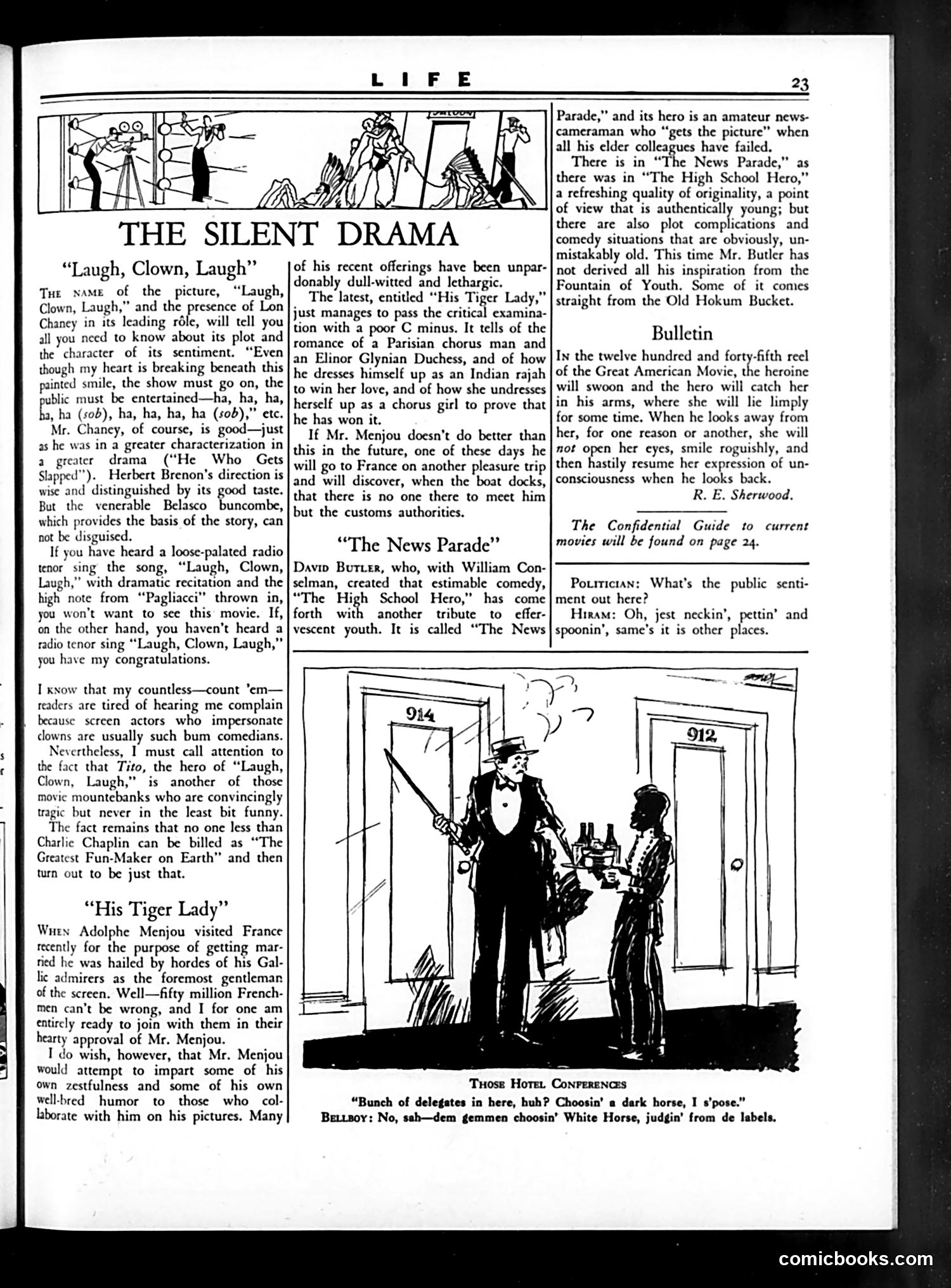
This page reviews three silent films from the 1920s. The main cartoon depicts a hotel hallway scene with two men in formal wear discussing hotel delegates, using dialect humor ("choosin' a dark horse," "White Horse"). The text reviews "Laugh, Clown, Laugh" (starring Lon Chaney), criticizing how screen clowns fail to be genuinely funny despite playing tragic roles convincingly. The reviewer dismisses "His Tiger Lady" with Adolphe Menjou as dull, though praising Menjou's French popularity. "The News Parade" receives qualified praise for originality despite recycled plot devices. The satire targets silent film conventions: the tired "tragic clown" trope, formulaic plots dressed in exotic settings, and predictable melodrama. The cartoonist mocks both the films' pretensions and contemporary audiences' fascination with them. The piece exemplifies how Life magazine critiqued popular entertainment through witty, irreverent commentary—the magazine's trademark approach.
📄 Transcribed text from this page (OCR, searchable)
Machine-transcribed from the original scan — historical spelling and the odd misread are preserved.
23 NT “Laugh, Clown, Laugh” Tue name of the picture, “Laugh, Clown, Laugh,” and the presence of Lon Chaney in its leading réle, will tell you al] you need to know about its plot and the character of its sentiment. “Even though my heart is breaking beneath this painted smile, the show must go on, the ublic must be entertained—ha, ha, ha, fo, ha (50), ha, ha, ha, ha (s08),” ete. Mr. Chaney, of course, is good—just as he was in a greater characterization in a greater drama (“He Who Gets Slapped”). Herbert Brenon’s direction is wise and distinguished by its good taste. But the venerable Belasco buncombe, which provides the basis of the story, can not be disguised. If you have heard a loose-palated radio tenor sing the song, “Laugh, Clown, Laugh,” with dramatic recitation and the high note from “Pagliacci” thrown in, you won't want to see this movie. If, on the other hand, you haven't heard a radio tenor sing “Laugh, Clown, Laugh,” you have my congratulations. I know that my countless—count ’em— readers are tired of hearing me complain because screen actors who impersonate clowns are usually such bum comedians. Nevertheless, I must call attention to the fact that Tito, the hero of “Laugh, Clown, Laugh,” is another of those movie mountebanks who are convincingly tragic but never in the least bit funny. The fact remains that no one less than Charlie Chaplin can be billed as “The Greatest Fun-Maker on Earth” and then turn out to be just that. “His Tiger Lady” Wuen Adolphe Menjou visited France recently for the purpose of getting mar- ried he was hailed by hordes of his Gal- lic admirers as the foremost gentleman of the screen. Well—fifty million French- men can’t be wrong, and I for one am entirely ready to join with them in their hearty approval of Mr. Menjou. I do wish, however, that Mr. Menjou Would attempt to impart some of his own zestfulness and some of his own well-bred humor to those who col- laborate with him on his pictures. Many of his recent offerings have been unpar- donably dull-witted and lethargic. The latest, entitled “His Tiger Lady,” just manages to pass the critical examina- tion with a poor C minus. It tells of the romance of a Parisian chorus man and an Elinor Glynian Duchess, and of how he dresses himself up as an Indian rajah to win her love, and of how she undresses herself up as a chorus girl to prove that he has won it. If Mr. Menjou doesn’t do better than this in the future, one of these days he will go to France on another pleasure trip and will discover, when the boat docks, that there is no one there to meet him but the customs authorities. “The News Parade” Davin Butter, who, with William Con- selman, created that estimable comedy, “The High School Hero,” has come forth with another tribute to effer- vescent youth. It is called “The News Parade,” and its hero is an amateur news- cameraman who “gets the picture” when all his elder colleagues have failed. There is in “The News Parade,” as there was in “The High School Hero,” a refreshing quality of originality, a point of view that is authentically young; but there are also plot complications and comedy situations that are obviously, un- mistakably old. This time Mr. Butler has not derived all his inspiration from the Fountain of Youth. Some of it comes straight from the Old Hokum Bucket. Bulletin In the twelve hundred and forty-fifth reel of the Great American Movie, the heroine will swoon and the hero will catch her in his arms, where she will lie limply for some time. When he looks away from her, for one reason or another, she will not open her eyes, smile roguishly, and then hastily resume her expression of un- consciousness when he looks back. R. E. Sherwood. The Confidential Guide to current movies will be found on page 24. Potrrictan: What's the public senti- ment out here? Hiram: Oh, jest neckin’, pettin’ and spoonin’, same’s it is other places. Tose Hore. Conrerences “Bunch of delegates in here, huh? Choosin’ a dark horse, I s’pose.” Be.izoy: No, sah—dem gemmen choosin’ White Horse, judgin’ from de labels. comicbooks.com