
Life, 1928-06-21 · page 10 of 38
Life — June 21, 1928 — page 10: what you’re looking at
What you’re looking at
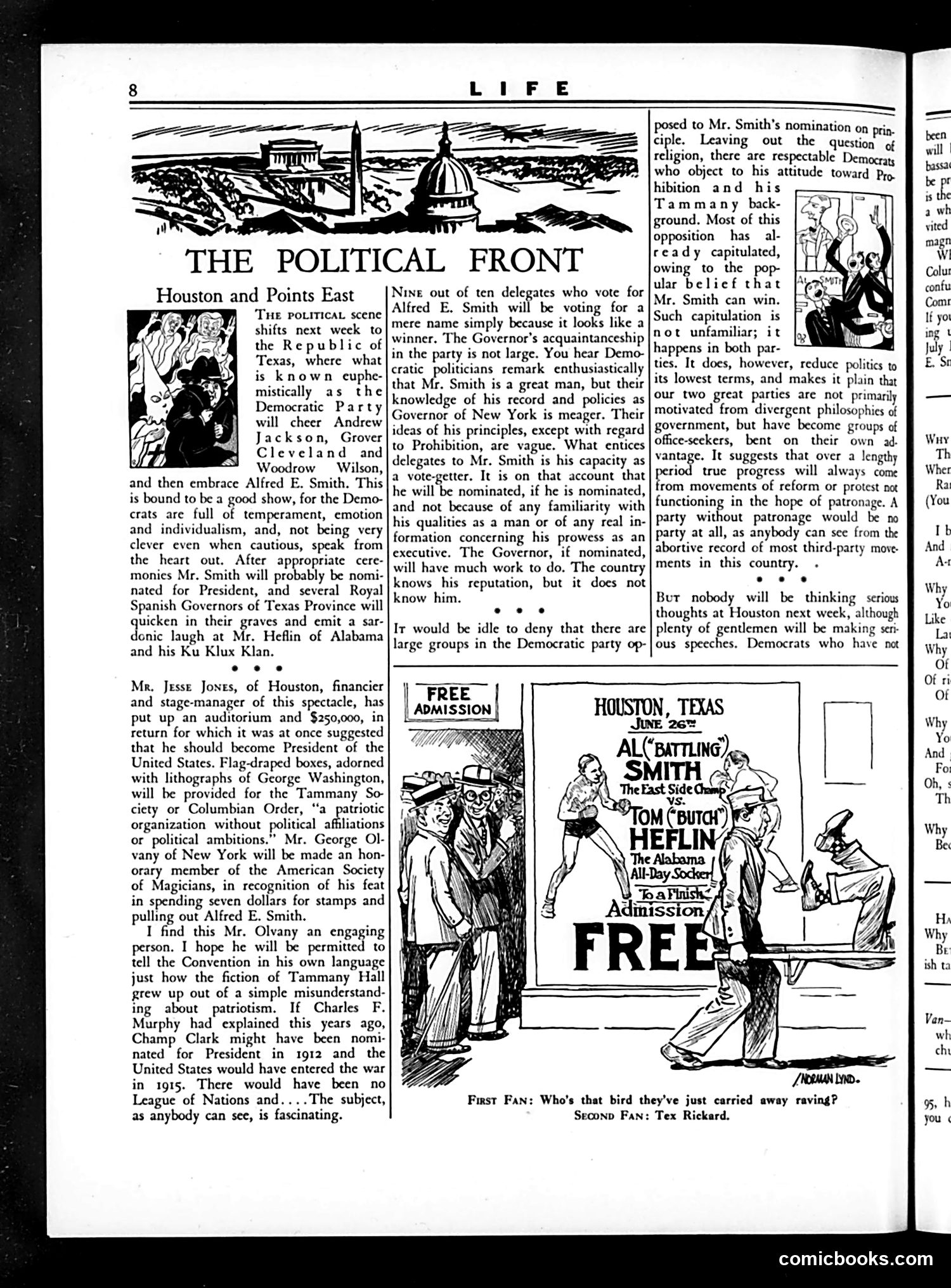
This Life magazine page satirizes the 1928 Democratic convention's competition to nominate a presidential candidate. The main article discusses Houston hosting the convention, where nine of ten delegates favor Alfred E. Smith despite Democratic resistance. The lower cartoon advertises a boxing match between "Al 'Battling' Smith" (the East Side Champ) and "Tom 'Dutch' Heflin" (The Alabama All-Day Socialite). This is political satire: Smith, a Catholic and anti-Prohibition Democrat from New York, faced opposition from conservative Democrats, particularly Senator Tom Heflin of Alabama—a Prohibitionist and Klan sympathizer. The boxing match metaphor visualizes their ideological conflict within the party. The joke's punchline involves a bird escaping during the bout.
📄 Transcribed text from this page (OCR, searchable)
Machine-transcribed from the original scan — historical spelling and the odd misread are preserved.
Houston and Points East ? THE POLITICAL scene shifts next week to the Republic of Texas, where what is known cuphe- mistically as the Democratic Party will cheer Andrew Jackson, Grover Cleveland and Woodrow Wilson, and then embrace Alfred E. Smith. This is bound to be a good show, for the Demo- crats are full of temperament, emotion and individualism, and, not being very clever even when cautious, speak from the heart out. After appropriate cere- monies Mr. Smith will probably be nomi- nated for President, and several Royal Spanish Governors of Texas Province will quicken in their graves and emit a sar- donic laugh at Mr. Heflin of Alabama and his Ku Klux Klan. Mr. Jesse Jones, of Houston, financier and stage-manager of this spectacle, has put up an auditorium and $250,000, in return for which it was at once suggested that he should become President of the United States. Flag-draped boxes, adorned with lithographs of George Washington, will be provided for the Tammany So- ciety or Columbian Order, ‘“‘a patriotic organization without political afhliations or political ambitions.” Mr. George Ol- vany of New York will be made an hon- orary member of the American Society of Magicians, in recognition of his feat in spending seven dollars for stamps and pulling out Alfred E. Smith. I find this Mr. Olvany an engaging rson. I hope he will be permitted to tell the Convention in his own language just how the fiction of Tammany Hall grew up out of a simple misunderstand- ing about patriotism. If Charles F. Murphy had explained this years ago, Champ Clark might have been nomi- nated for President in 1912 and the United States would have entered the war in 1915. There would have been no League of Nations and....The subject, as anybody can see, is fascinating. Nine out of ten delegates who vote for Alfred E. Smith will be voting for a mere name simply because it looks like a winner. The Governor’s acquaintanceship in the party is not large. You hear Demo- cratic politicians remark enthusiastically that Mr. Smith is a great man, but their knowledge of his record and policies as Governor of New York is meager. Their ideas of his principles, except with regard to Prohibition, are vague. What entices delegates to Mr. Smith is his capacity as a vote-getter. It is on that account that he will be nominated, if he is nominated, and not because of any familiarity with his qualities as a man or of any real in- formation concerning his prowess as an executive. The Governor, if nominated, will have much work to do. The country knows his reputation, but it does not know him. eee Ir would be idle to deny that there are large groups in the Democratic party op- | FREE | | ADMISSION posed to Mr. Smith's nomination on py ciple. Leaving out the question of religion, there are respectable Democrats who object to his attitude toward Pro. hibition and his Tammany back- ground. Most of this opposition has al- ready capitulated, owing to the pop- ular belief that Mr. Smith can win. Such capitulation is not unfamiliar; it happens in both par- ties. It does, however, reduce politics to its lowest terms, and makes it plain that our two great parties are not primarily motivated from divergent philosophies of government, but have become groups of office-seekers, bent on their own ad- vantage. It suggests that over a lengthy period true progress will always come trom movements of reform or protest not functioning in the hope of patronage. A party without patronage would be no party at all, as anybody can see from the abortive record of most third-party move- ments in this country. eee But nobody will be thinking serious thoughts at Houston next week, although plenty of gentlemen will be making seri- ous speeches. Democrats who have not First Fan: Who's that bird they’ve just carried away raving? Seconp Fan: Tex Rickard. comicbooks.com