
Life, 1928-06-21 · page 8 of 38
Life — June 21, 1928 — page 8: what you’re looking at
What you’re looking at
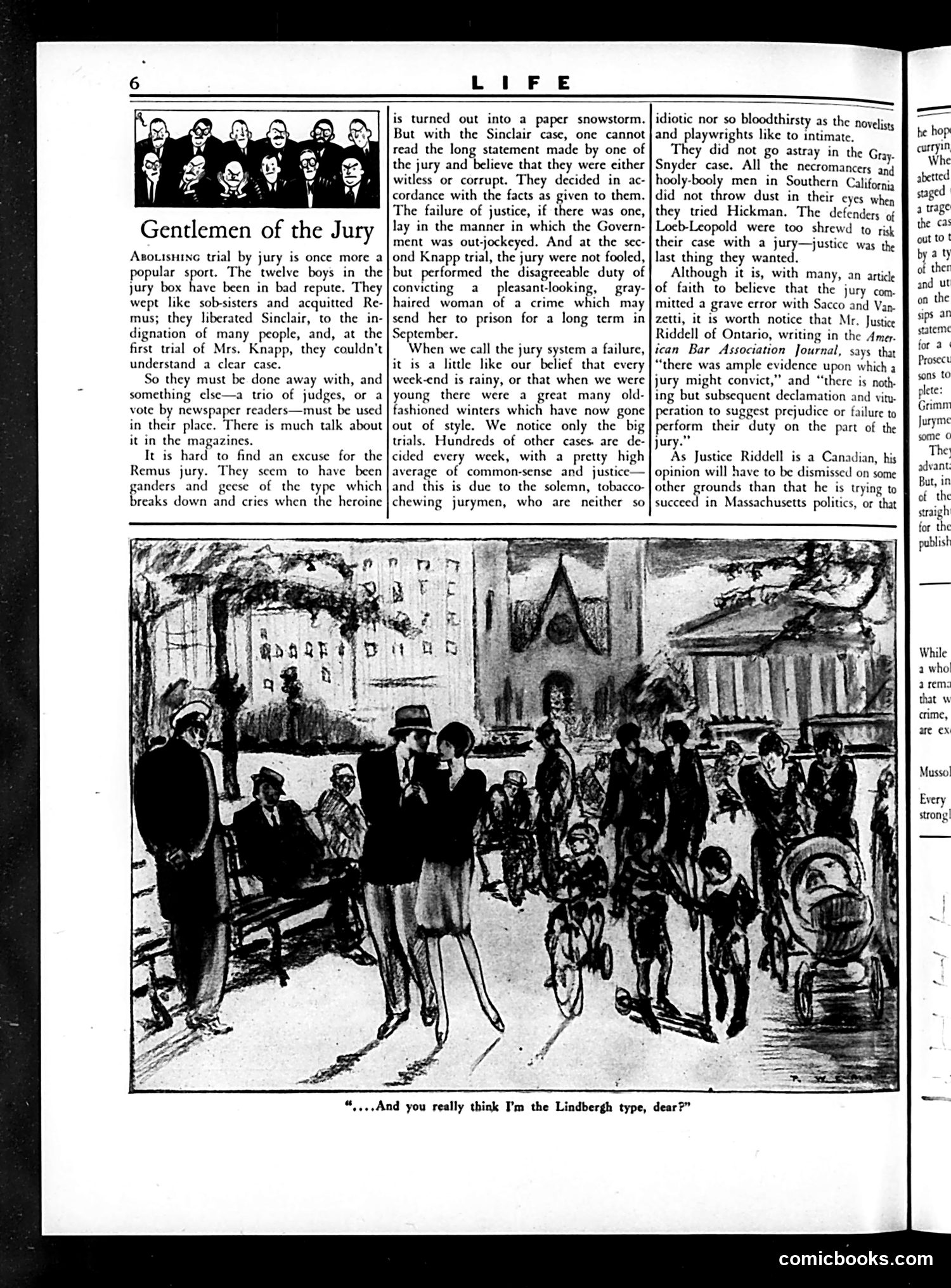
This page critiques the American jury system through text and a political cartoon. The article "Gentlemen of the Jury" argues that trial by jury has become outdated and ineffective, citing poor juror quality and questionable verdicts. It specifically references the Sacco-Vanzetti case (a controversial 1920s murder trial) and mentions Justice Riddell of Ontario criticizing jury failures. The cartoon below depicts a street scene where someone is sarcastically asking another, "And you really think I'm the Lindbergh type, dear?" This references the recent Lindbergh kidnapping case (1932), suggesting public anxiety about child abductions and ironically commenting on how ordinary people might be mistaken for criminals—reinforcing the article's point about jury unreliability and public hysteria influencing justice.
📄 Transcribed text from this page (OCR, searchable)
Machine-transcribed from the original scan — historical spelling and the odd misread are preserved.
6 LIFE ee SSS NS SSNSNSNSNSNSSNSSSSSSSSSSSSSSSSSSSq eee Gentlemen of the Jury AsoxisHinc trial by jury is once more a popular sport. The twelve boys in the jury box have been in bad repute. They wept like sob-sisters and acquitted Re- mus; they liberated Sinclair, to the in- dignation of many people, and, at the first trial of Mrs. Knapp, they couldn't understand a clear case. So they must be done away with, and something clse—a trio of judges, or a vote by newspaper readers—must be used in their place. There is much talk about it in the magazines. It is hard to find an excuse for the Remus jury. They seem to have been ganders and geese of the type which breaks down and cries when the heroine is turned out into a paper snowstorm. But with the Sinclair case, one cannot read the long statement made by one of the jury and believe that they were either witless or corrupt. They decided in ac- cordance with the facts as given to them. The failure of justice, if there was one, lay in the manner in which the Govern- ment was out-jockeyed. And at the sec- ond Knapp trial, the jury were not fooled, but performed the disagreeable duty of convicting a pleasant-looking, —gray- haired woman of a crime which may send her to prison for a long term in September. When we call the jury system a failure, it is a little like our belief that every week-end is rainy, or that when we were young there were a great many old- fashioned winters which have now gone out of style. We notice only the big trials. Hundreds of other cases. are de- cided every week, with a pretty high average of common-sense and justice— and this is due to the solemn, tobacco- chewing jurymen, who are neither so idiotic nor so bloodthirsty as the Novelists and playwrights like to intimate. They did not go astray in the Gray. Snyder case. All the necromancers and hooly-booly men in Southern California did not throw dust in their eyes when they tried Hickman. The defenders of Loeb-Leopold were too shrewd to risk their case with a jury—justice was the last thing they wanted. Although it is, with many, an article of faith to believe that the jury com. mitted a grave error with Sacco and Vap- zetti, it is worth notice that Mr. Justice Riddell of Ontario, writing in the Amer. ican Bar Association Journal, says that “there was ample evidence upon which a jury might convict,” and “there is noth. ing but subsequent declamation and vitu- peration to suggest prejudice or failure to perform their duty on the part of the jury.” As Justice Riddell is a Canadian, his opinion will have to be dismissed on some other grounds than that he is trying to succeed in Massachusetts politics, or that “,...And you really think I’m the Lindbergh type, dear?” —— he hop curryin Whe abetted saged a trage the cas out to t bya ty of ther and ut on the sips an sateme for a Prosece sons to plete: Gamm Juryme some 0 The: advant. But, in of the sraigh for the publist While a who a rema that crime, are ex Musso! comicbooks.com