
Life, 1928-06-21 · page 15 of 38
Life — June 21, 1928 — page 15: what you’re looking at
What you’re looking at
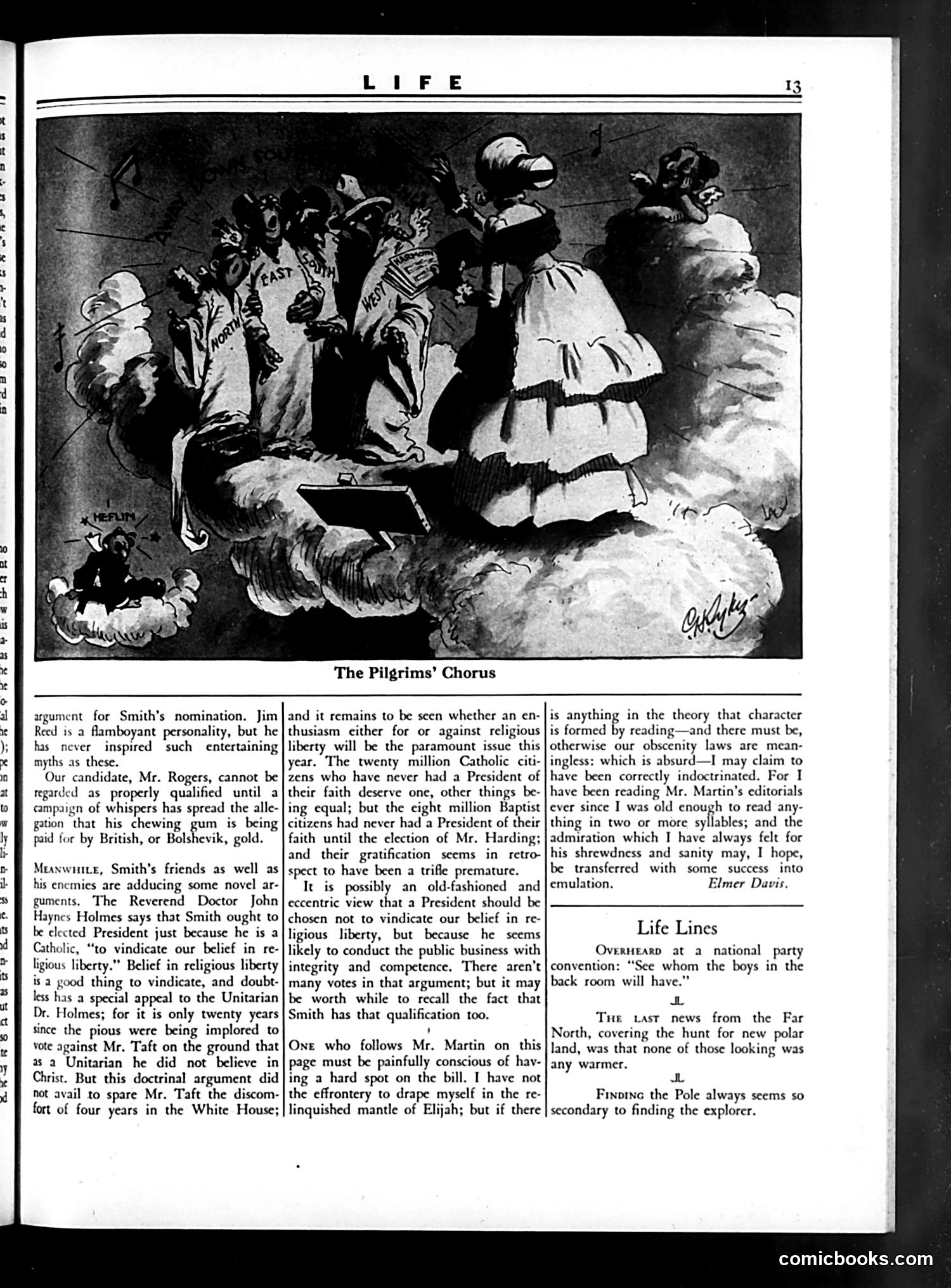
This cartoon satirizes the debate over Catholic presidential candidates. The text references "Smith's nomination" and discusses whether a Catholic should become President—a contentious 1920s-era issue. The pilgrims depicted represent early American Protestant settlers; they're shown gathered around what appears to be a voting box, with exaggerated features typical of period caricature. The satire contrasts the Pilgrims' historical struggle for religious liberty with contemporary resistance to Catholic political participation. The cartoon argues this opposition contradicts America's founding principles of religious freedom. The accompanying text debates whether character formed by Catholic reading differs from Protestant reading, ultimately defending religious tolerance in American civic life.
📄 Transcribed text from this page (OCR, searchable)
Machine-transcribed from the original scan — historical spelling and the odd misread are preserved.
0 at h Ww is > as 5% 1 0- al " ); pe r= €£SR5 RoOARG ara argument for Smith’s nomination. Jim Reed is a flamboyant personality, but he has never inspired such entertaining myths as these. Our candidate, Mr. Rogers, cannot be regarded as properly qualified until a campaign of whispers has spread the alle- gation that his chewing gum is being paid for by British, or Bolshevik, gold. Meanwuice, Smith's friends as well as his enemies are adducing some novel ar- guments. The Reverend Doctor John Haynes Holmes says that Smith ought to be elected President just because he is a Catholic, “to vindicate our belief in re- ligious liberty.” Belief in religious liberty is a good thing to vindicate, and doubt- kess has a special appeal to the Unitarian Dr. Holmes; for it is only twenty years since the pious were being implored to vote against Mr. Taft on the ground that as a Unitarian he did not believe in Christ. But this doctrinal argument did not avail to spare Mr. Taft the discom- fort of four years in the White House; The Pilgrims’ Chorus and it remains to be seen whether an en- thusiasm either for or against religious liberty will be the paramount issue this year. The twenty million Catholic citi- zens who have never had a President of their faith deserve one, other things be- ing equal; but the eight million Baptist citizens had never had a President of their faith until the election of Mr. Harding; and their gratification seems in retro- spect to have been a trifle premature. It is possibly an old-fashioned and eccentric view that a President should be chosen not to vindicate our belief in re- ligious liberty, but because he seems likely to conduct the public business with integrity and competence. There aren't many votes in that argument; but it may be worth while to recall the fact that Smith has that qualification too. One who follows Mr. Martin on this page must be painfully conscious of hav- ing a hard spot on the bill. I have not the effrontery to drape myself in the re- linquished mantle of Elijah; but if there is anything in the theory that character is formed by reading—and there must be, otherwise our obscenity laws are mean- ingless: which is absurd—I may claim to have been correctly indoctrinated. For I have been reading Mr. Martin's editorials ever since I was old enough to read any- thing in two or more syllables; and the admiration which I have always felt for his shrewdness and sanity may, I hope, be transferred with some success into emulation. Elmer Davis. Life Lines OverHearp at a national party convention: “See whom the boys in the back room will have.” JL Tue vast news from the Far North, covering the hunt for new polar land, was that none of those looking was any warmer. aL Finoinc the Pole always seems so secondary to finding the explorer. comicbooks.com