
Life, 1928-06-21 · page 14 of 38
Life — June 21, 1928 — page 14: what you’re looking at
What you’re looking at
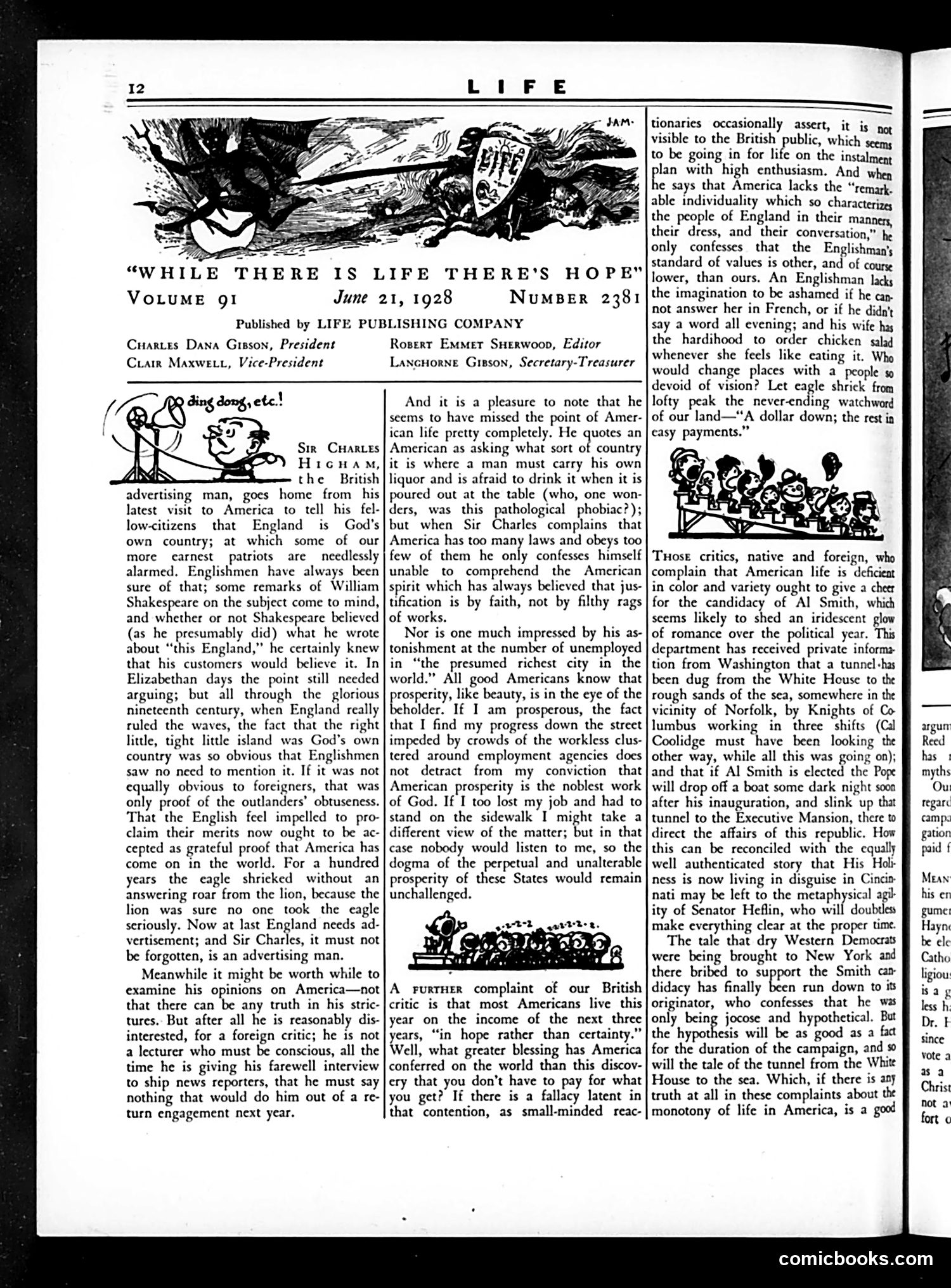
This page features editorial commentary on Sir Charles Higham's recent visit to America. The cartoon at top left shows a caricatured figure (likely Higham) with exaggerated features in a mocking pose, labeled "sing dong, etc!" The article criticizes Higham's negative observations about American life—specifically his complaints about unemployment, laws he found excessive, and what he perceived as lack of individual character among Americans. The editors defend American prosperity and social values against his critiques. The satire targets a visiting British commentator presuming to judge American society unfavorably. The piece defends American work ethic and prosperity while mocking Higham's condescension, suggesting his observations miss the point of American democratic spirit.
📄 Transcribed text from this page (OCR, searchable)
Machine-transcribed from the original scan — historical spelling and the odd misread are preserved.
VOLUME gI June 21, 1928 NuMBER 2381 Published by LIFE PUBLISHING COMPANY Cartes Dana Gipson, President Crain Maxwett, Vice-President Sir Cuarves Hicuam™, the British advertising man, goes home from his latest visit to America to tell his fel- low-citizens that England is God's own country; at which some of our more carnest patriots are needlessly alarmed. Englishmen have always been sure of that; some remarks of William Shakespeare on the subject come to mind, and whether or not Shakespeare believed (as he presumably did) what he wrote about “this England,” he certainly knew that his customers would believe it. In Elizabethan days the point still needed arguing; but all through the glorious nineteenth century, when England really ruled the waves, the fact that the right litle, tight little island was God’s own country was so obvious that Englishmen saw no need to mention it. If it was not equally obvious to foreigners, that was only proof of the outlanders’ obtuseness. That the English feel impelled to pro- claim their merits now ought to be ac- cepted as grateful proof that America has come on in the world. For a hundred years the eagle shricked without an answering roar from the lion, because the lion was sure no one took the eagle seriously. Now at last England needs ad- vertisement; and Sir Charles, it must not be forgotten, is an advertising man. Meanwhile it might be worth while to examine his opinions on America—not that there can be any truth in his stric- tures. But after all he is reasonably dis- interested, for a foreign critic; he is not a lecturer who must be conscious, all the time he is giving his farewell interview to ship news reporters, that he must say nothing that would do him out of a re- turn engagement next year. Rosert Emmet Suerwoon, Editor LancHorne Giason, Secretary-Treasurer And it is a pleasure to note that he seems to have missed the point of Amer- ican life pretty completely. He quotes an American as asking what sort of country it is where a man must carry his own liquor and is afraid to drink it when it is poured out at the table (who, one won- ders, was this pathological phobiac?); but when Sir Charles complains that America has too many laws and obeys too few of them he only confesses himself unable to comprehend the American spirit which has always believed that jus- tfication is by faith, not by filthy rags of works. Nor is one much impressed by his as- tonishment at the number of unemployed in “the presumed richest city in the world.” All good Americans know that rosperity, like beauty, is in the eye of the beholder. If I am prosperous, the fact that I find my progress down the street impeded by crowds of the workless clus- tered around employment agencies does not detract from my conviction that American prosperity is the noblest work of God. If I too lost my job and had to stand on the sidewalk I might take a different view of the matter; but in that case nobody would listen to me, so the dogma of the perpetual and unalterable prosperity of these States would remain unchallenged. A rurTHER complaint of our British critic is that most Americans live this year on the income of the next three years, “in hope rather than certainty.” Well, what greater blessing has America conferred on the world than this discov- ery that you don’t have to pay for what you get? If there is a fallacy latent in that contention, as small-minded reac- tionaries occasionally assert, it is not visible to the British public, which seems to be going in for life on the instalment lan with high enthusiasm. And when ¢ says that America lacks the “remark. able individuality which so characterizes the people of England in their manners, their dress, and their conversation,” he only confesses that the Englishman's standard of values is other, and of course lower, than ours. An Englishman lacks the imagination to be ashamed if he can. not answer her in French, or if he didn’t say a word all evening; and his wife has the hardihood to order chicken salad whenever she feels like eating it. Who would change places with a people so devoid of vision? Let eagle shriek from lofty peak the never-ending watchword of our land—“A dollar down; the rest in casy payments.” Tuose critics, native and foreign, who complain that American life is deficient in color and variety ought to give a cheer for the candidacy of Al Smith, which seems likely to shed an iridescent glow of romance over the political year. This department has received private informa tion from Washington that a tunnel-has been dug from the White House to the rough sands of the sea, somewhere in the vicinity of Norfolk, by Knights of Co lumbus working in three shifts (Cal Coolidge must have been looking the other way, while all this was going on); and that if Al Smith is clected the Pope will drop off a boat some dark night soon after his inauguration, and slink up tha tunnel to the Executive Mansion, there to direct the affairs of this republic. How this can be reconciled with the equally well authenticated story that His Hol- ness is now living in disguise in Cincin- nati may be left to the metaphysical agi ity of Senator Heflin, who itl doubules make everything clear at the proper time. The tale that dry Western Democrats were being brought to New York and there bribed to support the Smith ca didacy has finally Ee run down to its originator, who confesses that he was only being jocose and hypothetical. But the hypothesis will be as good as a fact for the duration of the campaign, and © will the tale of the tunnel from the White House to the sea. Which, if there is any truth at all in these complaints about the monotony of life in America, is a argurr Reed has myths Ou regarc camp: gation paid f Mean his en gume: Haync be ele Catho ligiou isa g less h. comicbooks.com