
A complete issue · 38 pages · 1928
Life — May 24, 1928
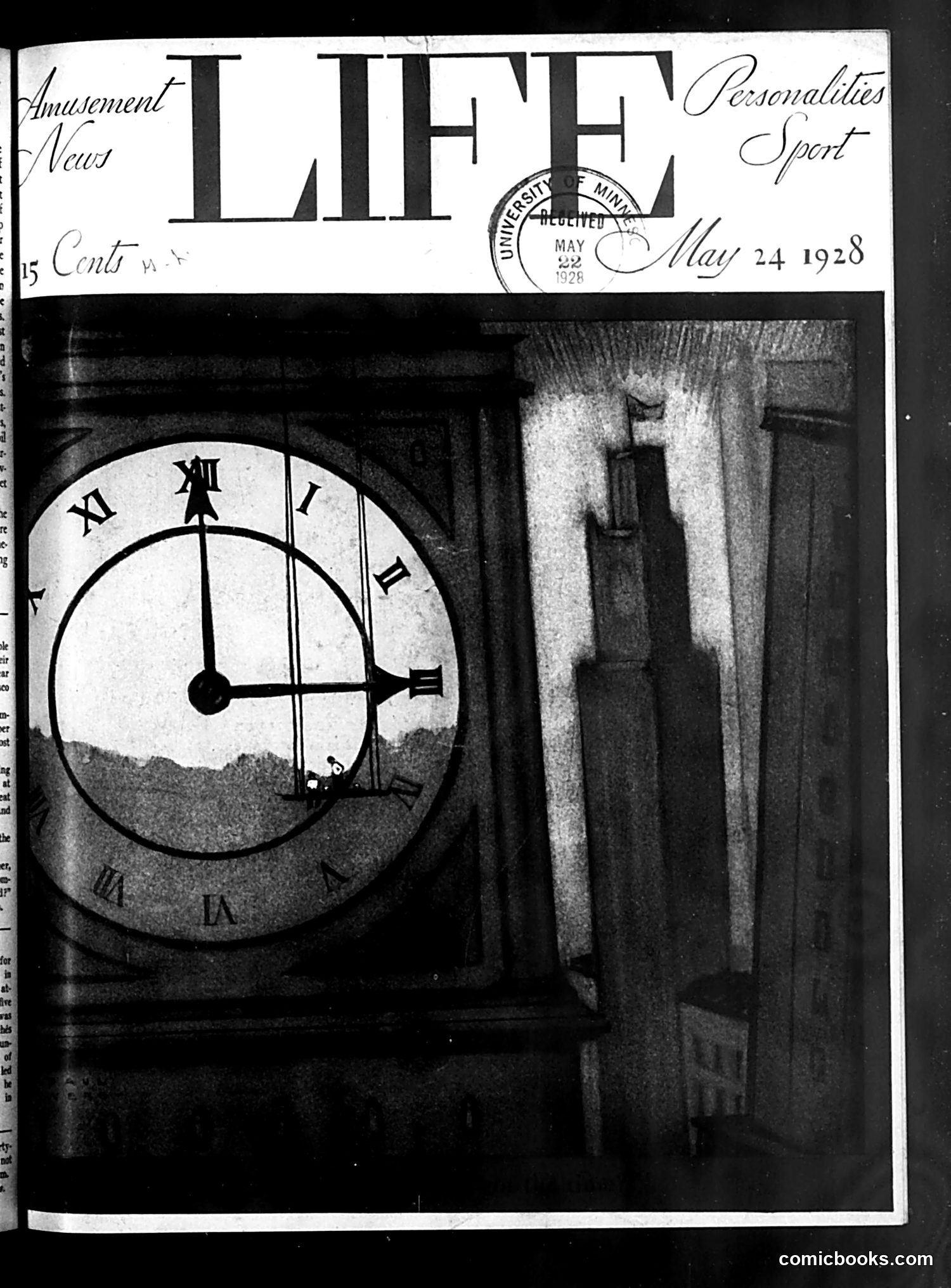
This cover features a large clock showing 3 o'clock, with a small figure appearing to climb or cling to it. The imagery likely represents a commentary on **time pressure or urgency** during the 1928 period, possibly related to political deadlines or social anxieties of the era. The cover sections indicate "Amusement News," "Personalities," and "Sport," suggesting this is a general-interest satirical magazine. Without clearer text identifying the specific figure or context, the exact target of satire remains unclear—it could reference politics, business, social conventions, or entertainment industry matters contemporary to May 1928. The clock motif suggests themes of racing against time or struggle with temporal constraints.
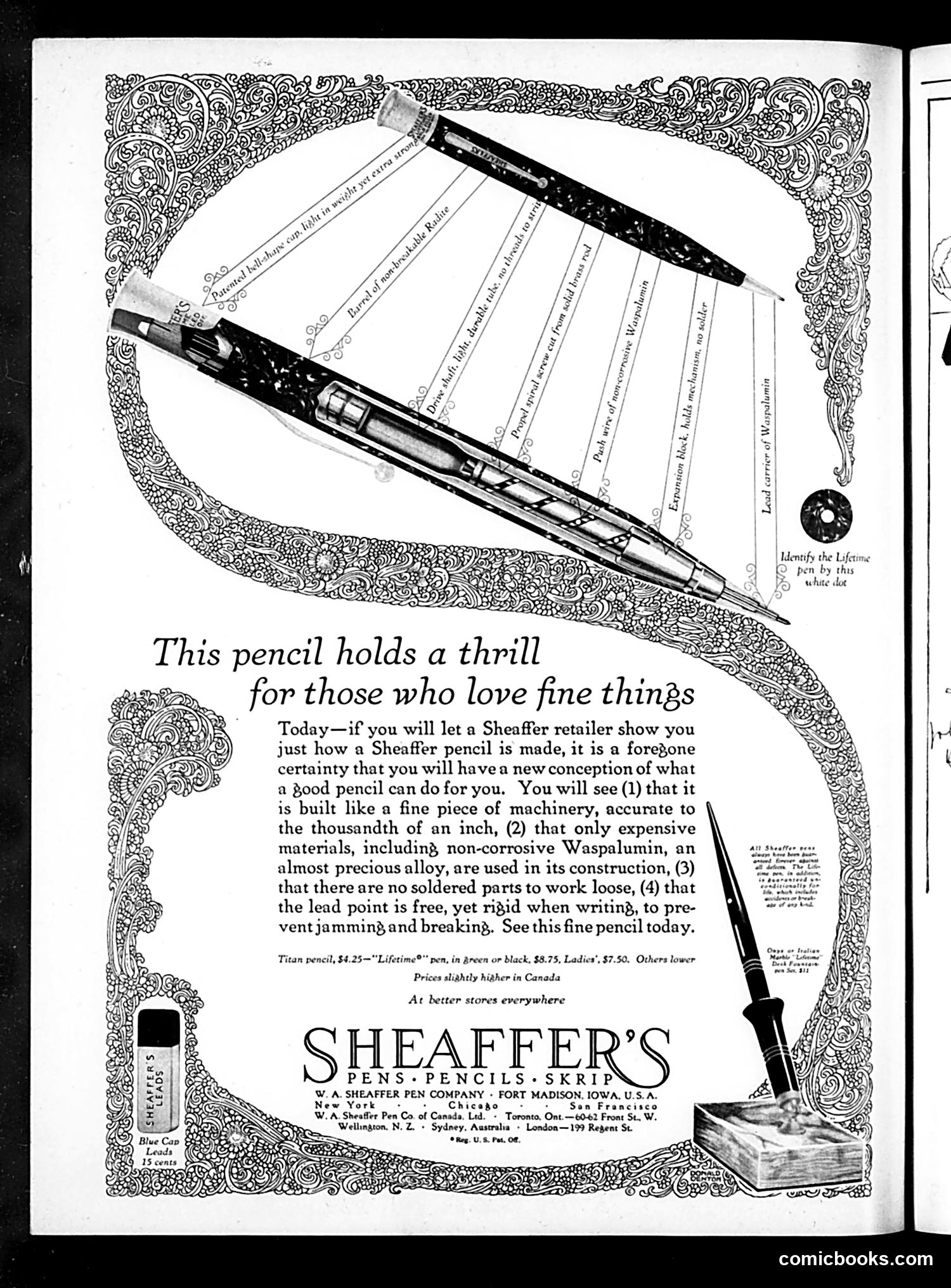
This is **not a political cartoon or satire**—it is a vintage **advertisement for Sheaffer's pencils**, likely from the early-to-mid 20th century. The page features an ornate decorative border and displays a detailed cross-section diagram of a Sheaffer pencil, with labeled components explaining its construction. The ad emphasizes the pencil's precision engineering, use of expensive materials (including "non-corrosive Waspalumim"), and superior writing performance. The marketing pitch highlights four key selling points: accurate manufacturing, premium materials, no soldered parts, and a rigid lead that resists jamming and breaking. Pricing and product variations are listed at the bottom. This is pure commercial advertising with no satirical or political content.
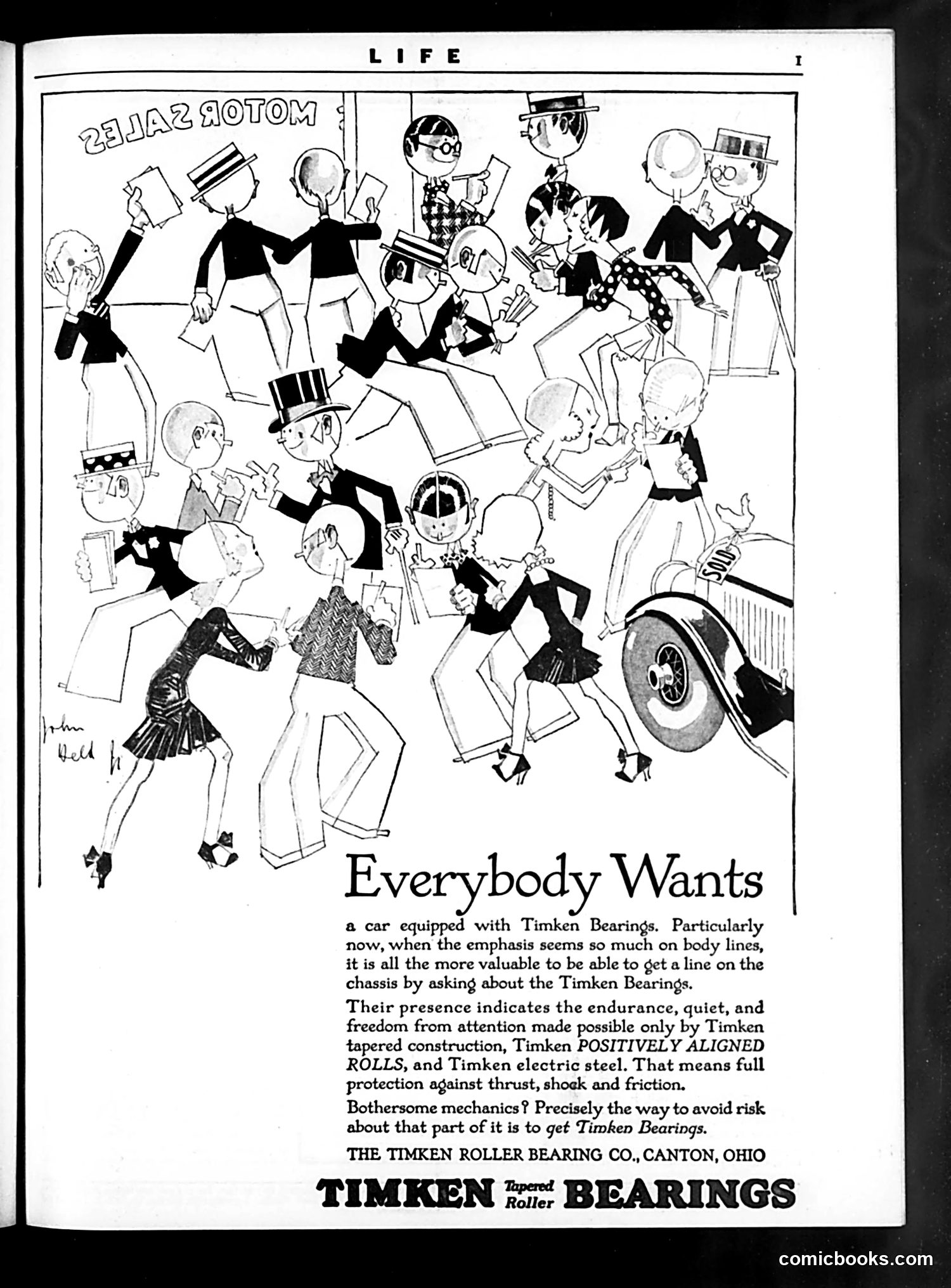
This page is primarily **advertising**, not editorial content. It's a Timken Roller Bearings advertisement from The Timken Roller Bearing Co. in Canton, Ohio. The cartoon illustrates the headline "Everybody Wants a car equipped with Timken Bearings" through a lively, crowded scene of stylized 1920s-era figures—men in top hats and suits, women in flapper dresses—enthusiastically gesturing toward or examining an automobile. The art style is typical of Art Deco-influenced commercial illustration. The satire is light: the ad humorously suggests that Timken bearings are so desirable that everyone wants them in their cars. The copy emphasizes technical benefits: durability, quietness, and protection against mechanical problems. This is straightforward product marketing rather than political or social commentary.
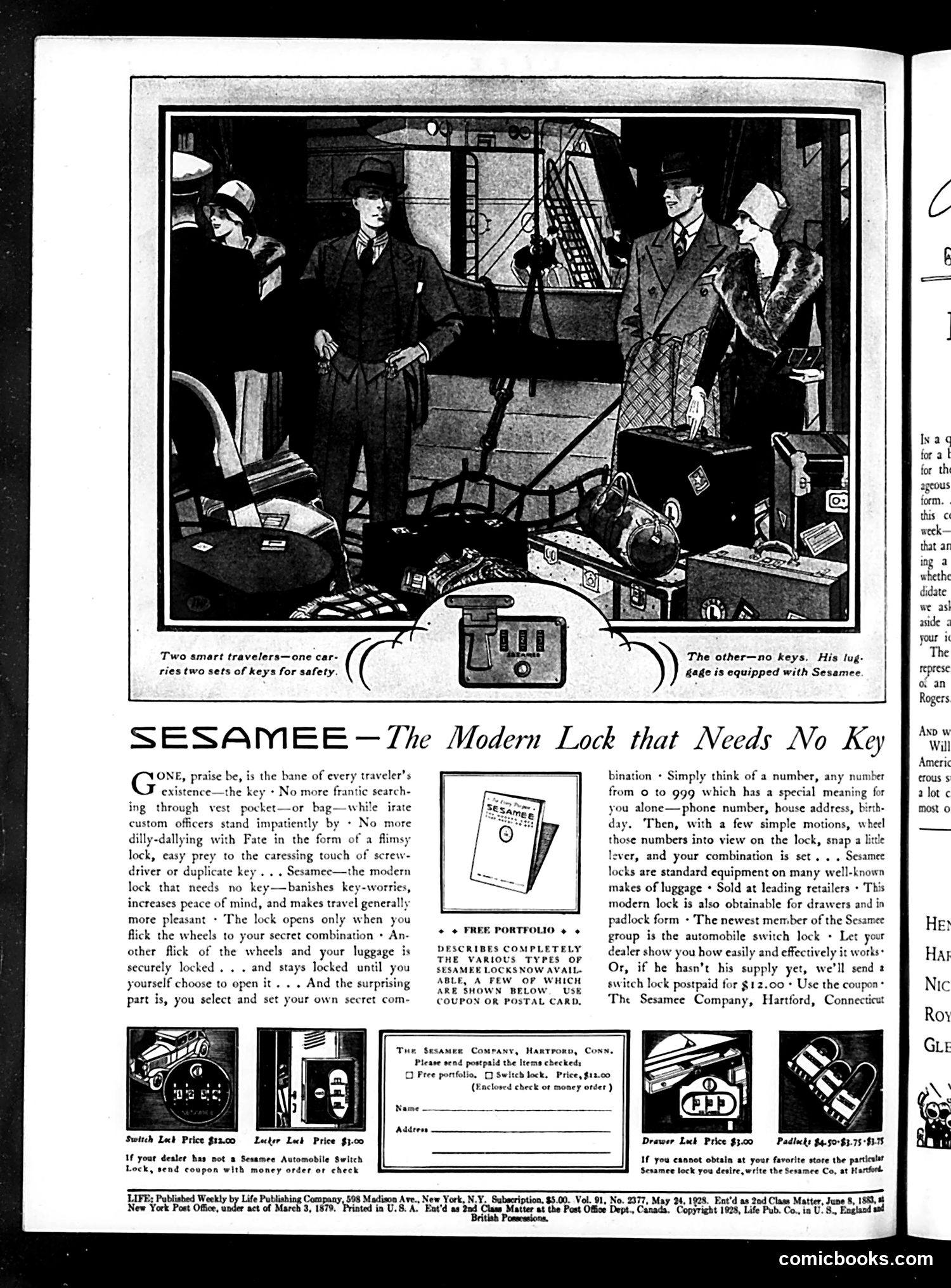
This page is primarily **advertising**, not political satire. It features a Sesamee lock advertisement—a combination lock requiring no physical key, innovative for the 1920s era. The top illustration shows well-dressed travelers at what appears to be a customs or luggage inspection, with the caption emphasizing the security advantage: "Two smart travelers—one carries two sets of keys for safety. The other—no keys. His luggage is equipped with Sesamee." The ad's appeal targets the anxieties of early 20th-century travelers: lost keys, luggage theft, and cumbersome key management. The numbered combination system (0-999) was presented as modern convenience and security. The lower section shows product variations (Switch Lock, Lever Lock, Drawer Lock, Padlock) with pricing around $1.00-$1.75, plus a mail-order coupon for interested consumers.
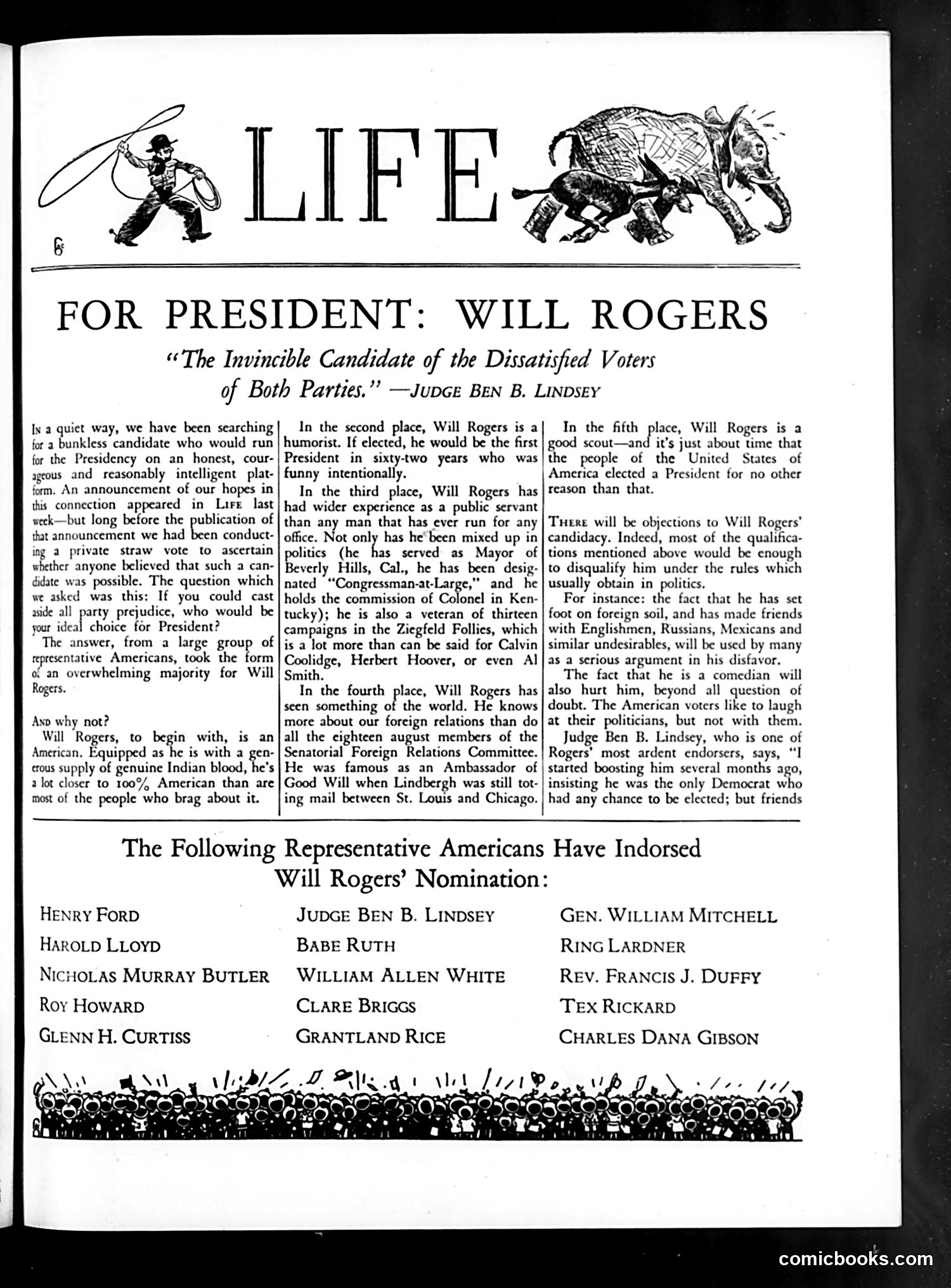
This Life magazine page satirizes a 1928 presidential campaign joke nominating **Will Rogers**, the famous American humorist and entertainer, as an alternative candidate for "dissatisfied voters of both parties." The piece humorously argues Rogers possesses genuine qualifications: he's genuinely American, funnier than previous politicians, experienced in public service (Mayor of Beverly Hills), widely traveled, and knowledgeable about foreign affairs. The satire mocks both major parties by suggesting a comedian would be preferable to their actual nominees. The endorsement list—including Henry Ford, Babe Ruth, and Harold Lloyd—comprises genuine celebrities of the era, enhancing the joke's plausibility and satirical punch. The illustration shows Rogers lassoing what appears to be an elephant, referencing the Republican Party symbol.
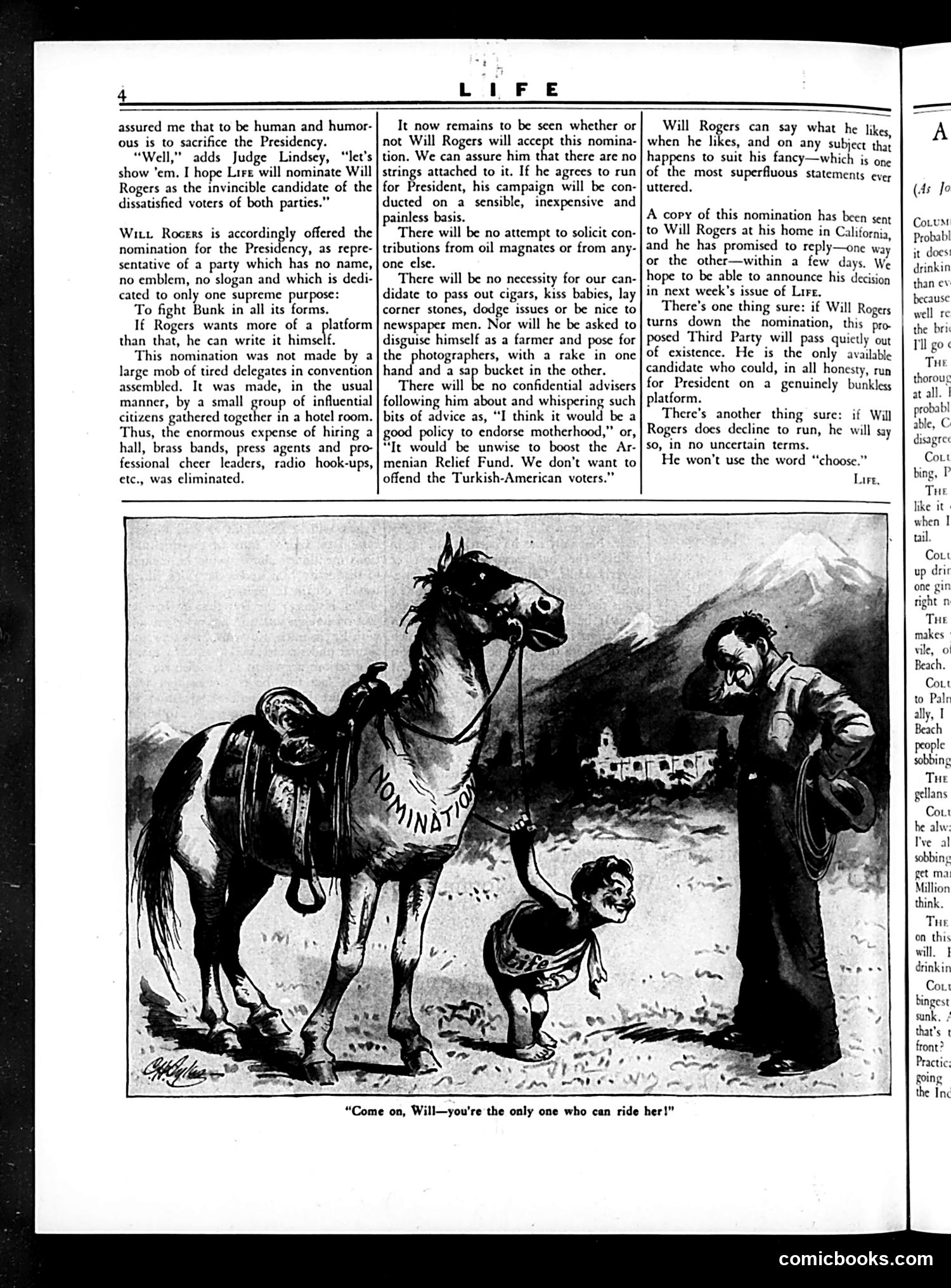
This Life magazine page discusses Will Rogers' potential presidential nomination. The accompanying political cartoon satirizes Rogers' candidacy by depicting him as the only figure willing to ride a camel labeled "NOMINATION"—suggesting the nomination is an unwieldy, difficult burden that others refuse to accept. The cartoon implies that Rogers, despite his popularity and humor, would be taking on an extremely challenging task by accepting the presidency. The camel, a beast of burden, represents the weight and difficulty of the office itself. The figures refusing to mount it suggest that more traditional politicians recognized the impracticality or undesirability of the position during this period—likely referencing economic or political turmoil of the era when this was published.
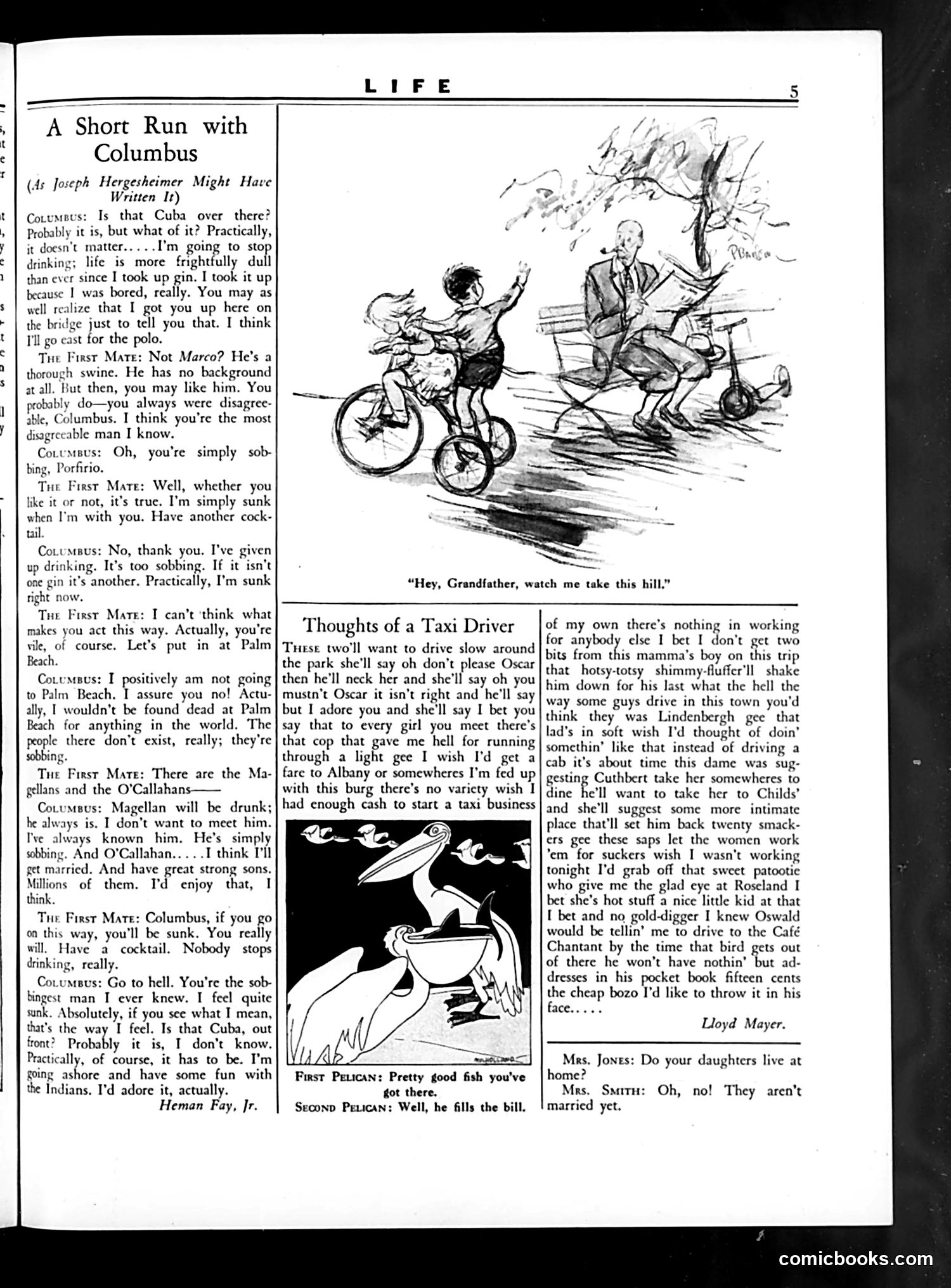
This page contains three distinct pieces: 1. **"A Short Run with Columbus"** (left): A satirical dialogue between Columbus and "The First Mate" about Cuba. Columbus expresses existential dread about life and drinking, while debating whether to visit Palm Beach. The satire mocks wealthy leisure culture and suggests Columbus—historically associated with exploration and discovery—is now reduced to idle socializing among the affluent. 2. **Illustration** (top right): Shows figures on bicycles, captioned "Hey, Grandfather, watch me take this hill"—a humorous domestic scene without clear political content. 3. **"Thoughts of a Taxi Driver"** (right): A monologue revealing a cab driver's crude, materialistic fantasies about female passengers. It satirizes working-class male attitudes and urban taxi culture of the era. The page overall satirizes American social classes and attitudes.
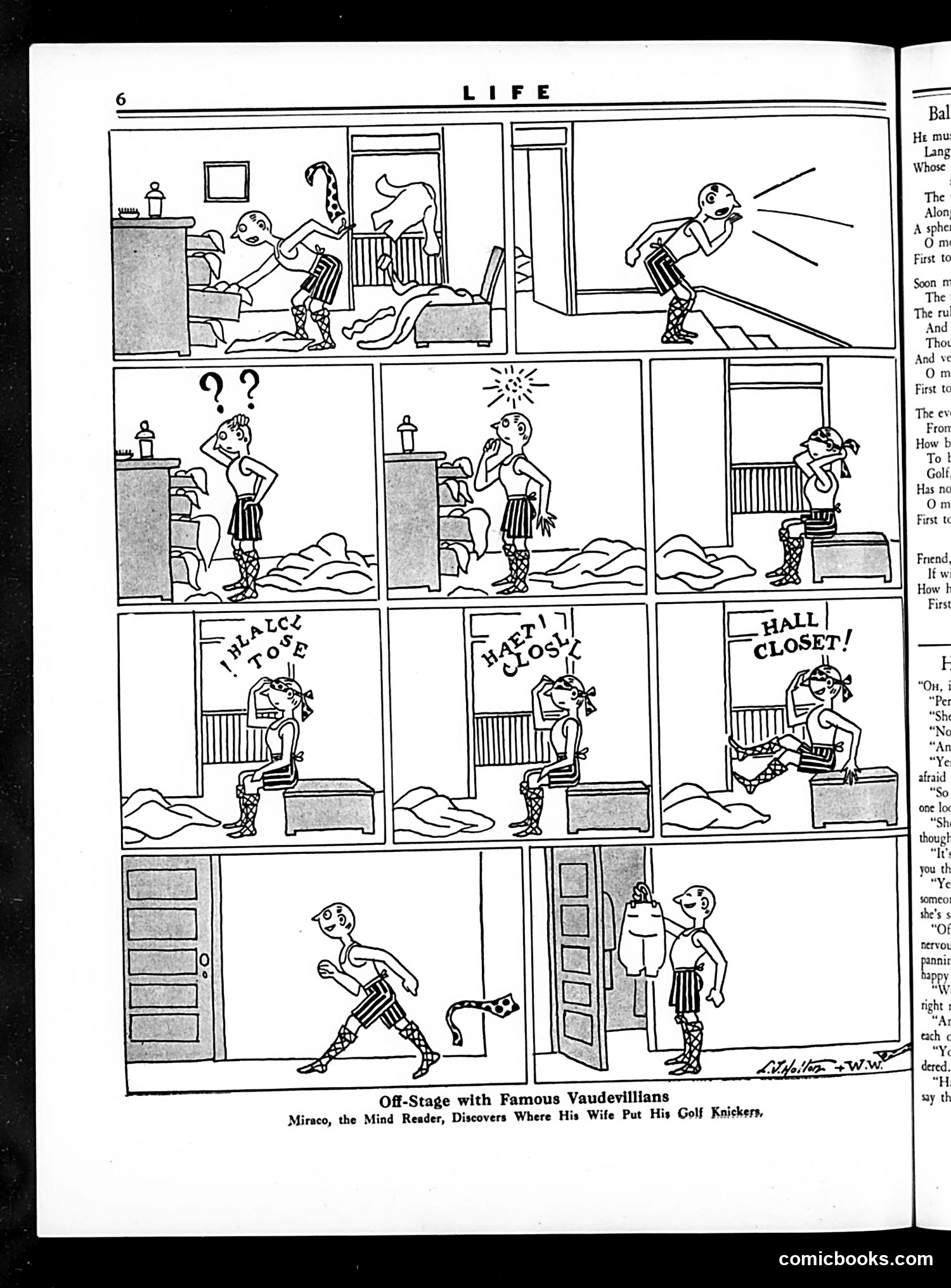
This comic strip satirizes a stage magician or mind reader named Miraceo. The narrative follows a vaudeville performer who claims supernatural abilities to discover hidden objects. The joke's progression: A man leaves his home, and Miraceo supposedly uses "mind reading" to locate where the man's wife has hidden his golf knickers (knickers being a style of men's pants). Through successive panels showing Miraceo searching the house—checking drawers, the hall closet, and eventually finding the knickers—the comic reveals the supposed "psychic" is simply conducting a mundane physical search. The satire mocks fraudulent spiritualists and mentalists who were popular vaudeville acts, suggesting their "supernatural" abilities are mere showmanship and practical detective work, not genuine magic.
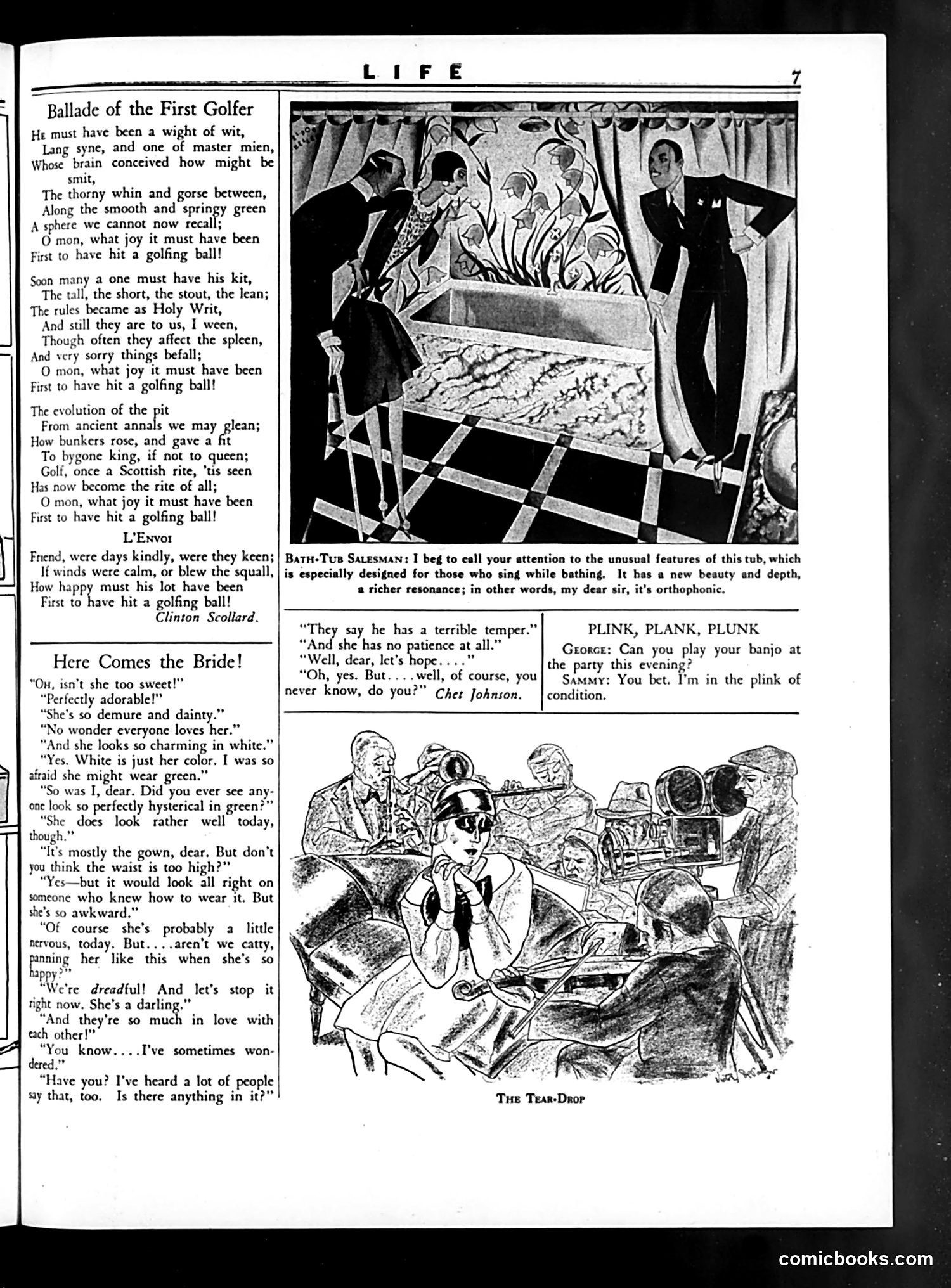
This page contains three distinct pieces of humor content: 1. **"Ballade of the First Golfer"** - A poem celebrating golf's origins, humorously suggesting the sport's invention was a momentous achievement ("what joy it must have been / First to have hit a golfing ball!") 2. **"Here Comes the Bride!"** - A dialogue satirizing wedding guests' superficial commentary about the bride's appearance and dress, particularly focusing on anxieties about whether her waist looks fashionably slim. 3. **"The Tear-Drop"** and **"Plink, Plank, Plunk"** - Brief comic sketches about social situations (a bride and party guests). The "bath-tub salesman" caption suggests product placement humor. The page reflects early 20th-century concerns with marriage propriety, fashion standards for women, and social etiquette—mocking both the obsessive focus on feminine appearance and the performative nature of social gatherings.
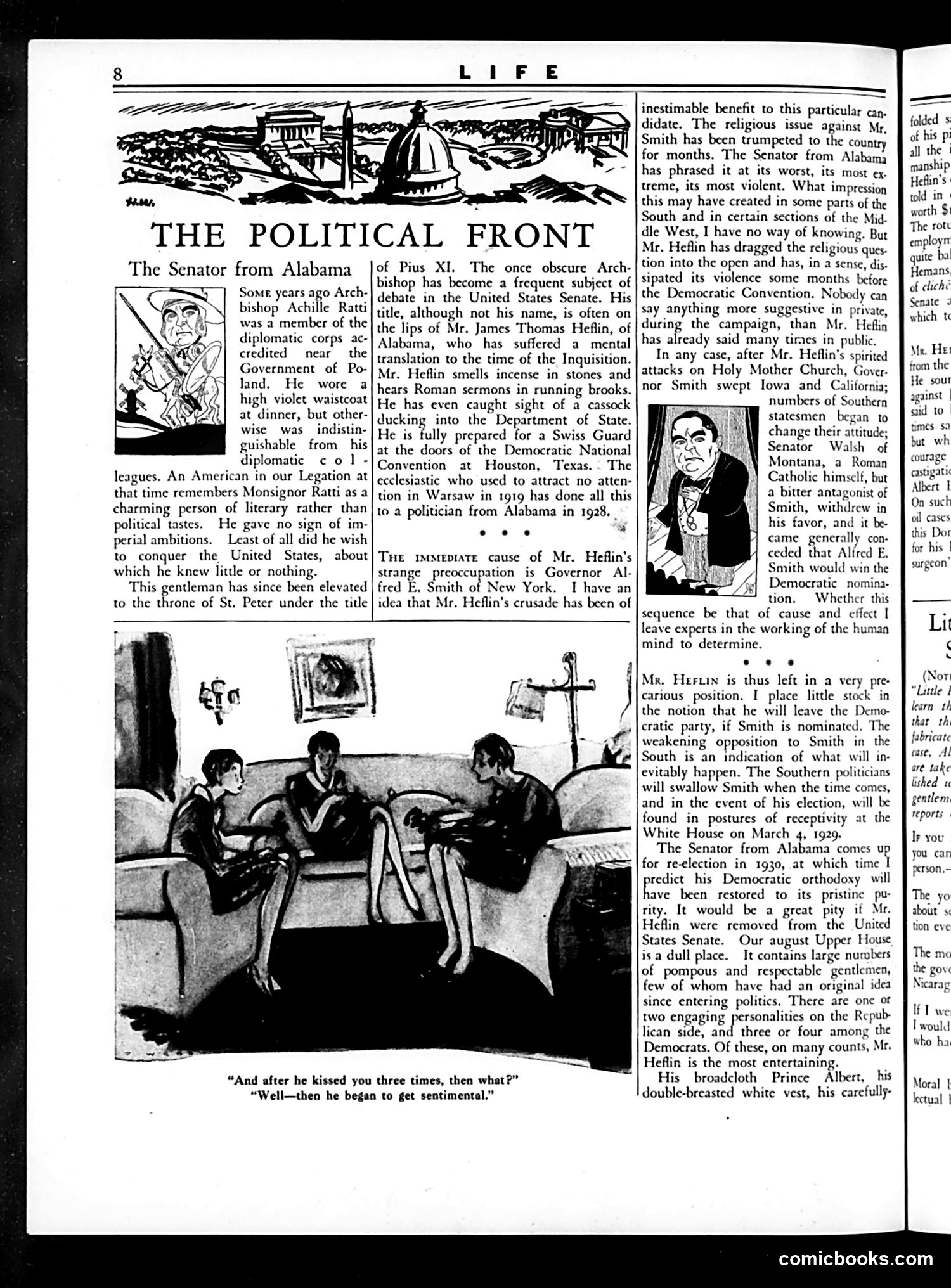
This page satirizes **Senator James Thomas Heflin of Alabama**, depicted in the left caricature. The article discusses Heflin's crusade against Archbishop Achille Ratti (later Pope Pius XI), whom Heflin accused of inciting anti-Democratic sentiment. The main cartoon shows a domestic scene where a woman asks a man, "And after he kissed you three times, then what?" to which he responds, "Well—then he began to get sentimental." The satire mocks Heflin's volatile personality and his seemingly emotional, unpredictable political behavior. The text suggests his opposition to Smith (likely Al Smith, a Catholic Democrat) is religiously motivated and politically destabilizing for the Democratic party in the South, portraying Heflin as an unreliable, mercurial figure whose dramatic crusades undermine Democratic unity.
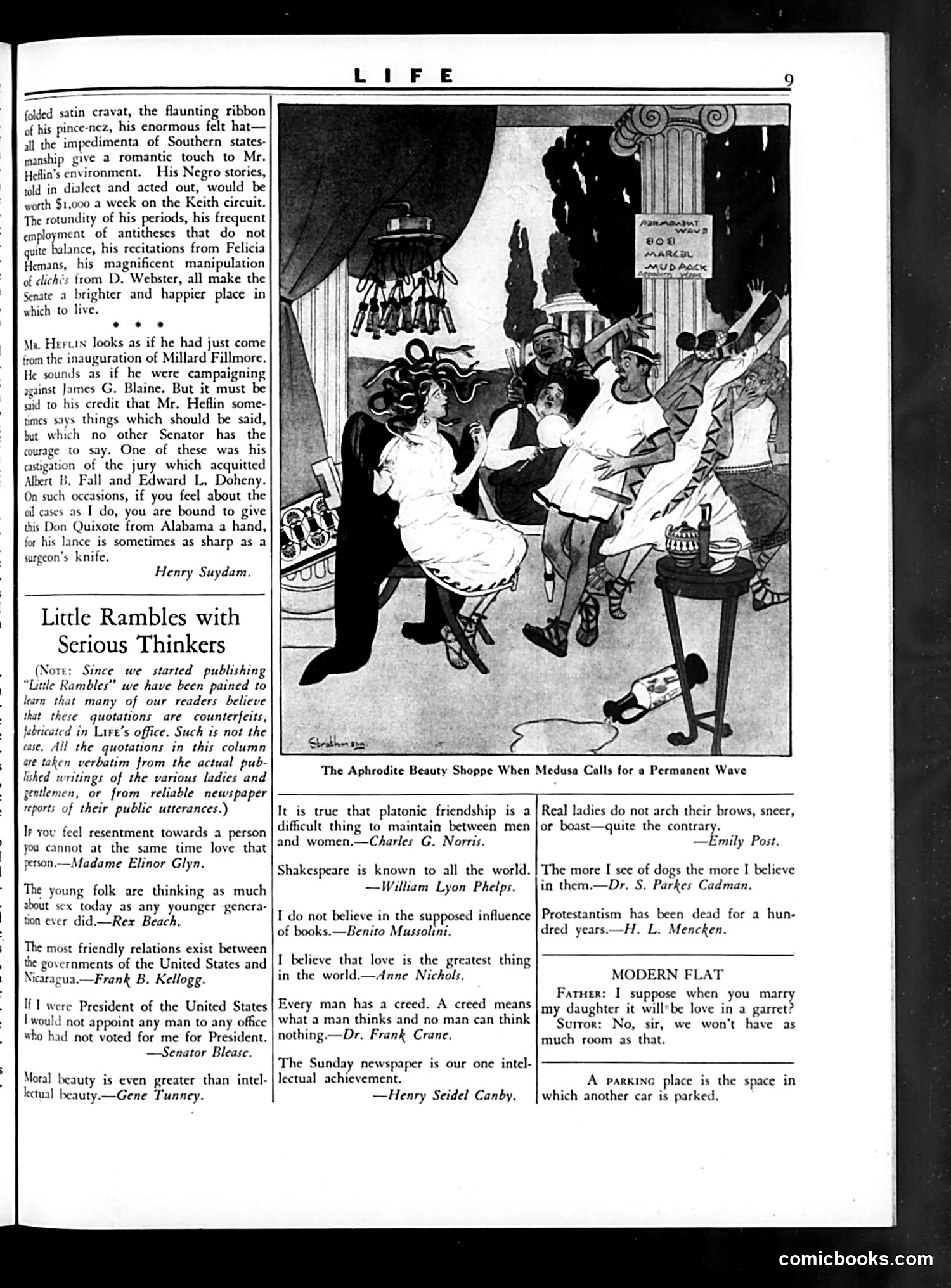
This cartoon satirizes women's beauty culture and the absurdity of applying modern cosmetic procedures to mythological figures. It depicts Medusa—the Gorgon with serpents for hair—visiting a beauty salon for a permanent wave (a popular 1920s-30s hair treatment). The humor lies in the incongruity: her writhing snake-hair makes a permanent wave both unnecessary and impossible. The beauty shop workers appear flustered, suggesting the practical impossibility of their task. The cartoon mocks both the vanity driving women to beauty treatments and the salon industry's claim to transform anyone's appearance. The accompanying "Little Rambles" section collects quotations on love, literature, and modern life—typical Life magazine filler content mixing humor with social commentary.
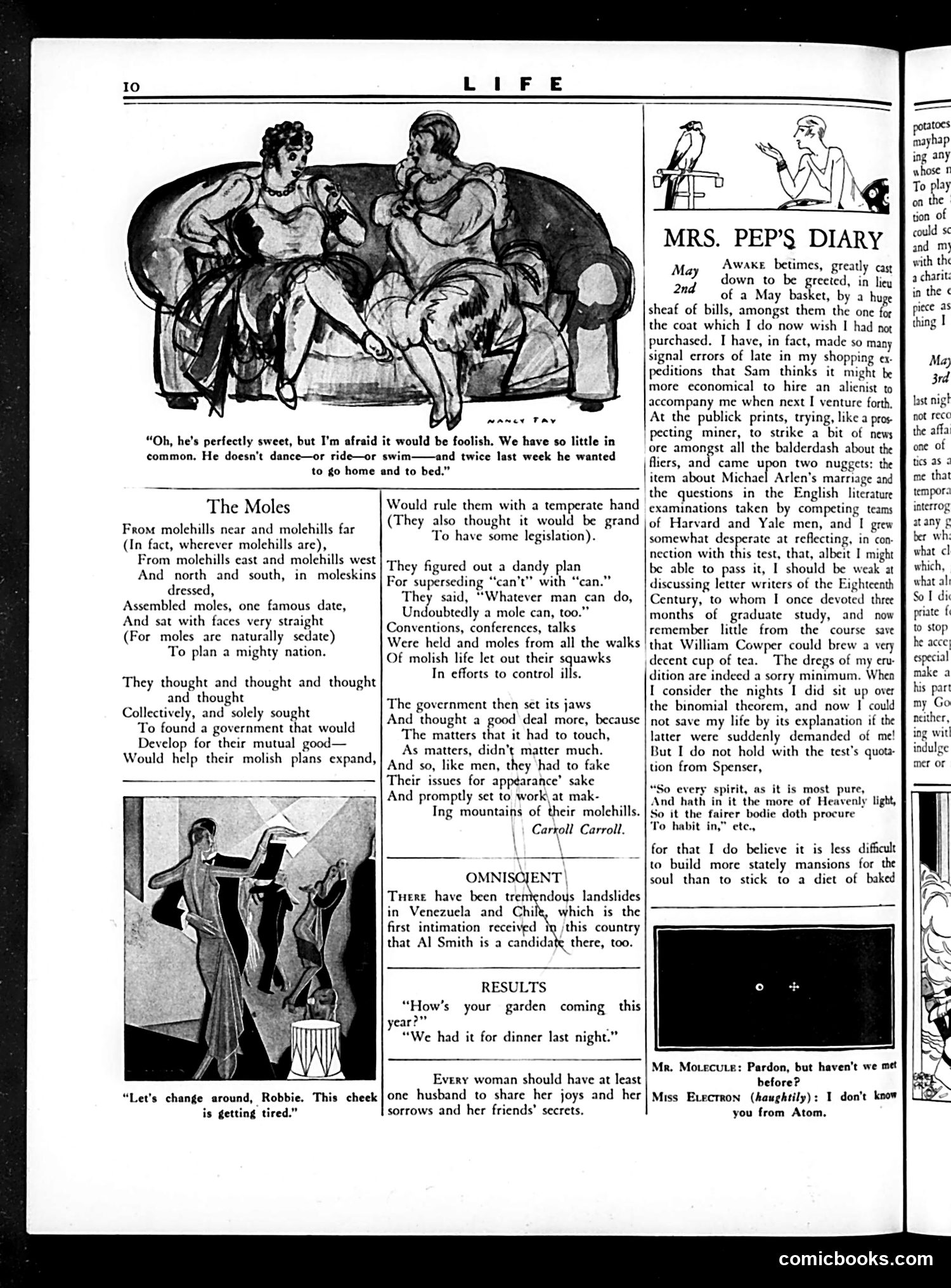
This page contains three distinct satirical pieces: **Top cartoon**: A couple on a sofa discusses a suitor. The woman says the man is "perfectly sweet" but lacks accomplishments—he "doesn't dance—or ride—or swim." The satire targets upper-class dating standards, mocking how wealthy society judges men by recreational skills rather than character. **"The Moles"**: A humorous poem by Carroll Carroll about moles from "molehills near and molehills far" who convene to plan government. It satirizes bureaucratic committees and governmental inefficiency through animal allegory—the moles endlessly debate while accomplishing little. **Lower cartoon**: Titled "Let's change around, Robbie. This check is getting tired," it appears to satirize marital dynamics and financial management, though the specific reference remains unclear. The overall page mocks social pretension, governmental dysfunction, and domestic relations.
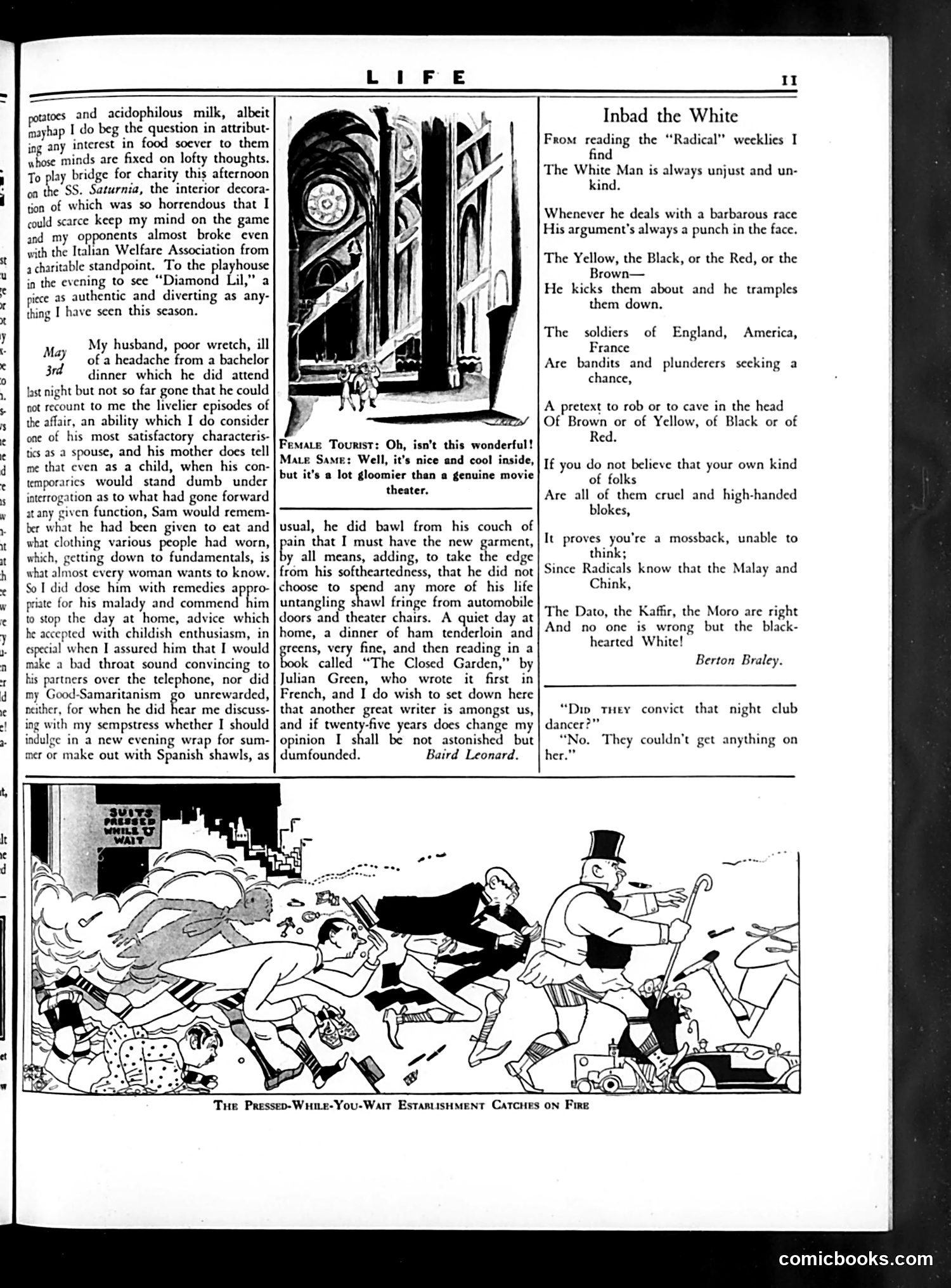
This page contains a poem titled "Inbad the White" by Berton Braley, which satirizes anti-immigrant and racist attitudes. The poem mockingly describes how "the White Man" treats other races—"The Yellow, the Black, or the Red, or the Brown"—as inferior, kicking and trampling them. Braley uses sarcasm to critique this prejudice, calling such attitudes proof of being "a mossback, unable to think." The bottom cartoon, captioned "The Pressed-While-You-Wait Establishment Catches on Fire," depicts chaos at what appears to be a laundry or pressing establishment with figures in disarray. The satire likely mocks contemporary business operations or customer service mishaps, though the specific reference is unclear without additional context. Together, the content addresses social prejudices and commercial absurdities of the era.
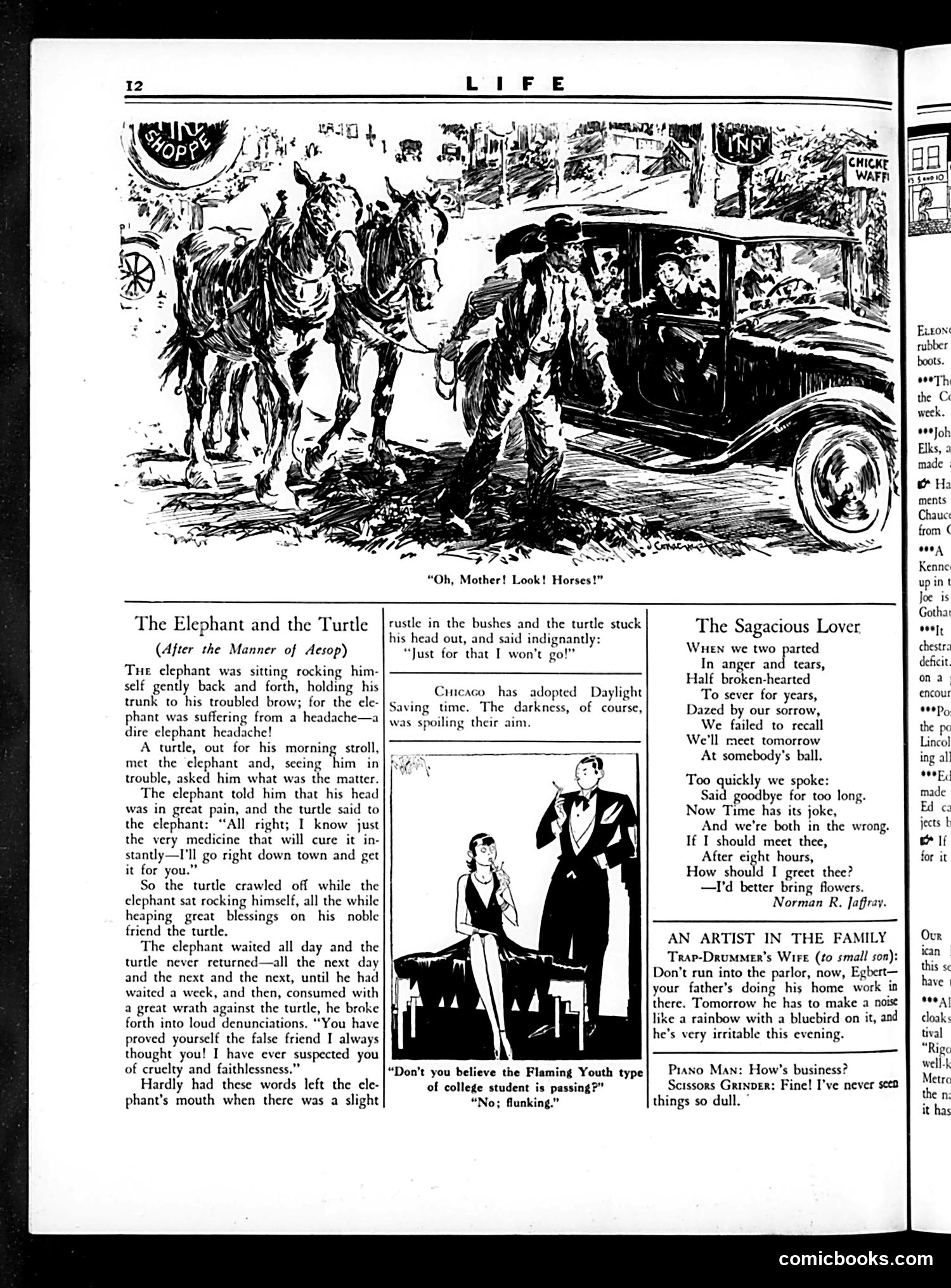
This page contains three unrelated humorous pieces typical of Life's satirical format: 1. **"The Elephant and the Turtle"** — An Aesop's fable adaptation about an elephant seeking a turtle's medical advice for a headache. The moral criticizes false friendship and betrayal, ending when the elephant breaks the turtle's shell in anger. 2. **Top cartoon "Oh, Mother! Look! Horses!"** — Shows a child spotting horse-drawn wagons while riding in a modern automobile, satirizing rapid technological change and the displacement of horses by cars—a timely reference to early 20th-century motorization. 3. **"The Sagacious Lover"** and brief humor pieces — Generic romantic and domestic comedy sketches common to the era. These represent Life's mix of moral fables, social observation about modernity, and lighthearted domestic humor.
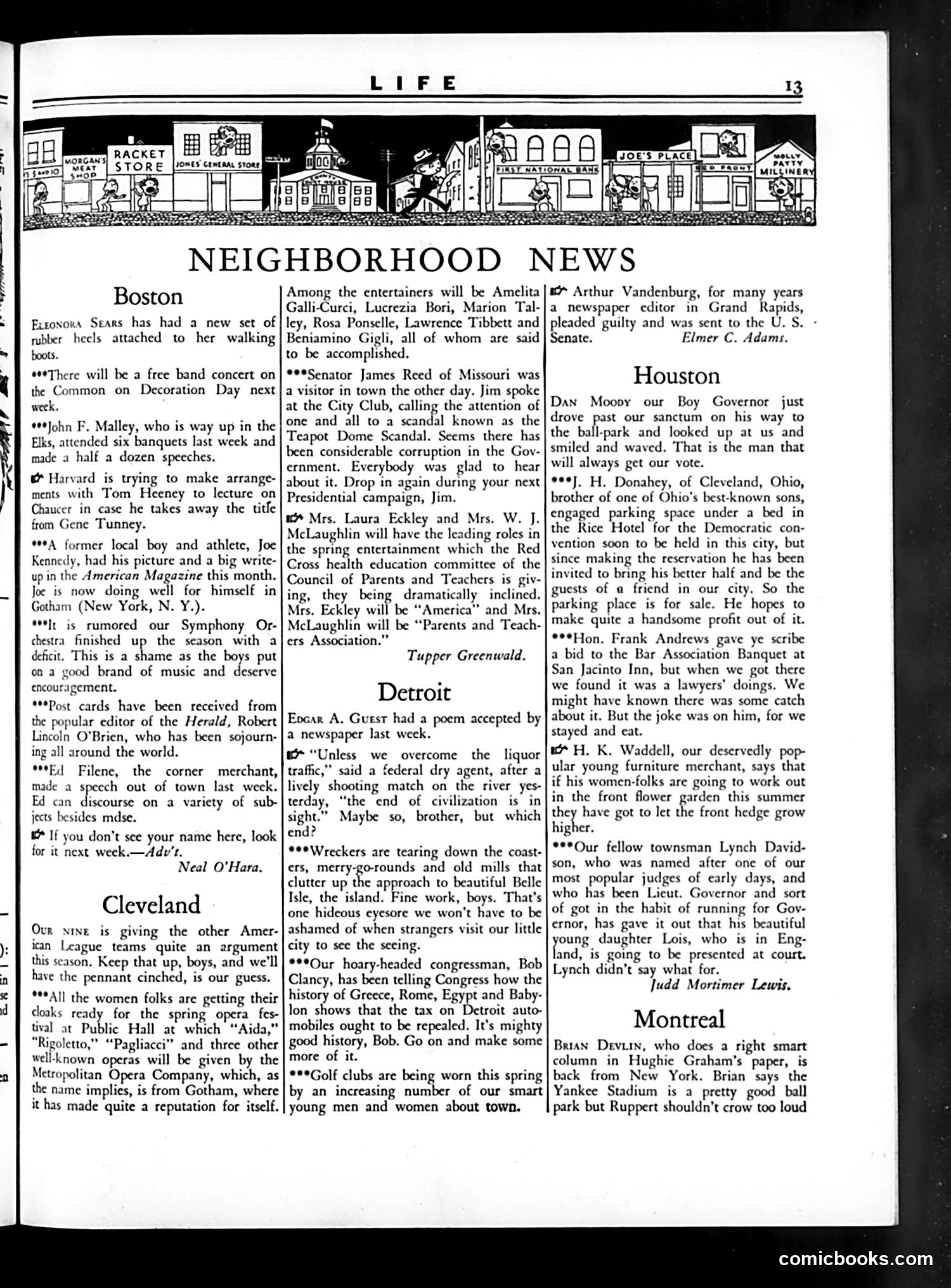
This page contains "Neighborhood News" — a satirical gossip column format covering social happenings in Boston, Cleveland, Detroit, Houston, and Montreal. The content mocks local figures and events rather than featuring political cartoons. The satire targets small-town pretensions and scandals: a congressman's dubious history lessons, a furniture merchant's wife seeking employment, concerns about liquor law enforcement, and complaints about noisy golf club activity. One entry jokes about a hotel reservation mix-up involving a lawyer's "catch." The humor relies on local references now obscure to modern readers — specific names and incidents meaningful only to contemporary audiences. The format itself satirizes society gossip columns by treating minor civic matters with mock-serious attention, gently ridiculing provincial social dynamics and small-town bureaucratic absurdities.
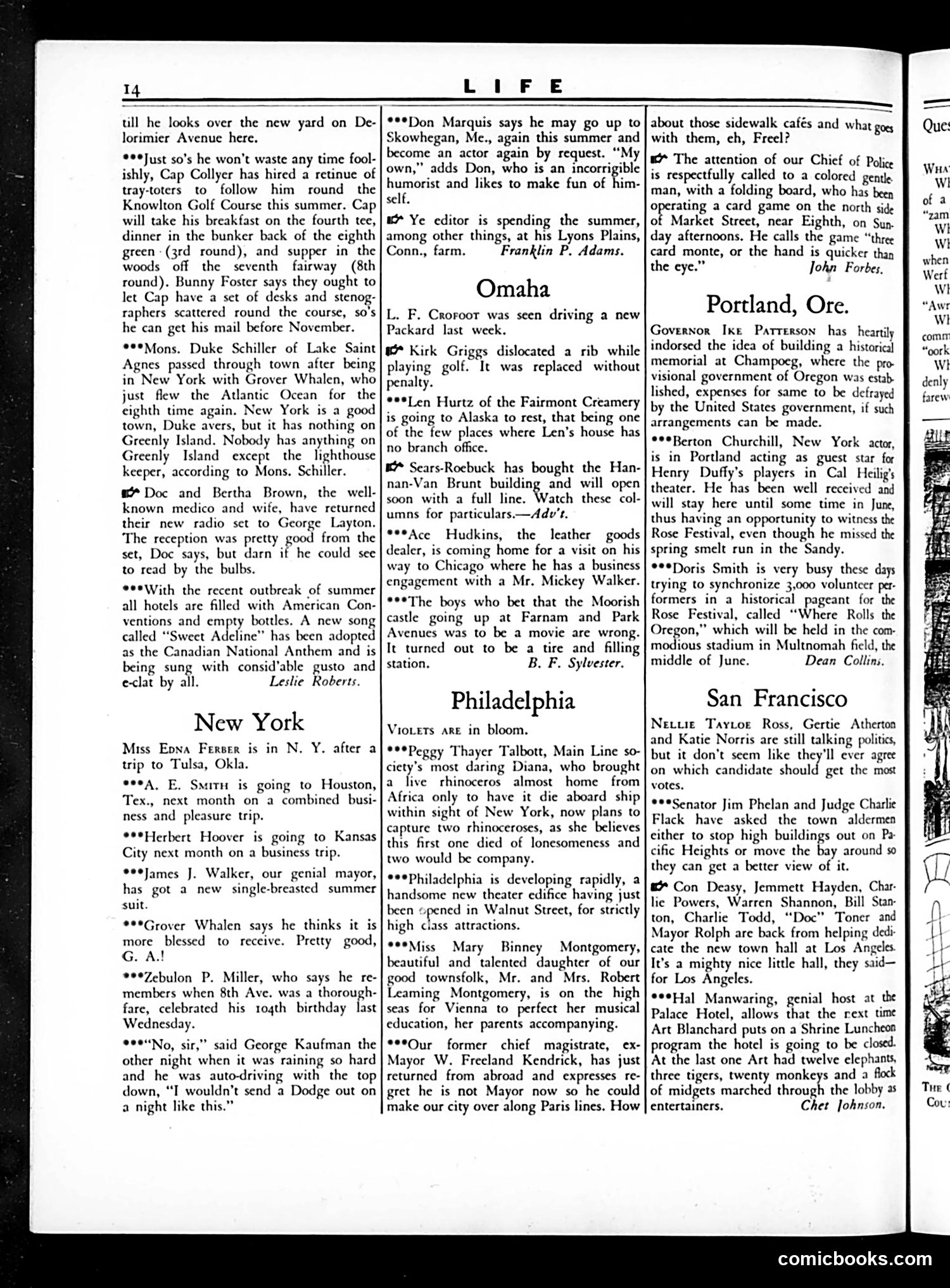
This appears to be a **gossip/society column page** rather than a political cartoon page. It contains brief local news items and social notes organized by city: New York, Omaha, Philadelphia, and San Francisco. The content consists of short anecdotes about notable local figures—their travels, business ventures, social events, and personal activities. For example, one item mentions someone buying a building, another describes summer golf outings, and another notes a theatrical guest appearance. The page is **satirical in tone** through its gossipy, tongue-in-cheek reporting style rather than through illustrations. It captures early 20th-century American social life and local celebrity culture, poking gentle fun at the activities and pretensions of prominent townspeople across different cities.
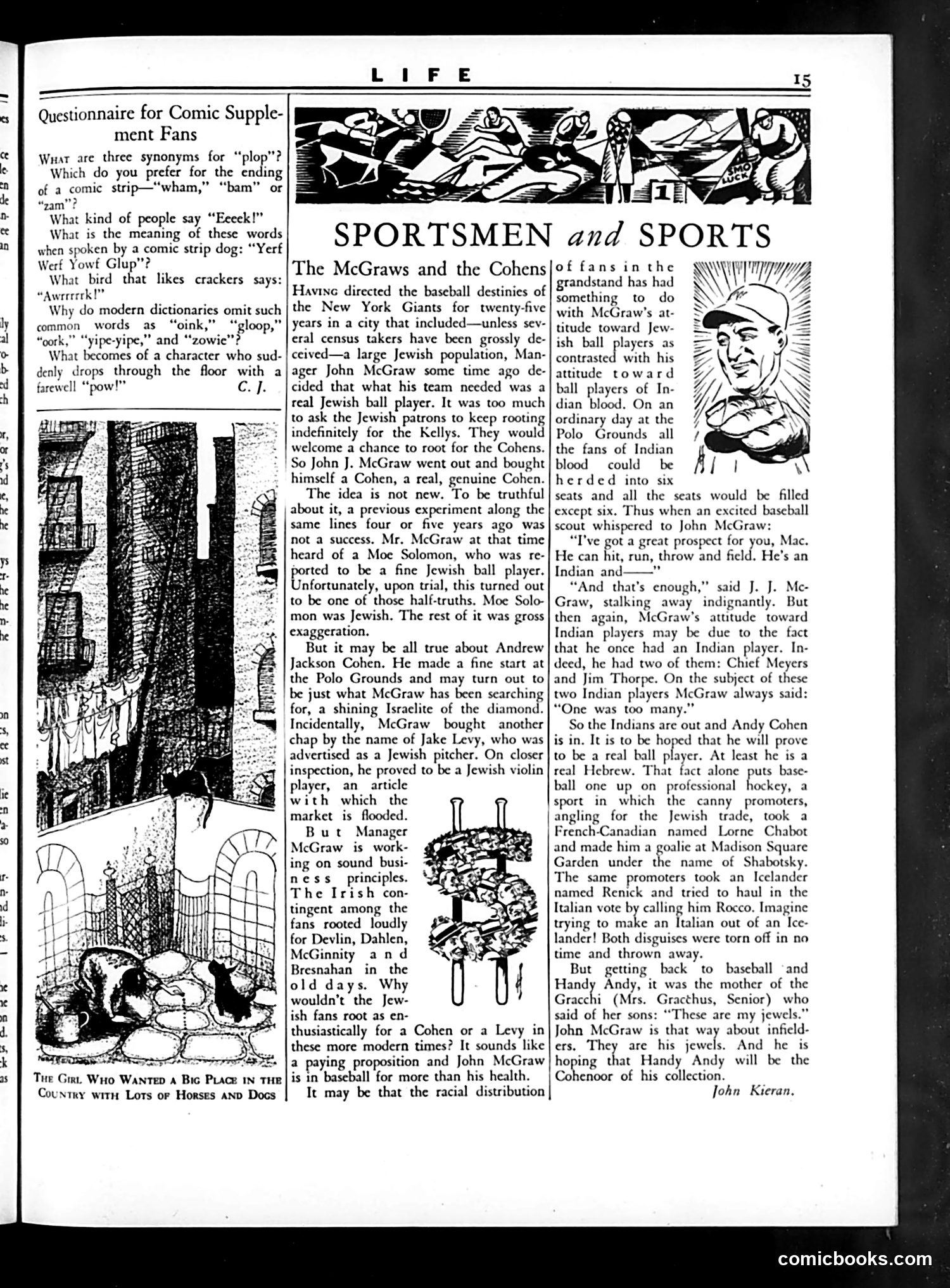
This article by John Kieran discusses Jewish participation in baseball, specifically focusing on John McGraw (manager of the New York Giants) and his attitudes toward Jewish players. The text describes McGraw's initial reluctance to recruit Jewish players, despite census data showing a large Jewish population in New York. It recounts failed attempts to sign Jewish athletes—including a violinist named Jake Levy and others—before eventually recruiting Andrew Cohen. The article critiques McGraw's ethnic prejudice while noting some progress. It references attempts to recruit other Jewish and immigrant athletes (Italian, Icelandic) for various sports, suggesting broader discrimination in professional athletics during this era. The cartoon illustrates a woman seeking a rural property with horses and dogs—seemingly unrelated to the main article's focus on baseball and ethnic discrimination in sports.
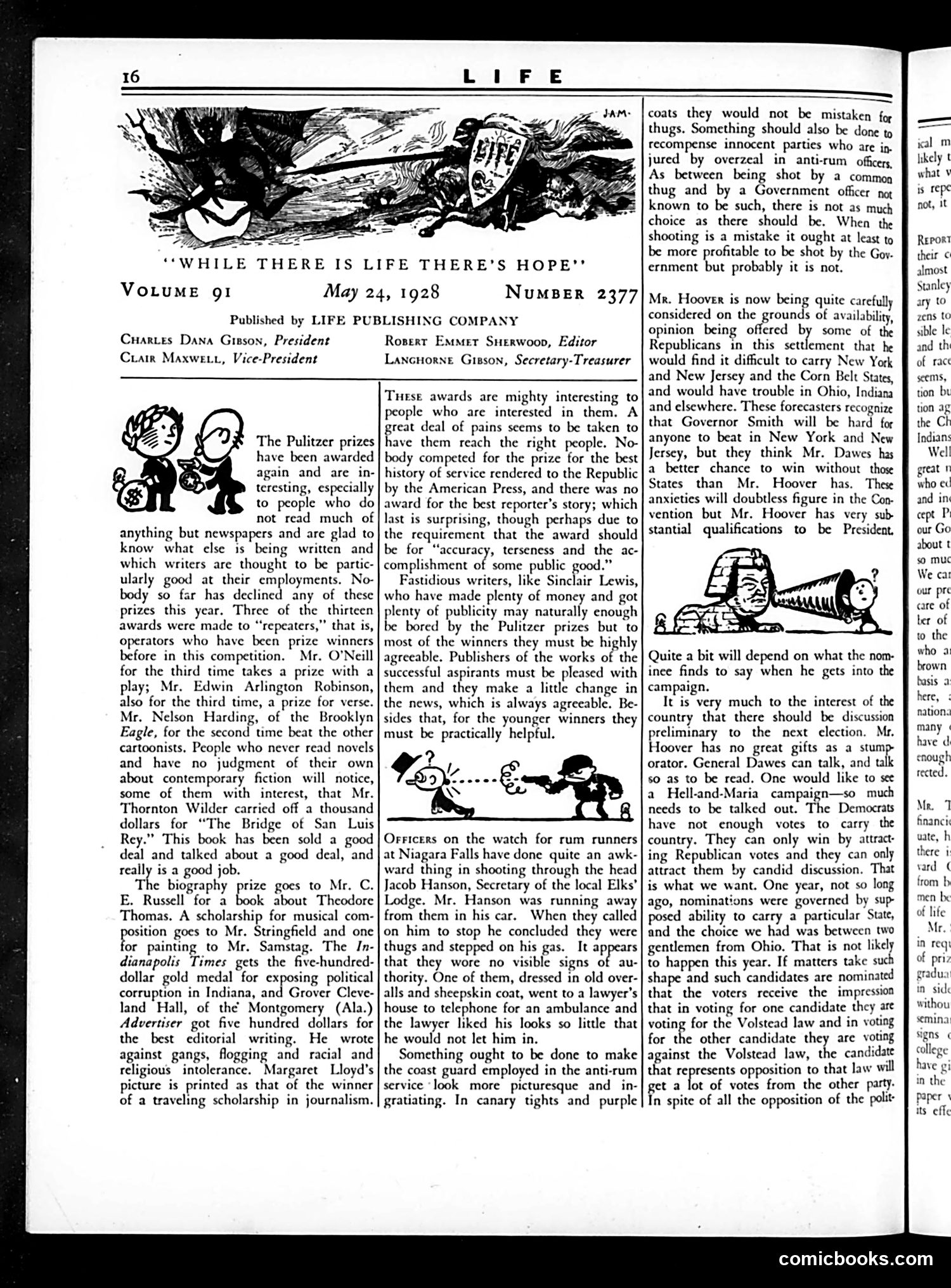
This page discusses the Pulitzer Prize awards and the upcoming 1928 presidential election. The text criticizes newspapers that merely "repeat" previous prize-winning formulas rather than pursue genuinely important journalism. The main political cartoon (lower half) depicts officers catching rum runners—referencing Prohibition enforcement during the 1920s. It shows the absurdity of the "anti-rum service," with coast guard personnel in dramatic pursuit. The page advocates for Herbert Hoover's presidential nomination, arguing he has better qualifications than General Dawes. The text emphasizes that the Democratic Party needs substantive discussion beyond just opposing the opposing candidate's policies. The overall tone suggests satire of both parties' campaign strategies and the era's Prohibition enforcement.
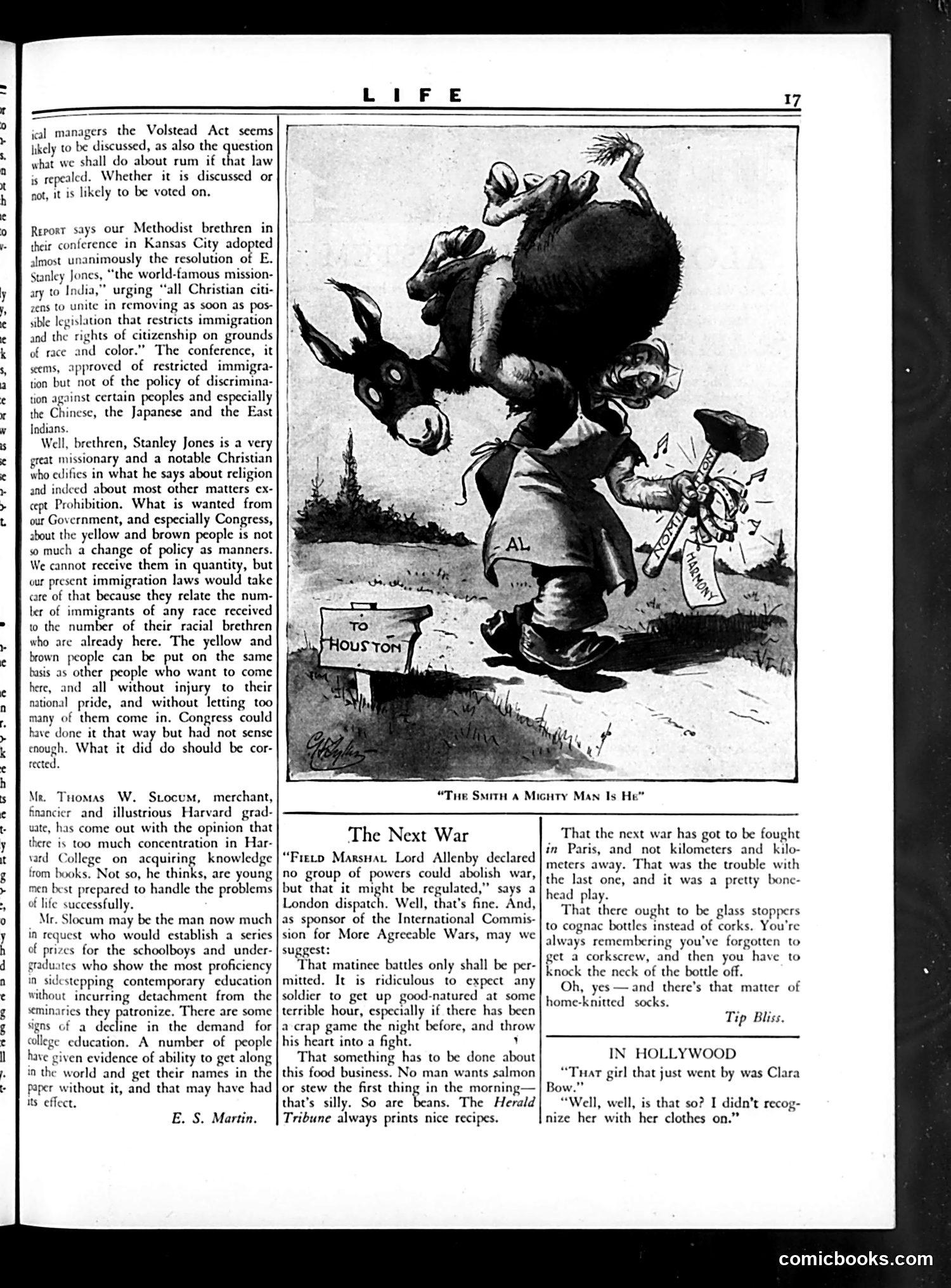
This cartoon satirizes American immigration policy through an exaggerated figure labeled "Immigration Law" (appearing as a large, chaotic man) tossing Asian and other non-European immigrants away from Houston, Texas toward Europe. The text discusses Methodist church resolutions opposing racial discrimination in immigration law, particularly targeting restrictions against Chinese, Japanese, and East Indian immigrants. The cartoon's title suggests immigration law itself is portrayed as a crude, violent force. The accompanying article by Thomas W. Slocum argues against concentration of power in Harvard College and advocates for broader educational access. The page reflects early 20th-century debates over restrictive immigration policies, racial discrimination in law, and progressive religious opposition to such restrictions.
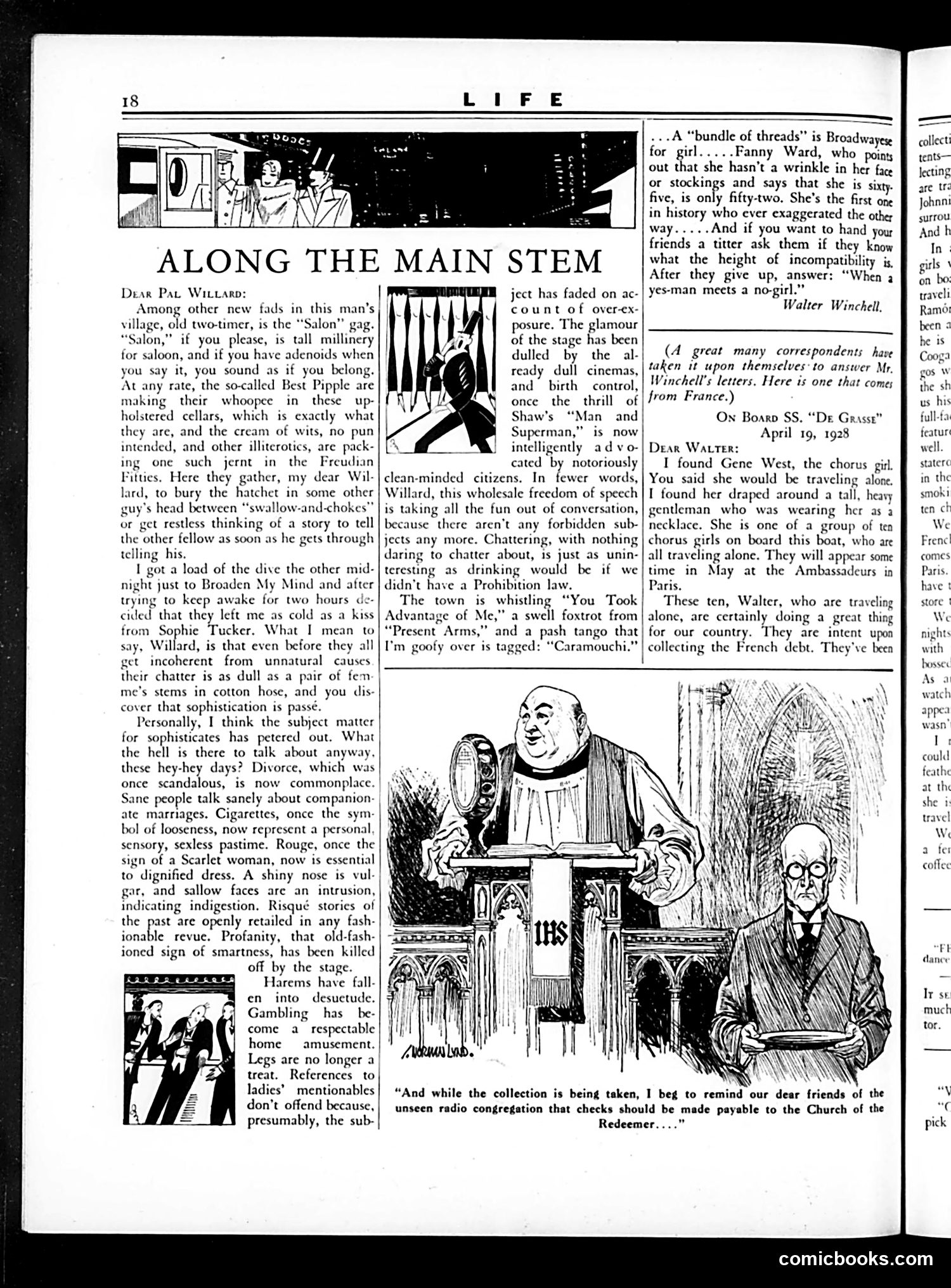
This page from *Life* magazine (1928) features a satirical column mocking the "Salon" fad—speakeasy culture during Prohibition. The writer argues that modern permissiveness has paradoxically made conversation *boring*: divorce, smoking, makeup, profanity, and even birth control are now socially acceptable rather than scandalous. Without taboo subjects to discuss, he claims, the sophisticated crowd has nothing interesting to say. The accompanying cartoon shows a priest collecting money "for the Church of the Redeemer"—likely satirizing how even religious institutions were compromising their values during this morally relaxed era. The column includes gossipy celebrity tidbits (Fanny Ward's age claims, chorus girls traveling "alone" with men), typical of *Life*'s mix of social commentary and Hollywood scandal. The overall message critiques 1920s "modern" values as having eliminated the very transgression that once made wit and rebellion appealing.
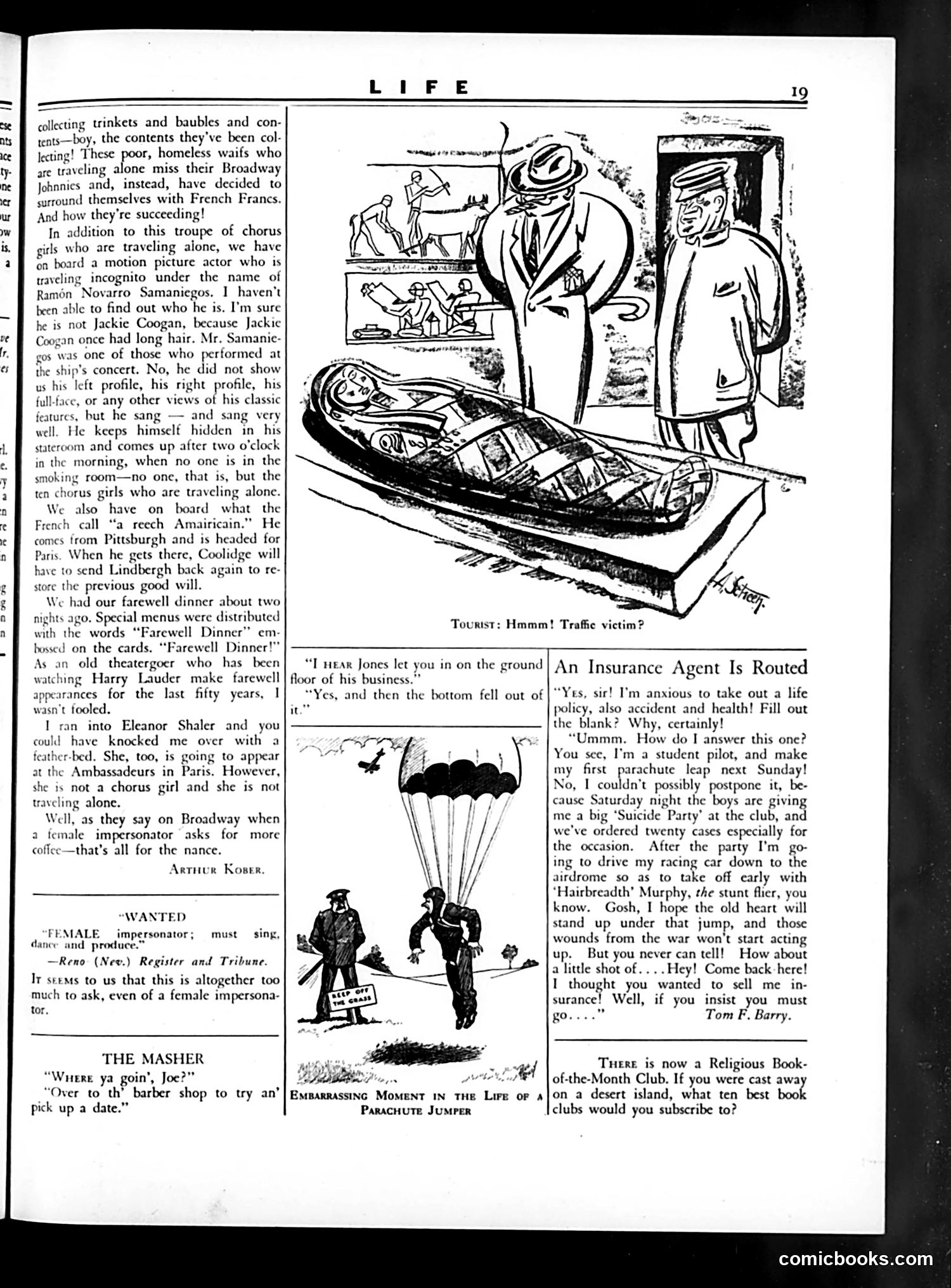
This page contains several humorous vignettes satirizing 1920s American social behavior and attitudes: **Main article** (left): Arthur Kober describes fellow ship passengers traveling to Europe, including chorus girls collecting "French Francs" (a double entendre suggesting both currency and romantic conquests), a mysterious motion-picture actor traveling incognito, and a wealthy American from Pittsburgh heading to Paris—with the joke that he'll damage Franco-American relations so badly that Coolidge will need to send Lindbergh to repair goodwill. **Cartoons**: 1. "Parachute Jumper"—depicts an awkward moment when someone notices a man in a coffin, suggesting the jumper's dangerous occupation. 2. "Insurance Agent Is Routed"—a student pilot applying for life and accident insurance comically lists his imminent activities: a "Suicide Party," racing-car driving, and stunt flying with war wounds. The agent flees in horror—the applicant is clearly uninsurable. The satire targets wealthy Americans abroad, reckless youth culture, and the absurdity of asking insurance companies to cover obviously high-risk individuals.
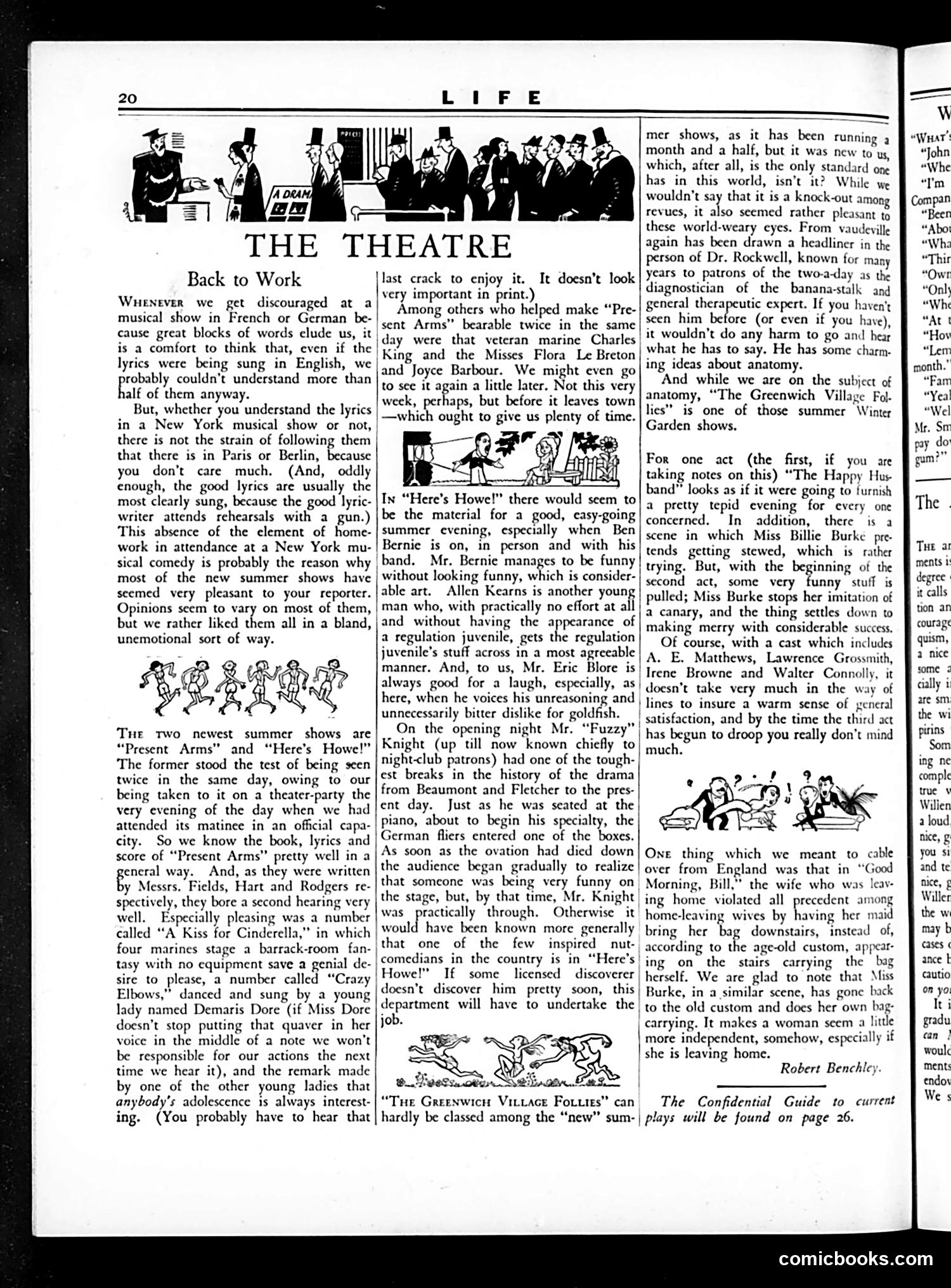
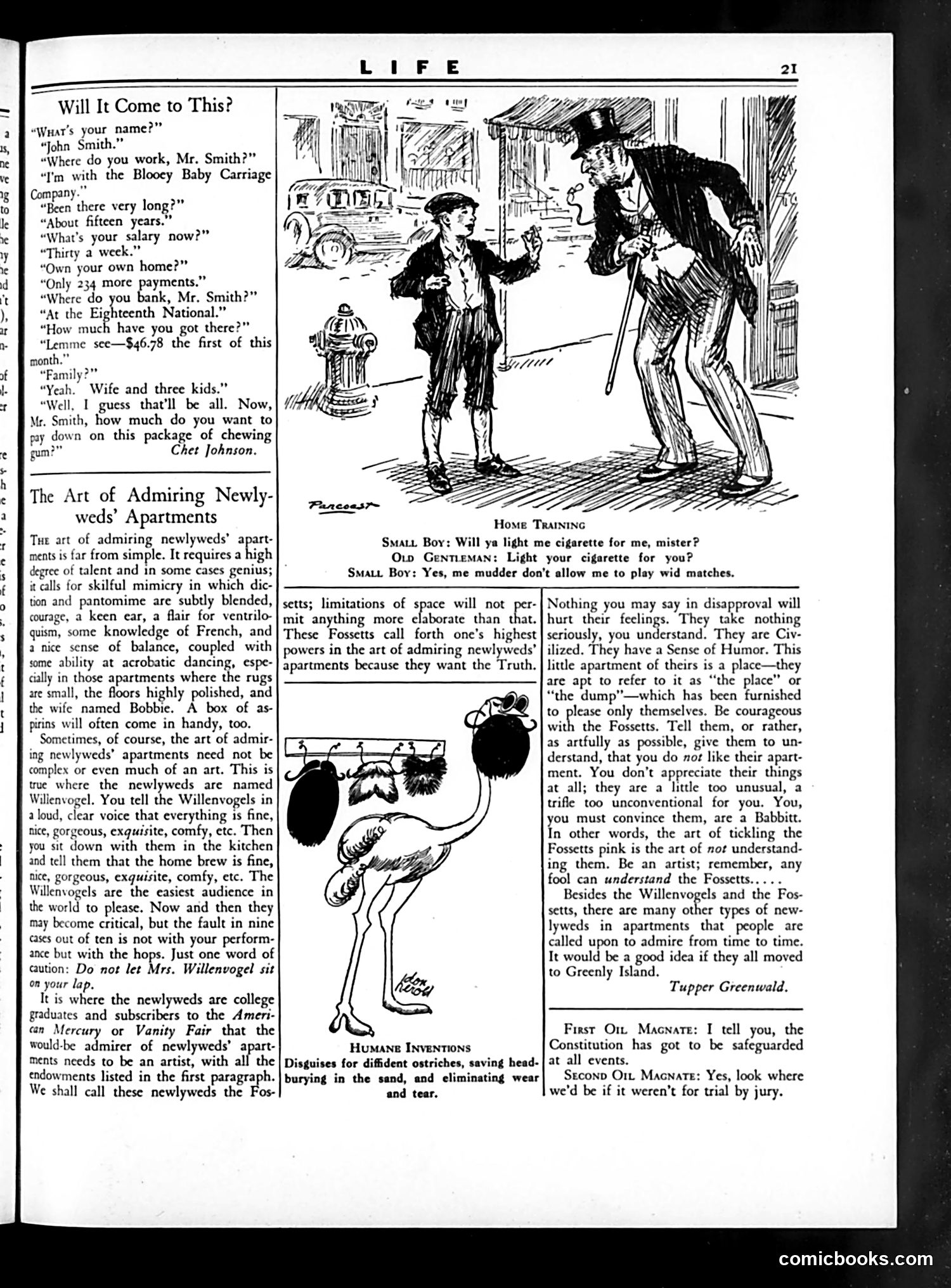
This page satirizes early 20th-century American economic anxiety and social pretension. **"Will It Come to This?"** (top): A working man named John Smith—employed fifteen years at the "Blooey Baby Carriage Company" earning thirty dollars weekly, with only $46.78 in savings and a home requiring 234 more payments—is asked by a well-dressed man how much he wants to pay down on *chewing gum*. The joke: despite financial precarity, consumer culture demands payment for everything, even trivial items. **"The Art of Admiring Newlyweds' Apartments"**: Satirizes social performance and class anxiety among young couples. The "Willenvogels" (German name, suggesting working-class immigrants) are easily pleased with flattery about their modest home. The "Fossetts" (implied educated, readers of *American Mercury* and *Vanity Fair*) require sophisticated dishonesty—one must pretend *not* to like their apartment to gain their approval. The satire targets both the pretentious intellectuals and the exhausting social rituals required to navigate different classes. **"Home Training"**: A street urchin asks an old gentleman to light his cigarette; when refused, the boy explains his mother forbids him playing with matches—absurd logic exposed as teaching through reverse psychology.
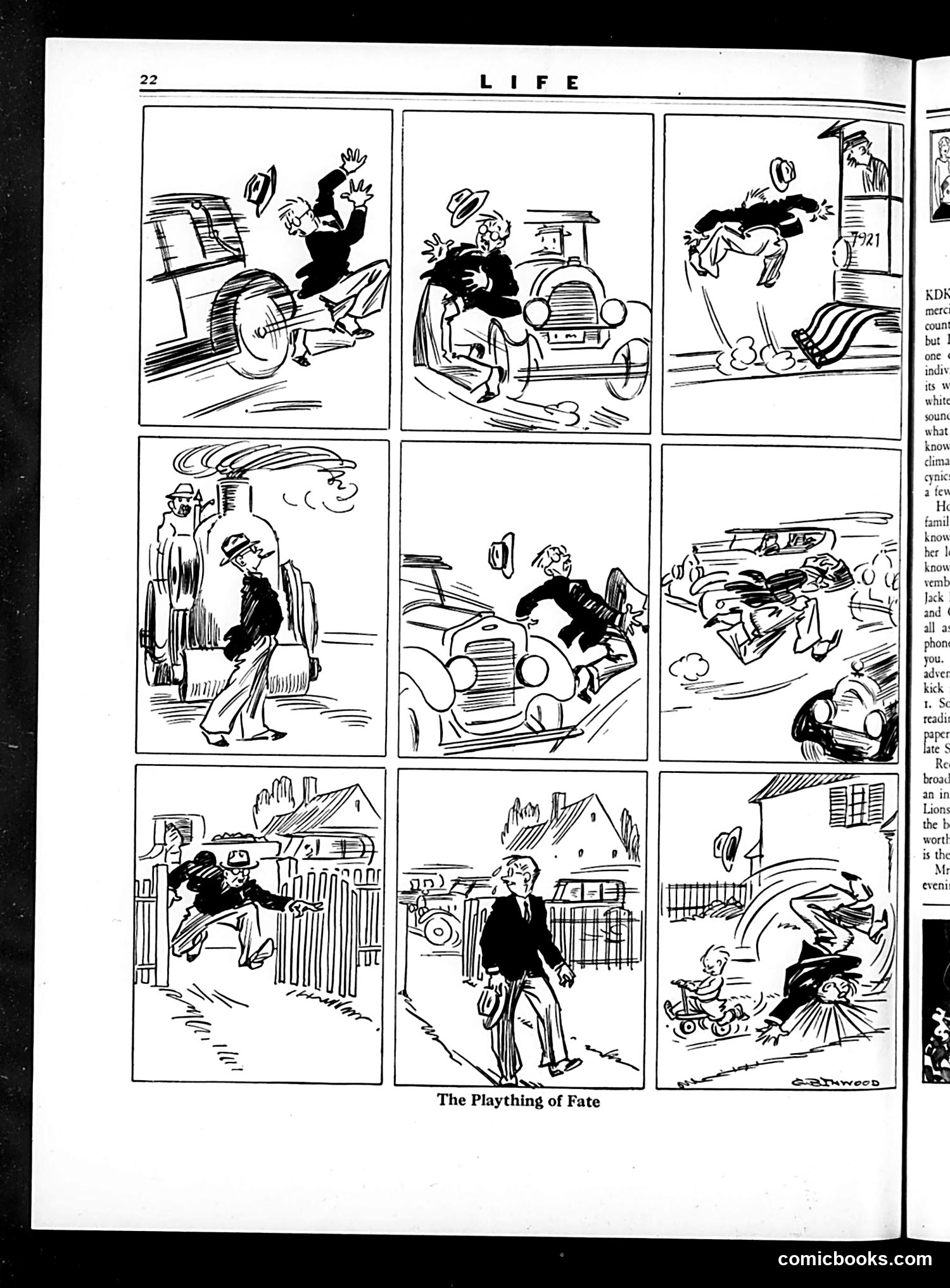
This nine-panel comic strip depicts a man experiencing a series of automotive misadventures. The narrative appears to be satirizing the unpredictability and dangers of early automobile culture. The protagonist encounters increasingly chaotic situations: his car malfunctions, he collides with other vehicles, crashes into buildings and fences, and nearly injures pedestrians and children. The title "The Plaything of Fate" suggests the strip mocks how helpless drivers are against mechanical failure and accident—portraying automobiles as instruments of unpredictable chaos rather than reliable transportation. The humor derives from slapstick physical comedy and the ironic contrast between the man's formal attire and his constant misfortune. This reflects early-20th-century anxieties about automobile safety and technology's integration into daily life.
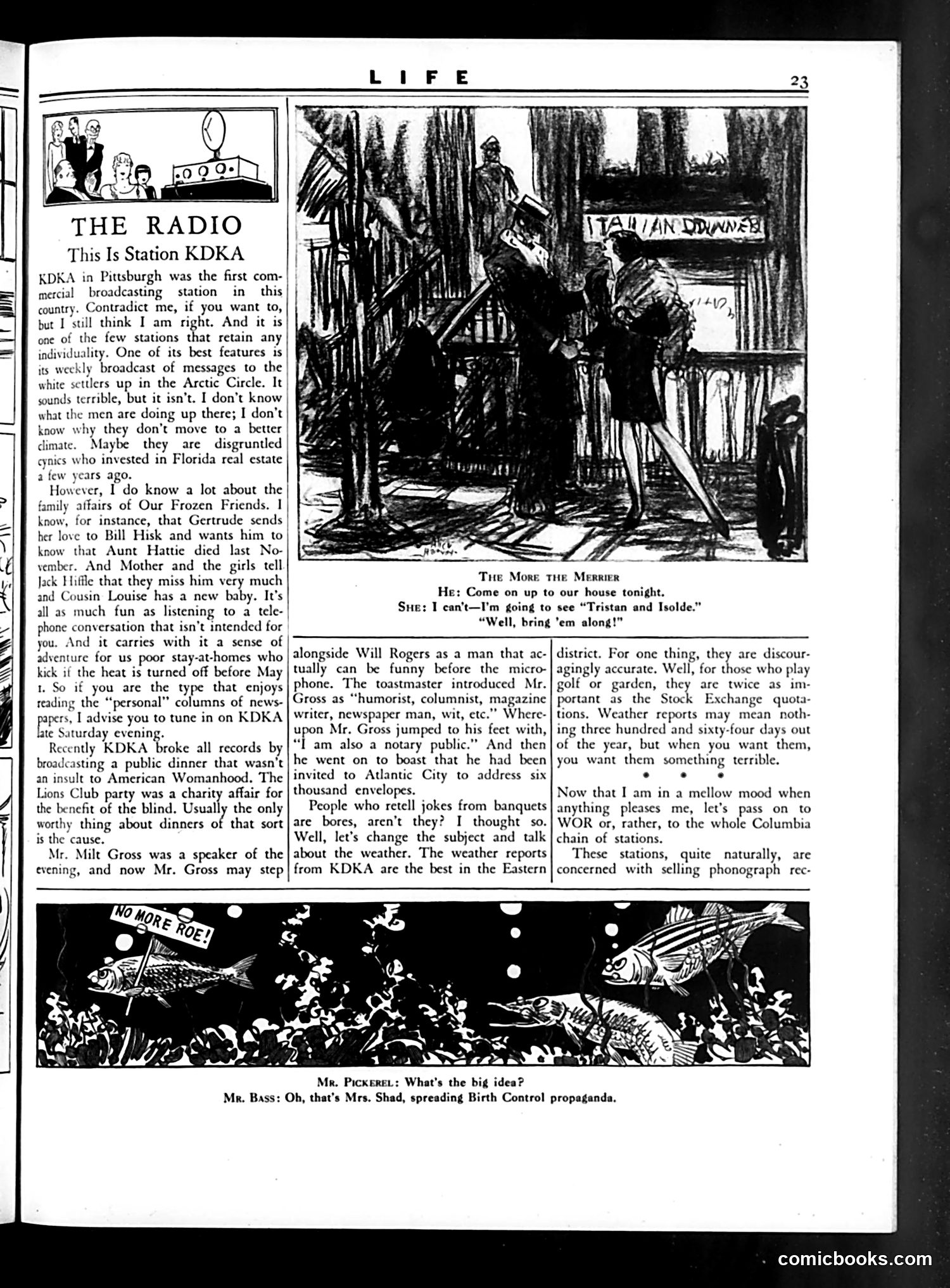
This page contains two distinct satirical pieces: **"The Radio" Column:** A humorous essay about KDKA, Pittsburgh's pioneering radio station. The author mocks Arctic Circle settlers who receive personal messages via broadcast, comparing it to eavesdropping on someone else's phone calls. He also satirizes a Lions Club dinner where humorist Milt Gross self-aggrandizingly listed his credentials before joking that he'd been hired merely to address envelopes—a self-deprecating deflation of his own importance. **"The More the Merrier" Comic:** A brief joke about a woman declining a date to see "Tristan and Isolde" (Wagner's opera), then being told to bring the opera along—absurdist humor mocking opera's lengthy, all-consuming nature. **Bottom Cartoon:** An underwater scene where fish Mr. Pickerei questions Mrs. Shad's activities. Mr. Bass explains she's spreading "birth control propaganda"—likely satirizing contemporary anxieties about women's reproductive rights advocacy, treating the concept as comically absurd even in a fish context.
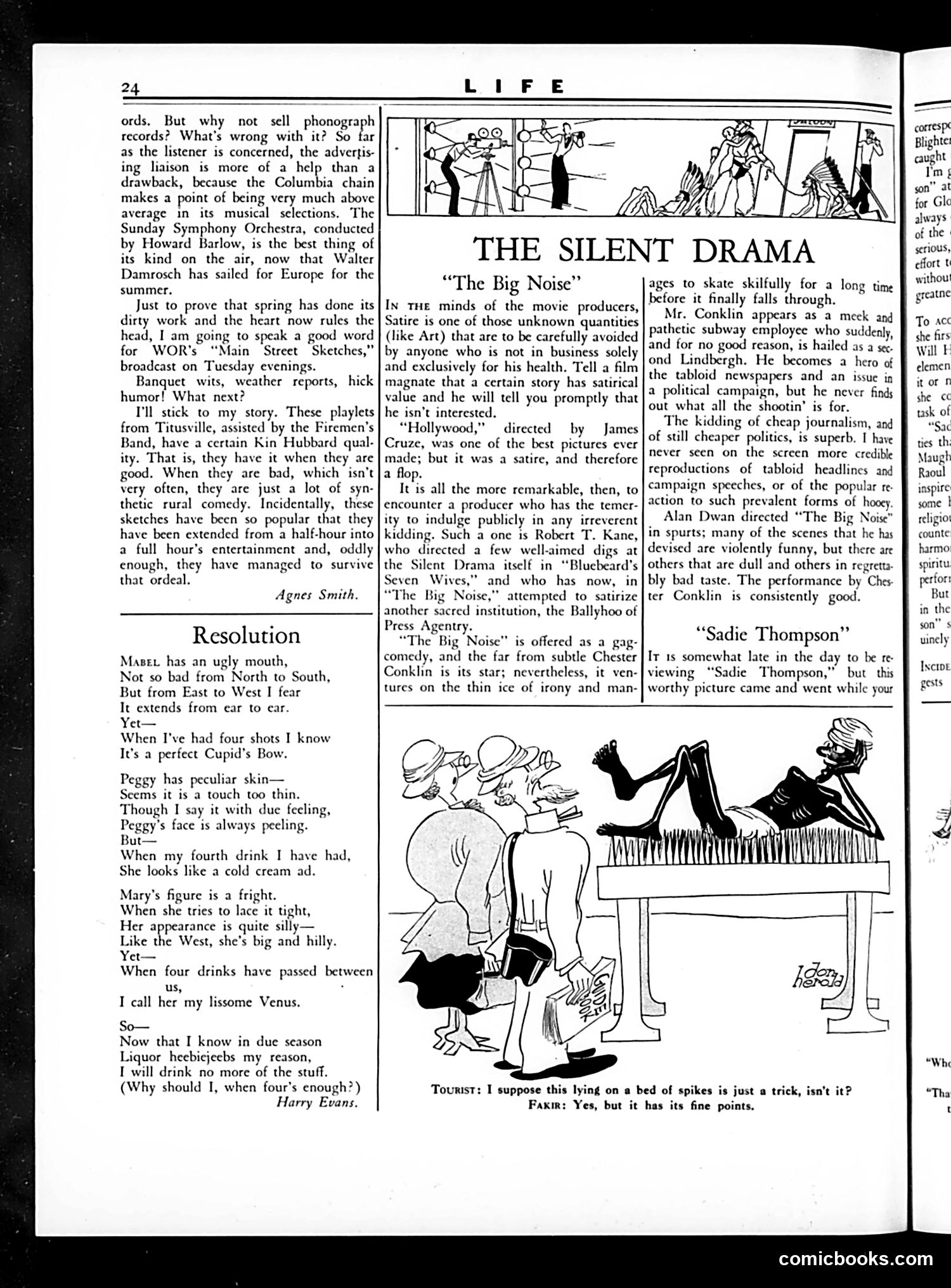
This page from *Life* magazine reviews three films and includes satirical poetry. The main review, "The Big Noise," discusses director Robert T. Kane's rare willingness to satirize Hollywood itself—specifically tabloid journalism, sensationalism, and press agentry. The film stars Chester Conklin as a meek subway worker mistakenly hailed as a hero, becoming entangled in cheap tabloid coverage and political exploitation. The reviewer praises the film's sharp critique of tabloid headlines and public gullibility, noting such satire was uncommon in Hollywood because producers avoided mocking their own industry's practices. The cartoon below depicts two tourists examining a bed of spikes, with one saying it's "just a trick" while the other claims it has "fine points"—likely satirizing tourist gullibility or con artists' ability to make dubious attractions seem legitimate. The "Resolution" poem humorously catalogs women's physical flaws using crude metaphors.
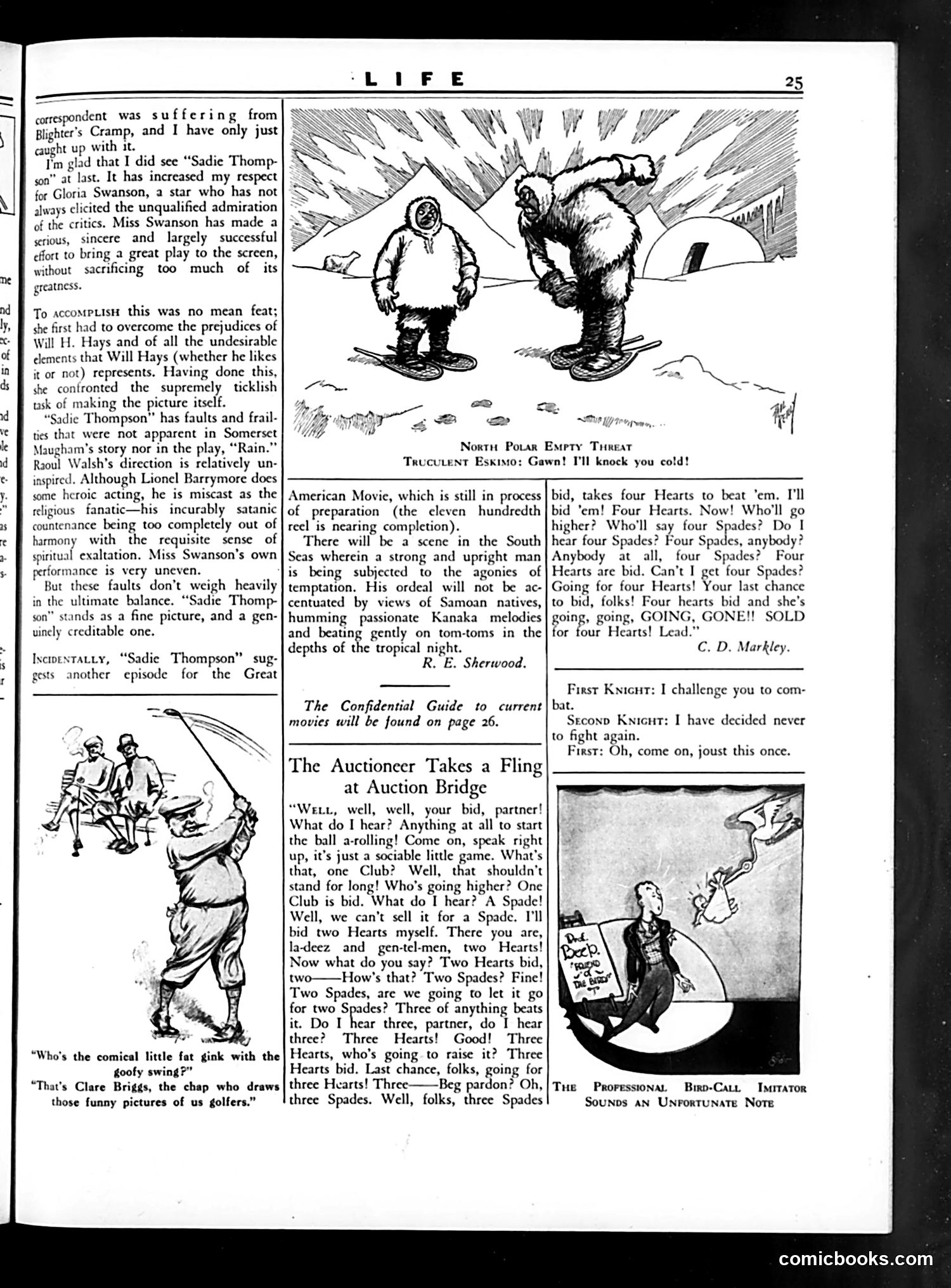
This page from *Life* magazine contains several distinct pieces of satire: **Top cartoon ("North Polar Empty Threat")**: Two heavily-bundled Arctic explorers confront each other with exaggerated bravado about knocking the other "cold"—a visual pun playing on their actual frozen environment. The humor lies in the absurdity of threatening violence in such a hostile setting where the climate is already deadly. **"The Auctioneer Takes a Fling at Auction Bridge"**: This satirizes the rapid-fire patter of a professional auctioneer applied to the card game auction bridge. The piece humorously mimics an auctioneer's rhythmic bidding speech ("going, going, GONE!") treating card game bids like merchandise at auction. **Knight cartoon (lower right)**: Depicts a knight declining further combat, suggesting the decline of chivalric traditions or simply mocking outdated codes of honor. The page reviews Gloria Swanson's film *Sadie Thompson* favorably and references Will H. Hays (film censorship enforcer). The cartoonist Clare Briggs is also credited.
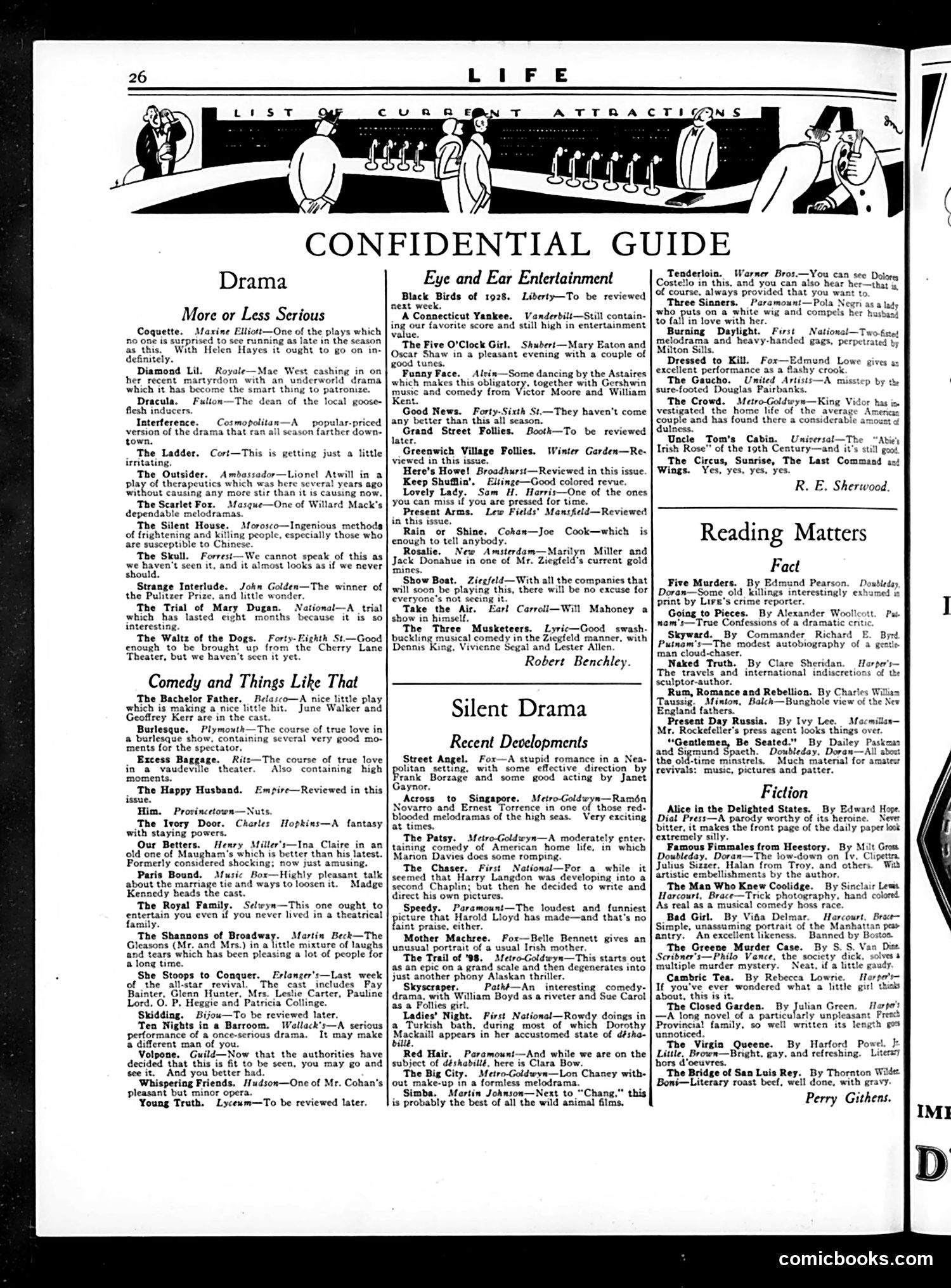
This page is a **theater listing and review guide**, not political satire. It's a "Confidential Guide" to current Broadway productions circa 1928, organized by genre (drama, comedy, musicals). The text provides brief, witty capsule reviews of shows then running. For example, it notes Mae West in *Diamond Lil* has become "the smart thing to patronize" (mocking fashionable audiences), and observes *The Trial of Mary Dugan* has "lasted eight months because it is so interesting." The tone is satirical and gossipy—typical of Life magazine's entertainment coverage. References include popular performers (Helen Hayes, Lionel Atwill, the Astaires) and venues (various Broadway theaters). The "Confidential" framing humorously suggests insider theater world knowledge. The header illustration appears to show theatrical scenes, reinforcing the entertainment focus. This is essentially a theater-goer's guide with snarky commentary, not political commentary.
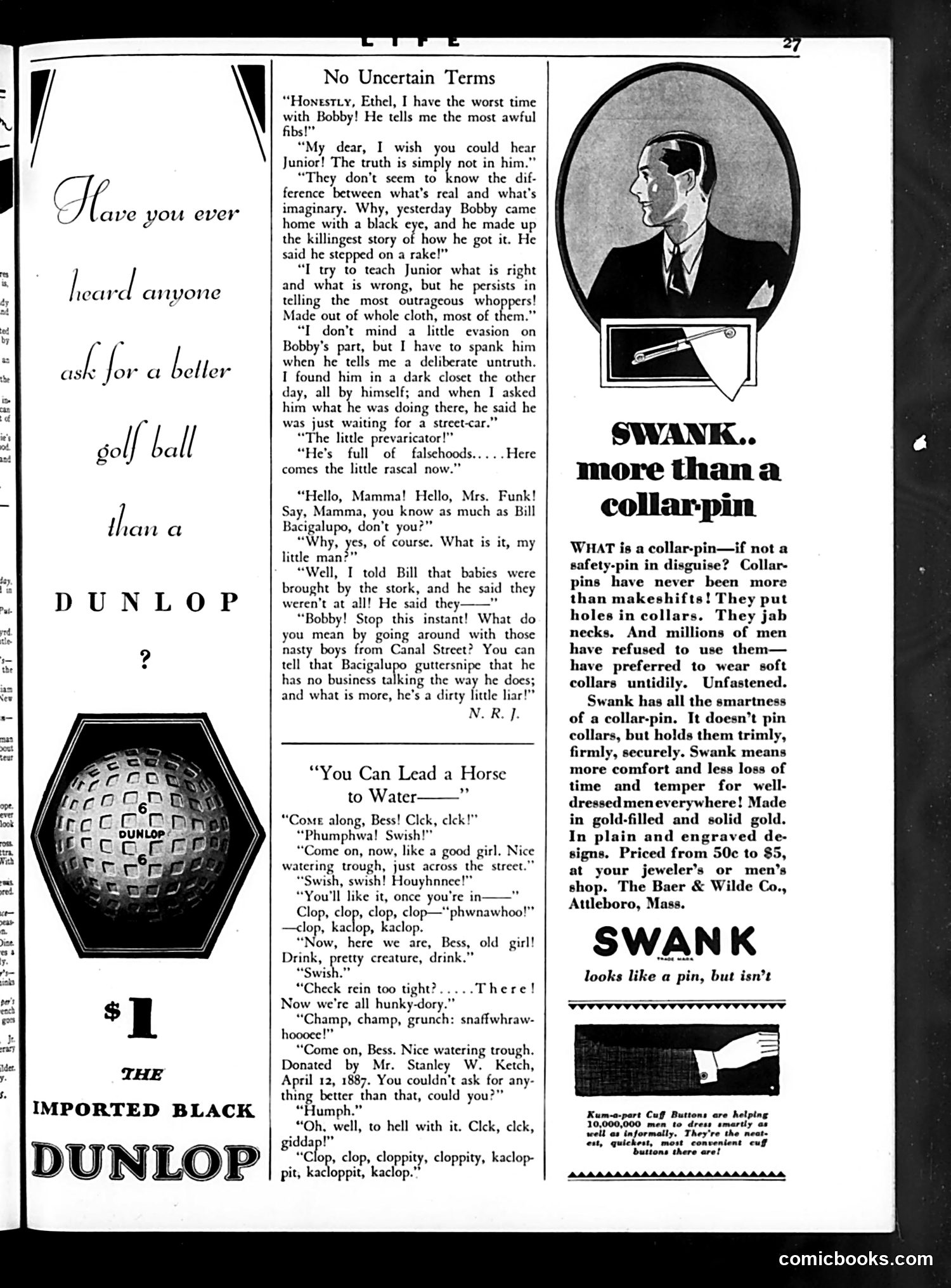
This page satirizes parental complaints about children's lying. Two mothers commiserate about their sons—Bobby and Junior—who tell elaborate falsehoods. The humor lies in the mothers' self-righteousness: they claim to teach honesty while gossiping and judging neighbors (Bobby's friend is dismissed as a "guttersnipe" from the lower-class Canal Street district), revealing their own moral inconsistency. The accompanying horse illustration ("You Can Lead a Horse to Water") extends the proverb: despite the owner's efforts to get the horse to drink, the animal refuses—a visual metaphor for the impossibility of forcing virtue or obedience, paralleling the mothers' futile parenting struggles. The page is primarily advertising for Dunlop golf balls and Swank collar pins, positioned around the satirical content.
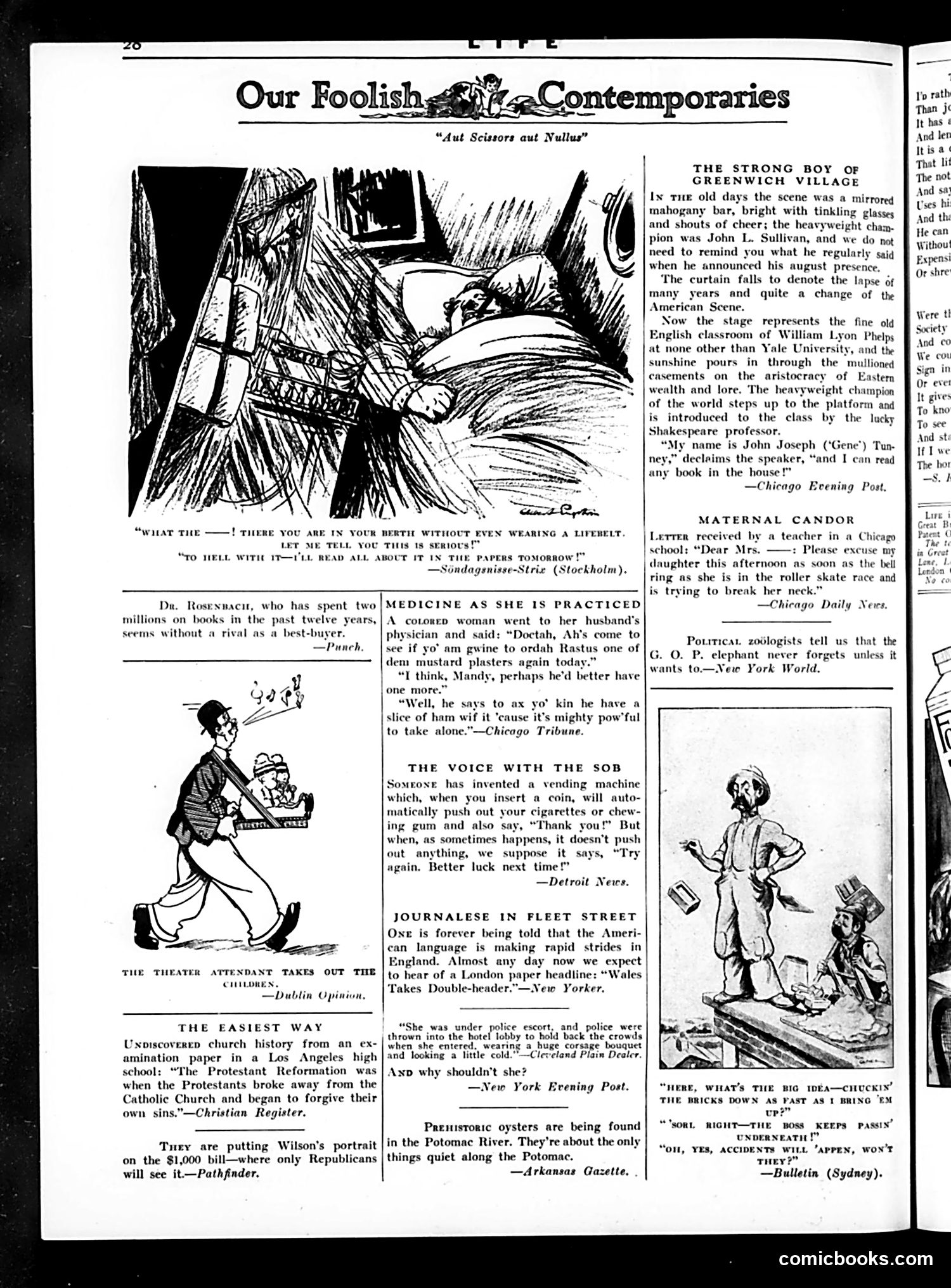
This page collects brief satirical items mocking contemporary social absurdities. Key pieces include: **"The Strong Boy of Greenwich Village"**: Contrasts the old boxing champion John L. Sullivan's rough mahogany-bar masculinity with a modern Yale professor introducing "Gene" Tunney (the heavyweight champion) to an elite classroom. The joke: Tunney claims he can "read any book in the house"—satirizing the pretension of athletes attempting intellectual respectability in refined academic settings. **Other jokes target**: mustard-plaster home remedies, vending machines that fail, American slang infiltrating British journalism, Wilson's portrait on currency (Republican dismissal), and a mother excusing her daughter from school to compete in roller-skating while risking injury. The cartoons mock fashionable Greenwich Village bohemians, theater ushers, and medical practices. The overall tone lampoons modern American culture's contradictions—mixing populism with snobbery, progress with foolishness—typical of *Life* magazine's satirical approach to 1920s American society.
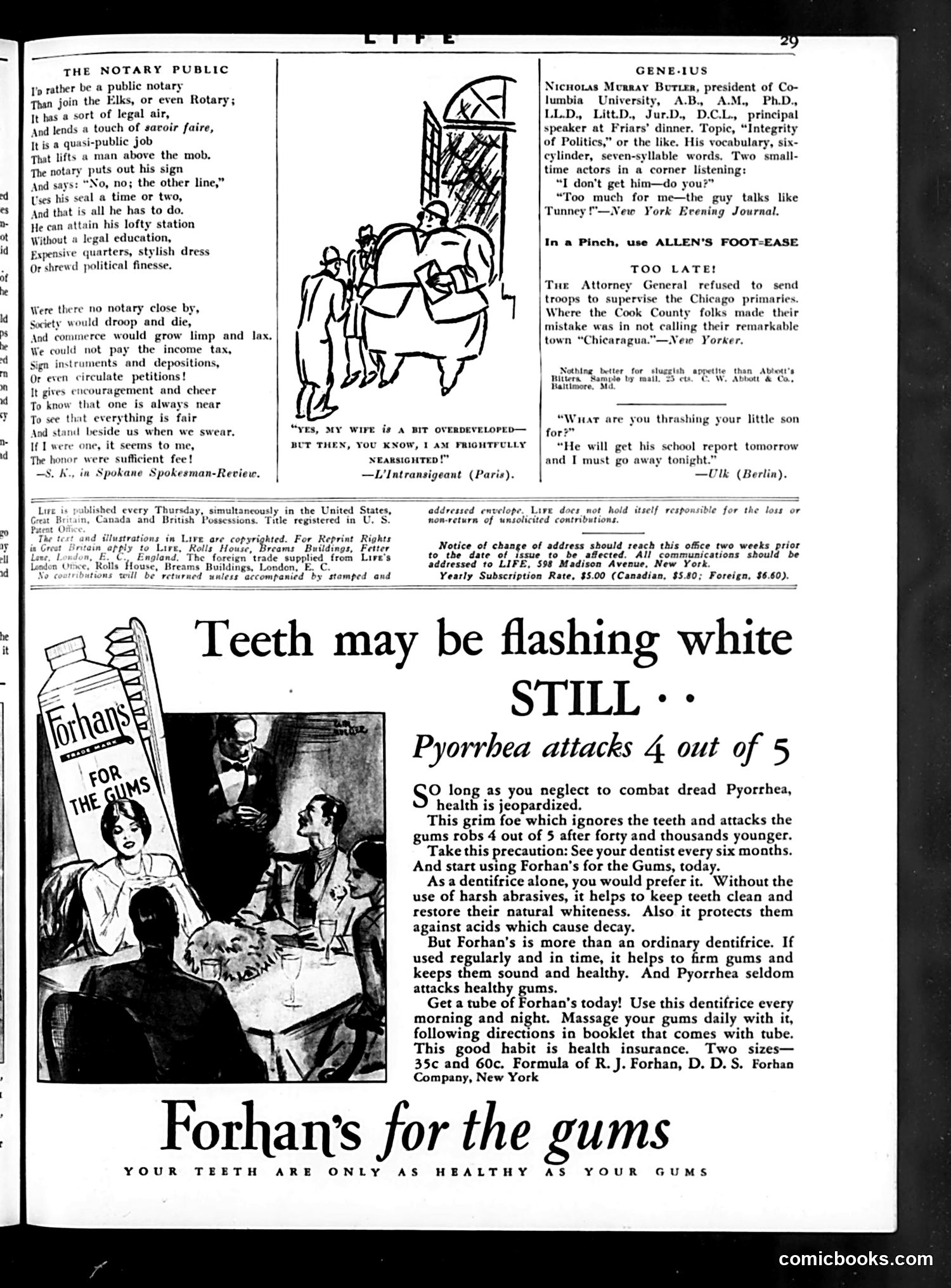
This page contains three distinct satirical pieces: **"The Notary Public"** (left column) mocks the inflated status of notary publics in American society. The poem ridicules how these minor officials—who perform trivial tasks using a seal—are treated with unwarranted respect and given fancy offices, positioning themselves above ordinary citizens despite requiring no legal education. **"Genius"** (center) features Nicholas Murray Butler, Columbia University's president, depicted as an intellectual snob. The cartoon shows two ordinary men unable to understand his pretentious, multi-syllable vocabulary about politics. The joke compares his speech to boxer Gene Tunney's—implying incomprehensibility. **"Too Late!"** (right) jokes about Chicago's notorious corruption during primary elections, punning that if the city were renamed "Chicaragua" (suggesting it's as lawless as Nicaragua), the Attorney General might have actually sent troops to supervise. The page is primarily **advertising** for Forhan's dentifrice (lower half), warning of pyorrhea (gum disease) affecting four of five people over forty.
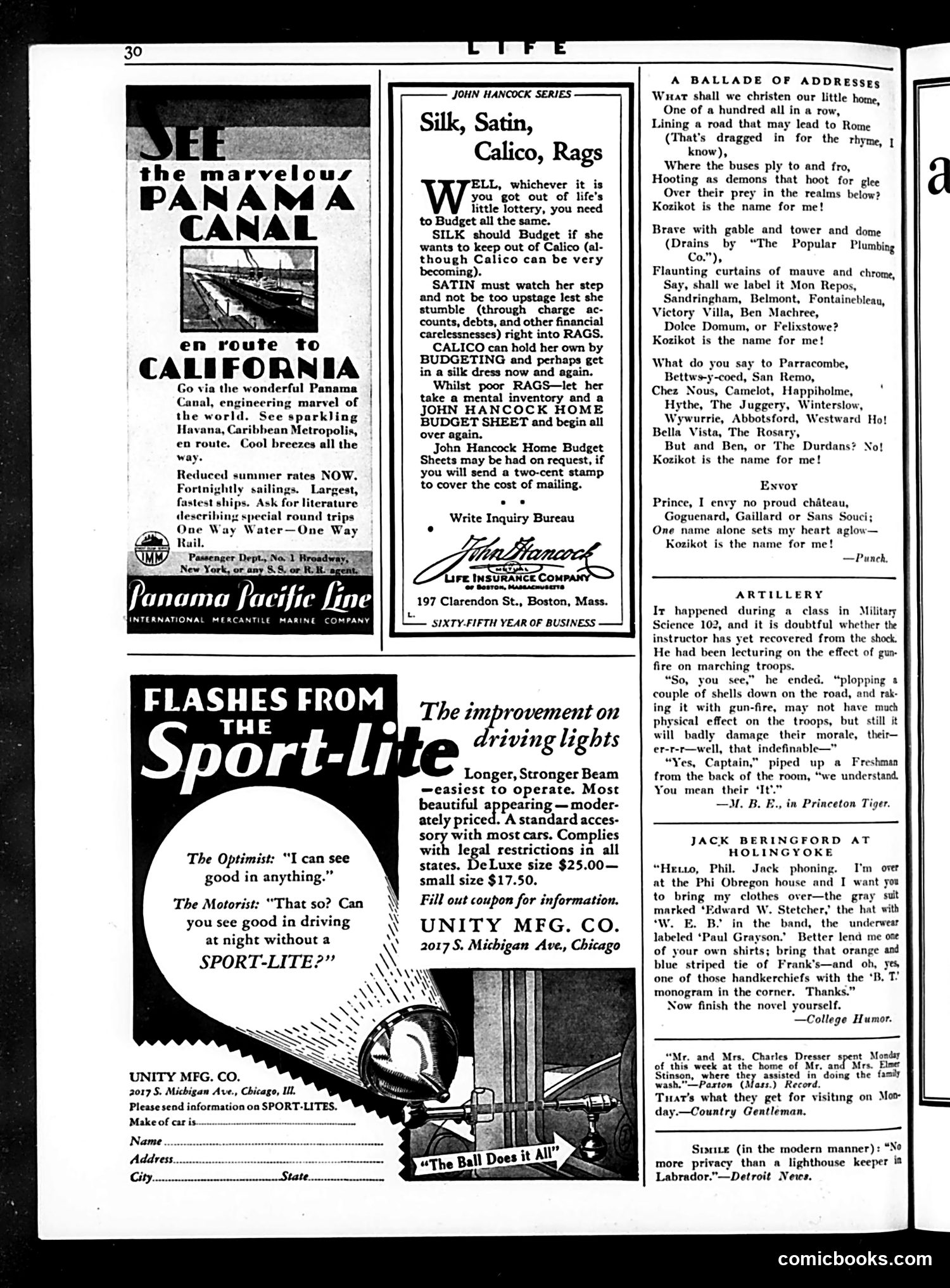
This page is primarily **advertisements and light humor**, not political satire. The main content includes: - **Travel ads** (Panama Canal cruise, California routes) - **Product advertisements** (driving lights, home budget sheets) - **Humorous verses and short comedic pieces** rather than political cartoons Notable items: The **"Silk, Satin, Calico, Rags"** article uses fabric types as metaphors for social classes/wealth levels, advising financial budgeting across all economic stations—a gentle commentary on 1920s class consciousness and personal finance. The **"Ballade of Addresses"** mocks the pretentious naming of suburban homes (Mon Repos, Sandringham, etc.), satirizing middle-class aspirations through increasingly absurd house names, culminating in the joke name "Kozikot." Short humor pieces include college jokes and military anecdotes with mild punchlines. **No identifiable political figures or events** are present. This appears to be a standard Life magazine entertainment/advertising page from the 1920s era.
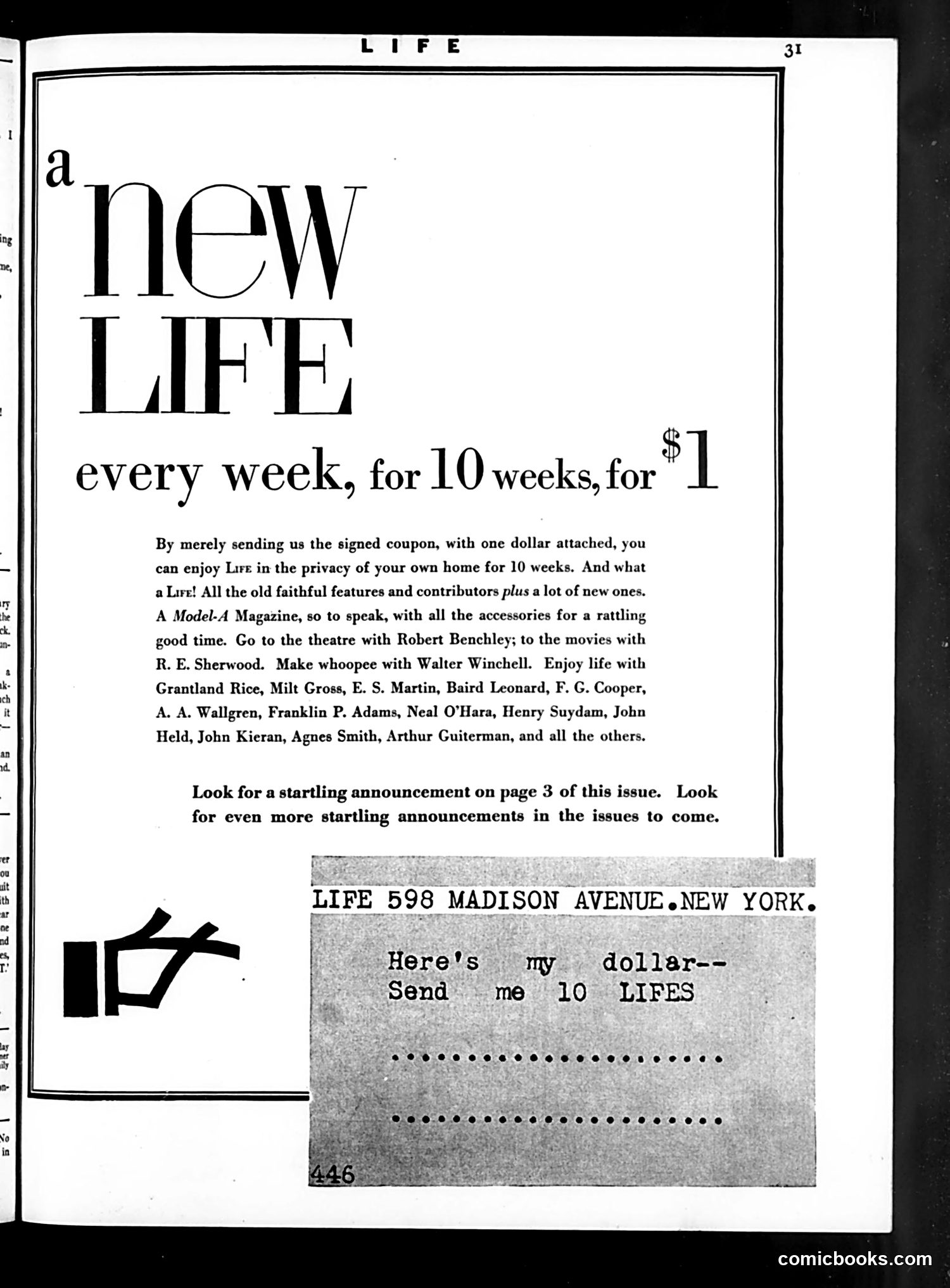
This is primarily a **subscription advertisement** for *Life* magazine, not a political cartoon. The page promotes a 10-week subscription offer for $1, positioning *Life* as a "Model-A Magazine"—a reference to Ford's popular new automobile model, suggesting modernity and broad appeal. The ad lists prominent *Life* contributors of the era (Robert Benchley, Walter Winchell, Grantland Rice, etc.), emphasizing entertainment and humor content. The coupon at bottom invites readers to subscribe by mail. The small **stylized logo** on the left (resembling a dollar sign or artistic mark) is *Life's* publishing emblem. This page reflects early 1920s magazine marketing: affordable home delivery of sophisticated urban entertainment for middle-class readers. The language—"make whoopee," theatrical references—targets readers seeking modern leisure and culture.
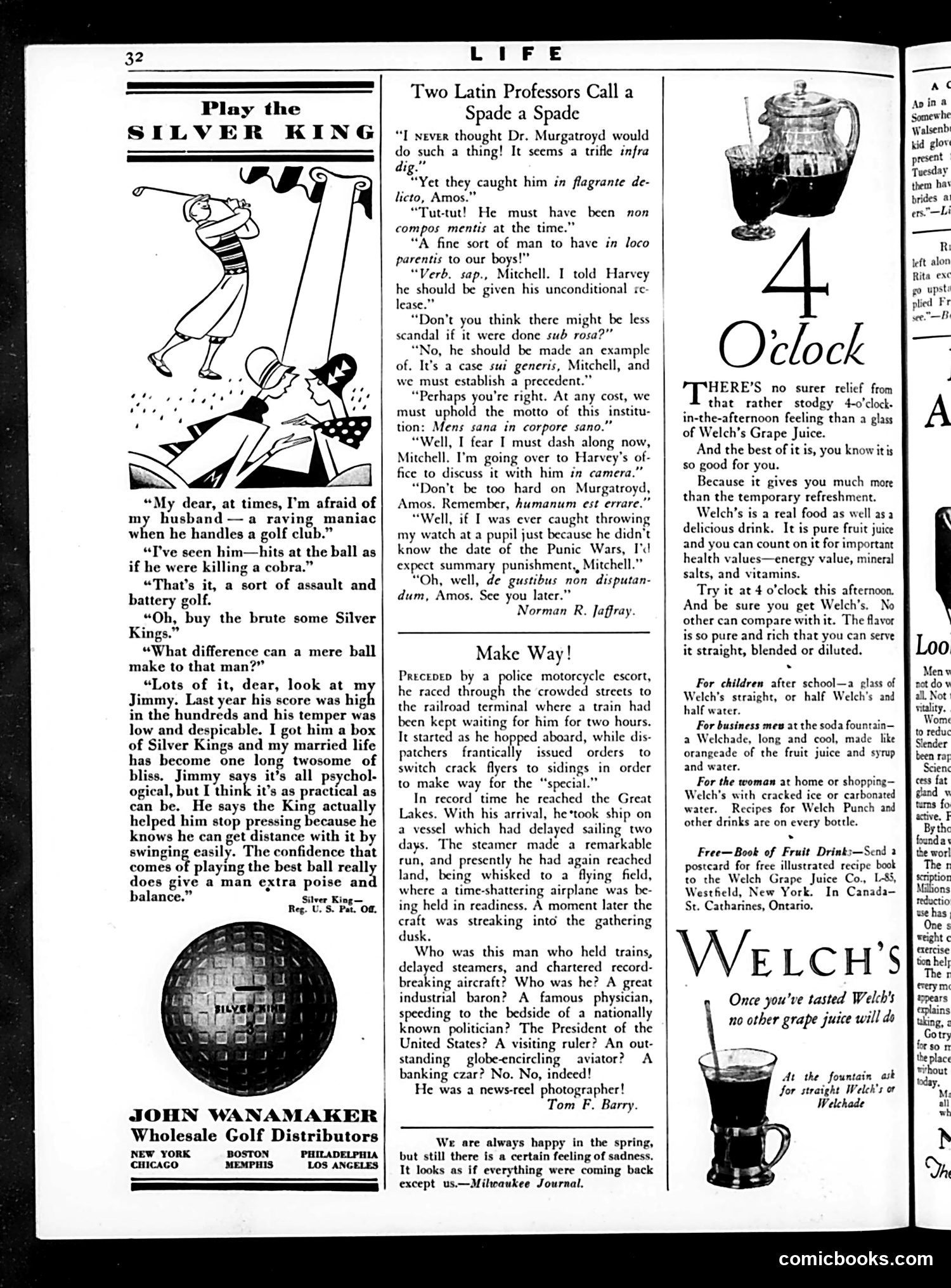
**"Play the Silver King"** (top left): A golf equipment advertisement disguised as marital advice. The joke is that a husband's violent golf frustration—swinging "as if he were killing a cobra"—can be cured by buying premium golf balls. It's satirizing both masculine aggression and consumer culture's promise that products solve personal problems. **"Two Latin Professors Call a Spade a Spade"** (center): Academic satire mocking pedantic scholars who discuss a colleague's misconduct (Dr. Murgatroyd) entirely in Latin phrases (*infra dig, flagrante delicto, mens sana in corpore sano*). The humor lies in their affected intellectualism masking gossip—using Latin's formality to discuss what amounts to scandalous behavior, while remaining oblivious to their own hypocrisy. **"Make Way!"** (lower center): A mock-heroic story about clearing trains, ships, and aircraft for an important VIP—only to reveal he's merely a newsreel photographer. It satirizes 1920s media culture's inflated self-importance and the era's fascination with speed and technological spectacle.
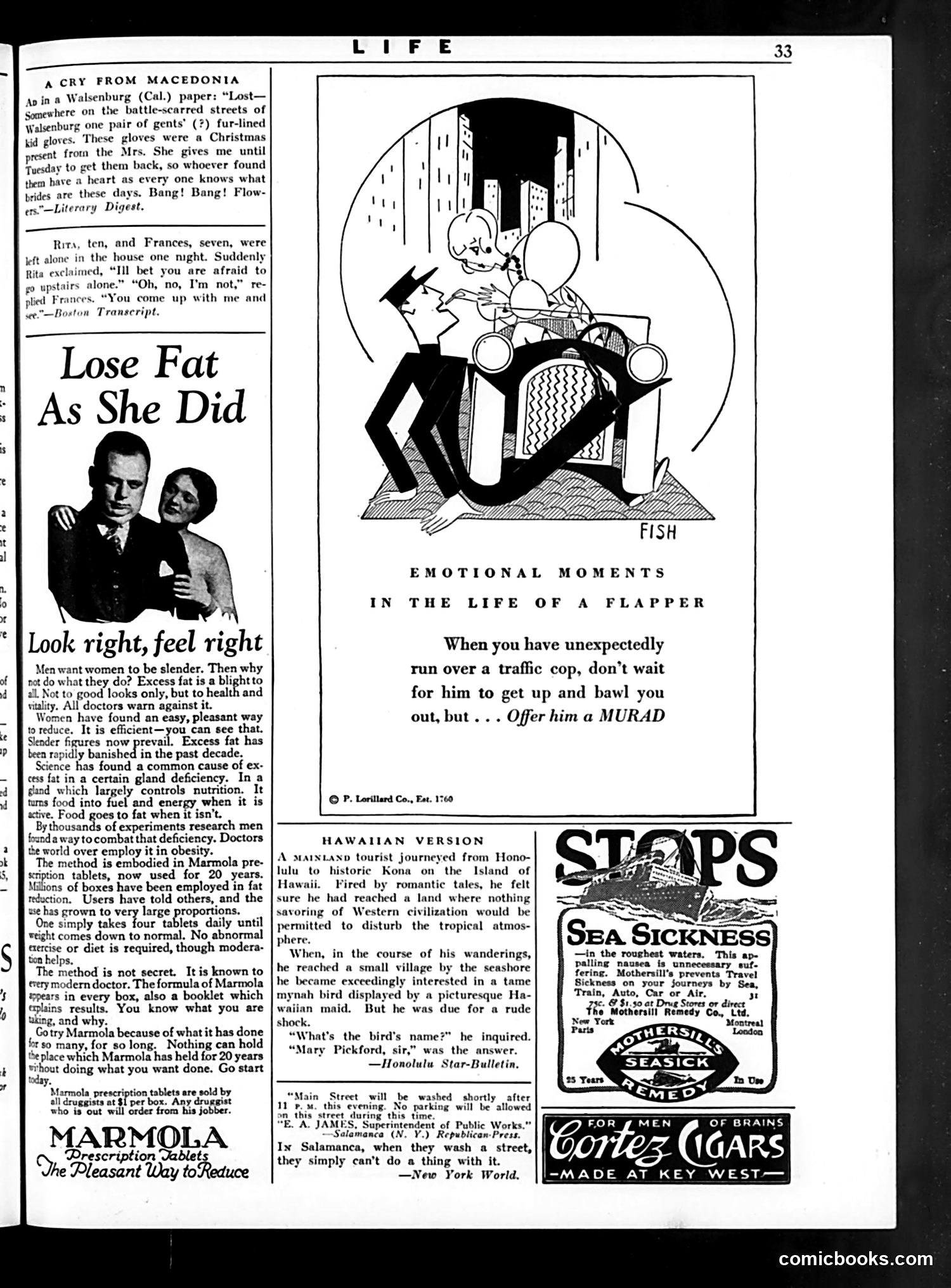
This page contains multiple satirical pieces typical of 1920s *Life* magazine humor: **"Emotional Moments in the Life of a Flapper"** (center cartoon): A flapper—a young, modern woman of the era—has hit a traffic cop with her car. The joke's punchline advises offering him a Murad cigarette instead of facing consequences. This satirizes both the reckless behavior attributed to "flappers" (women who defied Victorian norms with short skirts, smoking, and driving) and the era's cavalier attitude toward bribery or smoothing over mishaps. The surrounding **humorous anecdotes** mock small-town life and gender dynamics—lost gloves, children's fears, street-washing procedures—typical of *Life*'s satirical bite. **Advertisements** for Marmola (weight-loss tablets), Cortez Cigars, and Mothersill's seasickness remedy occupy the page. The Marmola ad is notably gendered, pressuring women to be "slender" for male approval—reflecting 1920s beauty standards and advertising's manipulative tactics.
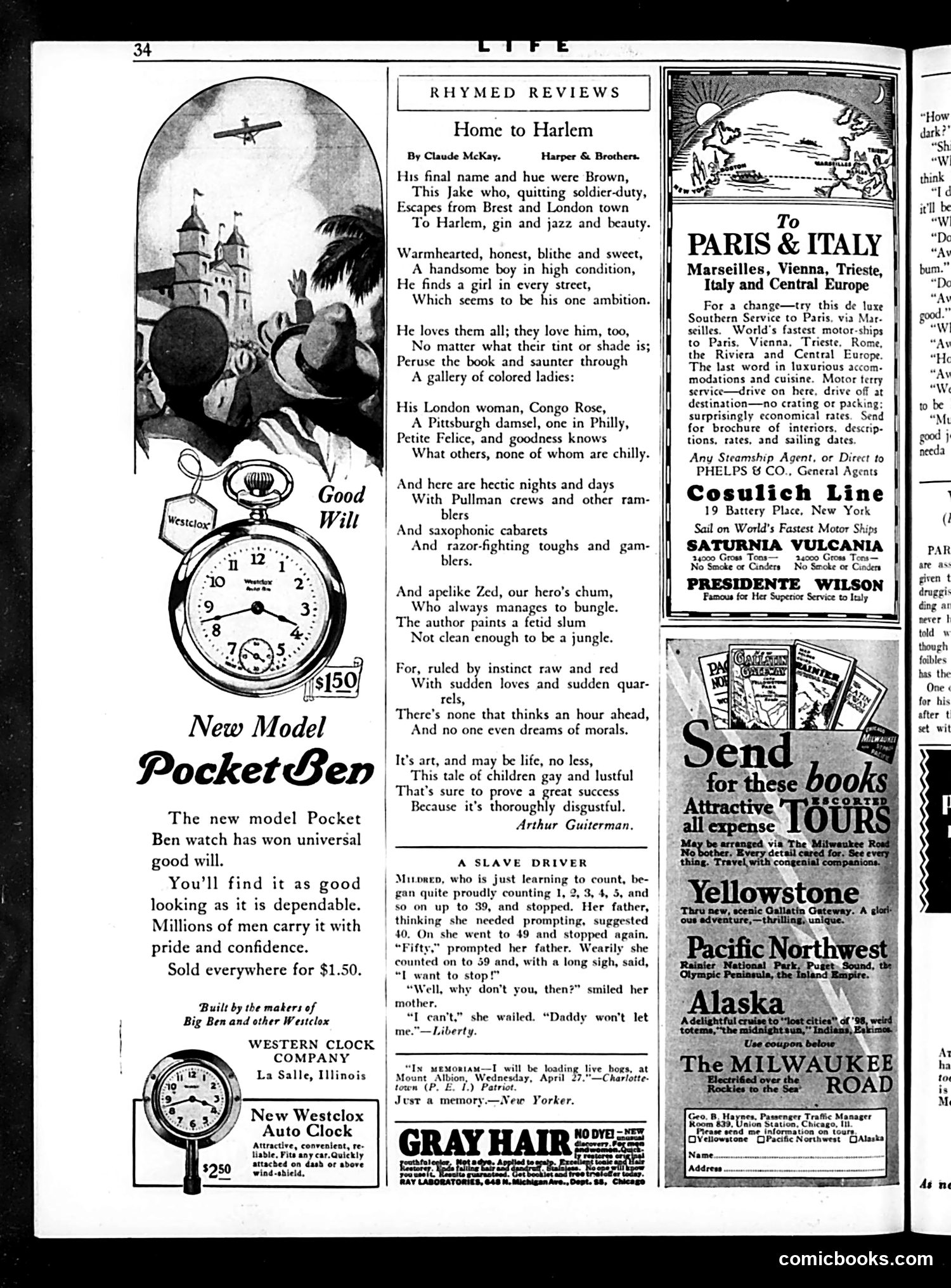
This page is primarily **advertising and literary content**, not political satire. The main feature is a rhymed book review of Claude McKay's *Home to Harlem* by Arthur Guiterman. The review is notably **derogatory**, using offensive language and stereotypes about Black characters and Harlem life. It emphasizes "apelike" behavior, sexual promiscuity, violence ("razor-fighting"), and moral depravity—reflecting the racist attitudes common in mainstream publications of this era. The reviewer's closing line ("thoroughly disgustful") suggests disapproval of the book's subject matter. The page also contains product advertisements: a Pocket Ben watch ($1.50), a Westclox Auto Clock ($250), and travel advertisements for European cruises and tours. **Historical context**: This reflects 1920s literary criticism's dismissive and racist framing of the Harlem Renaissance, even as it was occurring.
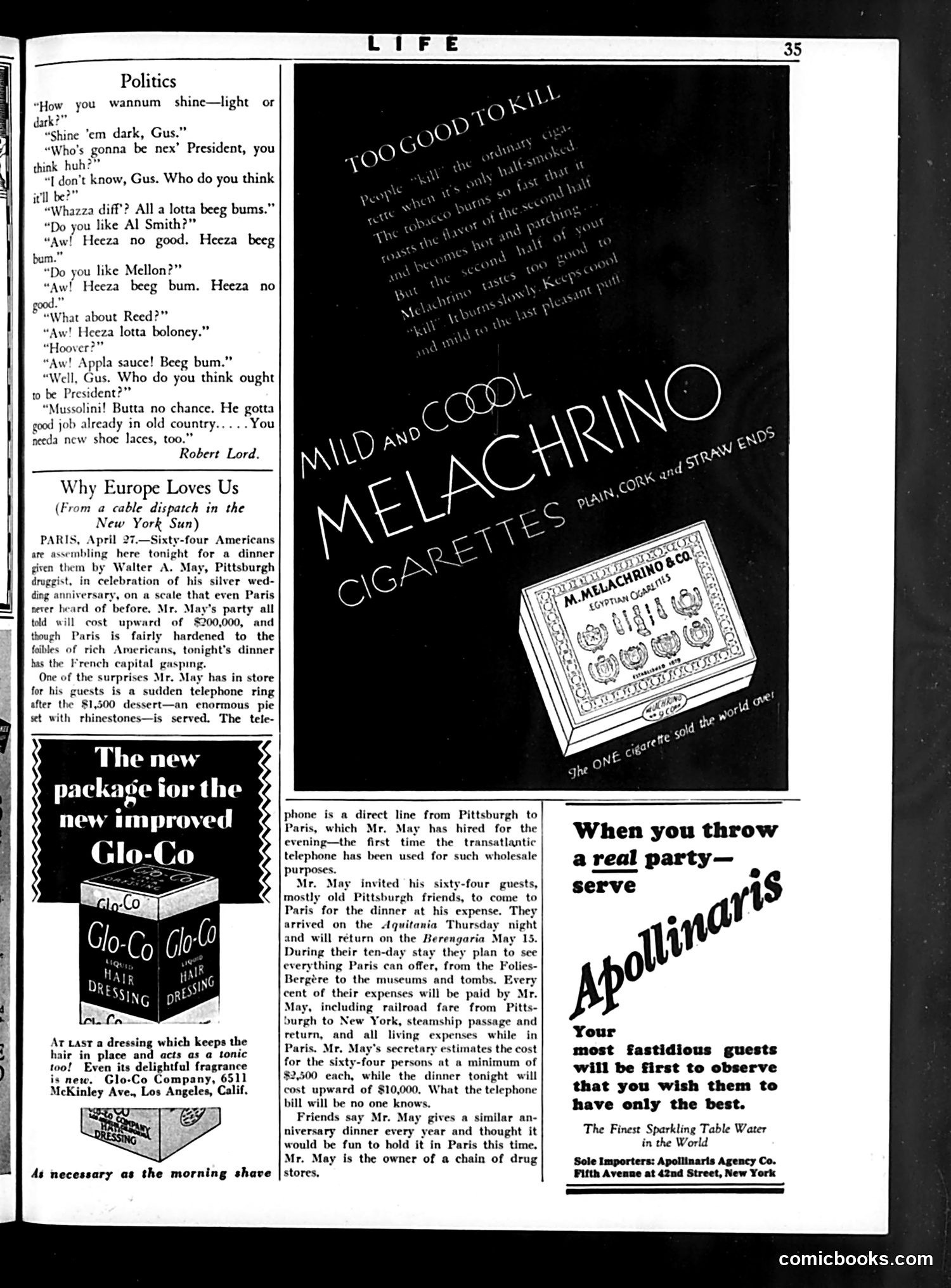
The "Politics" section is a satirical dialogue between two shoe-shiners (written in exaggerated immigrant dialect) discussing the 1928 U.S. presidential election. When asked about candidates like Al Smith, Andrew Mellon, and Herbert Hoover, the character Gus dismisses them all as "beeg bums," then jokes that the only competent leader would be Mussolini—who "gotta good job already in old country." The satire works on multiple levels: it mocks working-class political cynicism, immigrant stereotypes, and implicitly criticizes American politicians by comparing them unfavorably to an authoritarian dictator. The joke's dark edge—suggesting even Mussolini would be preferable to available U.S. options—reflects genuine 1920s anxieties about political leadership quality. The remainder of the page contains advertisements and a separate article about wealthy Pittsburgh businessman Walter A. May's extravagant Paris dinner party, illustrating American wealth and excess in the Roaring Twenties.
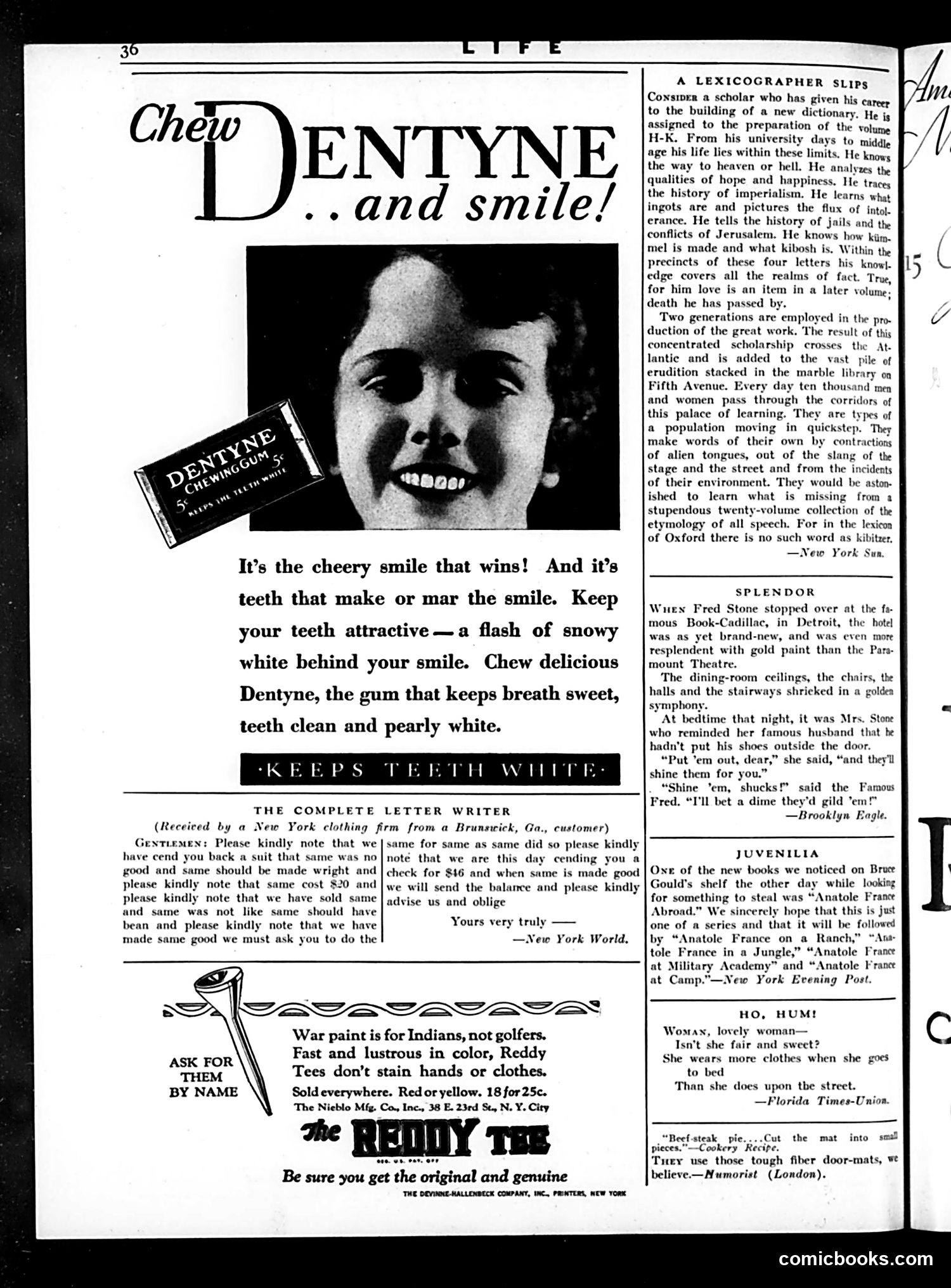
This page is primarily **advertising and satirical humor pieces**, not political cartoons. The main Dentyne gum advertisement uses a photograph of a smiling man to promote teeth whitening—the pitch being that an attractive smile depends on clean, white teeth. The copy promises the gum "keeps breath sweet, teeth clean and pearly white." Below are humorous filler pieces typical of Life magazine's satirical content: 1. **"The Complete Letter Writer"**: A joke letter from a Georgia customer to a clothing firm, written in deliberately poor grammar with repetitive phrasing ("same for same"). It satirizes illiteracy and poor business communication. 2. **"A Lexicographer Slips"**: Mocks a dictionary editor who, after years studying words H-K, misses the common Yiddish word "kibitzer" entirely—suggesting academic scholarship can miss everyday language. 3. **"Splendor"** and **"Ho, Hum!"**: Short, mild humor pieces about luxury hotels and women's clothing. The page reflects 1920s-30s Life magazine's mix of consumer advertising and genteel, often condescending social satire.