
Life, 1928-05-24 · page 18 of 38
Life — May 24, 1928 — page 18: what you’re looking at
What you’re looking at
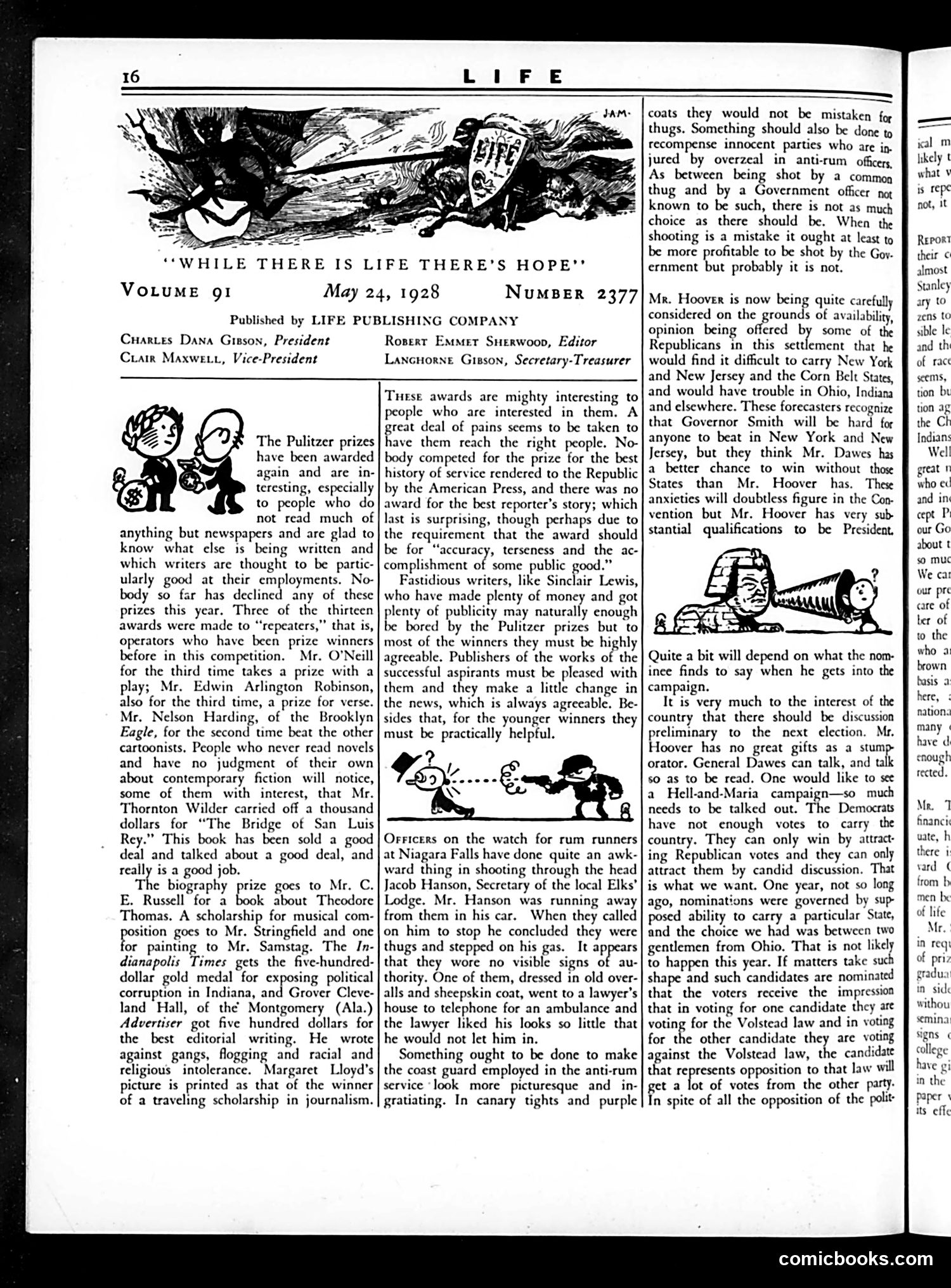
This page discusses the Pulitzer Prize awards and the upcoming 1928 presidential election. The text criticizes newspapers that merely "repeat" previous prize-winning formulas rather than pursue genuinely important journalism. The main political cartoon (lower half) depicts officers catching rum runners—referencing Prohibition enforcement during the 1920s. It shows the absurdity of the "anti-rum service," with coast guard personnel in dramatic pursuit. The page advocates for Herbert Hoover's presidential nomination, arguing he has better qualifications than General Dawes. The text emphasizes that the Democratic Party needs substantive discussion beyond just opposing the opposing candidate's policies. The overall tone suggests satire of both parties' campaign strategies and the era's Prohibition enforcement.
📄 Transcribed text from this page (OCR, searchable)
Machine-transcribed from the original scan — historical spelling and the odd misread are preserved.
‘“‘WHILE THERE IS LIFE THERE'S HOPE"’ VOLUME 91 May 24, 1928 NuMBER 2377 Published by LIFE PUBLISHING COMPANY Cuarces Dana Gipson, President Crain Maxwewr, Vice-President The Pulitzer prizes have been awarded again and are in- teresting, especially to people who do not read much of anything but newspapers and are glad to know what else is being written and which writers are thought to be partic- ularly good at their employments. No- body so far has declined any of these prizes this year. Three of the thirteen awards were made to “repeaters,” that is, operators who have been prize winners before in this competition. Mr. O'Neill for the third time takes a prize with a play; Mr. Edwin Arlington Robinson, also for the third time, a prize for verse. Mr. Nelson Harding, of the Brooklyn Eagle, for the second time beat the other cartoonists, People who never read novels and have no judgment of their own about contemporary fiction will notice, some of them with interest, that Mr. Thornton Wilder carried off a thousand dollars for “The Bridge of San Luis Rey.” This book has been sold a good deal and talked about a good deal, and really is a good job. The biography prize goes to Mr. C. E. Russell for a book about Theodore Thomas. A scholarship for musical com- sition goes to Mr. Stringfield and one for painting to Mr. Samstag. The In- dianapolis Times gets the five-hundred- dollar gold medal for exposing political corruption in Indiana, and Grover Cleve- land Hall, of the Montgomery (Ala.) Advertiser got five hundred dollars for the best editorial writing. He wrote against gangs, flogging and racial and religious intolerance. Margaret Lloyd's picture is printed as that of the winner of a traveling scholarship in journalism. Rosert Emmet Suerwoop, Editor Lancuorne Gipson, Secretary-Treasurer Turse awards are mighty interesting to people who are interested in them. A great deal of pains scems to be taken to have them reach the right people. No- body competed for the prize for the best history of service rendered to the Republic by the American Press, and there was no award for the best reporter's story; which last is surprising, though perhaps due to the requirement that the award should be for “accuracy, terseness and the ac- complishment of some public good.” Fastidious writers, like Sinclair Lewis, who have made plenty of money and got plenty of publicity may naturally enough be bored by the Pulitzer prizes but to most of the winners they must be highly agreeable. Publishers of the works of the successful aspirants must be pleased with them and they make a little change in the news, which is always agreeable. Be- sides that, for the younger winners they must be practically helpful. Orricers on the watch for rum runners at Niagara Falls have done quite an awk- ward thing in shooting through the head Jacob Hanson, Secretary of the local Elks’ Lodge. Mr. Hanson was running away from them in his car. When they called on him to stop he concluded they were thugs and stepped on his gas. It appears that they wore no visible signs of au- thority. One of them, dressed in old over- alls and sheepskin coat, went to a lawyer's house to telephone for an ambulance and the lawyer liked his looks so little that he would not let him in. Something ought to be done to make the coast guard employed in the anti-rum service ‘look more picturesque and in- gratiating. In canary tights and purple coats they would not be mistaken for thugs. Something should also be done to recompense innocent parties who are in. jured by overzeal in anti-rum officers, As between being shot by a commog thug and by a Government officer not known to be such, there is not as much choice as there should be. When the shooting is a mistake it ought at least to be more profitable to be shot by the Gov- ernment but probably it is not. Mr. Hoover is now being quite carefully considered on the grounds of availability, opinion being offered by some of the Republicans in this settlement that he would find it difficult to carry New York and New Jersey and the Corn Belt States, and would have trouble in Ohio, Indiana and elsewhere. These forecasters recognize that Governor Smith will be hard for anyone to beat in New York and New Jersey, but they think Mr. Dawes has a better chance to win without those States than Mr. Hoover has. These anxieties will doubtless figure in the Con- vention but Mr. Hoover has very sub stantial qualifications to be President, Quite a bit will depend on what the nom- inee finds to say when he gets into the campaign. It is very much to the interest of the country that there should be discussion preliminary to the next election. Mr. Hoover has no great gifts as a stum; orator. General Dawes can talk, and talk so as to be read. One would like to se a Hell-and-Maria_campaign—so much needs to be talked out. The Democrats have not enough votes to carry the country. They can only win by attract- ing Republican votes and they can only attract them by candid discussion. That is what we want. One year, not so long ago, nominations were governed by sup- posed ability to carry a particular State, and the choice we had was between two gentlemen from Ohio. That is not likely to happen this year. If matters take such shape and such candidates are nominated that the voters receive the impression that in voting for one candidate they are voting for the Volstead law and in voting for the other candidate they are voting against the Volstead law, the candidate that represents opposition to that law will get a lot of votes from the other party In spite of all the opposition of the polit — —_— ial m likely t what v is repe not, 1t Report their ¢ almost Stanley ary to zens to sible le and th of race seems, tion bu tion ag the Ch Indians Well great n who ed and in cept Pi our Go about t so muc We cat our pre are of ler of to the who a: brown basis a here, nations many have di enough rected. Me 7 financi uate, h there i vard ( from b men be of life Mr. in reqi of priz gradua in side withou semina signs ¢ college have gi in the Paper \ tts eff comicbooks.com